Feedback at the Scale of Chaos
The Analog Synth Workshops at GPN24
At GPN24 in Karlsruhe, a late-night workshop on chaotic sound synthesis turned into a wonderful, room-wide audio-feedback installation. There were Benjolins, a ukulele, a mutant Farfisa organ, and even an acoustic-electric guitar plugged into the signal paths. This is what Klangforschung sounds like once hackers stop caring for tonality and embrace curiosity for the electronic.
June 2026
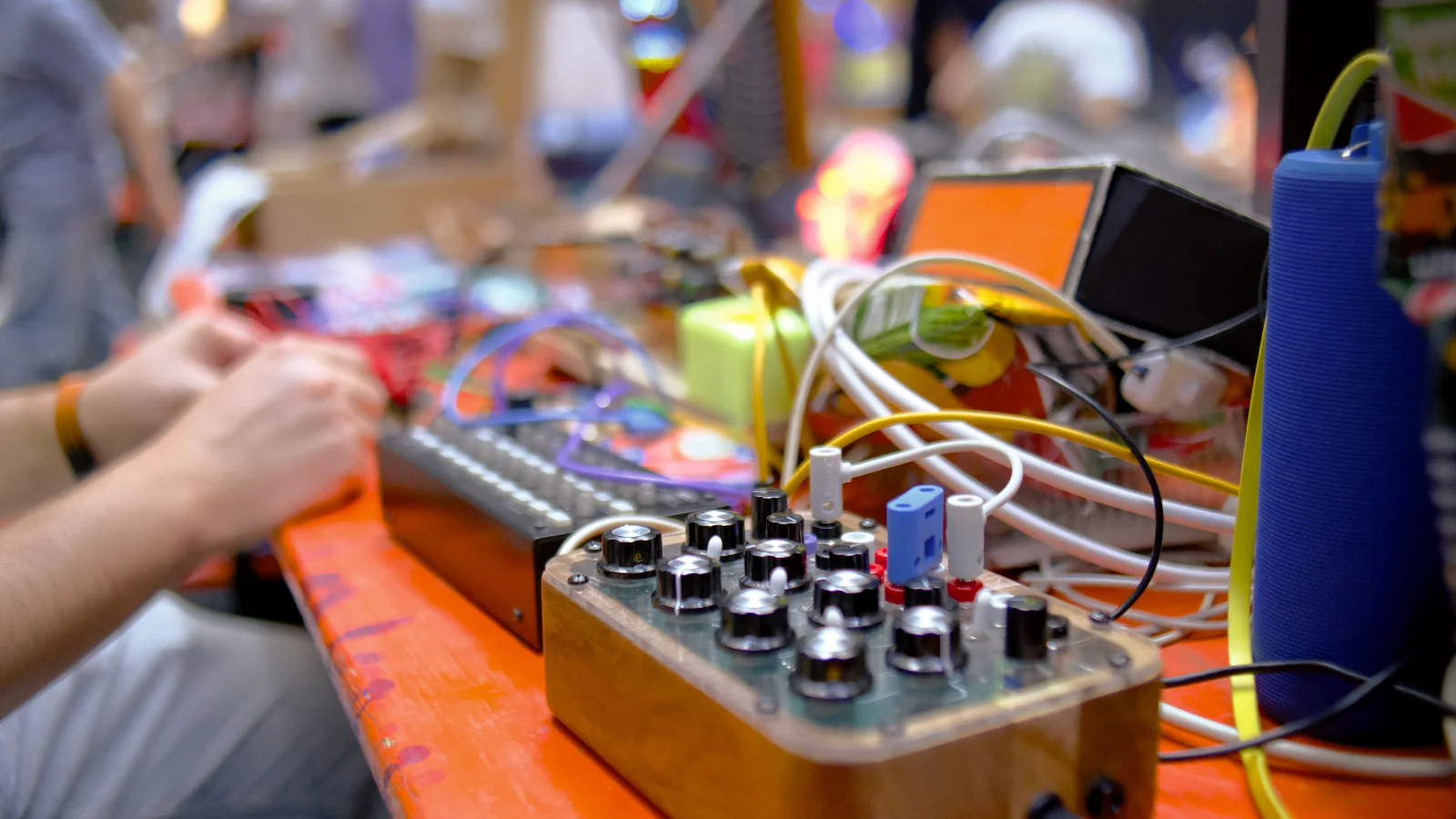
A custom Benjolin built on the workshop's orange tables,
surrounded by patch cables and a
KORG SQ-1
STEP
sequencer.
The Goulash Programming Nights (GPN) at the Center for Art and Media (ZKM) and Karlsruhe University of Arts and Design (HfG) is reliably a great playground for hardware tinkering, digital experimentation, and discovering new technologies. This year was no different. GPN24 ran from June 4th to June 7th, 2026, organized as ever by Entropia e.V., the Karlsruhe chapter of the Chaos Computer Club, under the tongue-in-cheek corporate motto Gulasch at the Scale of Chaos: attendees were cast as "stakeholders" of GPN24.de, a fictional mega-corporation that does everything, everywhere, around the clock.
I had the privilege of attending a session that captured the event's spirit of Klangforschung (sound exploration) better than anything else: Feedback at the Scale of Chaos – Chaotic sound synthesis. It ran twice, Friday and Saturday from 22:00 to midnight in HfG workshop rooms. The listing promised phantasmagoric soundscapes and warned of "heavy tonality violations" in the content notes. Both turned out to be accurate and quite refreshing.
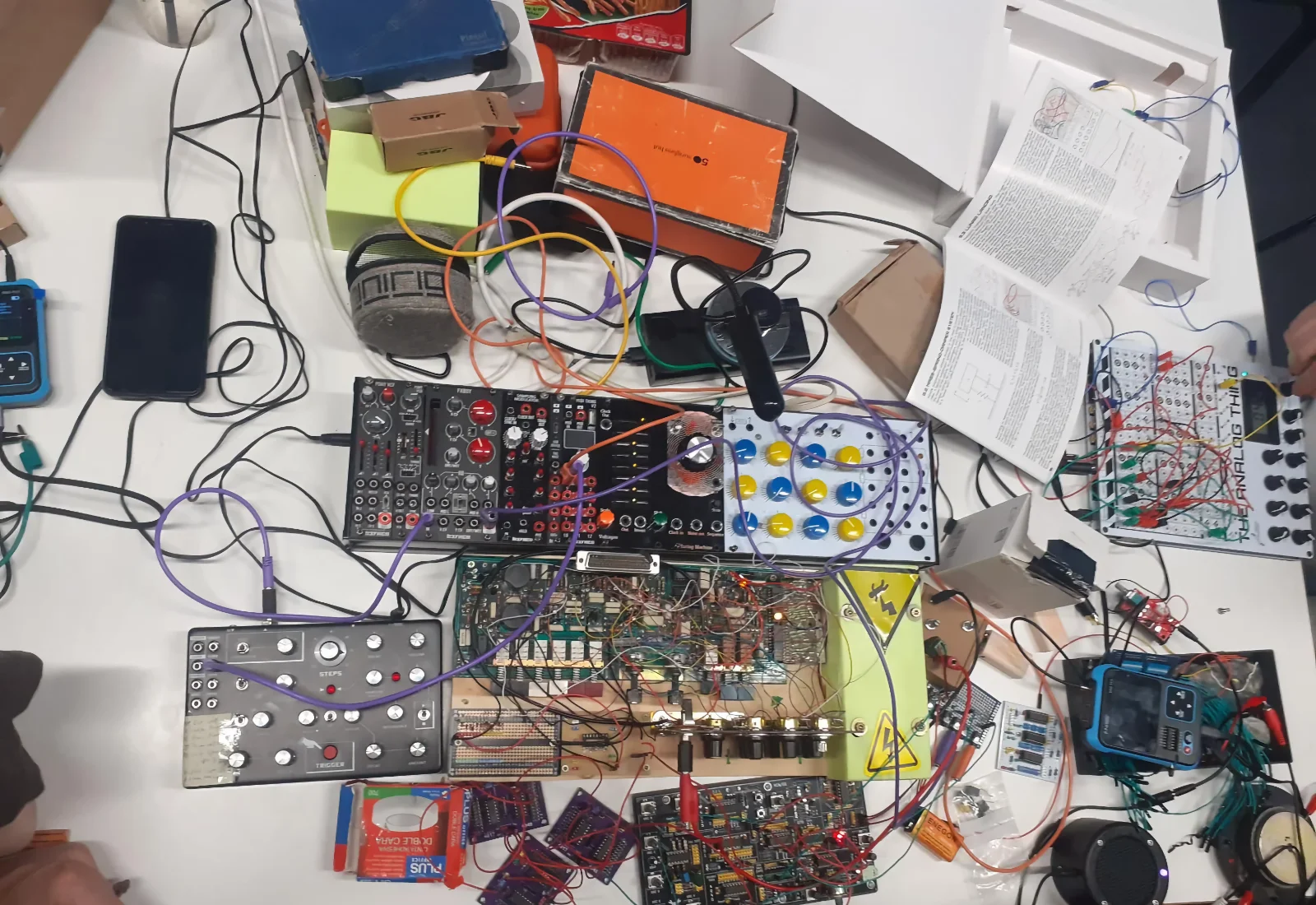
Tables covered in power cords, multi-socket multipliers, tiny
speakers, and a growing tangle of synth hardware, before the
feedback loops really got out of hand.
The room had been prepped by organizers qetu and j00n. In his speaker bio qetu claims with a wink that he has no idea of electronics or music, just an unstoppable urge to do dangerous sound experiments anyway. He is a sonic landscape explorer and modular tinkerer full of passion and energy. He is also an active member of the demoscene. I first met him at the Revision demoparty in 2025 in Saarbrücken.
Thanks to qetu and j00n the workshop room was ready for all the participants. The tables were covered in power cords, multi-socket multipliers, and tiny mono speakers, and next to each core instrument lay a printed instruction sheet. This particular detail was quite important: people of very different skill levels could skip the usual learning curve and start poking at things right away. Simply follow the instructions and help each other.
And it turned out to be a fun and educational workshop of a different kind.
Video: Impressions from the Analog Synth Workshop
This video showcases some of the tactile instruments present at the tables, focusing on a beautifully crafted, custom desktop synthesizer unit featuring a wood-trimmed casing and transparent interface plate. Watch as the workshop atmosphere comes alive through hands-on patching, knob tweaking, and live sound exploration, capturing a great weekend of community learning and experimental noise.
Video by a talented person with the nickname °~°
The Main Focus: The Benjolin Chaos Machine
The centerpiece of the workshop was the Benjolin, a standalone chaotic synthesizer designed by the Dutch hardware pioneer Rob Hordijk (1958-2022), who liked to describe his instruments as "bent by design". Together with the Blippoo Box and his modular system, it ranks among his best-known creations, and because Hordijk released the circuit as an open DIY design, custom builds have spread all over the hacker and synth scenes.
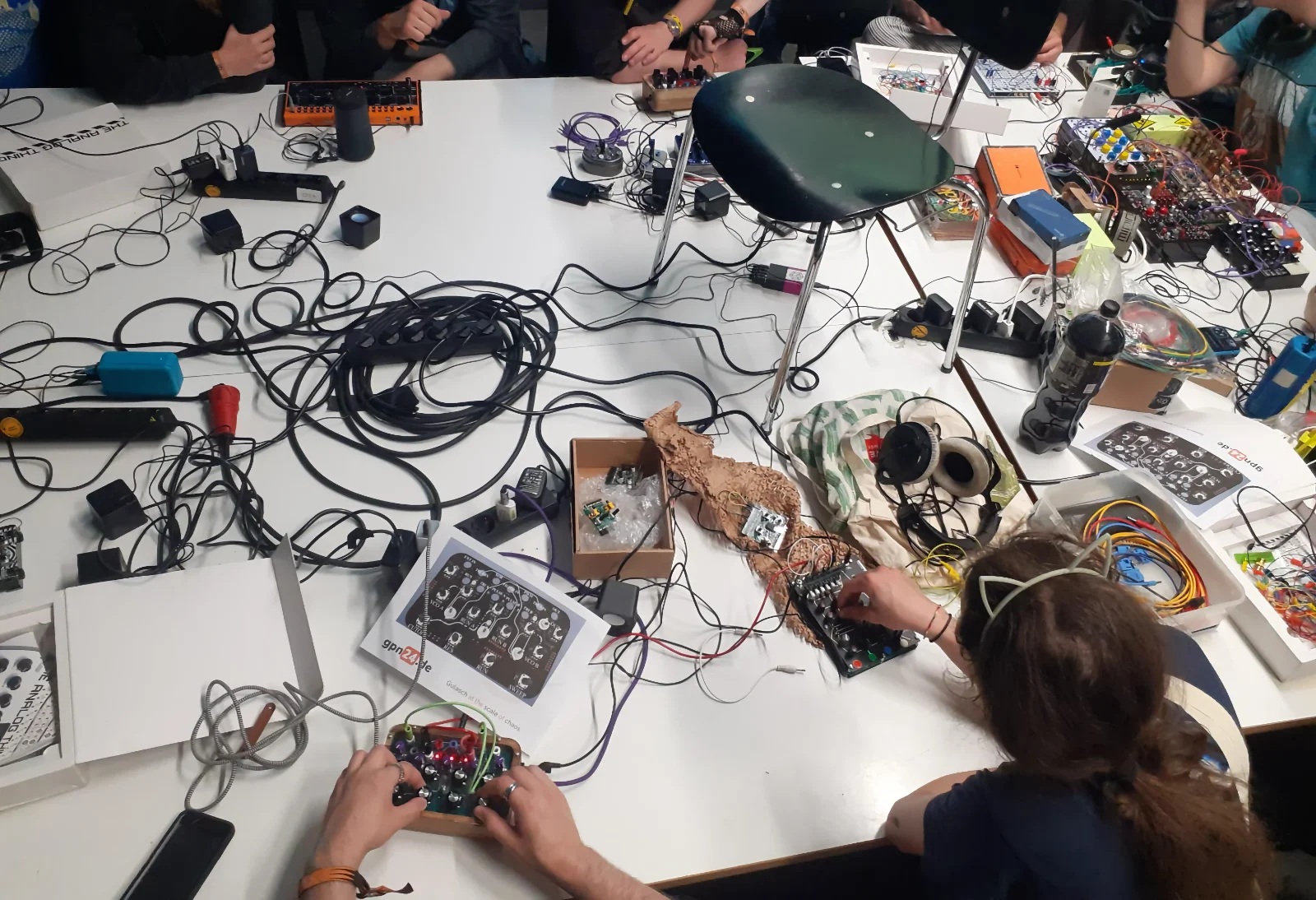
Friday night, workshop room 115: each station laid out with a
Benjolin, a tangle of power cords and patch cables, and a
printed patch diagram from gpn24.de.
A normal synthesizer gives you a predictable note when you press a key. The Benjolin more or less plays itself. Its two oscillators feed a shift-register circuit Hordijk called the Rungler: one oscillator supplies the data bits, the other clocks them through the register, and the stepped, semi-random voltage that comes out is routed back to modulate both oscillators and a filter. Since the output feeds back into itself, the textures keep evolving and never quite settle, though they do keep drifting into eerie, almost-rhythmic repetitions.
I'd love to call it feedback at the speed of light.
The units on hand were lovely custom builds in wooden enclosures with clear acrylic top plates, the green PCBs and dense wiring left fully visible. Pile on a tangled mountain of banana plugs and patch cables, and you have machines that are hard not to start poking at in a group. And they even had light sensors to trigger the Rungler's oscillator.
These particular Benjolin units came from workshops at the Laboratory for Music Electronics in Offenbach, led by circuit bending legend Joker Nies, who had conducted Benjolin workshops with Rob Hordijk himself at STEIM in Amsterdam in 2009 and 2011. The new interface design and PCB layout were created by co-organizer j00n. She runs Benjolin workshops together with Joker Nies.
Expanding the Installation: Analog Computers and Mutant Mods
Once the room had figured out the Benjolin basics, things grew. People started chaining very different kinds of hardware into long, unpredictable feedback loops, until the tables had turned into the grotesque, room-wide sound installation the workshop description had promised.
My favorite additions were the actual analog computer repurposed as a synthesizer. Patch continuous mathematical operations like integration and multiplication into a feedback loop, send the output voltage to a speaker, and a differential equation literally becomes a soundwave.
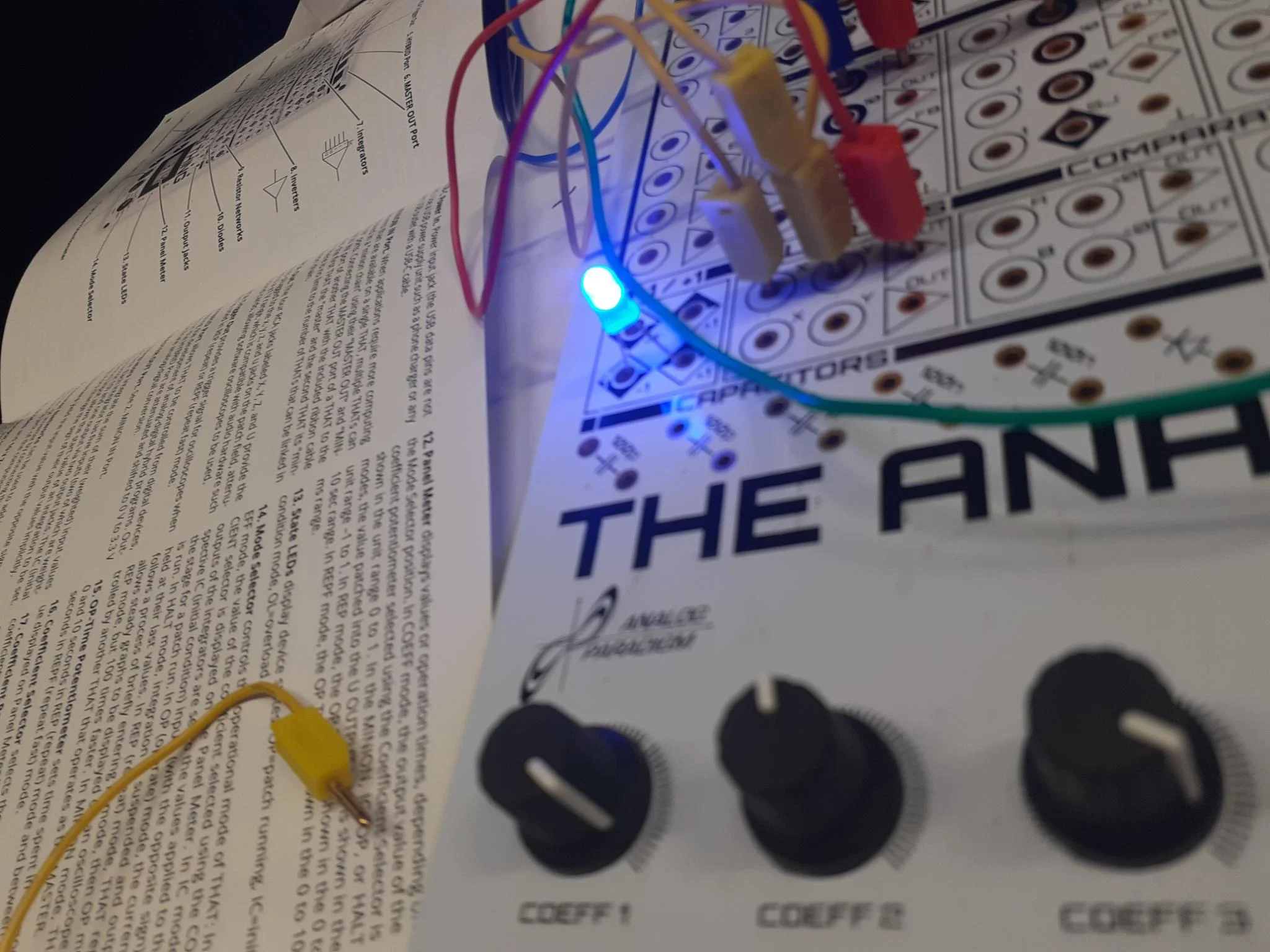
The Analog Thing
analog computer, patched with colored cables beside its manual,
with integration and multiplication wired straight into the
feedback loop.
The first evening also featured a video synthesizer that transformed audio waveforms into kaleidoscopic visual animations, projected onto the wall via a beamer. While everyone else was chasing sound, this device was generating psychedelic patterns from the same signals. They turned the room into a synaesthetic playground where you could see what you were hearing.
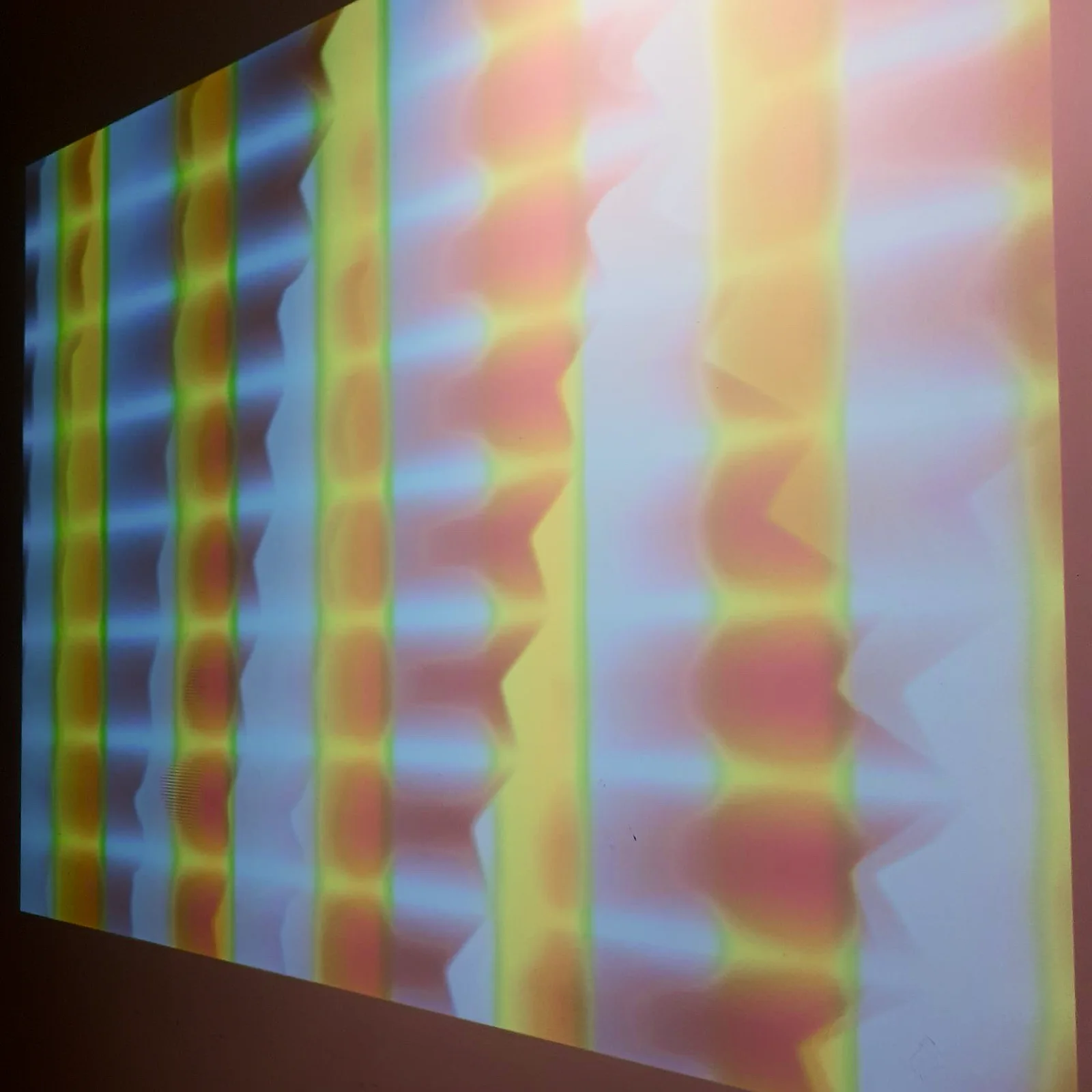
The colors of the video synthesizer caressing the walls as a projection.
Our group's patching got fairly involved. One participant used a Keith McMillen QuNexus smart-sensor keyboard to drive the wooden Benjolin, split the control voltage (CV) signals through a passive banana-plug distribution hub, and then cross-modulated them with a custom-built mini analog computer module: a compact blue box carrying a matrix of 12 knobs labeled along X, Y, and Z coordinates, turning continuous mathematical chaos straight into audio voltage.
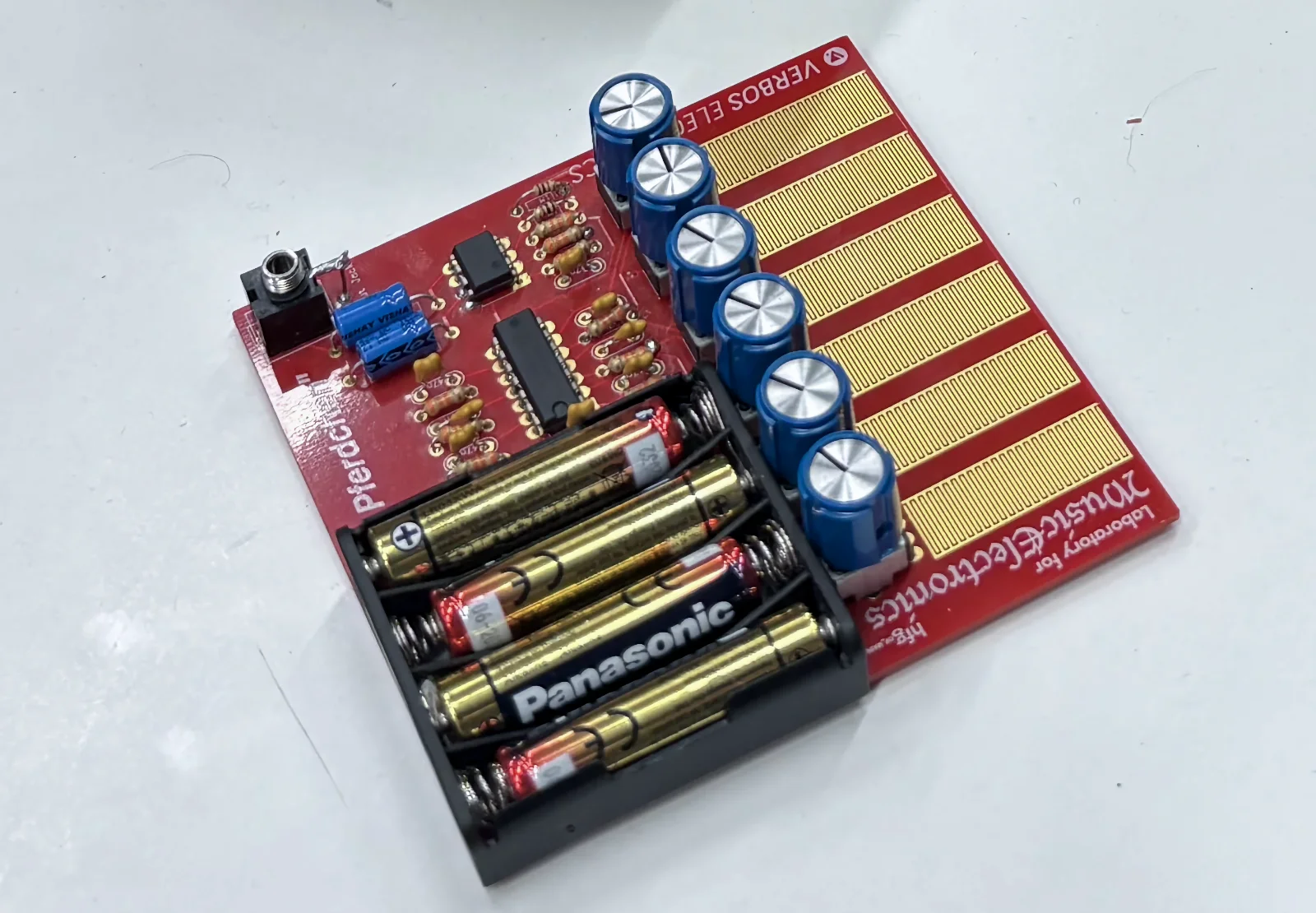
The "Pferdchen" (Little Horse): a little red PCB
synth with golden capacitive touch strips, keeping company with a
Benjolin and its printed instruction sheet.
Smaller battery-powered oddities joined in too, like the Pferdchen (Little Horse), a little red PCB synth with golden capacitive touch strips that contributed a raw, scratchy layer to the drone from its spot next to the Benjolin instruction sheets. This unit was created the same Offenbach lab during a workshop with Mark Verbos of Verbos Electronics.
The "mutant" of the night, though, was a completely custom open-chassis synth module salvaged from a 1970s Farfisa Matador electronic organ.
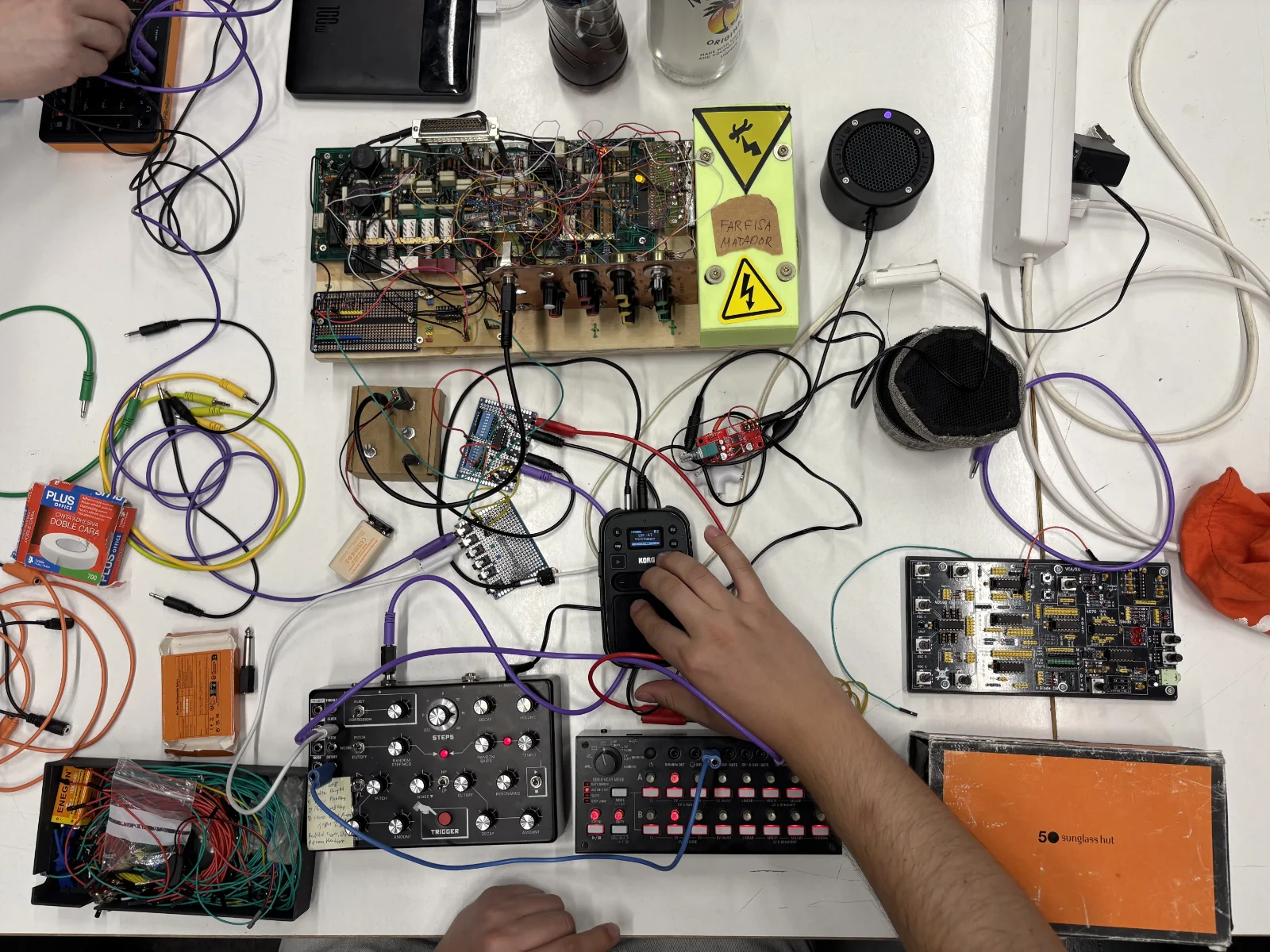
The Farfisa Matador drone engine: original voice boards mounted
on bare plywood, with a neon-green power enclosure and a
handwritten cardboard label.
The builder, Julian, had stripped out the original voice boards, mounted them on a bare piece of plywood, and wired up a front panel with rows of black, yellow, and green knobs to coax the organ's transistor architecture into an experimental drone engine. With its 3D-printed neon-green power enclosure and handwritten cardboard label, it was peak hacker aesthetic.
Julian made the journey from Spain to Karlsruhe with a dazzling collection of music devices, including some intriguing pieces of equipment whose function remained entirely enigmatic to me. But I totally loved his Teenage Engineering OP-1. What a beautiful machine!
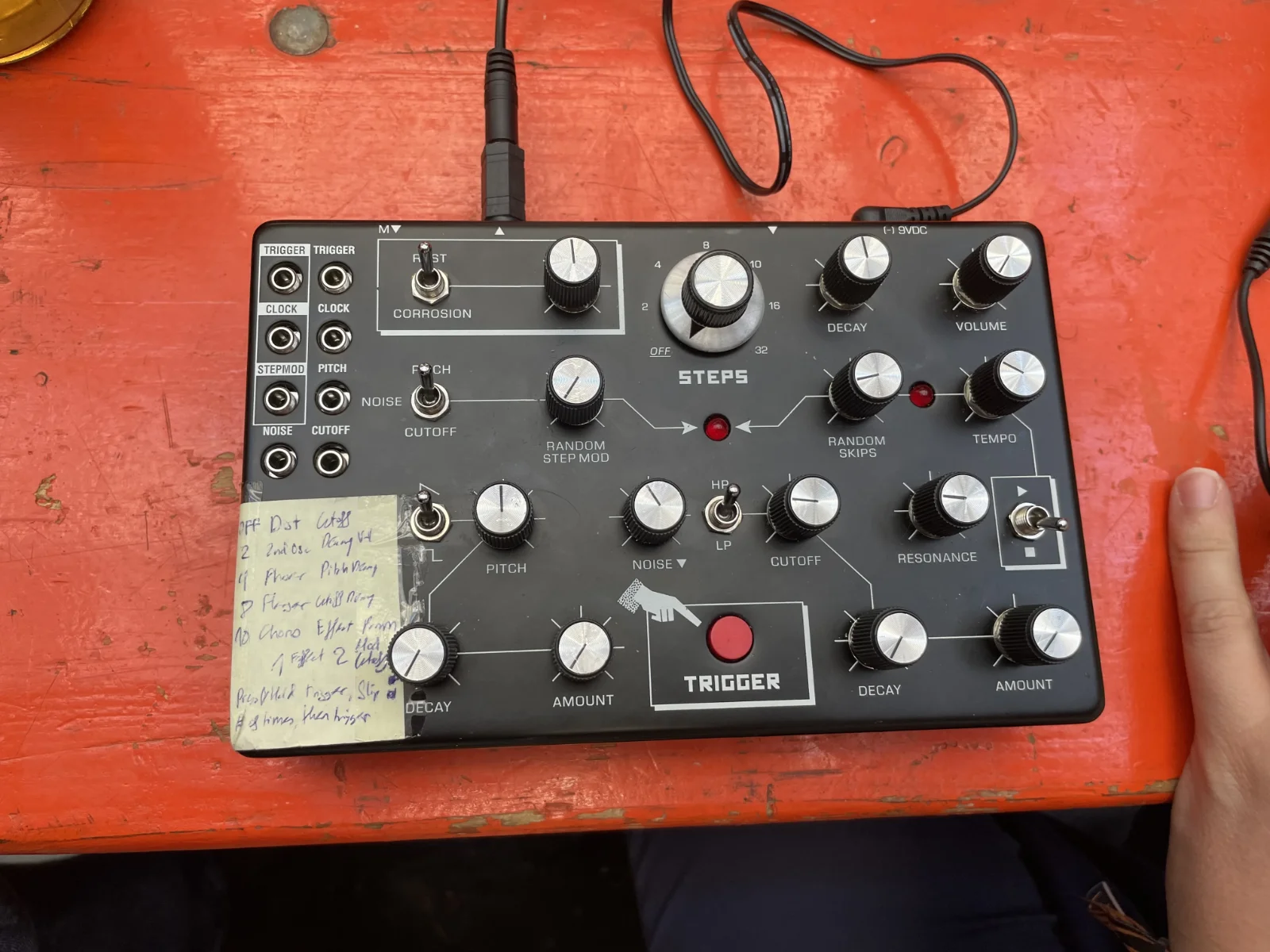
Julian's Metal Fetishist digital noise and drone generator. A strip of
masking tape serving as a cheat sheet for a hidden configuration menu.
Nearby we had a standalone Metal Fetishist by Body Synths digital noise and drone generator: a rugged black unit with an experimental patch matrix up top, a big red manual trigger button, and a strip of masking tape serving as a cheat sheet for a hidden configuration menu. It rewires the machine's guts or adds new signal paths.
Software Nodes, Portable Synths, and Guest Jams
The rest of the room was full of a mix of digital control and hands-on instruments. On the software side, a laptop ran Bespoke Synth, a node-based open-source DAW, hooked up to Ableton Push 2 grid controller for live parameter mapping.
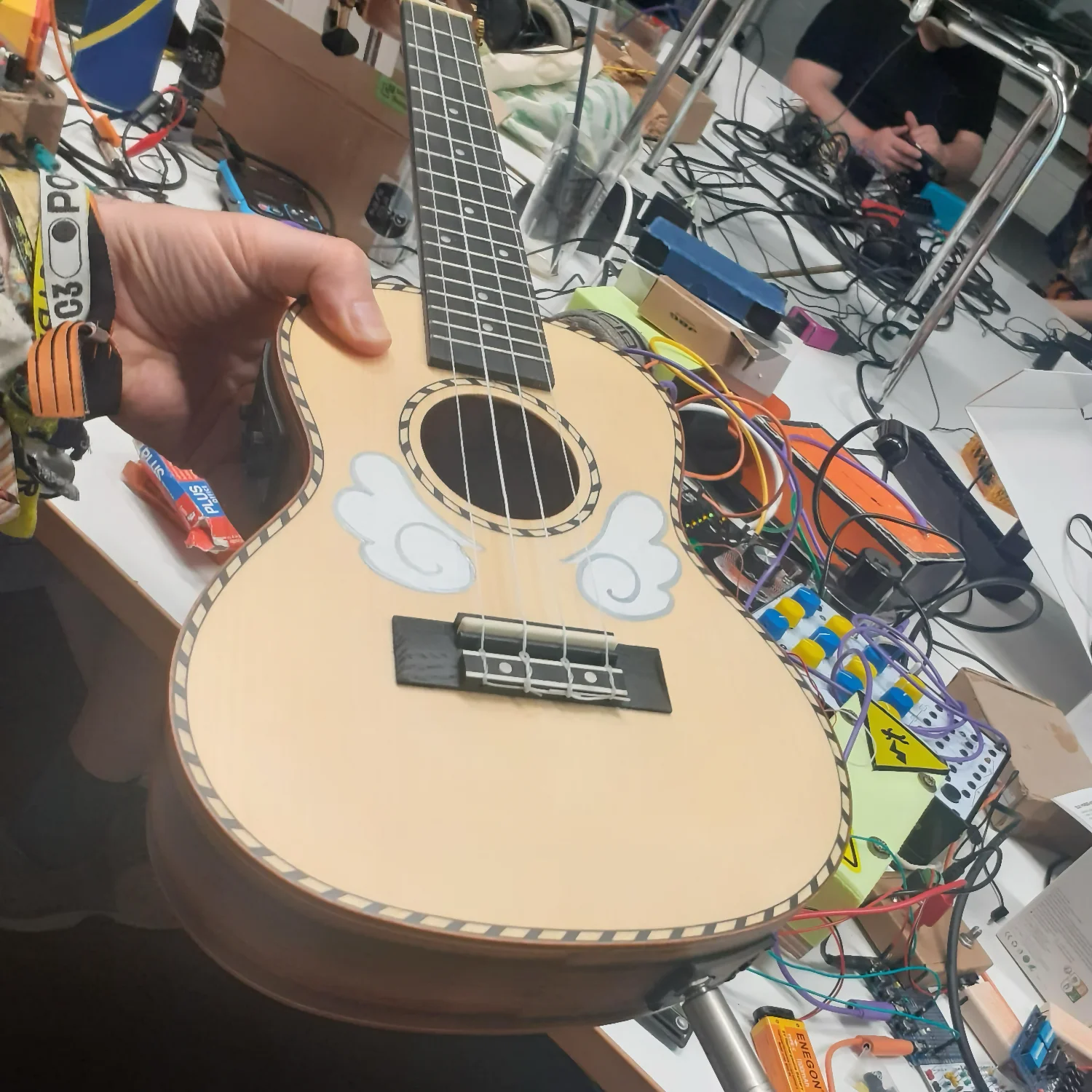
The surprising electric ukulele
One participant on the first evening brought an electric ukulele (yes, such a thing exists!) whose signal qetu and his compatriots successfully routed through the analog computer (THAT), applied ring modulation, and then sent to a Benjolin where hand movements controlled the filter frequency via its light sensor. The result sounded less like a ukulele and more like an apocalyptic orchestra of distorted electric guitars.
Utterly delightful!
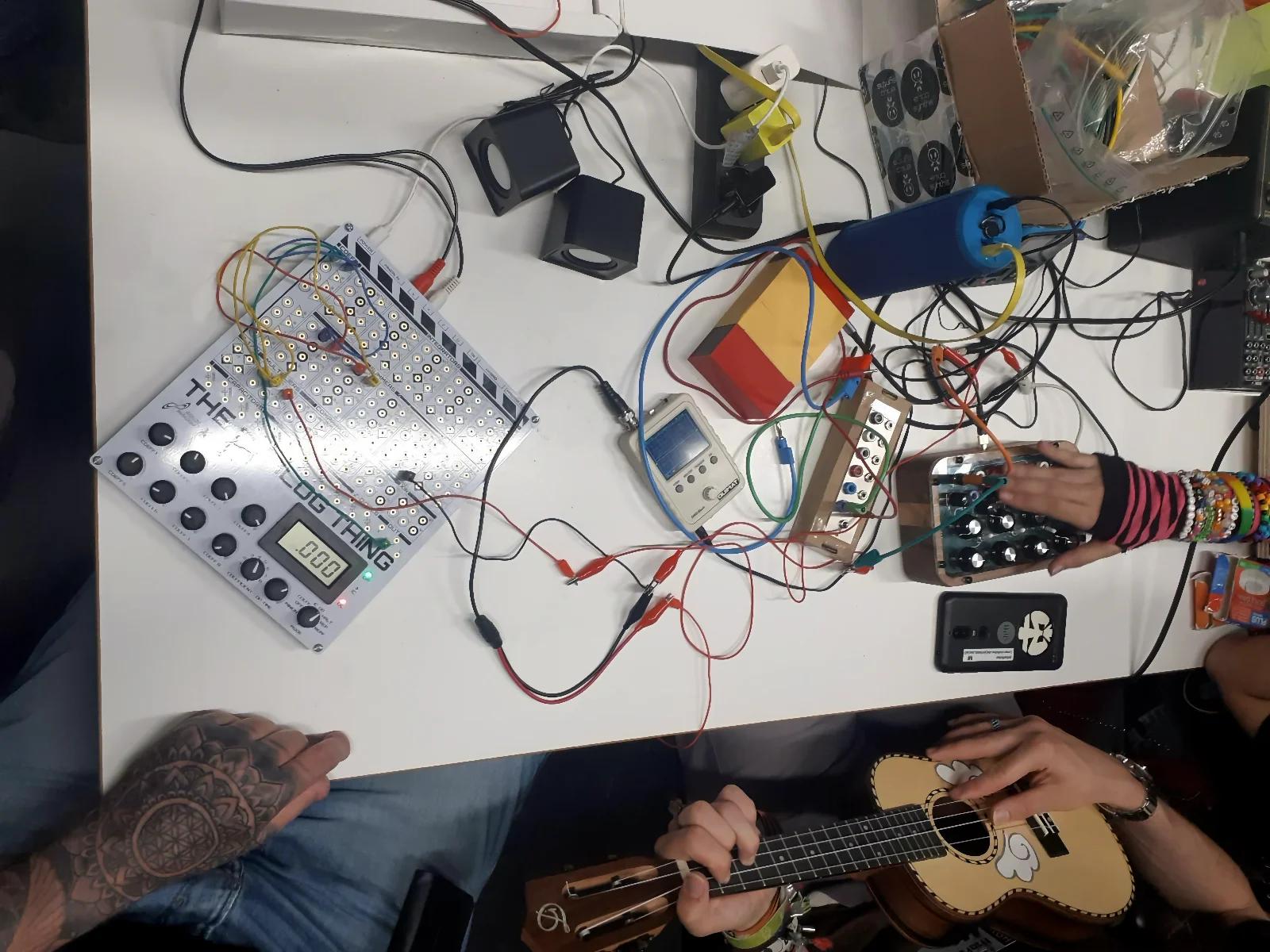
The setup to connect the ukulele
On the portable hardware side, desktop stations paired a paraphonic IK Multimedia UNO Synth Pro X with two of Roland's pocket-sized AIRA Compact units, the T-8 Beat Machine and the J-6 Chord Synthesizer, synced via 3.5mm jacks. The second night brought a different crop of gear back to the white tables: one station featured a Yamaha Reface DX, the pocket-sized FM synth that revives the DX100 lineage, wired up to cube speakers and a tangle of patch cables while someone explored its touch-sensitive sliders.
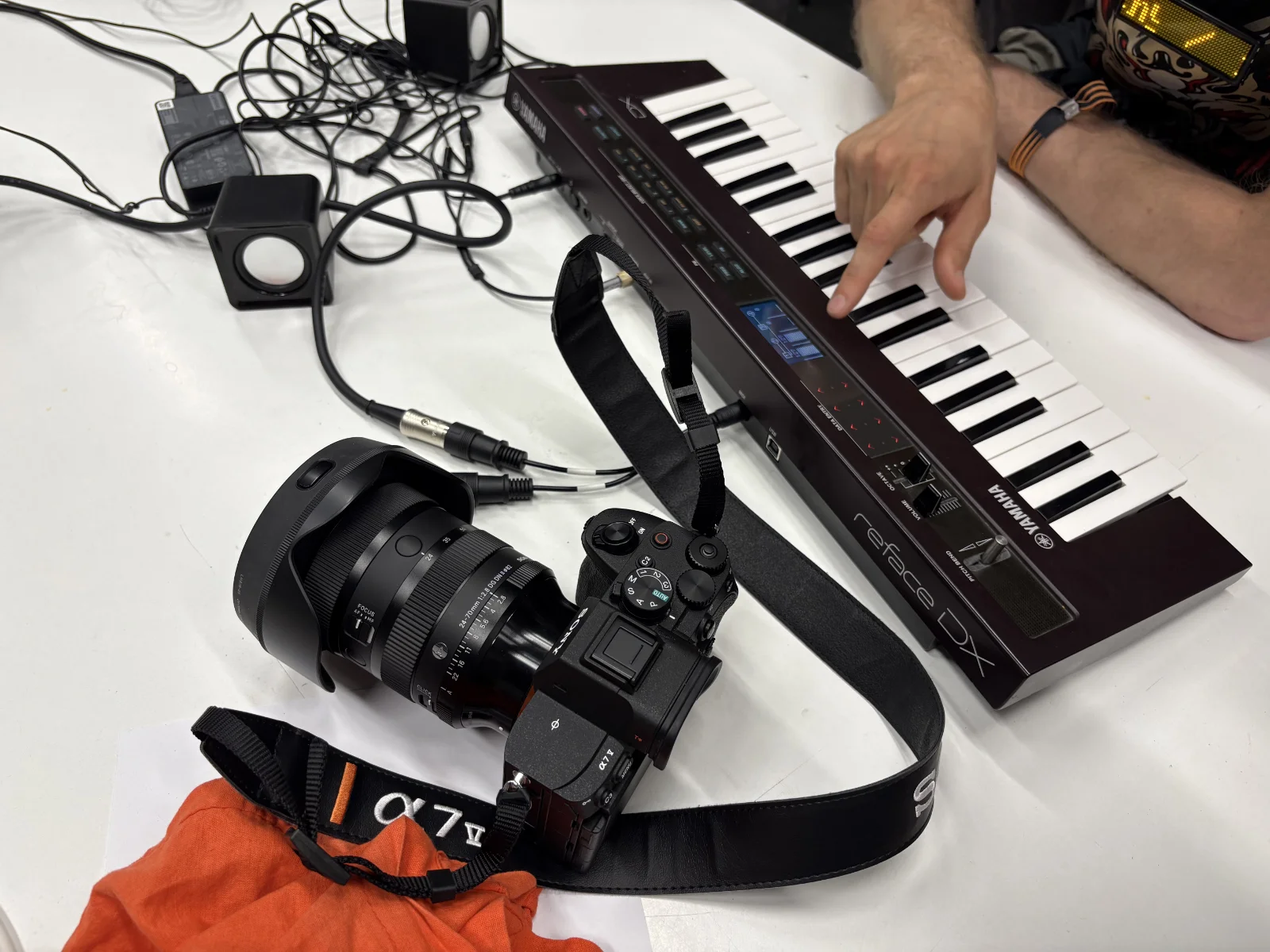
Saturday night, workshop room 112: a
Yamaha Reface DX
on the table, FM parameters under the fingers and a Sony Alpha 7
IV ready to document the cables and LEDs.
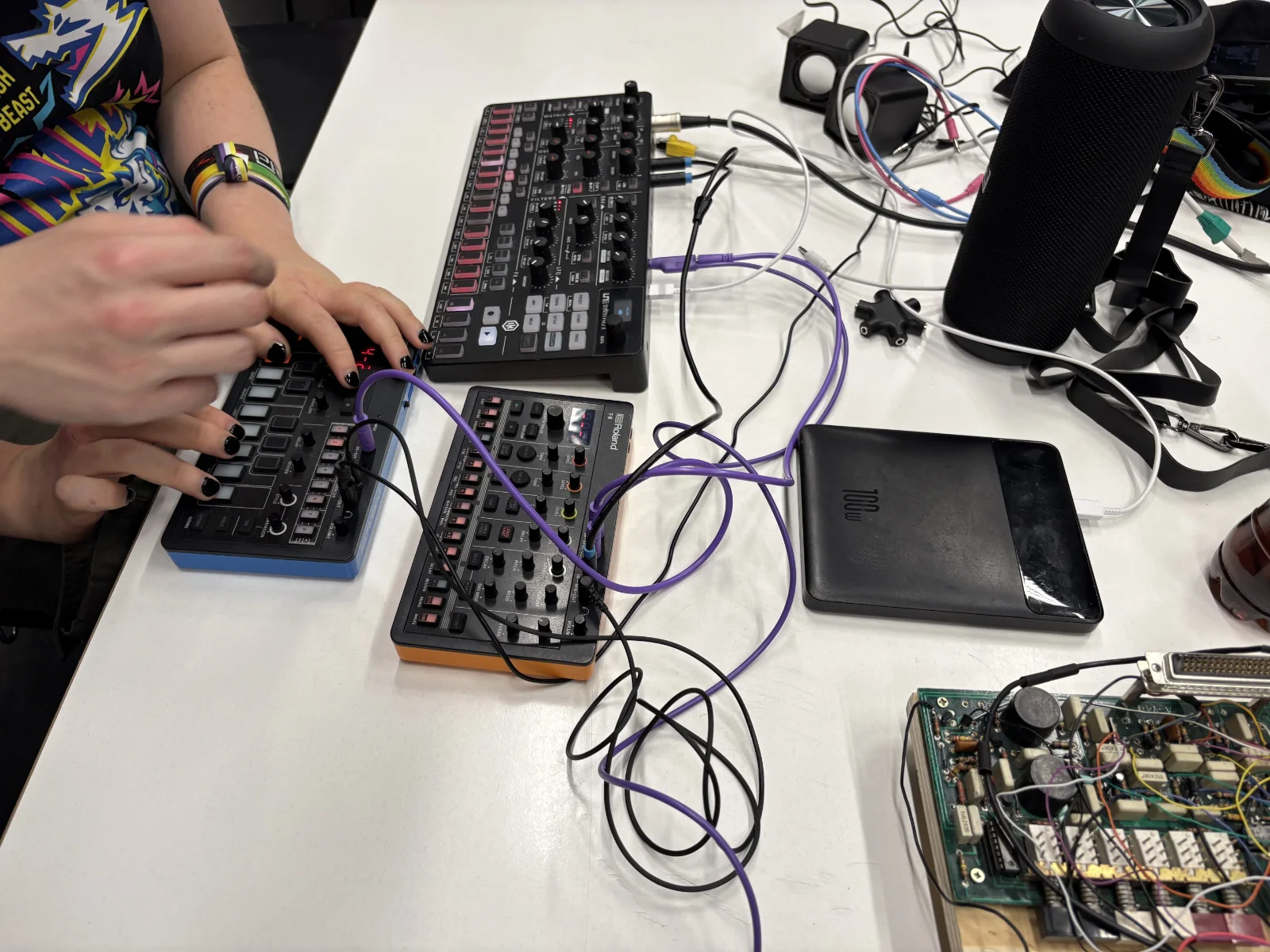
Roland's pocket-sized AIRA Compact T-8 Beat Machine and
J-6 Chord Synthesizer, synced via 3.5mm patch cables.
We were also lucky to have Mitch Altman join the workshop: the Berlin-based hacker, co-founder of San Francisco's Noisebridge hackerspace, and inventor of the TV-B-Gone. He brought his own analog synth setup, including the ArduTouch synthesizers people had just soldered in his workshop earlier at GPN24. He passed gear and advice around freely, a still point of friendly calm while a dozen machines hummed, buzzed, and beeped away around us.
Things got even stranger when a participant showed up with an acoustic-electric guitar with a built-in preamp and equalizer. We tried to patch it into the signal paths of the analog synths, but it didn't really work out.
I guess Oscar Wilde wasn't thinking of this when he said: "Experience is what we call our mistakes."
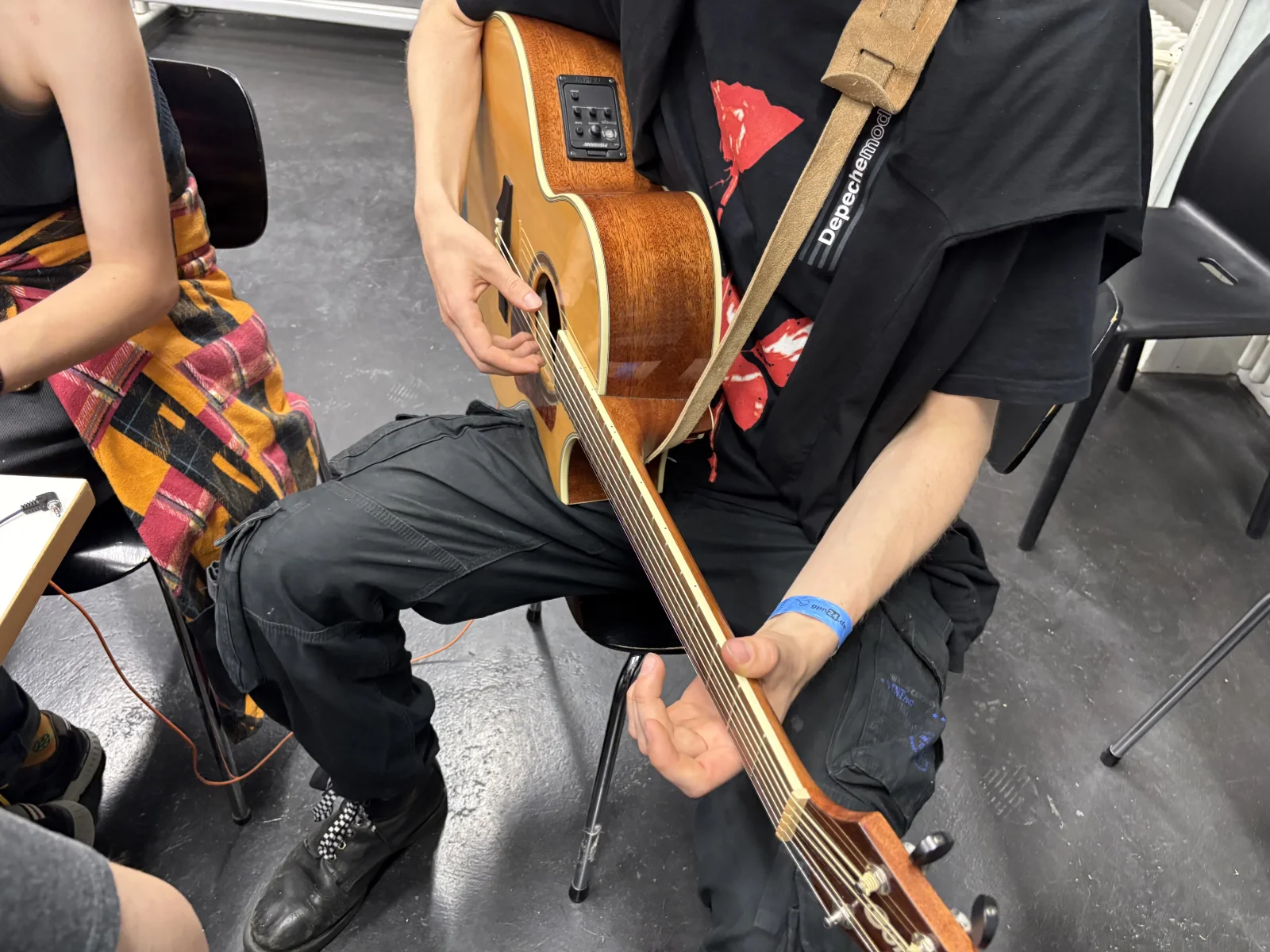
An acoustic-electric guitar with a built-in preamp and
equalizer, its strings about to meet the room's feedback
loops.
Self-Organized Cacophony
Of the roughly 20 participants, about half were complete novices and half experienced synth heads. Nobody had to stand at the front and lecture like in a classroom. We got cracking and simply paired up or formed small groups. Powered by their astonishing enthusiasm, qetu and j00n kept moving between the groups, explaining how things worked, making sense of the patch diagrams, debugging hardware, and generally keeping everyone learning. They were like bees in a field of flowers, buzzing around and collecting pollen. (I really don't have a handle on metaphors, but you get the idea.)
Several participants had brought small oscilloscopes along. They are practically the debuggers of analog sound synthesis. These pocket-sized devices made the invisible visible, displaying waveforms in real time so newcomers could see exactly what their patch cables were doing to the signal. It's one thing to hear a filter sweep; it's another to watch the sine wave morph into a sawtooth and back again on a tiny glowing screen.
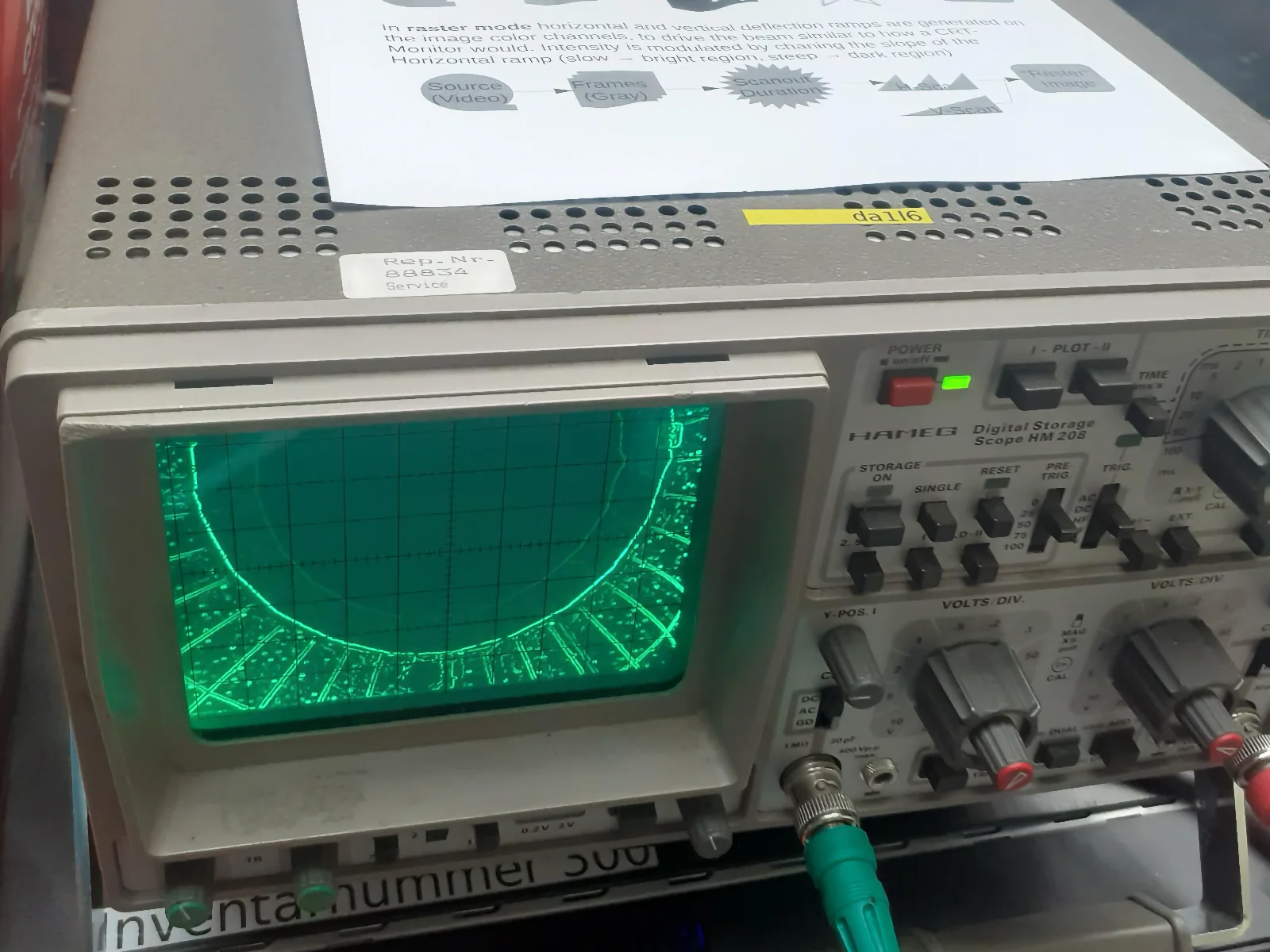
A Hameg digital storage oscilloscope displaying the chaotic waveforms generated by the Benjolin and analog computers, making the invisible visible.
Did the whole thing collapse into room-wide cacophony now and then? Sure, this was totally expected. But when your centerpiece is an instrument built to exploit chaotic feedback, the noise is the feature, not a bug.
The first evening's session was scheduled to end at midnight, but the synth heads were so absorbed in their tinkering that nobody wanted to stop. The workshop finally wrapped up at 01:30 in the morning!
It was a great collaborative jam in the best DIY tradition. And given how much synth hardware, soldering, and custom patching took over the tables this year at GPN, the community seems to be making a serious bid for 2027 to officially become the Year of the Synth.
What stuck with me most, though, was the sheer joy in the room. There is nothing quite like watching someone play with a circuit for the first time, hear it answer back, and light up because they made that happen. Give people a bit of competent guidance, a little passion to go with it, and results they can hear right away, then their enthusiasm is almost impossible to contain. That is the real magic of a workshop like this!
If you want a taste of that for yourself, keep your eyes peeled for qetu's and j00n's next workshops. Pull up a chair, take a sip of Club Mate, grab a few patch cables, and let the feedback take it from there.
Gallery: GPN24 Impressions
Beyond the workshop rooms, GPN24 was a feast for the eyes. Here are some impressions from around the venue that capture the unique atmosphere of this hacker and artist gathering.
Hover mouse pointer over the slideshow to stop automatic progression.
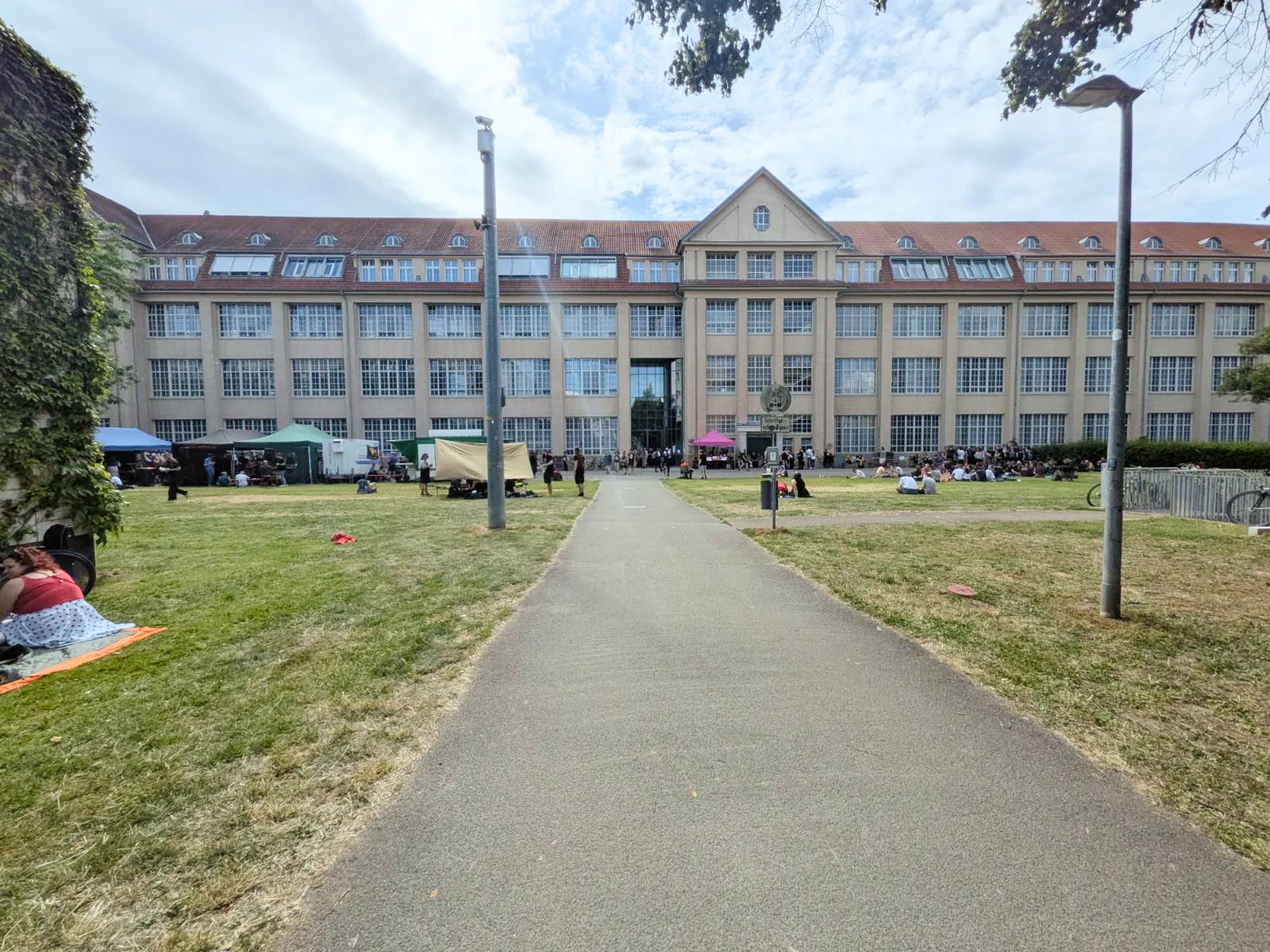
The ZKM Courtyard
The iconic Center for Art and Media building in Karlsruhe, where GPN24 attendees gathered outdoors between sessions on a sunny June day.
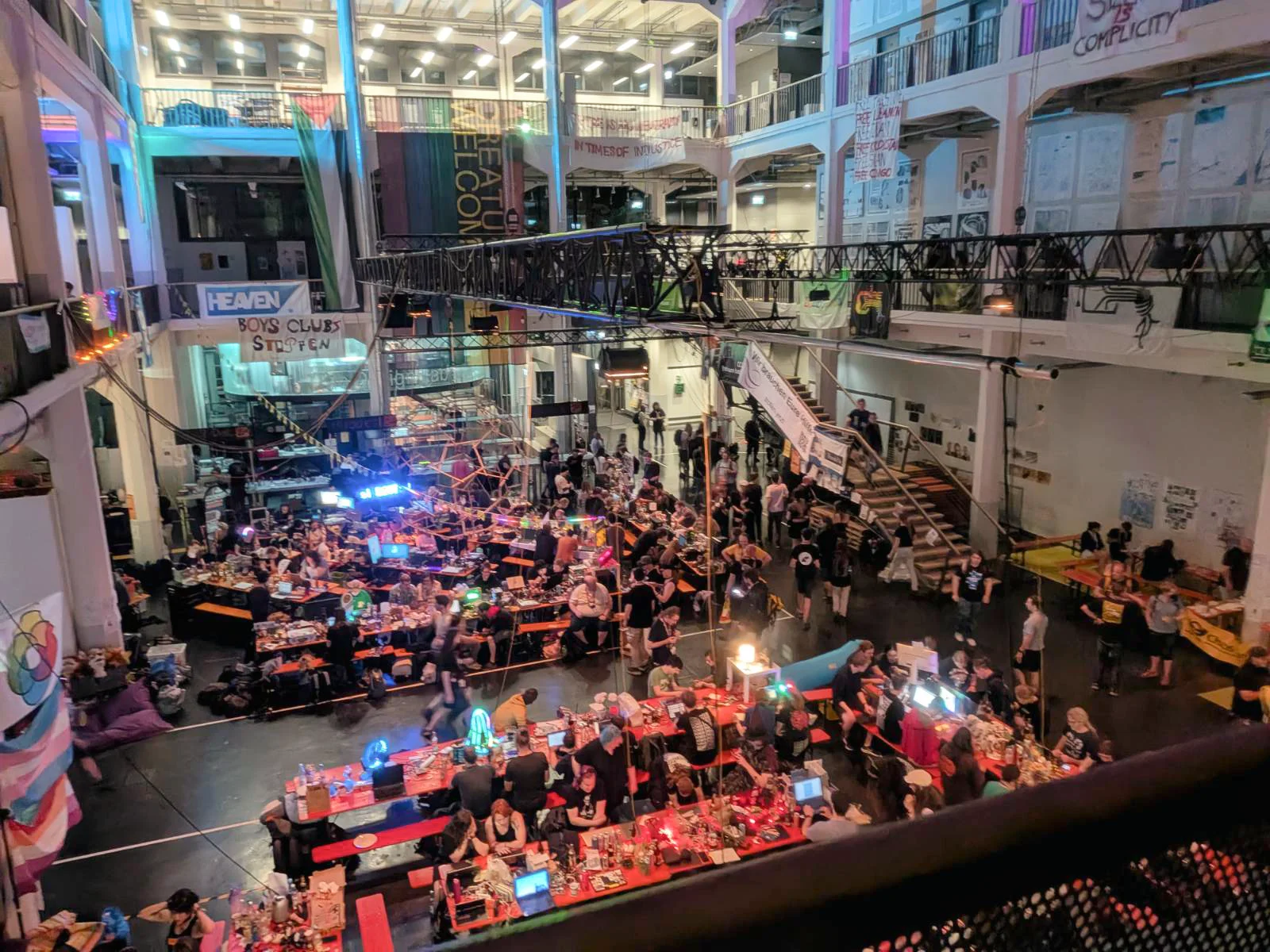
The Main Hall
ZKM's industrial hall transformed into a hacker paradise, with hundreds of attendees, colorful LED lighting, and endless rows of workshop tables.
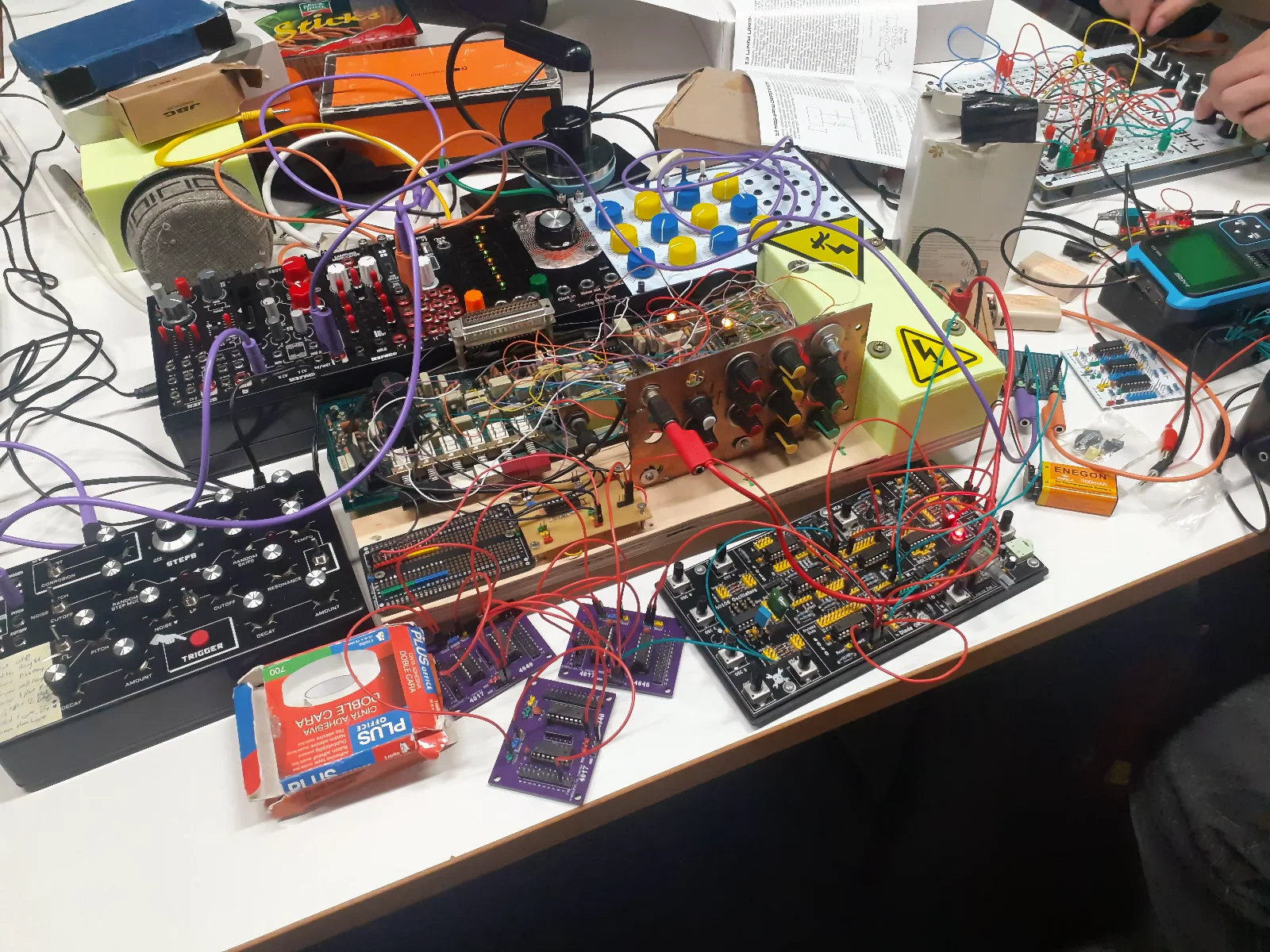
The Hardware Jungle
A typical workshop table at GPN24, covered in synthesizers, Eurorack modules, patch cables, oscilloscopes, and a healthy dose of creative chaos.
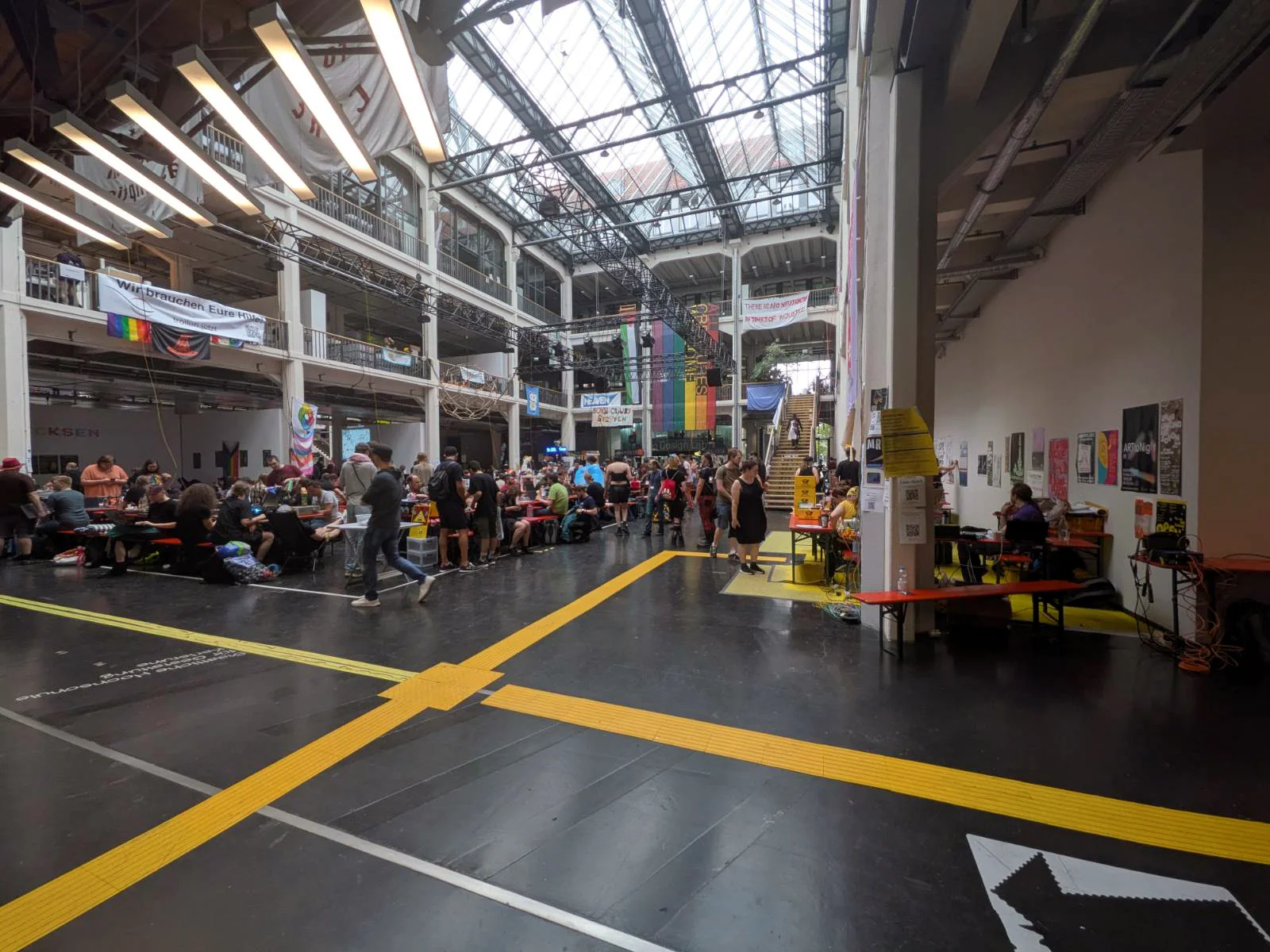
The Floor at GPN24
Another view of the expansive hall at the ZKM and the HfG, showing the industrial architecture with its glass roof and distinctive yellow floor markings.

Shark Brigade
The beloved IKEA shark plushies made an appearance at GPN24, because no proper hacker event is complete without them lounging on the lawn.

Budget Audio
Stacks of TWOXO Speedlink speakers ready for distribution. When you need dozens of mono speakers for a fabulously chaotic synth workshop, TWOXOs are cheap and cheerful.
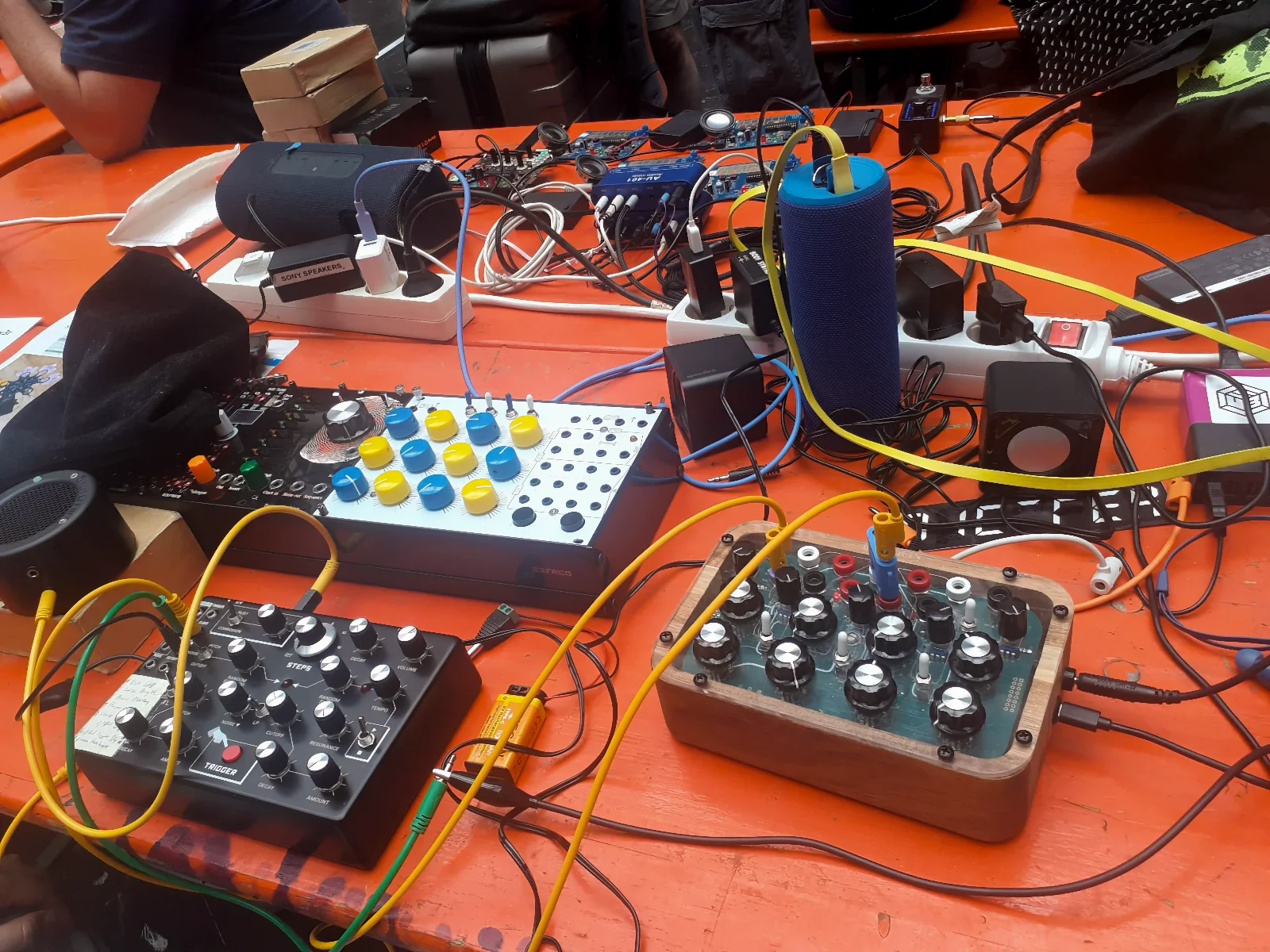
Workshop Setup
The preparation phase on the iconic orange GPN tables, with mini analog computers, custom modules, and a rainbow of patch cables ready for the evening's sonic experiments.
A Note on the Visuals
We took plenty of photos over the two days to document the blinking LEDs, cables, and circuit boards, but strictly followed GPN's photo rules: no participants' faces are recognizable in the shots. The focus stays entirely on the hardware that brought us all together.
Credits
This article was a team effort. qetu and j00n co-organized and ran the workshop, with Julian, Jo-To, and several others contributing gear and expertise. The mysterious °~° created the excellent video. Most of the photos were taken by qetu, j00n, Julian, and °~°. They all supplied the technical details. I was mostly there for my wonderful hair.