The Psychological Tree
The Tree Drawing Test and Its Limitations
January 2025
During a psychological evaluation decades ago, I was asked to draw a tree. I later learned this seemingly innocent exercise was a gateway into the labyrinth of someone's personality. Recently, I decided to revisit that moment and draw another tree, this time with an iPad and decades of life experience in hand. Let's see how the Tree Drawing Test holds up.
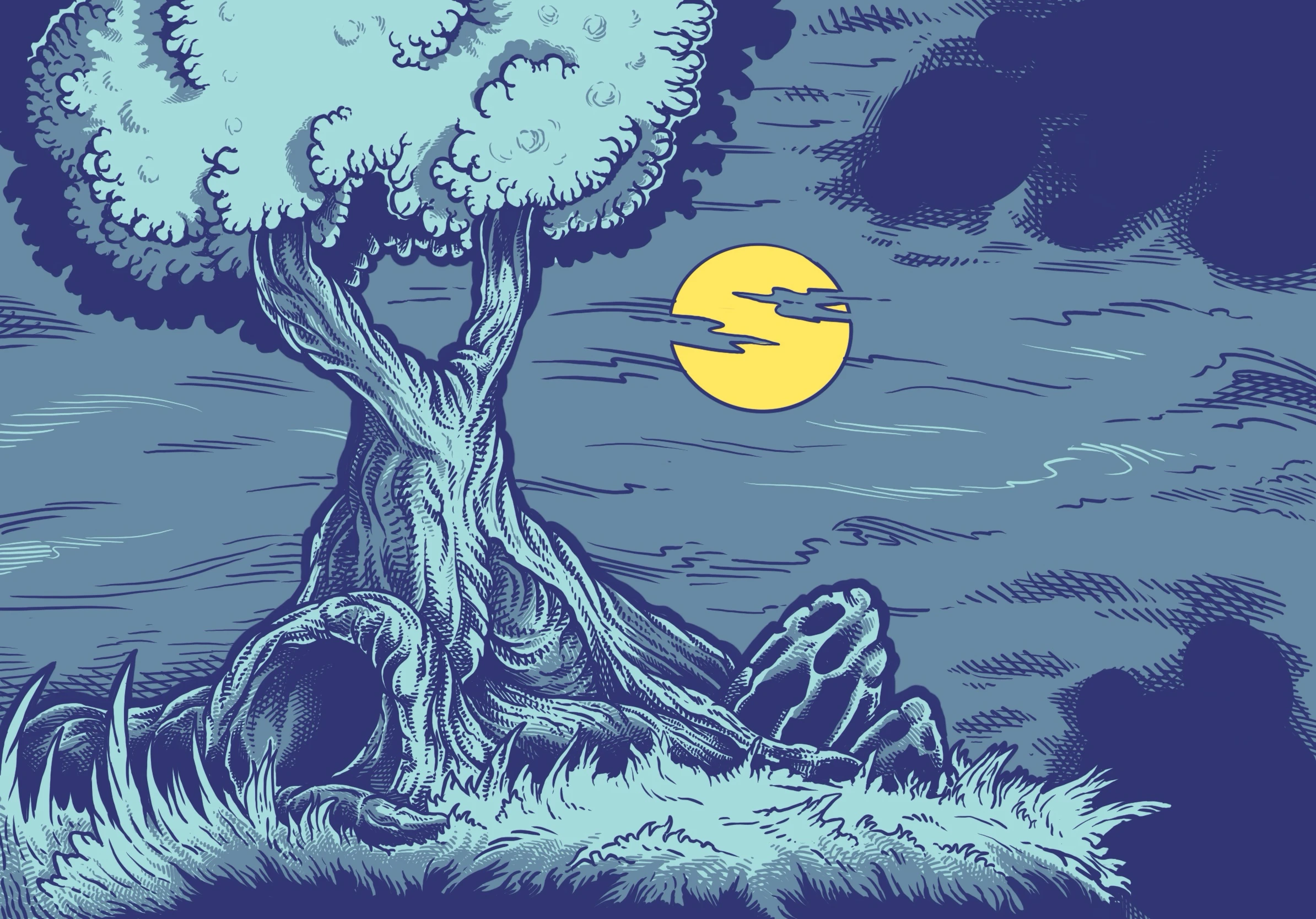
I hope this tree passes muster in a psychological test
More than two decades ago, I did a psychological test during my military service. It consisted of different cognitive and personality tests. Some of the tests were on paper and others were in a group interacting with other people. One of these tests I could not forget. We had to draw a tree. Each one of us. By ourselves. With a pencil or a pen on paper.
Apparently, this would allow the psychologist to gain insights into a person's personality, emotions, and mental state. This type of test, often referred to as the Tree Drawing Test or Baum Test, is based on the idea that spontaneous drawings can reveal unconscious thoughts and feelings. It belongs to the family of so-called projective techniques, the most famous of which is the Rorschach inkblot test, in use since 1921 and controversial for almost as long.[1]
The tree test has a surprisingly concrete history. From 1928 onwards, Emil Jucker, a vocational guidance counselor in Zurich, asked his clients to draw a tree as an aid in choosing a career. He interpreted the drawings intuitively, without any fixed method.[2] The Swiss psychologist Karl Koch (published in English as Charles Koch) picked up the idea from Jucker and systematized it. His slim 88-page book Der Baum-Test appeared in Bern in 1949,[3] and an English edition, The Tree Test, followed in 1952.[4] Koch's original instruction was simply "Draw a fruit tree!", to be carried out with a pencil on a blank sheet of white paper.[2] The test is still in print today. Its publisher describes it as a projective test that takes five to ten minutes, is suitable for anyone from the age of six, and is used in psychological practice, school psychology, career counseling, admissions procedures, and psychiatry.[5] It even found its way into the cockpit: a 1954 doctoral thesis at the University of Zurich examined Koch's tree test as an aid in the medical and psychological selection of pilots.[6] So it is no great surprise that it turned up in a military evaluation.
Tree drawings are part of a broader tradition of drawing tests. Florence Goodenough's Draw-a-Man test of 1926 used children's drawings to estimate their intelligence,[7] and John Buck's House-Tree-Person technique of 1948 asked for a house, a tree, and a person, and read all three for signs of personality.[8]
Drawing the Tree
One evening in January while I was sitting in a Souvlakeria in Thessaloniki after I had enjoyed an excellent meal, I decided to give it a shot and drew a tree in Procreate on my iPad.
While I had a vague memory of the way a drawing of a tree would be analyzed, I deliberately did not research it before I drew the tree. I wanted to see if I would draw the tree differently now that I am older and have more life experience. I decided that I'd look it up after finishing the drawing and provide my own analysis of the tree. (Please note that I am a total lay person where psychology is concerned.)
This is what I drew.
How I drew a tree with decades of experience. (Watch on YouTube)
Back when I drew the tree decades ago, we used a pencil, a biro and paper. Essentially, this limited us to a monochromatic or grayscale drawing. This time, I used an iPad and Procreate. And I added some color (though admittedly not a lot of it). The process was different, but the essence was the same: to create a tree that on some subconscious level reflected my thoughts and feelings. (I also felt that a time-lapse video recording of a tree in black and white would be a bit boring.)
To create the tree, I began with light pencil outlines on a separate layer, sketching the basic structure and placement with a loose hand. Once satisfied with the framework, I refined the contours, giving the lines more weight and form to anchor the composition. To add depth, I layered in bold blacks, strategically placed to create visual weight and emphasize the tree's structure. Cross-hatching came next, carefully applied to add shading, texture, and a sense of volume that brought the tree to life.
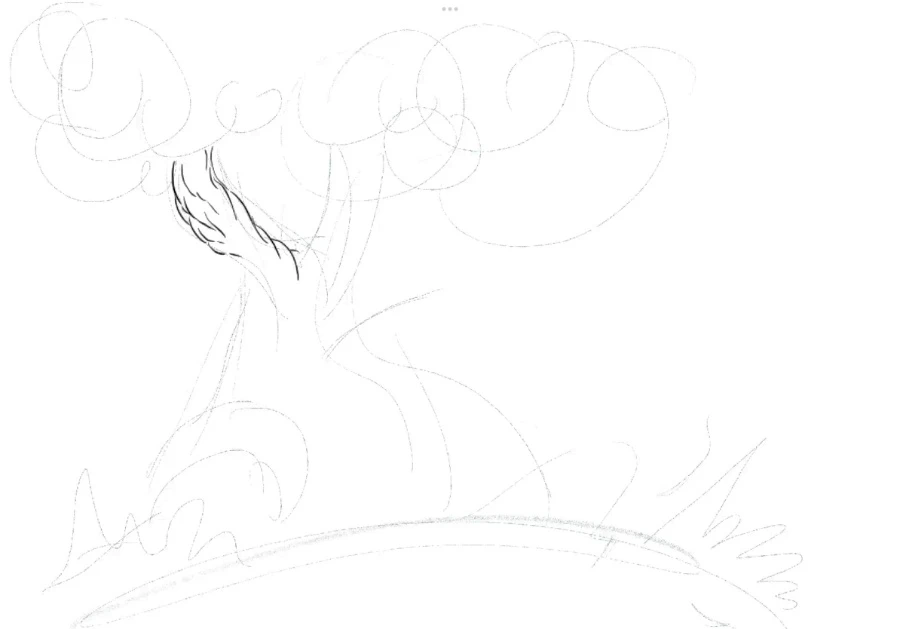
Step 1: the sketch
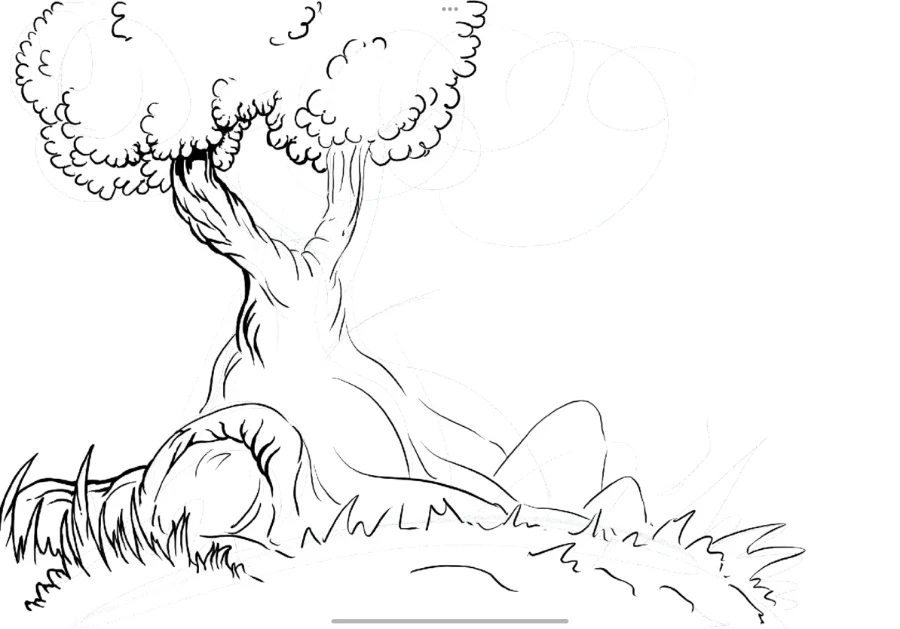
Step 2: the contours
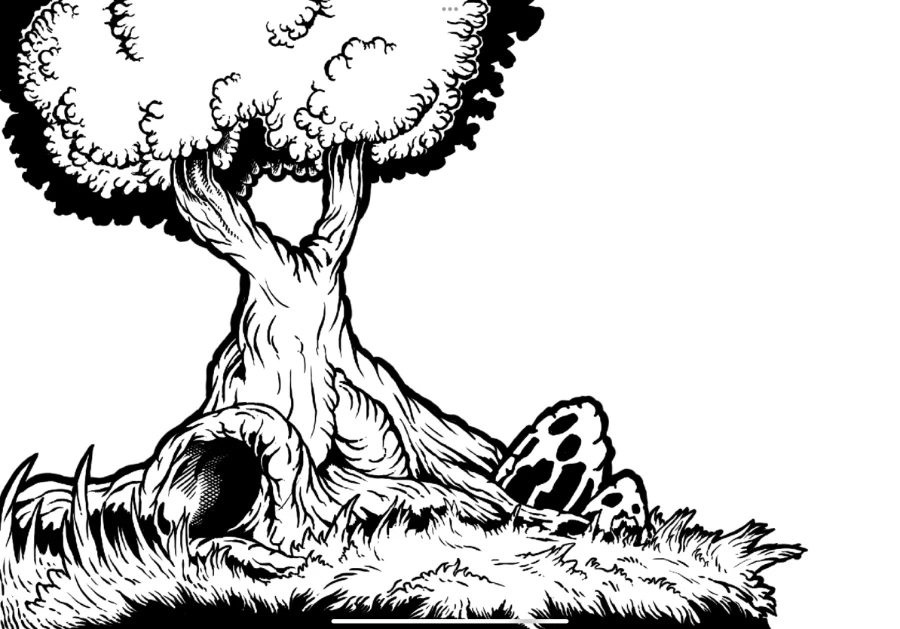
Step 3: adding weight
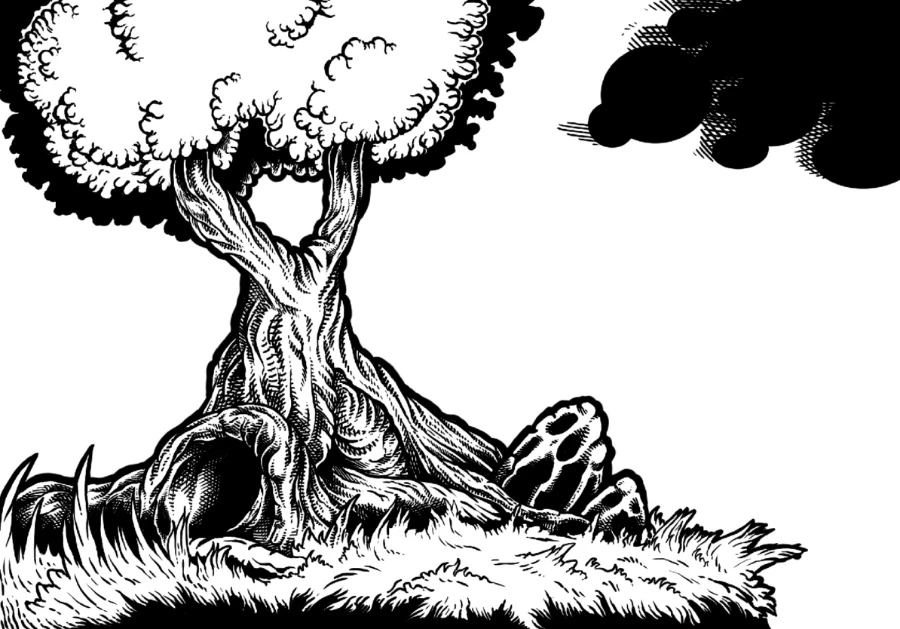
Step 4: hatching
For the colors, I embraced a minimal palette of four tones. I transformed the line art into a dark teal. A turquoise-blue filled the tree and foreground, complemented by a slightly darker tone for the sky. By cross-hatching this darker tone into the tree and ground, I created depth and dimension. This blended light and shadow. To complete the scene, I added a bright yellow moon, a vivid focal point against the ethereal blues. My intention for the final piece was an abstract, dreamlike quality: a surreal nightscape drenched in cool, otherworldly hues.
(I'd like to note that I have in the past year or two become a bit obsessed with limited color palette drawings. I find that creating them can be quite rewarding and the results can be quite striking. Some of my old drawings and paintings are very colorful and sometimes go overboard with the color palettes. I have been experimenting with the more limited style for a while now and I am quite happy with the results and find the process quite appealing.)
Just dropping in the fully colored drawing here again so that you don't have to scroll up to see it.
Interpreting the Tree
Psychological tests like the Tree Drawing Test have a certain mystique about them. On the surface, it's just a tree. A trunk, some branches, and leaves. But it seems, to a psychologist, the drawing is like a personality Rorschach blot, offering a sneak peek into the depths of your psyche.
I had always asked myself, what exactly one could glean from the drawing of a tree. I looked it up and apparently, it really is a thing. The reasoning behind this test seems to be as rooted as the tree itself. The way you draw - whether the trunk is solid or shaky, the branches spread out or cut short, or whether you throw in a swing or a family of squirrels could supposedly reflect your sense of stability, ambition, relationships, and emotional openness. If the tree has a deeply furrowed trunk, maybe you're wrestling with stress. Bare branches stretching skyward, might suggest you are yearning for growth or feeling exposed. A tree with a big crown and tiny roots? Perhaps you're all about dreaming big but skipping the groundwork (don't worry, we've all been there).
Koch's own method was more elaborate than the internet summaries suggest. After years of using the test on adults and schoolchildren, he worked out a two-step interpretation. First comes the overall impression and the "space symbolism" of the drawing, that is, its size and placement on the page. Then follows a detailed analysis of more than fifty features, such as the course of the roots, the contour of the trunk, the shape of the crown, and the fruit. For some of these, like the ratio of trunk to crown, he used age-specific reference values gathered from schoolchildren and adults.[2] Researchers who use the test today have kept the basic symbolism: the crown is taken to reflect a person's emotional and mental state, the trunk their inner emotional functioning, and the roots their sense of security and unconscious drives.[9][10]
Analyzing the Tree
Okidoki, now that I have a result, let's take a shot at analyzing the tree. I am not a psychologist, so this is just a fun exercise. The boxed sections highlighted in green are a simplified summary of the criteria commonly attributed to the Tree-Drawing Test (Koch's Baum Test), the way a lay person like me finds them described online. They are not Koch's actual manual. The parts in the regular text are the aspects that I believe are present in my drawing.
I think that if we go on this little journey together, we might learn more about the way the Tree Drawing Test works and what its limitations are. Here is what I came up with.
1. General Characteristics
- Size of the Tree: A very small tree might suggest feelings of inadequacy or low self-esteem, while a very large tree could indicate grandiosity or a need for attention.
- Placement on the Page: A tree drawn very low on the page might suggest insecurity or a pessimistic outlook, while one drawn high could indicate ambition or optimism. A tree in the center may suggest balance or a well-adjusted personality.
Size of the Tree: I guess the tree I drew is large but not too large. I guess that means I am not grandiose but also not feeling inadequate.
Placement on the Page: I placed the tree to the left of the center of the page and aligned to the top. The tree is cropped at the top. To be fair, this loosely follows the principle of the rule of thirds (which is not a psychological category). I guess the whole thing might mean I am well-adjusted. I guess that's a good thing. I hope.
2. Trunk
- Width: A thick trunk often signifies strength, stability, or confidence. A very thin trunk might indicate vulnerability or emotional fragility.
- Lines and Texture: A smooth, solid trunk may reflect emotional stability, while jagged or broken lines could suggest stress or trauma.
Width of the trunk: The trunk is quite thick. I'm not sure I'm that strong and confident but I guess this would signify it. I hope that's true.
Lines and Texture: I've given the trunk a bit of texture. It is not jagged or broken but certainly not smooth either. I guess that means I might be leaning a bit into being stressed. I don't know if it would be trauma though. I hope not.
3. Branches
- Size and Spread: Large, spreading branches may indicate openness, sociability, or a desire to reach out to others. Sparse or drooping branches might reflect withdrawal or sadness.
- Direction: Upward-growing branches may suggest optimism and growth, while downward or broken branches can indicate feelings of hopelessness or loss.
Size and Spread: The branches I drew are on the larger end and more spread out than not. I guess that means I am to a certain extent open and sociable. I certainly believe that I have a strong tendency to introversion and a lot of my social behaviour is learned.
Direction: The branches are mostly upward growing. I guess that means I am optimistic and growing. I certainly try to be optimistic despite the setbacks in life.
4. Leaves
- Abundance: A tree with lots of leaves might reflect vitality and an active mind, while a tree without leaves could suggest feelings of barrenness, depression, or detachment.
- Details: Intricately drawn leaves might indicate a meticulous or perfectionist personality, while simple or absent leaves may reflect disinterest or simplicity.
Abundance: The tree I drew has a lot of leaves. To be fair, they are a condensed bush-like mass of foliage. I'm not sure it is totally accurate to say that the tree has many leaves because it was easier for me to draw a blob of leaves and only lay down some accents to suggest leaves. It struck me as much too laborious to render out each leaf individually. I hope that still means I am vital and have an active mind.
Details: The leaves are not intricate. They are just a general suggestion of leaves rather than distinctly defined leaves. I guess that means I am not meticulous or a perfectionist. I certainly try to be meticulous where necessary, though I must admit I believe that striving for perfectionism can often get in the way of getting things done. Certainly, where drawing the crown of a tree, rendering out every leaf was a bit too much for me.
5. Roots
- Presence of Roots: Roots can signify how grounded or connected a person feels. Prominent roots may suggest a focus on one's foundations or security, while a lack of roots could indicate a feeling of disconnection or instability.
Presence of Roots: Okay, so this is a big one. The roots I drew are clearly visible, strong and gnarly. They grow in and out of the ground. I guess that means I am grounded and connected. I'm not sure what grounded and connected means in this context. But I am certainly quite a flighty fellow, having lived in four different countries over the past ten years and held three different jobs. I guess the interpretation of the drawing means I am grounded and connected in some way.
6. Overall Style
- Realism vs. Abstract: A highly realistic drawing might reflect conventional or analytical thinking, while a more abstract style could indicate creativity or unconventional thought processes.
- Use of Space and Proportion: Balanced proportions may suggest harmony, while disproportionate elements could indicate emotional imbalance or specific areas of concern.
Realism vs. Abstract: This is a tricky one. I consider a line drawing in a comic book style quite abstract without going into the realm of the surreal. I guess that means I am creative and have unconventional thought processes. I certainly try to be creative, though I must admit that I am sometimes quite conventional in my thinking to remain pragmatic. I think this point and the previous one (about the roots) are the ones where the whole Tree Drawing Test starts to fall apart.
Use of Space and Proportion: I think the proportions are balanced. This might be less of an expression of my inner working but more of a function of my drawing experience. I instinctively know how to balance a drawing (though I must also admit that some of my drawings are really unbalanced because I wasn't paying attention while drawing them). I certainly try to be in harmony with myself and the world around me.
7. Additional Elements
- Knots, Holes, or Scars: These features might represent unresolved emotional pain or trauma.
- Weather Conditions: A tree surrounded by sunshine or flowers might reflect positive emotions, while one under storm clouds or with falling leaves could signify sadness or anxiety.
Knots, Holes, or Scars: This is also a tricky one. I drew a large hole in one of the roots, and some parts of the tree definitely look like knots and scars. I know why I drew them: I wanted to make the tree more interesting. But I also must concede that like many fallible human beings I have unresolved emotional pain and probably some trauma too.
Weather Conditions: The tree is drawn at night. So that rules out sunshine though the moon is shining brightly. I didn't draw any flowers and I added some black areas in the sky to suggest clouds and might even look a bit gloomy. While I certainly try to be positive and optimistic, this part of the drawing suggests that I might not be as positive as I think I am.
Overthinking the Tree
While I think that the drawing of a tree can provide useful clues, I don't think it should be used for a diagnosis on its own. And it isn't. Koch himself intended the test as an aid to a comprehensive understanding of a person, not as a tool for differential diagnosis.[11] Psychologists interpret such drawings in the context of other assessments, interviews, and observations to avoid over-generalizations or misinterpretations.
The scientific standing of the test is, to put it mildly, contested. A major review of projective techniques published in 2000 concluded that the substantial majority of indexes derived from the Rorschach and similar tests are not empirically supported, that the validity evidence for figure drawings is "even more limited," and that projective indexes have not consistently shown that they add anything beyond other psychological tests.[12] Reading a tree feature by feature, the way I did above, is exactly the kind of "sign" interpretation that this review takes apart. Where the tree test has held up best is in studies that measure rather than interpret. A 2015 study of several hundred patients found that people with Alzheimer's disease drew smaller trees than healthy controls, and that tree height and the trunk-to-crown ratio predicted cognitive impairment. Even then, the authors proposed the test only as one tool within a larger battery of neuropsychological tests.[13] Other research groups have measured crown and root areas to screen for depression and to track the treatment of schizophrenia, with the same caveat that qualitative readings of a drawing are subjective.[9][10]
Let's be honest: it is a little funny. Imagine your future self being psychoanalyzed based on your drawing skills, or whether you decided to draw a robust oak or a half-dead shrub that looks like it came out of a Tim Burton film.
I can't help but wonder if someone once handed in a tree with googly eyes or accidentally turned theirs into broccoli. How does that translate? Does "broccoli energy" mean you're health-conscious or just creatively confused?
Now that I have revisited this test decades later and drew my tree digitally on Procreate, I thought about how my tree might look compared to my younger self's. Did the military psychologist back then see something in my tree that I didn't? And now, does my iPad-drawn creation scream "balanced adult," or does it whisper, "this person overthinks their menu options at the Souvlakeria"?
Either way, the Tree Drawing Test reminds us of something universal: the stories we tell (even in the form of a tree) are uniquely ours, branching out in ways only we can explain. But hey, if my tree says more about me than I intended, at least I can blame it on the souvlaki-induced food coma. It certainly was a fun exercise.