Why the Treo 90 is Like an Amiga 500 for your Pocket (in Spirit)
The Handspring Treo 90 is not compatible with the Commodore Amiga 500. It does not run AmigaOS, it cannot load ADFs, and it will never boot Workbench. And yet, it evokes something deeply familiar to anyone who had an Amiga on their desk. Not technically. Spiritually. It's not all bonkers! Bear with me. I'll explain.
September 2023
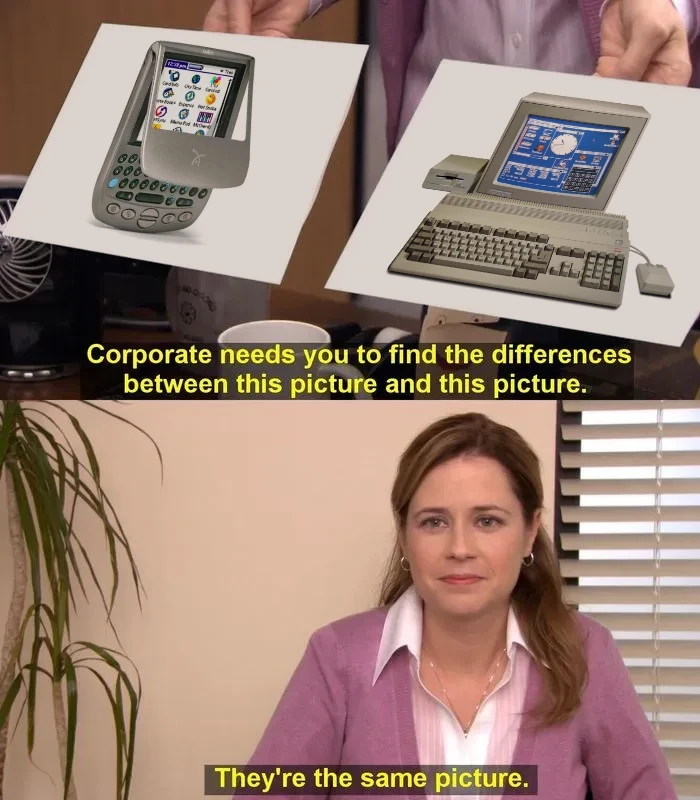
Are they really that similar? They don't look alike...
The Handspring Treo 90 is one of my favorite Personal Digital Assistants (PDAs) of all time.
It was released in 2002. It combines a physical keyboard, stylus input, and a color screen into a tiny, pocketable computer. Powered by a Motorola 68k–derived CPU it has ample RAM for the time. It was designed not just for organizing life, but for writing, drawing, and tinkering on the go. Handspring had a line of early smartphones called Treo and this was the only device without a cell modem. This made it more self-sufficient and smaller. It also allowed Handspring to give it an SD card slot.
The Commodore Amiga 500 is one of my favorite homecomputers of all time.
It was released in 1987 and built around the Motorola 68000. The Amiga was famous for its advanced graphics, stereo sound, and multitasking operating system. It became a creative playground for games, music, graphics, and demos. To this day it defines what a personal computer could be for an entire generation. During demoparties, its fans yell "Amigaaaaa" in support and out of sheer delight!
At one point I jokingly started to see the similarities between these two devices that looked so different on the surface. When I started to realize there was no need to joke. Let's look at what makes them so similar.
A Motorola Heart and Similar Capabilities
At the core of the Treo 90 sits a Motorola DragonBall VZ, specifically the MC68VZ328, clocked at 33 MHz.
This series of processors is derived from the Motorola 68000 family. For Amiga users, that alone rings a bell. The 68k wasn't just a processor. For a generation of young computer fans it was the first 16-bit CPU. And more... it was a mindset: a clean design for approachable machines.
Particularly in demoscene, many developers had the feeling that they could fully understand what the computer was doing. To this day are even demoparties devoted to machines with a Motorola 68k CPU: 68K Inside.
Palm OS is simple, but fast and coherent. Like the Amiga, the Treo 90 feels like hardware and software were designed together, not awkwardly bolted onto each other like in the PC-compatibles back in the day.
With 16 MB of RAM, the Treo 90 lives in the same psychological space as classic Amigas did in their day: not infinite, not wasteful, but enough to do things. The point isn't raw capacity; it's that the device invites you to make things rather than merely consume them.

The Treo 90 and the modern recreation A500 Mini. Despite their
different eras and form factors, they share a similar design
philosophy.
Pixels and Color Matter
A 4096-color display sounds quaint today, but it strikes a balance between price and performance. Back in its day, the Amiga made rich color graphics feel normal at a time when many systems were still living in text modes and simple palettes. The Treo 90 does something similar within the handheld world: it offers "enough color" to make drawing feel expressive.
Apps like TealPaint turn the Treo into a genuine pocket art tool. Drawing with a stylus on a resistive touchscreen can feel oddly close to Deluxe Paint with a mouse: fun and immediate.
Serious Text on a Seriously Small Screen
The Treo 90's lovely and clicky little keyboard isn't an afterthought. It is central to the experience. Word processors like WordSmith or CardTXT make it a real writing machine: focused, quick, and pleasantly distraction-free. No notifications, no feeds, just you and the text.
Other devices running Palm OS often skimped on input, relying solely on a form of handwriting recognition called Graffiti. The Treo 90 embraces typing as a core interaction method. This elevates it from a mere PDA to a genuine pocket computer.
From Floppies to SD Cards
Where the Amiga 500 relies on 3.5" floppy disks (and later hard drives) the Treo 90 leans on an SD card slot. Functionally it serves the same role: removable storage that belongs to you. Files can be copied, archived, swapped between machines. It's the pocket-sized equivalent of a disk box on the desk.
Familiar Worlds in Miniature
The resemblance doesn't stop at philosophy or tools: it also extends to games. Several titles that defined the Amiga experience also exist in Palm OS versions and run comfortably on the Treo 90. There are versions of Elite, Lemmings, and SimCity. These are quite faithful adaptations of games that once showcased what the Amiga could do, now reimagined for a device that fits in a pocket.

Elite running on both the Treo 90 and the Amiga.
And then there is Frobnitz, a Z-Machine interpreter for Palm OS. It allows the Treo 90 to run classic Infocom interactive adventures like Zork, Planetfall, The Hitchhiker's Guide to the Galaxy, and many more. With its physical keyboard the Treo becomes an almost ideal platform for text adventures on the go.
The Amiga was never just about graphics or sound; it was about breadth: arcade action, deep simulations, experimental software, and text adventures living side by side. The Treo 90 echoes that tradition in miniature.
Where the Illusion Breaks: Sound and Screen Resolution
There are two area where the Amiga comparison falls apart.
The first is sound. The Treo 90's audio is extremely basic, relying on a simple piezo speaker capable of little more than beeps and rudimentary effects. Next to the Amiga's famous 4-channel stereo sample playback, this feels almost comically inadequate.
The contrast is quite stark. The Amiga was a multimedia powerhouse built to sing. The Treo 90 is a quieter machine— one that favors text, drawing, and thought over spectacle. The spirit survives, even if the music does not.
The second is screen resolution. The Treo 90's 160x160 pixel display is tiny compared to the Amiga 500's standard 320x256 (or higher) modes. This limits how much detail can be shown at once.
To be fair, at such a small size the Treo's screen is surprisingly sharp and usable. But it does mean that complex graphics or large workspaces are out of reach. The Amiga's expansive display really can't be matched here.
And finally, of course the Treo 90 does not have any custom chips like the Amiga's Agnus, Denise, and Paula. So no blitter, copper, or hardware sprites. Despite this the system still manages to evoke that same sense of a capable machine. Games like the shoot-em-up Astraware Zap , the puzzler Bejeweled and the driving action game Spy Hunter showcase impressive graphics and gameplay for the platform. They would have felt right at home on an Amiga.
Not an Amiga, But Family
The Handspring Treo 90 is not an Amiga in any technical or compatibility sense. But it carries a related DNA where it matters: a 68k lineage, creative software, capable color, real input, removable storage, and a user-centric philosophy. It's a pocket computer that still feels like a computer.
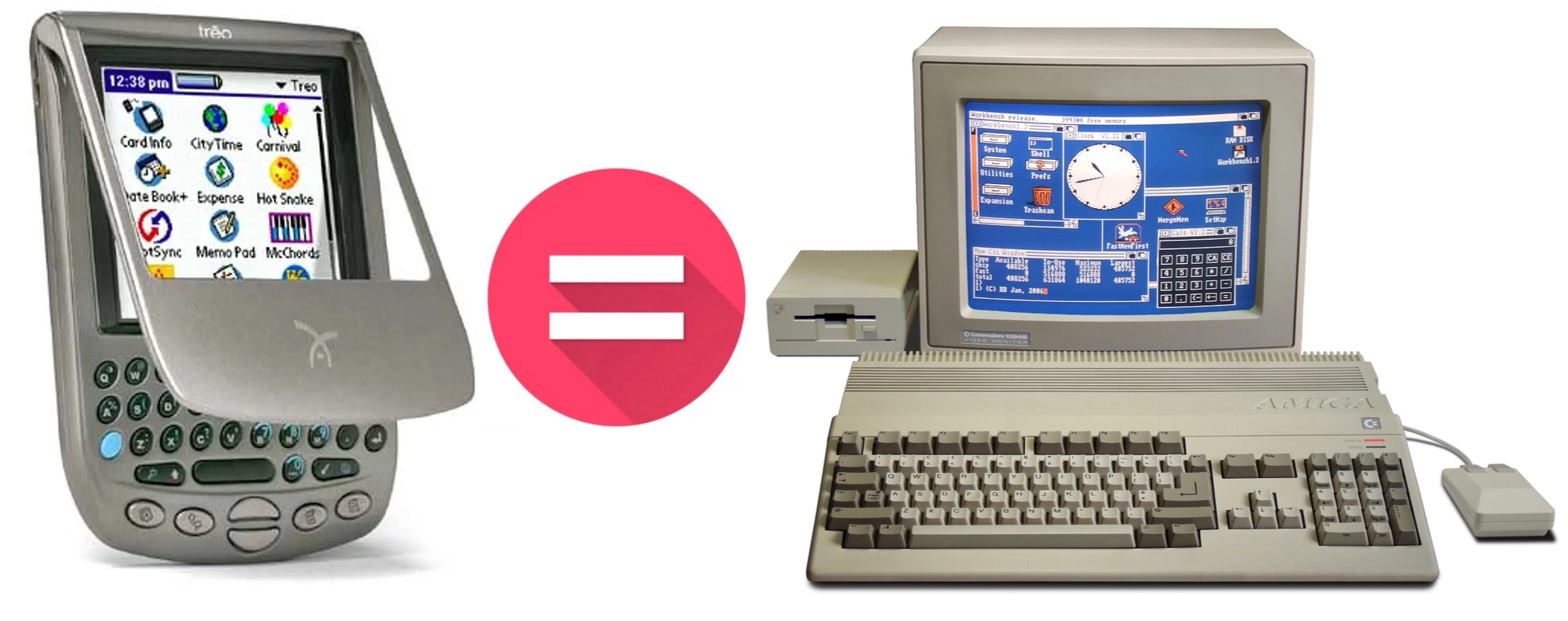
Let's see how similar they are.
Amiga 500 vs. Handspring Treo 90
Different eras, same spirit. Not compatible, certainly not identical... but philosophically related.
| Aspect | Amiga 500 | Treo 90 |
|---|---|---|
| CPU lineage | Motorola 68000 | Motorola 68k-derived Dragonball VZ |
| RAM | 512 KB - 1 MB (expandable to 2 MB chip RAM and 8 MB fast RAM) | 16 MB |
| Colors | Up to 4096 | 4096 |
| Creative tools | Deluxe Paint, ProTracker, Final Writer | TealPaint, WordSmith, CardTXT |
| Input | Keyboard + mouse | Keyboard + stylus |
| Storage | Floppies / HDD | SD card |
| Sound | 4-channel stereo samples | Piezo speaker (basic) |
| Role | Creative home computer | Creative pocket computer |