Angels in a Makeshift Utopia
The Chaos Communication Congress 39C3 in Hamburg
For four days every year, the Chaos Communication Congress creates a parallel universe consisting of hacker meet-ups, art exhibitions, political salons, and technologists' playgrounds. In 2025, it manifested once again in Hamburg as the 39th Congress. I was lucky enough to attend for the very first time! This is my travelogue of the punk rock technology utopia.
January 2026
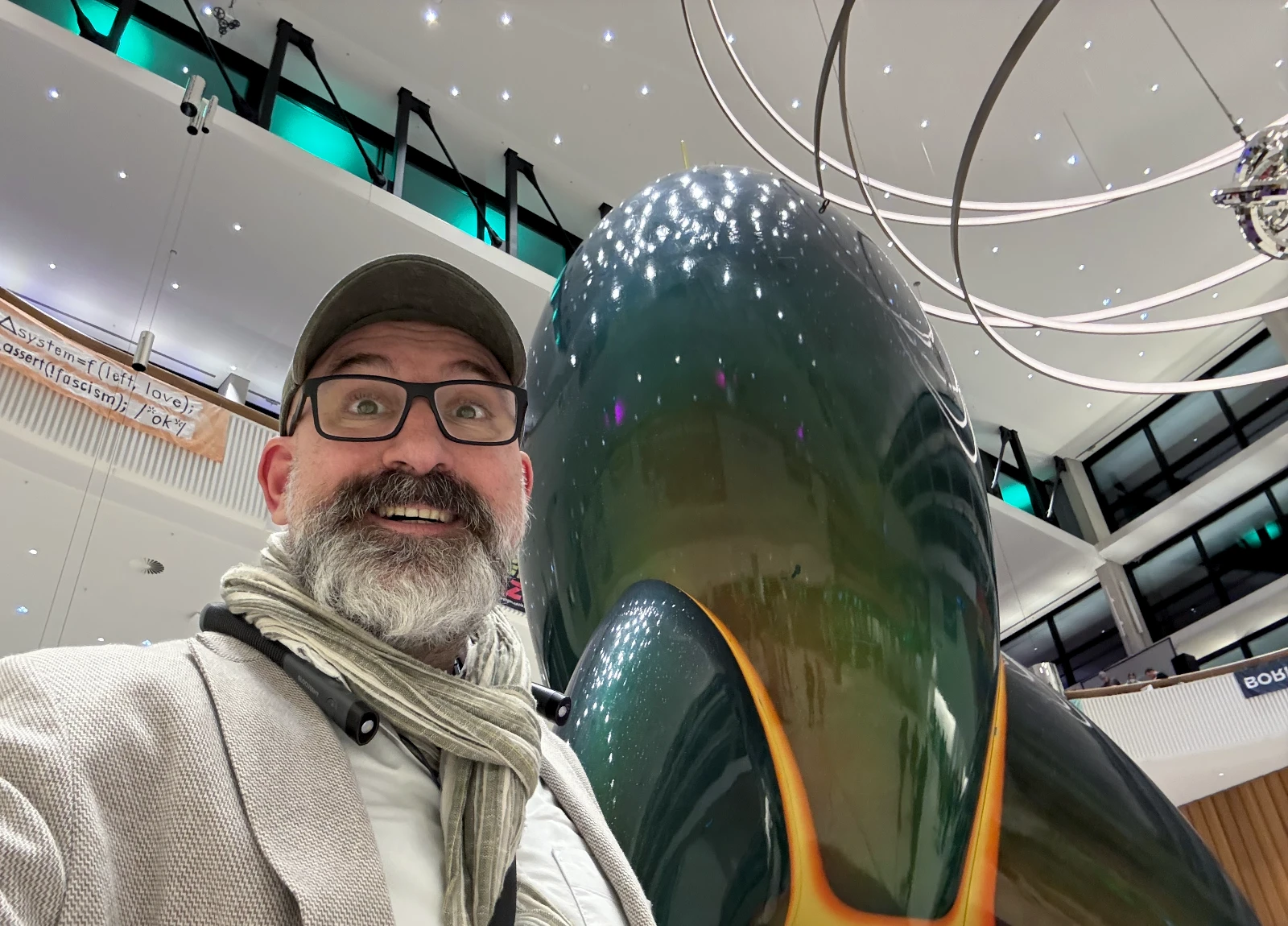
The plexiglass rocket called "Fairy Dust" stood high in the
entry hall of the Congress Center Hamburg.
Let me tell you about my adventures at my very first Congress... but before we get there, I should explain what the Chaos Computer Club is, and what the Chaos Communication Congress actually represents.
If you want to skip ahead to the cool bits, you can jump straight to the slide show with photo impressions.
The Chaos Computer Club (CCC) is Europe's largest and most influential hacker organization. It was founded in Hamburg, Germany, in 1981. This non-profit society combines deep technical expertise with a strong ethical and political stance. They focus particularly on privacy, freedom of information, and the social impact of technology.
For the CCC the word "hacking" does not mean anything illegal or destructive, but rather a creative exploration and critical inquiry. The CCC aspires to learning how systems work in order to question and improve them.
Over the decades, the club has become a strong public voice in debates about digital rights, surveillance, and technology policy. Despite this gravitas, I think it remains rooted in its playful and curious hacker culture.
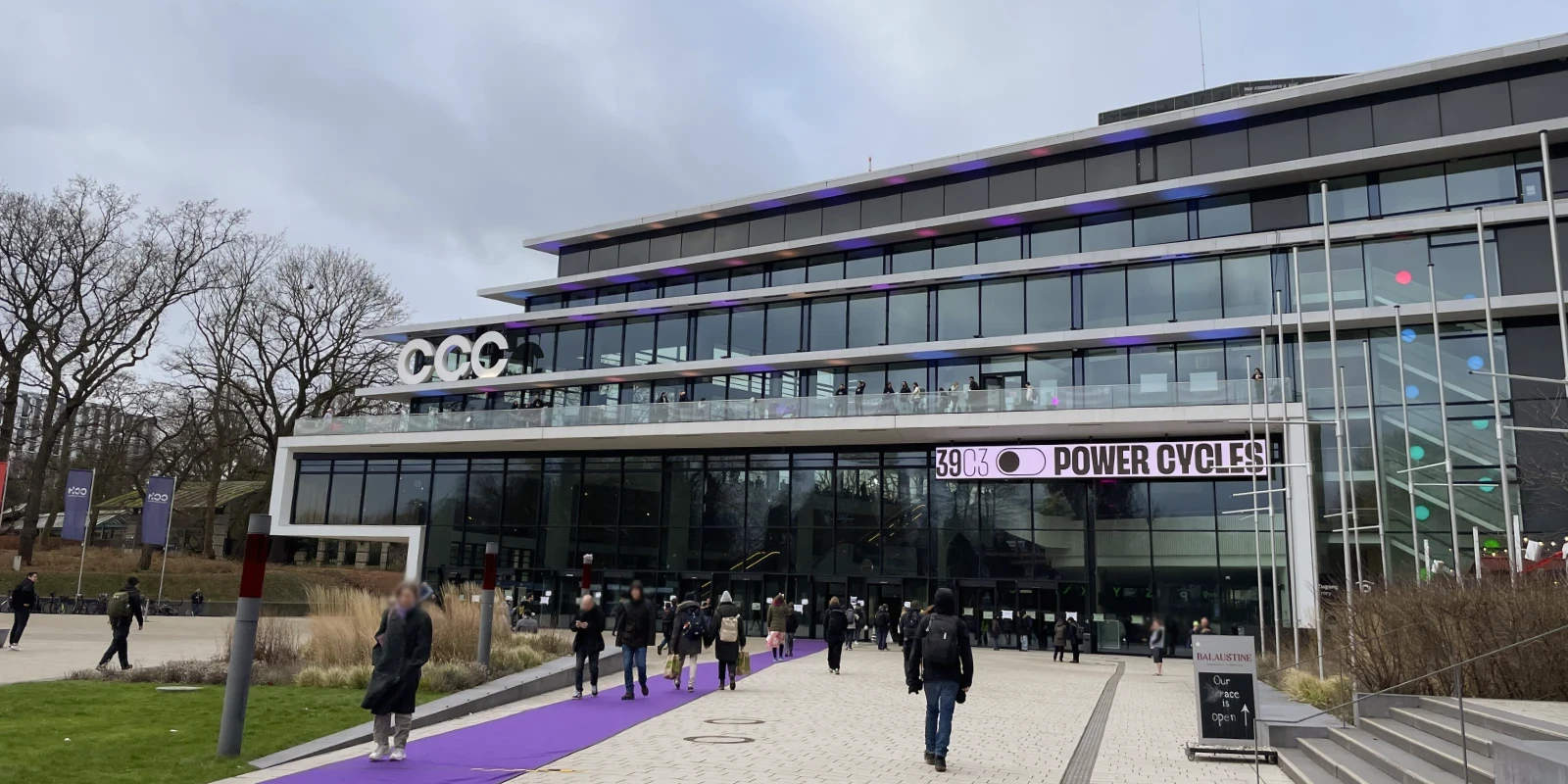
The 39th Chaos Communication Congress (39C3) was
held at the Congress Center Hamburg (CCH).
The CCC and its local chapters organize many events throughout the year. But the flagship event every year is the Chaos Communication Congress (C3) between Christmas and New Year. Together with Def Con in Las Vegas, it is one of the world's most prominent gatherings for hackers, artist technologists, and activists.
C3 spans several days of talks, workshops, assemblies, and informal encounters covering topics from computer security and cryptography to politics, art, science, and society. This year's Congress, 39C3, featured more than 160 talks. Since most of them are recorded and made available online, I knew I could watch them later at my own pace. My main intention for attending was not just to absorb talks, but to connect with people, explore their work firsthand, and to contribute as a volunteer.
Beyond its elaborate lecture program, the Congress is defined by its self-organized nature. Attendees build their own spaces and run their own infrastructure. An army of volunteers serve as "Engel" (angels), helping with logistics, security, and more. This makes the Congress a collaborative utopian effort with an atmosphere of sharing, experimentation, and mutual respect.
I'd even go so far to say that it is more than a mere conference but like a temporary city built with curiosity and responsibility. At its very core lies the conviction that technology should serve people rather than control them.
While I had been to many demoparties that are only tangentially related to the CCC. I had only ever once attended a Chaos event before: the 23rd edition of the Goulash Programming Nights (GPN) in 2025 held in Karlsruhe at the Center for Art and Media (Zentrum für Kunst und Medien, ZKM).
I had never attended the Congress itself. At the end of 2025, I was hoping to change that.
The logo of this year's Chaos Communication Congress,
39C3.
Adventurous Ticket Finding
Getting a ticket for the Chaos Communication Congress is notoriously difficult. Demand far exceeds supply. Tickets usually sell out within minutes. Attendance is deliberately limited to keep the event manageable, safe, and community-oriented. This means there is no realistic "buy later" option. Ticket vouchers are first made available to club members. Then on specific days, the sale of tickets is opened to the public. Thousands of people try to complete their ticket purchases at the same time. The allotment of tickets for the particular date is sold out very quickly. You need to rely on careful planning, fast reflexes, and a lot of luck. Others gain access through volunteering as an Engel or via assemblies with limited ticket allocations.
As a result, securing your attendance often becomes something of an achievement in its own right.
I had wanted to go to the Congress for several years already, especially after we had returned to approximate normality and to physical editions after the pandemic. The Congress was no longer reduced to online video streams and conversations through messaging apps.
In January 2025, during a Code Retreat in Linz, Austria, I met a few kind and welcoming members of a local CCC hackspace. They mentioned that they might be able to help with tickets for C3. I joined their Signal group. Still, I never quite felt comfortable there, feeling like an outsider who hadn't fully earned their place.
A Connection at GPN
Over Easter at the demoparty Revision in Saarbrücken I made the acquaintance of Qetu, an analog computing and synthesizer enthusiast. We immediately hit it off. We met again at the Goulash Programming Nights in Karlsruhe and again at the Evoke demoparty in Cologne in August. Those were all very fortunate coincidences. At some point Qetu casually mentioned that he might be able to help me get a ticket for C3.
My heart filled with hope. This was exciting!
The Ticket Arrives
When the CCC started to ramp up their Congress announcements in September and October, voucher codes began circulating. The possibility suddenly felt realistic. Fortunately, Qetu came through in the end.
He provided me with a voucher code, invited me to join the retro hacking assembly NeuSchwabenland Antifa, and helped me secure a ticket for the 39th Congress (shortened as 39C3). I am keenly aware of how fortunate I was, and deeply grateful that my wish finally became reality!
Over the next few weeks, I followed the Congress announcements, registered as an Engel volunteer, and prepared my gear for the trip. I even purchased a DECT phone. The Congress runs its own DECT infrastructure, allowing volunteers, organizers, and assemblies to communicate without relying on commercial mobile networks.
I even registered as an Engel volunteer and on the page where mentors and Congress-newbie mentees could connect. CyberPunkJake of the Ministry of Chaos (part of the Milliways assembly), a friendly Brit reached out and became my mentor for the Congress (he's also known as _Jake, I think the undescore is silent).
The year's holiday season approached, 39C3 was scheduled for 27th to 30th December. My first Congress was about to start! But first, I had to get to Hamburg...
Day Zero: Arrivals in the Mist
My journey began in Sofia on December 26th. I was unusually well-rested. My luggage situation was ambitious. Alongside a suitcase and backpack, I carried a small satchel with my iPad Pro and, most importantly, in my hand I carried a box containing The VIC-20 and a portable LCD monitor.

This looks like me with my iPad satchel.
(Scene from
Hangover.)
I started my trip with a minor hurdle when the taxi driver refused card payment, forcing me to sprint into the airport for cash. I boarded my plane to Frankfurt, listened to a long retrospective of Ultima IV on Youtube, and managed to sleep during most of the flight. The connection to Hamburg was uneventful. Even my luggage made it through without issues (though only on the way to the congress).
Hamburg welcomed me with cold darkness and wet fog. After taking the S-Bahn into town, I stepped off at a deserted station and felt the loneliness that often accompanies arrivals in unfamiliar places. Messages from Qetu suggested that securing a table in the retro hacking area might be difficult. I needed to hurry.
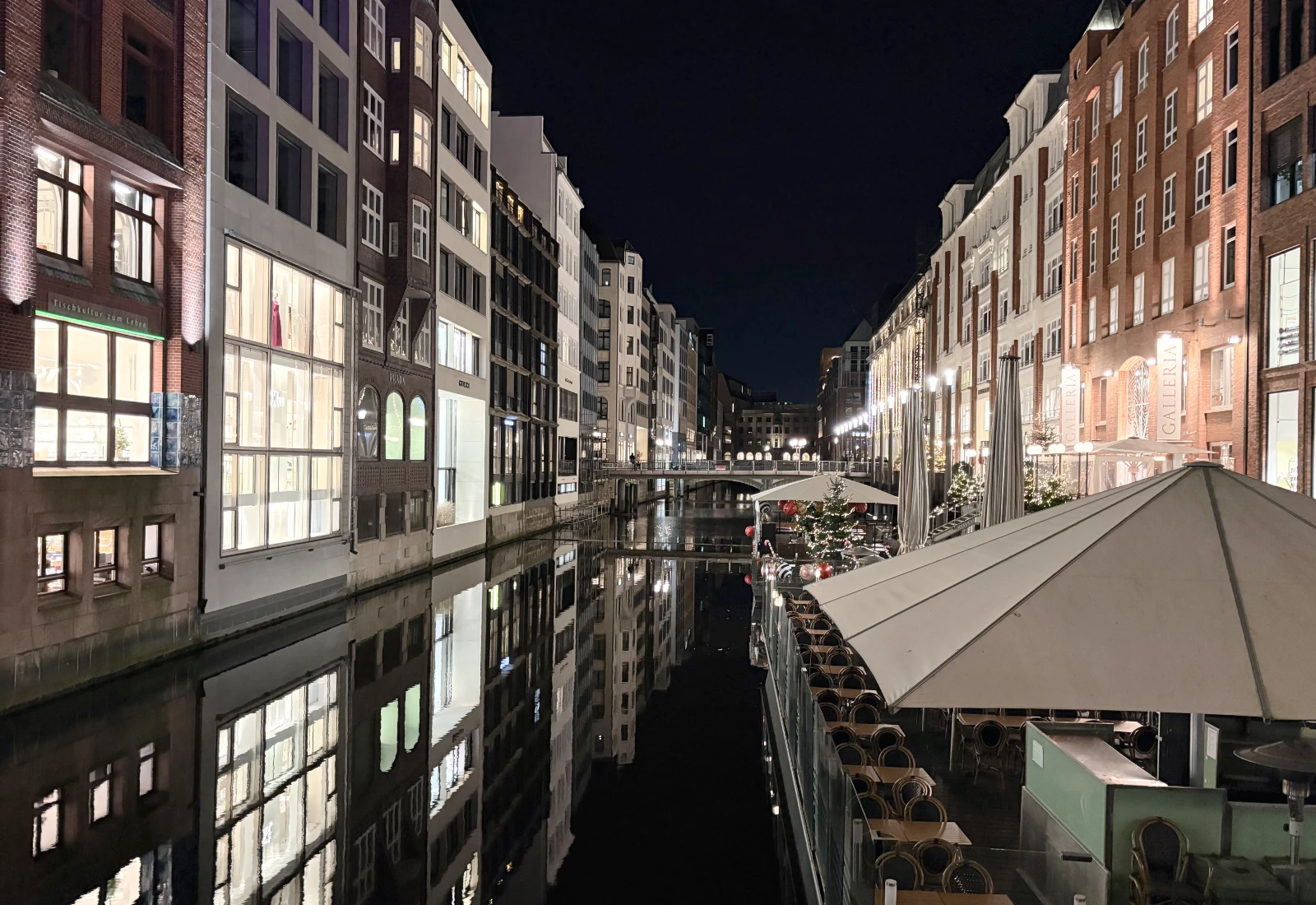
The Hamburg canals illuminated at night.
I had booked a very reasonable AirBnB not far from the Congress Center. When I arrived, it turned out to be a basement apartment. It was underground. I guess that's why it is so cheap. But it was warm and cozy. I had two bunk beds with a total of four sleeping places to myself, a small kitchen, and a bathroom. After unpacking, I set about preparing for the evening's adventure.
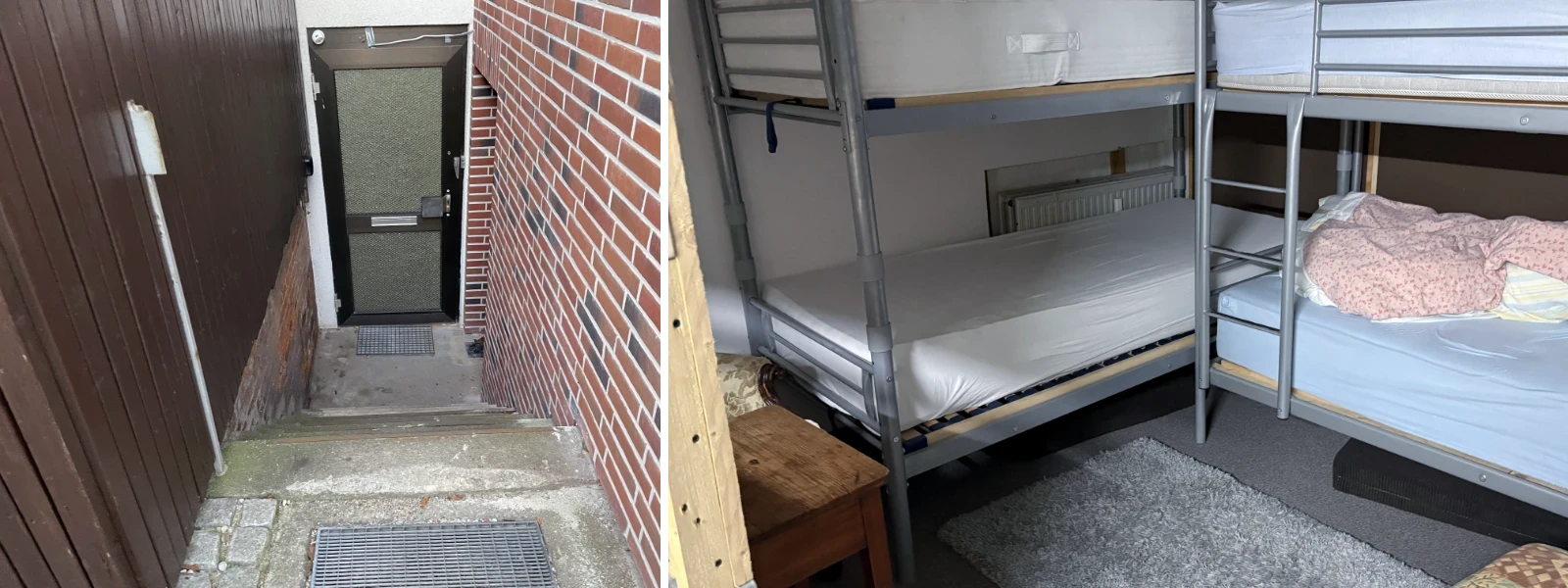
The AirBnB basement apartment. This is my contribution to the
'underground' aspect of this event.
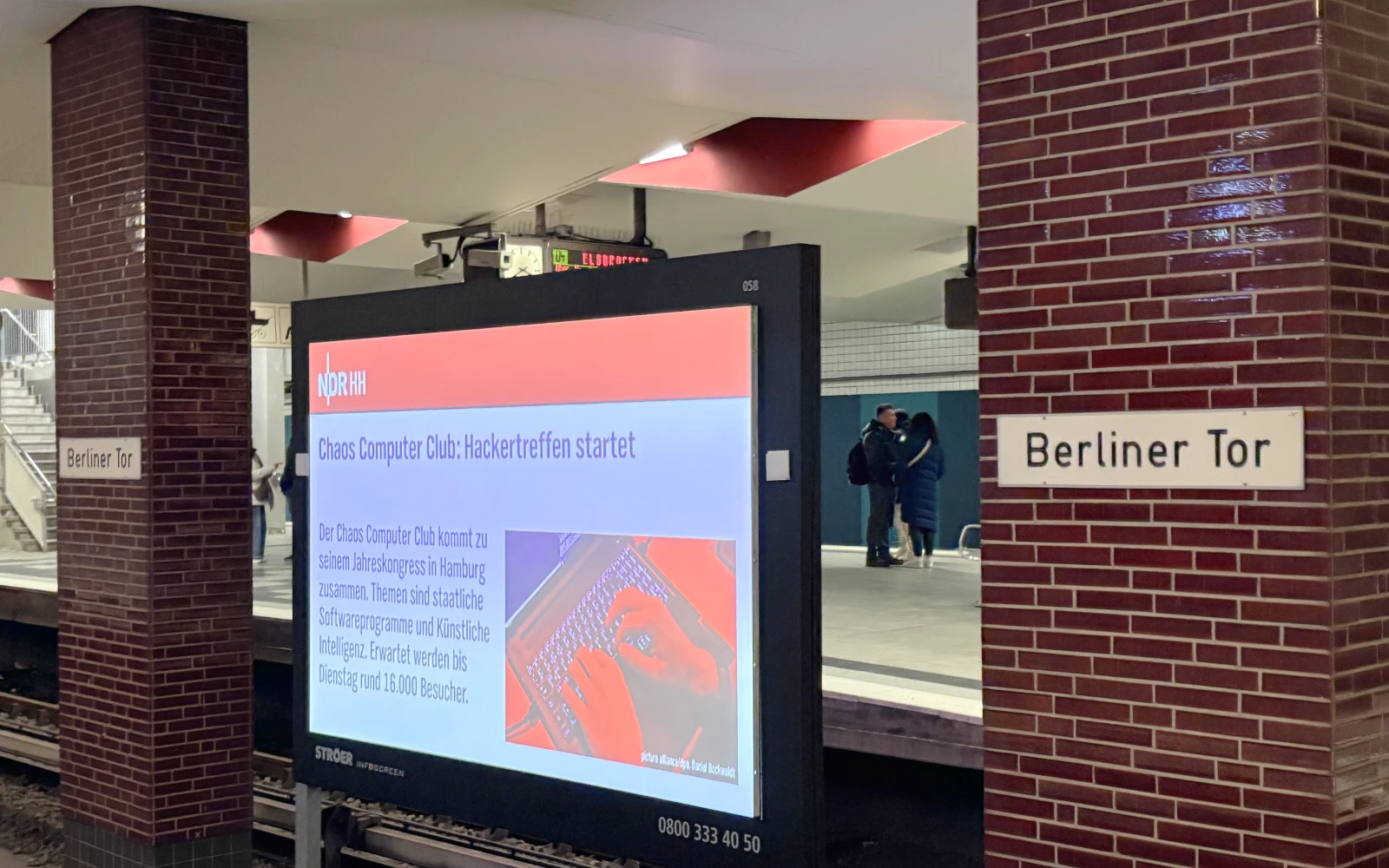
When I took the U-Bahn to get to the Congress, I was reminded
of 39C3.
Power Cycles
I took the U-Bahn, crossed a park on foot, and finally caught sight of the glowing CCC letters on the side of the Congress Center Hamburg. They hovered in the fog like a hacker's bat-signal. Not even the dangerously slippery ice on the path could keep me from feeling awe as I hurried into the building.

The entry hall of 39C3 in the Congress Center Hamburg.
The motto of this year's Congress is "Power Cycles." This not only refers to turning your devices on and off but also to the cyclical nature of power in various contexts. Over the next few days around 16,000 people would be gathering in the Congress Center.
And I was proud to be one of them.
I got in line to register. The process was fast and well organized. In the entrance hall, the iconic plexiglass rocket "Fairy Dust" towered approximately seven meters high. It is made of shiny green fiberglass. For the CCC, the rocket is a symbol representing the "final frontier" theme of hacking.
After I was about done waiting in line, Qetu found me, helped me get an attendee's armband and guided me to our table in the retro hacking area. He had secured a spot for us. I set up TheVIC20 with my LCD monitor in an elegant configuration requiring only a single power supply.
We shared the table with Svolli, whose setup of PC and Commodore 64 behind two large screens dominated the area. At this year's Revision, I had attended one of Svolli's talks about the Sorbus 8-bit computer he had built from scratch , and I was excited to meet him in person again.
Even though Qetu had found and reserved the space for most of us, he had a bit of a bad conscience that he couldn't accommodate all members of the group. So he relinquished his own desk space for others to use. Instead, he used his connections with the folks from the legendary C-Base and set up his gear in their area. His analog computer, synth and amplifier set-up certainly needed the space!
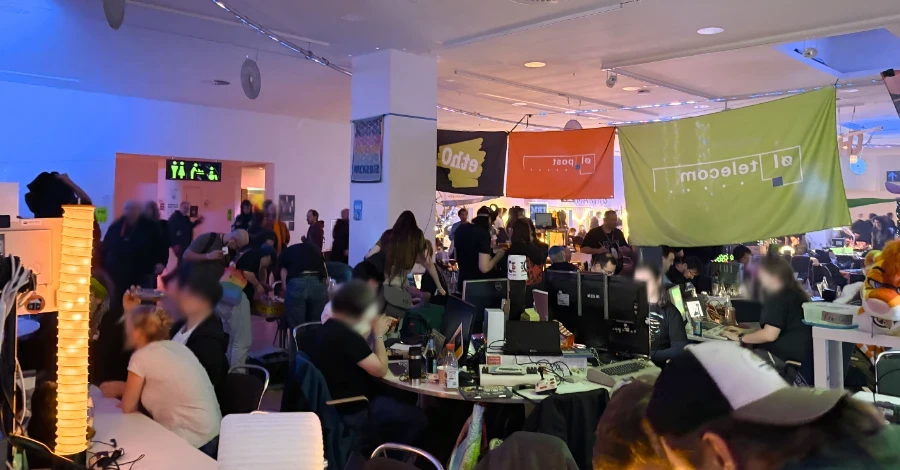
The retro hacking area.
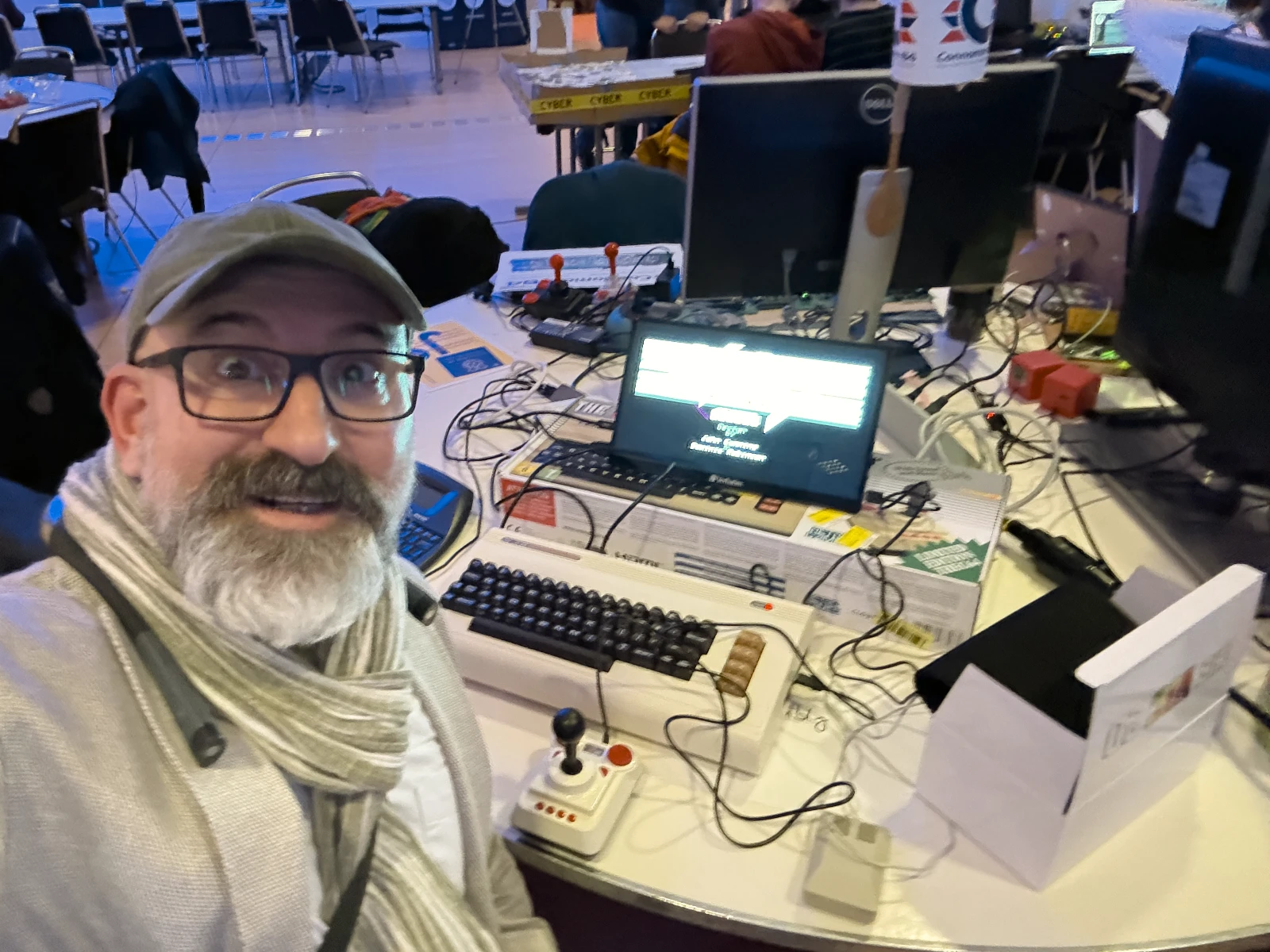
Proud to have set up my VIC-20.
Since I wanted to chronicle the event, I started typing notes on my Alphasmart Neo2. This is my trusty writing companion, a "smart keyboard" with a monochrome LCD screen and a battery life measured in months. It immediately attracted curious looks and questions. Yes, I had brought it along with me. And yes, it was an anachronism even at the Congress.
My role model for this is Richard Karsmakers, one of the members of the demogroup The Exceptions and one of the editors-in-chief of the remarkable ST-News diskmag in the 1980s and 90s. Back in the day, he'd use his trusty Cambridge Z88 as a portable writerdeck at demoparties, reporting on his experience and letting others write their thoughts about events as they unfold. It is my honor to continue this tradition.

My beloved Alphasmart Neo2.
Eventually, exhaustion started to catch up with me. After all, I had been travelling most of the day. Bidding everyone a good night, I left. The actual Congress was kicking off the next day, I wanted to be rested.
After passing through Dammtor station and purchasing an unreasonably hard sandwich and overpriced flavored water, I made my way back to the AirBnB. The apartment had cooled considerably and the refrigerator hummed ominously.
Too tired to think, I fell asleep under two blankets.

Some people actually slept in the congress building on chairs
or on mats they had brought themselves. I opted to sleep in an
AirBnB.
Day One: Stories, Systems, and Serendipity
I woke at 8:45 to a Signal message from CyberPunkJake, my mentor, about a meetup scheduled for 9:30. Under ideal circumstances, I'm sure I could have made it on time, but instead I took the wrong subway line and ended up in Überseequartier. It was a fitting beginning for a Chaos event. I succeeded in the productive embrace of failure.
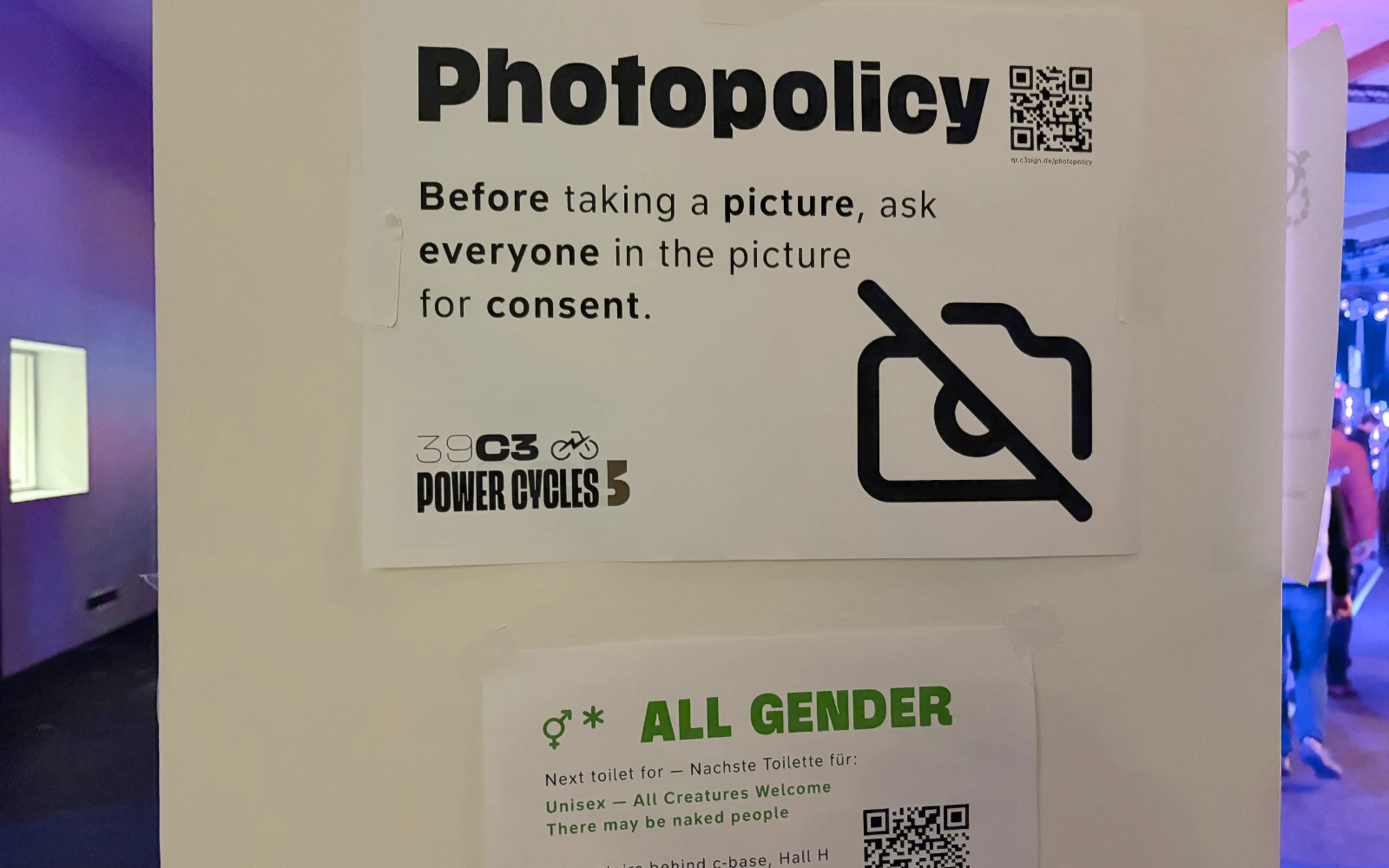
The photo policy notice at the Congress.
Opening Ceremony
By 9:50, I arrived at the Congress Center and loaded up Psychedelia by Jeff Minter on TheVIC20.
Upon meeting him, CyberPunkJake turned out to be a genuinely kind person who gave me invaluable guidance on navigating the Congress, volunteering as an Engel, and registering my DECT phone for use inside the building. We had to hurry because the opening ceremony was about to start.
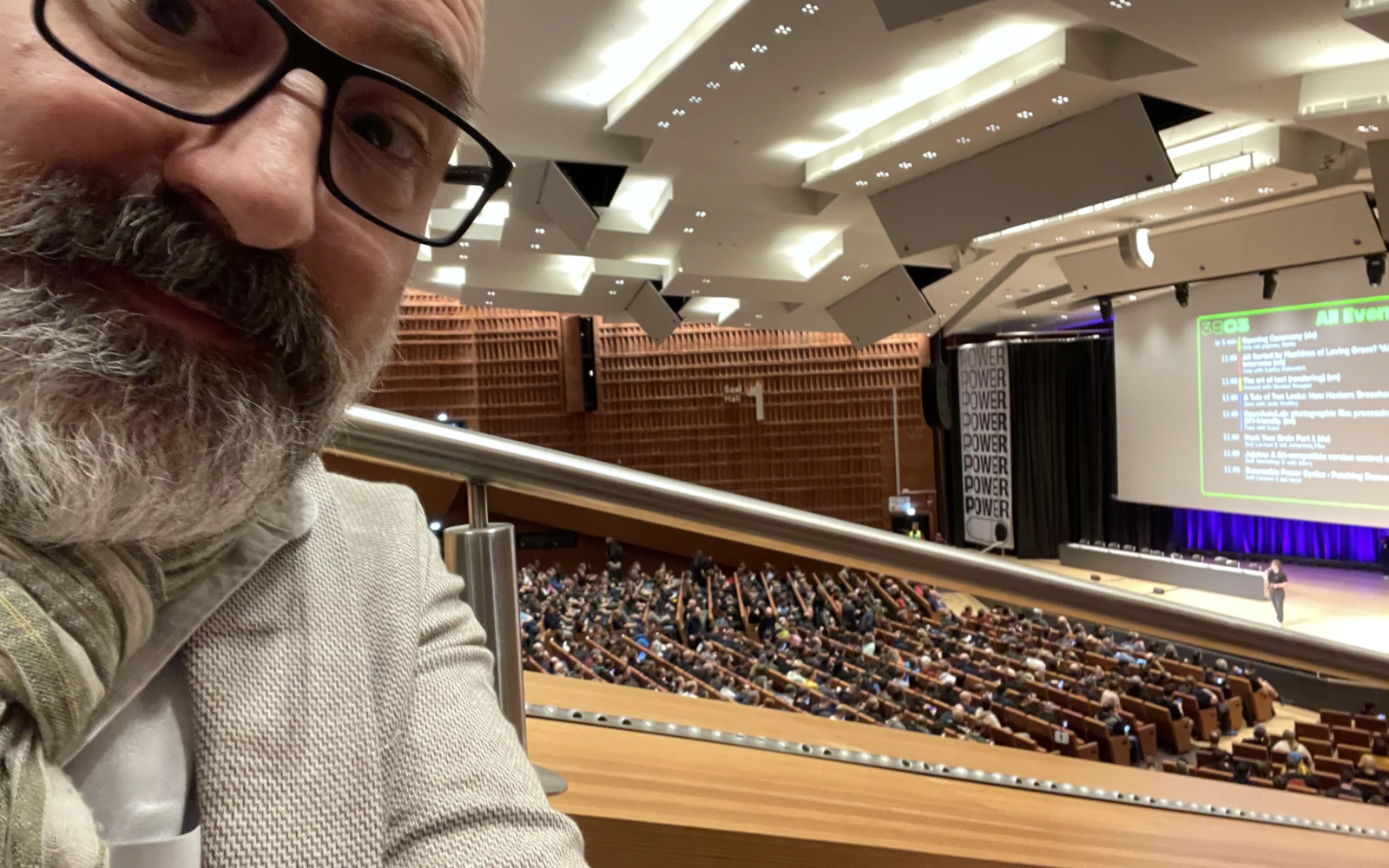
Me, literally, the moment, I learned that I shouldn't take a
photo like this.
The intro began with a reminder not to take photos if people were in the frame without their consent. That warning was delivered at the exact moment I was taking a selfie in the presentation hall full of people behind me. Well... at least I'll remember it! To be fair, the audience was far away in the background, so no harm done because you can't really recognize anyone's face.
I decided then and there to respect the photo policy and avoid taking pictures of people without their permission. If there are people in a wide shot, then I'll make sure to blur their faces out later.
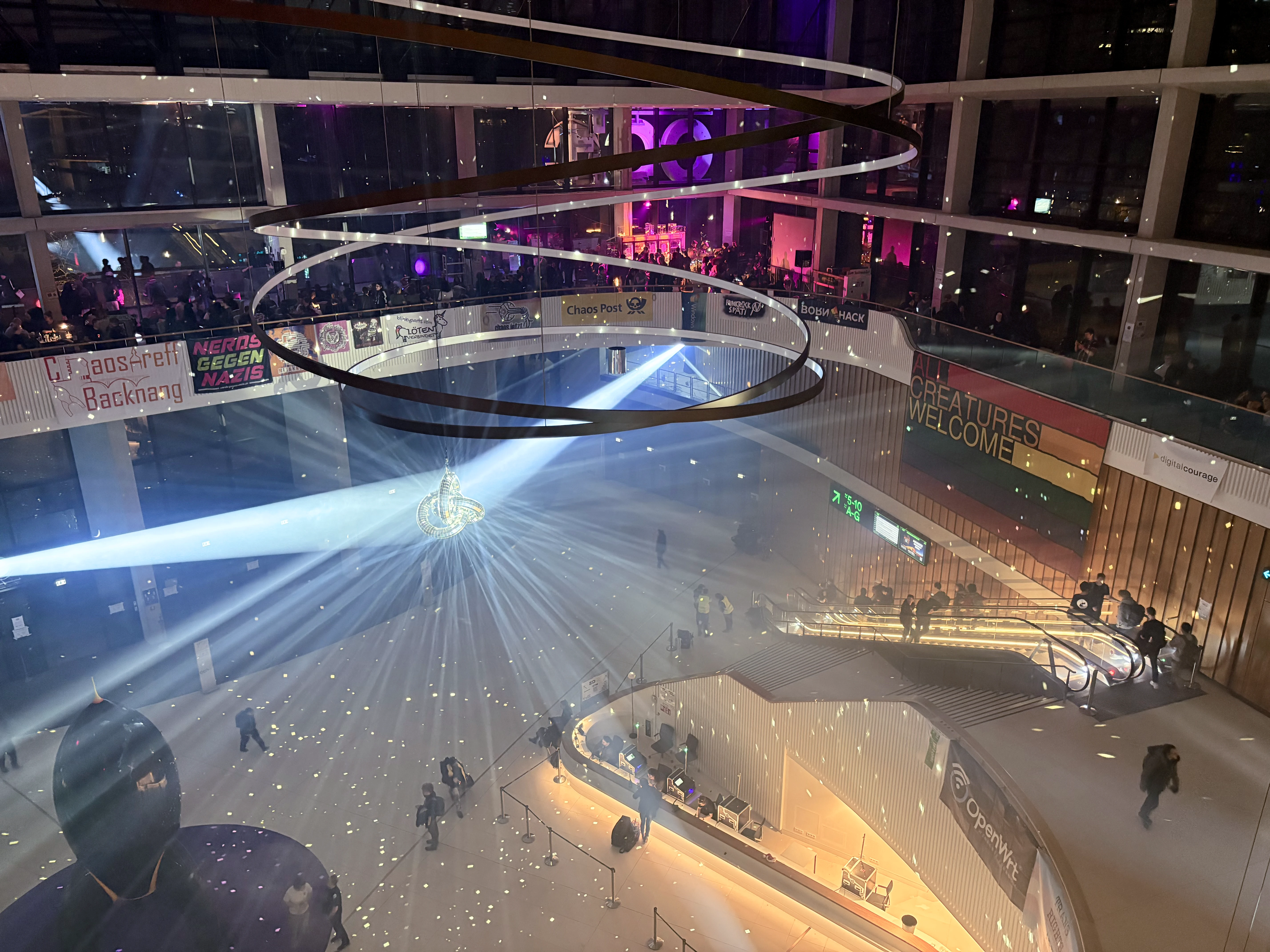
The CCH entry hall alive with activity.
The actual opening ceremony by pajowu and Stella was high-energy and used charmingly analog cut-out paper drawings (see image below). They were projected live using a document camera and switched out manually by the presenters. This gave the talk a DIY aesthetic that fit perfectly with the Congress spirit.

The delightful cut-outs used during the opening were manually
readjusted and "animated" instead of using a PowerPoint slide
deck (yes... there are three hands in this picture... not sure
how they hacked that).
After wandering through the different halls, collecting stickers, and admiring an impressive array of hardware, I settled into a talk by Katika Kühnreich on fighting fascism. Her English was imperfect, and her slides had some typos, but I loved it because the ideas were really powerful! They landed with clarity and force. She framed fascism as a story. And it was one that could be rejected! She argued that dedicating even just two hours a week to working towards resisting fascism could make a difference.
She referenced Umberto Eco's essay Eternal Fascism: Fourteen Ways of Looking at a Blackshirt and Richard Brautigan's poem All Watched Over by Machines of Loving Grace. The messages of Kühnreich's talk will certainly linger in my thoughts for a while.

A small love note Qetu randomly found while we were exploring
the venue.
All the Talks Are Belong to media.ccc.de
The Congress featured an overwhelming number of talks, workshops, and presentations across many parallel tracks, far more than any single person could fully physically attend. In this article, I will only touch on a handful of sessions that stood out to me personally. Fortunately, documenting and sharing knowledge is a core value of the CCC, and most talks from 39C3 are recorded and gradually published online.
Please find the CCC's media platform here: media.ccc.de.
This allows anyone to revisit, discover, and explore the full breadth of what was shared.
Unexpected Connections
Back in the retro area, I met Thunder.Bird of the C64 Club Berlin who is one of the main folks to produce the Digital Talk diskmag. We set out in search of snacks, failed to find an open supermarket, and eventually ended up at McDonald's in Dammtor station. Over fries, a remarkable chain of connections revealed itself. Thunder.Bird organizes the Berlin C64 BCC demoparty and collaborates with Logiker from Vintage Computing Carinthia (VCC) who allowed me to join VCC and help with the ski jumper demo for Transmission64. Through Thunder.Bird I also found out that the man who held a really cool CCC talk on archiving diskmags I really liked last year was by Torsten Roeder... who turned out to be part of our team's Signal group.
Later that day, I had the privilege of meeting Torsten for a short chat. I also had a beer with Stefan Höltgen. He had written the excellent book "Resume: Hands-on Retrocomputing" about computer archeology (here's an excerpt, it's pretty good!). Both Stefan and Torsten are academics in the university field of media and computing history. They've held some brilliant talks about retro computing (I did however regrettably miss their self-organized talk this year. I'd like to kick myself for it! At least Torsten's talk on the Text Encoding Initiative was recorded).
Sometimes it is great to meet your heroes! (Though I was too starstruck to even mention that I had completed a Master's degree in MediaArtHistories and written my thesis about the early Atari ST demoscene. I felt that anything I'd say would be just silly compared to their awesome research.)
I am still dazzled by all the connections.
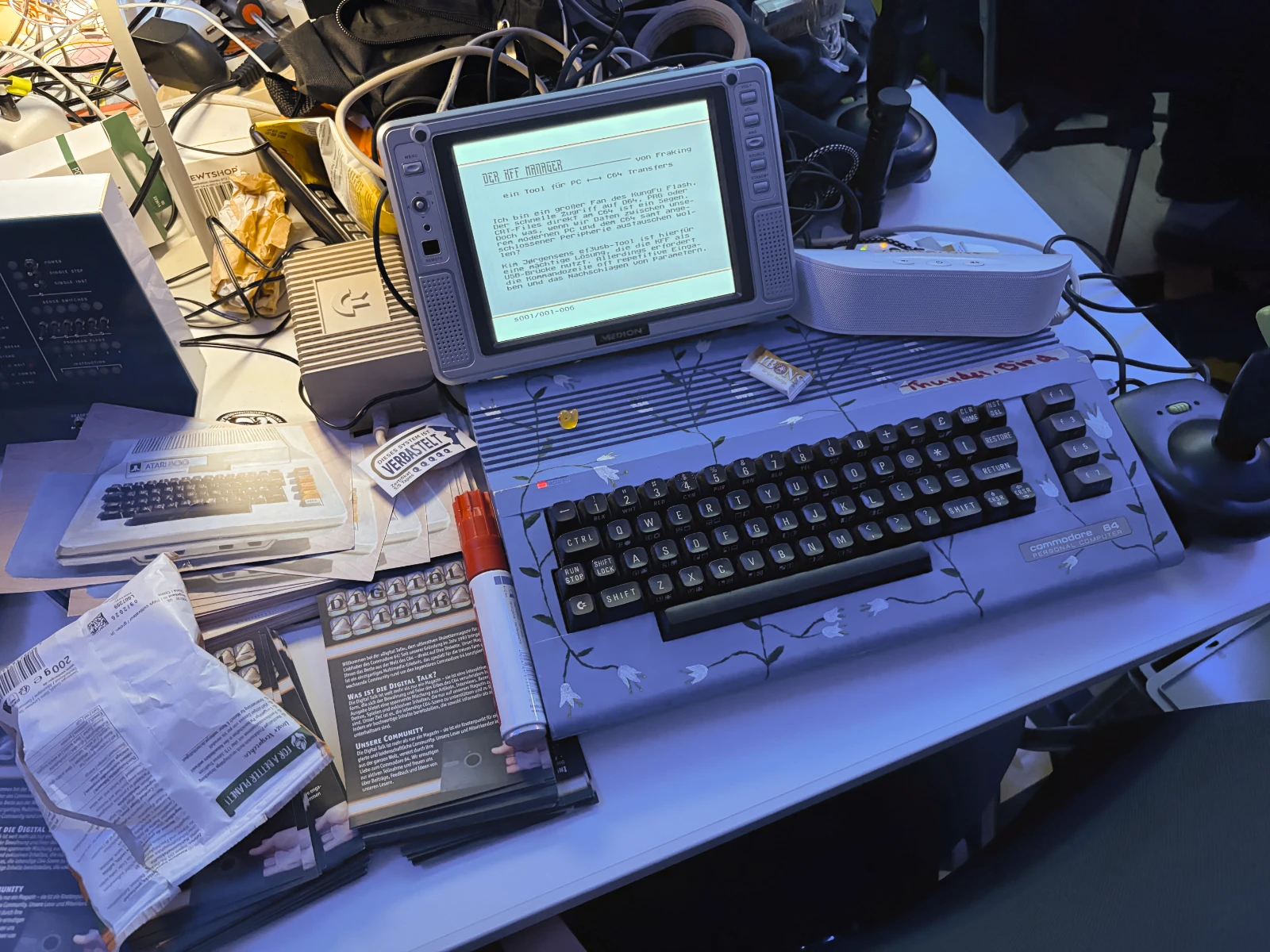
The Digital Talk C64 diskmag running on Thunder.Bird's
C64c.
As if that were not enough, Thunder.Bird reminded me that we had already once met at Revision earlier that year. He had told me about his diskmag back then, and I had mentioned my fondness for the diskmag ST-News. He had even written about our encounter in an issue of Digital Talk. Dangit! Everything is delightfully connected...
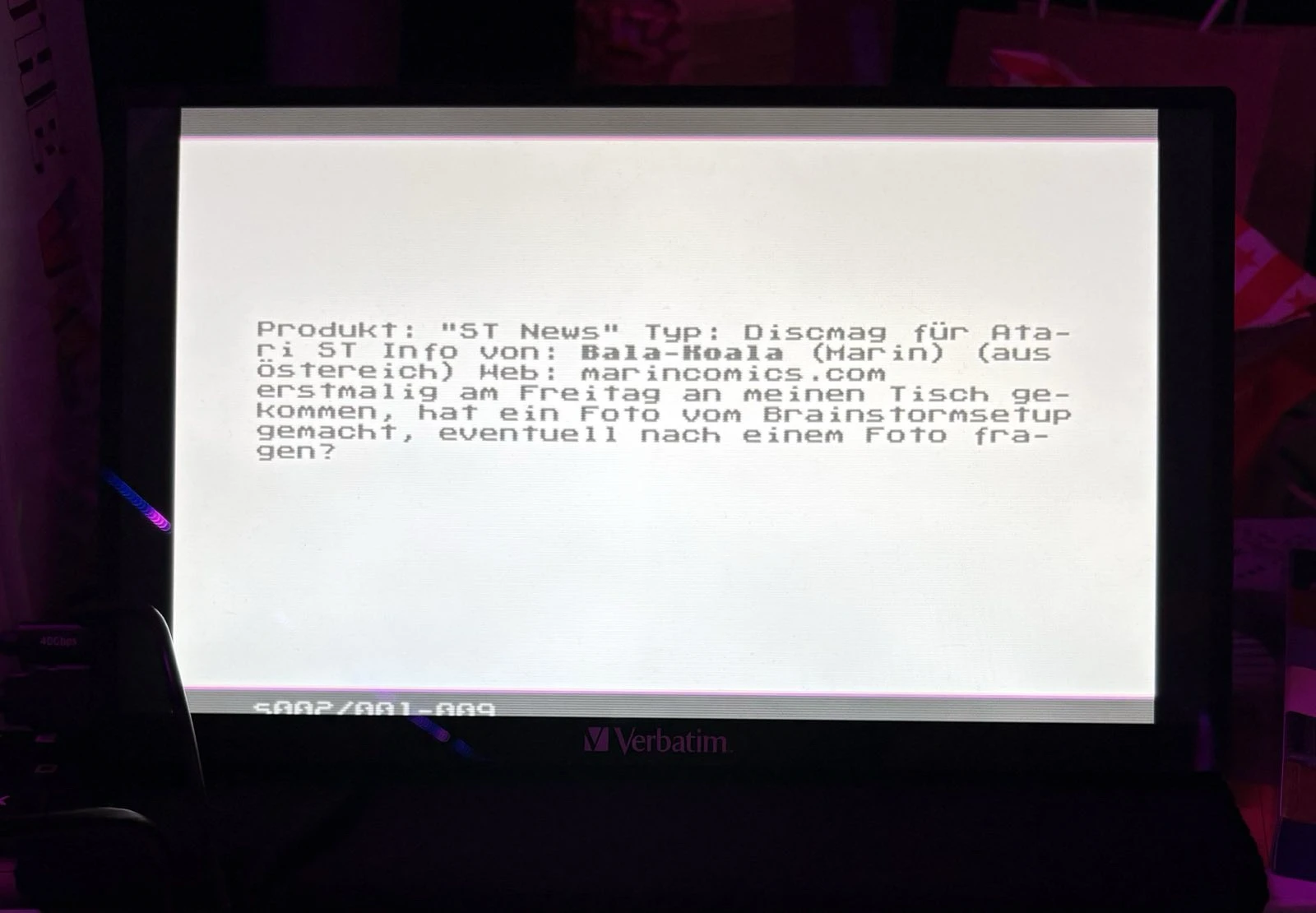
OMG! Thunder.Bird mentioned me in his diskmag! (To my shame I
must admit I had forgotten about our encounter, even though I
also mentioned him in
my Revision 2025 demoparty
report.)
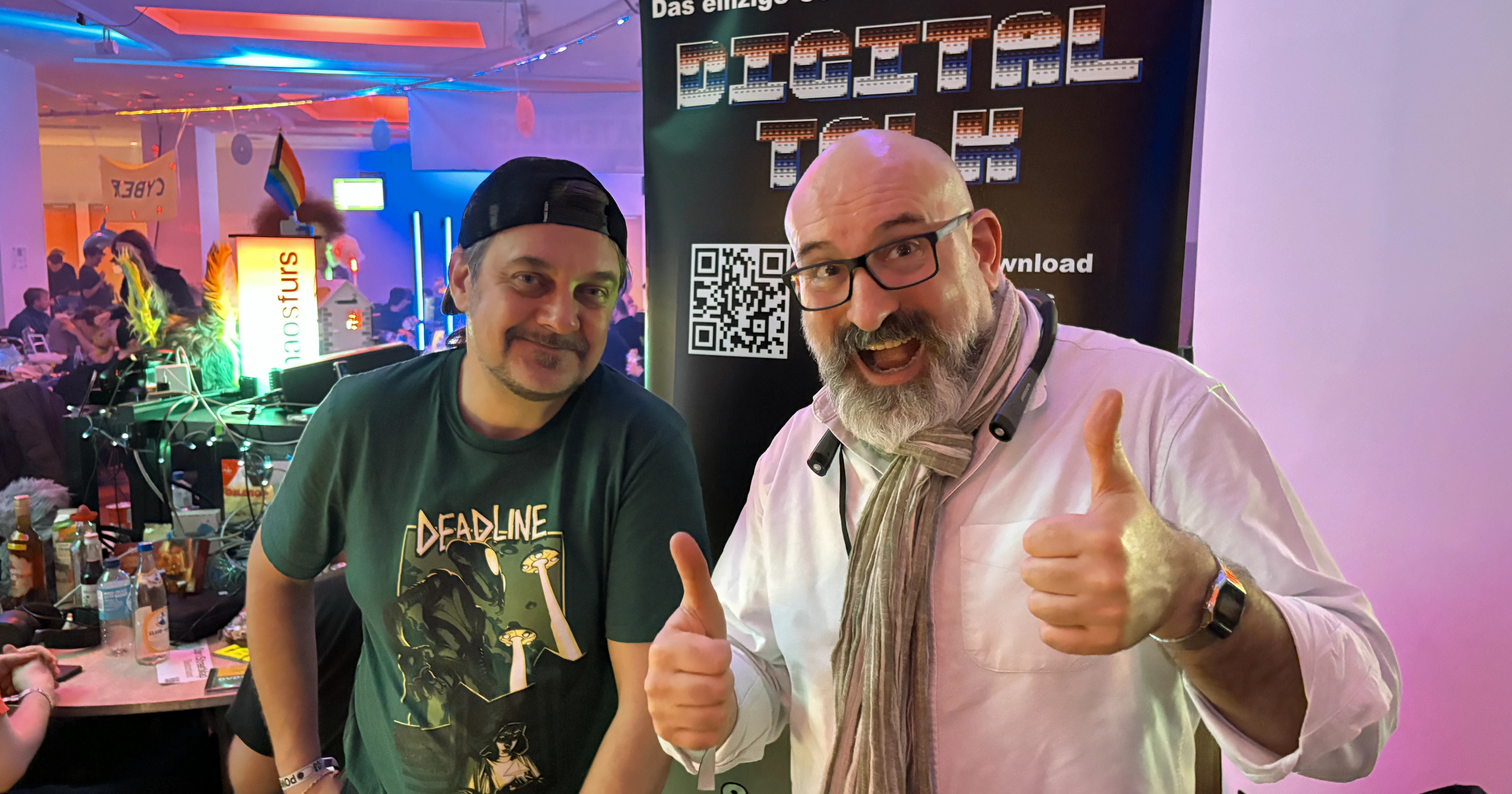
My awesome meeting with Thunder.Bird.
The remainder of the day unfolded in a blur of impressions. I tried to understand how volunteering as an Engel worked, sat through an unhelpful introductory talk, attended a much better general Engel briefing, and finally signed up for an access control shift on Sunday, the next day. It took me a while to figure out what's what, who's who and (most importantly) what's who! I was back to being a rookie
At some point, I realized I was becoming both an attendee and a contributor (in however small a way). I loved it!
The evening brought social beers, shopping runs, and more retro encounters. We got our beers from a lively little bar called the Späti, which was packed with people and just delightful. The atmosphere was warm despite the cold outside. Our group chatted away sitting at our tables in the retro hacking area. I met the demoscener Mist, played with his Ultimate C64, and learned about his work disassembling GEOS. Thunder.Bird gifted me a C64 ebook, both as a physical disk and as a disk image.

Mist's spanking new and amazing Ultimate C64.
At some point, we found ourselves on the top floor of the CCH in a lounge area with a bar, where experimental sound artist Felix Kubin was DJing. His sonic explorations were pretty cool. He layered audio as textures over each other and produced unexpected rhythms. While researching the works of Kubin, Qetu found a very fitting description of the musical experience: "Man würde zwar gerne dazu tanzen, es geht aber einfach nicht" (You'd like to dance to it, but you simply can't). It wasn't music that demanded movement. It just rewarded attention.
Qetu confided in us that he was waging a bureaucratic war with an institution called "Salzamt". It may or may not be fictitious. In Austria, "Salzamt" is what you call an office that exists in theory but does absolutely nothing in practice.
Historically, it was literally an authority in charge of salt. This was once a big deal, later... not so much. Over time, the word became shorthand for a bureaucratic black hole: a place where requests go to retire early, paperwork spontaneuously disappears, and nothing ever comes back out.
Qetu does not accept this.
If someone tells him "Das kannst du gleich beim Salzamt abgeben", they don't mean "handle this officially". They mean "forget it, this will lead nowhere." Qetu wants to fight the Salzamt and take the process to its final stage, perhaps even in the great supreme court of the cosmos. He was a bit sketchy on the details and did not reveal how he'd do it...
Or maybe we were just drunk. (Though I don't seem to remember Qetu drinking anything.)
Of course, there is only a German-language Wikipedia article about the Salzamt (though the automatic translation covers the topic quite well, just scroll to the appropriate section at bottom.)
We let the late evening dissolve into midnight. I think we were mesmerized by the peculiar beauty of Kubin's unconventional sound but I had to leave to get some sleep.
By the time I stumbled back to the apartment around one in the morning, I was still slightly drunk, and full of anticipation for my first Engel duty the next day.
Day Two: Angels, Robots, and Toilet Raves
Despite very little sleep, I arrived on time for my first Engel shift, working access control for the catering area. My shift partner, Gom, turned the two hours into an engaging conversation about the history of the Congress and the political landscape of his native Saxony. The time passed quickly. It felt good to contribute in a small way to the smooth running of the event.
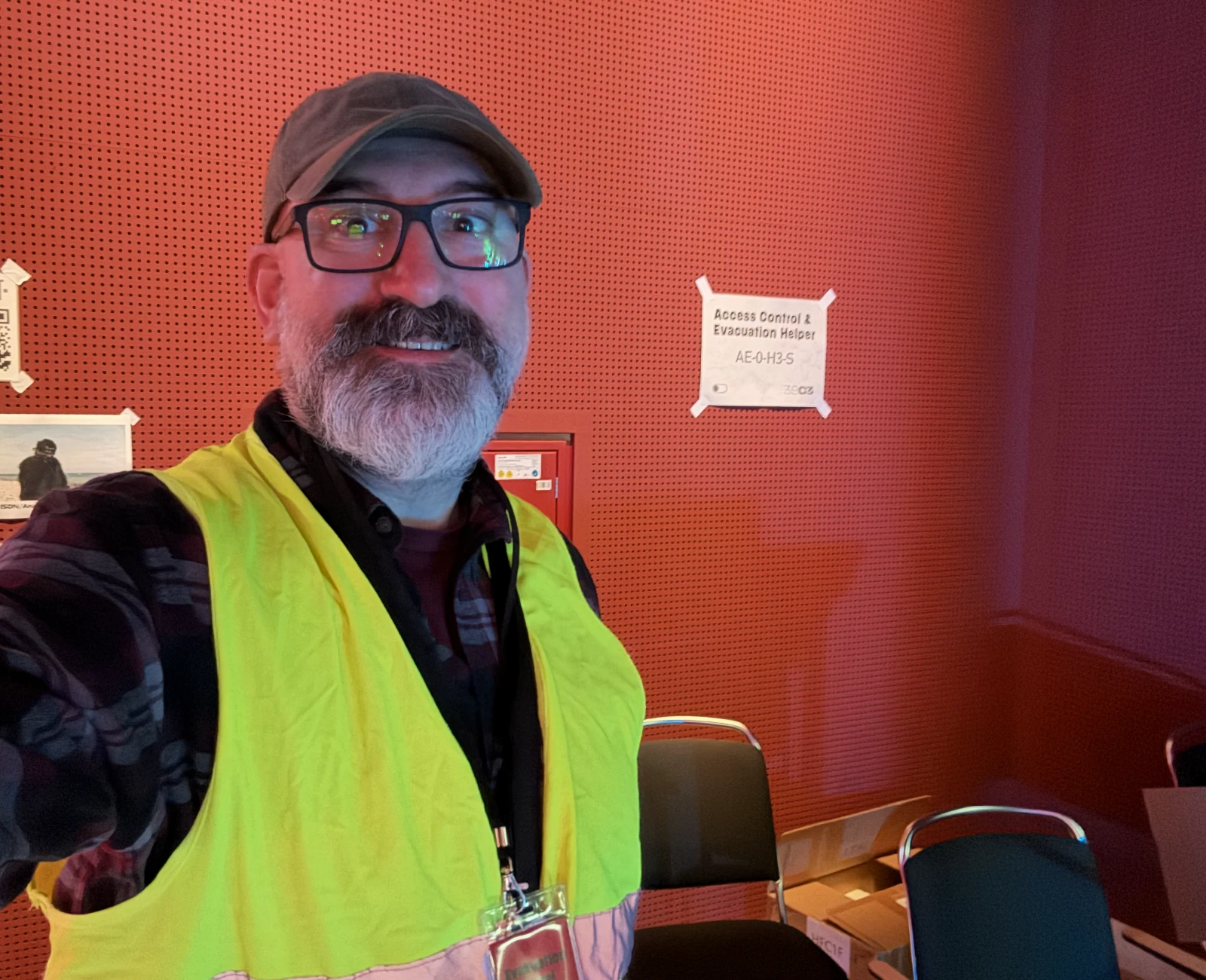
My first Engel duty doing access control for the catering
area.
I don't know the exact numbers for this particular Congress, but typically 2,000 to 3,000 Engel volunteer their time. This got me thinking...
The way things work at the Chaos Communication Congress has a bit of a utopian character. Perhaps you could even argue it is controlled anarchy (in the original sense of the word as a society without rulers).
And I don't mean just the abstract ideals, but how they are actually practiced.
For a few days, a large numbers of people self-organize with minimal hierarchy and surprisingly little enforcement. Shared responsibility replaces control, and cooperation is the default.
The volunteerism of the Engel forms the backbone of this temporary utopian society. And now I can count myself among them.
Engel are not simple background labor but visible participants. We contribute as a form of belonging rather than as an obligation. There are so many different types and "levels" of Engel based on experience like knowing your way around the location or knowing the organizational structures, or based on their specific specialization like being a translator, an A/V expert, an editor or a cook who prepares meals for the large number of Engel. And of course, there are the famous folks like the official CCC speakers like Constanze Kurz and Linus Neumann who embrace responsibility while remaining kind and patient with others who have just joined.
Volunteering as an Engel is not entirely without its rewards. Beyond the satisfaction of contributing to the greater good at the Chaos Communication Congress, there are a few tangible incentives as well. If you volunteer for a certain number of hours, you earn a coveted Engel T-shirt, with shifts during the build-up and tear-down phases counting extra. Those who manage to exceed a much higher threshold may even receive consideration when tickets for the next Congress are allocated.
I was nowhere near any of these milestones. This being my first Congress, I deliberately chose breadth over optimization. I wanted to explore assemblies, talk to as many people as possible, and get a feel for the event as a whole. Attending talks, while still important, ended up being the lowest priority in favor of my other interests because they are recorded.
The knowledge of the CCC members and guests is shared freely through the talks, video streams, and self-organized sessions. Expertise is a commons and not a commodity. This makes the boundary between audience and creator deliberately thin: attendees are encouraged to participate, build, speak, and experiment, even if they do it imperfectly. How else do you learn?
The temporary utopia is full of rough edges and unfinished ideas. The main thing is that it is an environment where experimentation feels safe. Failure is not only an option, it is welcome. The main way to improve is by trying, occasionally failing and eventually succeeding. As a result the CCC's utopia is not a polished blueprint for society, but a living demonstration that alternative ways of organizing technology, work. And I expect that it mainly works because they are temporary.
In that sense, the Congress does not present a finished utopia. It does however provide a glimpse into what is possible.
Apologies for the detour. I just feel that this is so refreshing and a stark contrast to what I experience at work or in many other everyday settings where people trying to subtly dominate others seems to often be the default.
Fighting Fascism
Another talk that I cherished was Zentrum für Politische Schönheit: Ein Jahr Adenauer SRP+ und der Walter Lübcke Memorial Park.
The Zentrum für Politische Schönheit (Center for Political Beauty) converted an old prison transport bus into the "Adenauer SRB+", which has been traveling throughout Germany as a mobile art and protest project since the start of 2025. Named after German chancellor Konrad Adenauer and the extreme right-wing Socialist Reich Party (SRP), which Adenauer banned in the 1950s, the bus represents a deliberate historical provocation. The Zentrum draws parallels between the early post-war period and the present day, demanding a consistent approach from government against right-wing extremist activities particularly against the AfD (Alternative for Germany) party.
They describe the bus as a mobile "command center of civil society". It is equipped with exhibition materials and technology for demonstrations. The Zentrum uses it strategically at politically charged events. In their talk, they described how they drove to AfD events to disrupt them. And they showed us how they disturbed an open-air TV interview with AfD leader Alice Weidel. They parked the bus close to the interview spot and sang "Scheiß AfD" ("shitty AfD") in a harmonic and peaceful manner so loudly that both interviewer and interviewee couldn't understand a word. I know it is a juvenile but... what a great blend of art and activism!
At the same time, the local police forces repeatedly attempted to get the Adenauer SRB+ bus off the streets by withdrawing its legal permits. The Zentrum described how this puts the proportionality of state intervention into question. In their talk they also described many of their other accomplishments: they built a memorial for Walter Lübcke, a conservative politician who had been murdered by a right-wing extremist. It should serve as a reminder for Germany's conservative party CDU/CSU about the risks of cooperating with the AfD.
This was a great talk!
Fighting Enshittification
As I walked through the Congress Center afterward, I bumped into one of our team members and offered them a bunk bed at my AirBnB if they needed rest. After all, they were one of the folks who slept on chairs in the Congress venue and I had three free beds. They hesitated, and I understood why.
Later, I attended a powerful talk by Cory Doctorow called A post-American, enshittification-resistant internet about Europe's potential to counter the enshittification of the web and our devices, a talk I fully intend to rewatch.
I remember listening to a really well produced podcast that described what Cory Doctorow means with "enshitification". It describes how online platforms degrade over time in a predictable cycle:
- They start out user-friendly to attract people with great features and low friction.
- Once users are locked in, they shift to favor businesses by ramping up the amount of ads, increasing the fees, and/or algorithmic throttling.
- They finally squeeze everyone to maximize profits for shareholders.
This results in platforms that feel worse, less useful, and more exploitative over time. Doctorow argues this isn't inevitable technology decay, but a consequence of monopolies, lock-in, and weak regulation.
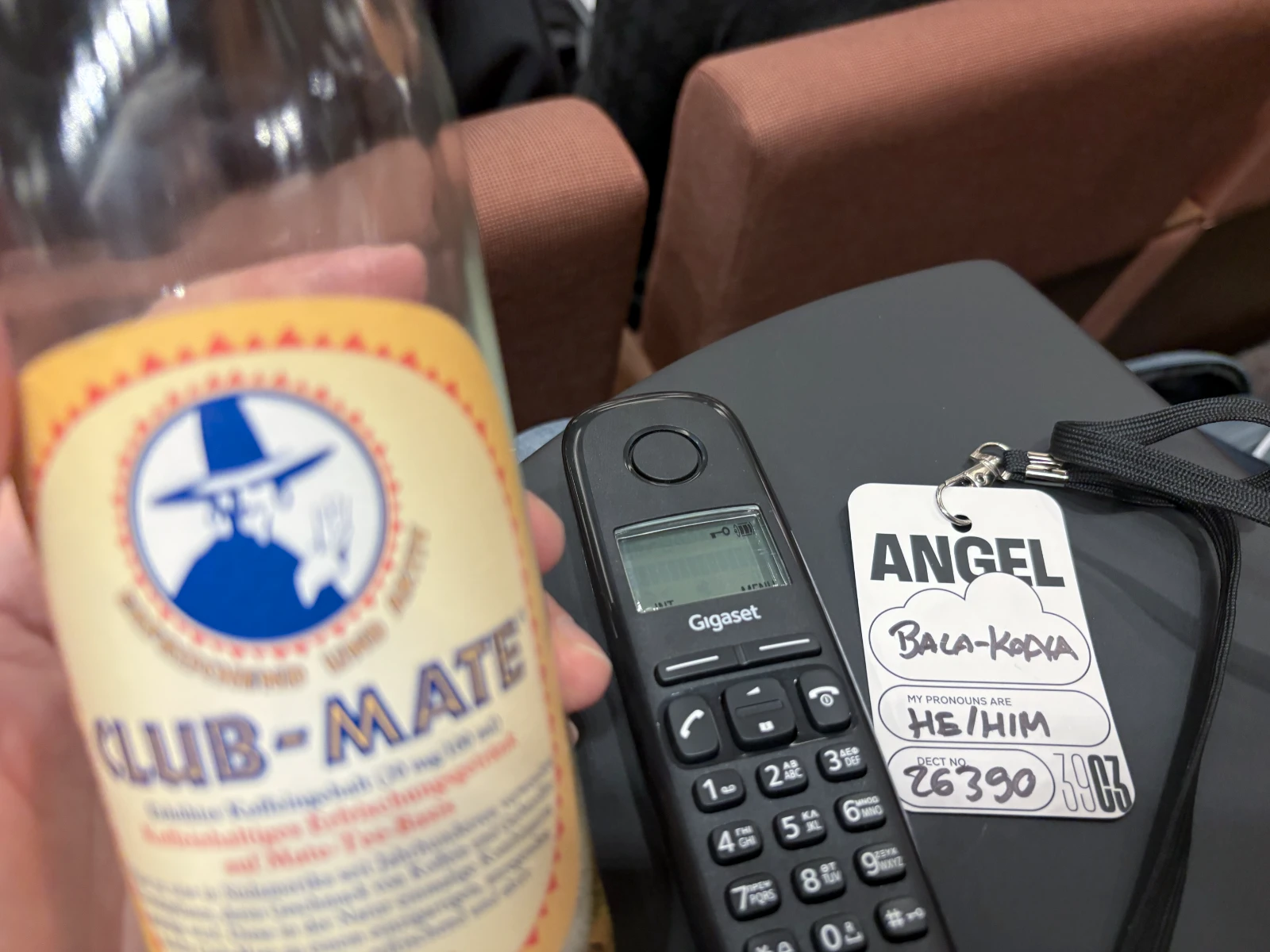
I am going native... drinking Club Mate, using DECT, and
wearing my Angel badge.
After a McDonald's lunch and a brief rest, I watched the CCC yearly retrospective on the online video stream. This year it did feature the great FeFe, due to a serious health incident earlier in the year, and it was carried instead by familiar voices such as Linus Neumann and Constanze Kurz.
Back at the congress, I met Max from Vienna. He approached me because my Alphasmart Neo2 had caught his eye. I happily gave him the full "tour" of the device. We spoke about the Austrian scene and his involvement with Metalab. It was one of the many small but fun encounters at the Congress.
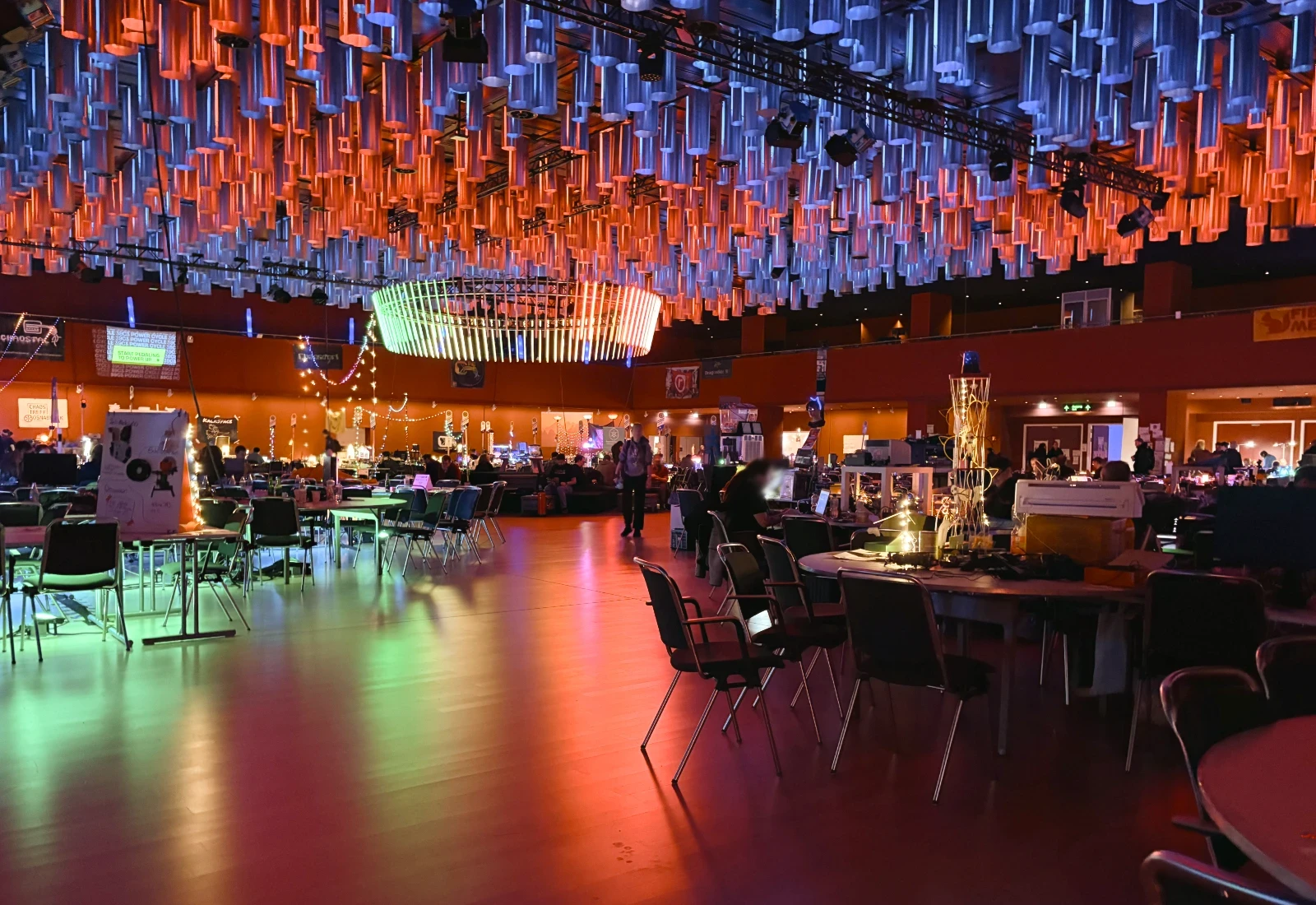
One of the neighboring halls with other assemblies... with
wonderful illumination and atmosphere.
Joyful Absurdity
The evening escalated into increasingly joyful absurdity. I encountered a person wearing a glowing Rubik's Cube costume. He told me he had created it himself with a 3D printer.
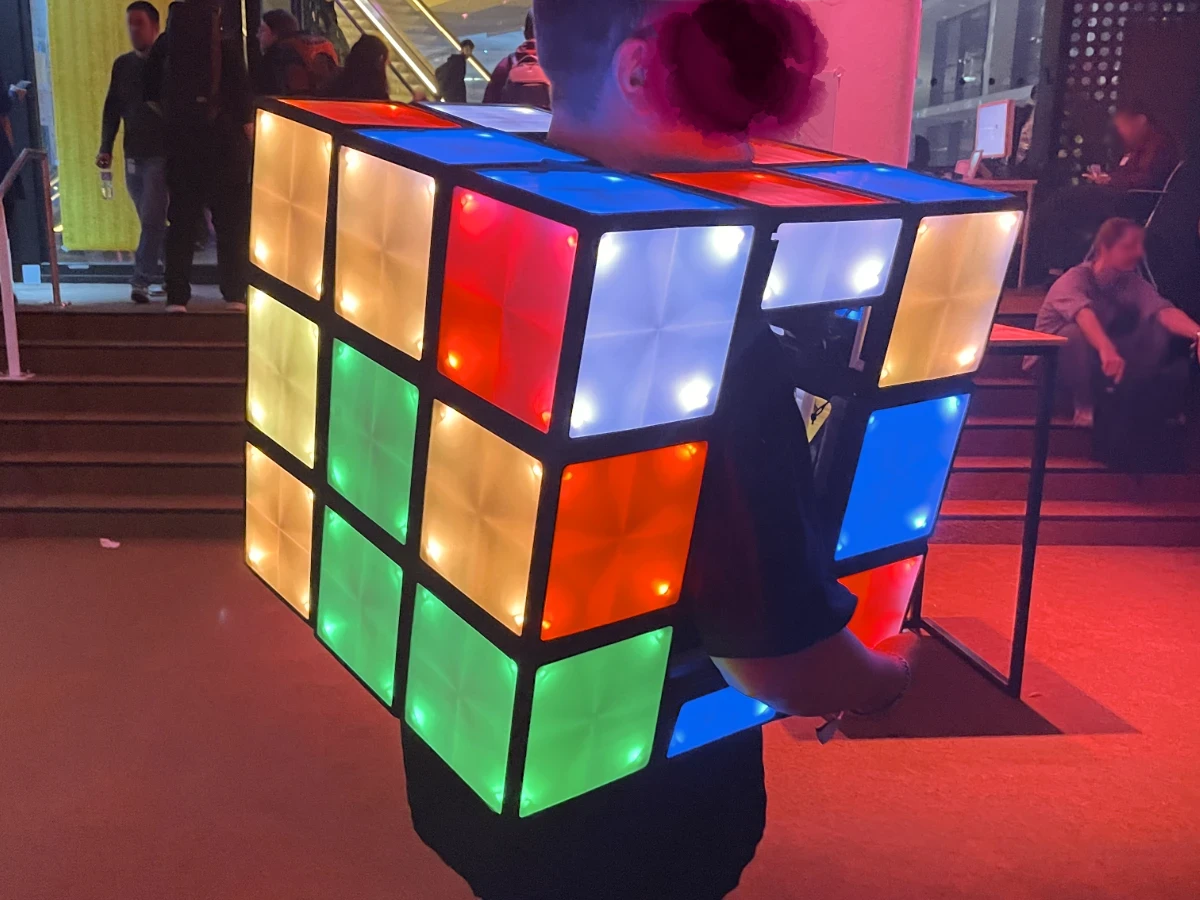
Rubik's Cube costume guy (I covered his face to avoid
identification, though it did require more than mere blurring
to anonymize him).
Eventually I made my way to a toilet rave in the twisty little passages in the bowels beneath the halls of the CCH. The rather roomy toilet area was equipped with a DJ deck and speakers.
In an enthusiastically theatrical manner, the DJ twisted and adjusted his console while a couple of dozen people danced to the echoey resonance of music as it bounced off the tiled walls. Spectral lights swept across the room. For a moment, you could really forget what the original purpose of the space actually was (until someone flushed and exited a toilet booth). The atmosphere was unforgettable, if not exactly pleasant in olfactory terms.
Understandably, I didn't capture any photos of the toilet rave, but the memory remains vivid (as do the odors).
Later, at Qetu's table in the C-Base area, I wrote notes on the Alphasmart Neo2 while curious onlookers gathered and asked me about it.
Even when I bought a black CCC hoodie at the Fashion Operations Center (yes... FOC... tihihihi), I once again had to explain why I deliberately choose devices like the Neo2 that do less than a regular laptop but last so much longer. The explanation never fails to surprise people.
Our team ended the night with shared drinks and long conversations. Eventually, all public transport shut down. Despite this we managed to find a bus that brought me and the person who'd bunk with me back to the AirBnB.
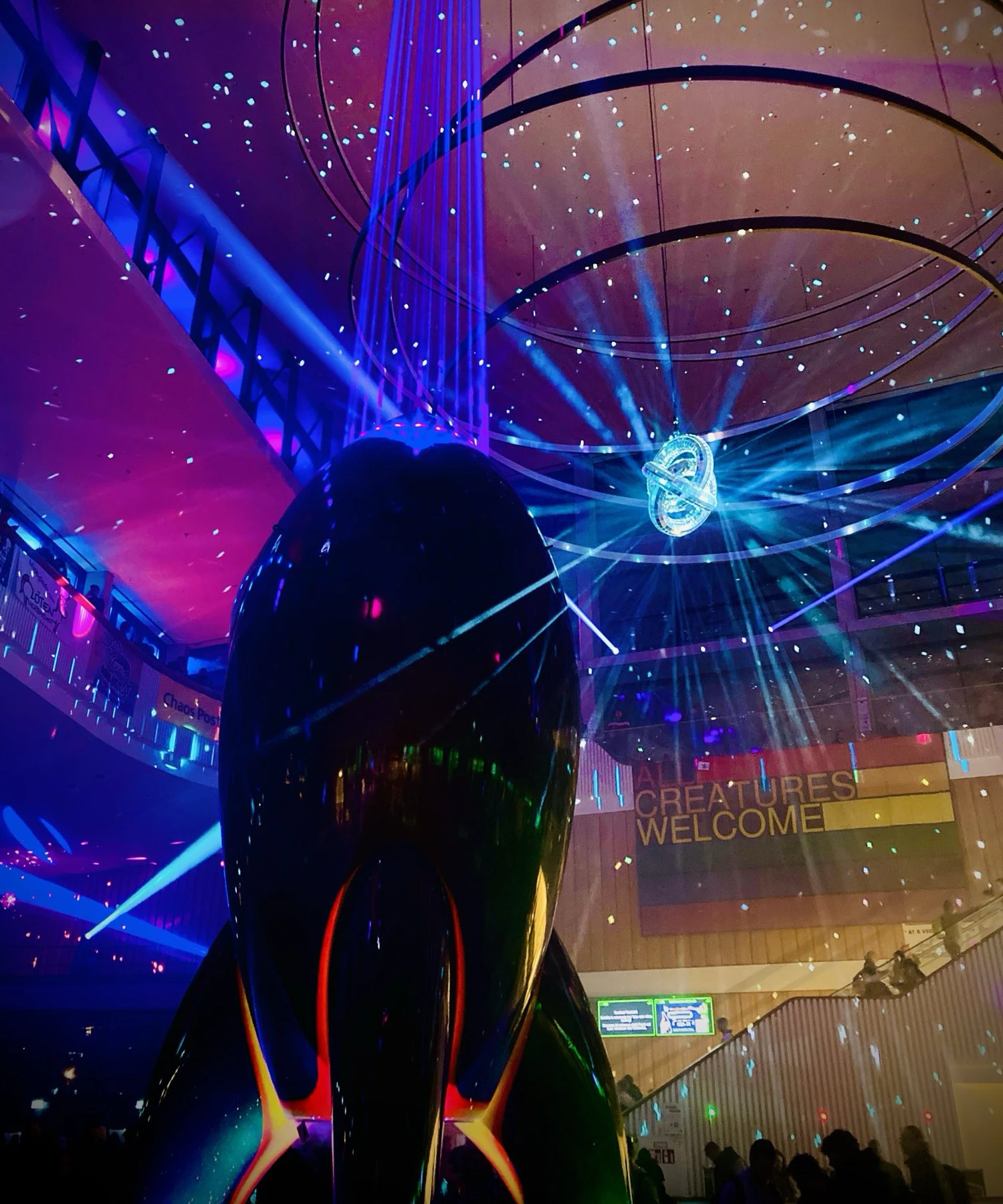
The beautifully illuminated rocket in the entrance hall looks
like it's ready for launch (The excellent photo was shot by
Merc3, ksc. Used by permission.).
Day Three: Robots, Inexplicable Art Installations, and Five in the Morning
The day began with coffee. One of our team members, Angelo, gave a lightning talk. He was a UNIX aficionado with a PiDP-1 and PiDP-11 (in both cases Raspberry Pis attached to replicas of the DEC PDP-1 or PDP-11 front panel). So we rushed to the large stage to be there on time. Angelo's talk focused on the history of a UNIX distribution he was trying to salvage. He was nervous, but it went well and his talk was really good.
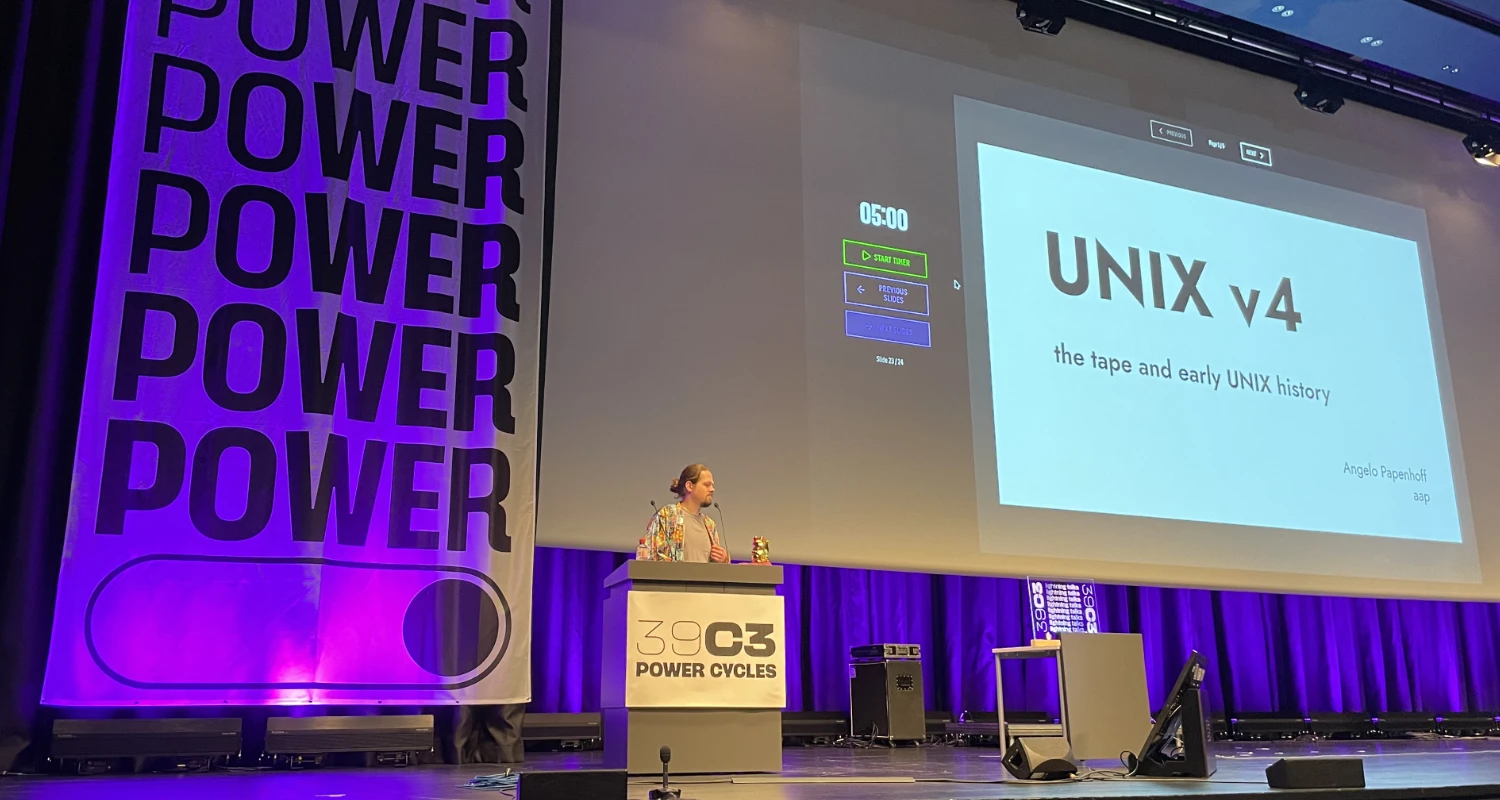
Angelo's lightning talk about UNIX history (he gave his
consent to being pictured here).
The topics of the other lightning talks ranged from drones and AI data poisoning to an introduction to the Shitty Robot Competition (yes, that is the official name!). The level of quality was impressively high across the board.
After eating a Backfischbrötchen at the train station, I attended talks on forms of protest in public office, influencer-promoted food supplements, and radical transparency initiatives. Each talk kept me engaged and thoughtful. I nearly felt a bit insufficient in my own activism.
I later joined a presentation by folks who produce the Signal messenger, Meredith Whittaker and Udhav Tiwari called AI Agent, AI Spy. They spoke about the AI features on Windows 11 and the privacy issues caused by agentic AI on an OS level. This was followed by a talk by Constanze Kurz and Franziska Görlitz on the use of Palantir software by police. The company operates in a blackbox with little transparency and accountability. Both talks were informative and deeply unsettling.

A random statue of an alien, inexplicably but fittingly
placed in one of the halls.
The Shitty Robot Battle
Let me first get one thing straight. I'm not calling the event "shitty" in a derogatory way. On the contrary, I found it to be quite interesting: makeshift robots fight each other on stage. The official name of the event uses the word "shitty" deliberately.
The reason why they call it the Shitty Robot Battle is because the technology they use for the robots is limited. Intentionally unreliable robots competed while the audience cheered enthusiastically, broadcast by overhead cameras that turned minor movements into dramatic events.
The Shitty Robot Battle fully embraced the shittiness of the robots. Like all robot battles in reality and on reality TV, they aren't really that good. But the pilots of the robot warriors totally accept this and make their robots especially shitty. The audience were in on the joke and cheered along like this was a world championship sports event. The details of the "battles" (if you could even call them that) were broadcast on multiple large screens using overhead cameras.
And lemme tell you, even though some of the robots were actually tiny but they looked monstrous on the big screen.
The battles were fun, self-aware, and oddly moving despite the robots fighting each other like drunk kittens (not my words... I picked them up from long-time attendees).
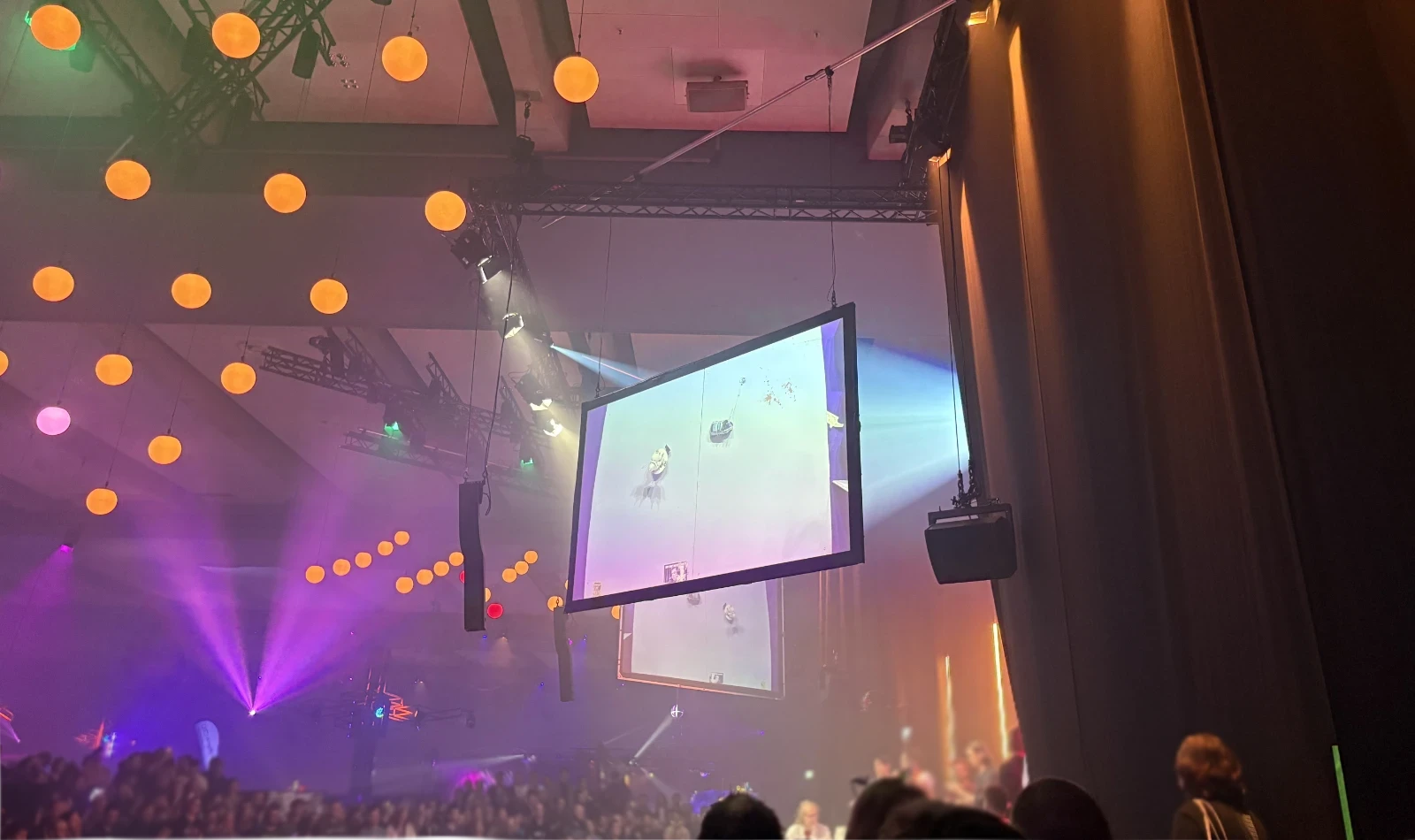
You can see the robots in action on the overhead screen here.
They are pitiful things that barely meet each other, but the
audience loved them.
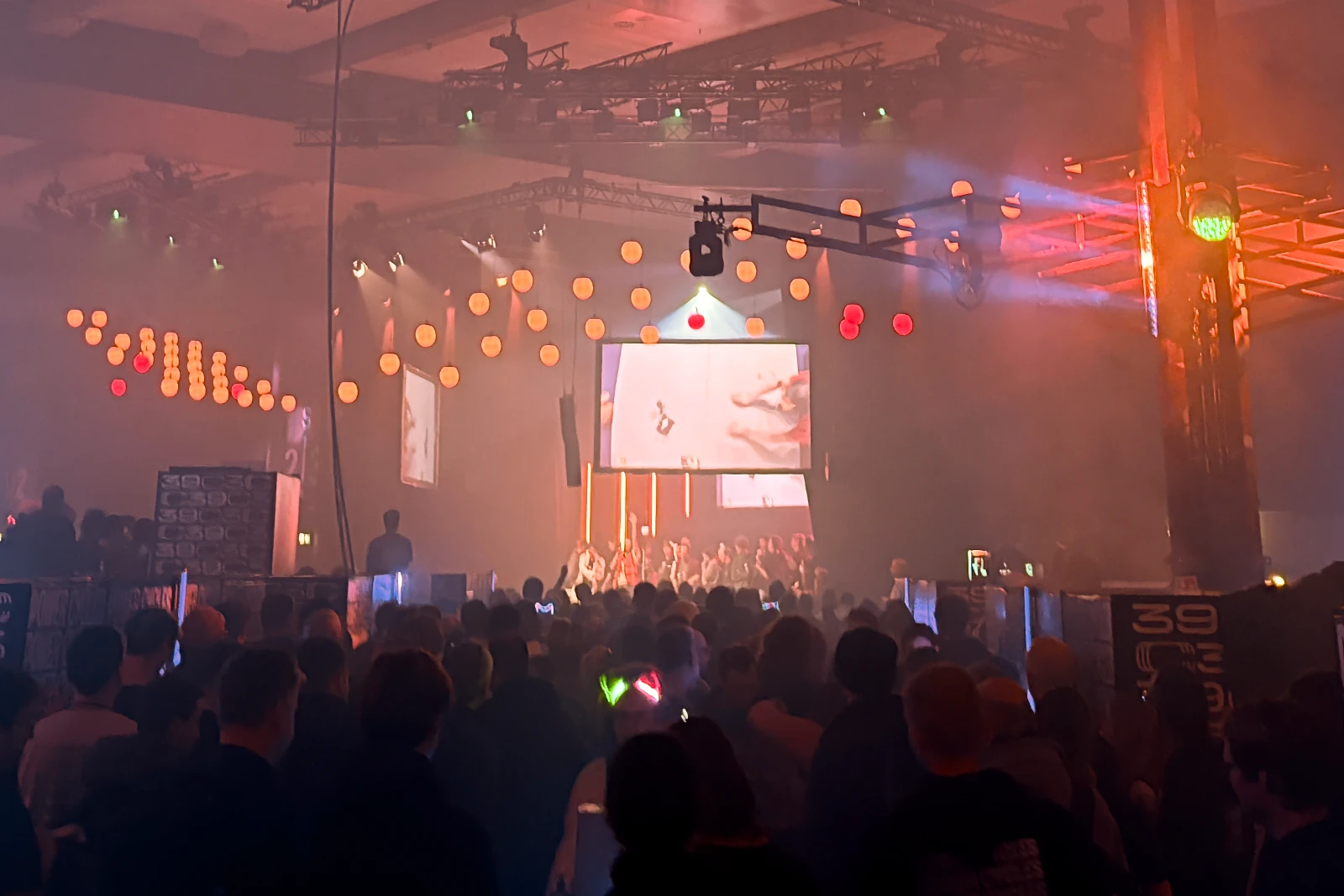
The Shitty Robot Battle drew a massive crowd who followed the
action and cheered.
Going Postal
This might be as good a place as any to describe what the Chaos Post is.
It is the internal postal service of the Chaos Computer Club at events like 39C3. It allows attendees to send physical notes, postcards, or small messages to other participants inside the venue. Then an actual person goes out to deliver it.
The interesting part is how they are addressed. You can use a nickname, an assembly, or a physical location. Then it is up to the Chaos Post to find the recipient.
At one of the talks at this very Congress, a Chaos Post delivery person asked for a specific blood type in the audience because that was the only identifying attribute of the recipient he was given. Though, from what I gathered, he had to leave without finding the right person. You can see that it really is a practical joke, a very social one.
Some people regard the Chaos Post as an embodiment of the Congress spirit. Fun, social, and a bit absurd.
At some point, we learned that the Chaos Post was looking for volunteers to act as delivery people, carrying handwritten messages and small notes across the venue. One small but important clarification followed immediately: serving as a Chaos Post messenger did not count as Engel duty. So it did not count as a credit toward being considered for tickets for the next congress. It was volunteering... but apparently of a different category.
This distinction did not sit well with Angelo. And really, who else could have taken issue with it quite so perfectly? Angelo, whose name literally means angel, pointed out with mild indignation that angels are messengers by definition. In religious tradition, angels do not merely assist; they deliver. To exclude messengers from being considered Engeln was, in his view, conceptually absurd.
This was our moment of semantic rebellion. Even the most carefully organized utopia is not entirely heavenly.
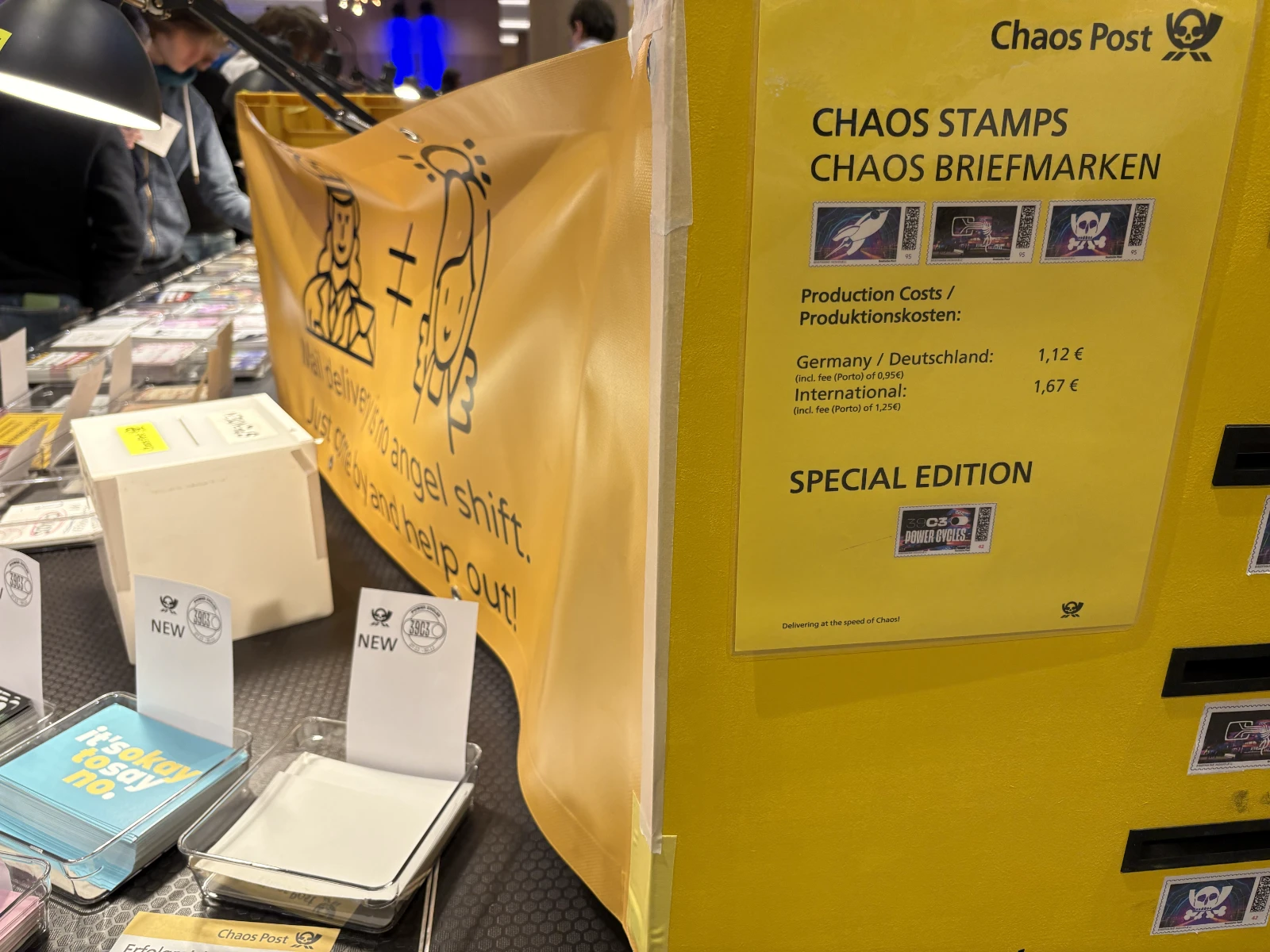
The Chaos Post office at 39C3. There were so many people
there, that I had to get very close to avoid having any of
their faces on the picture.
On the way back out of the hall, I saw that there was even a table for Magic the Gathering. Close to it, I found the Milliway's section where the assembly of my mentor CyberPunkJake was located. Unfortunately, I couldn't find him. Granted, I came unannounced. I could have written to him on Signal, sent him a postcard using the Chaos Post or simply called him on my DECT phone, but I didn't.
I went to the main stage to watch a talk about a bit-flip memory exploit called Rowhammer. It turned out that the presenters were from Austria. It was an entertaining talk but I did not have the technical expertise to understand minutiae of the exploit.
I decided to get a Tschunk (a popular drink made from Club Mate, rum, and sugar) at the bar and wandered around the halls.
The Inexplicable Sound-Water-Light Contraption (Or: Why You Shouldn't Drink Before Asking About Complex Art Installations)
Among the many technological wonders at the Congress, there were several inexplicable Rube Goldberg-like art installations that defied explanation.
One in particular caught my attention: a bewildering contraption that transformed sound into light in a very round-about way.
The friendly folks at the table explained it to me in great detail. Unfortunately, it was late at night and I had already consumed so much Tschunk (but I opted to replace the Mate with Cola but kept the rum). So what follows is my best reconstruction of what they said, filtered through the haze of rum and sugar. The only reason I actually even recalled this contraption is because I found the photos after the event and had to piece together what it was about.
As far as I could gather, it worked something like this.
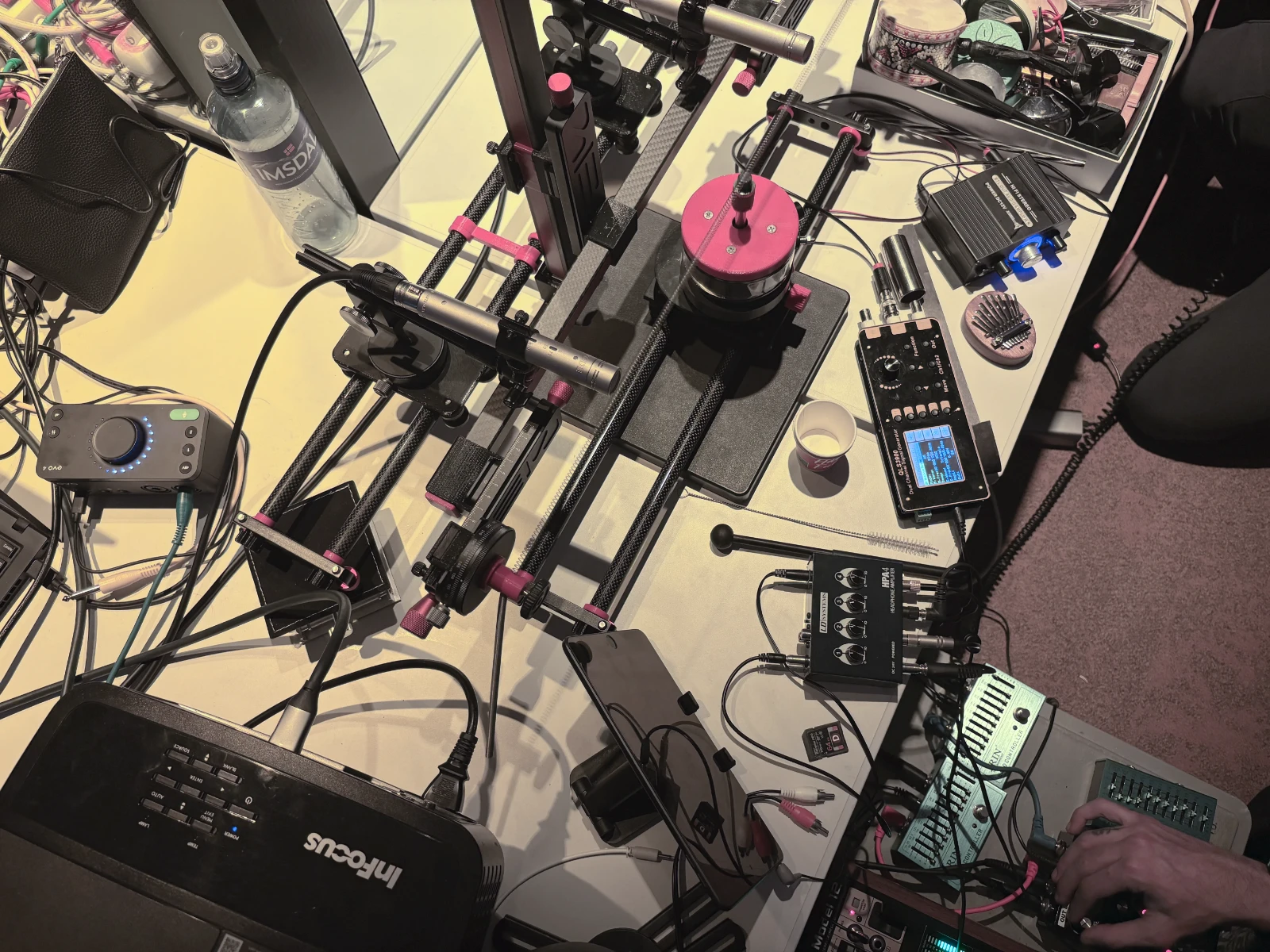
A rod rubs against a wire that moves back and forth, creating
friction. A microphone picks up these sounds.
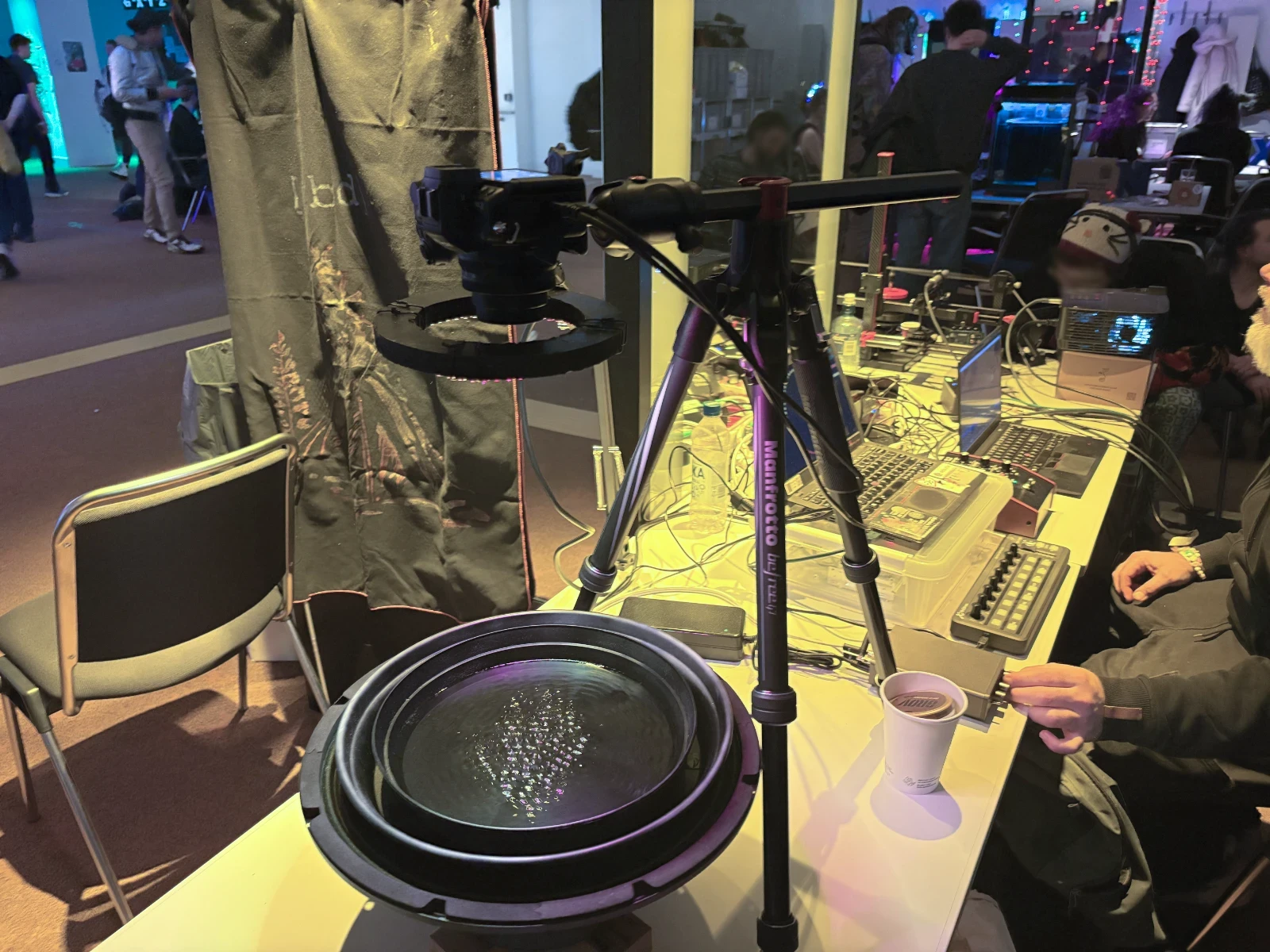
The audio signal is then sent to a large speaker lying
horizontally on the desk. Inside the speaker, there's water.
The vibrations from the sound create waves in the water. Above
this aquatic audio experiment hovers a multicolored lamp, with
a camera pointed directly at the water's surface.
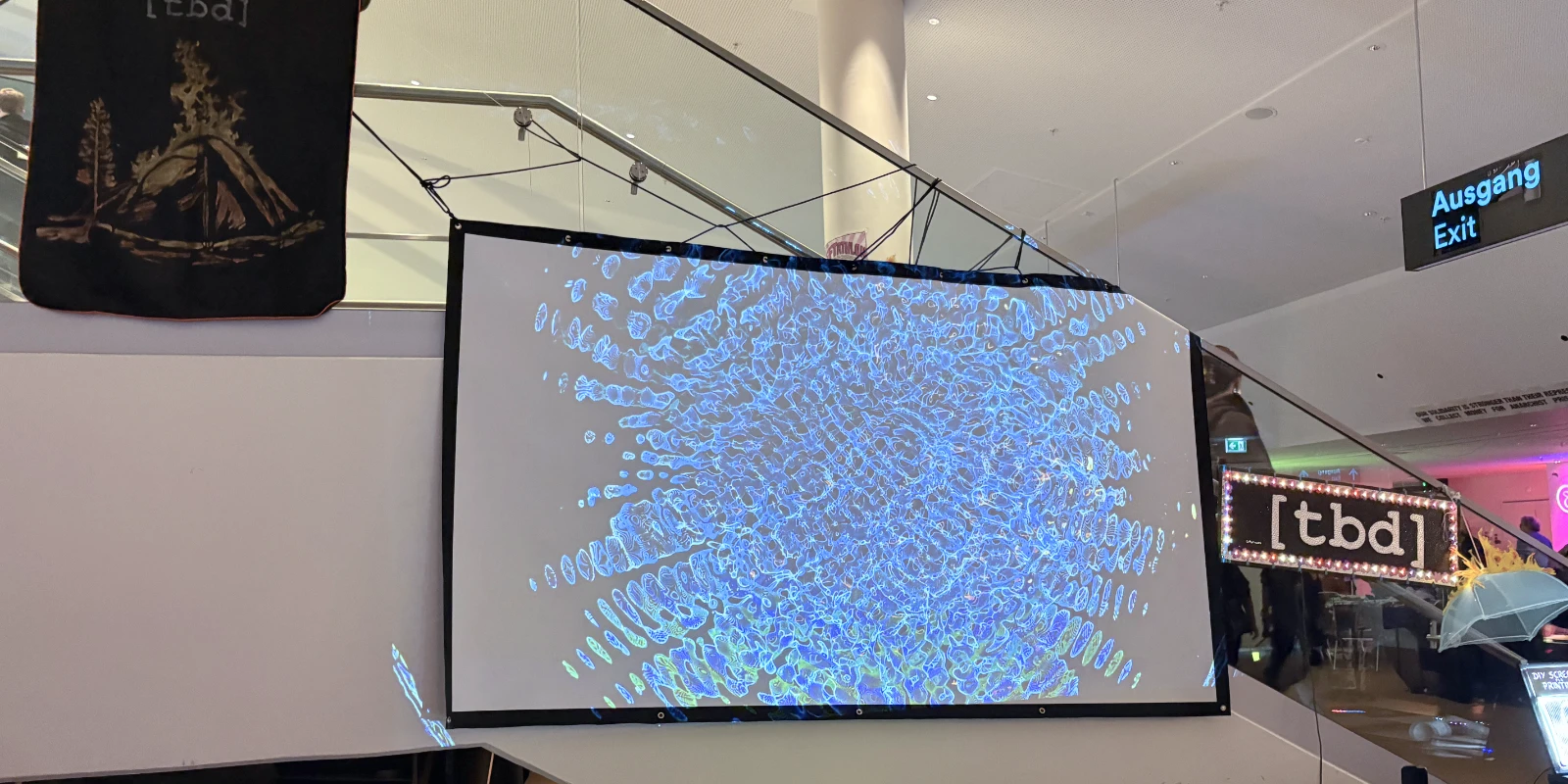
The camera captures the dancing waves and light patterns, and
this video feed is then projected onto a massive wall next to
the staircase.
In other words: friction > sound > water ripples > pretty colors > giant wall projection. Or as I understood it late in the night: "Wire goes brrr, water goes wiggle, wall goes pretty."
The fact that someone not only conceived of this chain of transformations but actually turned it into a physical reality and then brought it to the Congress is precisely why I love this event. It's beautifully pointless, technically sophisticated, and absolutely mesmerizing. Even if I can't properly explain it.

Speaking of art installations, here are some light chains
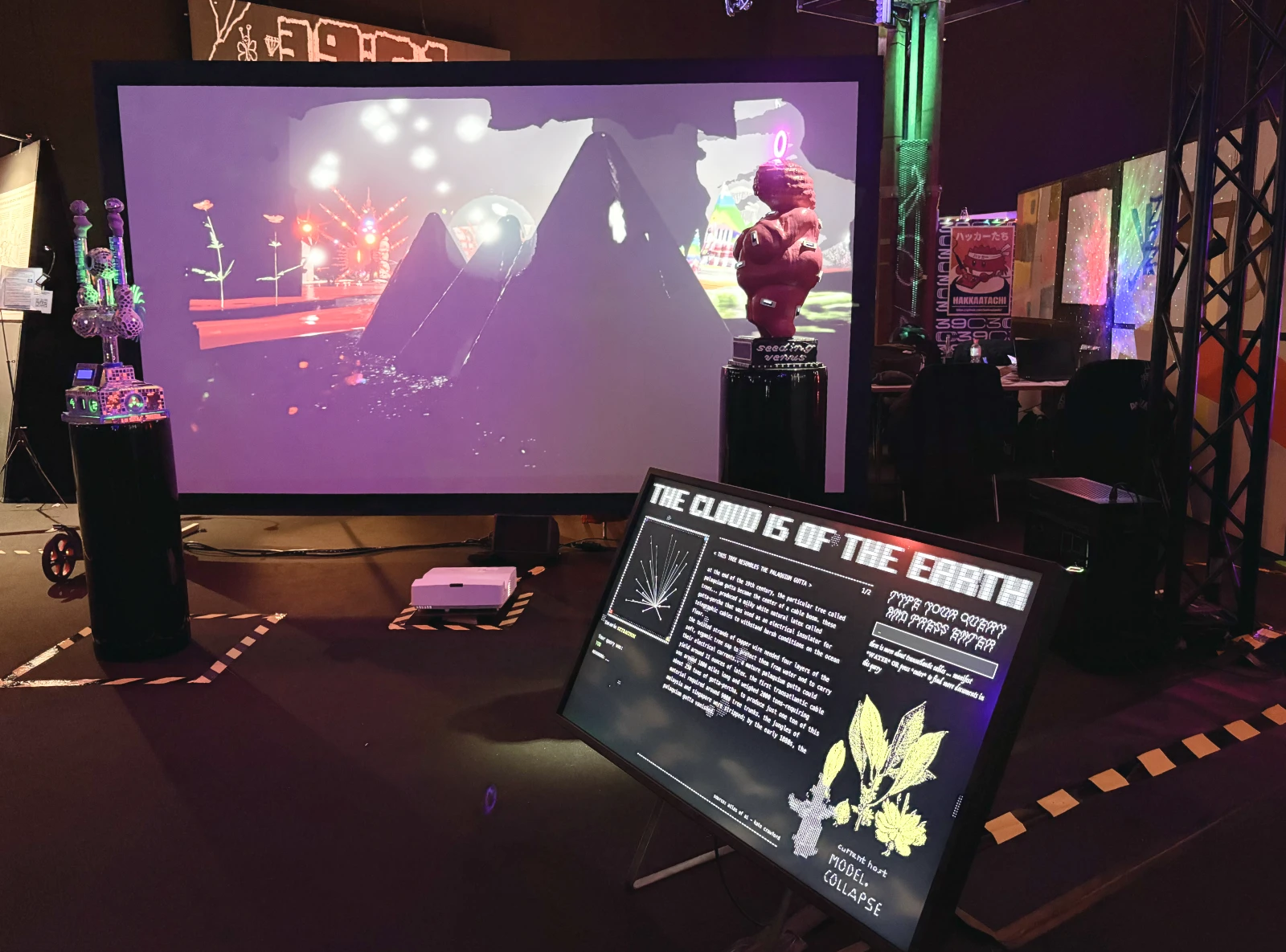
An interactive light and video installation with the Venus of
Willendorf.
Until Five O'Clock in the Morning
I planned to leave around midnight, but instead found myself sitting with Thunder.Bird, Qetu, Angelo, and some other folks. Four beers turned into many more. We talked until five in the morning about literature, comedy, robots, and life.
I finally returned to the apartment around 5:30 and managed to fall asleep like a tranquilized hippo shortly after.
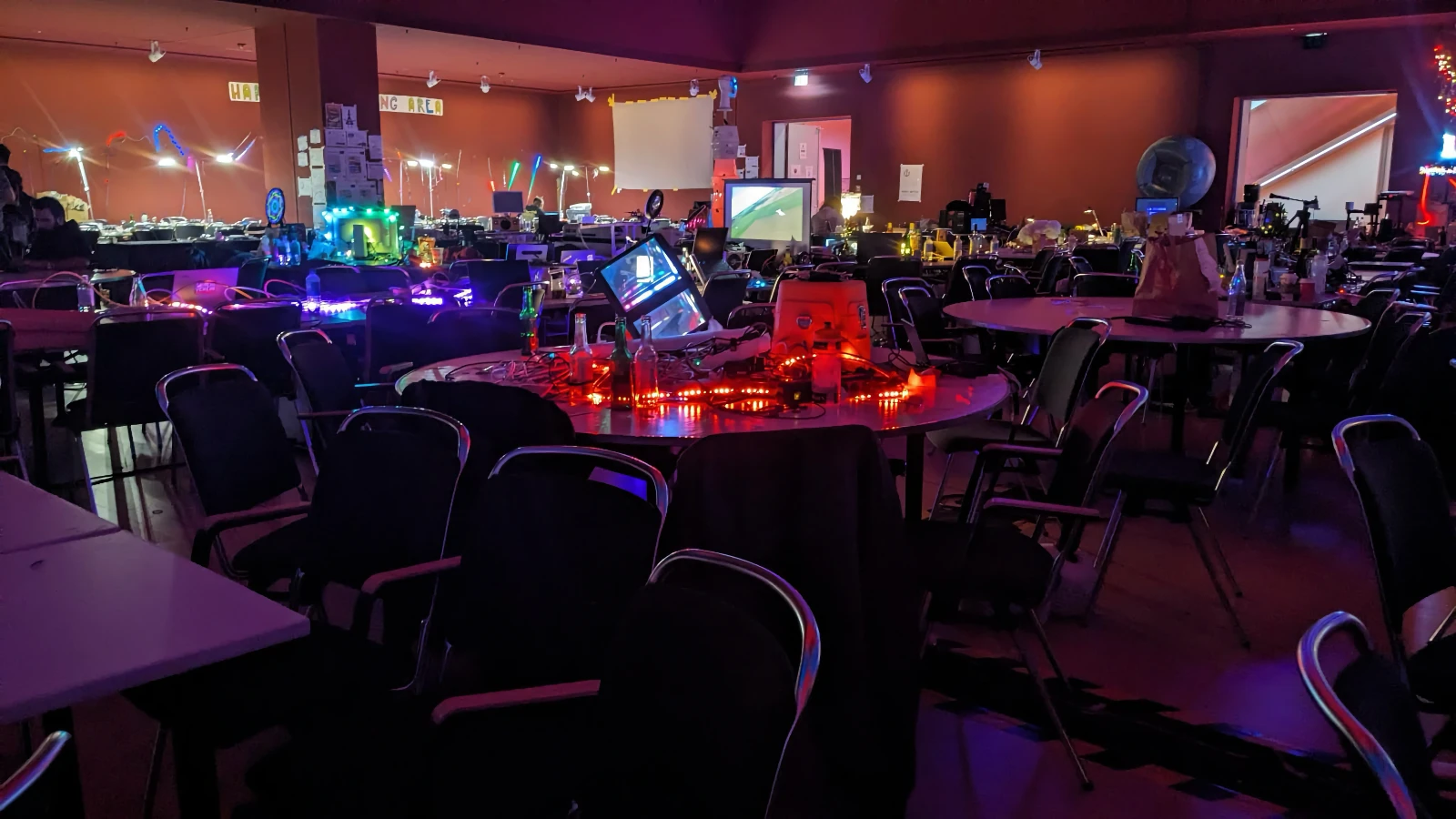
Little did I know that the folks did not go to sleep. They used the opportunity of the quiet night to wander the halls of the Congress Center, which were beautifully illuminated but otherwise mostly deserted. They took some amazing photos that I include here with Angelo's blessing.
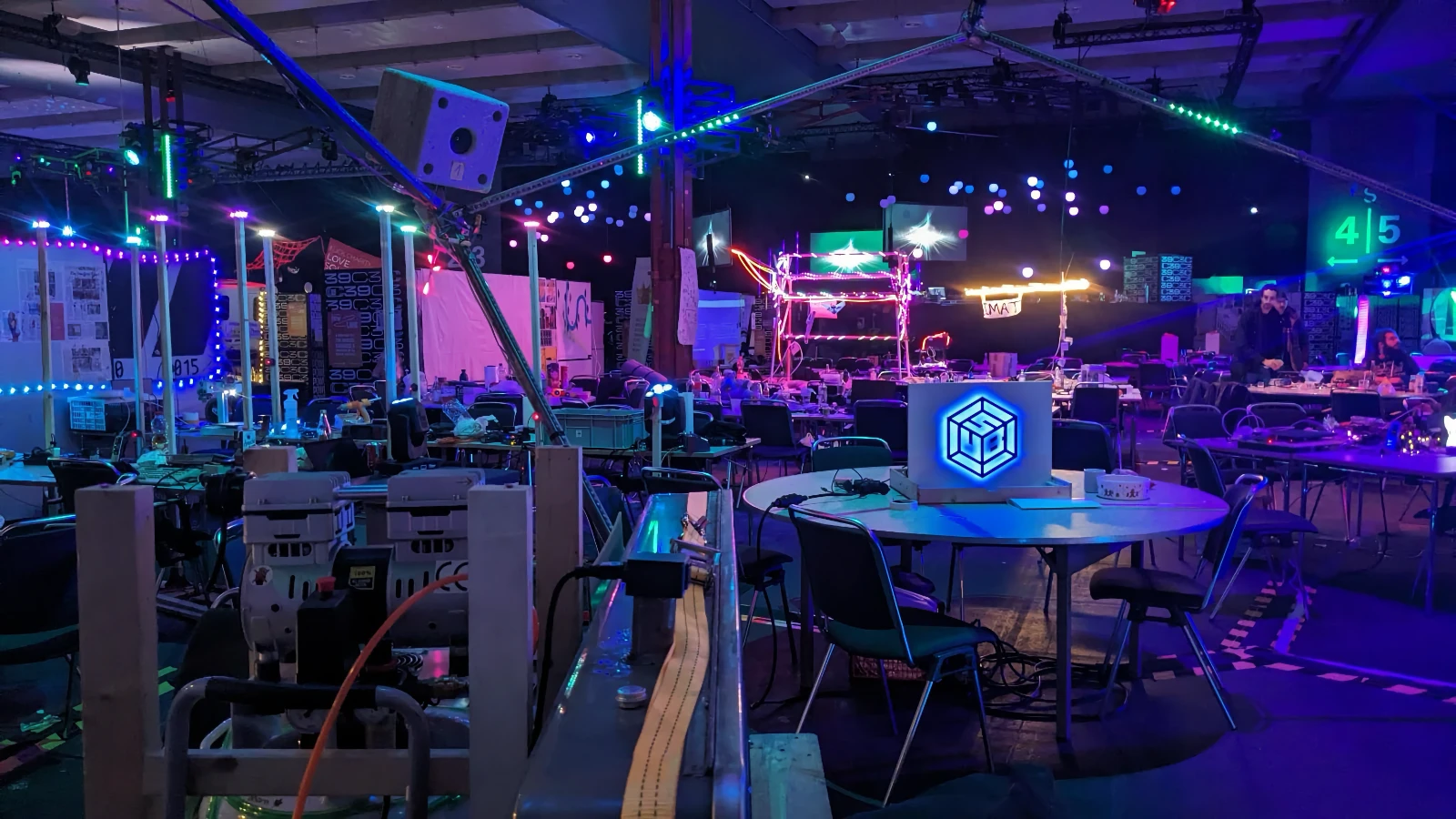
One of the neighboring halls devoid of people at night.
(Photo by Angelo P.)
Another beautiful hall of assemblies abandoned at night.
(Photo by Angelo P.)
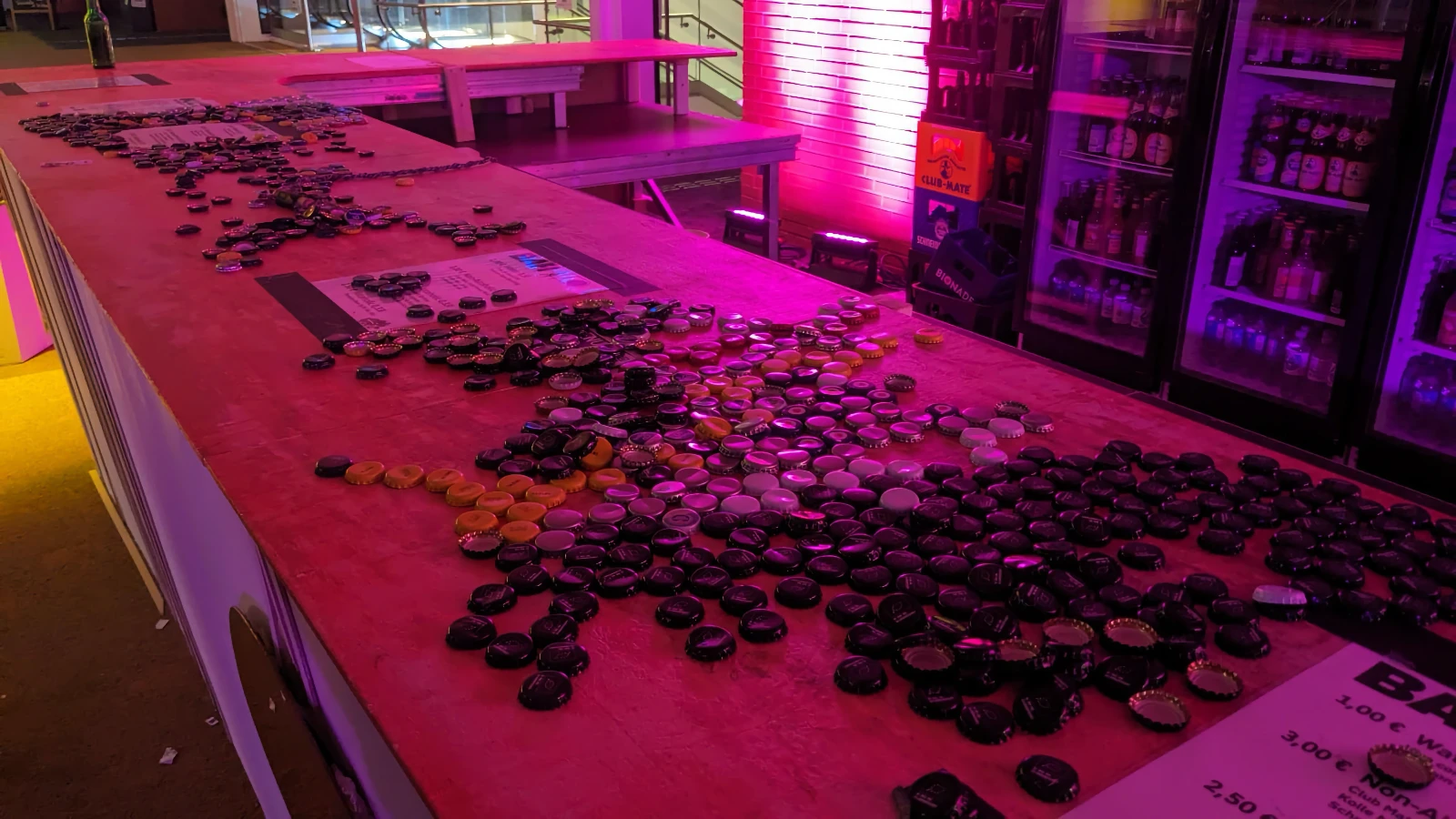
The bar at night looks like the guests suddenly left without
a warning notice. Respect for the massive number of beers
consumed. (Photo by Angelo P.)
Day Four: Goodbyes and Departures
On the final day, I woke late, exhausted but content.
I returned to the Congress Center. I said my goodbyes, attended a talk on the greatest security nightmares of 2025, and stayed for the closing ceremony with Stella and pajowu (again delightfully animated by hand with paper cut-outs of self-drawn cartoons).
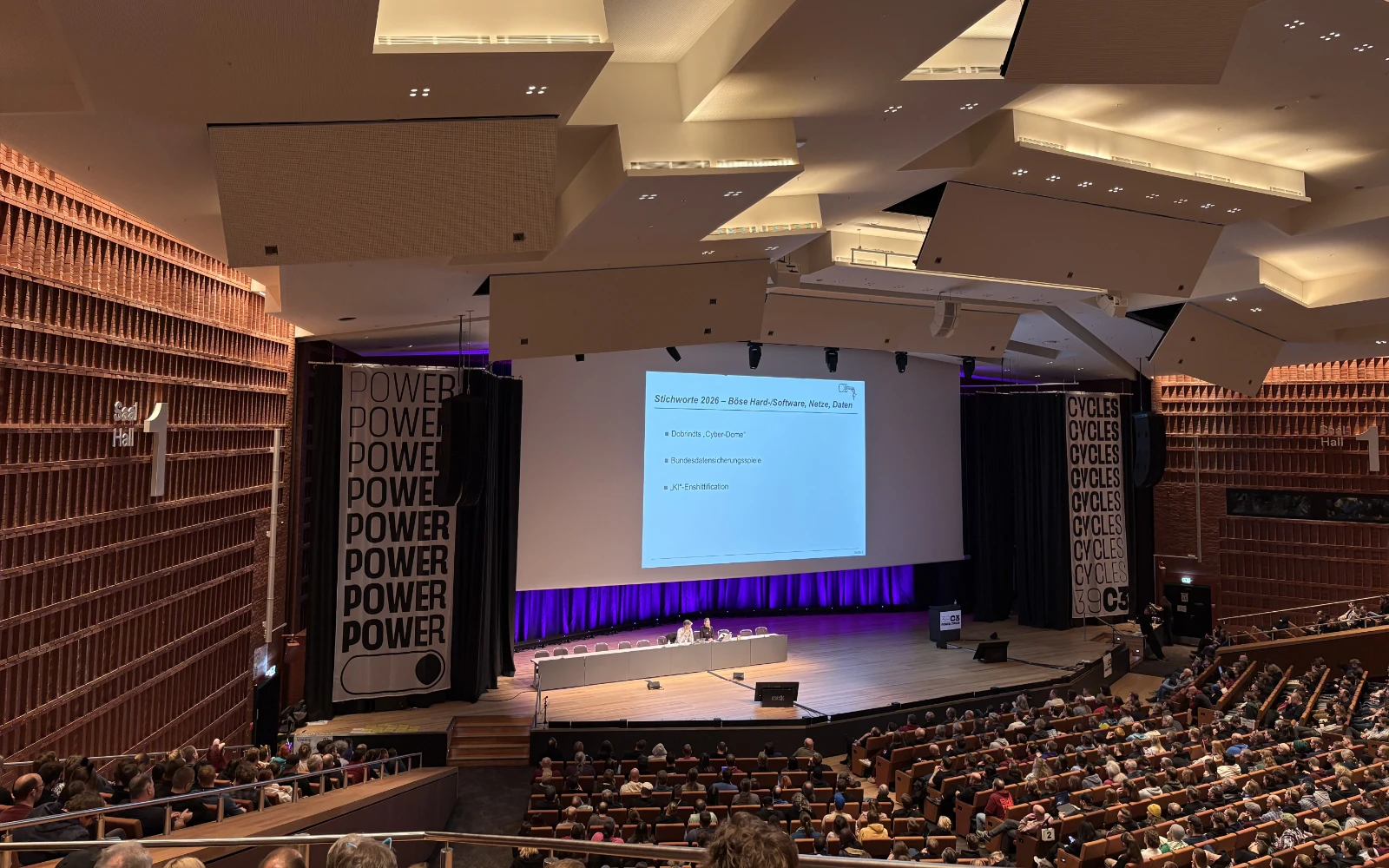
Security Nightmares in 2025
Afterward, I wandered into the city, found something to eat, and allowed the weight of the past days to settle. The congress had done what I hear it does best: it overwhelmed me, inspired me, exhausted me, and rearranged my priorities.
(And just for the sake of completeness, on my return flight with a layover in Frankfurt, my luggage got delayed. And I only got it back two days later. While it was mildly irritating as it was, I don't even want to think about what this would have been like if it had happened on the way to the congress!)
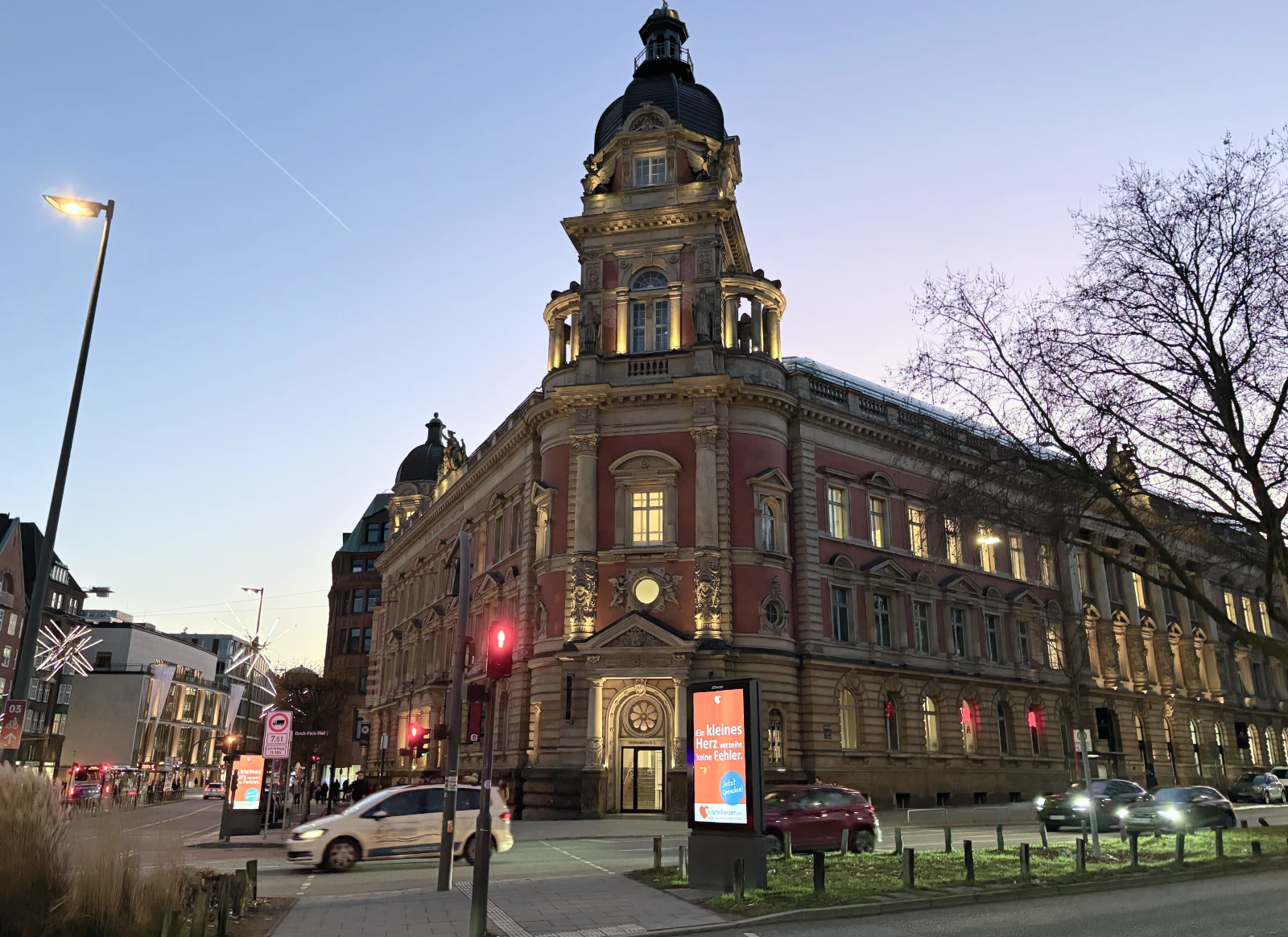
I only managed to see bits and pieces of Hamburg before
leaving.
And what did I think of the whole experience?
Dangit! There is just so much. The 39th Chaos Communication Congress showed me how technical, social, and political systems are built by people. It showed me how stories matter, that tools can be deliberate choices, that volunteering creates belonging, and that utopia is something you practice.
I had learned so much along the way. I will first show you some photos before I continue with what I've learned in detail.
Photo Impressions from 39C3
Here are some photos I couldn't put anywhere else to capture the atmosphere at 39C3. Please note that due to the photo policy (and privacy reasons), the photos avoid showing any identifiable faces. By the way, the really cool pics were taken by Angelo and used with permission.
(To make the image carousel pause, place the mouse pointer over it without clicking or tap on its center of the photo on a touchscreen device.)

This is one of the smaller stages in the hustle and bustle of one of the halls.

I like this poster for the Leftathon. It just oozes 1960s counter-culture (damned if I know what it's about though!)

The Congress Center Hamburg illuminates the night like a beacon for hackers, artists, and punk rock technologists alike.

The main presentation stage, Saal Eins. Official CCC speaker Constanze Kurz and lawyer Franziska Görlitz spoke about the "Blackbox Palantir" and how the company evades accountability

Just a random Leopard on the table of the Swiss congregations.
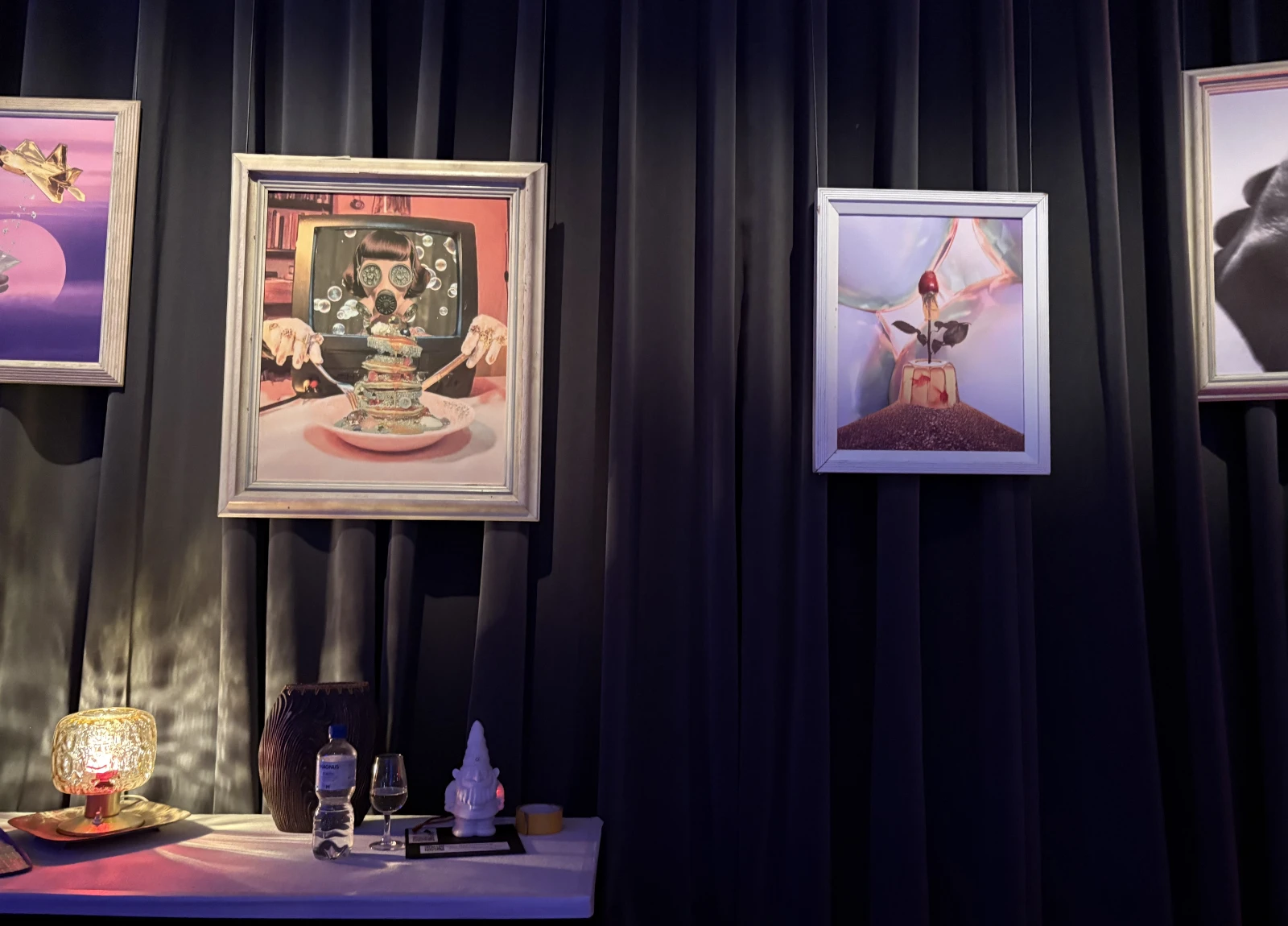
In one of the halls, some folks had set up a comfortable lounge with couches and even a full-size double bed. They decorated it with paintings. Unfortunately, I couldn't make any pictures of the lounge because there were too many people.
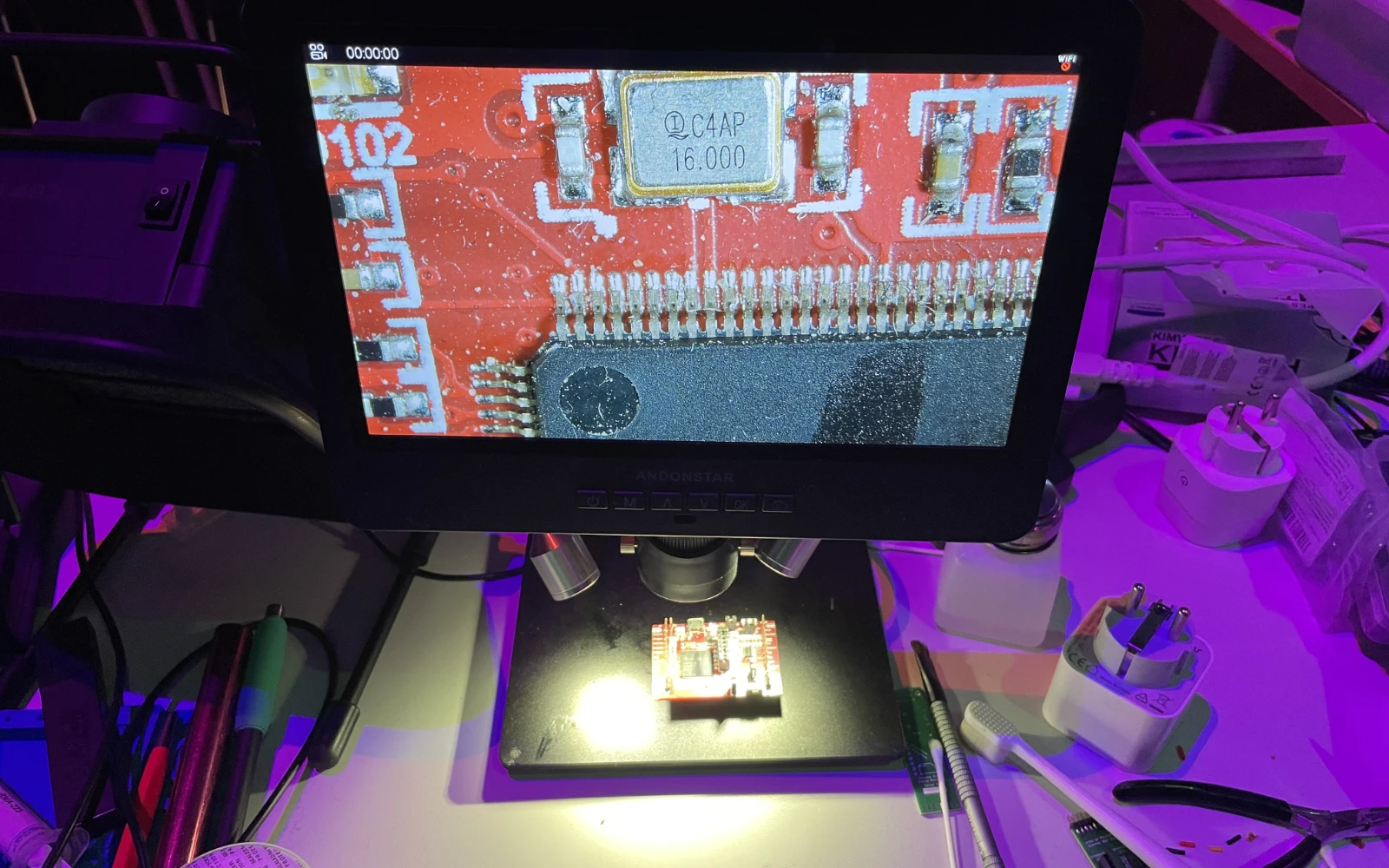
Someone had brought a microscope for chips and set it up for anyone to try.
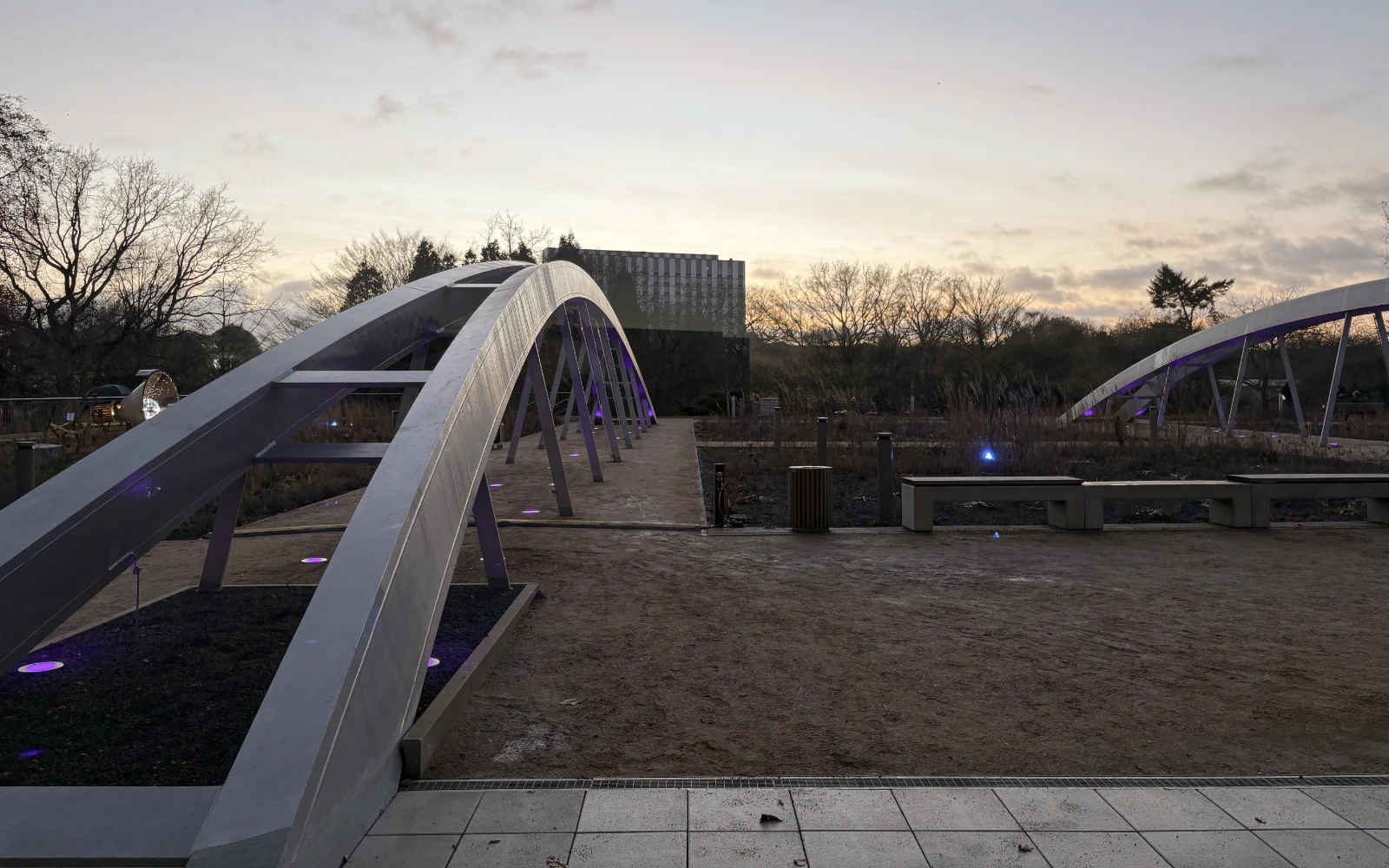
This is a section of the CCH's roof I could photograph. It was used as one of the smoking areas at the event.
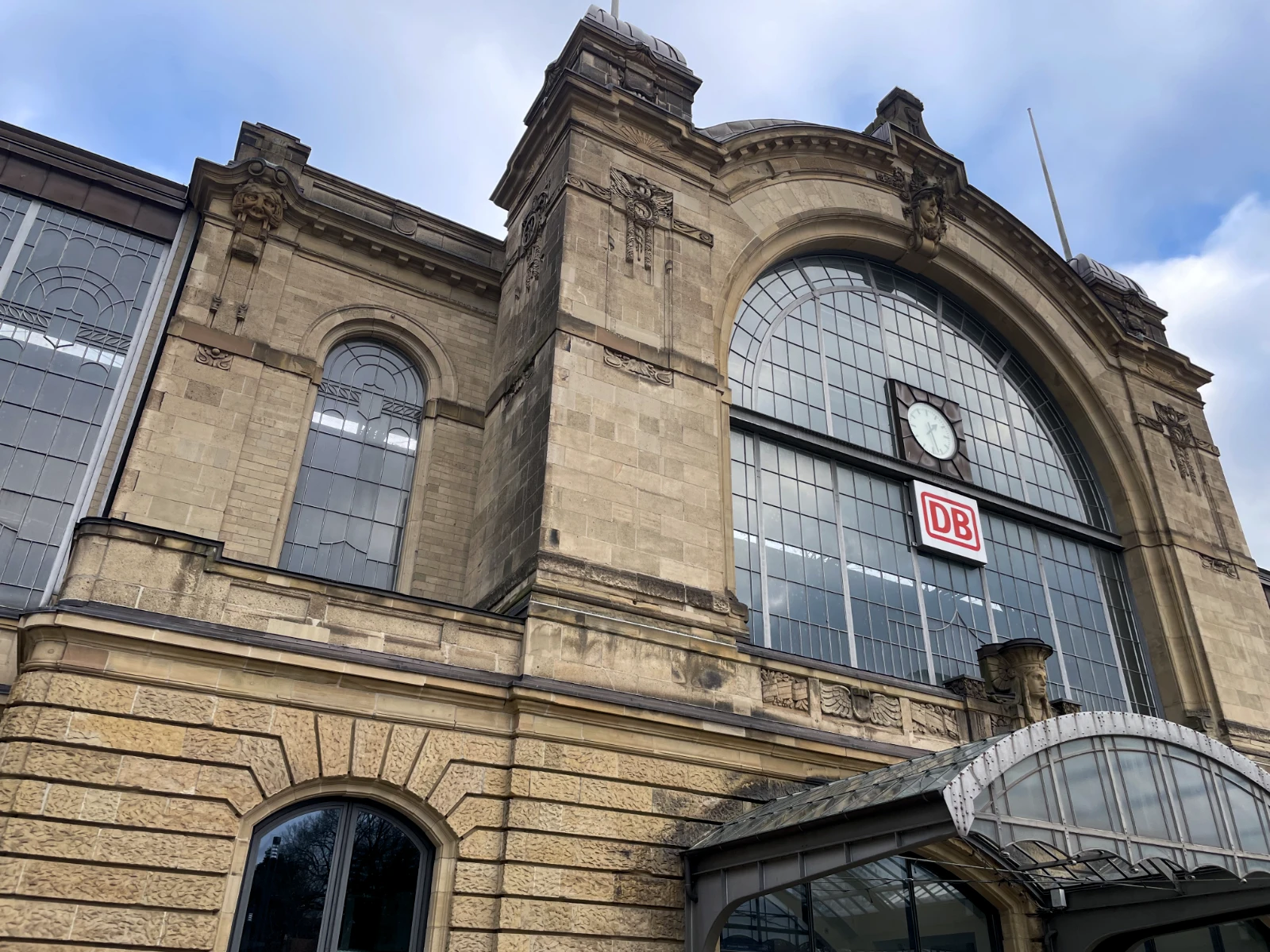
Hamburg's Dammtor station, the one close to the Congress Center.
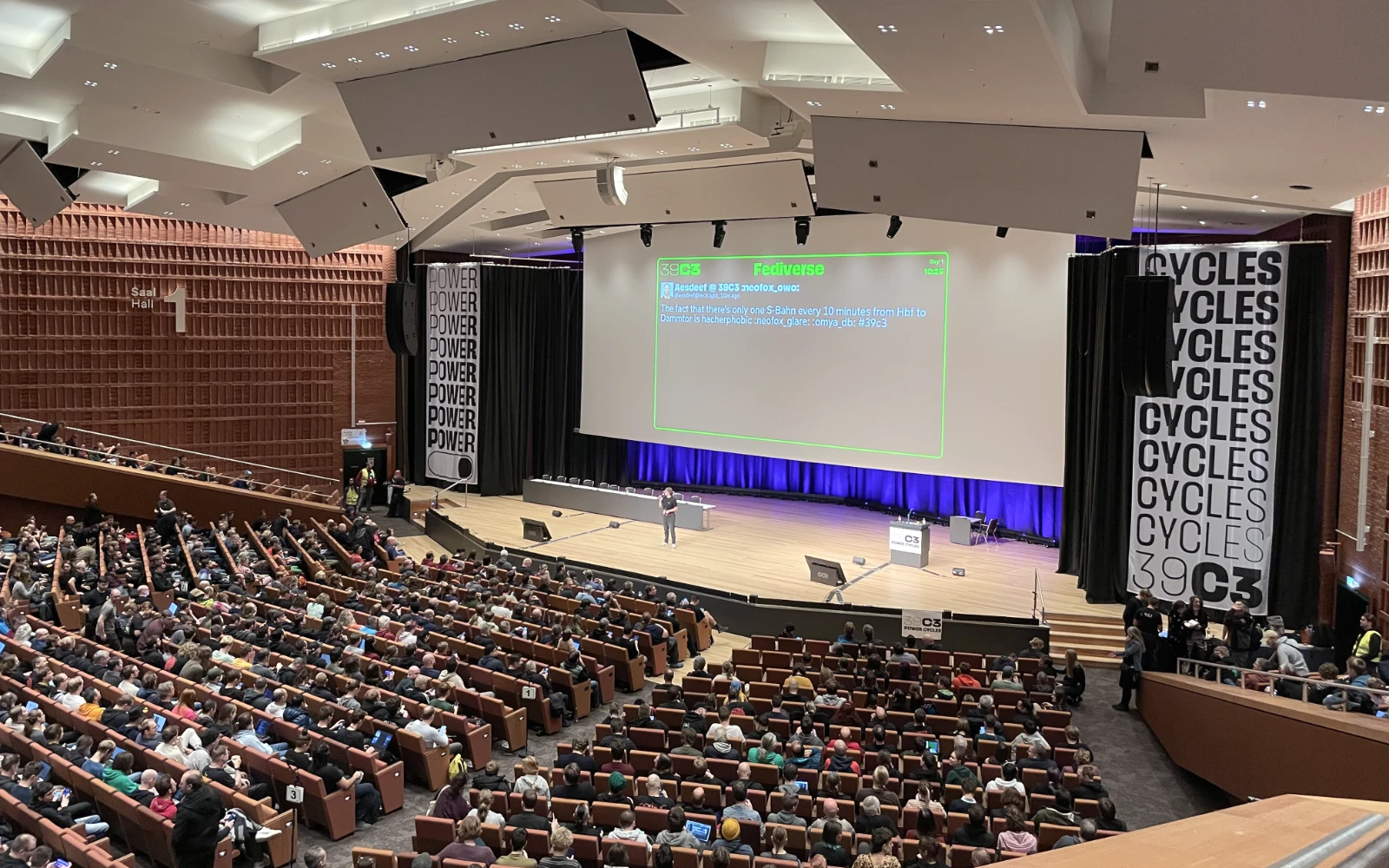
A different perspective of the mainstage at 39C3

Another wonderfully archaic gadget just operating by itself for visitors to witness and play around with. A plotter diligently drawing a picture on large sized paper.
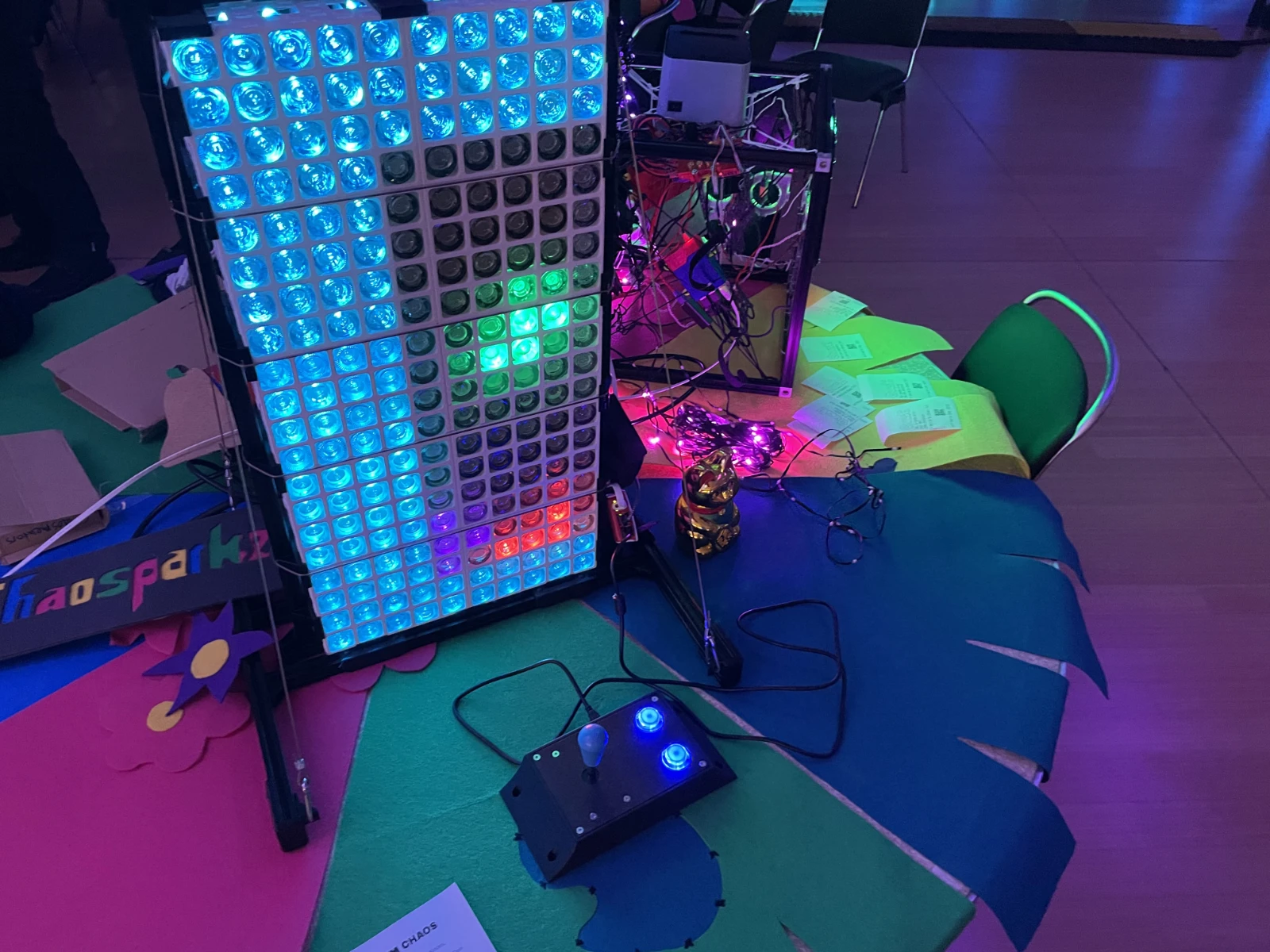
In the Retro Hacking Area, someone had brought their self-made Tetris game made of lights!
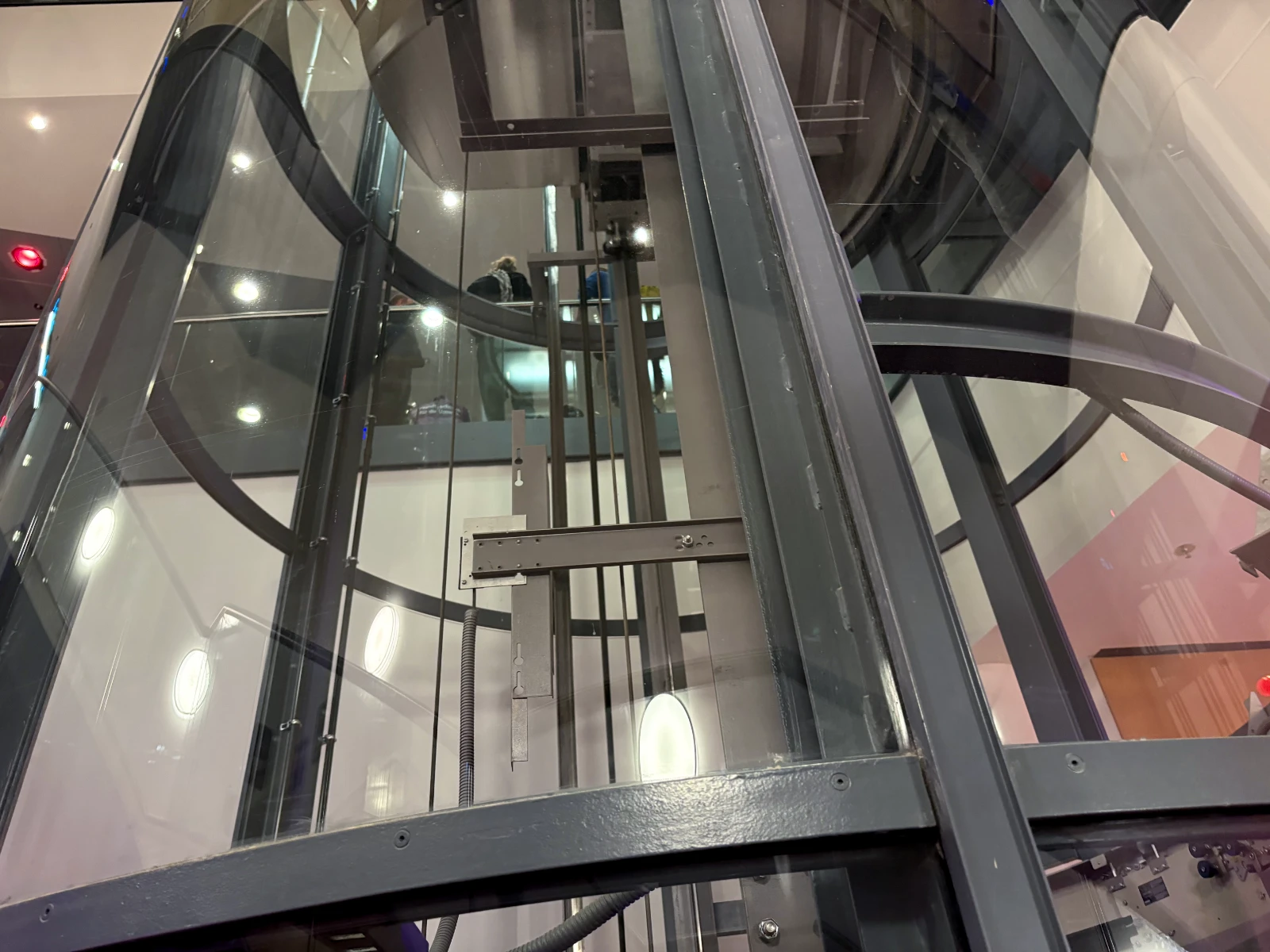
This is an odd perspective shot of an elevator. One of the few lifts, we could actually use without getting a warning from one of the Engel.
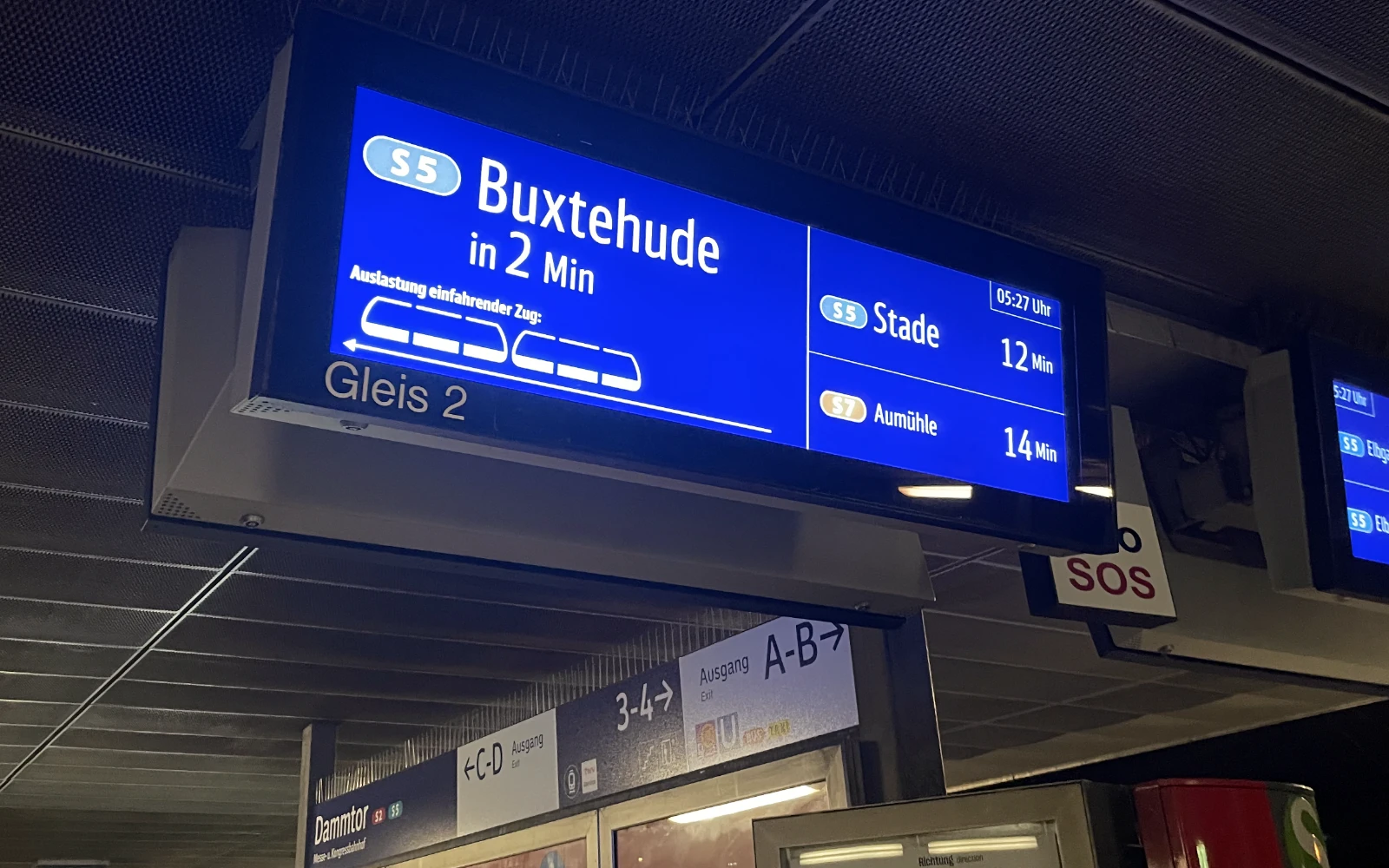
This is a bit of an inside joke in Austria. 'Buxtehude' is used as a term for 'the middle of nowhere'. I had no idea that it is a real place. I would like to extend my apologies to the inhabitants.
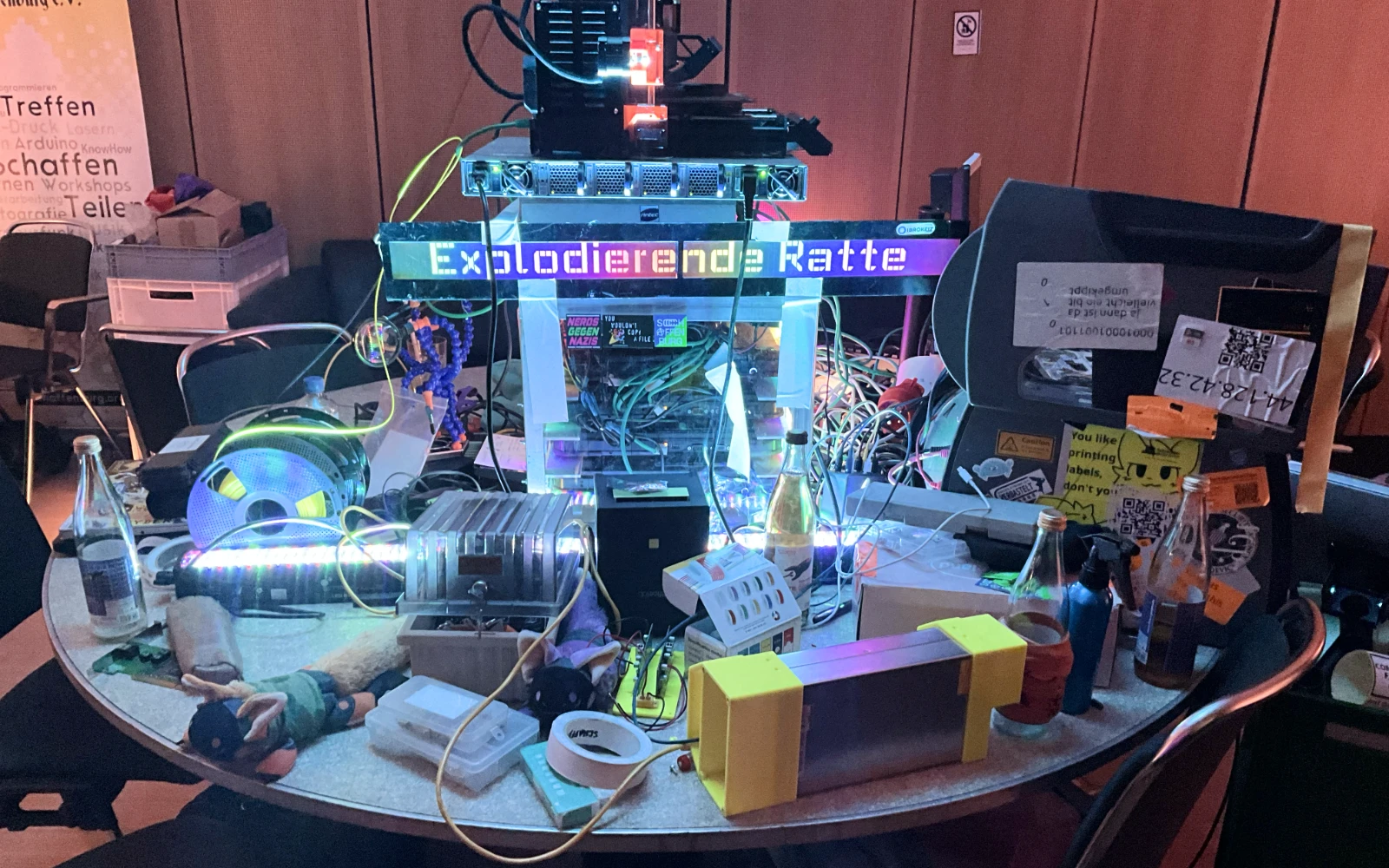
I absolutely adore bumping into random technology that's just on display. In most cases, I have no idea what it does beyond its aesthetics, but that's part of the charm.

One of the fire fighters on standby duty at the event was dressed as a furry. Why not!?

This was one of the hacking consoles in the retro hacking area. The monitor, styled like something from Bioshock, displayed a cryptic text string. You had to guess the password based on the text and enter it into the prompt. I failed, but a little kid after me cracked it.
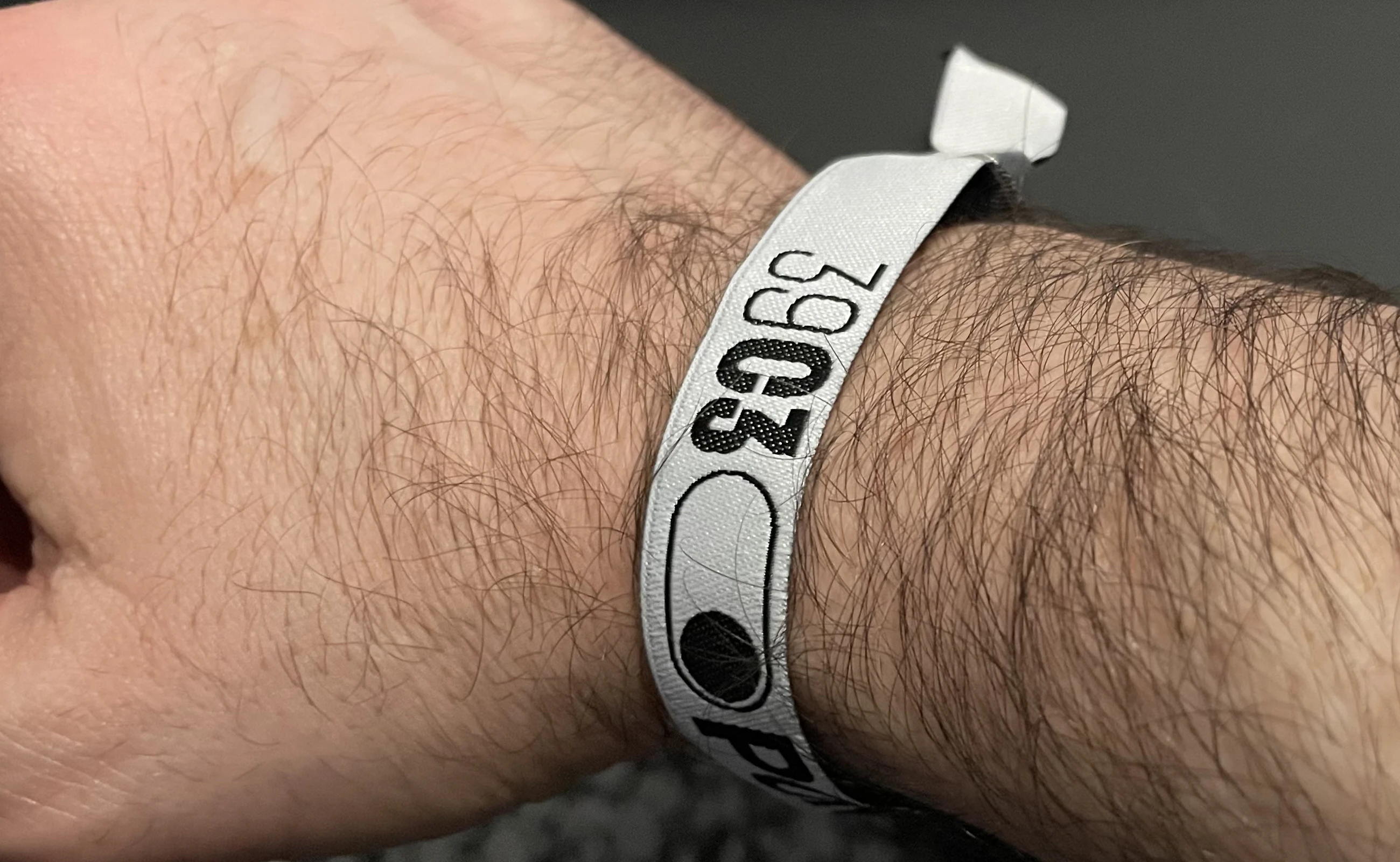
My hairy arm with the 39C3 attendance armband. A badge of honor for Congress attendees!
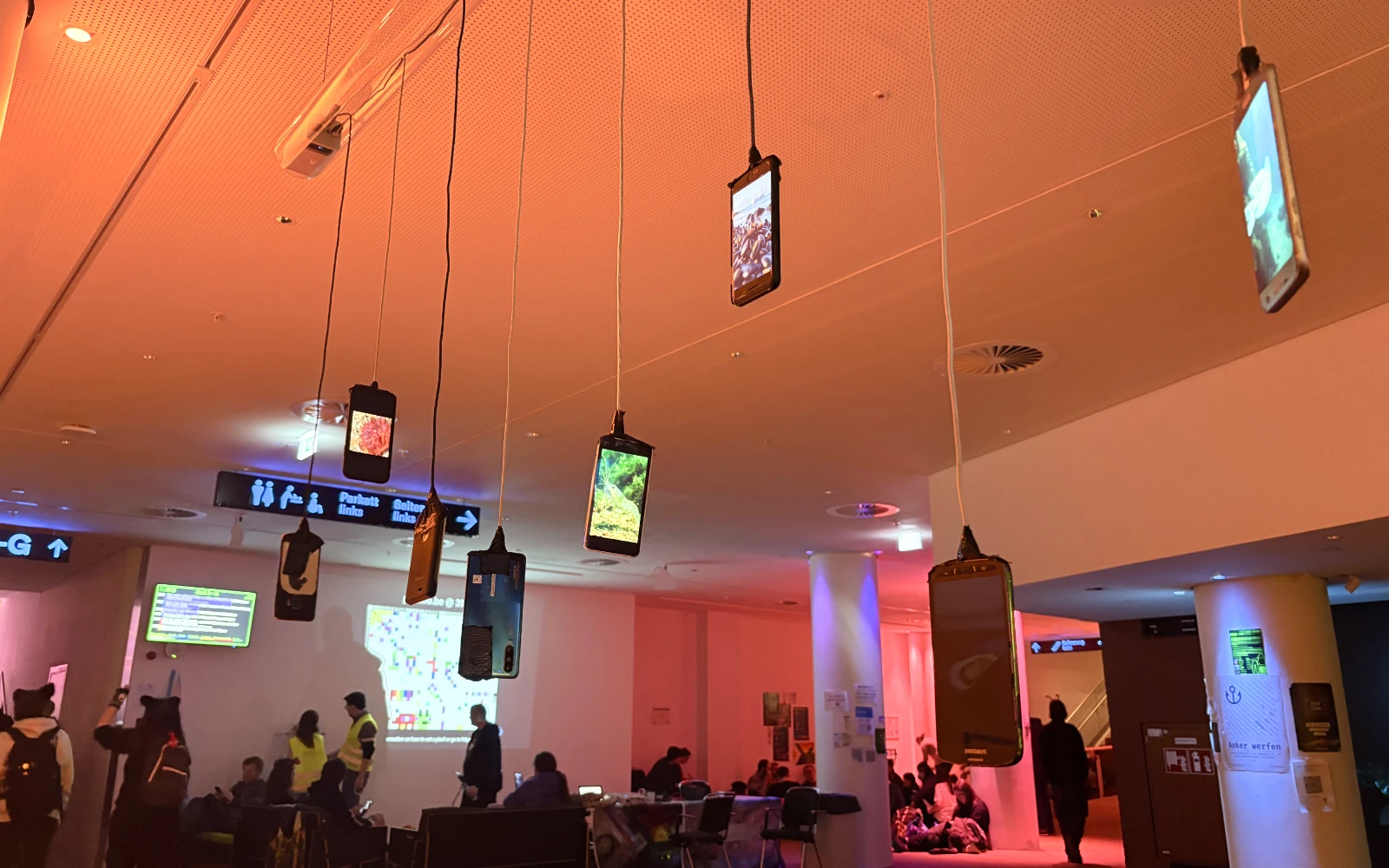
The venue was peppered with astonishing art installations like these smartphones hanging from the ceiling.

I always appreciate the chance to play around with the Minitel terminal, the outstanding telecomputing system from France that peaked in the 1980s.
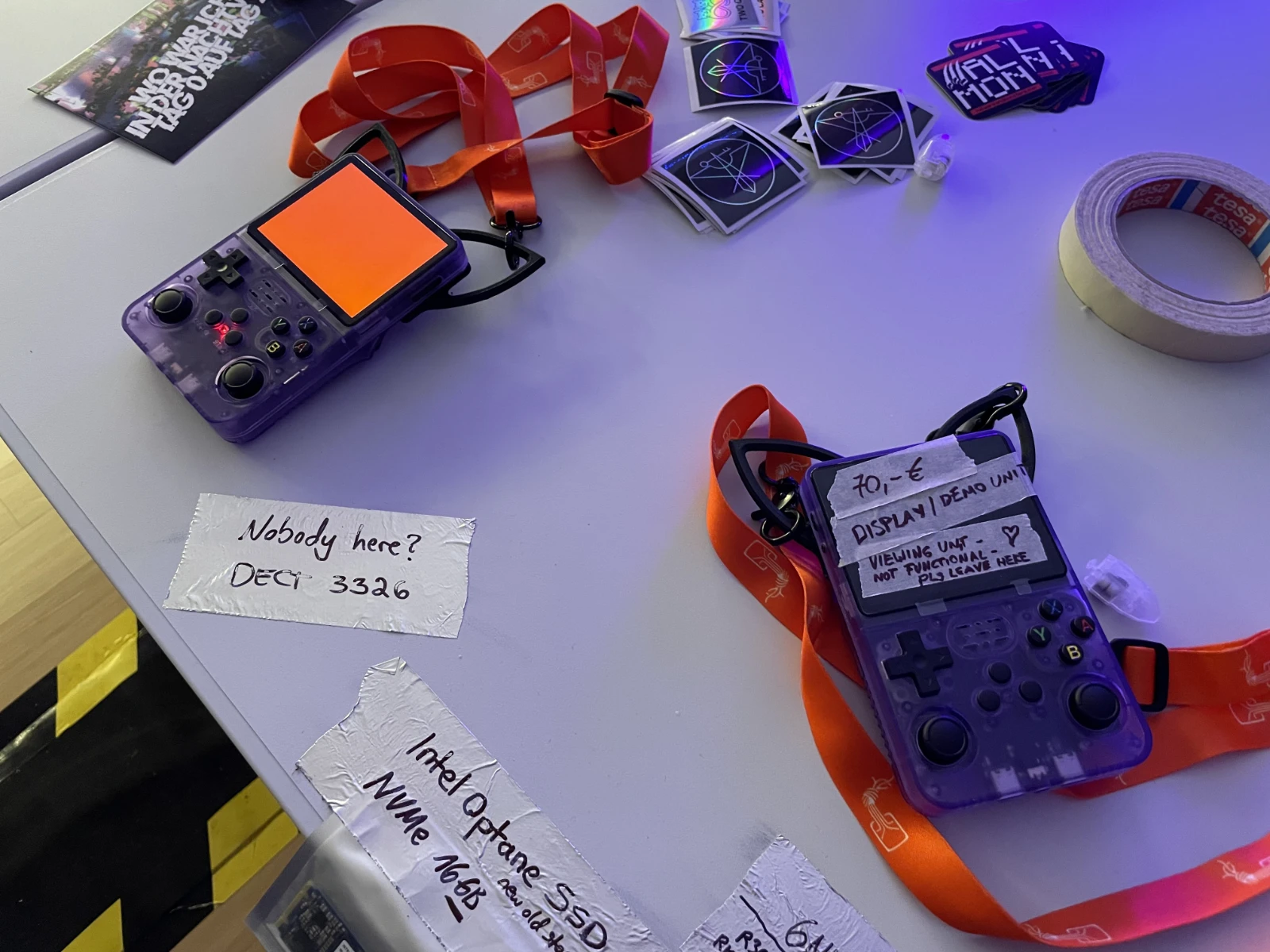
I found these two portable consoles in the retro hacking area.
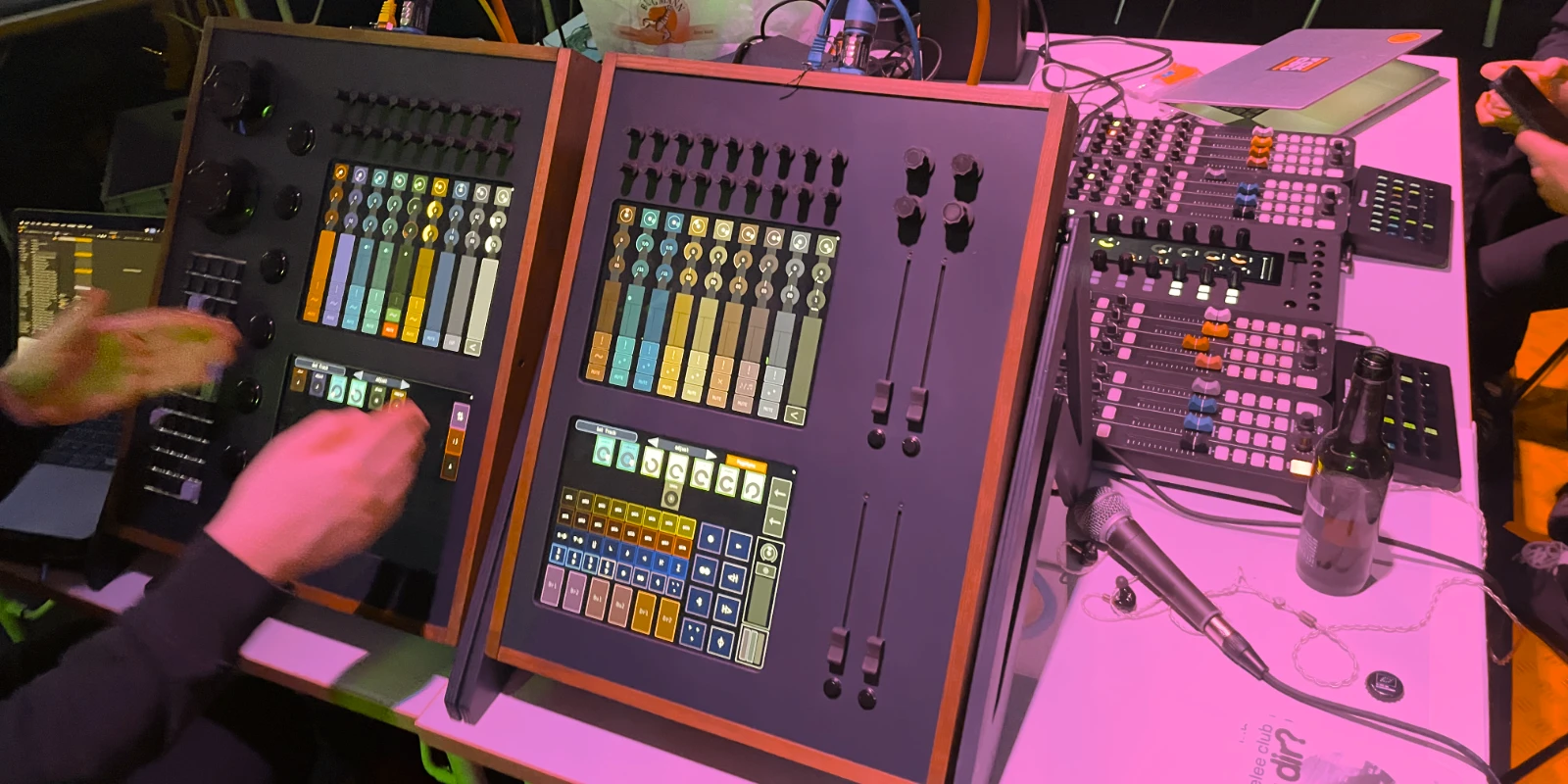
I think this is a custom-built MIDI/OSC control surface. These tablets integrate with physical faders, knobs, and buttons in a handcrafted enclosure. But I'm so unknowledgeable about musical devices that this is only a wild guess.

I bumped into this oscilloscope on someone's table. No idea what it's showing, but it's beautiful.
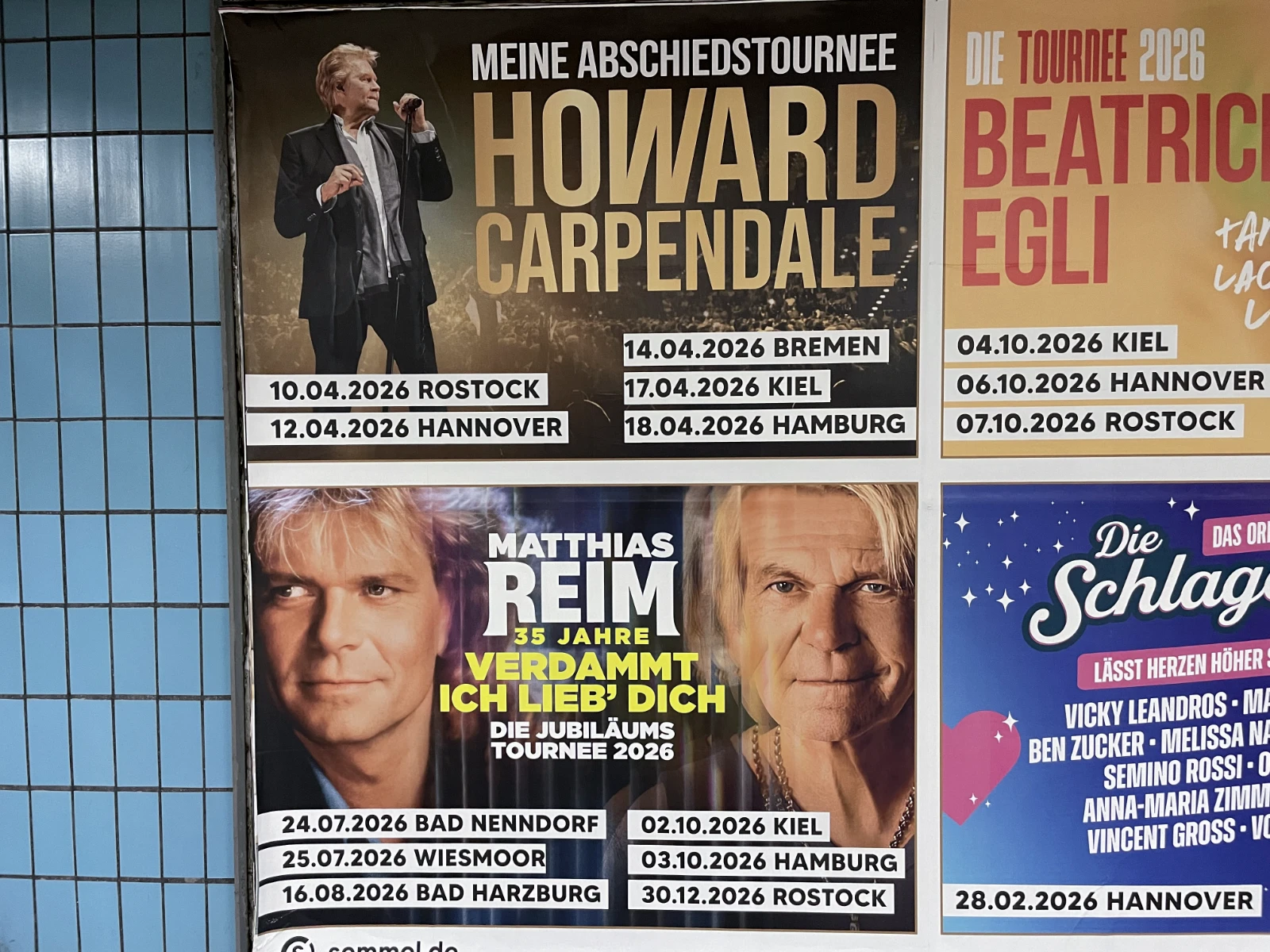
Advertisements for two concerts hanging in one of the metro stations. Darnit... Howard Carpendale and Matthias Reim could be twins.

Of course, someone has hacked a sewing machine.
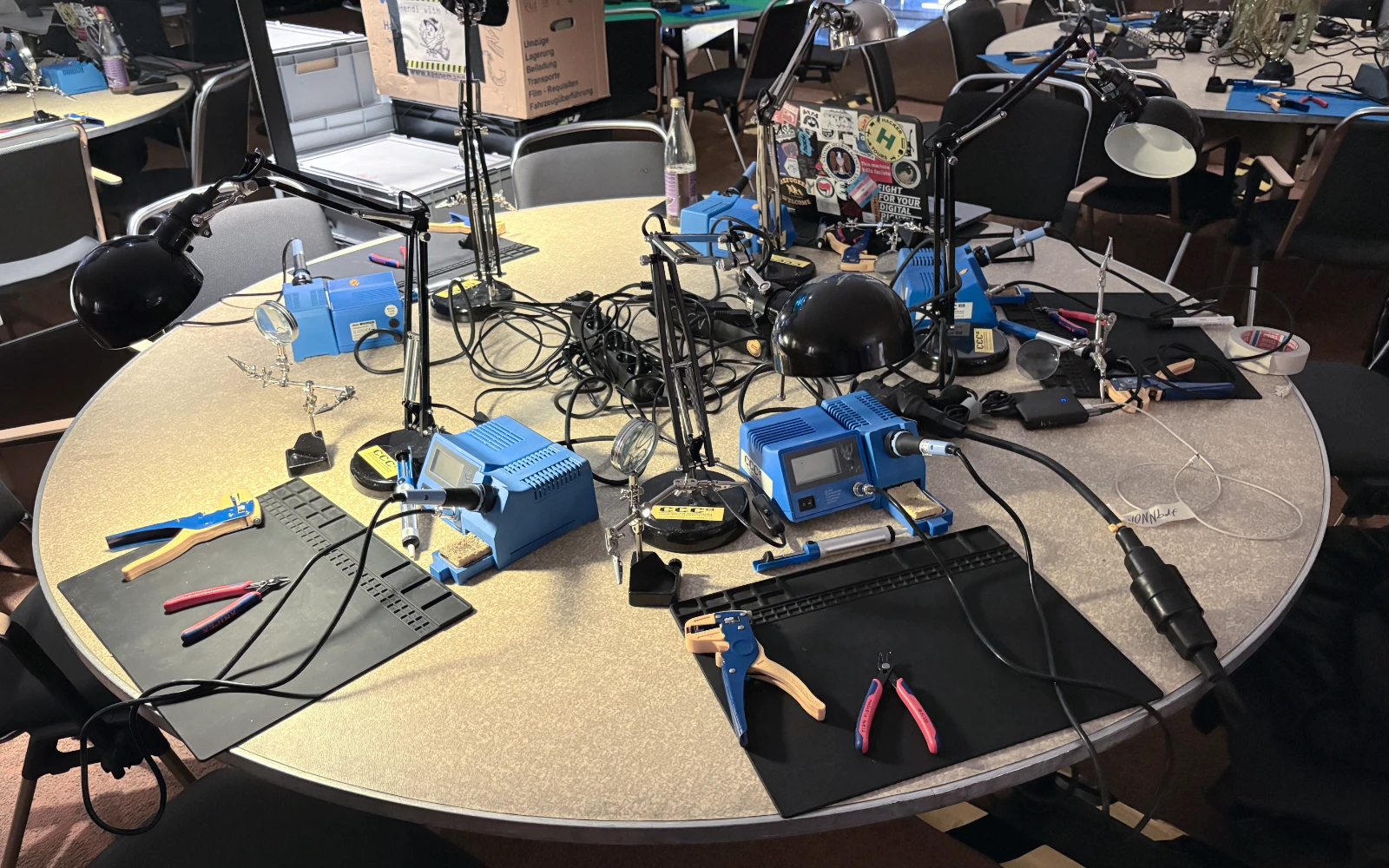
These are the spectacular desks in the soldering assembly area. I took this picture on day zero, before the Congress started, when all the tools were still clean and laid out neatly.
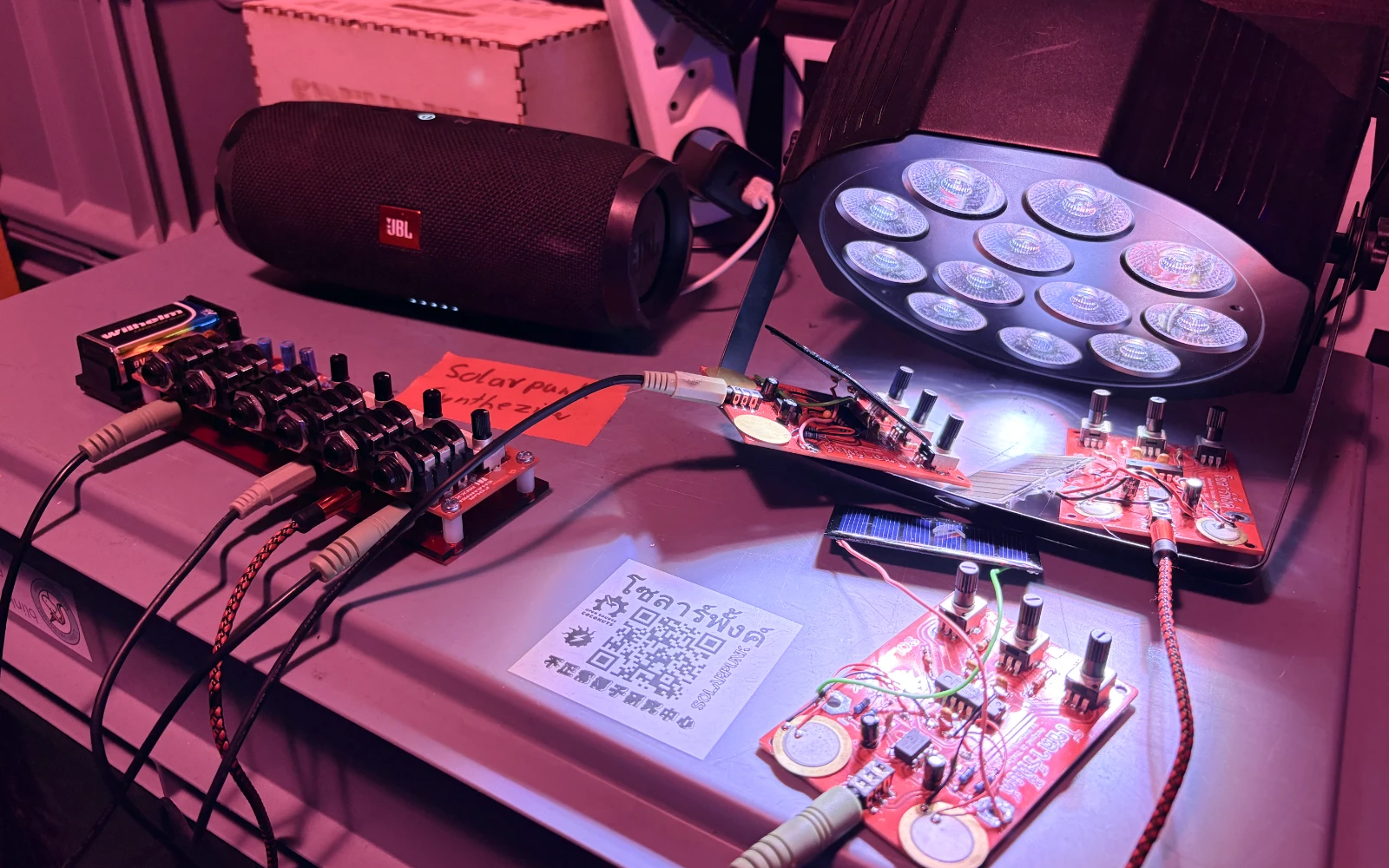
This is a device that runs on some sort of electricity (Captain America would get this reference.)

A synth in the C-Base area. That space seemed to have the highest concentration of electronic musicians.

The three shells from 'Demolition Man' were in the bathroom close to the retro hacking area. I still don't know how to use them.
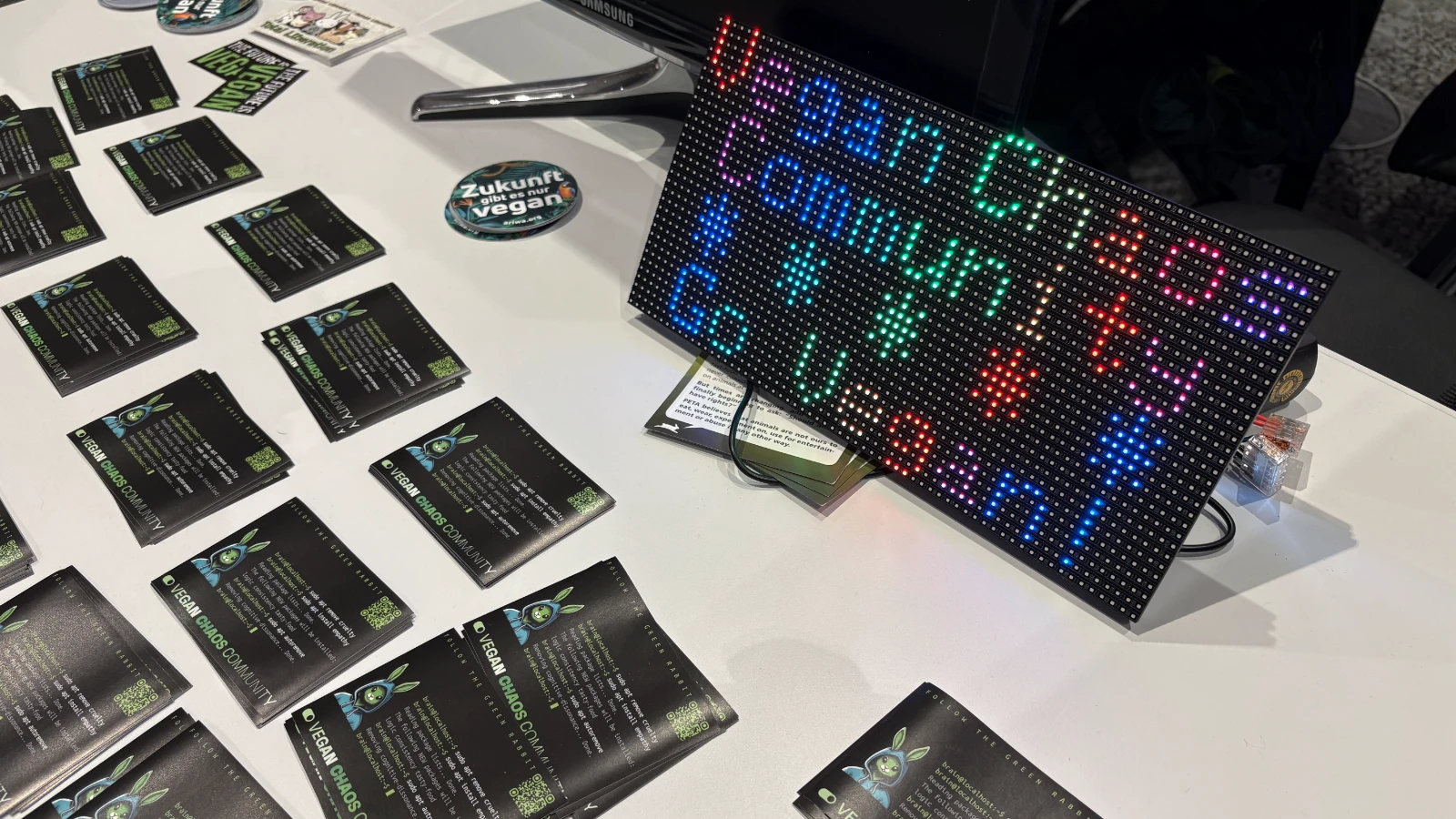
A welcoming table set up by the vegan community.

This is an original Vectrex game console from the 1980s running Asteroids with its beautifully crisp vector graphics. Someone in our retro hacking area had brought it with them.
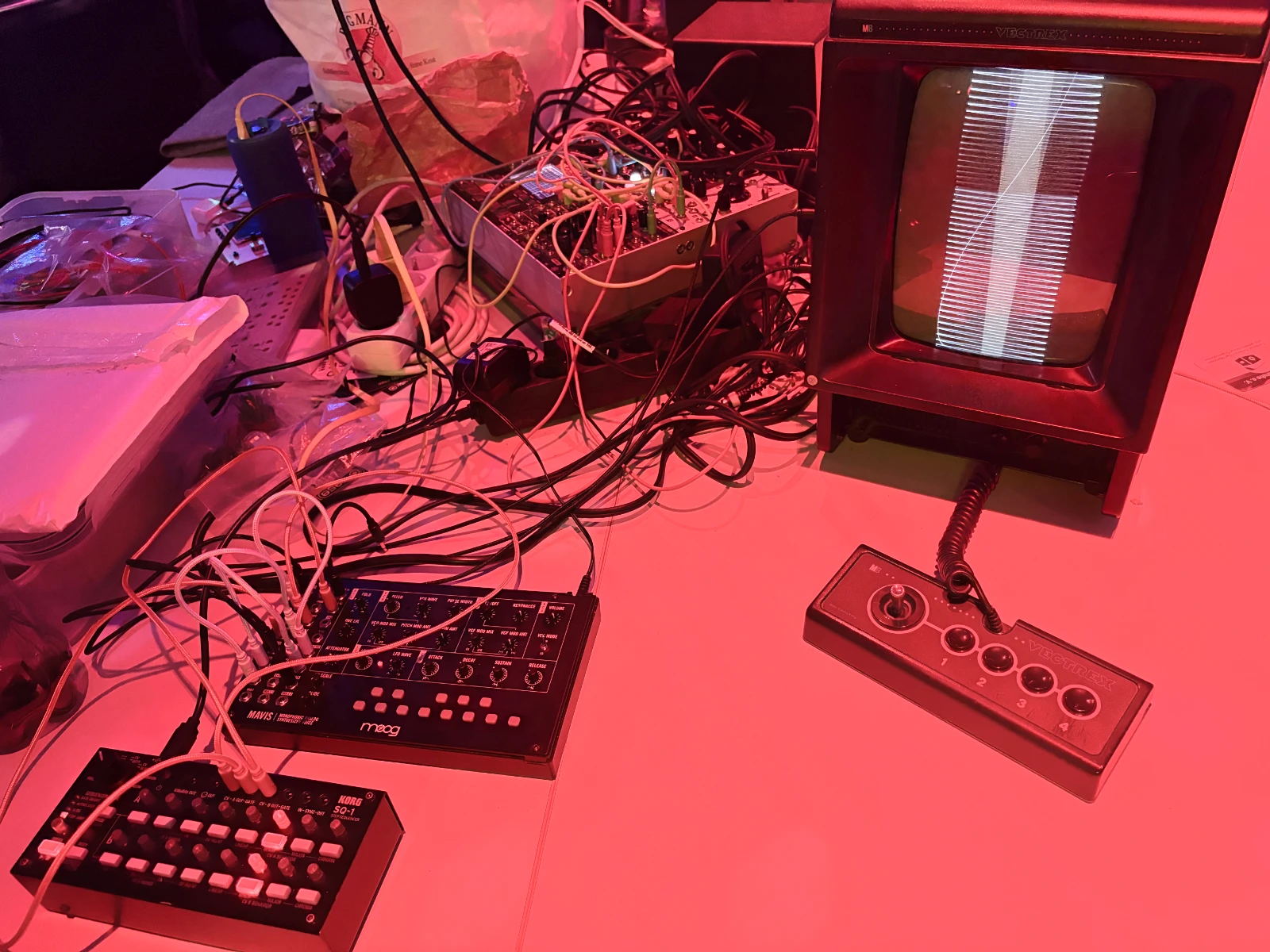
Of course, Qetu didn't want to play Asteroids when he got his hands on the Vectrex, he used it as an oscilloscope (it had been adapted by its owner).

Bureaucracy is everything: a request form to set a pixel. (Photo by Angelo P.)
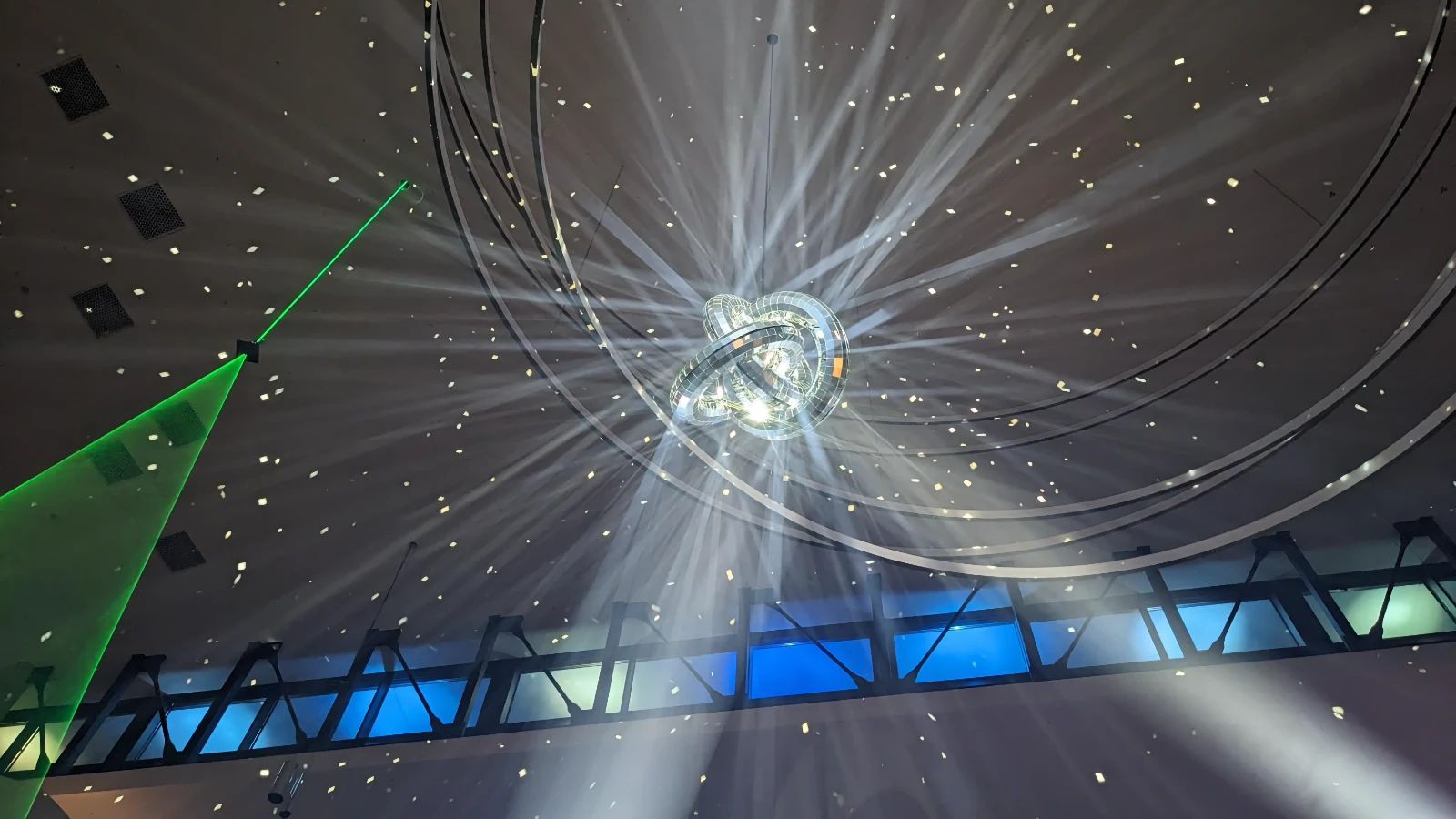
High above the rocket in the entry area, sparkly Borromean rings float. They are hypnotic. I cannot look away. All hail the sparkly rings. (Photo by Angelo P.)
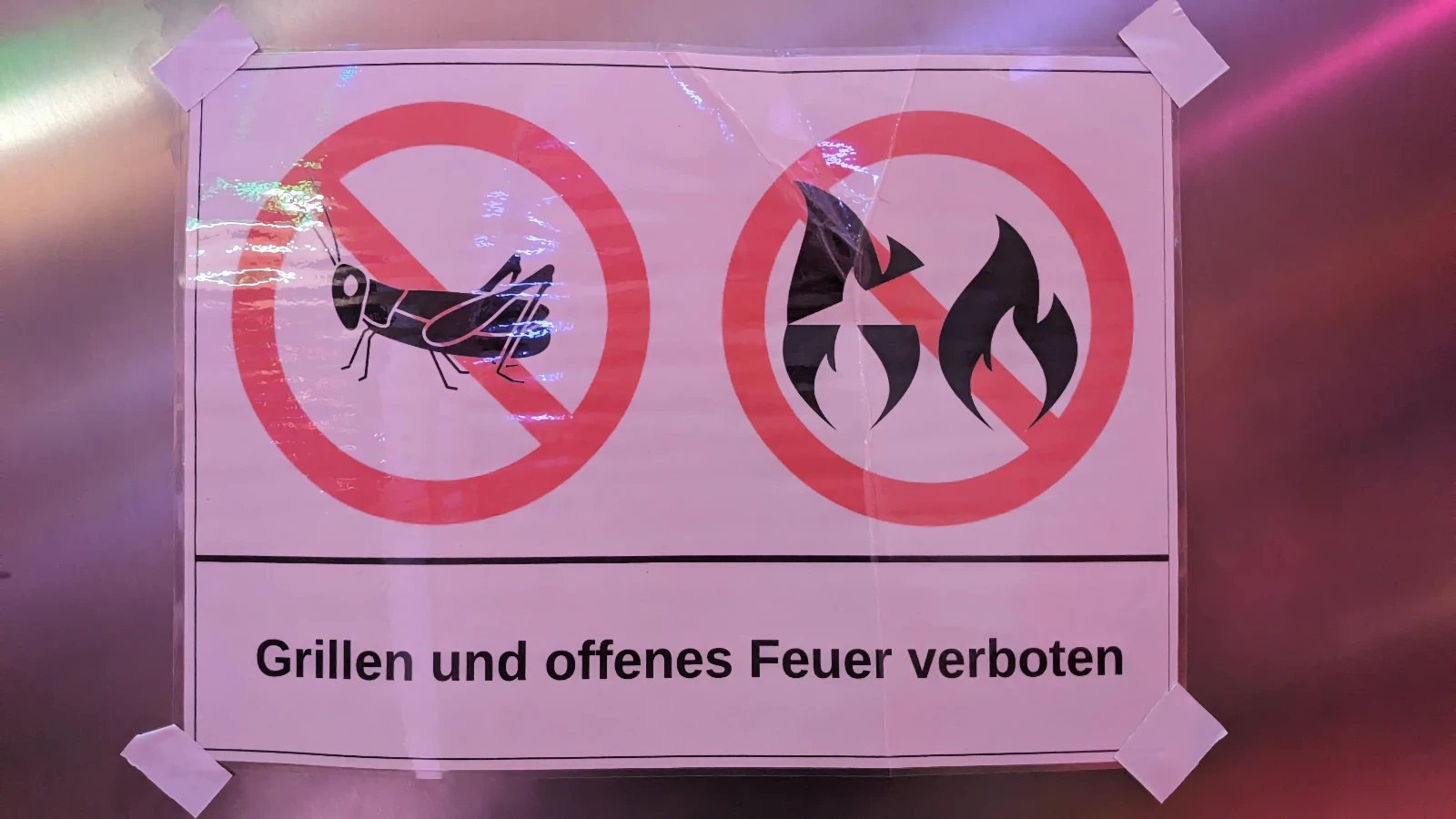
I have so many questions... and I am kinda scared of the possible answers. (Photo by Angelo P.)

The 39C3 cheat sheet. Finally some clear instructions to follow! (Photo by Angelo P.)

Yes, this is an overhead projector covered by a plush animal with googly eyes. I want to cuddle it! (Photo by Angelo P.)

Okay... so this is the Cosmic Cube. It was harnessed by Hydra. The Red Skull wanted to use it to destroy the east coast. Captain America thwarted his dastardly plans! I'm quite certain I've got the facts straight. (Photo by Angelo P.)
My Illuminated Little Mind: Punk Principles at 39C3
As already stated, I learned a lot at this Congress. But what exactly?
Somewhere between retro hacking tables, soldering irons, volunteer shifts, political talks, and late-night conversations, something clicked for me... and I mean that without any irony or sarcasm.
I don't think I can pinpoint a single talk or moment. Rather, it is a pattern that suddenly became clearer. I believe that there is a shared way of thinking that is similar to the Punk ethos.
Ironically, anyone who gets to know me will quickly realize that I am very far removed from being a punk in the literal sense. And yet, I found myself feeling more and more attached to what I believe punk ideas actually are.

The scene produces so many amazing pamphlets and printed
material that transport ideas in a tangible form. You don't
need to be a writer to create and share your thoughts in this
way.
Permission Not Required
Punk rock taught us that we don't need permission to create something. Simply start a band without training, print a zine without editors, release records without labels. Walking through the Congress, I saw the same principle expressed in code, hardware, and writing. People publish, build, and create without waiting to be chosen. If you can deploy it, it exists.
I like the thought that authority shifts away from institutions and back to individuals. Acts of creation should become their own justification.
The punk idea of Do-It-Yourself has evolved into owning the full stack. Where punk bands once pressed their own vinyl and booked their own shows, hackers own their domains, control their hosting, and keep their work portable. At the Congress, this mindset was everywhere: self-hosted services, hand-built infrastructure, and a clear preference for understanding systems rather than outsourcing responsibility. Dependency, I realized, might be the modern equivalent of slavery.

One of the many 3D printers at the Congress. Maybe now that
we can create and share physical things ourselves, the
old-fashioned notion of seizing the means of production now
has a totally different meaning?

Another 3D printer at the Congress. This is an open model.
Perhaps the open hardware movement is another expression of
the punk DIY ethos?
Bypassing the Gatekeepers
Anti-gatekeeping runs just as deep. Punk bypassed magazines and radio stations through zines and pirate broadcasts. Hackers do the same with their websites, RSS, mailing lists, and federated networks. Again and again at the Congress, the message was implicit but clear: if a platform can erase you, it owns you. We should try to call out that asymmetry wherever possible.
What also resonated strongly was the emphasis on participation over spectatorship. Punk scenes grew horizontally, with audiences becoming creators. At the Congress, I saw this at work: readers become writers, users become contributors, volunteers become organizers. Small audiences are valid. Influence does not require scale... and culture is something you actively do, not something you passively consume.
I came to the Congress expecting to learn about technology and politics. I know it sounds pathetic, but I think I changed a bit. I have a renewed sense that how we build, publish, and share is an ethical choice.
Maybe Punk did not disappear, it just transformed into something new. These days, it often writes code, runs on self-hosted servers, and steadfastly refuses to ask for permission.
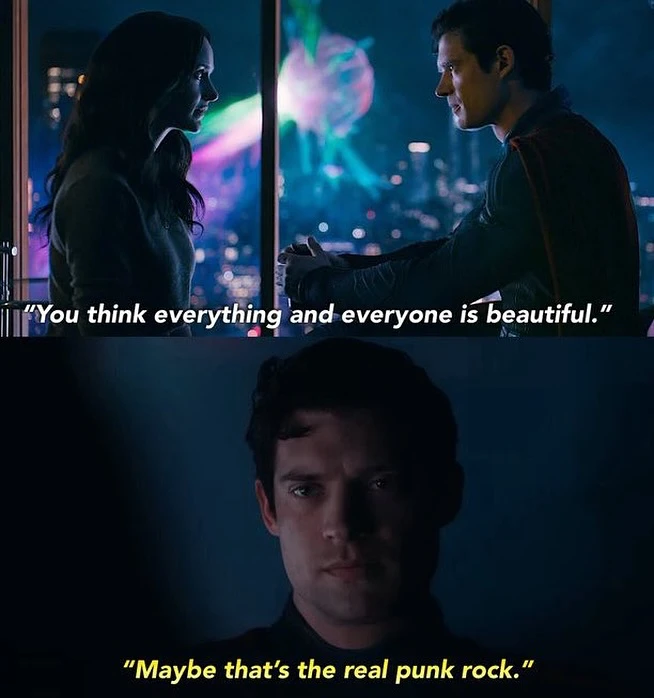
Who am I to argue? Even Superman says that kindness is the new
punk rock.
Unless otherwise stated, all photos were shot by me. I tried to anonymize as many people as possible... well, except for the CCC "celebrities" on stage.