How a Hackathon Can Be a Mirror to Your Soul
A Survival Guide to the People You Meet
Hackathons are a blast. An entire product cycle crammed into one intense, concentrated session. You get a problem, a deadline, a team, and start with a blank canvas. Then, you find out what participants are really made of. Here's a handy guide to the usual suspects.
April 2026
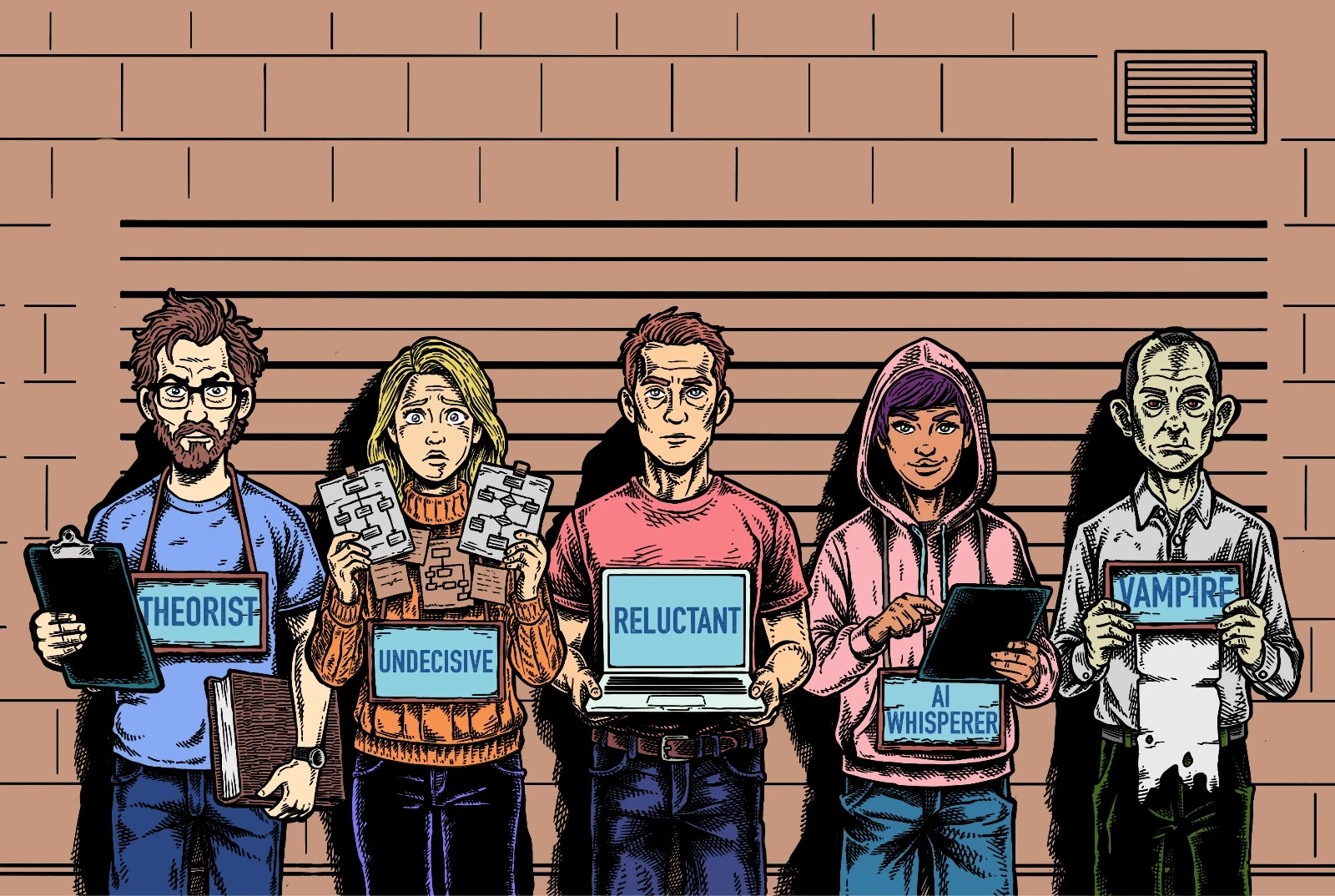
Perhaps you might recognize some of the archetypes... (Drawing by Marin Balabanov)
A competitive hackathon is an "innovation marathon."
Teams race to solve a specific problem, like building an AI tool for healthcare or a machine that folds your laundry (a man can dream, right?). The clock is ticking, usually for 24 or 48 hours, but sometimes longer. It's a pressure cooker designed to transform an idea into a functional prototype using caffeine and pizza as fuel.
It all ends with a high-stakes pitch to a panel of judges. Teams are judged on how well their solution works and how well they can argue the value proposition. Win, and you could walk away with cash, startup funding, or even a job offer. It really is a proving ground, and you get to learn a lot. And have fun while at it!
But beyond the code, hackathons are crash courses in human chemistry. You're often thrown into a team with complete strangers, forced to bridge gaps in personality and skills. Success means checking your ego at the door. You have to prioritize the team's goal over your own brilliant, world-changing ideas (at least for the weekend).
I recently wrapped up a two-week internal data science hackathon. It was as interesting and high-energy as it sounds, but since it was "work-work," I'll keep the juicy details under wraps.
This wasn't my first rodeo. Since 2022, I've been to quite a few hackathons, and our team even won CraftHack 2023 in Budapest. I try to write articles about my experience because this helps me learn from them. Here are some of them: CraftHack 2022, the KfW Hackathon 2023 in Frankfurt, Junction X 2023 and Graffathon 2024, both in Helsinki, and Build X 2025 in Budapest.
So what I can share is universal. Whether it's a recruitment hackathon or a community event like CraftHack, you are likely to bump into some of the remarkably consistent cast of characters.
Under pressure, the technical facade drops away. A hackathon acts as a mirror to your soul, reflecting back parts of your personality you might not see in a standard office setting. The loud get louder, the silent get silenter (yes, that's a real word), and the archetypes almost always emerge.

Tropic Thunder knew it... The dudes really are emerging!
The Archetypes
1. The Theorist (Who Doesn't Deliver)
Every hackathon has one. They speak early, and often. They always go on about "best practices". They'll warn you about scalability concerns for a prototype that only needs to survive a five-minute demo. They are genuinely brilliant... but their Git commit history is a ghost town. With digital tumbleweeds!
There is a fix though: give them a clear, time-boxed task. "Could you get the user authentication working by 3 PM?" is a great way to turn theory into practice (or to keep them busy so they don't get in the way).
2. The Chronically Undecisive
Thoughtful, responsible, but totally terrified of making the wrong choice. Just when you start coding, they'll want to "quickly reconsider" the database technology or project structure. Their heart might be in the right place (quality!), but in a hackathon, momentum is oxygen. Paralysis by analysis is a real threat!
3. The Super Collaborator
The person who not only asks "How can I help?" and means it but actually sees the work that needs to be done and where their team mates struggle. They pair-program without ego. They notice when a teammate is drowning and work to reduce friction wherever they go. They just make everyone around them 20% faster, without chasing the spotlight.
4. The Pillar
They can be the engine. While the rest of the team debates the "vision," the Pillar is busy setting things up, fixing the pipeline, committing the first solution, and untangling API integrations. They deploy the build at 2:30 AM without fanfare. Without them, there is no final product.
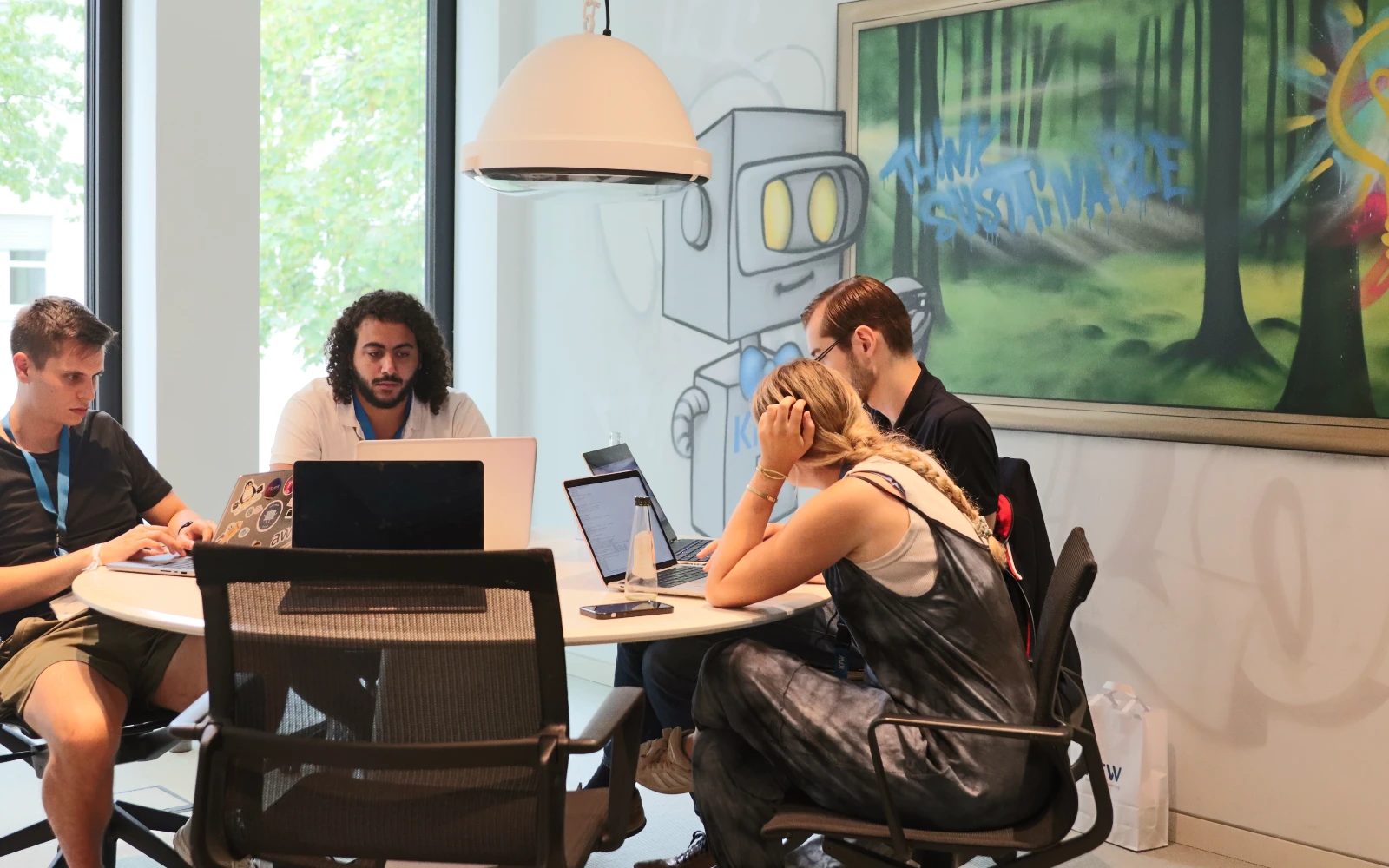
Hackathon participants in action at the KfW Hackathon in
Frankfurt.
5. The Reluctant Participant
Sometimes it seems like they were assigned to the hackathon. Often they just look totally overwhelmed. They'll ask, "Wait, what are we building?" two days into the sprint. Then the team has to make the choice to use their energies to babysit and spoon-feed a relucant team member of to power through to the end.
6. The Slide Deck Hero
Developers often undervalue this role until it's too late. While the team is debugging at the eleventh hour, this person is crafting the narrative of the actual presentation. Judges don't only award points for the technical ingeniuity of the solution, they also reward the clarity and the impact of a good presentation. And the slide deck is part of it.
7. The AI Whisperer
A new but powerful breed. They move shockingly fast. They use AI to scaffold and generate features super quickly. At their best, they unlock rapid experimentation. At their worst, they build layers of "black box" logic that whithers when you look at it because no one understands it. Though, they do come through, more often than not!
8. The Silent Genius
You might barely notice them in the brainstorming sessions. They don't argue. They listen instead. Then, without an announcement, they push a beautifully structured solution that resolves the blocker the team has been wrestling with for six hours.
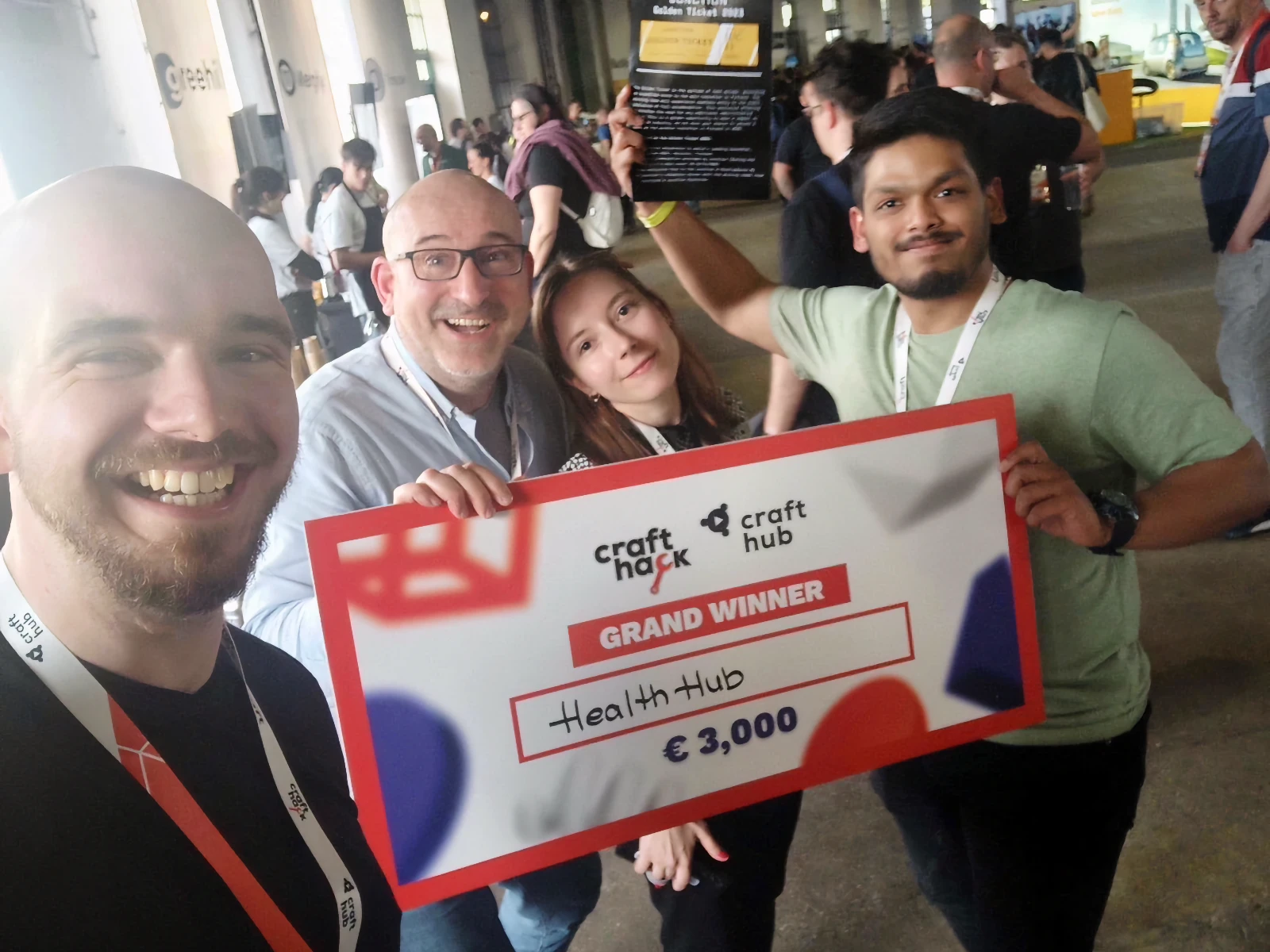
Our team at CraftHack 2023 in Budapest.
9. The Energy Anchor
Hackathons are endurance sports. The Energy Anchor celebrates every small victory. They bring snacks and suggest a walk when vibes turn sour. They are the fuel that keeps the engine running when thing look like they might breaks at midnight.
10. The Energy Vampire
The Colin Robinson of the group. They narrate problems in slow motion, sigh at constraints, and bring up office politics at 11:45 PM. They manage to deplete everyone's enthusiasm.
They don't kill the project with bad code... they kill it by making the air itself feel heavy.
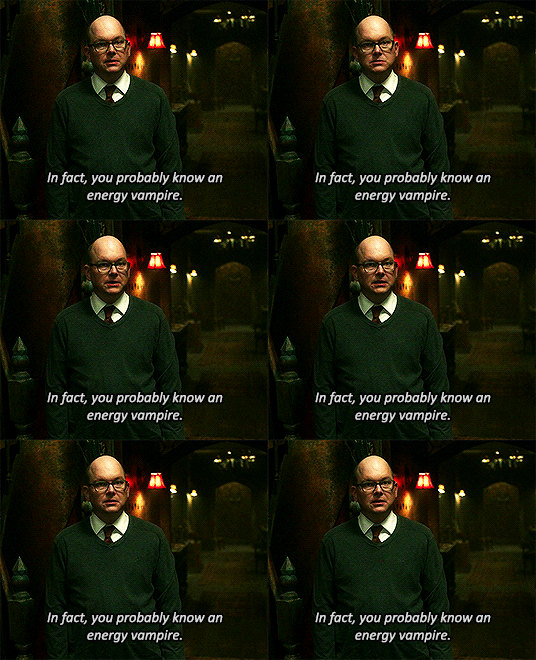
Hi Colin!
11. The Shapeshifter (The Truth)
The most honest archetype is the one that encompasses all of them. If a hackathon is a mirror, it's one that changes depending on the light. It is also a marathon of the mind. So it is rare for someone to stay in one "box" the whole time through the whole run.
Like Matt Smith's Doctor said right before regenerating: "We are all different people, all through our lives." It's just as fair to say we can be many different people throughout a single hackathon.
A participant might start as the Theorist during the optimistic morning brainstorm, transform into the Pillar during the afternoon grind, and, as fatigue sets in, temporarily devolve into a grumpy Energy Vampire at 1 AM. Your archetype often fluctuates based on your level of fatigue, enthusiasm, and, most (probably) importantly, caffeination.
Recognizing this "regeneration" in yourself and your teammates is the ultimate survival skill.
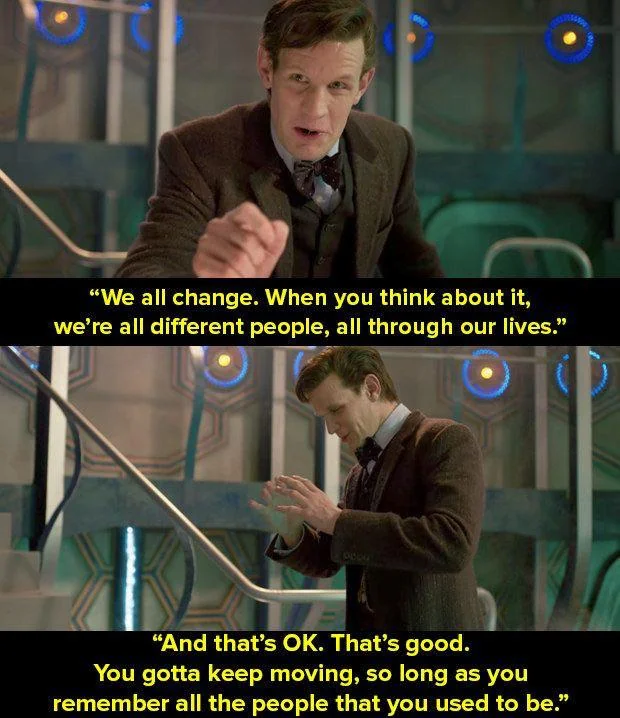
Thank you, Doctor!
Picking The Right Team Size
The ideal team size is a topic of much debate.
Some folks might prefer two-person teams because this allows them to be agile and efficient, they also run the risk of getting stuck if one person hits a wall. But larger teams of more than five people can be too unweildy and prone to coordination issues. They can also lead to "too many cooks in the kitchen" syndrome where people get in each other's way. A team of three to five people is often considered a good size. They can bring more diverse skills and ideas to the table.
To be fair, this is not my personal opinion. I've participated in quite a few hackathons. Most organizers actively discourage teams of more than five people because it makes for a worse experience. Europe's largest hackathon, Junction X in Helsinki, limits the team size to five. And they have more than 1,300 participants each year. (I once met someone who had participated in the fabled Absher Tuwaiq Hackathon in Saudi Arabia, the world's largest hackathon with around 4,000 participants, but dangit... I didn't ask about the team size limit there.)
It becomes particularly tricky when your team is composed of folks you don't know. It takes time to learn how they work, how they communicate, how they handle pressure, or how they think. You don't have this time at a hackathon. A smaller team can be more nimble and easier to manage. You can quickly adapt and pivot without worrying about too many moving parts. But if you have a team of people you know well and have worked with before, a larger team can be a powerhouse of creativity and productivity.
So maybe a team of four is the most agile and diverse without sacrificing effectiveness.
That all being said, no matter what the team size, it is certainly part of the fun of a hackathon to meet new people and learn how to work with them. If you figure it out, you might end up with a new friend and a new teammate for the next hackathon.
The Real Takeaway
When the final pitch is over and the hackathon venue slowly empties, you realize that the event was just the medium. The real result was the reflection. Hackathons are unique learning opportunities that you simply can't replicate in a standard 9-to-5 environment. They force you to see yourself in the mirror in a different light.
In these mini-sprints, you learn the hard way how to truly collaborate. You learn when to fight for your ideas and, perhaps more importantly, when to swallow your pride for the sake of the deliverable. How you handle the "you" that shows up when things go wrong. When the clock is ticking, "being right" is rarely as valuable as "being done."

Hitchhiker's Guide to the Galaxy
You don't just build a prototype. You build a better understanding of how you yourself handle pressure, obstacles, and success. In the crucible of the hackathon, you discover the archetype within you.
You discover how you react when a deployment fails at the worst possible time, or how you lead when the team loses its way. Whether you were the Pillar, the Theorist, or the Energy Anchor this time around, each event is a chance to refine your "human stack." And the great thing is that you are not set in stone. You can change as you learn.
So, grab another slice of cold pizza and get ready for the pitch. Win or don't win, you're coming out the other side a little bit sharper and smarter than when you started. And you walk away with a better understanding of the person staring back at you.

March 2025
Brains, Voice, Eyes, and Beard
Our Hackathon Adventure at BuildX Voovo Budapest
The clock was ticking, pizza power was flowing through our veins, and our team, the Health Hackers, was racing to build an AI-powered quiz generator at the BuildX Voovo Hackathon in Budapest. What followed was a whirlwind of late nights, AI struggles, and last-minute twists in a battle against time and technology.
Read more
November 2023
Junction X 2023
Helsinki Hackathon Horizons
In November 2023 at the Junction X hackathon in Helsinki, our team tackled the challenge by steel maker Outokumpu, focusing on sustainable AI solutions in steel production. The experience was delightful and enriching showcasing the power of diverse collaboration and the spirit of ingenuity, leaving us with invaluable insights and memories.
Read more
August 2023
Coding for a Cause
Our Hackathon Adventure at KfW Bank in July 2023
On a warm July weekend in 2023, in the heart of Frankfurt/Main, our team participated at the KfW Bank Cloud DevOps Hackathon. We jumped into challenges ranging from Microsoft Azure Cloud to Kubernetes and beyond. Join us as we recap our unforgettable adventure, filled with innovation, camaraderie, and a whole lot of code.
Read more
May 2023
Our Team Won A Hackathon
Caffeine, Code, and Collaboration: CraftHack 2023
In May 2023, we participated in the CraftHack 2023 hackathon in Budapest and created the POC for HealthHub, a doctor's AI assisted portal for scheduling CT scans. To our delight and surprise, our team was awarded the grand prize from among forty competing teams. It was an unforgettable experience. This is what happened, these were the mistakes we made, and this is what we learned.
Read more

Bye Colin!