VI. Creating Documentation
Video Recording for Documentation
When I started this project, I set my mind to documenting the steps as thoroughly as possible without being exceedingly boring or getting lost in details. I decided to record videos of the process of upgrading the retro hardware, record videos of the initial sketches and story breakdowns, make screen videos of the actual pixeling and drawing process directly by capturing the video signal from the Framemeister upscaler attached to the Atari STE.
I recorded three videos that I uploaded to YouTube chronicling the journey to the finished pixel art comic.
I used two Panasonic HCV-180 HD digital camcorders on tripods to record the manual drafting and design process at the drawing board. I had two additional photo lights, one on a tripod, and one attached directly to the camera via the shoe.

Figure 39: The camera and lights setup for filming
(Source:
Marin Balabanov)
For the captures of the Atari STE's screen I used an Elgato HD60 Game Recorder to feed the HDMI signal from the Framemeister into it, and then provide a pass-through to the monitor. The signal chain was quite elaborate. The Atari ST output via a SCART cable, which was converted to composite video, fed into the Framemeister (which needs a few milliseconds to upscale the video), then passed through the Elgato HD60 before finally reaching the LCD. All of this introduced a slight lag between input and video display, but it was barely noticeable. In any case, I only recorded part of the drawing process, leaving the Elgato HD60 detached and using the Framemeister directly attached to the LCD for most of the time.

Figure 40: The Elgato HD60S (Source: elgato.com)
For the voice recording I used a small Sony voice recorder designed for office use (which explains the mediocre sound quality).
I used Final Cut Pro X on a MacBook Pro to edit and composite the disparate videos and audio files, adding some chiptune music I captured from YouTube videos of old-school demos.
The final results were rendered to HD and uploaded to YouTube. Together with the text of this document the videos can be found at marincomics.com/duk-pixelart/
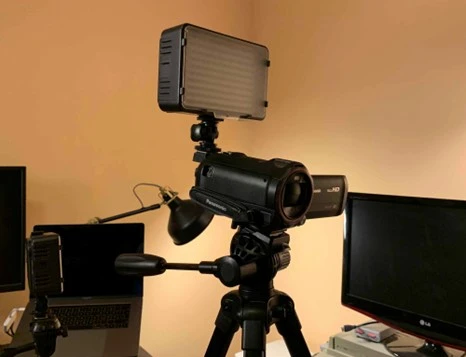
Figure 41: Close-up of the camera and light setup
(Source:
Marin Balabanov)