Stay Forever Con Nord 2026
A Retro Weekend in Hanover, From the Pavillon to the HI-SCORE Museum
At the end of October 2026, I flew to Cologne, fought my way across Germany on delayed trains, and spent a long weekend in Hanover for the Stay Forever Con Nord. There were two days of live podcast recordings in front of a packed hall, a quiz night, lots of conversations about games that are older than some of the attendees, and, on Saturday night, an after-show among the blinking arcade cabinets of the HI-SCORE video game museum. Getting home turned into a little adventure of its own. It was great fun.
October 2026
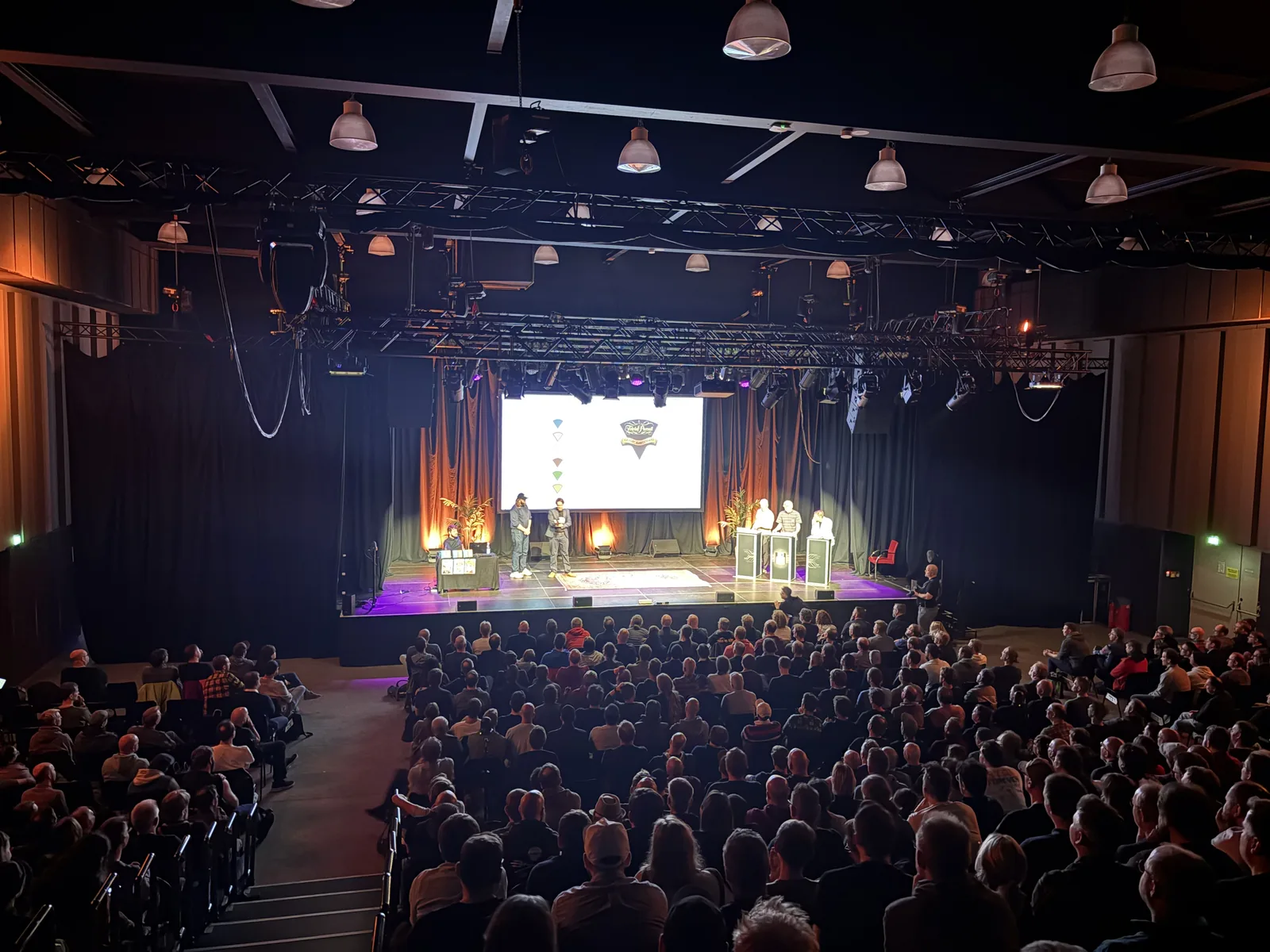
A full house at the Pavillon for the Saturday night quiz.
What Is Stay Forever?
If you don't speak German, you might not have heard of it, so let me give you some context. Stay Forever calls itself the largest German-language retro games podcast, and I don't think anybody would argue with that. Since 2011, it has been taking apart the computer and video games of the 1980s, 1990s, and early 2000s, usually one game per episode, and usually for well over two hours. The episodes cover how a game was made, who made it, what the magazines said about it at the time, and why it still matters (or why it doesn't). It's history told with an insider's knowledge and a fan's affection.
The podcast was started by two veterans of the German games press. Gunnar Lott was the editor-in-chief of GameStar and GamePro, and Christian “Chris” Schmidt was GameStar's deputy editor-in-chief. Both later moved into the games industry itself. That double perspective of having reviewed these games as journalists and then seen how the sausage is made from the inside is what gives the show its flavor. Gunnar is the anecdote podcaster, the warm storyteller who likes to start his sentences with “Back in the game shop…”. Chris is the meticulous researcher who has read every interview and every postmortem, loves a good pivot table, and is said to own more than 10,000 PC big boxes.
Over the years, Stay Forever grew from a two-man hobby into a listener-funded production with a whole team and a family of spin-off formats:
- Fabian Käufer is the calm console expert who can't be rattled by even the most heated discussion. He co-hosts episodes and was Chris's opponent in the convention's “Box Office Battle”.
- Henner Thomsen is the tinkerer and hardware expert behind the Technik episodes, which deal with the computers and consoles rather than the games.
- Rahel Schmitz-Beckers is the horror specialist. She's at her best when the lights go out or when Cthulhu is involved, and she also brings in role-playing topics.
- Christian Beuster is the quizmaster of the live quiz and the master of the trick question.
- Paul Schmidt is the artist behind the podcast's poster artworks.
The convention swag bag even contained a trading card in the style of a well-known pocket monster franchise: “Stay Forever – Schnapp sie dir alle!” (“Catch them all!”). It has a pixel art portrait of each of the six podcasters, two types each, an attack, and special abilities, plus a box to tick once you've spotted them in the wild. Gunnar's attack is “GET ALL”, and Henner can supposedly play Quake on a toaster.
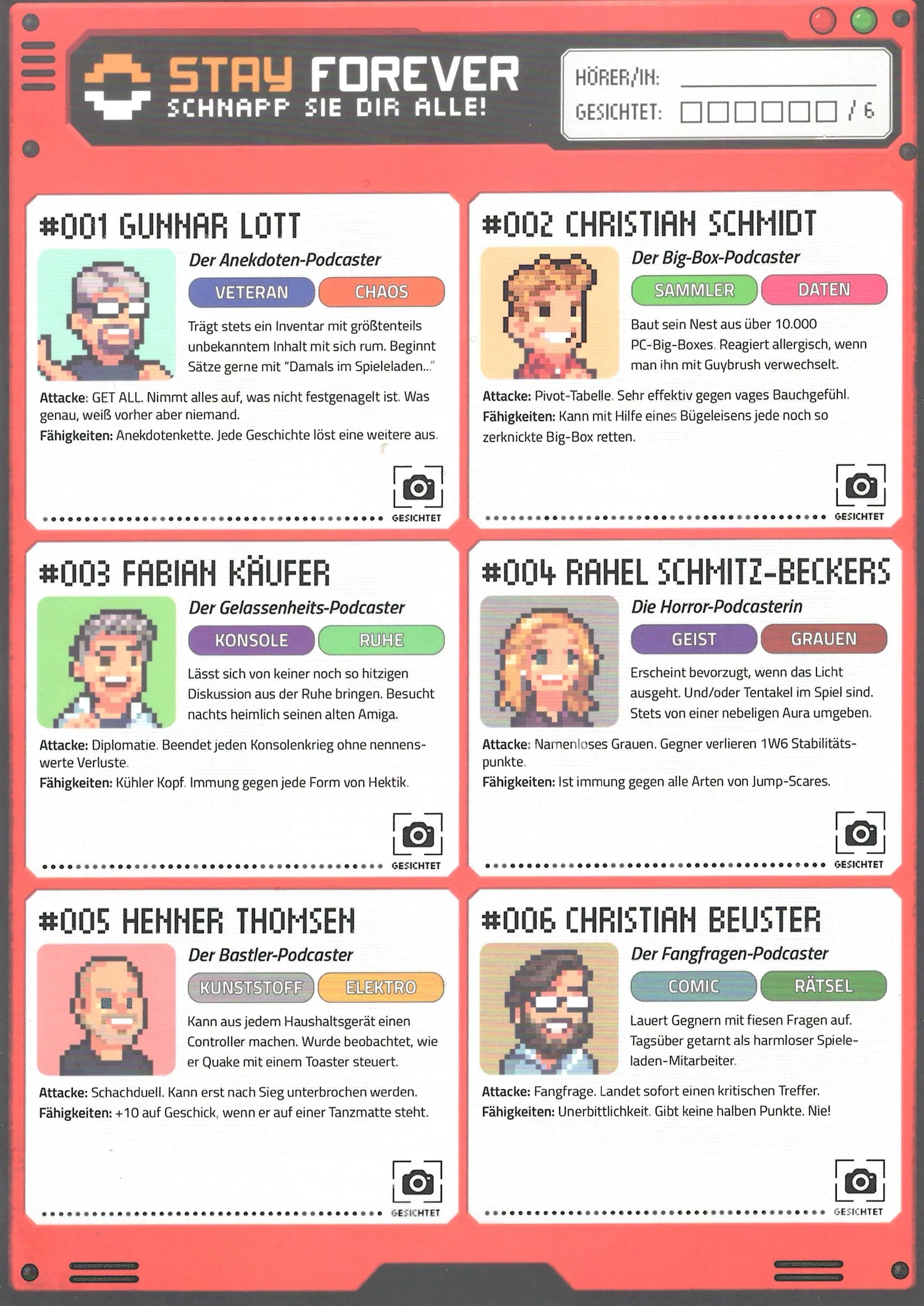
Gotta spot 'em all: the Stay Forever trading card.
On top of the main show, there are formats like Stay Forever Spielt (playthroughs), Ausgefragt! (listener questions), Pixelkino (films), and Das Format ohne Namen (a chat with no game focus at all). The supporters, who pay a monthly fee, get access to well over a thousand exclusive episodes. The podcasters also tour Germany with a live stage show, and since 2024 the community has had its own convention, which started in Karlsruhe. This year, a northern edition was added in Hanover.
Getting There: Sofia, Cologne, and Deutsche Bahn
My journey started on Friday, October 23rd, with an early flight from Sofia to Cologne/Bonn. By half past ten, I was standing on a platform at Cologne's main station, next to the big blue tent of the Musical Dome, in a very good mood. My plan was simple: a few regional trains via Hamm and Minden, and I'd be in Hanover by half past three.
Of course, this being Deutsche Bahn, things did not go according to plan. My connection fell apart in Hamm, and I ended up spending a good part of the afternoon in its admittedly very handsome station hall and in Charlie's Bistro close by, where I had a few beers while chatting with some of the locals. I kept refreshing the DB app and staring at the departure board. When I could finally move on, I made it as far as Minden, where I waited for the next regional train to Hanover. I arrived at 19:51, a little more than four hours later than planned. At least the stations were pretty.
Arriving in Hanover
I stayed at the Motel One next to the Opera House, which turned out to be perfectly located: the station, the city center, and the convention venue are all within walking distance. Sadly, the delays had a price. I arrived far too late for the get-together that the Stay Forever fan community had organized for the evening before the con, at Reimanns Eck on the Lister Meile 26, just a few steps from the convention venue. So I checked in and went out on my own to stretch legs that had spent the whole day on trains. Hanover welcomed me with shiny wet pavements, and the Opera House glowed under a full moon after the rain. Hanover was showing me its best side right away.
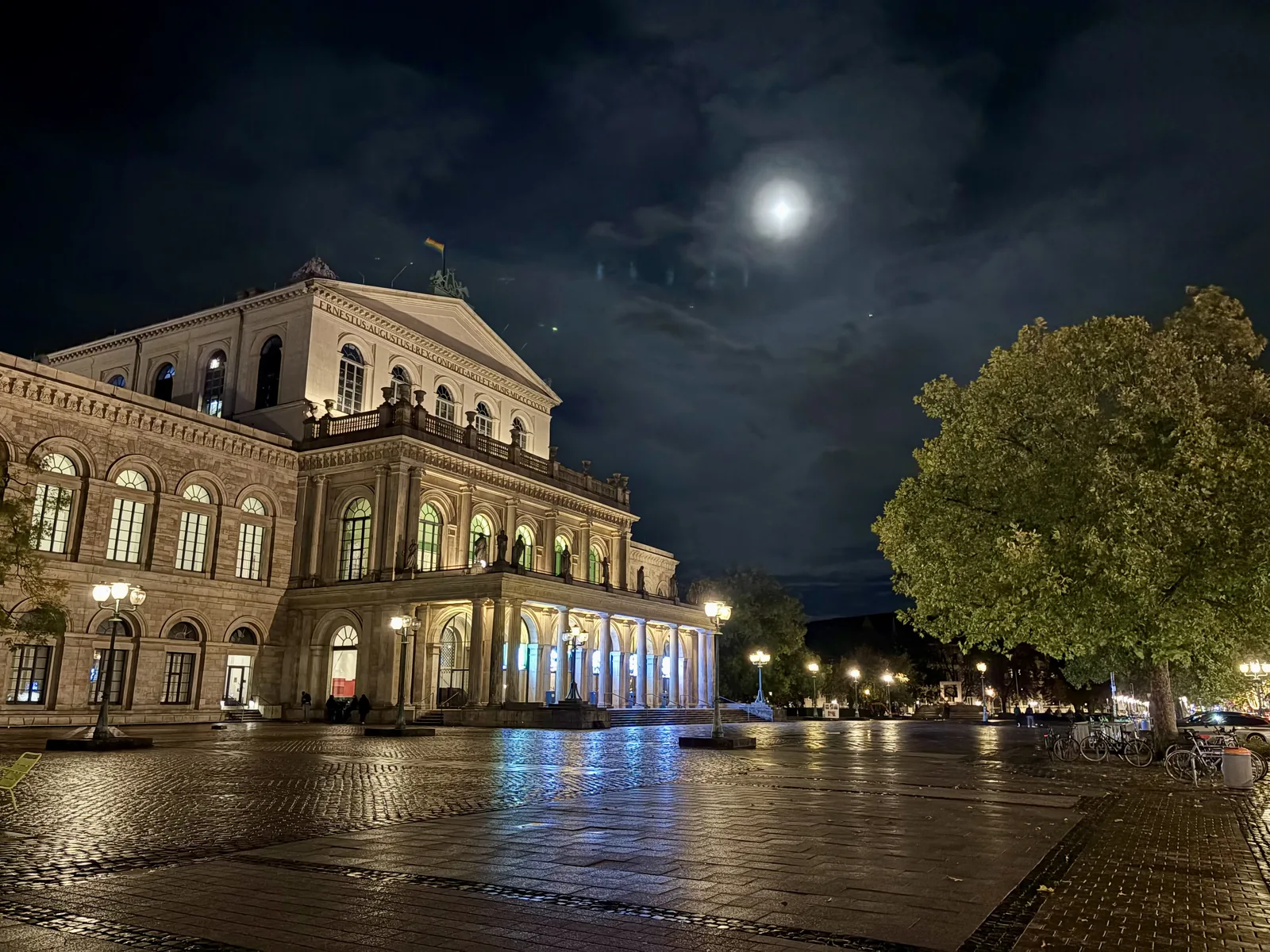
The Hanover State Opera on Friday night, with the moon doing its best to light the scene.
The convention venue, the Kulturzentrum Pavillon, is just a five-minute walk from the north exit of the main station. On Saturday morning, under a grey sky, my way there led me from the Opera House past the station's neo-Renaissance facade and the equestrian statue of King Ernst August. Locals apparently arrange to meet “unterm Schwanz”, under the horse's tail.
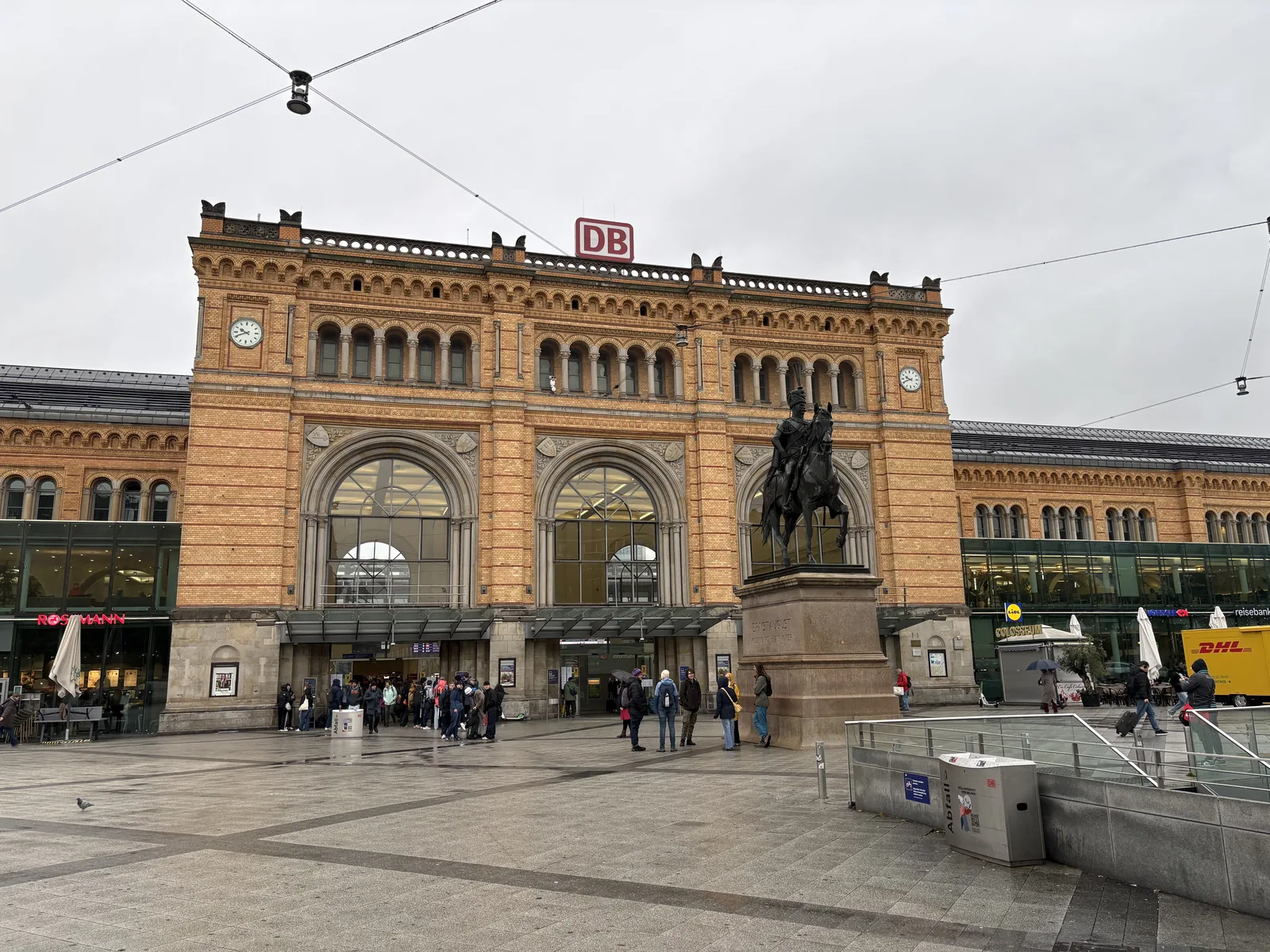
Hanover Hauptbahnhof and Ernst August on Saturday morning.
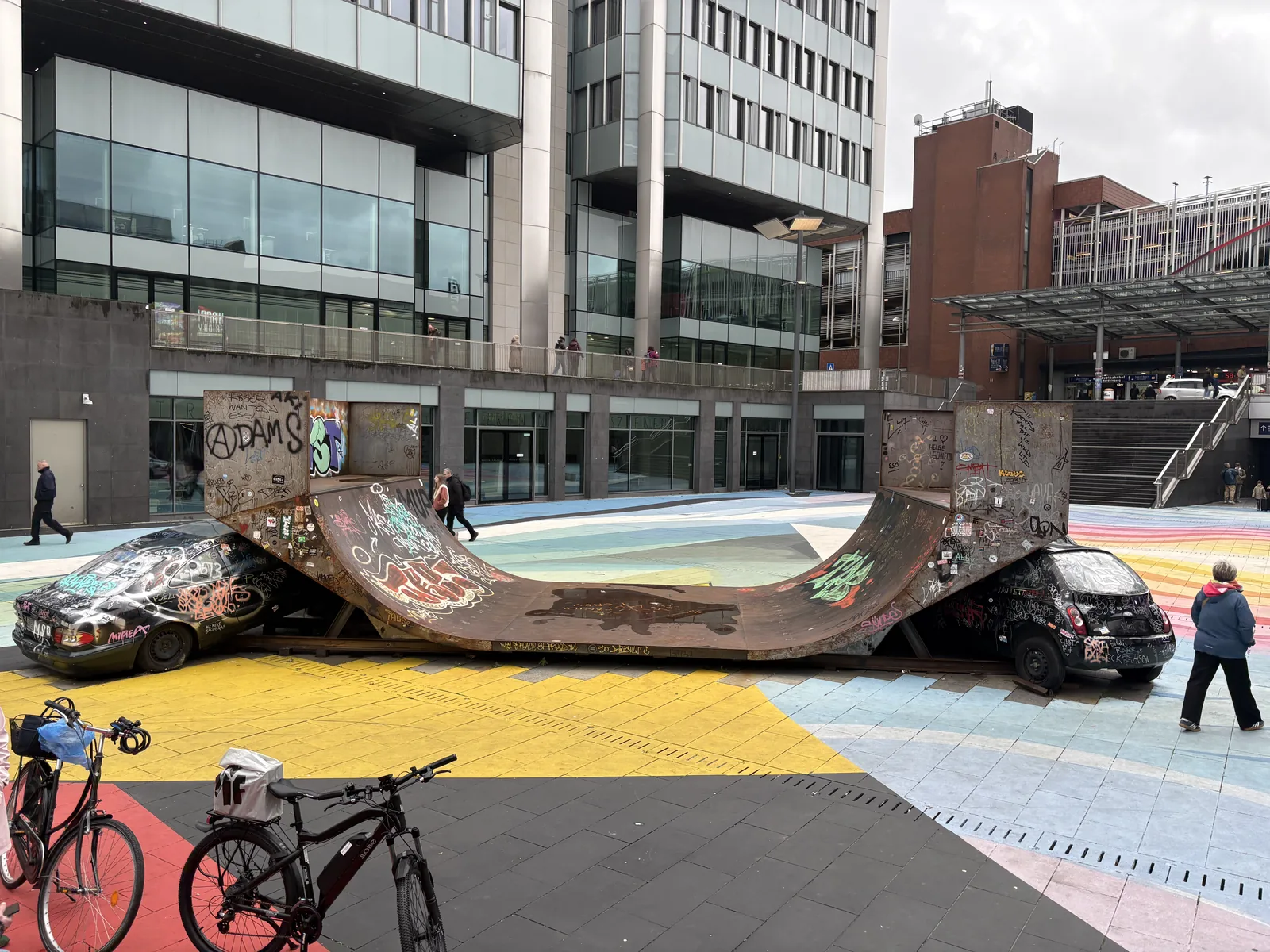
Behind the station on Raschplatz: a graffiti-covered half-pipe on top of two crushed cars.
During the breaks, I wandered through the city center. The pedestrian zone between the station and the Kröpcke is one long shopping mile, with a sunken promenade running alongside it, and at night the old Kröpcke clock stands there like a lighthouse. It is another of the city's meeting points, a role it has apparently played since the nineteenth century.
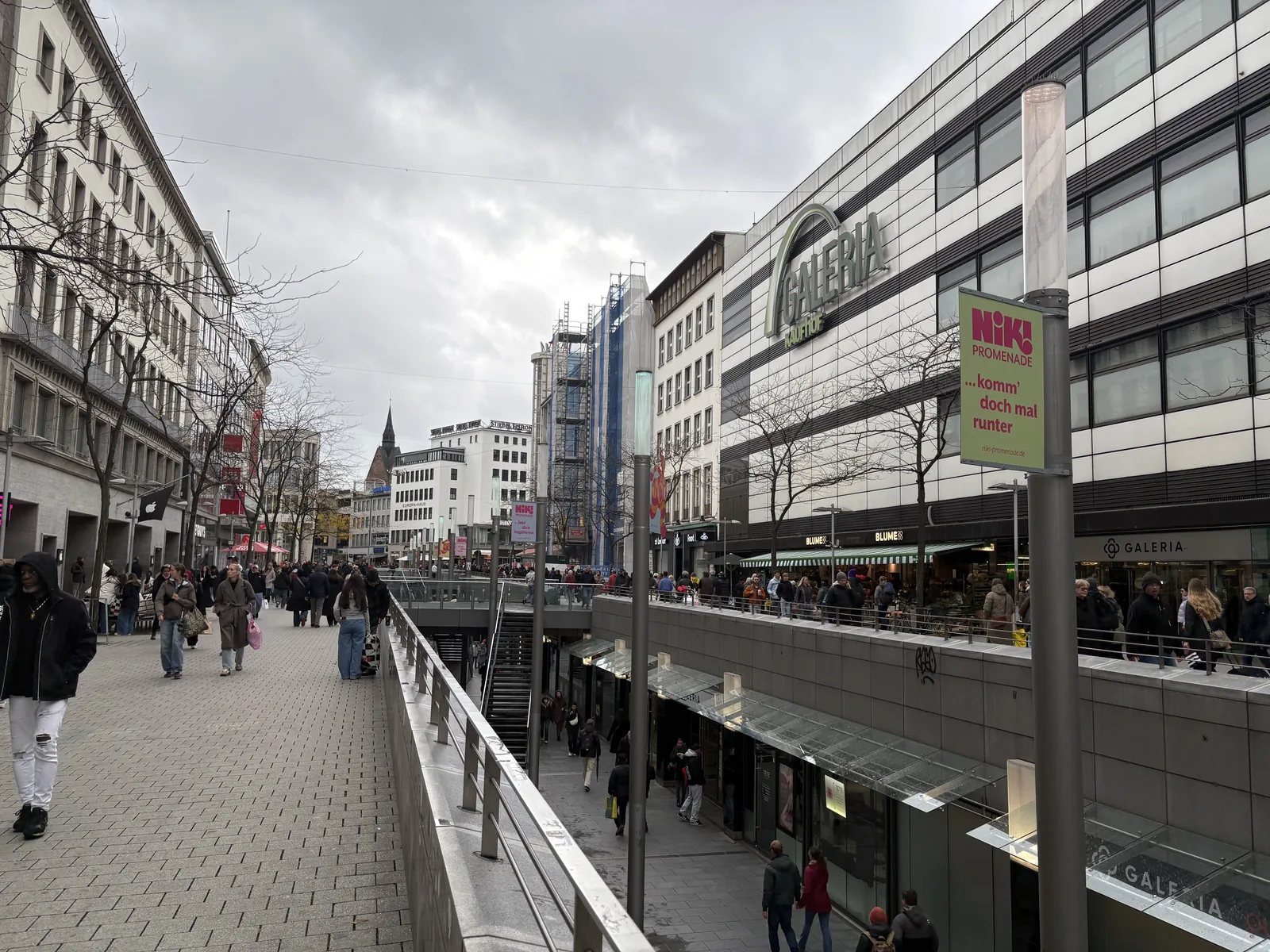
The pedestrian zone by day.
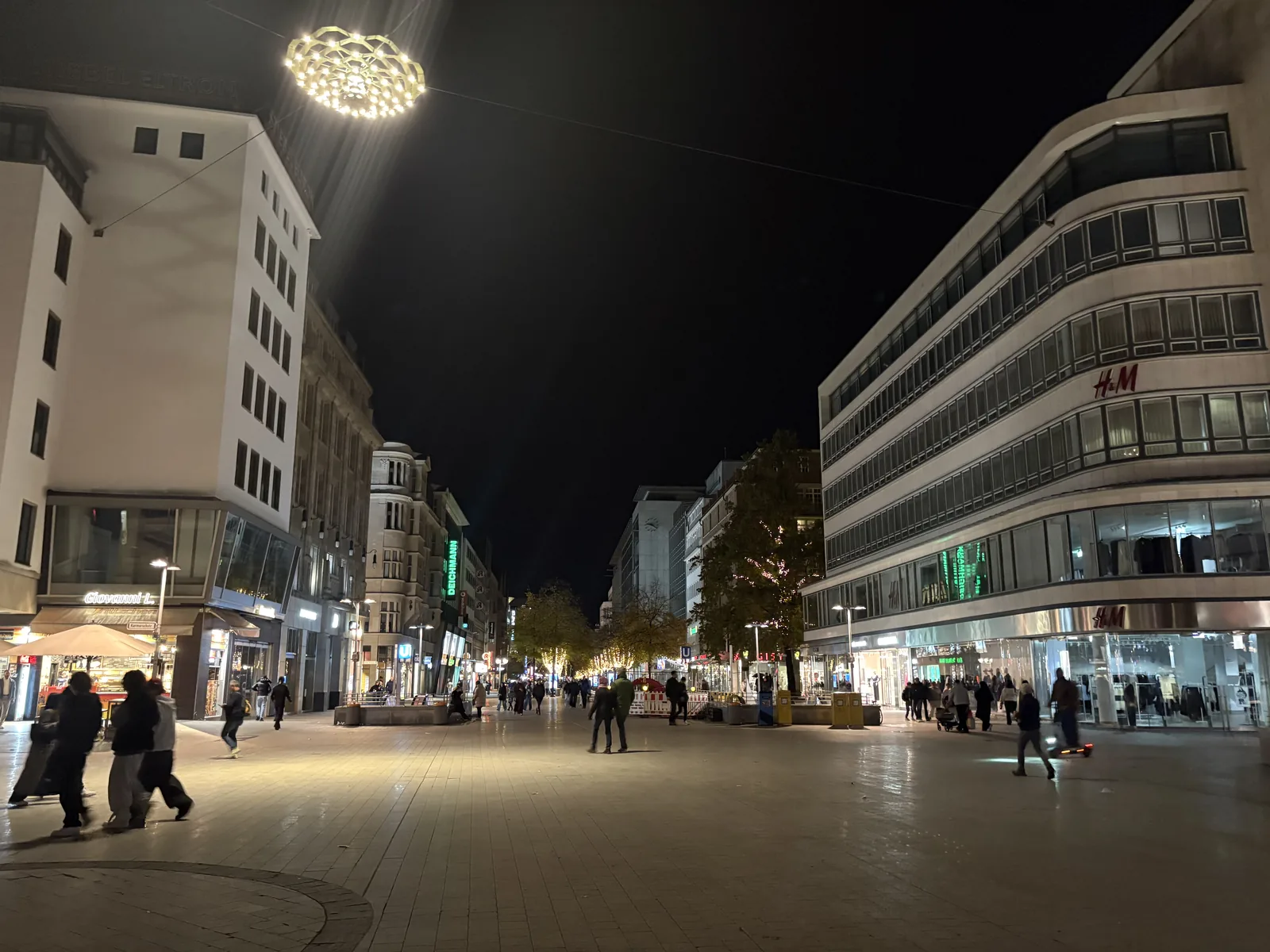
And by night.
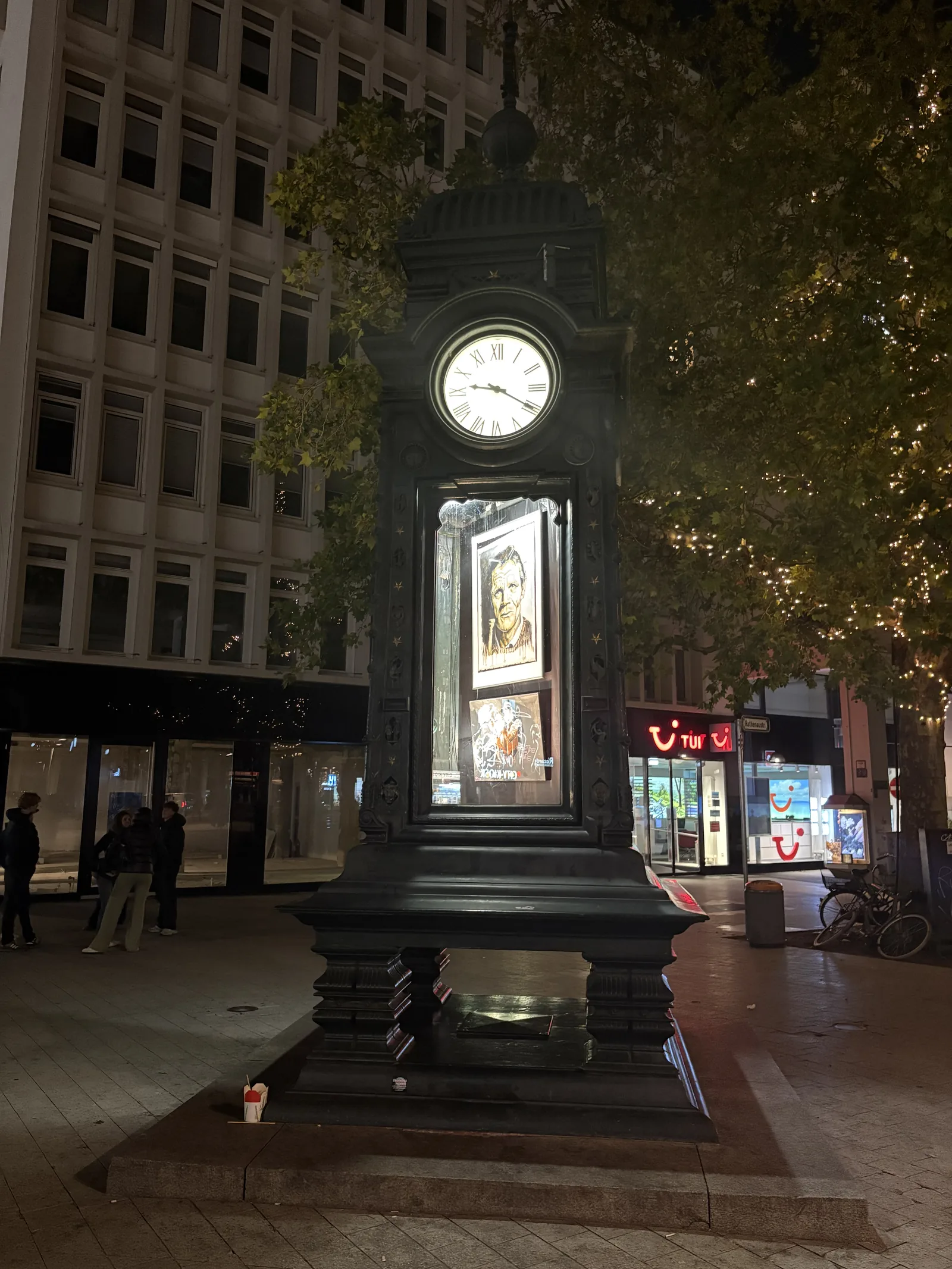
The Kröpcke clock.
Saturday: The Convention and the HI-SCORE After-Show
Doors Open at the Pavillon
From what I gathered, the Kulturzentrum Pavillon seems to be one of Hanover's best-known cultural venues. It was founded in 1977 by a citizens' initiative, in a flat-roofed building just behind the main station that had originally been put up as temporary retail space for a department store. Today, it is a cultural institution of the city of Hanover and hosts more than 350 events a year: concerts, cabaret, comedy, theater, and readings on several stages. It is also home to the MASALA world music festival, and it can hold up to 1,200 visitors.
The building is located on the Lister Meile, recognizable by its red roof overhang, and faces Weißekreuzplatz. On that square, I stumbled upon something I didn't expect: a segment of the Berlin Wall, set up as a memorial to the victims of the wall and the barbed wire that once divided Germany.
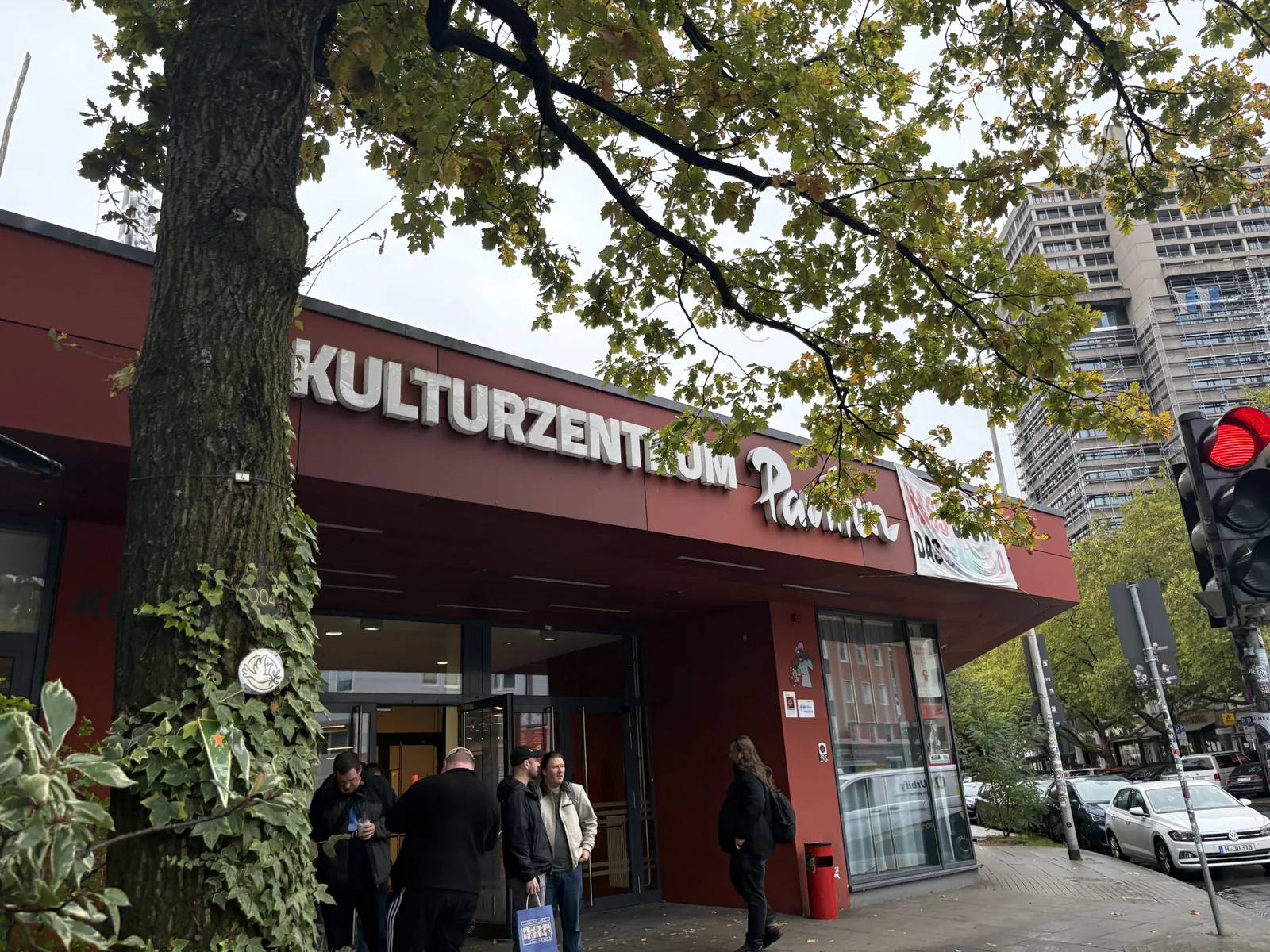
The Kulturzentrum Pavillon.
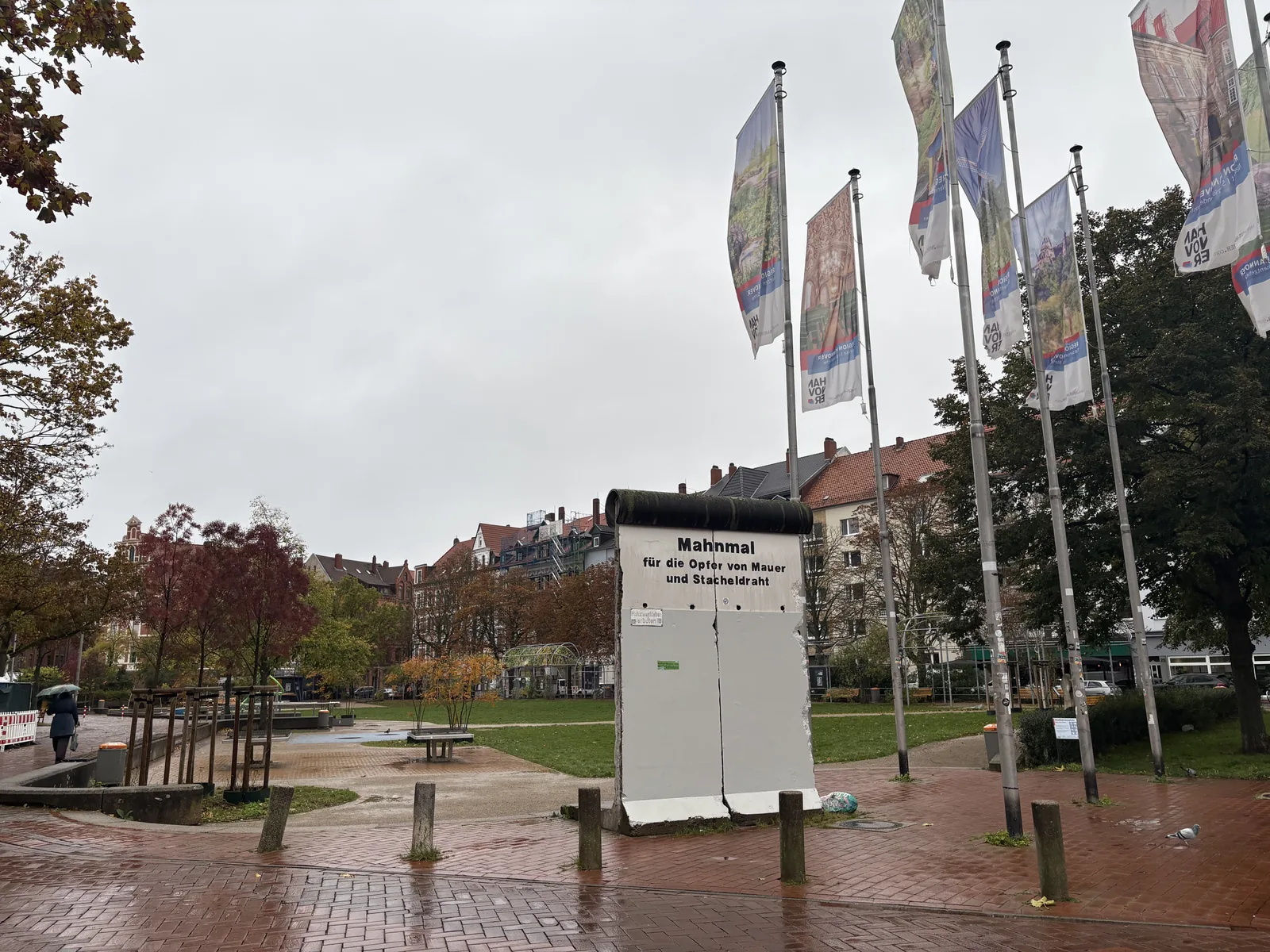
A piece of the Berlin Wall on Weißekreuzplatz.
The doors opened at 9:30 on Saturday, and by ten the entrance hall of the Pavillon was full of people. The crowd was what you'd expect from the audience of a retro games podcast: lots of people in their forties and fifties, many in hoodies and band shirts, and many who clearly had been listening for a decade or more. At check-in, we got our swag bags.
A brochure in the swag bag included a floor plan of the Pavillon, which made it easy to find your way around. Everything branched off the foyer: the merch stand and a photo box on one side, the cloakroom, a food area, and the toilets. The Großer Saal, the big hall with the stage, was where all the podcast shows and panels took place. The Kleiner Saal, the small hall, held the artist exhibitions. Two smaller rooms completed the picture: R1 was a quiet room for anyone who needed a break from the crowds to read books on retro computing, and R2 was for miniature painting.
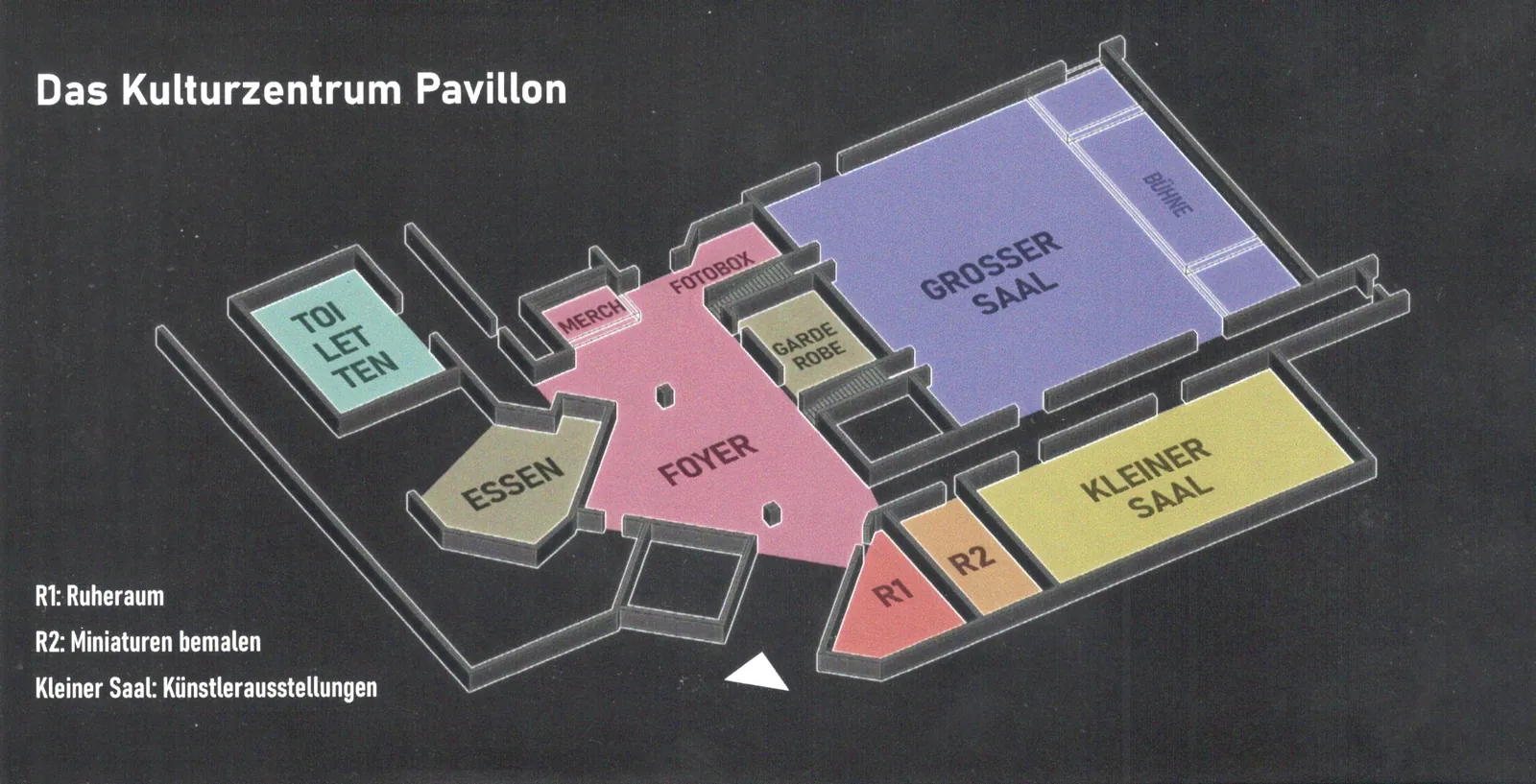
The floor plan of the Pavillon for the convention: R1 was the quiet room, R2 the miniature painting room, and the small hall held the artist exhibitions.
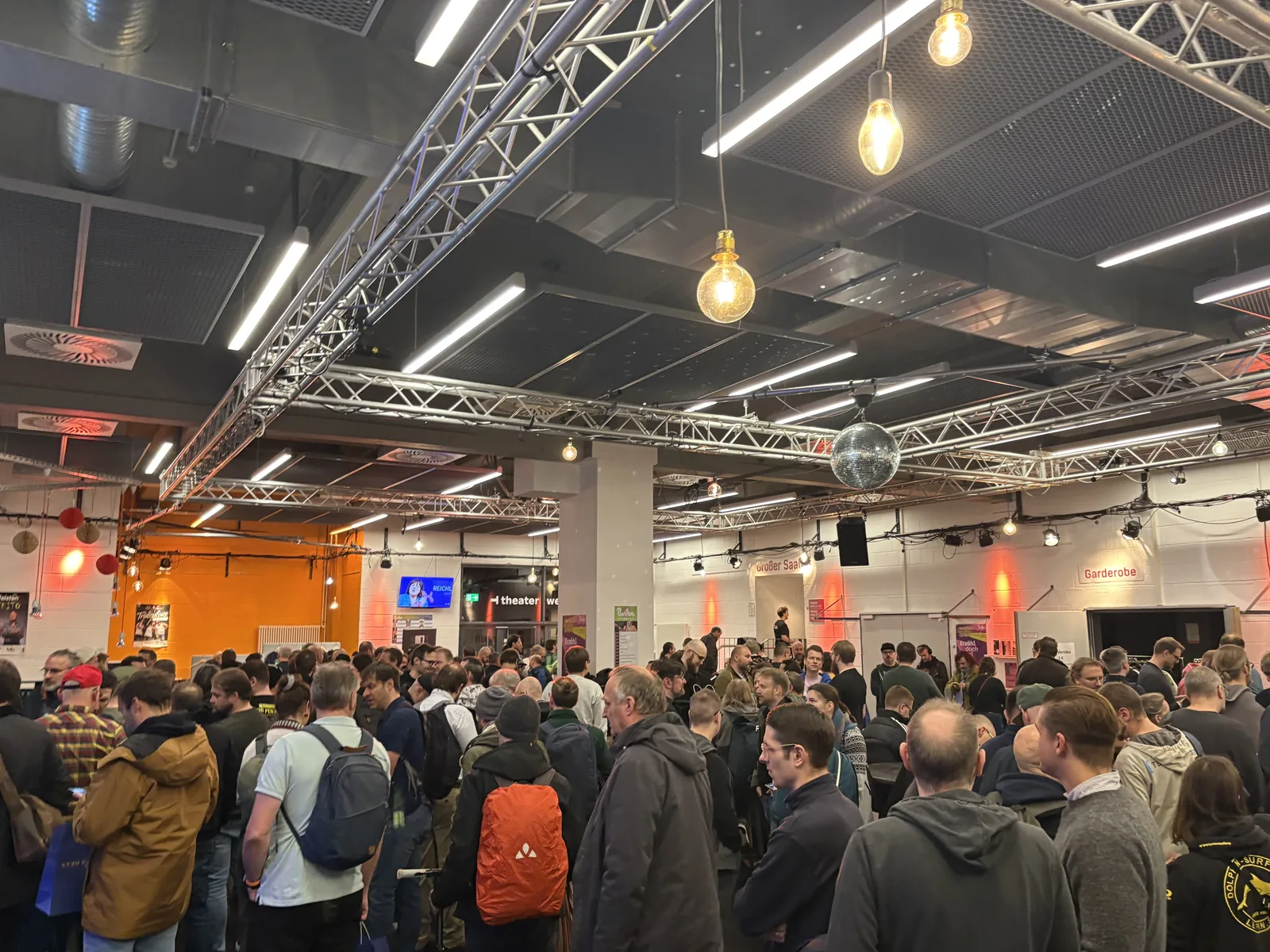
Saturday morning: the entrance hall fills up.
The Stay Forever floppy disk logo, ready for photos.
The merch stand sold Stay Forever branded T-shirts, hoodies, coffee mugs, mousepads, and all sorts of other goodies. I even spotted Rahel taking turns behind the counter between her stage appearances, handing out shirts and mugs. Of course, I couldn't resist buying a T-shirt myself. And since this was the Pavillon, a cultural center with decades of concerts behind it, even the corridor to the toilets was a museum of its own, plastered with old gig posters.
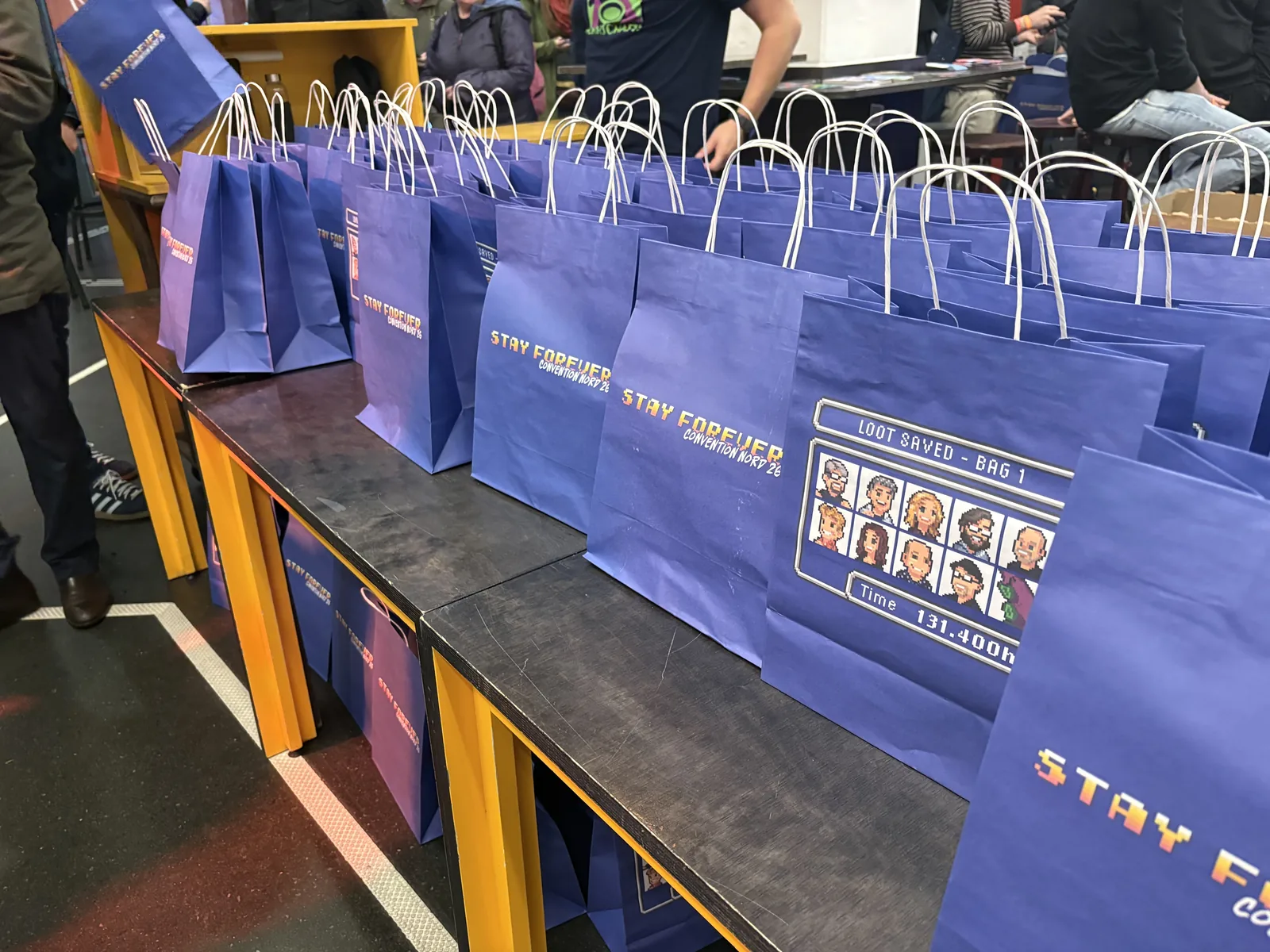
The swag bags.
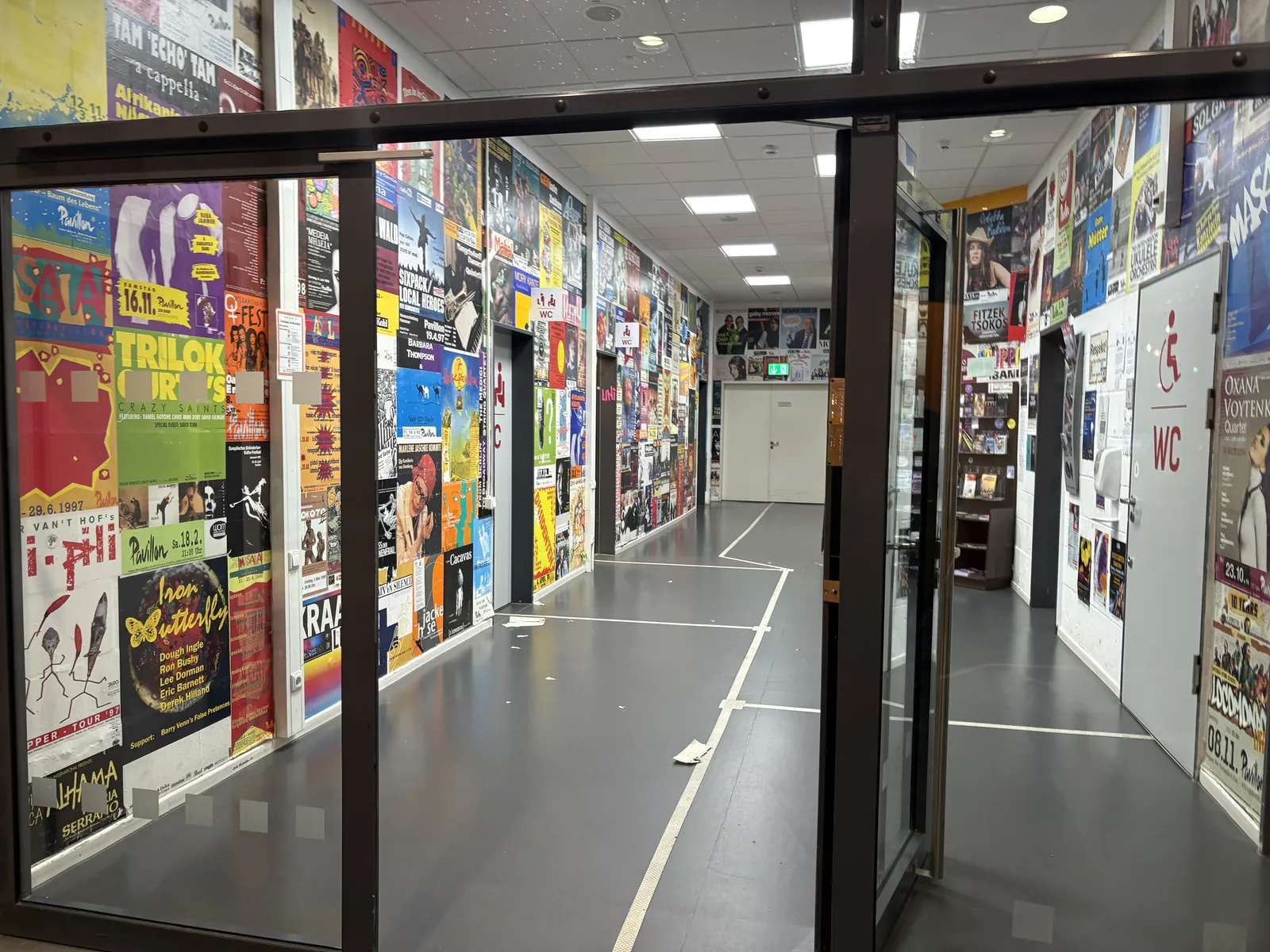
Even the way to the restrooms is lined with concert history.
The swag bag held a paper armband for the weekend, the trading card, the brochure with the floor plan, and my favorite item: the Stay Forever Community-Dungeon 2026, a little game created by Marius from Karlsruhe, a member of the Stay Forever fan community. The goal is to escape from a dungeon while completing two quests: grab the key and open the chest, and find the sword and slay the boss.
The catch is that the dungeon is split into three sections, and every visitor gets only one of them. To solve your quests, you have to find two other convention visitors who have the other two sections. You solve a quest by laying two sections side by side in the right way, so that, for example, a path connects the key to the chest. Each correct combination reveals one of your two solution symbols, which you tick off at the bottom of the sheet: a rook, a shield, a club, a pawn, a heart, or a spade. Once you have both, you take them to the merch stand and collect a small present. You don't even need all three sections at once, since you can match them up one after the other.
It's a lovely idea. The puzzle is really an icebreaker in disguise, and it works. You can't solve it on your own, so you have to walk up to strangers, compare dungeon maps, and start talking. At a convention full of people who usually listen to podcasts alone with their headphones on, that's a very clever way to turn listeners into a community. Icebreakers like this have become something of a tradition at the Stay Forever conventions. At the earlier editions in Karlsruhe, so I'm told, there were bingo cards on which you had to collect signatures from people matching obscure gaming criteria.
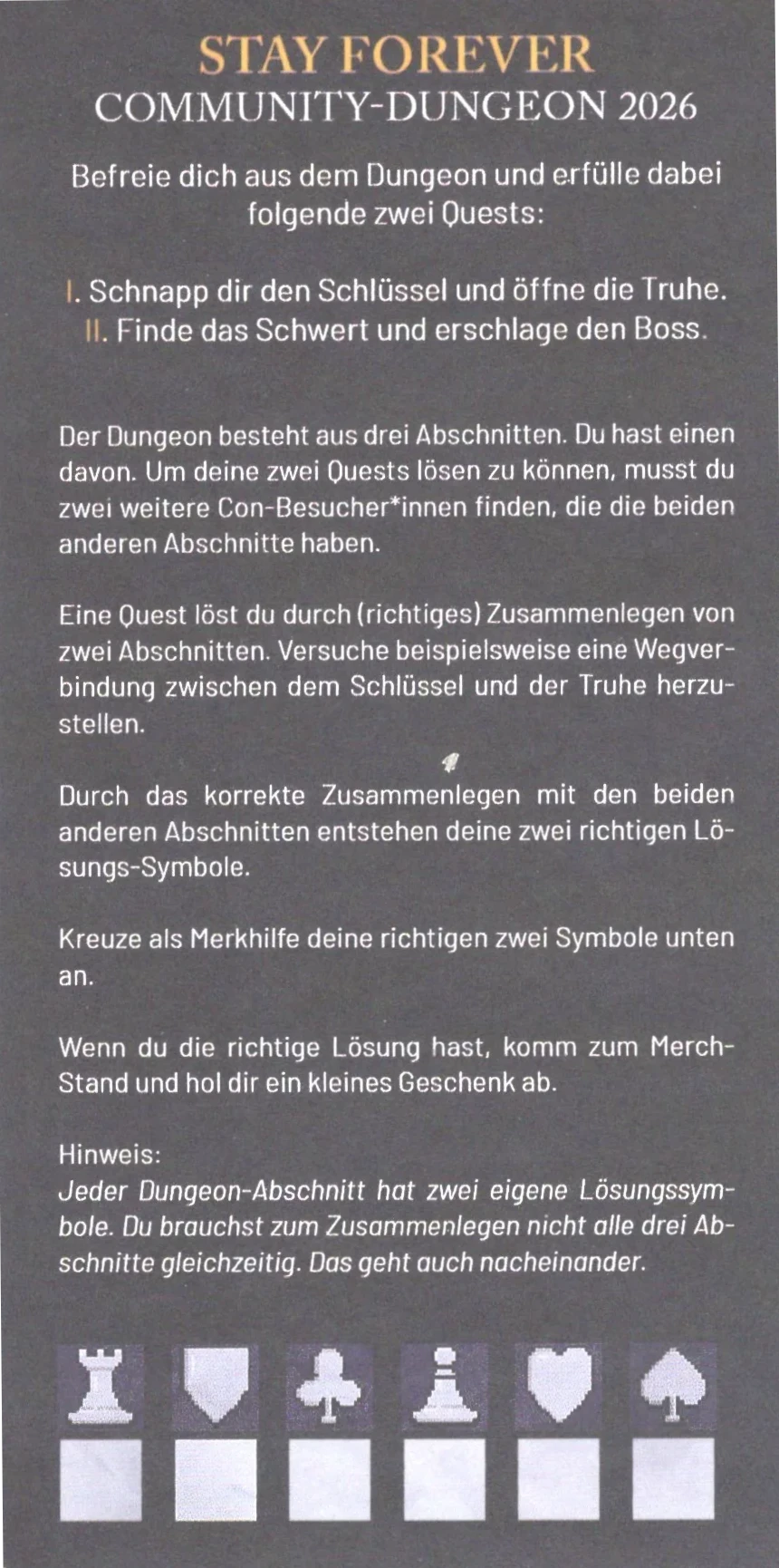
The rules of the Community-Dungeon 2026. You'll need two fellow adventurers to escape.
Art, Miniatures, and Mario Kart
Away from the main stage, there was plenty to do. The exhibition in the small hall showed Paul Schmidt's artwork for the podcast. Each episode poster reimagines a classic game as a film poster in vector graphics, complete with the episode number, the air date, and a small color palette. I found Beneath a Steel Sky, Shadowrun, Dragon's Lair, Planetfall, Deus Ex, Fable, Quake, and Elite with its wireframe ships, which goes all the way back to episode 37 in 2014. His 2013 farewell tribute to LucasArts, made when Disney shut the studio down, hides a cheeky little Easter egg: look closely at the cemetery, and one of the gravestones is inscribed with “Stay Forever”. On Sunday, Paul Schmidt gave a tour of his exhibition and answered questions in front of his posters.
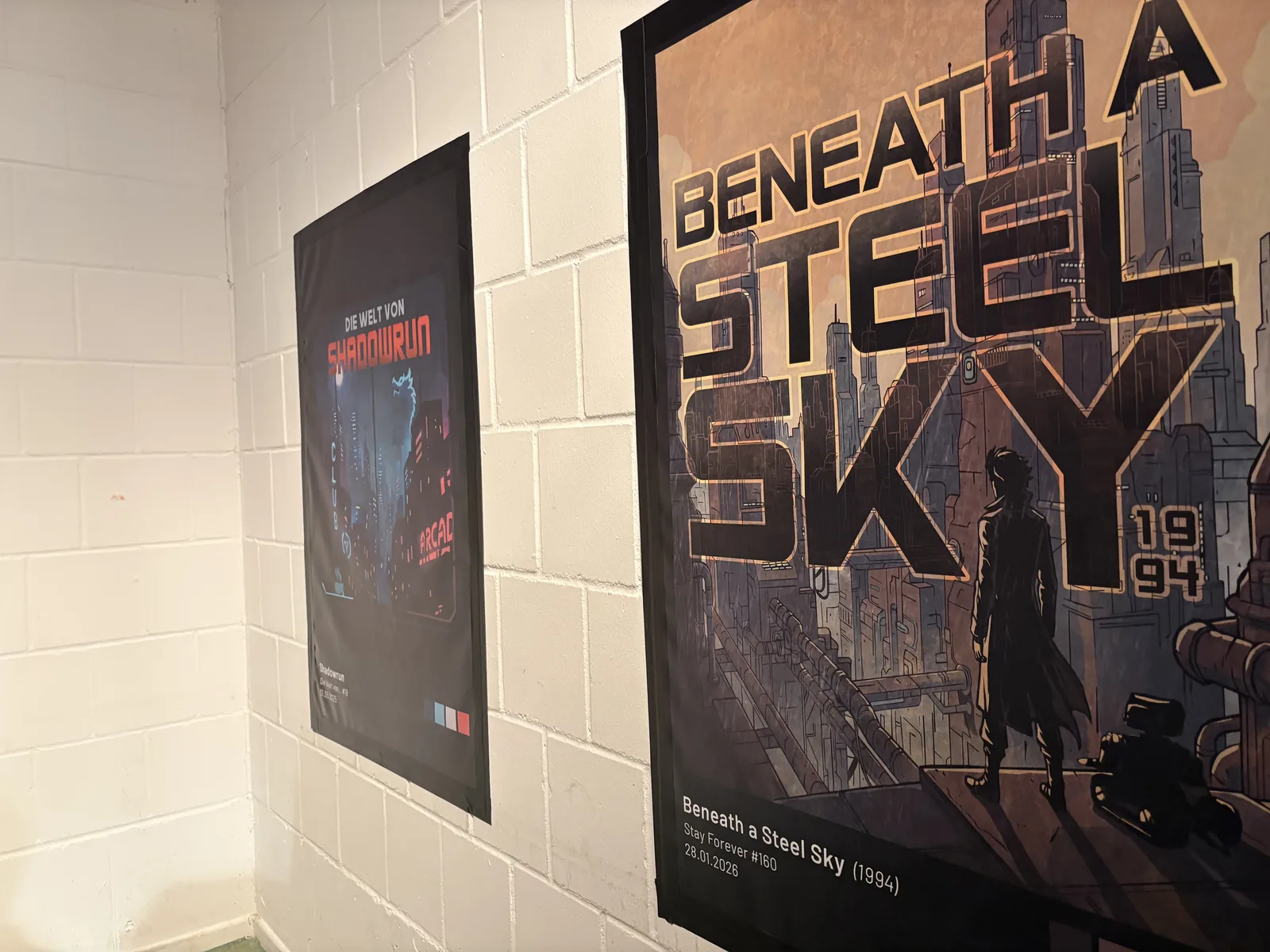
Shadowrun and Beneath a Steel Sky.
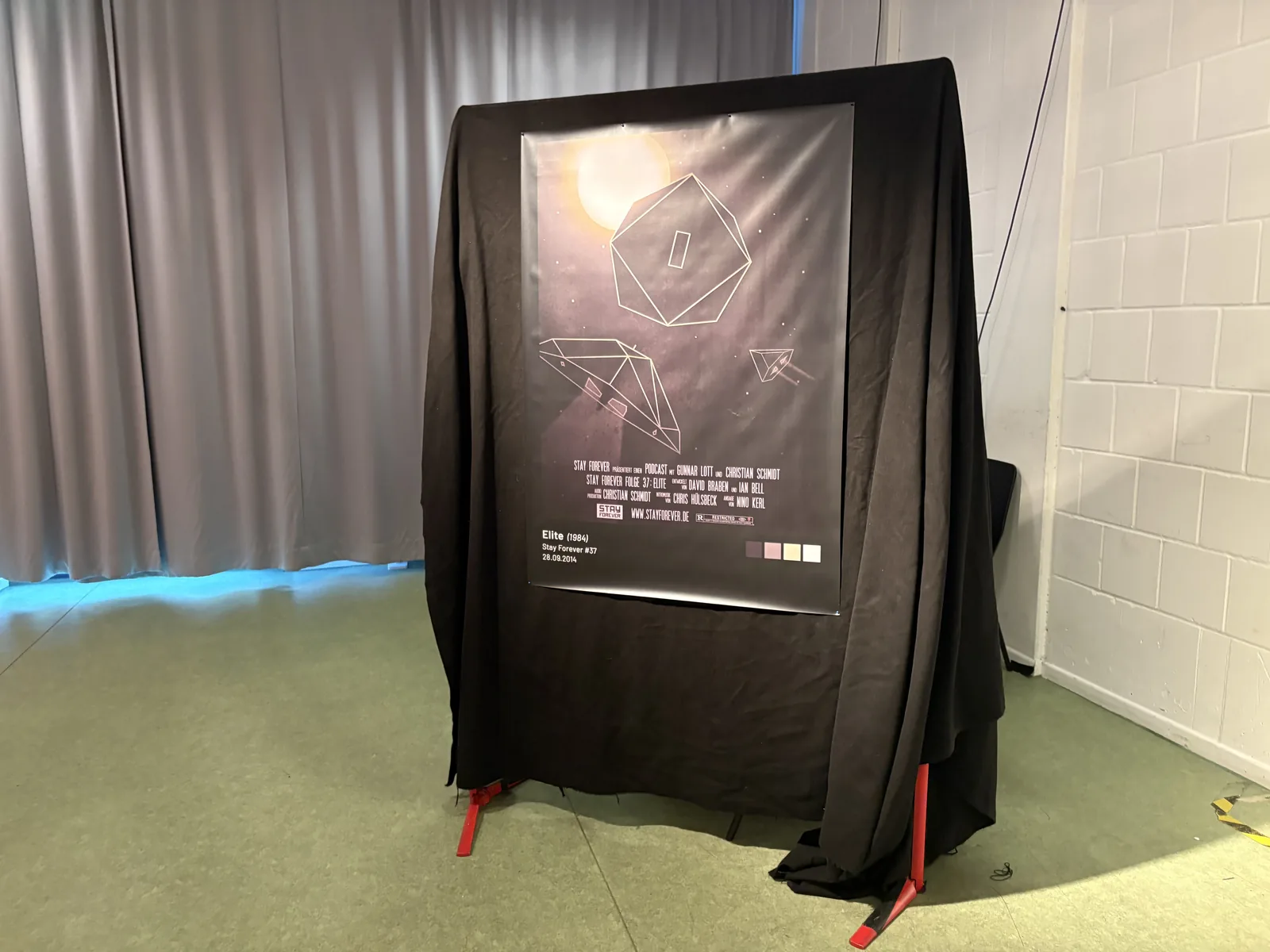
Elite, episode 37.
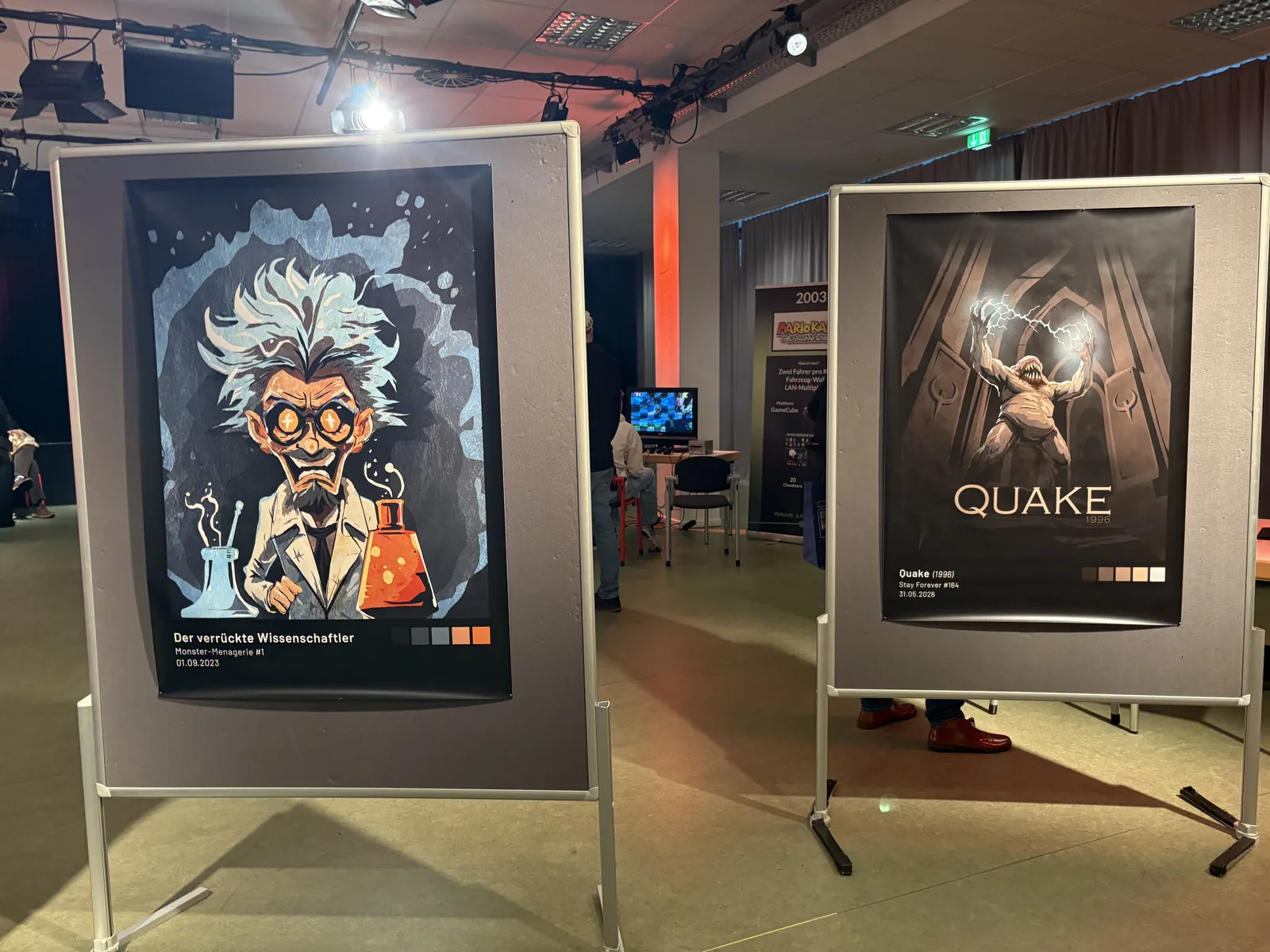
A mad scientist and Quake.
Next to them hung the works of Philipp Eggersglüß,
which made me laugh out loud. He said that back in 2014, he spotted a rural
tapestry at a flea market, felt that something was missing, and
spent an afternoon stitching the Death Star into a Black Forest
sky. Since then, he has been buying the kind of kitschy vintage
needlepoint tapestries you find at flea markets and smuggling
computer culture into them. He works in half cross-stitch, a
cousin of the fine petit point technique, but with thicker yarn,
so the pixels come together faster. In one, a pixelated face
with “Deal With It” sunglasses stares out of a gilded
frame. In another, an idyllic embroidered farmhouse scene carries
the most destructive command in DOS history:
C:\>FORMAT C:. Some of his pieces are already
fixtures in the retro living room at the HI-SCORE museum, which I
would visit that very night, and of the roughly 160 works he has
made over the years, barely a dozen remain unsold.
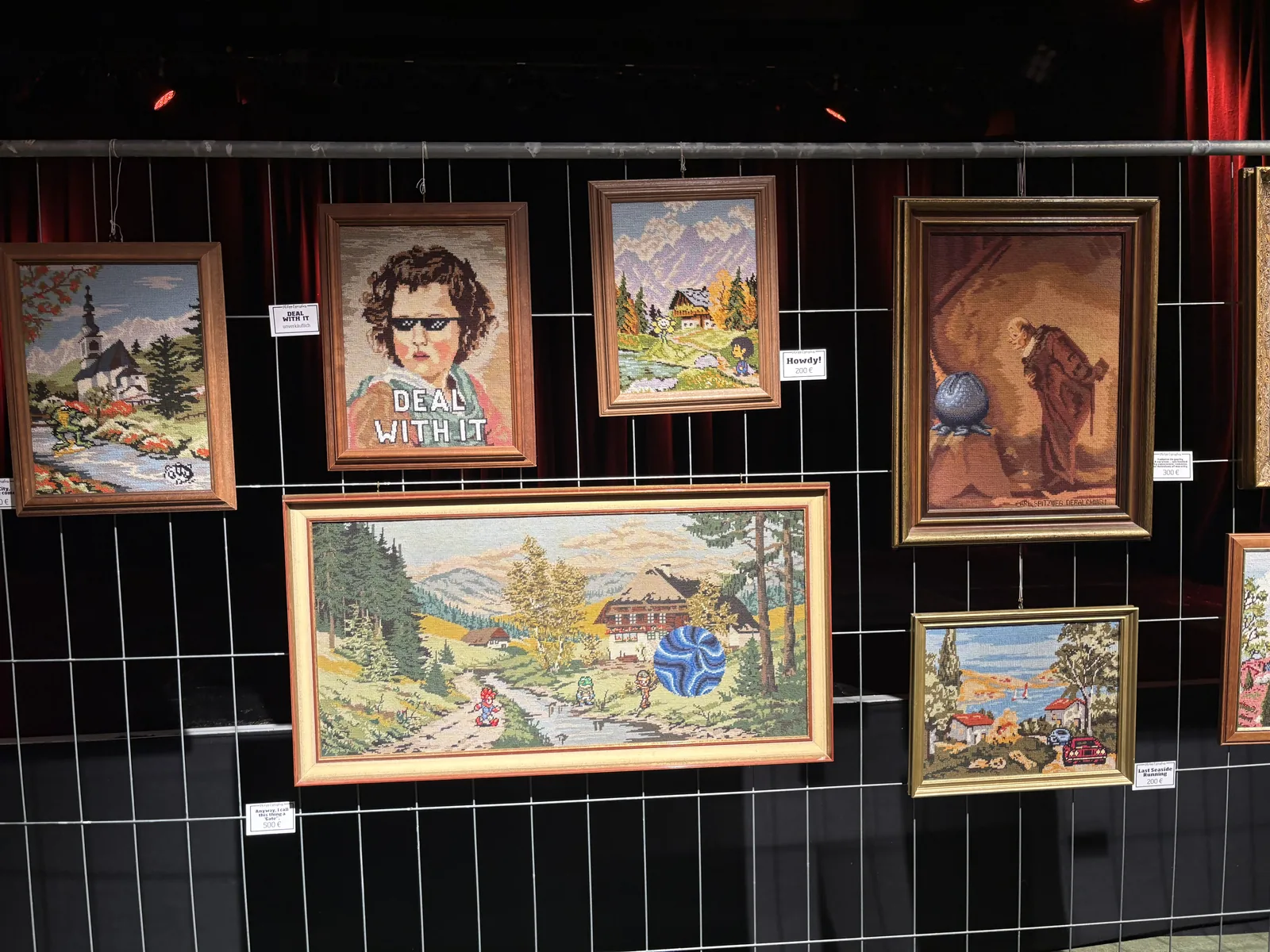
Philipp Eggersglüß smuggles video games into flea market paintings.
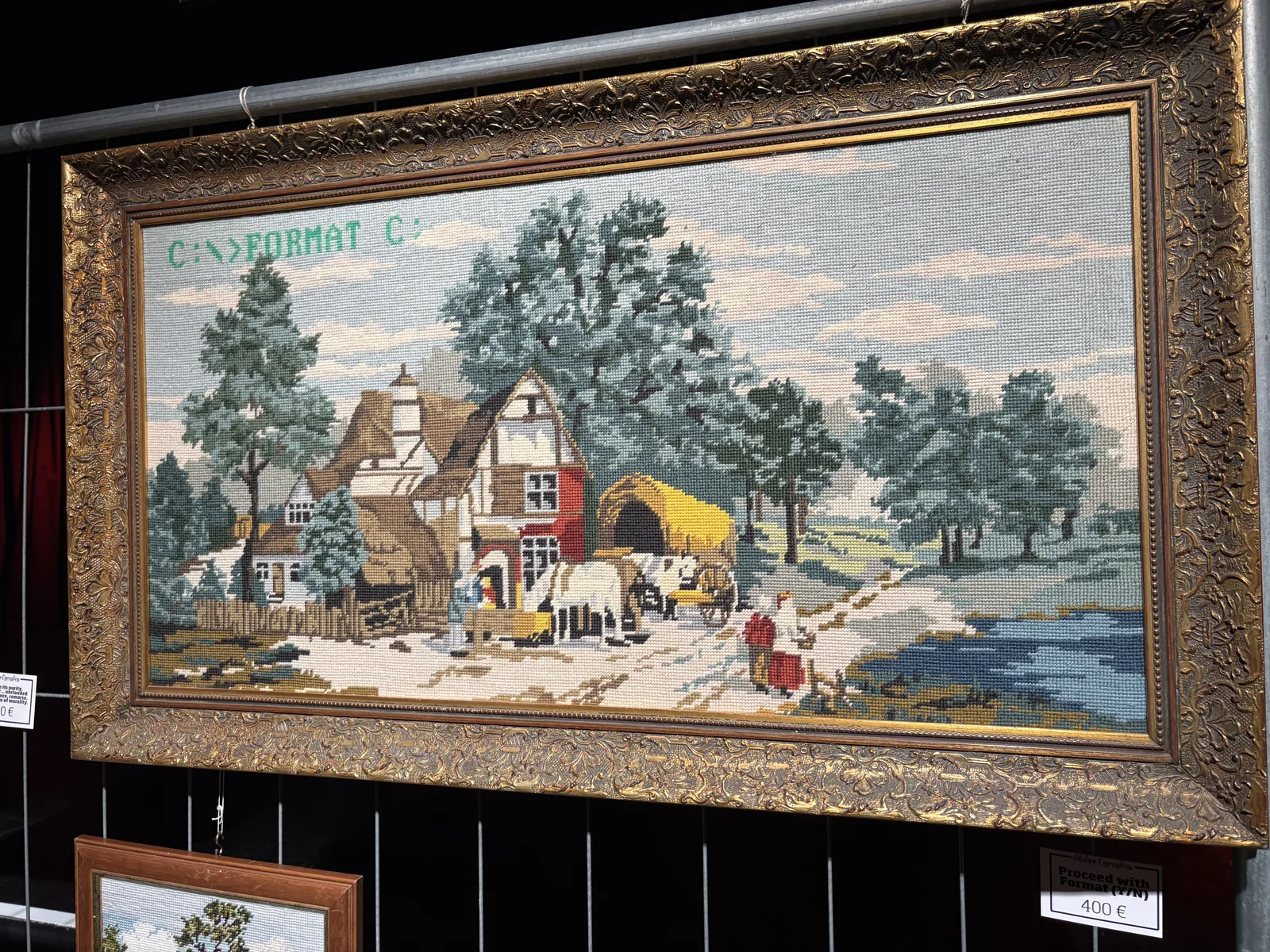
Rural idyll, about to be wiped.
In room R2, next to the small hall, Phantasos Studio ran a miniature painting workshop. They had 3D-printed and primed a whole arsenal of figures themselves, and the purple tentacles from Day of the Tentacle seemed to be the hands-down favorite on the tables. The long tables were set with lamps, brushes, and paint pots on Saturday morning, and by Sunday afternoon, every seat was taken by grown men bent in deep concentration over tiny figures. The display table even had a Pac-Man and a Space Invader among the fantasy miniatures.
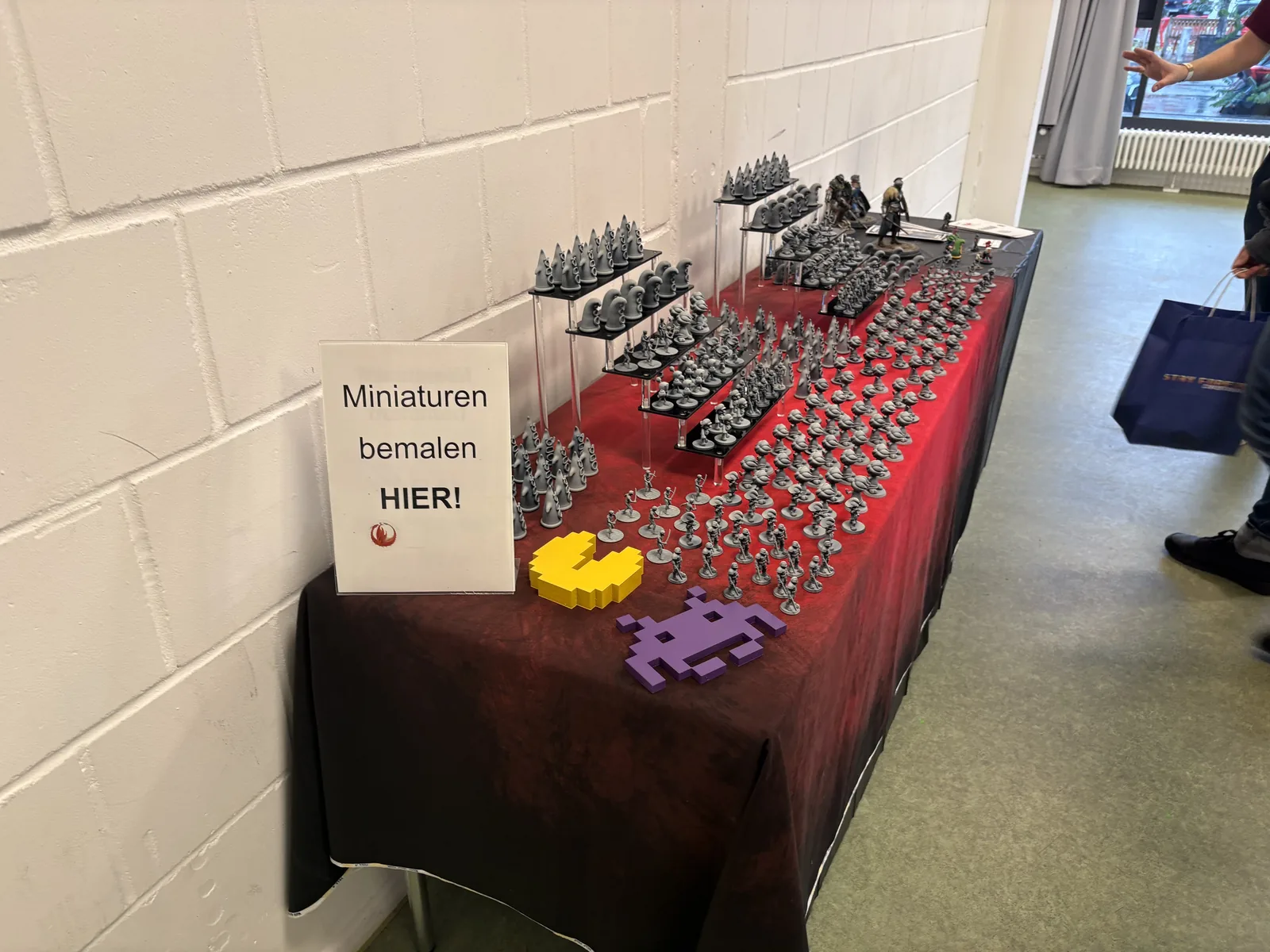
“Paint miniatures here!” Pac-Man approves.
Phantasos Studio ran the painting tables.
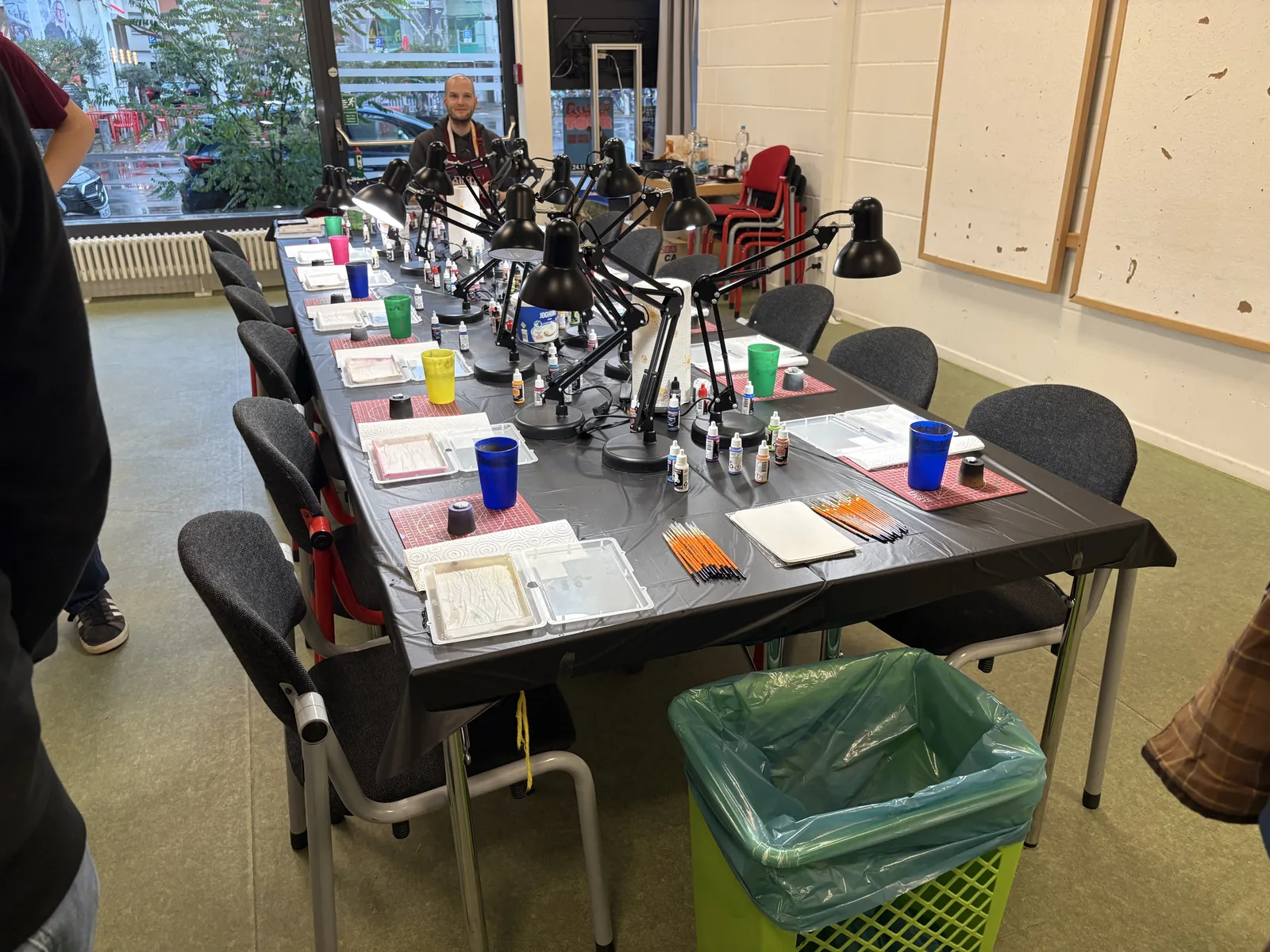
Saturday morning: all set up.
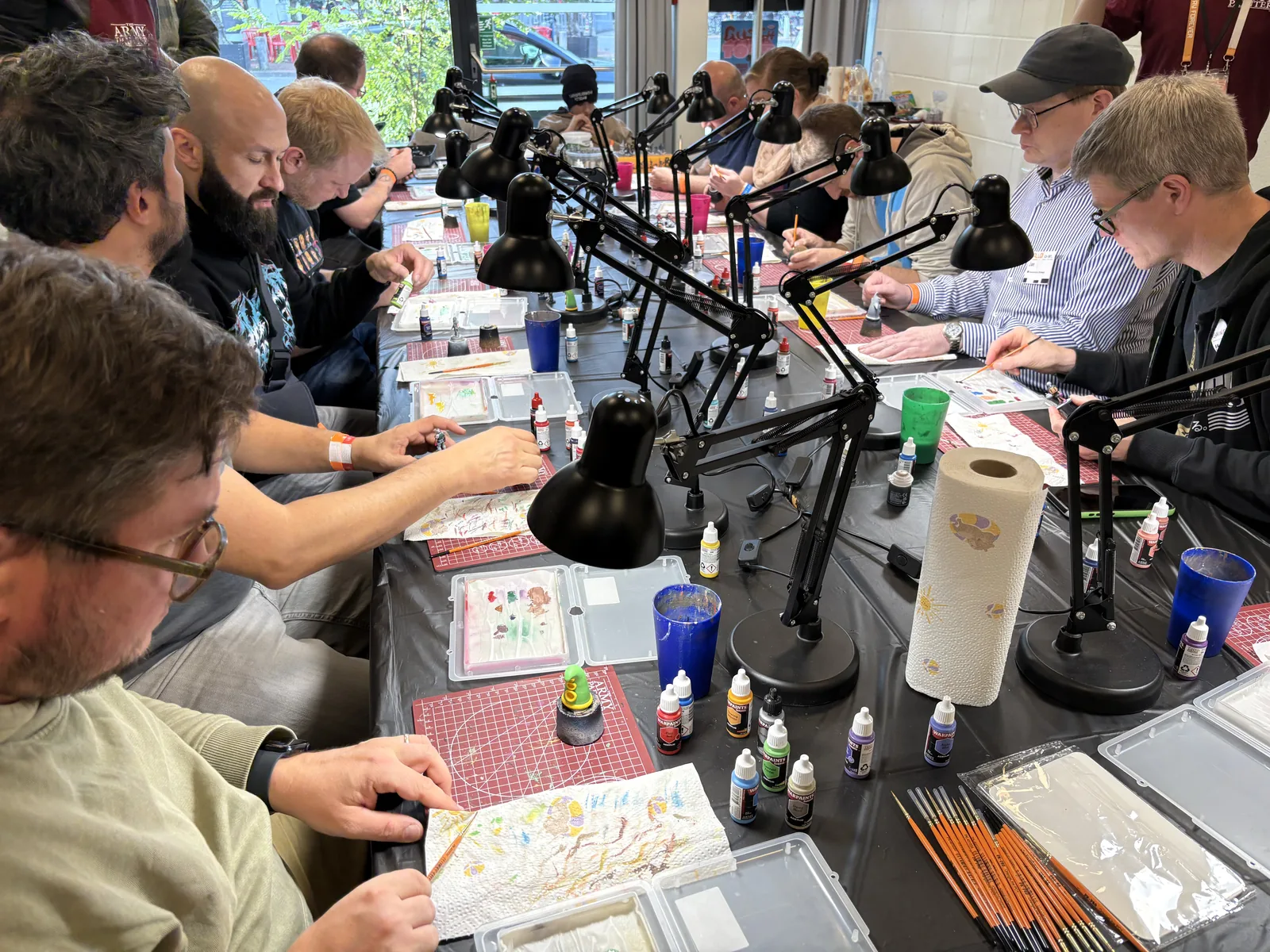
Sunday afternoon: not a free seat.
And of course, there were games to play. A GameCube was set up with Mario Kart: Double Dash!! from 2003, the one with two drivers per kart, next to a roll-up banner that listed its 20 characters and 16 tracks. It's a fitting choice for a podcast that has slowly started to cover the 2000s.
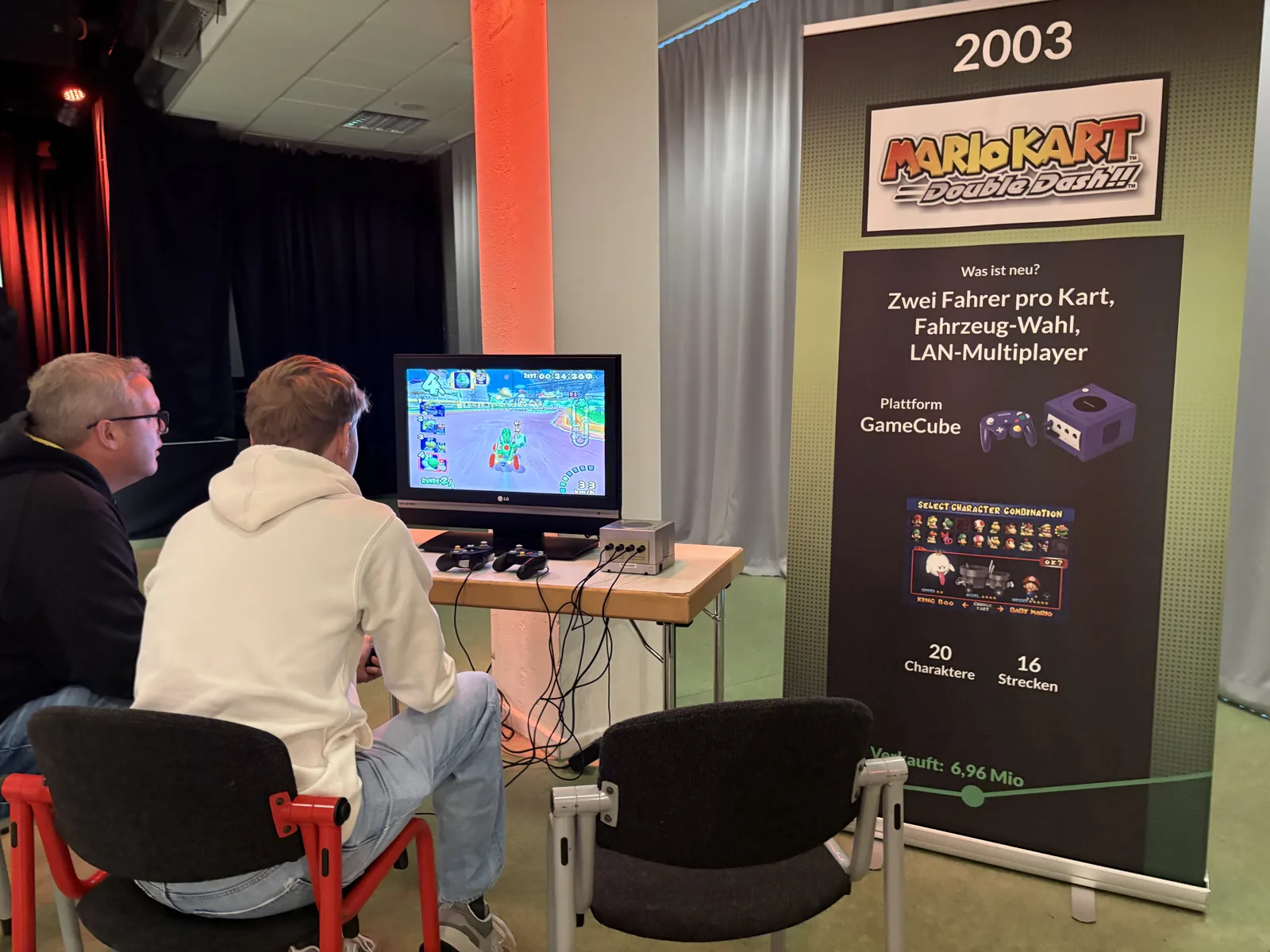
Mario Kart: Double Dash!! on the GameCube.
Saturday on Stage
The heart of the convention was the Großer Saal, the big hall. An audience of probably around five hundred filled its seats from the opening welcome by Chris, Gunnar, Marius, and Marko at 10:30 onward.
It had been a nervous morning for the team, as they told us later: about 45 minutes before the doors opened, the main projector completely lost its signal. For a tense while, the technicians stared at dark screens, until the Pavillon's own venue crew saved the day just in time. And during one of the early segments, Chris had to swap out a dying wireless mic transmitter pack mid-conversation. Up on the balcony, the AV team kept the ship steady. The whole convention was also streamed live with multiple cameras and a live director for those who couldn't make it to Hanover.
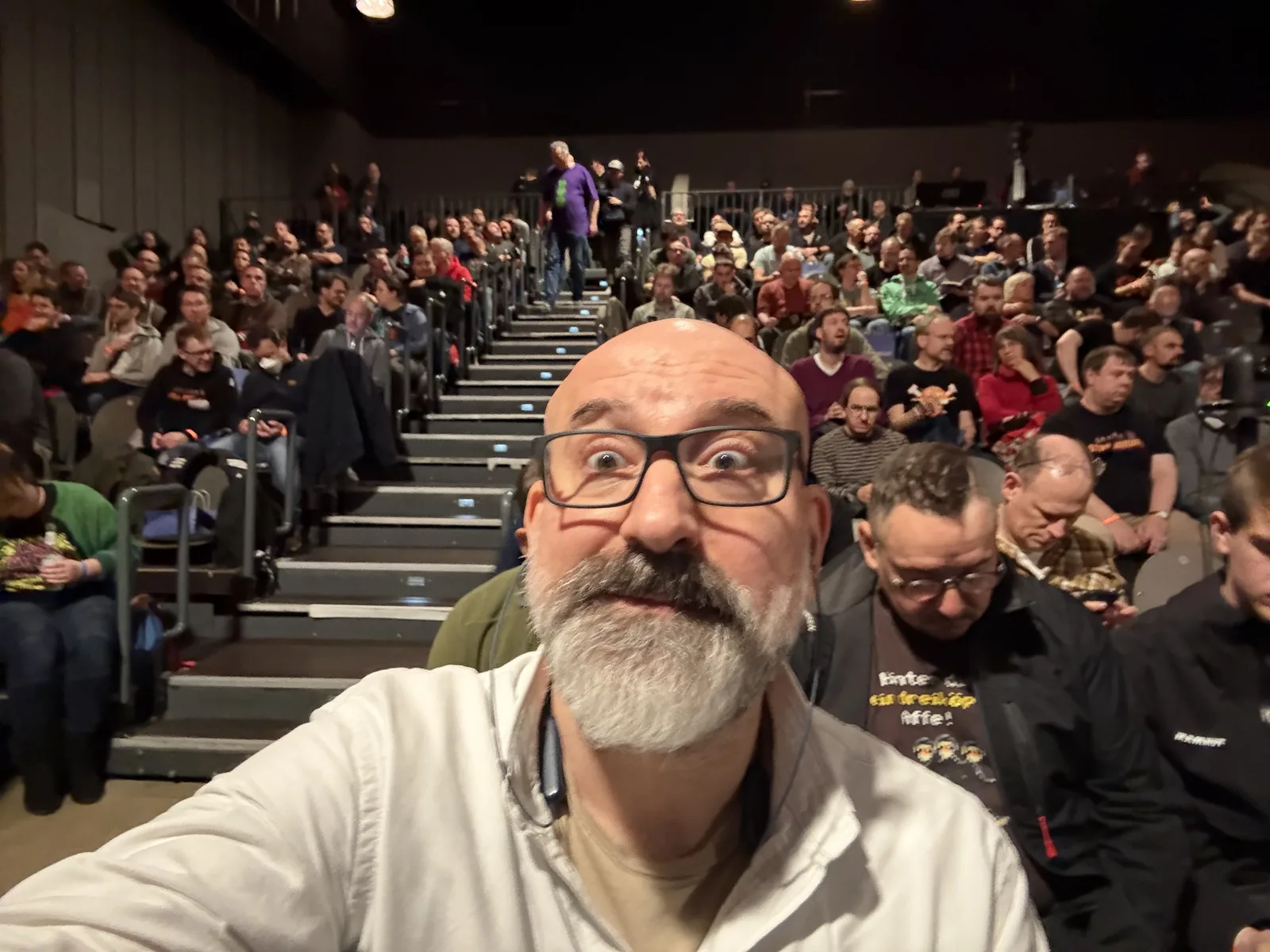
Me and my fellow retro fans.
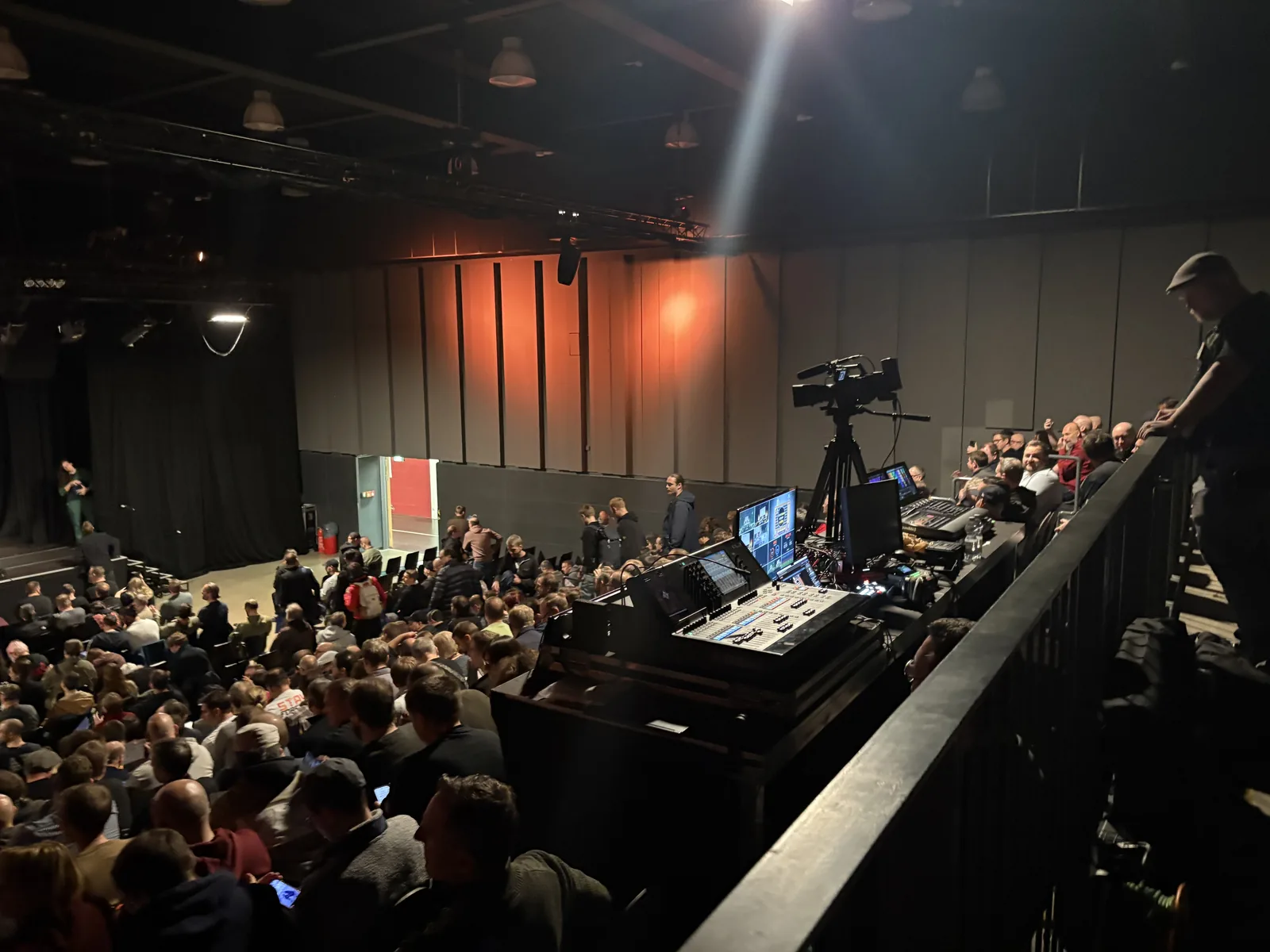
The AV team on the balcony, with the hall filling up below.
The program opened with a Box Office Battle between Fabian and Chris, refereed by Gunnar. After that, Rahel and Johannes took the stage for “Bernard with the CRT monitor in the basement”, a look at whodunits in games like Infocom's Deadline, Return of the Obra Dinn, and The Painscreek Killings. Fittingly for a whodunit, their slide deck refused to work, so they improvised the whole talk on the fly, and it worked anyway. After the lunch break, Chris and Gunnar had a proper argument with a tier list of the best games from Germany, which is exactly as nerdy and as entertaining as it sounds. When Moorhuhn, the chicken-shooting game that paralyzed German offices around the year 2000, appeared on the big screen, the whole hall groaned and laughed at the same time.
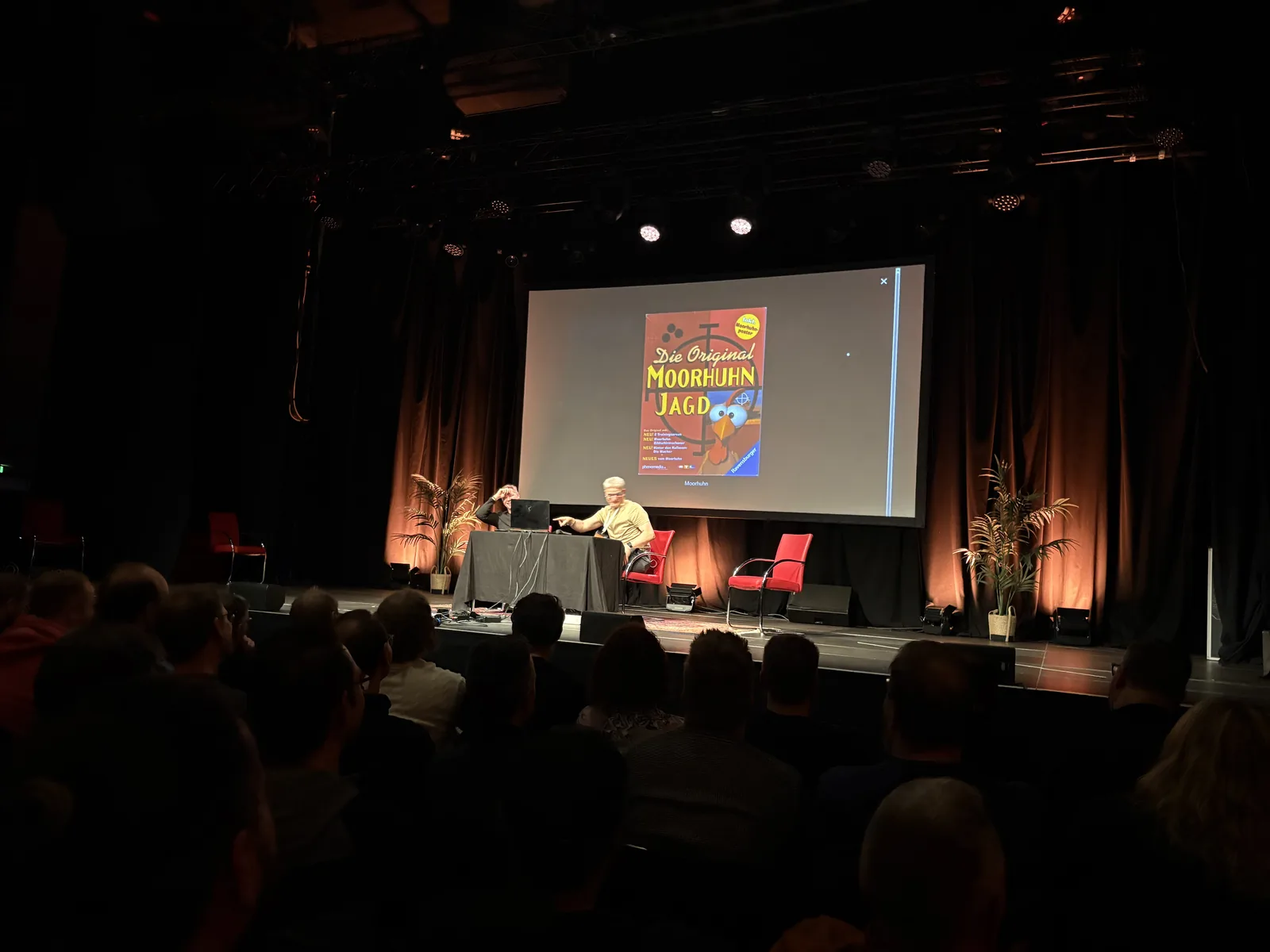
Where does Moorhuhn belong? A question of national importance.
During one of the breaks, I got to say hello to Gunnar in person. After so many hours of having his voice in my ears on walks and train rides, it was a little surreal to finally stand next to him. He was every bit as friendly as he sounds. I must admit that I was quite starstruck.
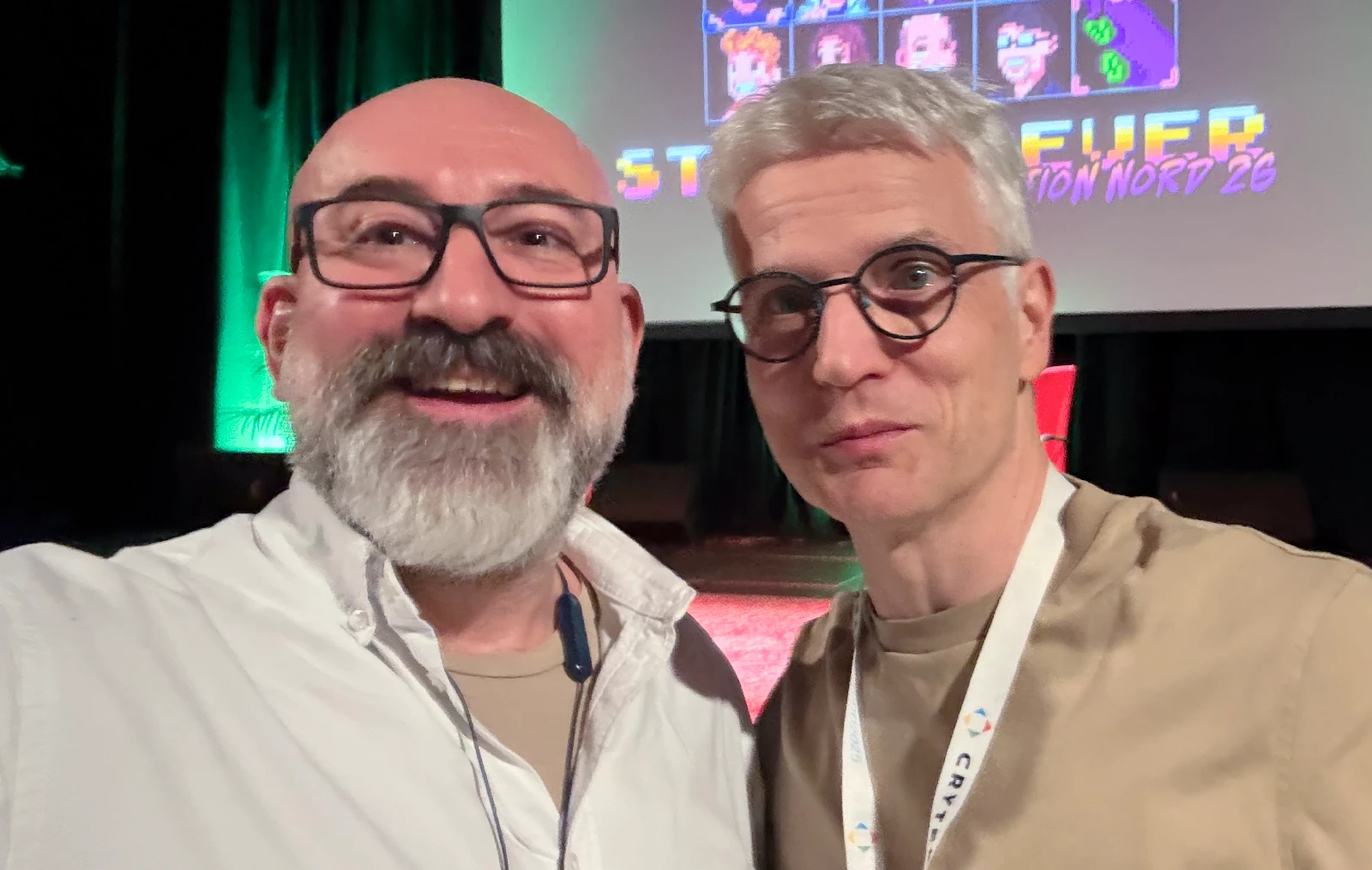
With Gunnar Lott, one of the two founders of Stay Forever.
In the late afternoon, Mháire Stritter and Rahel took the stage for Fantastische Metalle, a talk on orichalcum, mithril, adamantium, and all the other metals that only exist in myths, fantasy novels, and RPG inventories. Tracing these magical alloys from ancient Greek lore and early modern literature all the way to John Milton's Paradise Lost, they explored why fiction keeps inventing materials superior to steel, and how those materials became indispensable fixtures in RPG loot tables. It was a lovely piece of cultural history.
Mháire impressed me a lot. She is a German role-playing game author with more than twenty publications for and about pen-and-paper RPGs, including novels set in role-playing worlds. She is also a professional game master with well over a thousand sessions under her belt, and a familiar face on Orkenspalter TV, one of the oldest and largest German channels about pen-and-paper role-playing and live-action role-playing (LARP). On stage, she struck me as someone who has read, watched, and played just about everything pop culture has to offer, from ancient myths to Tolkien to the loot tables of video games, and who has thought hard about all of it. Her knowledge of RPGs, and of Das Schwarze Auge in particular, is enormous, and she shares it with obvious joy.
Another highlight of the day followed at six: a veterans' talk with Bernhard Ewers about what it was like to work at Blue Byte back in the day. Blue Byte was one of the great German developers of the 1980s and 1990s, the studio behind Battle Isle and The Settlers. Hearing about the early days of the German games industry from someone who was there is the kind of thing that makes Stay Forever special.
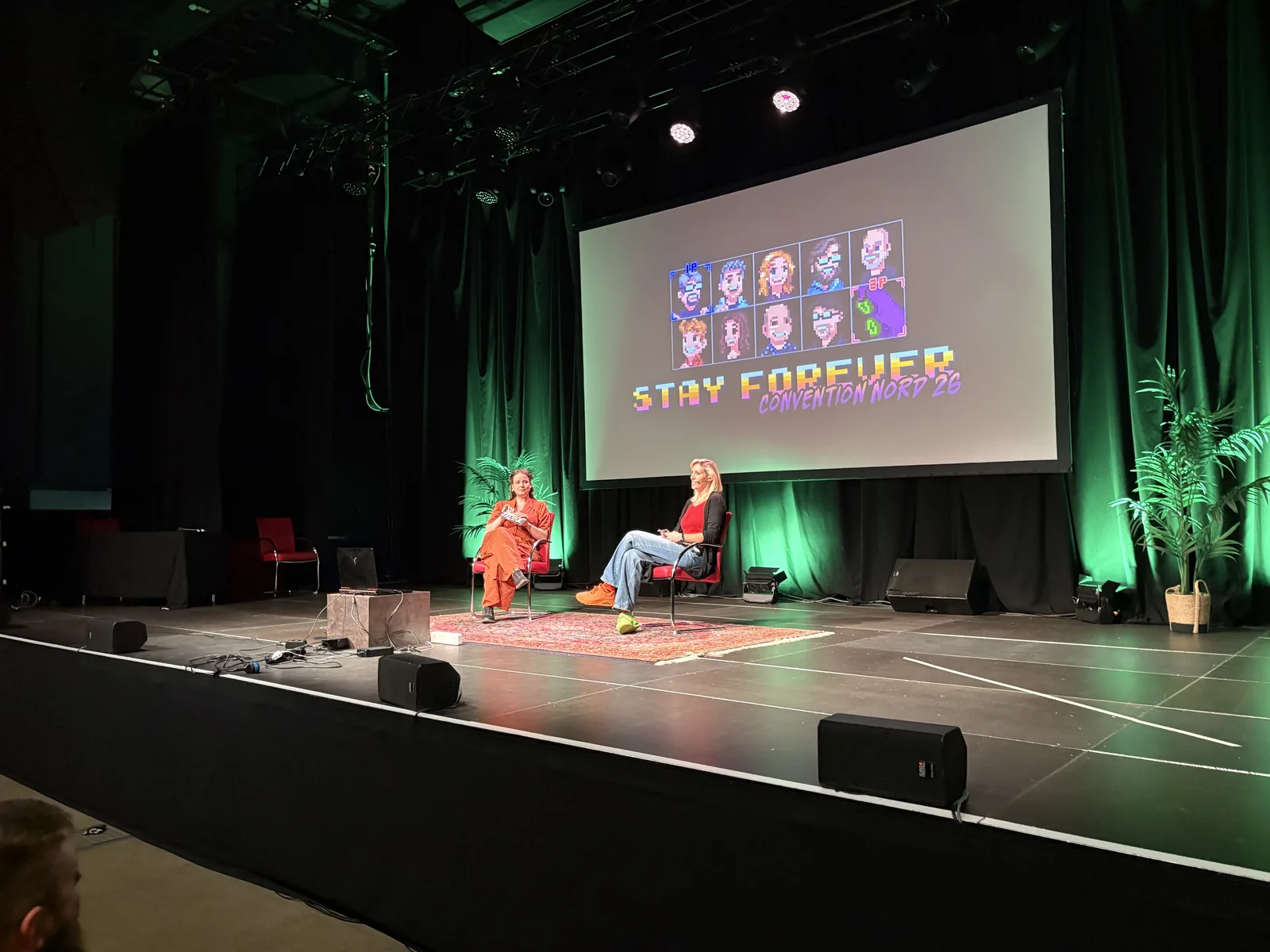
Mháire and Rahel on fantastic metals.
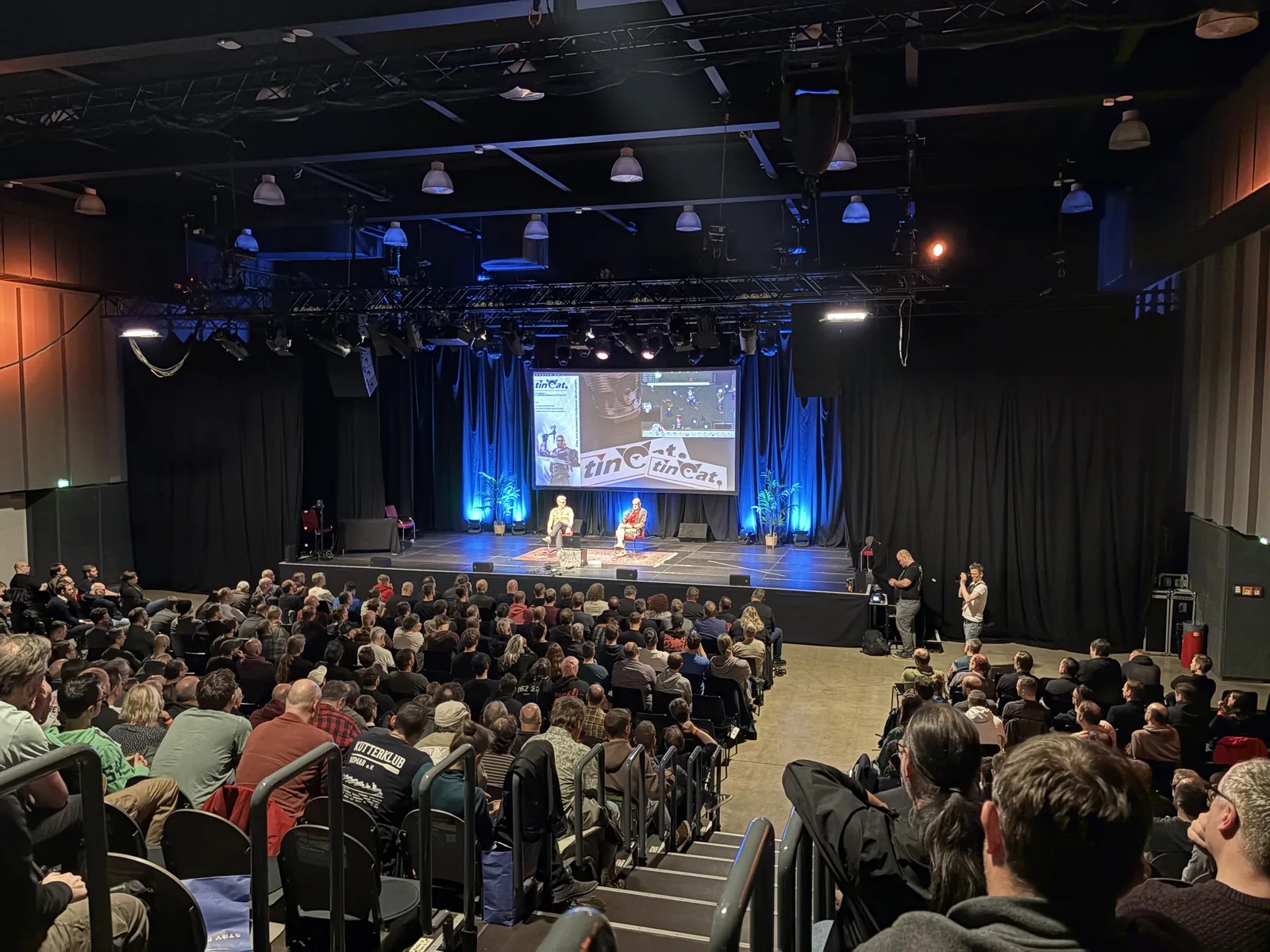
Bernhard Ewers and Gunnar on the Blue Byte years.
The day ended with Das Quiz, hosted by Christian Beuster, with Chris, Gunnar, and Fabian on the candidates' podiums and the hall cheering them on. Beforehand, Fabian had joked that his mission for the weekend was to write the ultimate underdog story and finally win his first live quiz. He even tried to coax Chris into letting him win, but Chris insisted that an unearned victory was worthless. Gunnar confessed that he was at a disadvantage in front of a live audience: unlike the audio quiz on the podcast, the stage version relies heavily on fast visual and sound buzzers, and while Chris is already barking out the answer, Gunnar is usually still mentally searching through 1988. Two hours of obscure trivia in front of an audience that knows the answers better than the candidates do is a special kind of pressure, and everyone on stage handled it gracefully. In the end, after a prolonged battle, Chris took the victory.
The After-Show at HI-SCORE
After the quiz, we headed off to what the organizers called the after-show, and what for me was the real party of the weekend, at the HI-SCORE video game museum in Hanover's Südstadt. The convention had organized a shuttle bus from the Pavillon, so a coach full of slightly tired, very happy retro fans rolled through the dark city, lit in blue like a disco on wheels. A few minutes later, we were dropped off in front of a nondescript industrial building with a very colorful fence.
The weather held up nicely, which was lucky, because a good part of the party took place outside. In the yard, fire bowls burned between deck chairs with the Stay Forever logo. Since the museum couldn't hold everyone at once, the convention visitors were admitted in groups for an hour at a time, and the others warmed their hands at the fire and talked about games until it was their turn.
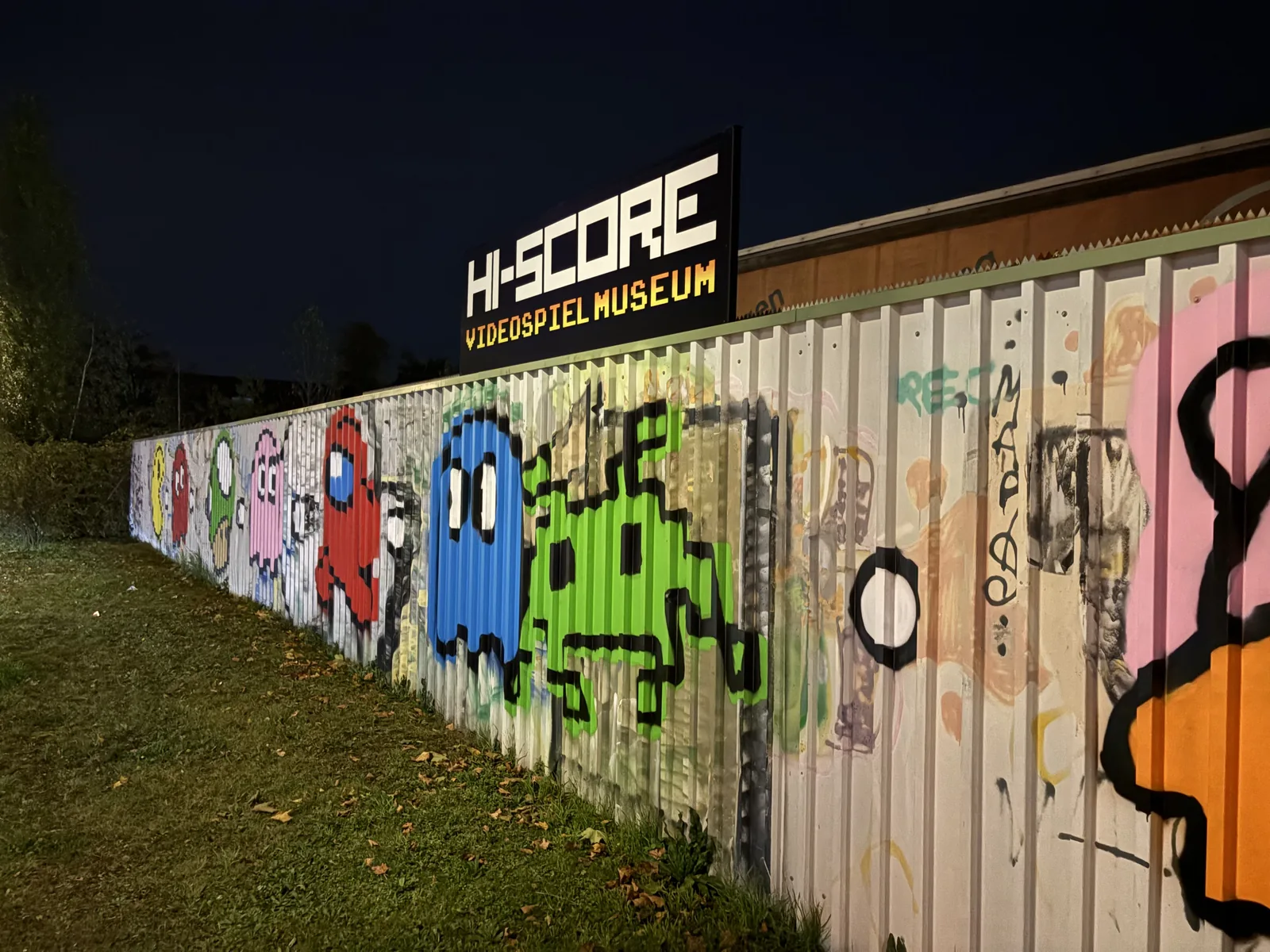
The graffiti wall of HI-SCORE.
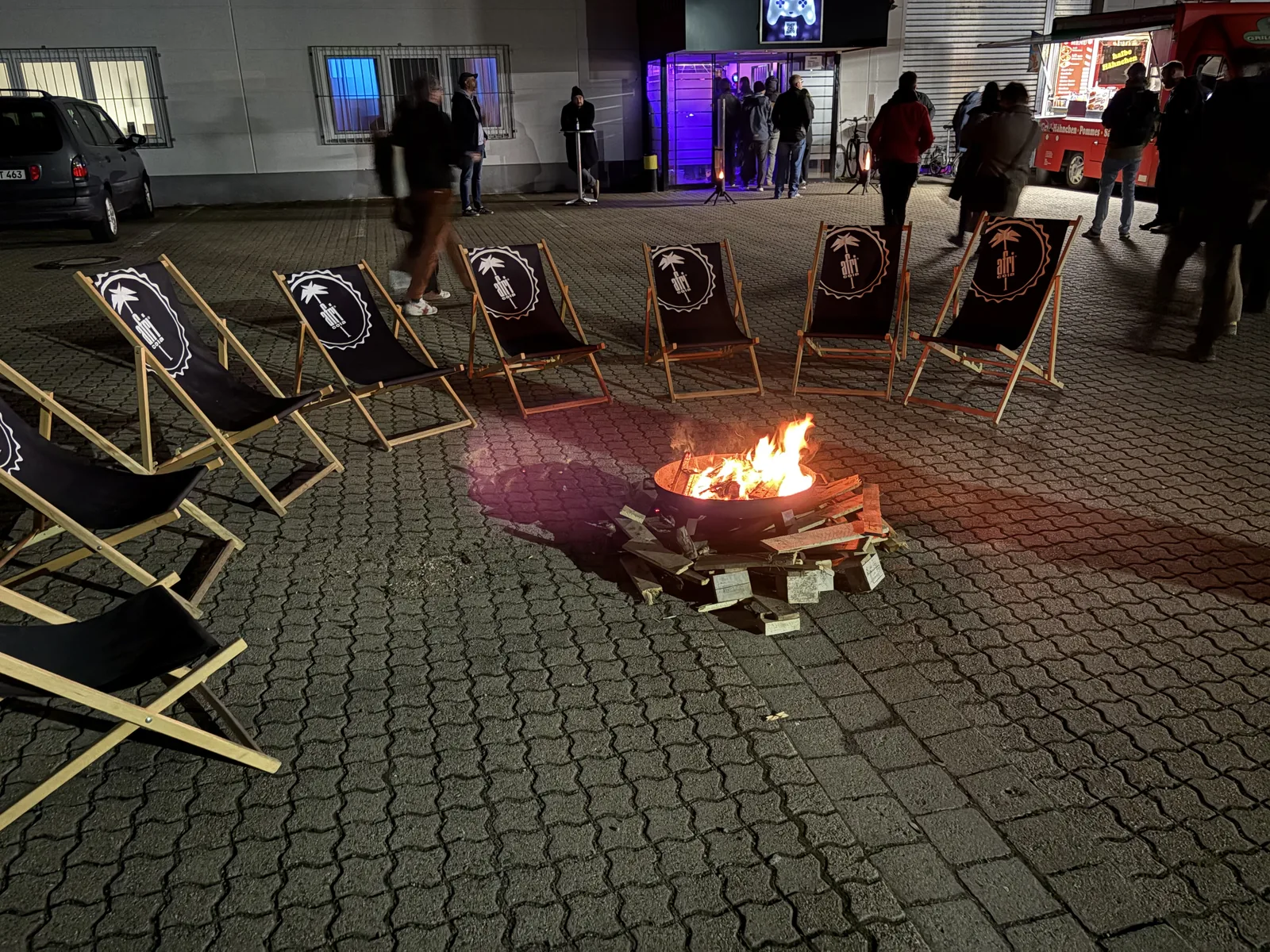
Fire bowl and deck chairs.
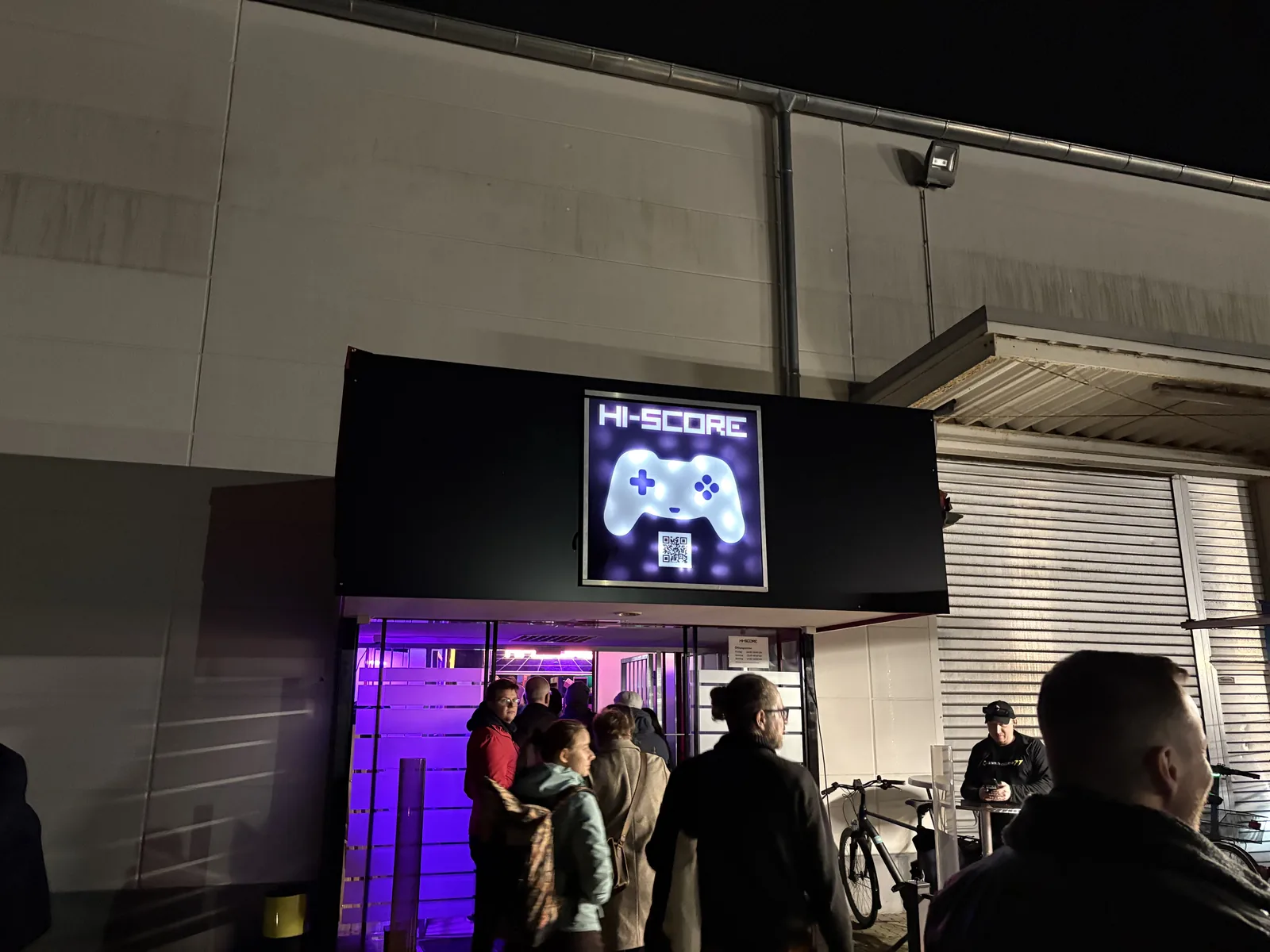
Queuing for our hour inside.
Inside, the entrance hall had been turned into a party zone. A giant projection welcomed us to the “After Show Party @ HI-SCORE”, with a QR code for sending your photos to a live photo wall. HI-SCORE also has a really nice bar of its own, glowing in neon pink and purple, where I treated myself to a bottle of Herrenhäuser, the local Hanover pilsner. There was even a food truck waiting for us in the yard, though by that point I had honestly eaten enough for the day.
What Is HI-SCORE?
HI-SCORE is Hanover's video game museum, and one of the most hands-on museums I have ever been to. It is run by the non-profit association Gaming in Niedersachsen. It first opened in 2023 in a shopping mall in the city center, and has since moved into a former industrial hall at Anna-Zammert-Straße 28 in the Südstadt. The corrugated metal walls of the grounds are now covered in graffiti of Space Invaders and Pac-Man ghosts.
Inside, the museum spans more than 1,000 square meters and six decades of gaming history, from the early days of computing via classics like Space Invaders, Donkey Kong, and Street Fighter to modern rhythm games and current consoles.
There are around 190 original devices on display. The best part: most of them are playable, and every machine is set to free play, so you don't need a pocketful of coins. Its own card calls it a “Museum zum Anfassen”, a museum you're supposed to touch. According to the museum, its collection of arcade cabinets and consoles is one of the largest in Europe. There is also a stage for tournaments and other nerdy events, and the whole place can be booked for private parties. It's normally open from Friday to Sunday, so check the website before you go.
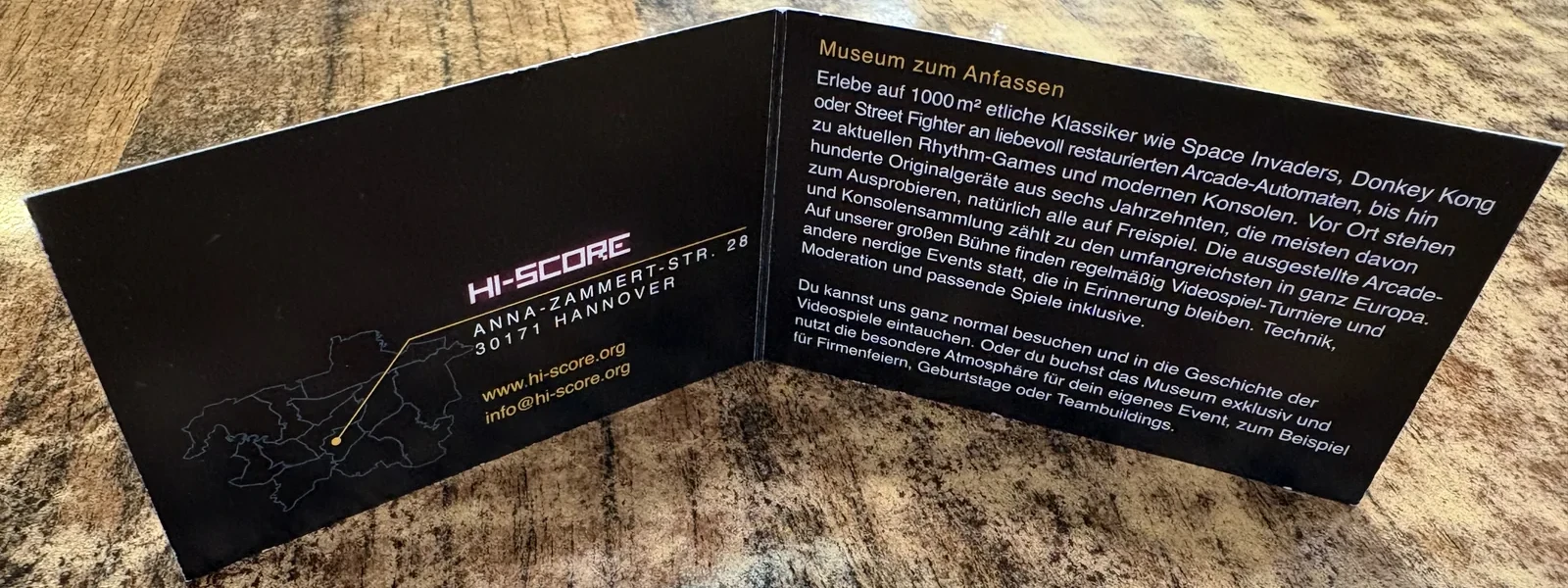
The card of a museum you're supposed to touch.
The exhibition is laid out as a journey through time. One of the first things I saw was a little shrine to Konrad Zuse, the German computer pioneer who built the Z3 in 1941, with ferrite core memory and other old components behind round glass windows. Not far away, a Commodore CBM sat on a desk in a wood-paneled corner, under a lampshade with a fringe, looking for all the world like it was waiting for someone's uncle to come home and do the accounting.
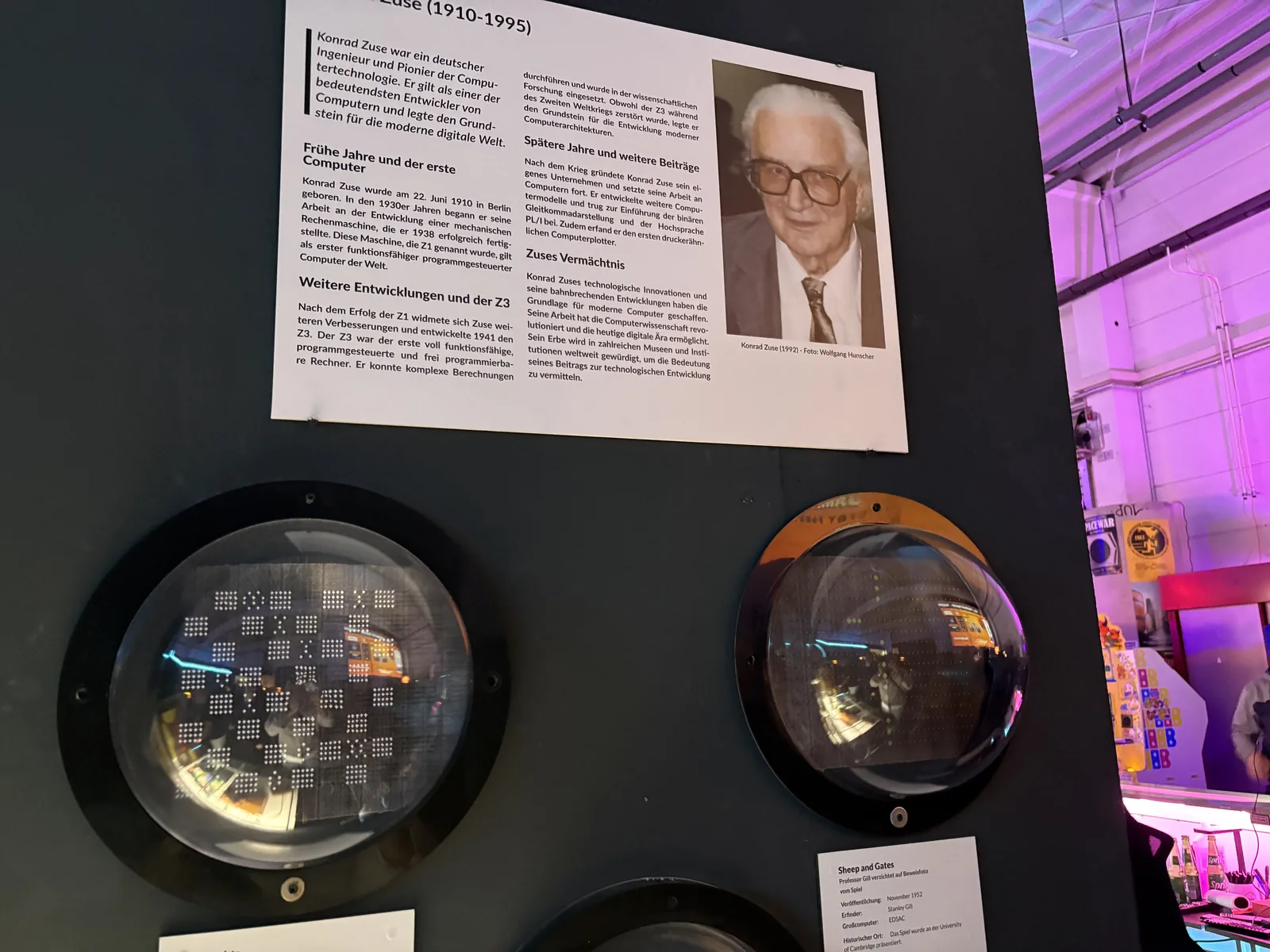
A shrine to Konrad Zuse.
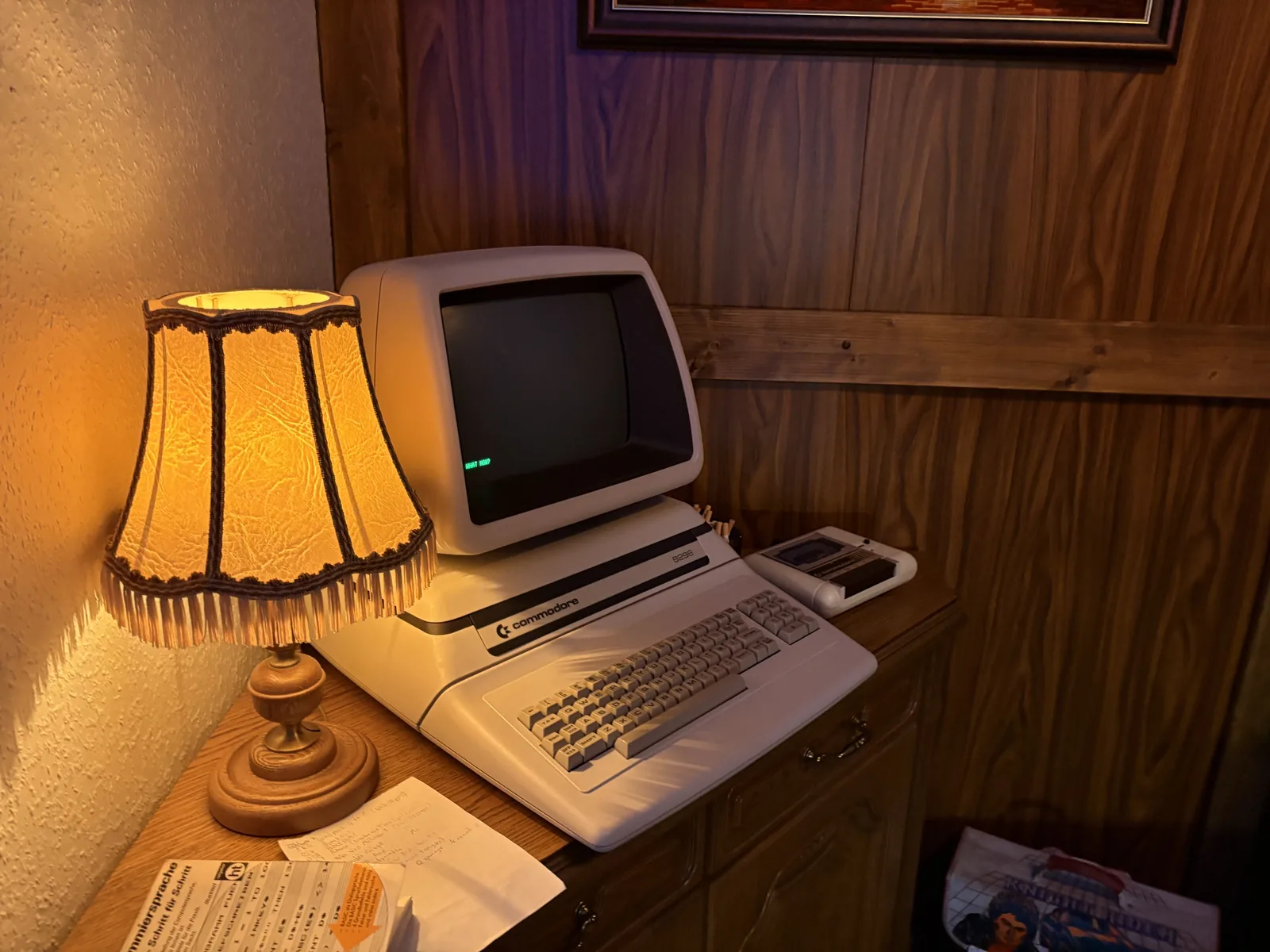
A Commodore CBM in its natural habitat.
Then came the home consoles and computers, each on its own table with its own CRT and an info card. There was an Atari 7800 hooked up to a gloriously retro red LG television, and a Philips Videopac+ G7400, the European successor to the Videopac (or Magnavox Odyssey², as the Americans knew it). And there were two old friends side by side: a NES and a Commodore 64C. Two machines that powered my childhood, both running on variants of the same MOS 6502 processor. A little further on stood an Amiga 500, and in a glass case, a Japanese Famicom with its disk system next to the infamous Power Glove.
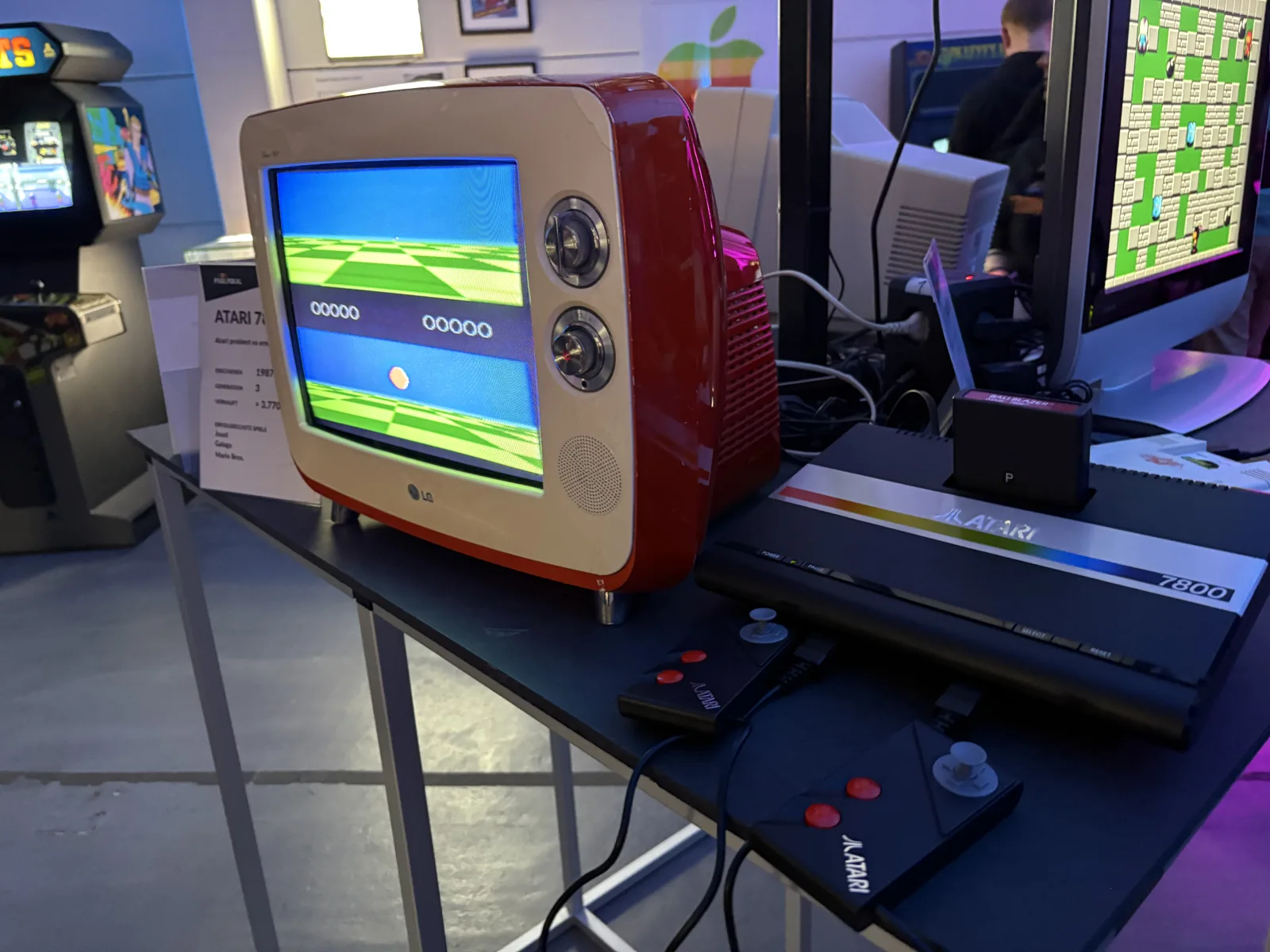
The Atari 7800.
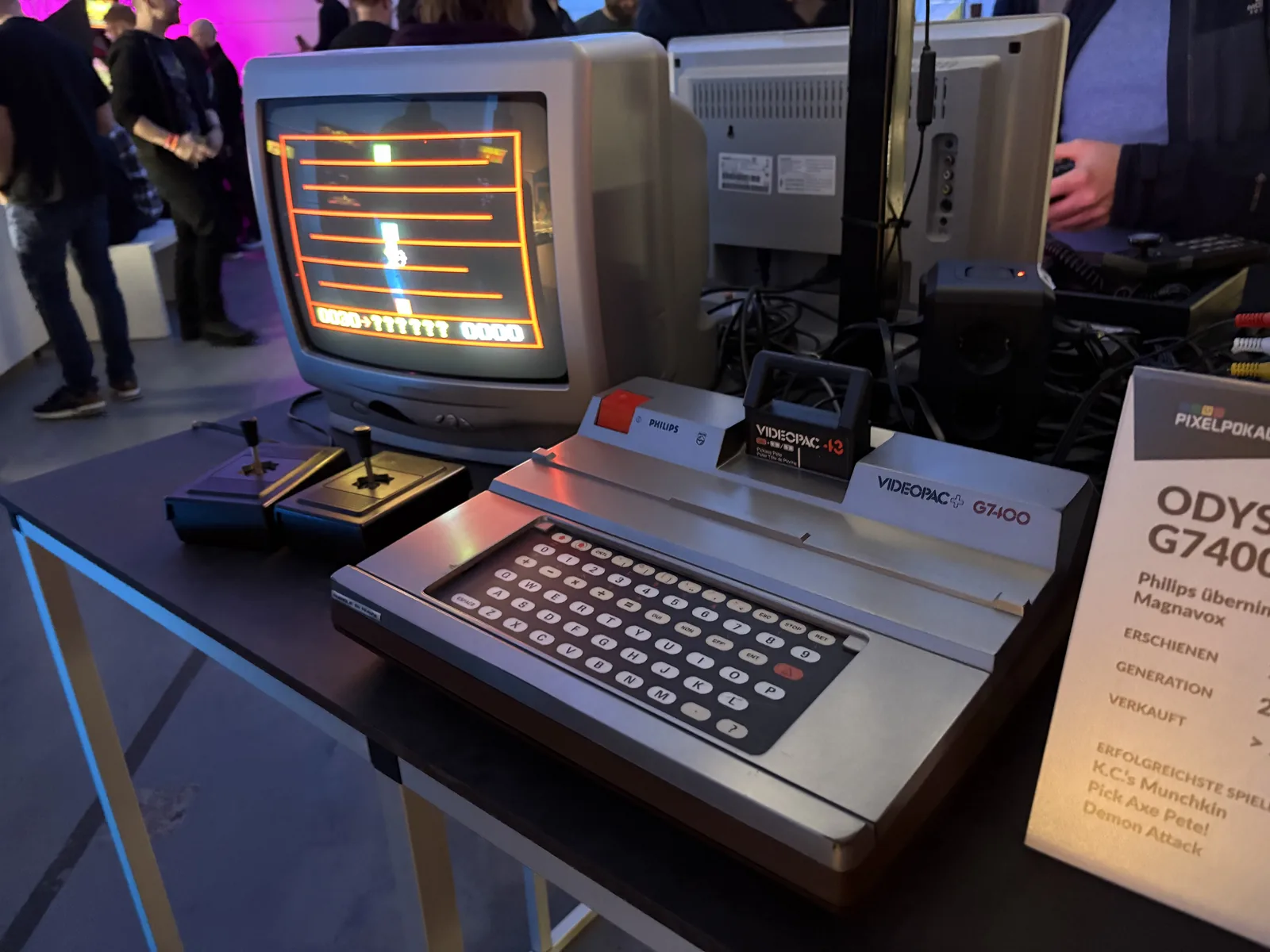
The Philips Videopac+ G7400.
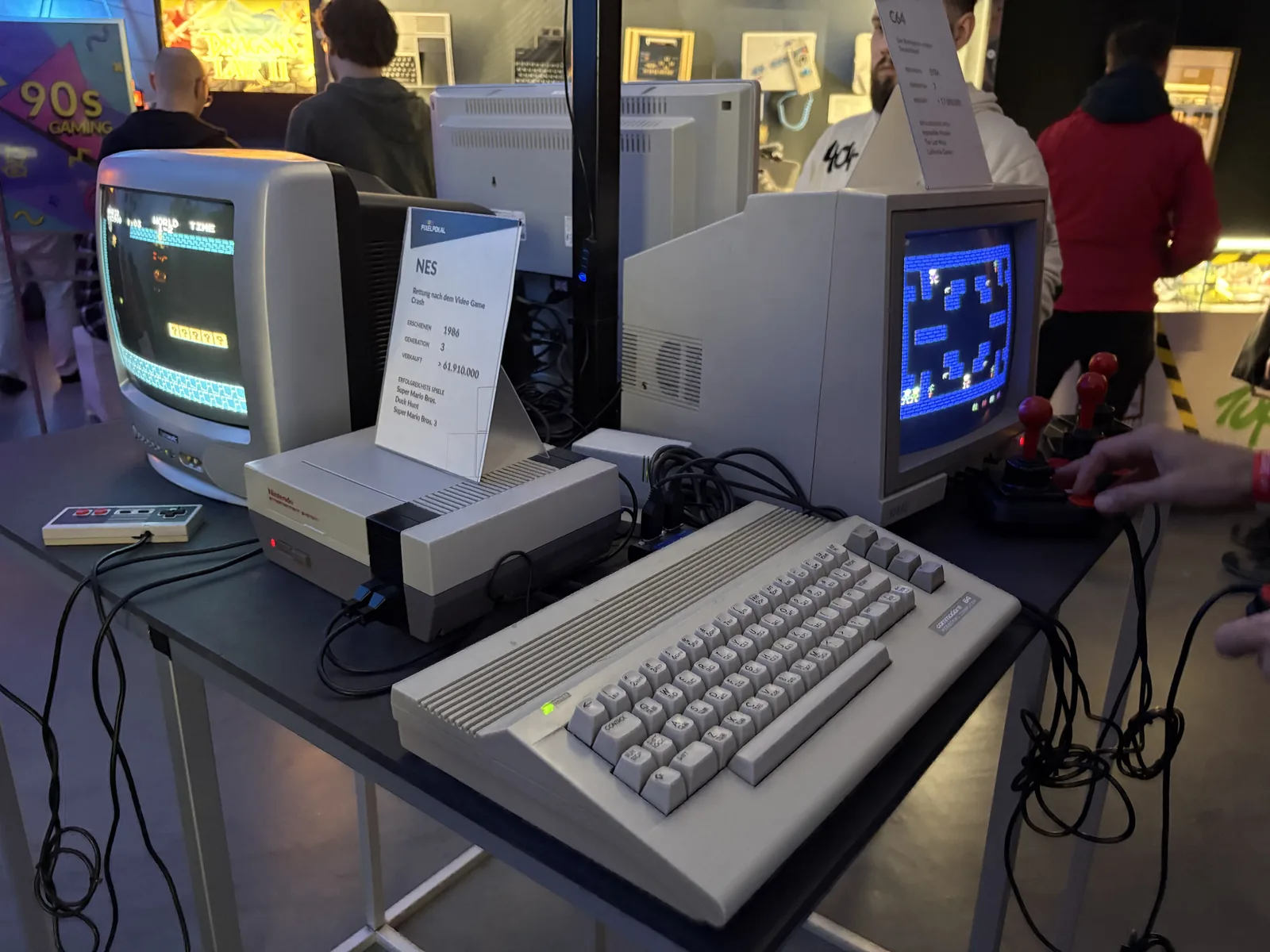
NES and C64: 6502 buddies.
One display case I found particularly clever: a pile of sand and junk with a copy of Cyberpunk 2077 lying in it. The case drew a line from the infamous 1982 E.T. game for the Atari 2600, whose unsold cartridges ended up buried in a landfill in the New Mexico desert, to the troubled launch of Cyberpunk almost forty years later. Both games were rushed out for Christmas, and both became cautionary tales.
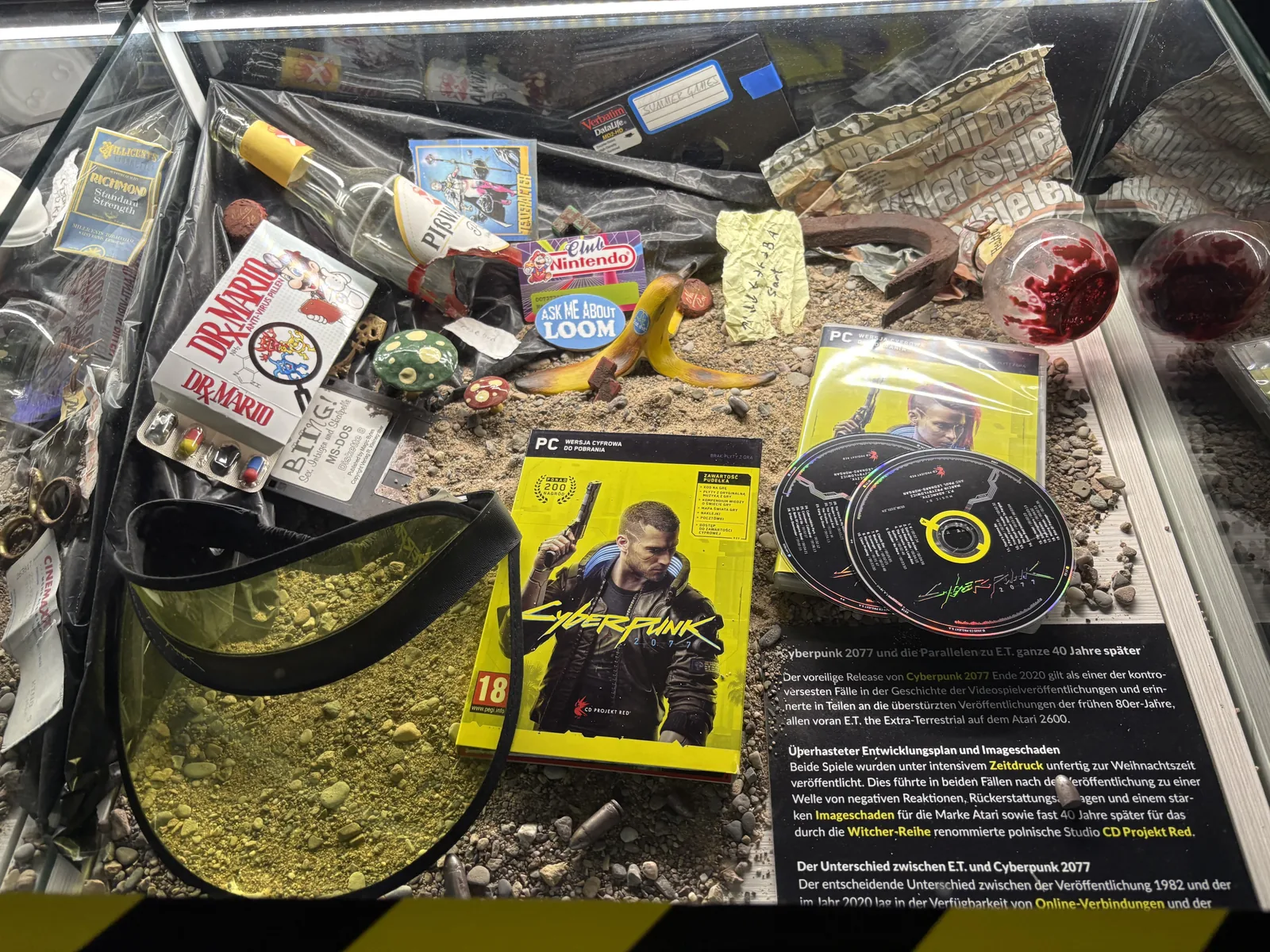
Cyberpunk 2077 in the landfill, forty years after E.T.
One of the most fun corners was a fully furnished 1980s or early 1990s teenager's bedroom: a CRT on the floor, toys and game boxes everywhere, an inflatable chair, and the general level of mess that would get any child a talking-to. The walls were plastered with posters of Lara Croft, Jurassic Park, and Hackers. Nearby, a wall of handhelds and oddities showed the evolution of portable gaming, all the way to Nintendo's ill-fated red Virtual Boy. Two of the big 16-bit rivals, the Super Nintendo and the Mega Drive, stood peacefully next to each other, where the console wars of bygone days were settled with a pair of controllers.
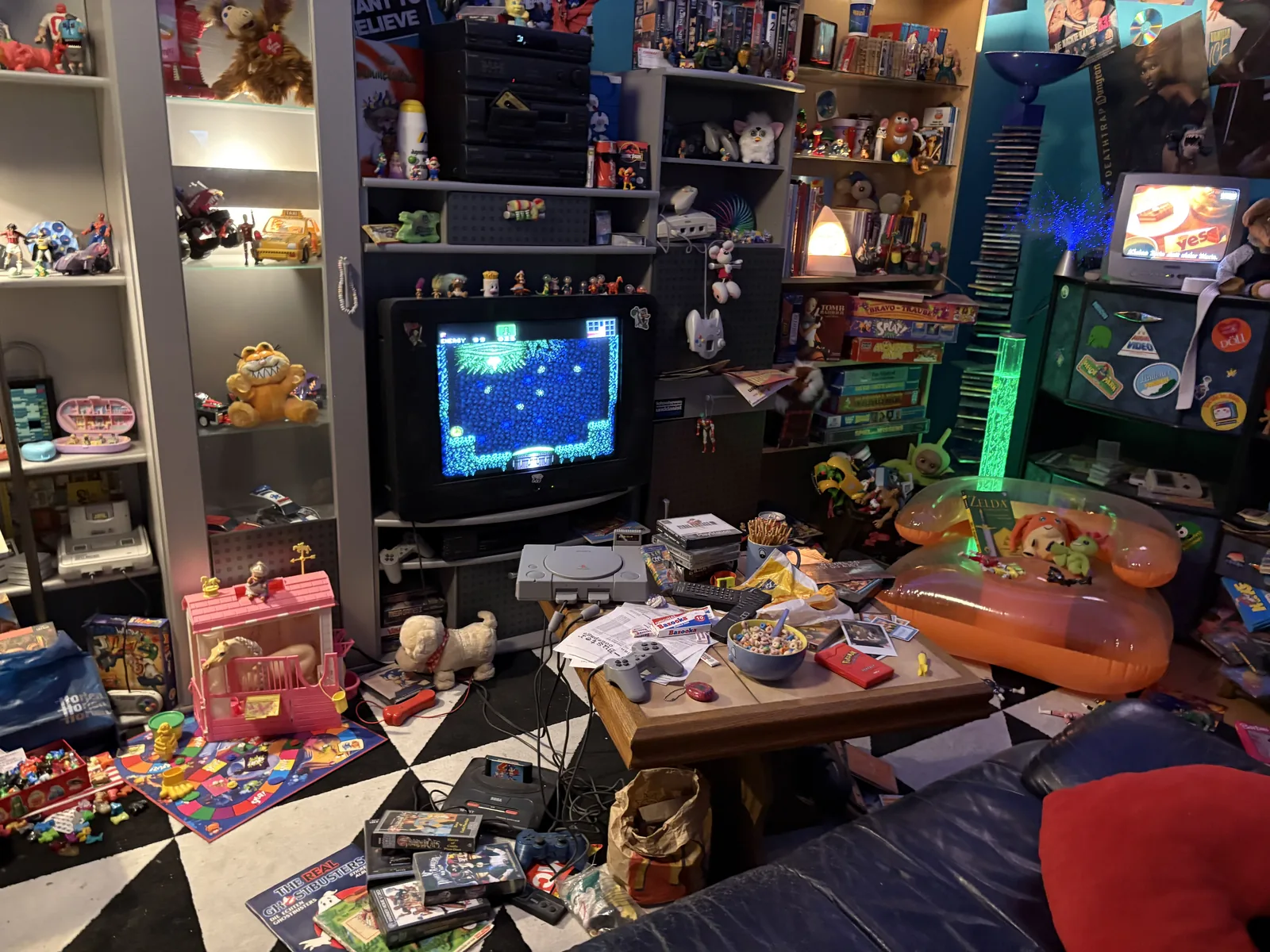
Somebody please tidy up this 1980s bedroom.
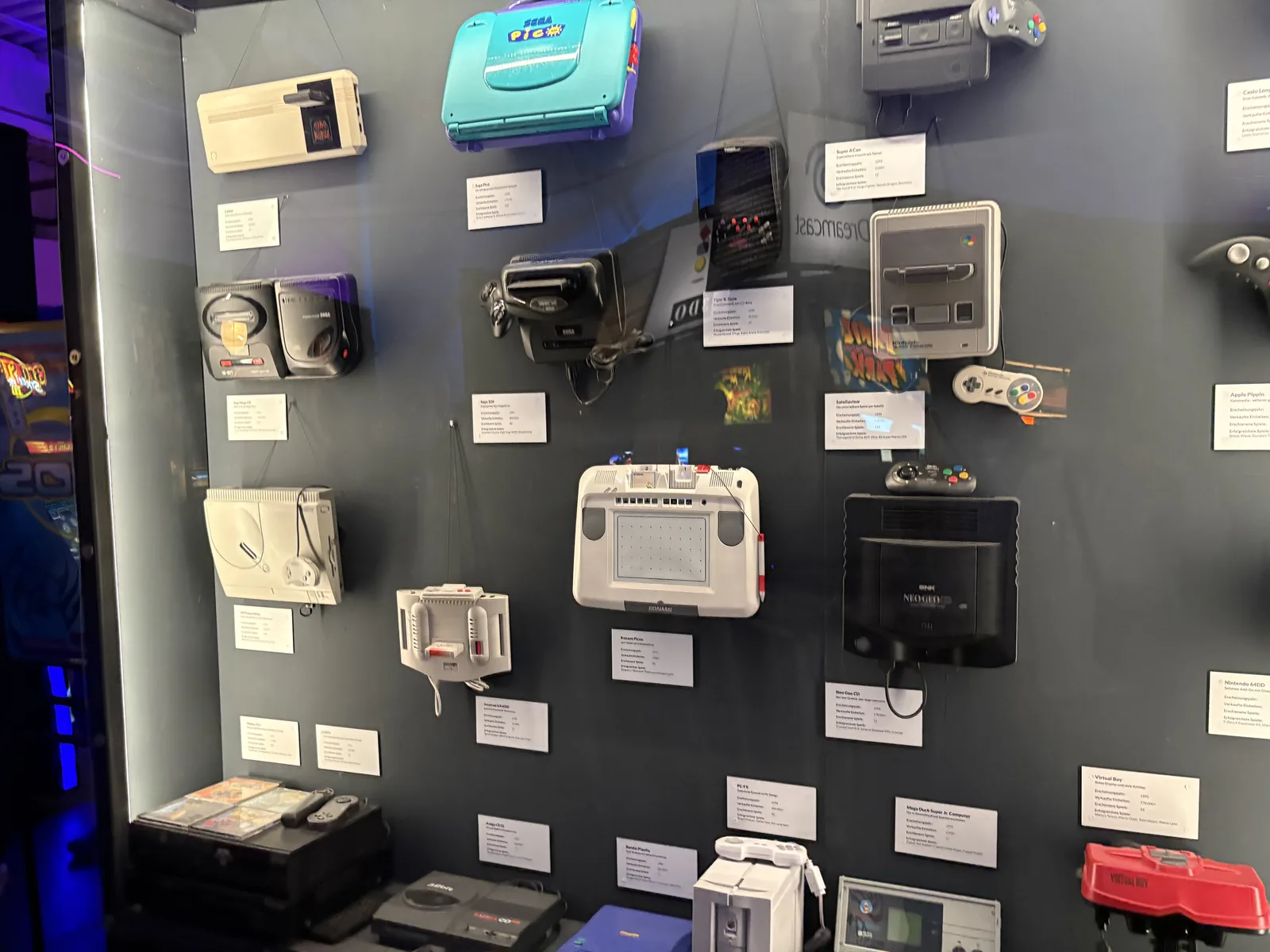
The console wall.
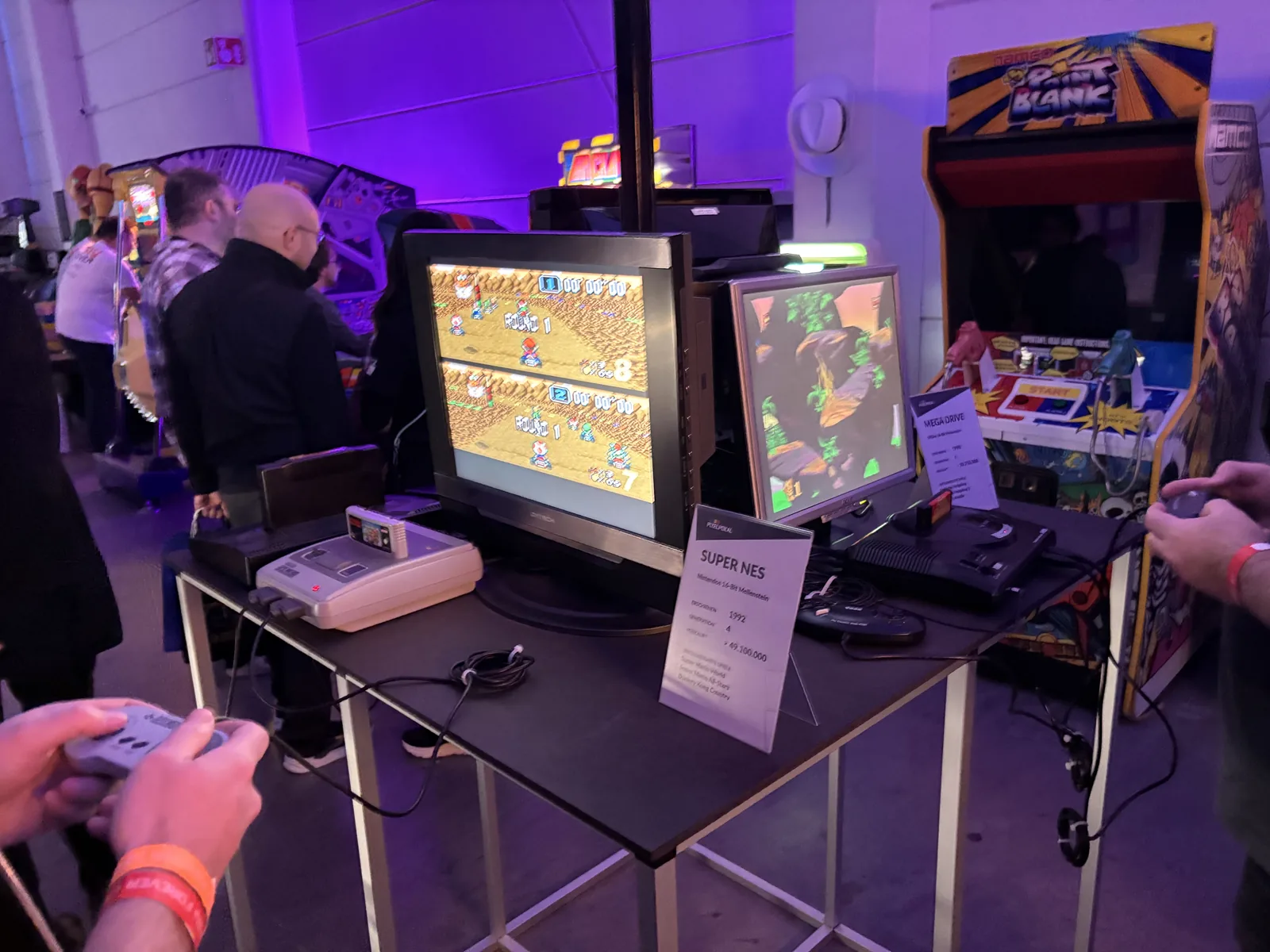
SNES and Mega Drive, at peace at last.
And then there were the arcades, and that is where the claim of being one of the largest collections in Europe really shows. The golden age classics were all there: Defender, Donkey Kong, Galaxian, and a Q*bert cocktail table. I played a round of Joust, Williams' 1982 classic in which you fly around on an ostrich and lance other knights. I used to play the faithful conversion on the Atari ST and the Palm IIIc.
There was a Polybius cabinet, the arcade machine from the famous urban legend that supposedly brainwashed its players in 1981. I took a look, and it seemed reassuringly harmless. (I do own and play the Jeff Minter version of Polybius on the PS4.)
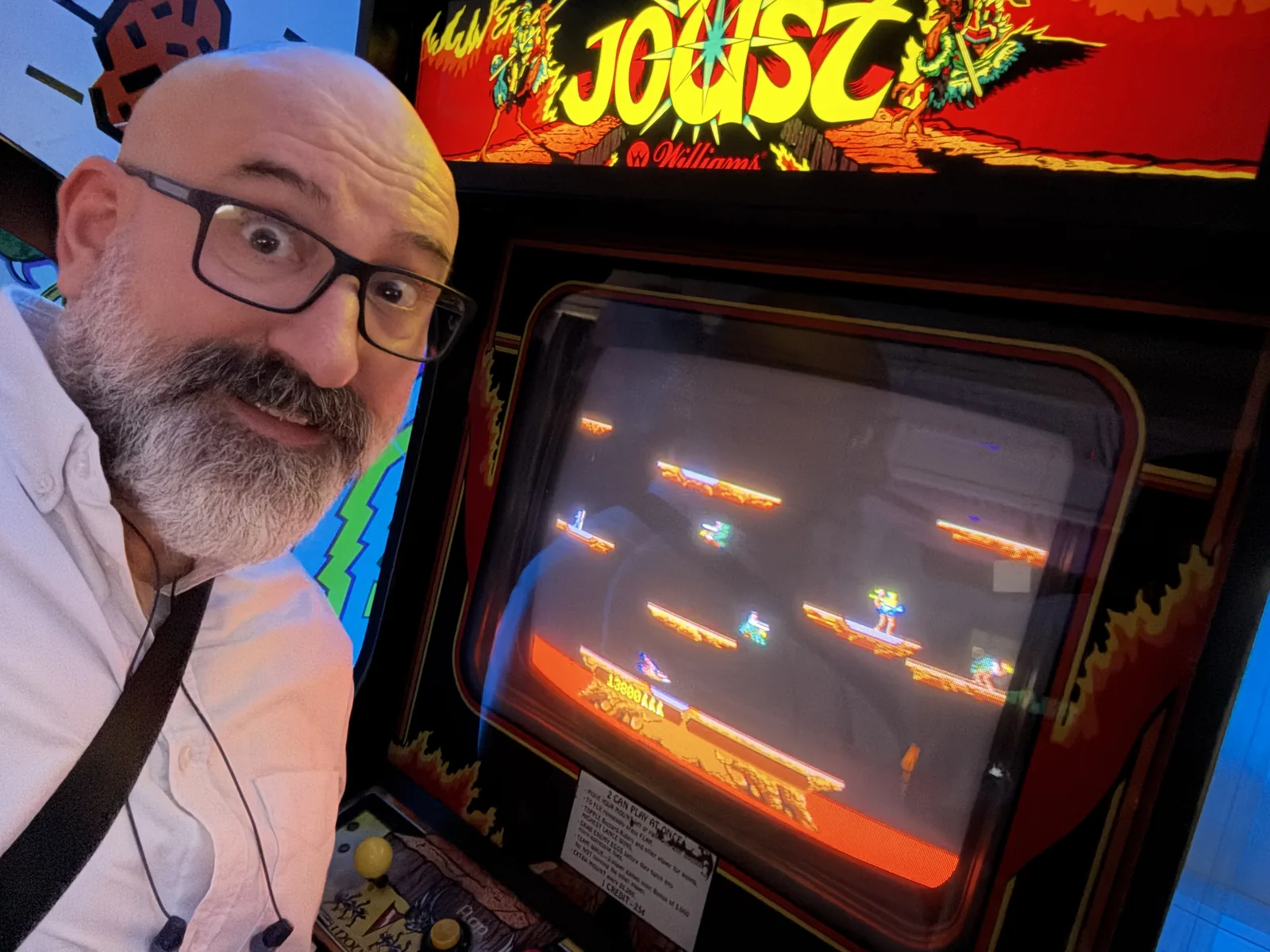
Me versus Joust. Joust won.
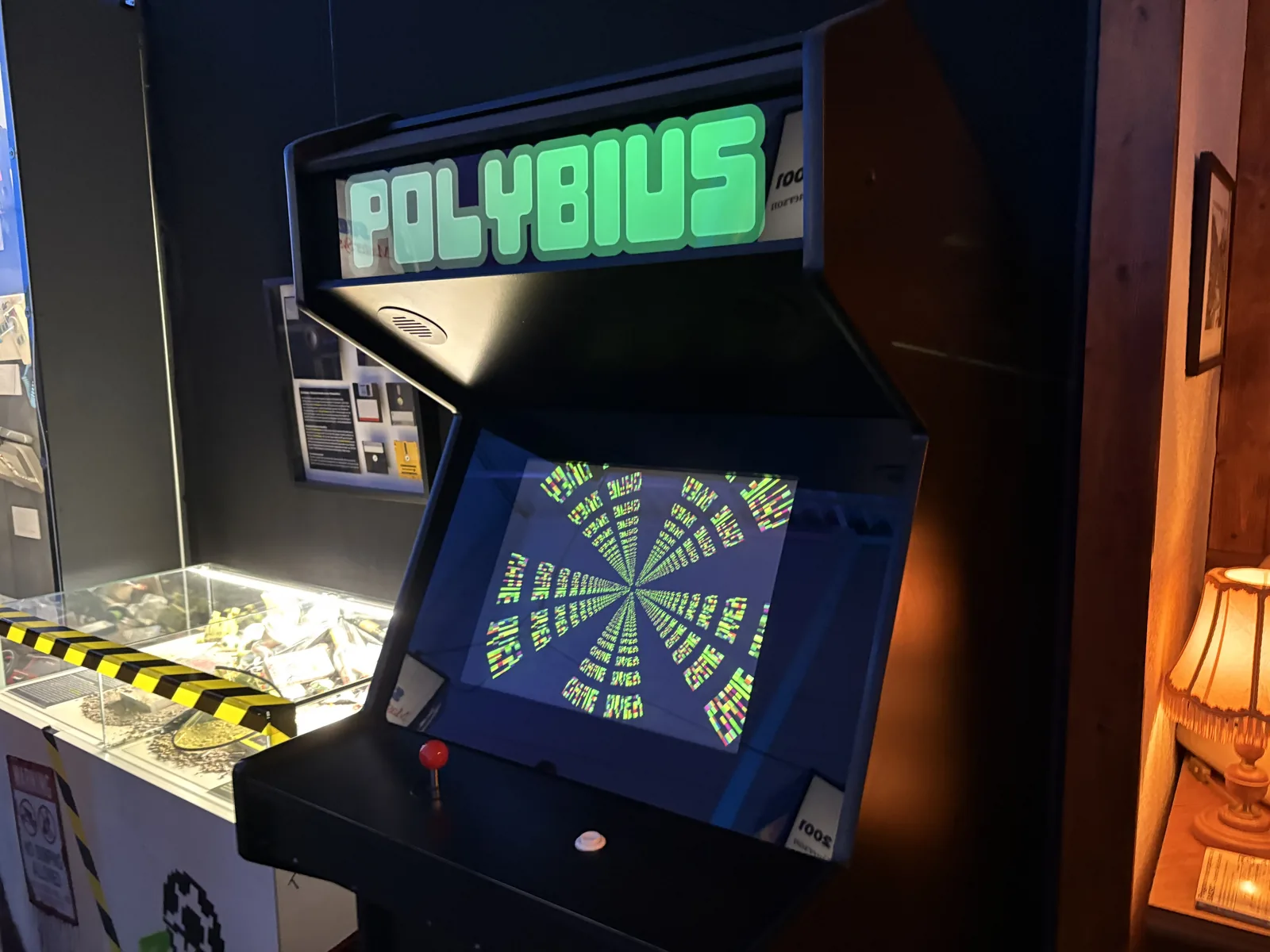
Polybius. Don't stare at it too long.
Further in, the museum turns into a proper Japanese-style arcade, all purple light and noise. There was a Tetris cabinet next to a big sit-down racing machine, a street racing cabinet guarded by a life-size Hatsune Miku figure, and a Pump It Up dance machine. I sat down for a selfie between Mario Kart Arcade GP and the F-Zero AX racing seats, marveled at a Japanese Densha de GO! train-driving simulator in a full-size driver's cab, and was watched over by life-size statues of Samus Aran and a BioShock Big Daddy. I especially loved Sega Marine Fishing, which comes with a fishing rod controller, complete with a reel. A pinball machine glowed in its own corner, and on the stage at the back, a modern gaming setup with Fortnite reminded everyone that today's games will be tomorrow's museum pieces.
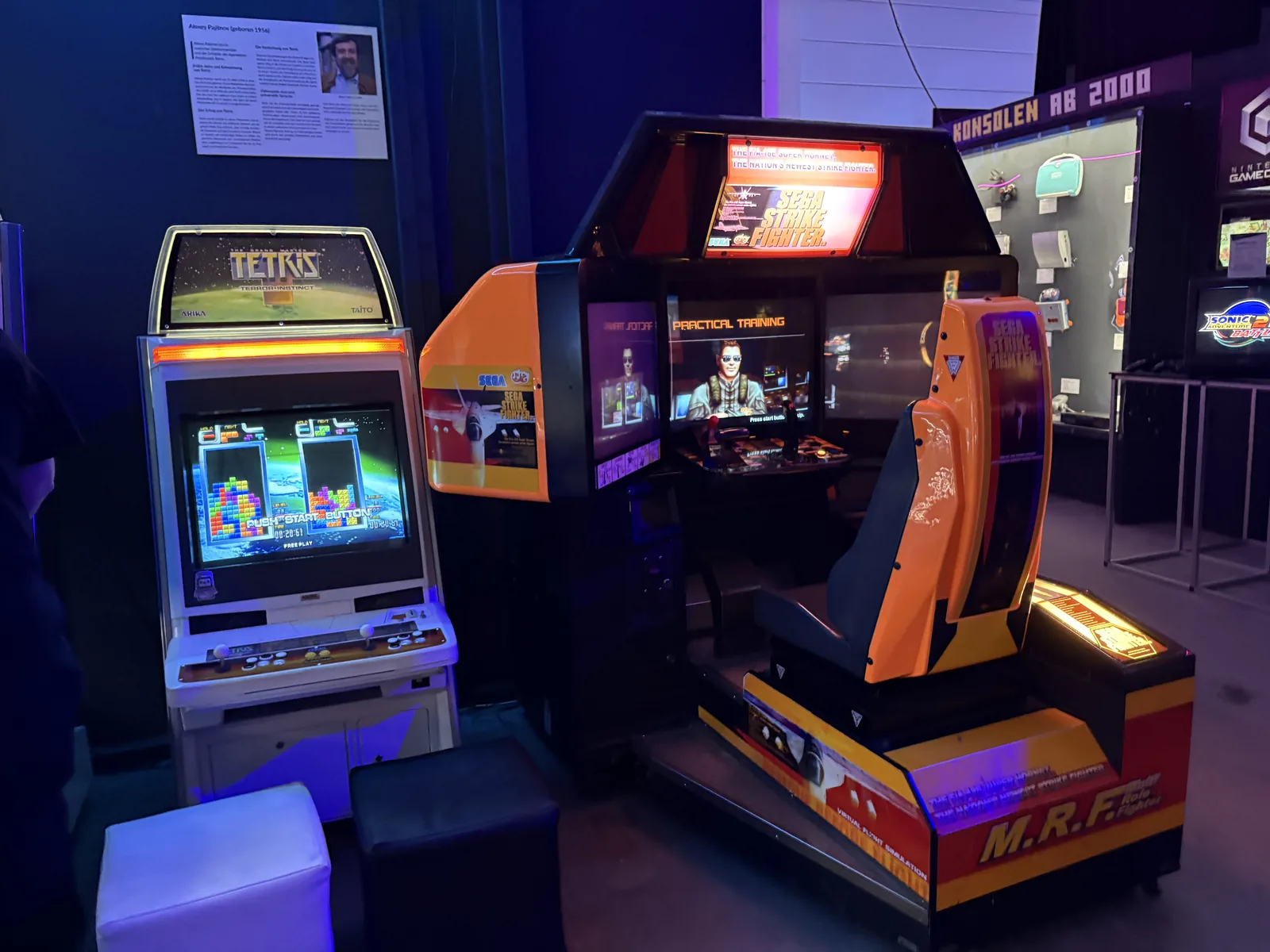
Tetris and a racer.
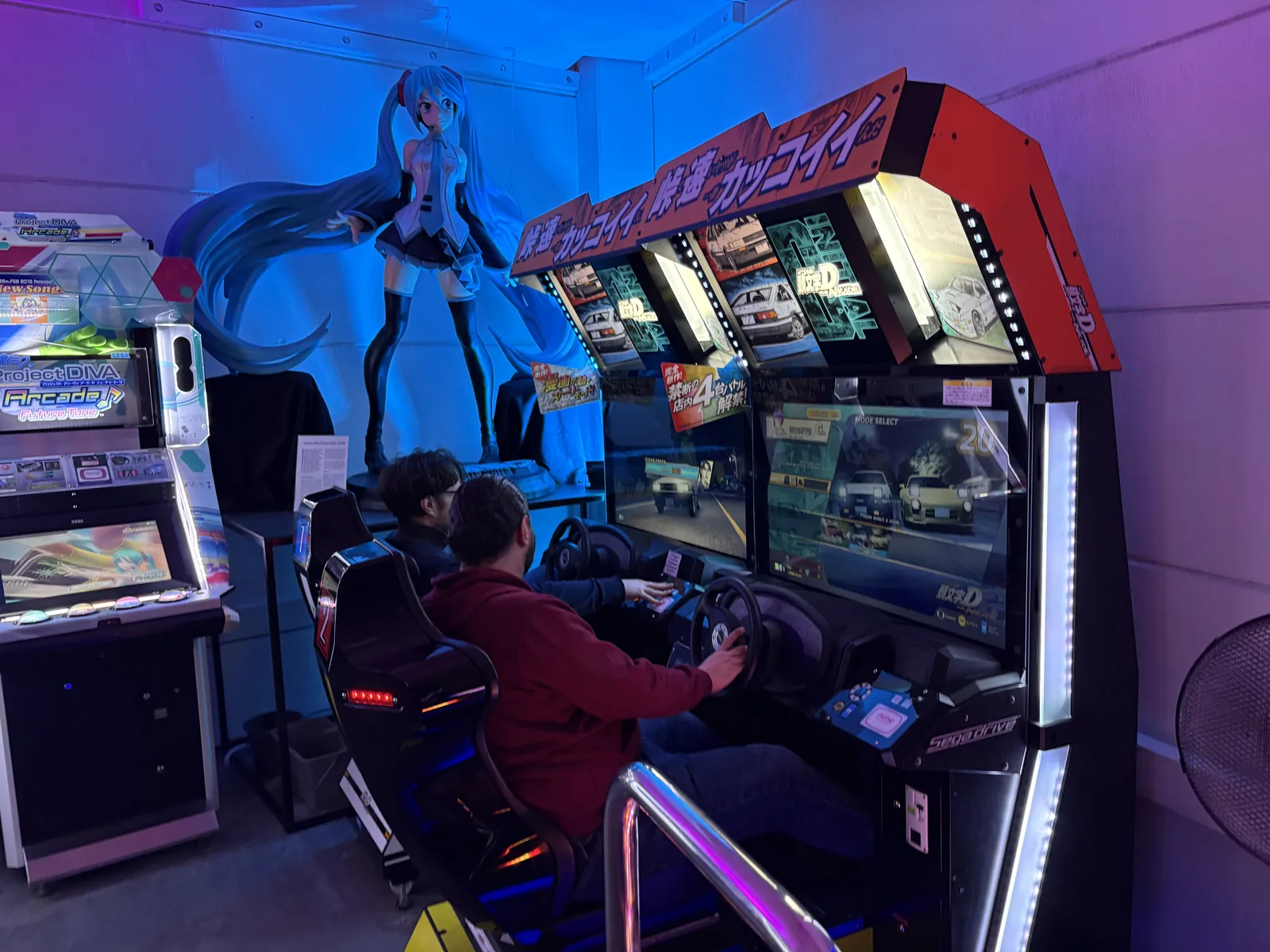
Racing under Miku's watchful eye.
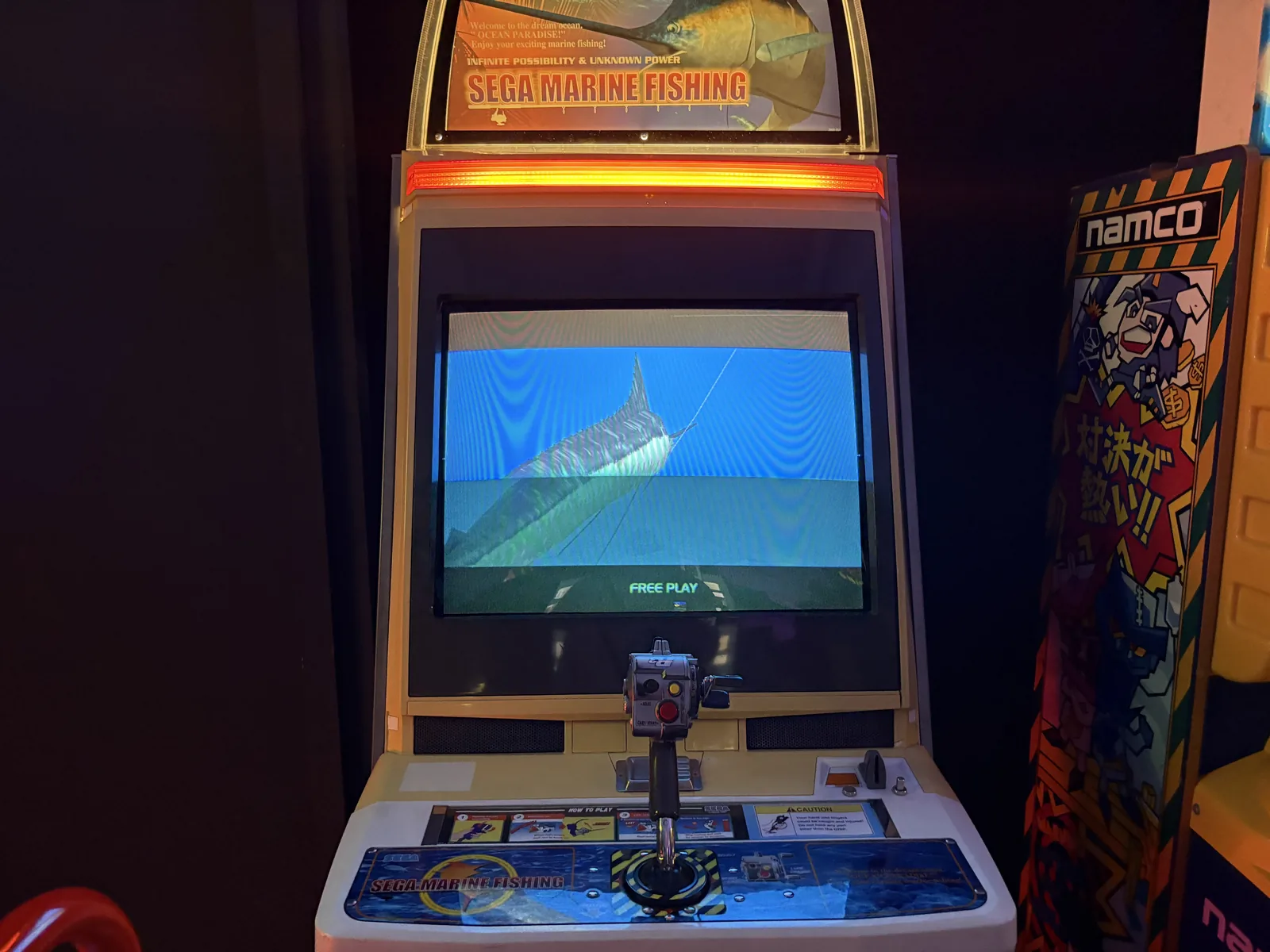
Sega Marine Fishing.
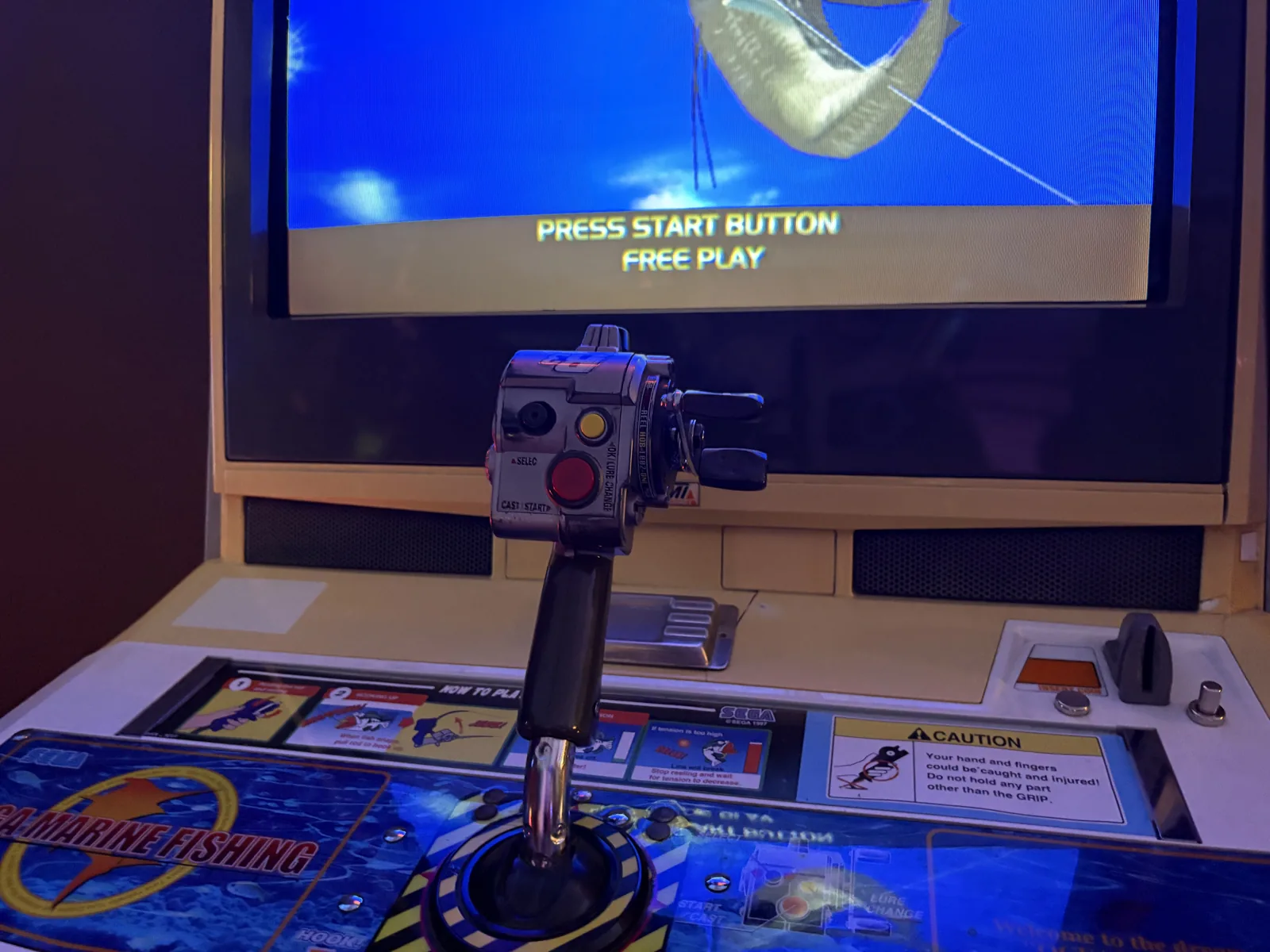
The rod-and-reel controller.
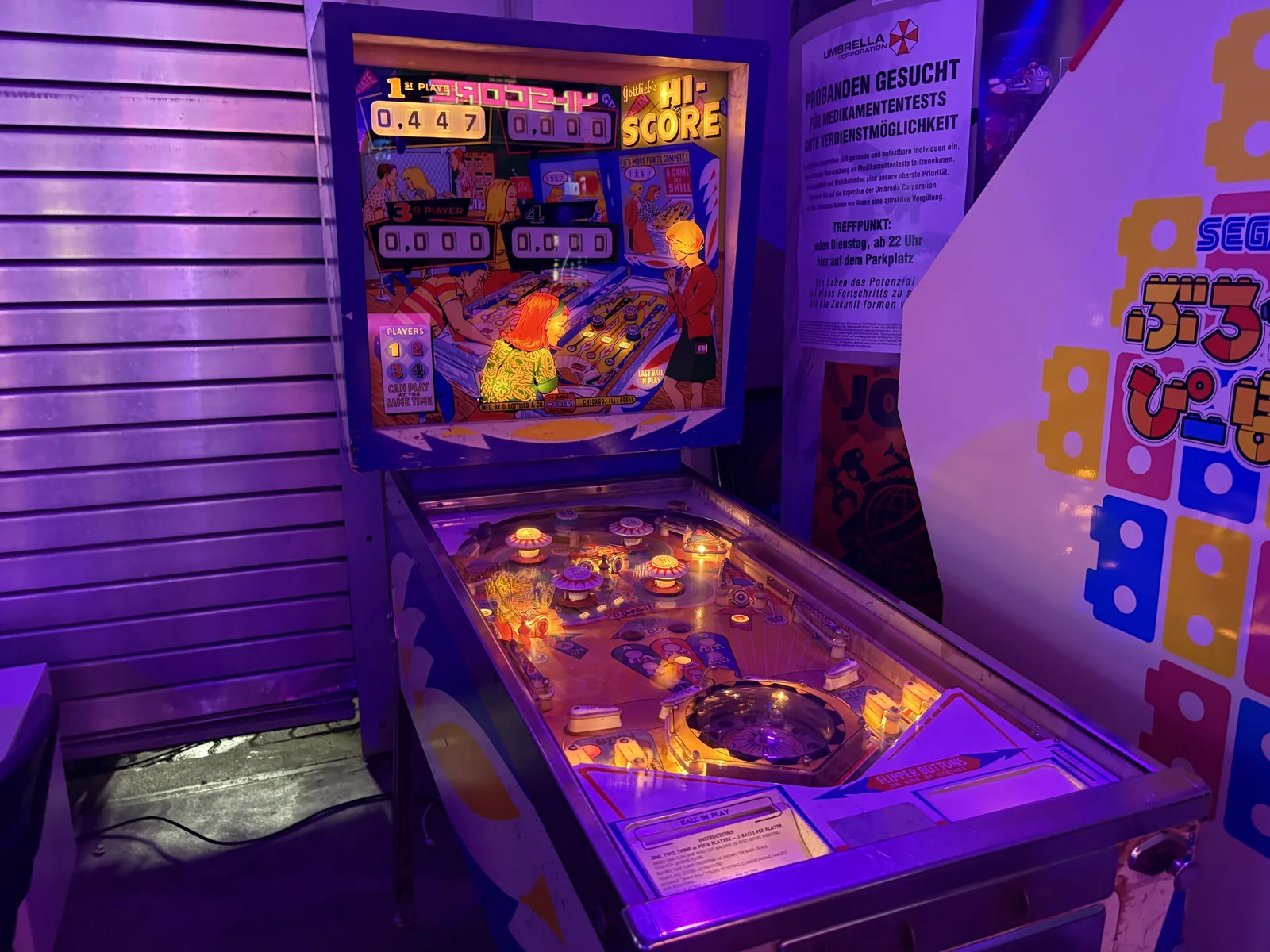
Pinball in purple.
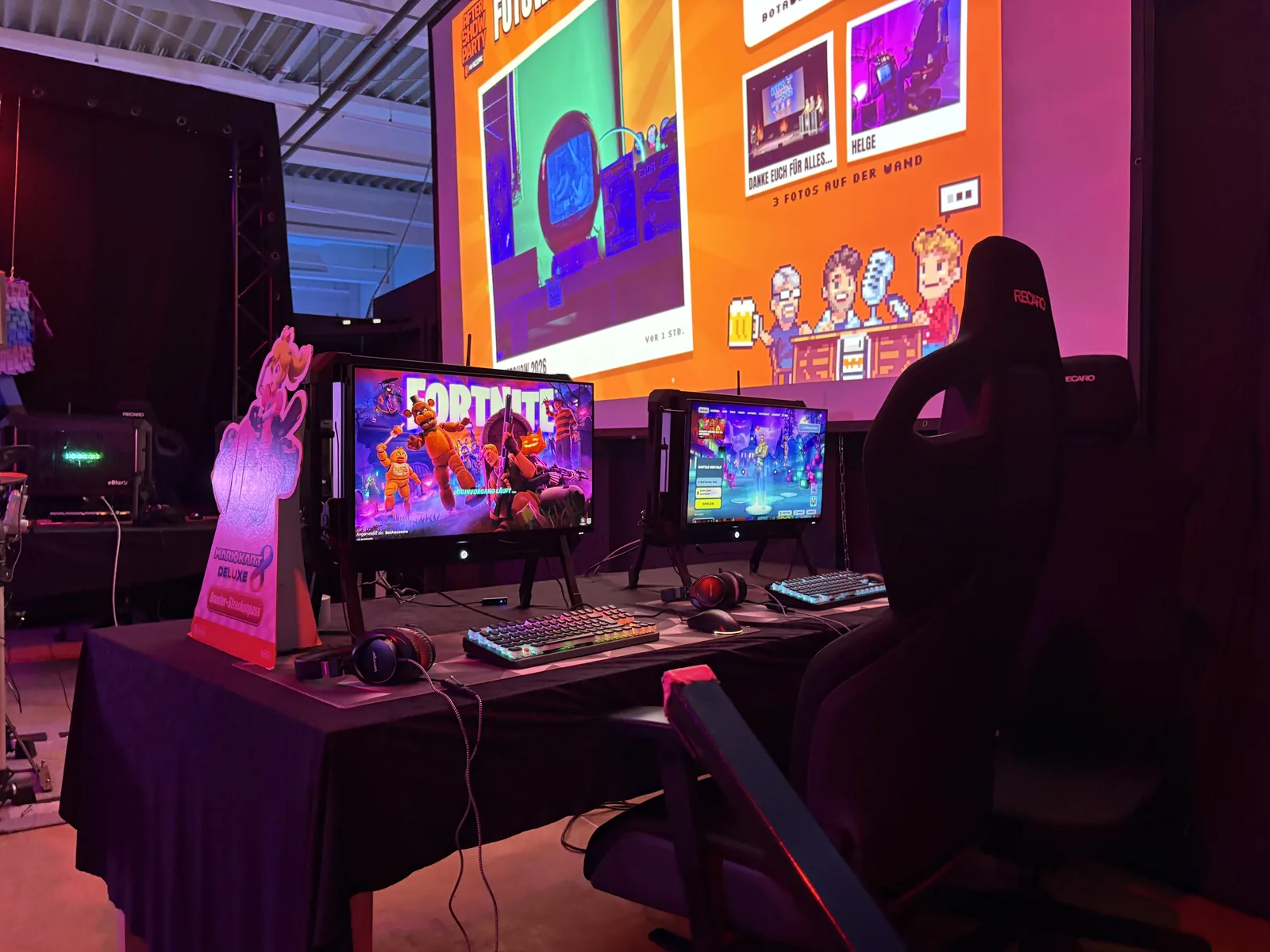
Tomorrow's retro: Fortnite.
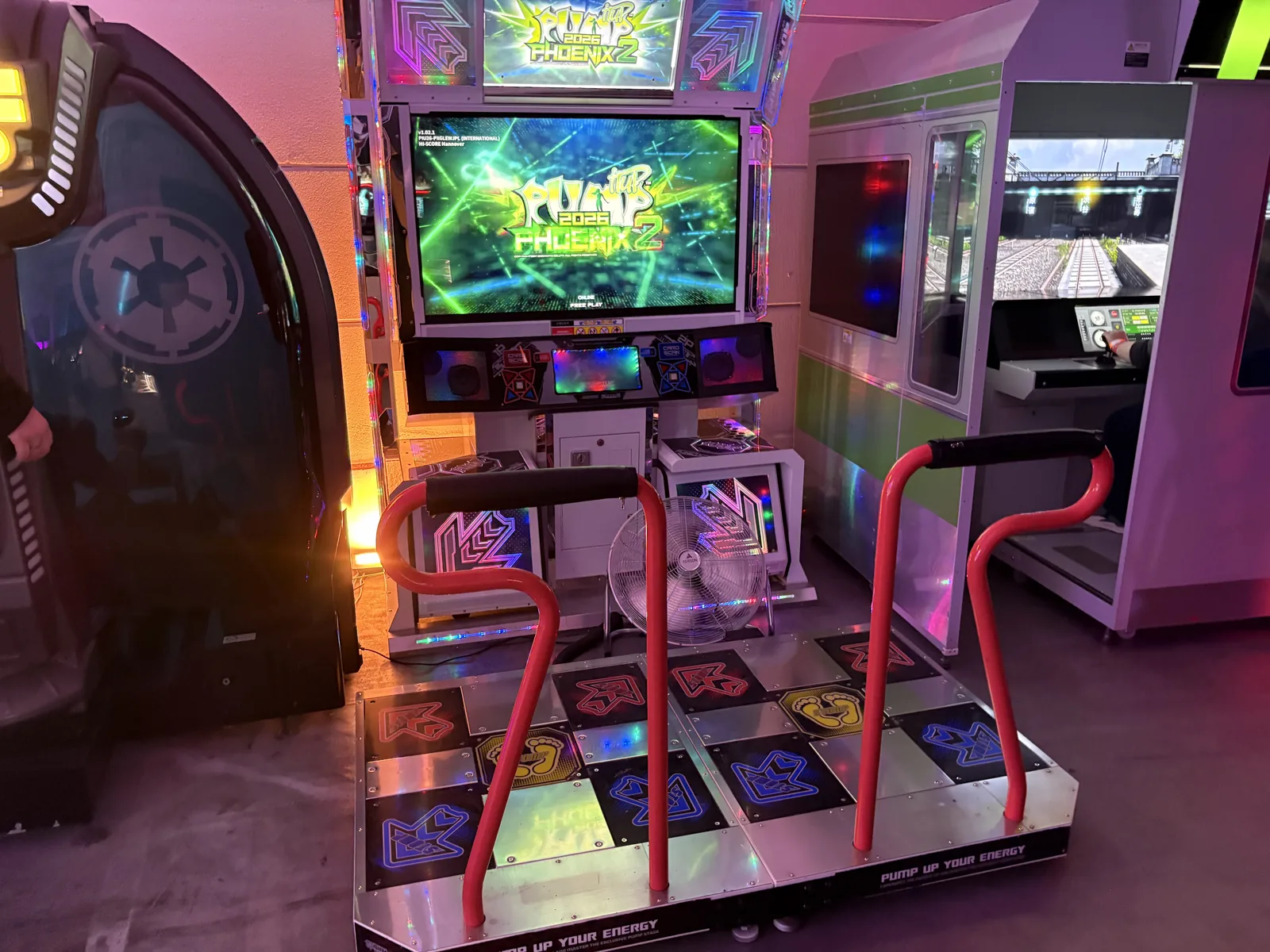
Pump It Up.
The last thing I played before our hour was up was Pong, the game the whole medium started with. This one was an analog coffee table cabinet glowing in violet light. More than fifty years on, the simplest game in the building was still the one drawing the most intense players.
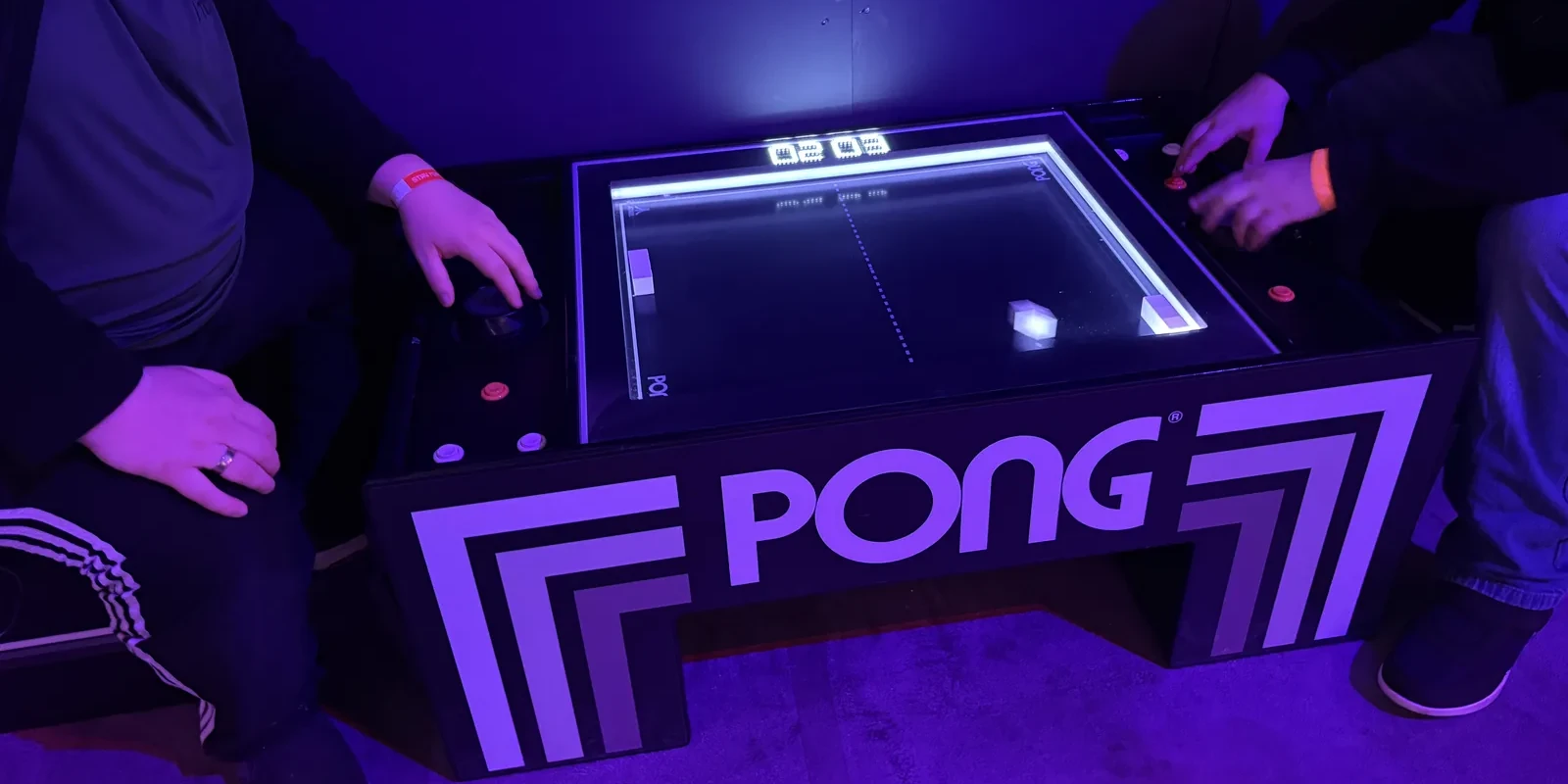
Where it all began: a Pong table, still drawing a crowd.
Afterwards, I went back to the fire and the bar, and later squeezed in a second round through the museum. It was well past midnight when I finally said goodbye. Instead of waiting for a ride, I walked back into town. It took a while, but after a day of sitting in a dark hall and an evening among blinking screens, a long walk through the quiet streets of Hanover was exactly what I needed to clear my head and get some fresh air.
Sunday: Morning Chat, Gamebooks, and Stunt Island
Sunday started more quietly, with Das Format ohne Namen Live. It's a chat between Chris and Gunnar about whatever comes to mind, explicitly without games. The hall was dark and the mood was cozy, and I think quite a few of us were still recovering from the night at HI-SCORE.
At eleven, Ausgefragt! Live brought the whole team on stage. Chris, Gunnar, Fabian, Henner, Rahel, and Christian Beuster, plus guest Paul Kautz, answered questions from the audience, and people lined up at the microphone in the aisle.
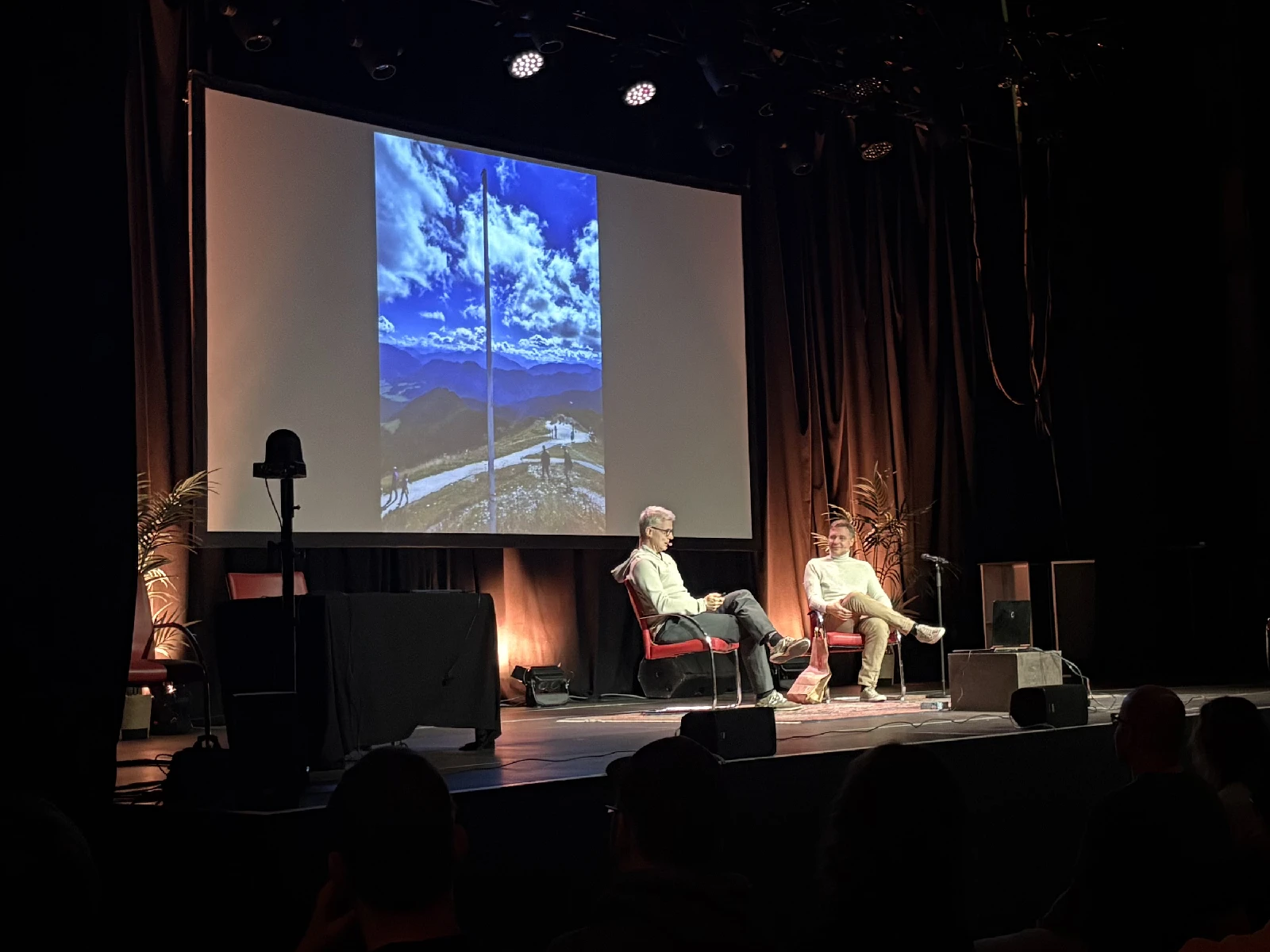
Das Format ohne Namen, live and in the dark.
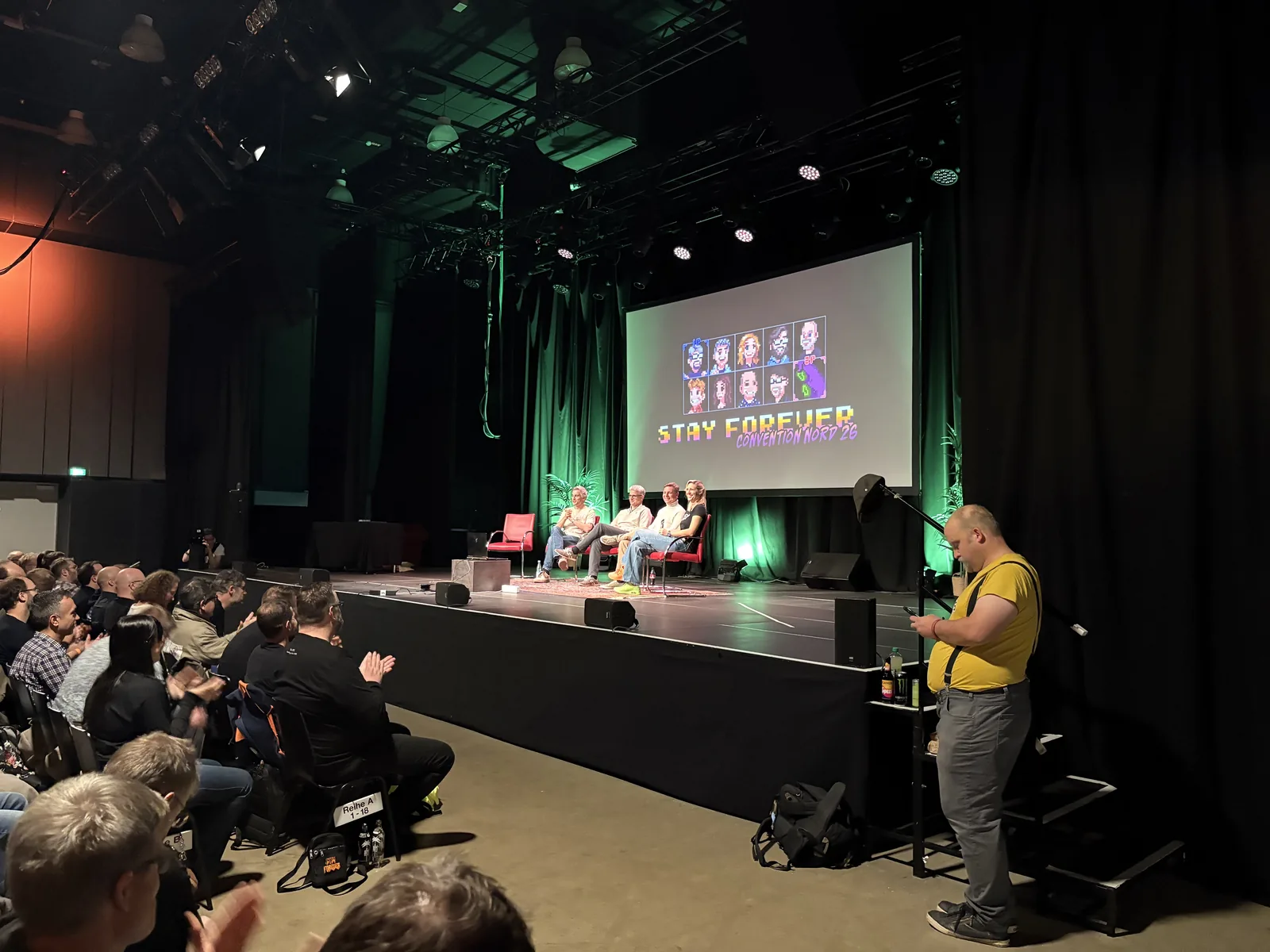
Questions from the floor at Ausgefragt! Live.
The afternoon brought Mháire and Gunnar talking about how a gamebook is made. That's the choose-your-own-adventure kind of book, where you turn to paragraph 237 if you open the door, and where you secretly keep a finger in the previous page just in case. Having co-authored several gamebooks with her partner Nico, Mháire explained how such a book is planned, how the branching decision trees are mapped out, and how you keep hundreds of numbered paragraphs logically consistent. By the end, she had made me look forward to getting back into reading gamebooks, something I haven't done in far too long. It was followed by Henner and Fabian with a live episode of SF Technik Bits, where Henner brought a bunch of force-feedback joysticks that could be controlled by another joypad at the same time. It culminated in a wonderfully absurd Quake battle between Henner, using a force-feedback steering wheel, and Fabian, using one of the force-feedback joysticks. The catch was that both players' input devices were influencing each other simultaneously.
The convention closed with a classic Stay Forever episode live on stage: Chris, Gunnar, and Paul Kautz did a deep dive into Stunt Island, Disney's 1992 flight simulator with a built-in film studio. You could fly stunts, film them from multiple camera angles, and then edit your own movies. It's a wonderfully strange game, way ahead of its time, and a good choice to end a weekend devoted to the creativity of old games.
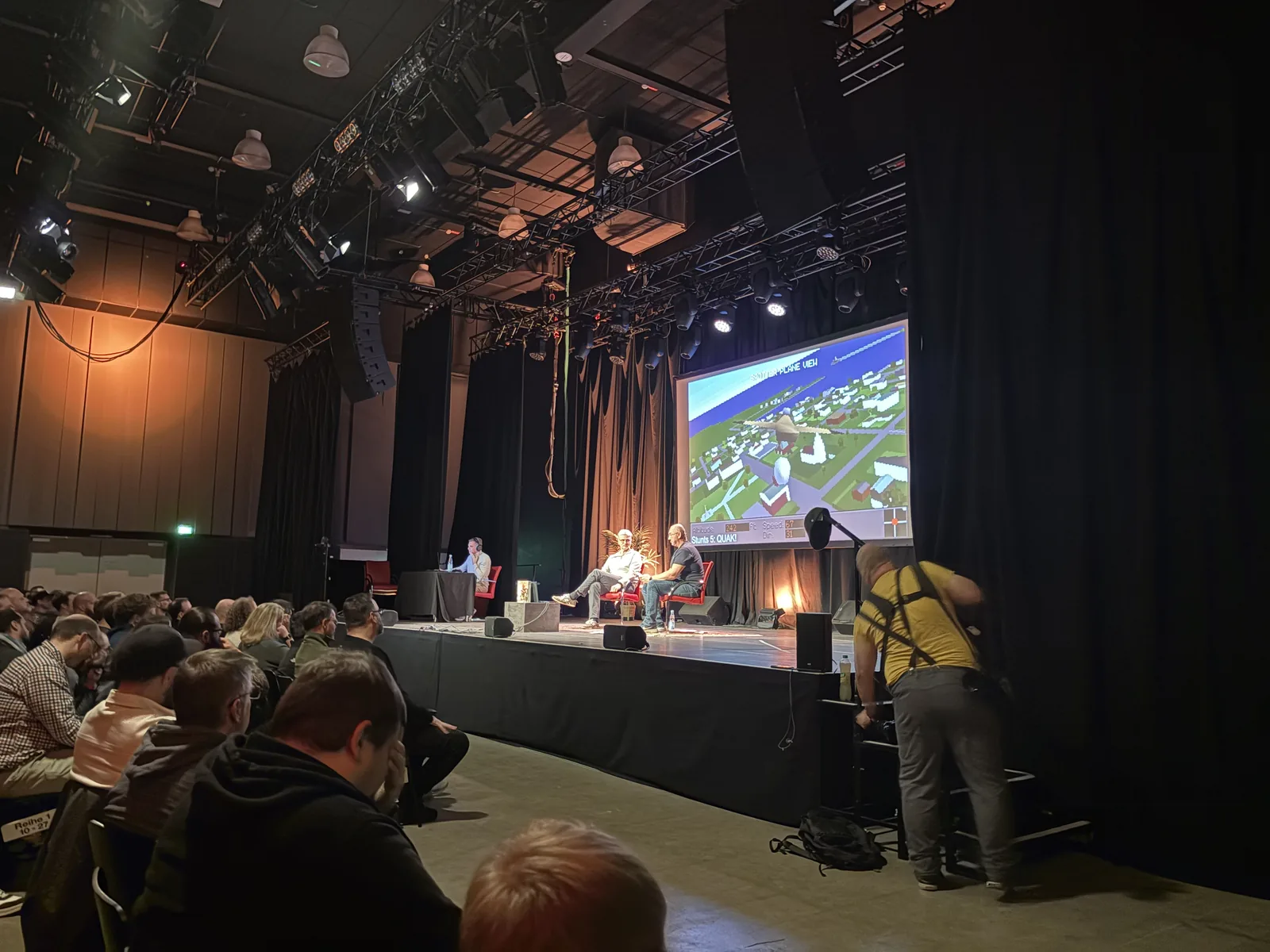
The grand finale: Stunt Island with Chris, Gunnar, and Paul Kautz.
Doing What You Love
The thing I keep coming back to is how warm the whole event felt. A podcast is a strangely intimate medium: you spend hundreds of hours with voices in your ears, and then you're suddenly in a room with hundreds of other people who have done the same. Nobody had to explain why they cared about a 1992 flight simulator or the metals of Middle-earth.
Watching Mháire, Gunnar, Chris, Rahel, and the rest of the team on stage, I also kept thinking that these are people doing what they love. They have turned their love of games, stories, and pop culture history into a profession and built a whole community around it. I really hope they can make a good living from it. I find this absolutely wonderful, and when I was younger, I would have loved to take a path like that myself. But I feel that I'm now making real strides in my job while still keeping my interests alive on the side, like here on this website. That's a pretty good deal too.
The Way Back
For the way back, I had booked a FlixTrain from Hanover to Cologne on Sunday evening, so that I could catch my flight to Sofia the next morning. Departure was scheduled for 18:23. When I got to the station, it had already slipped to 20:48. So I settled into a pub in Hanover's central station to wait, and was very surprised to find an ashtray on my table. You could still smoke in there!
I gave up smoking a while ago. My younger, smoking self would probably have been delighted. But mostly, it struck me as very retro, a fitting end to a weekend spent with things from the past. Smoking in bars and restaurants has been banned in most of Europe for years. Austria finally banned it in 2019, and North Rhine-Westphalia, where I was headed, has had a strict ban since 2013. Lower Saxony, however, still allows it in small single-room pubs and separate smoking rooms.
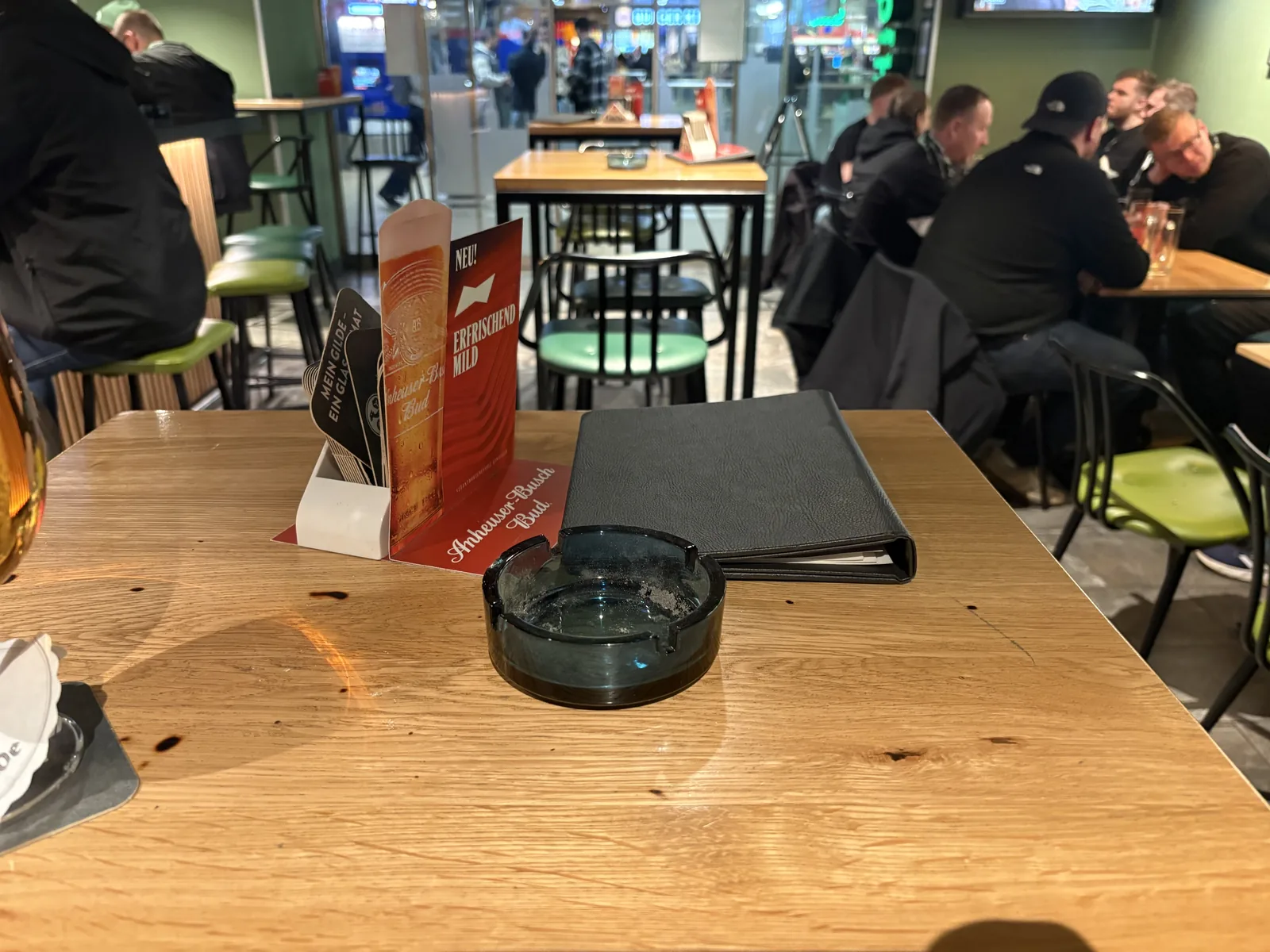
The pub in Hanover's central station, ashtray included.
Once the FlixTrain had finally arrived and we set off, it was delayed even further along the way. And I was surprised, and frankly a bit appalled, by how filthy the train was: food scraps and rubbish on the floor between the seats, as if nobody had cleaned it in days. I finally made it back to Cologne well after midnight. This meant that I had a very short night. I walked past the cathedral at dawn on my way to the airport. Then I flew back to Sofia, where smoking in enclosed public spaces has been banned since 2012.
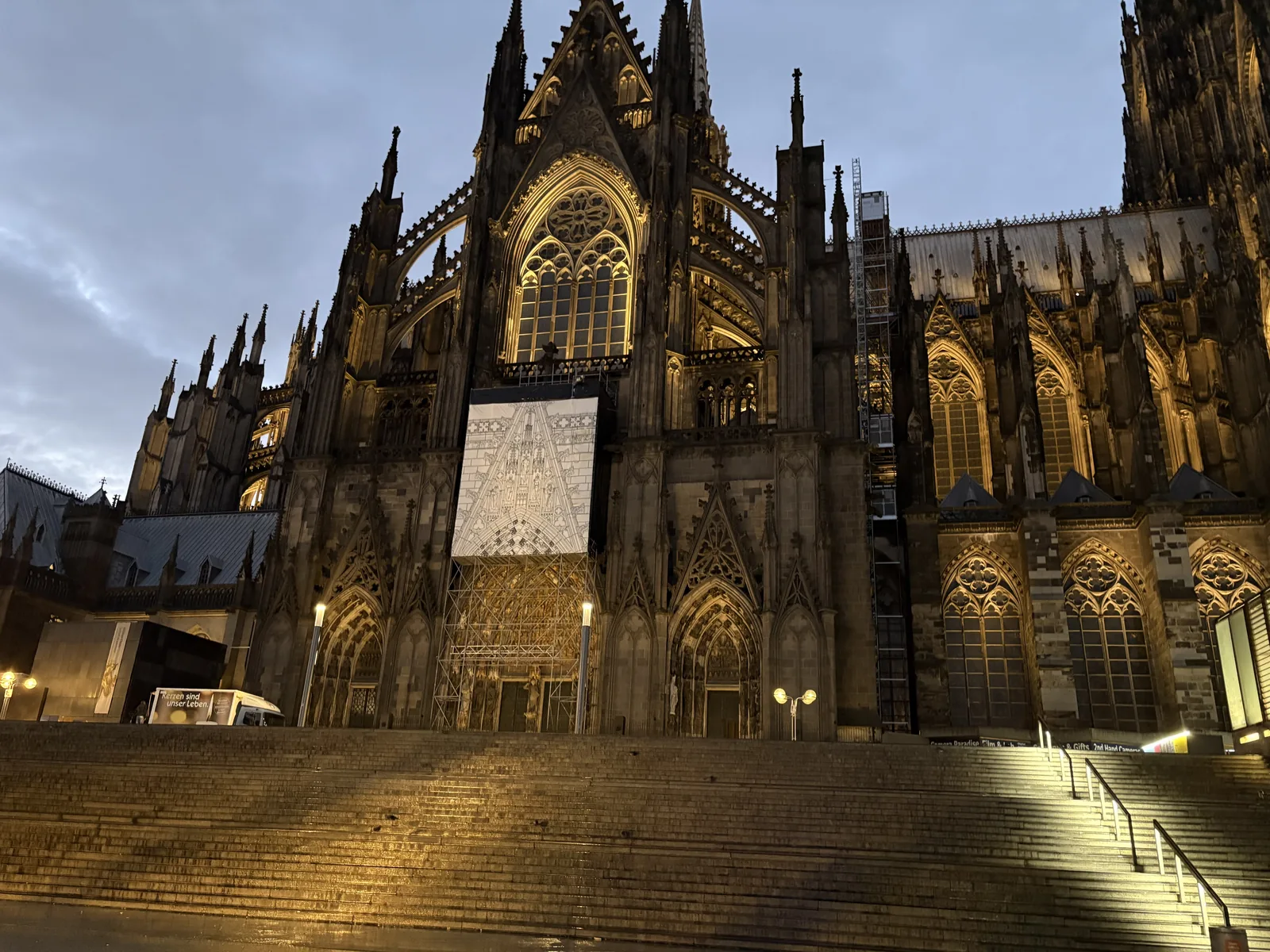
Cologne Cathedral at dawn, on my way to the airport.
Thank you to the whole Stay Forever team and the HI-SCORE crew for a wonderful weekend. Despite Deutsche Bahn and FlixTrain, I would love to come back.
The Program at a Glance
For reference, here is the on-site program as published by Stay Forever.
Saturday, October 24, 2026
| Time | Session | On stage |
|---|---|---|
| 09:30 | Doors open | |
| 10:30 | Welcome & Intro | Chris, Gunnar, Marius, Marko |
| 11:00 | Box Office Battle: Fabian vs. Chris | Fabian, Chris, Gunnar |
| 12:30 | Bernard mit dem Röhrenmonitor im Keller (a whodunit) | Rahel, Johannes |
| 13:30 | Lunch break and meet & greet | |
| 15:00 | Ein Streitgespräch mit Tierlist | Chris, Gunnar |
| 16:30 | Fantastische Metalle | Rahel, Mháire |
| 18:00 | Veteranengespräch: Wie war es damals bei Blue Byte? | Bernhard Ewers, Gunnar |
| 19:00 | Evening break and meet & greet | |
| 20:00 | Das Quiz | Christian Beuster and candidates |
| 22:00 | After-show at HI-SCORE |
Sunday, October 25, 2026
| Time | Session | On stage |
|---|---|---|
| 09:30 | Doors open | |
| 10:00 | Das Format ohne Namen Live | Chris, Gunnar |
| 11:00 | Ausgefragt! Live | Chris, Gunnar, Fabian, Henner, Rahel, Christian B., Paul Kautz |
| 12:00 | Lunch break and meet & greet | |
| 13:30 | Wie entsteht ein Spielbuch? | Mháire, Gunnar |
| 15:00 | SF Technik Bits Live | Henner, Fabian |
| 16:30 | Stunt Island | Chris, Gunnar, Paul Kautz |
| 18:00 | End of the convention |
Frequently Asked Questions
What is Stay Forever?
Stay Forever is the largest German-language podcast about retro games. It was founded by the former GameStar editors Gunnar Lott and Christian Schmidt, who discuss one classic game per episode in depth, and it has since grown into a team of several hosts and a whole family of spin-off formats.
When and where did the Stay Forever Con Nord 2026 take place?
The convention took place on October 24 and 25, 2026, at the Kulturzentrum Pavillon on the Lister Meile in Hanover, Germany, just a few minutes' walk from the main train station.
What was on the program?
Two days of live podcast recordings on stage, including a Box Office Battle, a talk on whodunits in games, a tier list debate, a talk about fantasy metals, a Blue Byte veterans' talk, a big evening quiz, a live Ausgefragt! Q&A session, a talk on how gamebooks are made, a Technik Bits episode, and a deep dive into the 1992 flight simulator Stunt Island. Alongside the stage, there were meet and greets, an art exhibition, and miniature painting.
What was the after-show at HI-SCORE?
On Saturday night, the after-show moved to the HI-SCORE video game museum in Hanover's Südstadt. A shuttle bus took visitors there from the Pavillon. There were fire bowls and deck chairs outside, and convention visitors could explore the museum in groups for an hour, with its arcade cabinets, pinball machines, and playable consoles all set to free play.
Links
- Stay Forever, the podcast
- Stay Forever Convention Nord 2026, the official program
- HI-SCORE, the video game museum in Hanover
- Kulturzentrum Pavillon, the venue
Related on This Site
If the hour at HI-SCORE was your favorite part of this report, you might also enjoy my speedrun of the Retro Gaming Museum in Vienna, an evening in a WWII bunker full of beeping, blinking arcade cabinets and consoles.