C for Commodore
The BCC Demoparty 2026
In a Berlin hackerspace, fifty enthusiasts gathered around a 40-year-old computer to create new things. BCC#20, hosted by the C64 Club Berlin at C-Base, celebrated many c-words: craft, constraints, and Commodore. Let me tell you how beige machines glow under spaceship lighting, how questionable karaoke singers are accompanied by beautiful chip music, and how 64 kilobytes are enough to create digital worlds!
February 2026
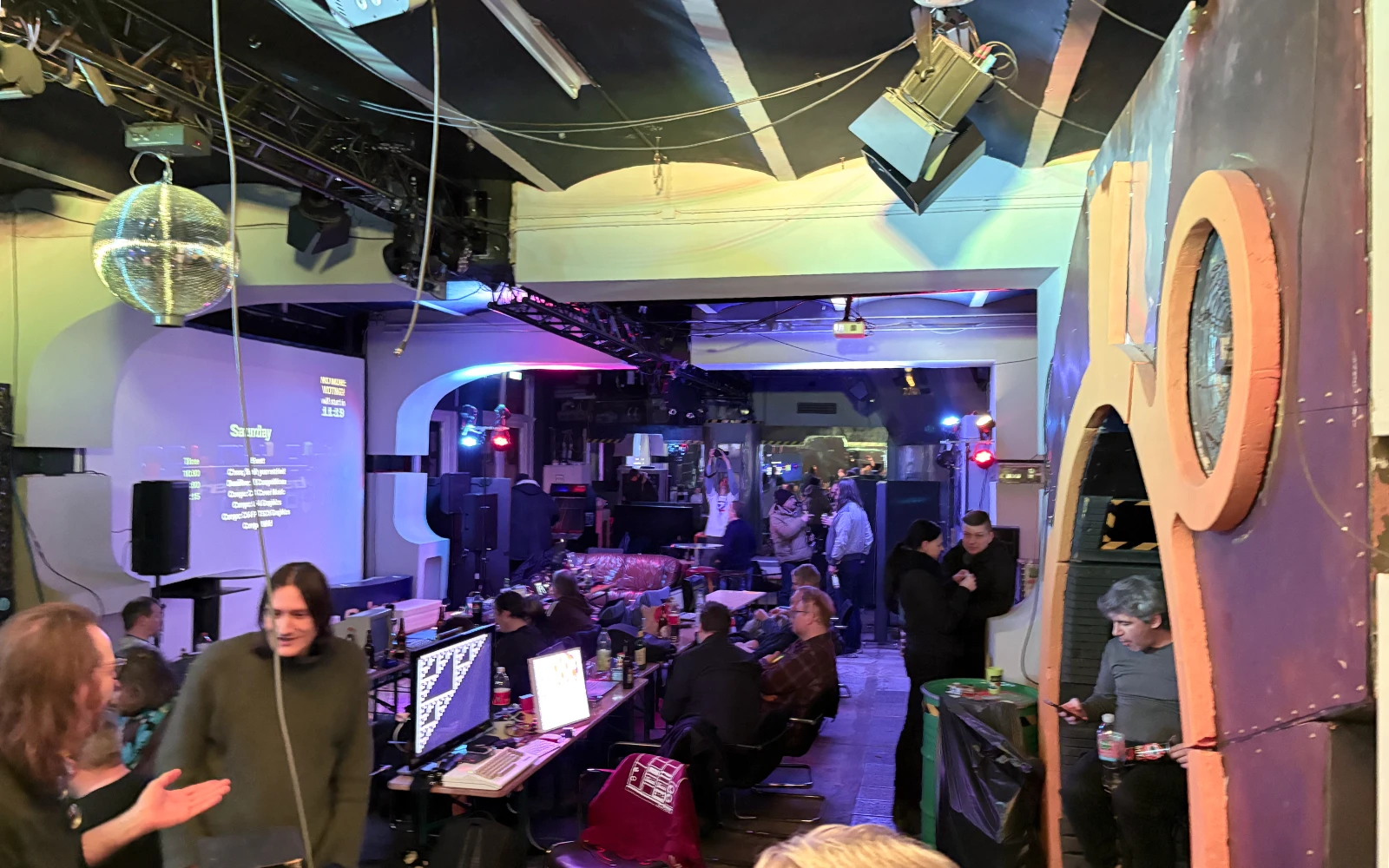
The main room of the BCC 2026 demoparty in C-Base Berlin.
For three days, in a hackerspace in Berlin that calls itself a crashed spaceship, the Commodore 64 home computer proved that it is still very much keeping up with us!
From Friday, February 20th, to Sunday, February 22nd, the 20th edition of the BCC demoparty was hosted by the C64 Club Berlin at Berlin's legendary C-Base. The motto this year: "20 Years - More of the Same!" Around fifty enthusiasts met to create a working environment for this remarkable 8-bit Commodore machine from 1982 It still continues to attract programmers, musicians, graphicians, and stubborn romantics. The C64 really has become the eternal computer.
For one weekend, the "C" in C-Base stood unequivocally for Commodore. We'll be using the c-word a lot in this article, so let's just get it out of the way right now: C is for Commodore!
This was only my second time visiting C-Base. The first time was in 2024. The afterparty of DrupalCamp was held at C-Base. The location has a nice bar, with a volunteer providing local Berliner and Czech beer, as well as other beverages. They affectionately call him the bar bot.
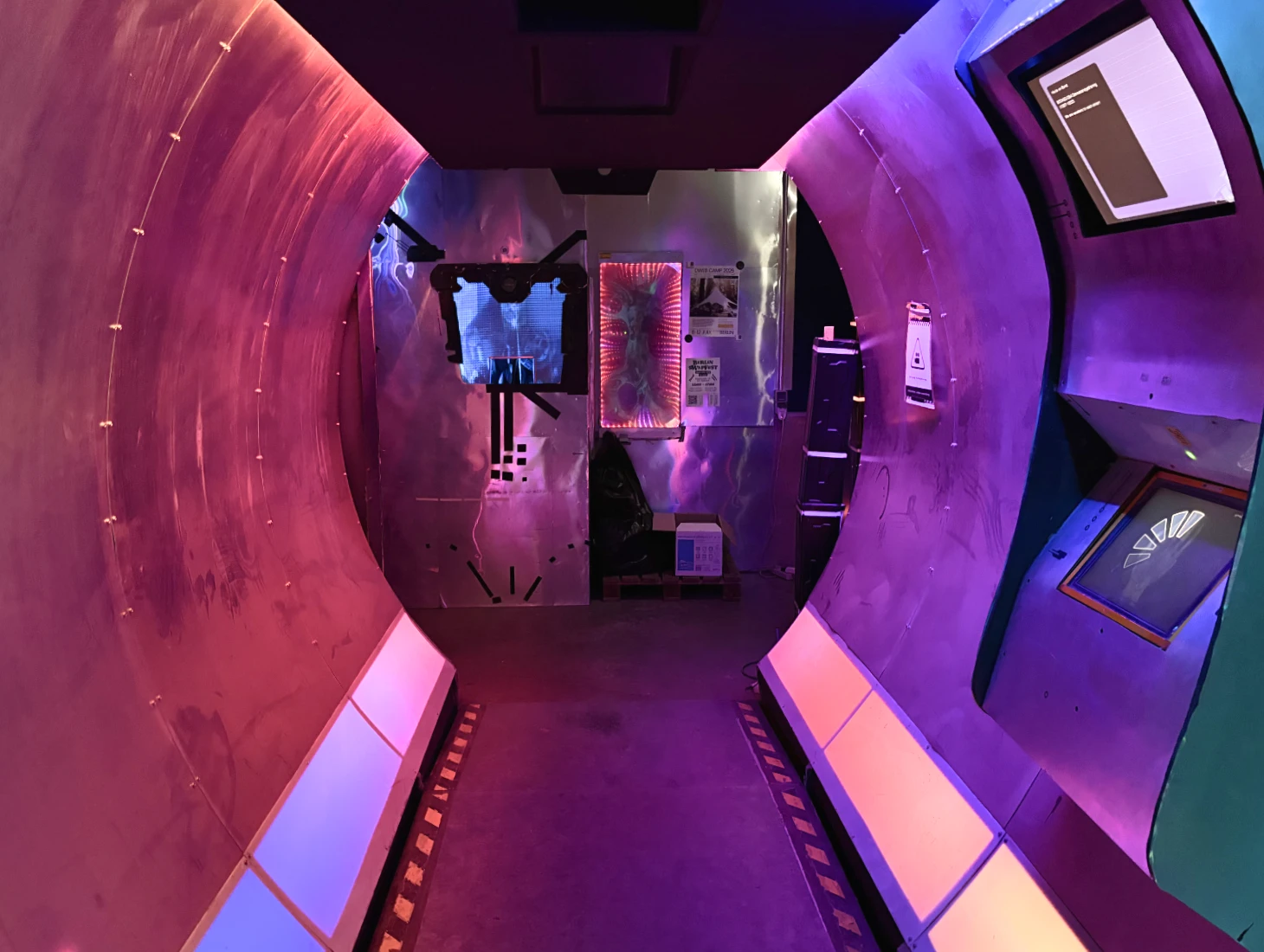
The legendary entrance corridor of C-Base Berlin, where the BCC
2026 demoparty took place.
A Late C64-Believer
I did not grow up with a Commodore 64.
I always respected the C64, but arrived decades too late. I bought a modern recreation: a variant of the full-sized TheC64 Maxi called TheVIC20.
Some sceners frown upon HDMI ports and USB sticks. I understand that. Authenticity matters. But I also value ease of use in the modern world.
TheVIC20 allows me to participate without repairing power supplies from 1984. I believe it lets me focus on what the scene is about: the fun of making things under constraint.
My entry into the C64 world happened almost accidentally, through a small contribution to a demo for Transmission64 in 2025. Additionally, I had two chance encounters and conversations with Thunder.bird, editor of the floppy-based C64 diskmag Digital Talks. The first was at Revision 2025 and the second and much longer meeting was at the phenomenal 39th Chaos Communication Congress (39C3).
Thunder.bird invited me to BCC in Berlin. I'm happy I said "yes". And it was exceptionally good fun.
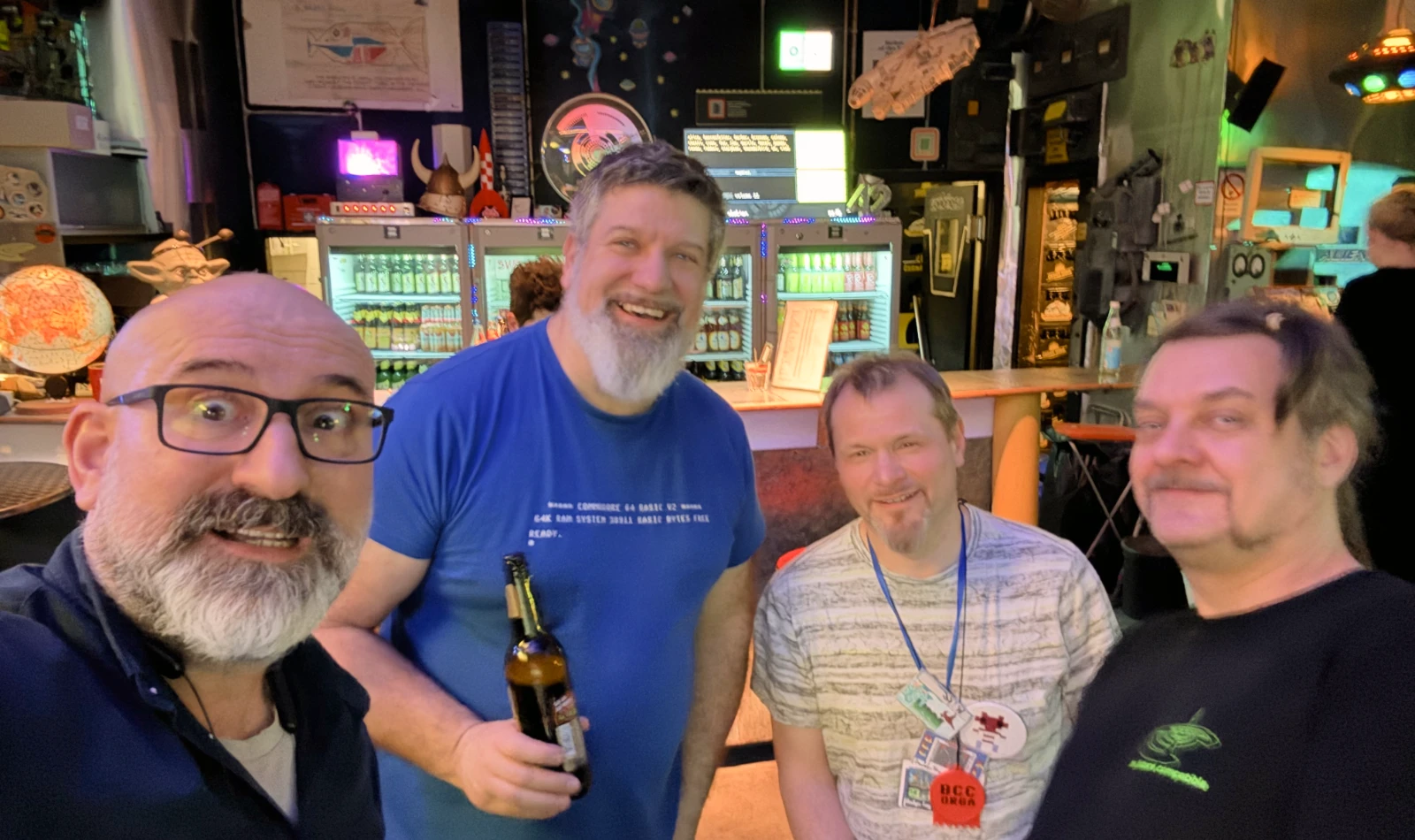
Thunder.bird (right) and some of his orga team members at BCC
2026.
The Voice of BCC: Presenting and Singing
Every demoparty has a rhythm. At BCC, that rhythm had a voice: TheRyk.
He was the presenter of the event. TheRyk (or Ryker, as we called him) guided the demo show with relaxed authority. His English moderation was peppered with the occasional German word for warmth or mischief. He has remarkable stage presence without ego.
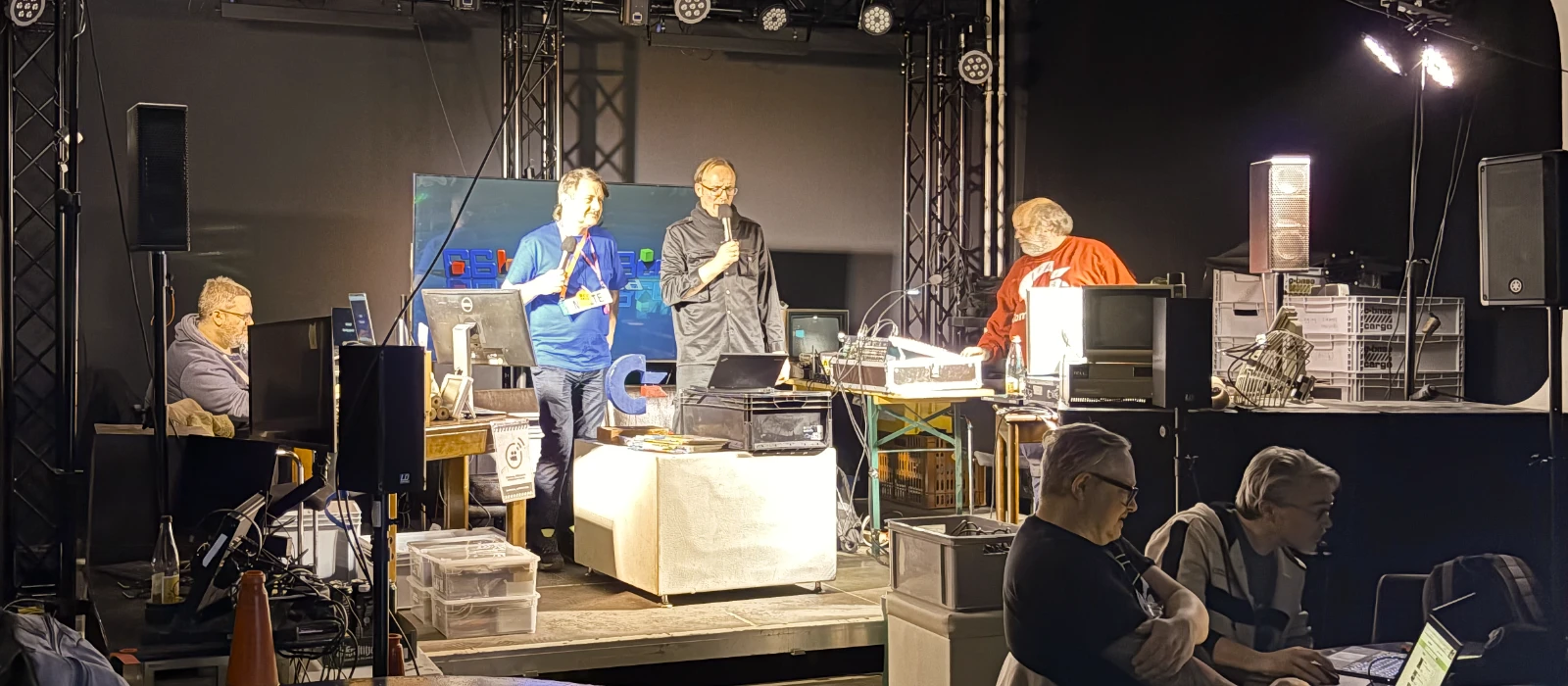
The BCC organizers on stage. Charlie (far left), Thunder.bird,
and TheRyk (center). Brainstorm (right). All of them are key
figures in the C64 scene and were instrumental in organizing BCC
2026.
He was also one of the driving forces behind the main event on Friday night: SID karaoke. I'll try to provide more details about this karaoke event (despite my memory gaps due to the vast amounts of alcohol consumed).
A real C64 was connected to the projector. Lyrics of songs by Donna Summer, Queen, and many others were rendered in uncompromising 40-column text. Lush SID reinterpretations of these songs played through the sound system. And Ryker encouraged anyone who wanted to stand before the audience and belt out a song. He even sang alongside many participants: enthusiastically, convincingly, generously.
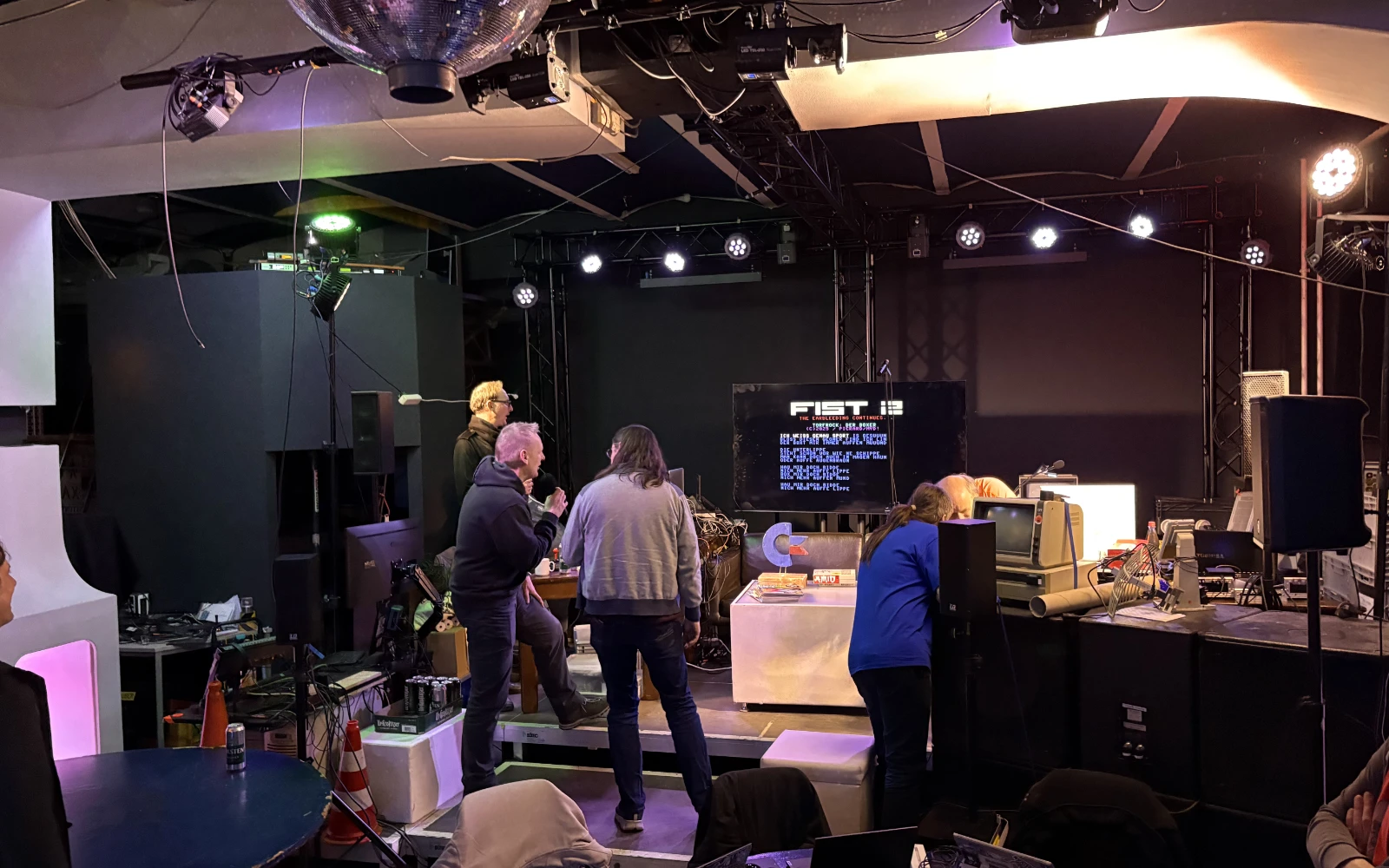
SID karaoke at BCC 2026, where participants could sing famous
songs with SID music.
At some point Bela and I sang Born to Be Alive. I stand by the enthusiasm; I regret nothing! But I do have to extend my apologies to the BCC audience for my terrible singing.
Brainstorm & the Shape of Sound
The BCC party flooded the whole C-Base with music.
One of the key pillars enabling this is Brainstorm, a BCC organizer and long-standing presence in the demoscene. At Revision, in particular, he erects what can only be described as a SID cathedral: three Commodore 64 machines, three monitors, a mixing desk, and speakers large enough to remind you of the wonderful qualities of the SID chip.
At BCC the mixing desk was larger, but he only had two C64s. Brainstorm didn't just play SID music: he staged it, he amplified it, and he allowed the chip to occupy the full aural space of C-Base.
I must confess that at times it was a bit too loud for my tender ears. But I was amused when a first-time attendee asked me if the music really only used the C64's sound chip, because some of it sounded too good for an 8-bit machine that was sold at Aldi at one point.
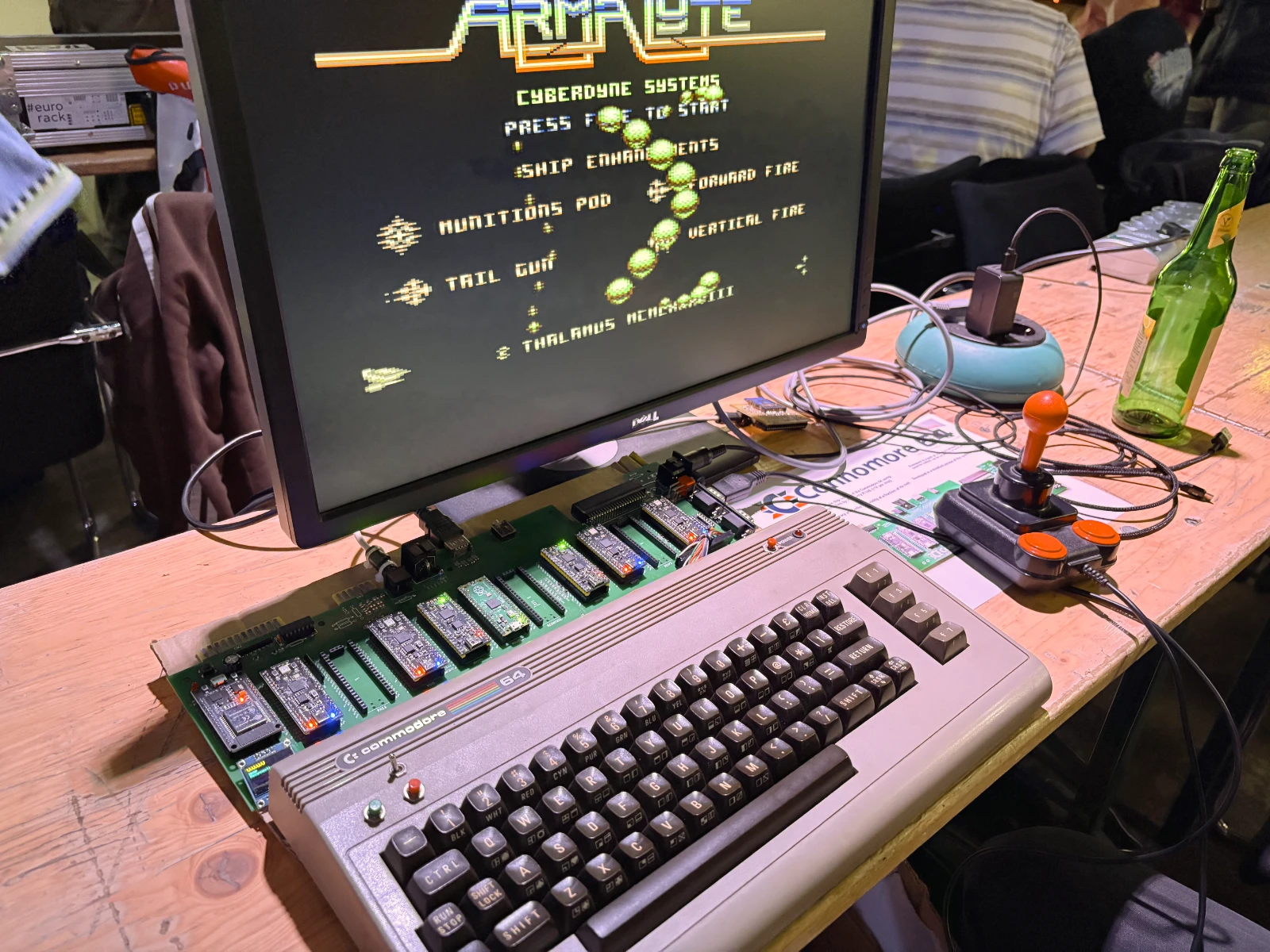
A custom-built C64 with all of its chips replaced with Raspberry
Pi Picos running the necessary software to emulate them.
Games That Refuse to Age
One of the most compelling threads running through BCC is the way it collapses time.
I met dkrajzew, who had programmed the puzzle game Brain Break thirty years ago. Only now has he released it physically, in a beautifully printed glossy box (as well as digitally via itch.io). The game is surprisingly sophisticated: running in high-resolution mode, enhancing the playfield with hardware sprites, and even multiplexing them to exceed the machine's apparent limits.
I think the term multiplexing captures something essential about the C64 scene. The machine gives you eight sprites. In some scenarios, you need more. So smart coders reuse them mid-frame. They choreograph timing. They create abundance from limitation.
I had to pinch myself. How wonderful is it that thirty-year-old code is still alive to this day?!
I don't really know how to describe it. I can't have nostalgia for a machine I never owned, so it must be something else. Perhaps something is multiplexing memories to make them appear in multiple places in the mind…
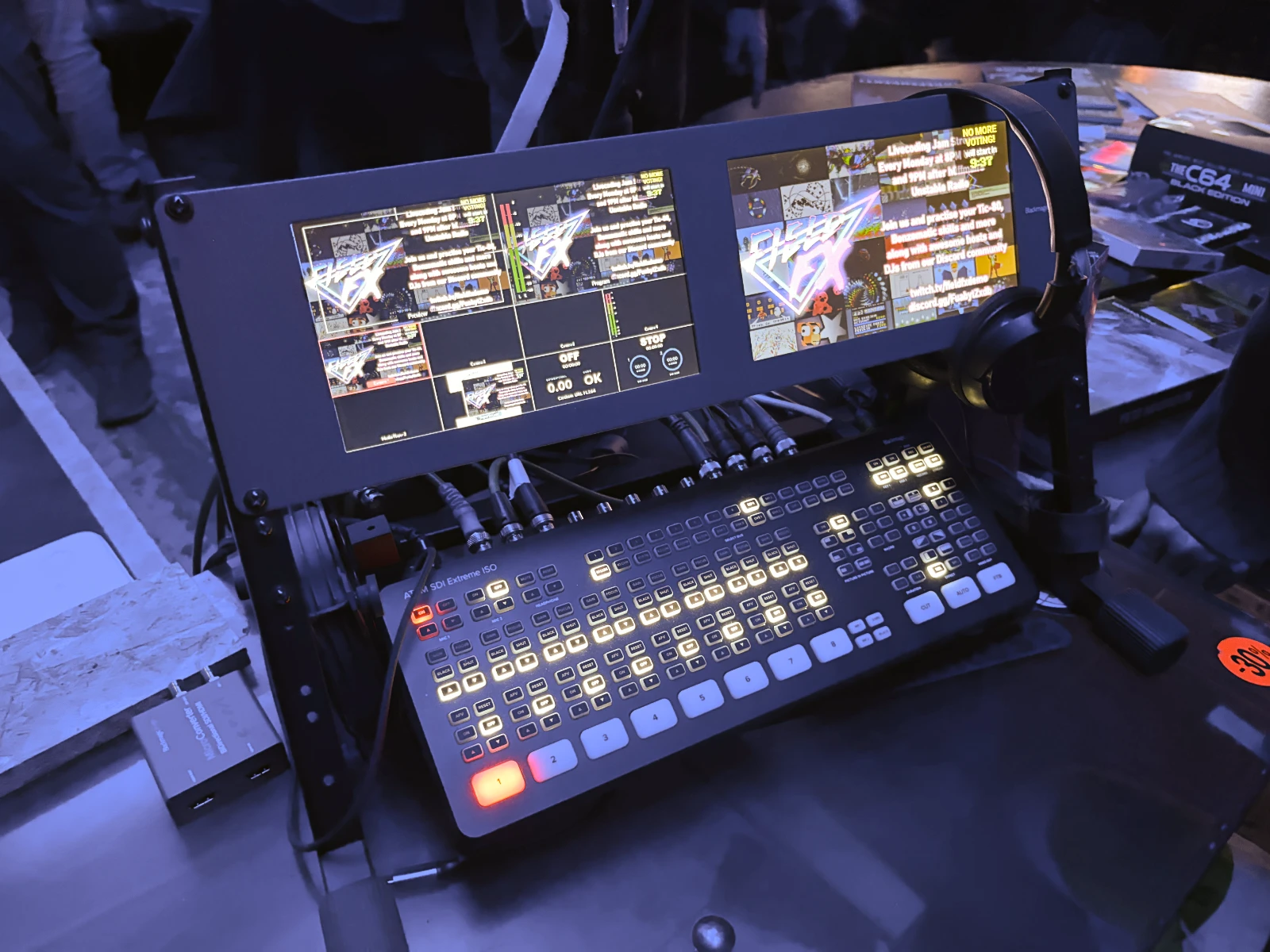
The technical setup used to run the screens at C-Base.
Extending the Canon
I also met another first-time BCC attendee from Dresden who designs new levels for classic games. He distributes them through Protovision, the pre-eminent publisher of C64 games these days. He even created new levels for Boulder Dash 2 on the PC, which were later incorporated into an official re-release.
I find this act of creation a bit revolutionary... as though he is rebelling against the passage of time!
Retro games are sometimes treated as sacred artifacts that preserve history and should not be changed. But here was someone extending them, adding new geographies to familiar landscapes. The C64 ecosystem is not frozen. It is very much in motion.
The past is editable. (As Rabenauge, the winners of the "Wild" category, will prove later.)
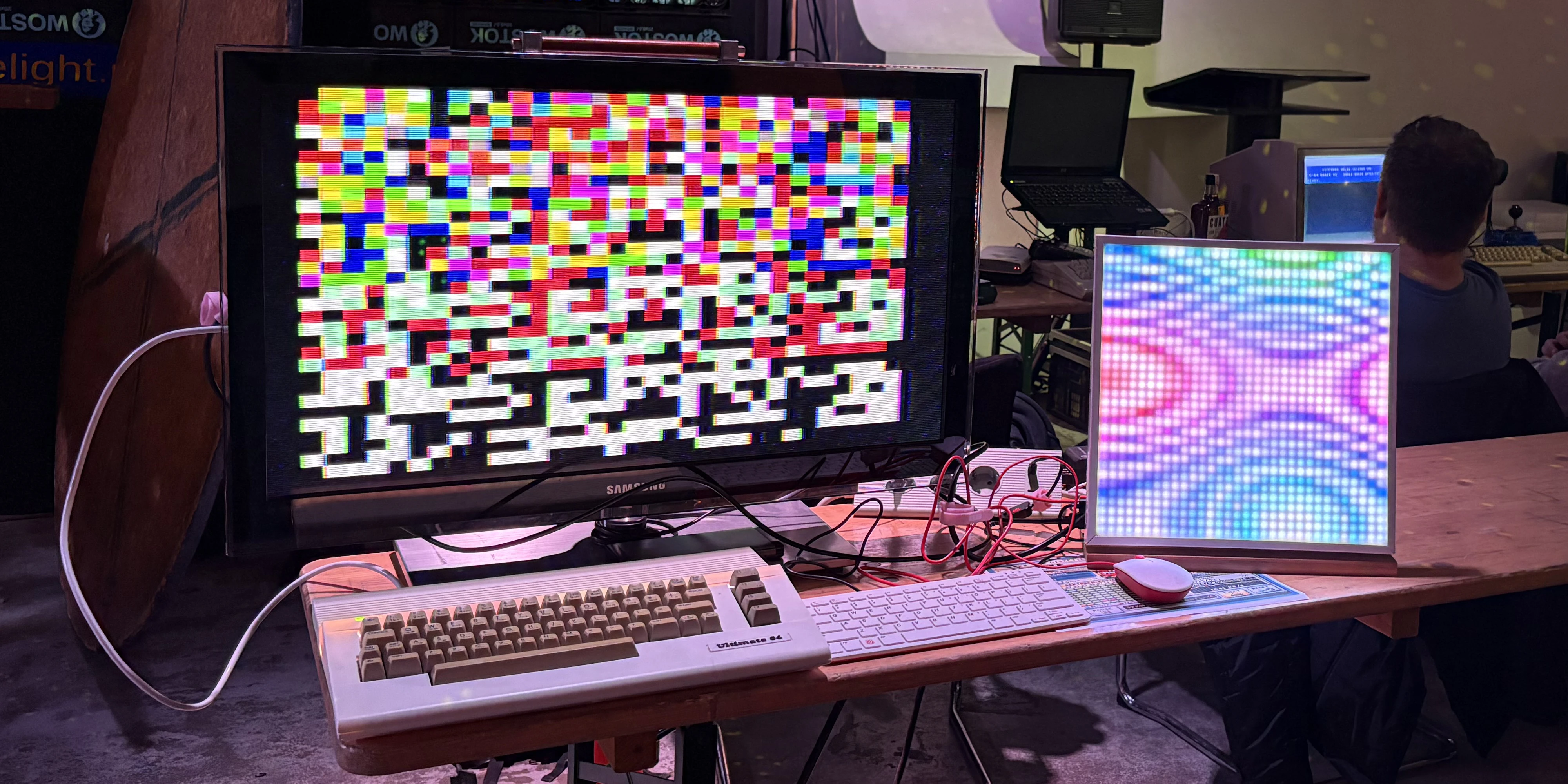
Demoscene veteran
SvOLLI
of Tristar and Red Sector Inc. takes the C64 to the next level
with a custom-built machine and a Raspberry Pi 400. I am
unworthy to even look at it!
Pixel Punx, PETSCII, and Protovision
Then there were Pixel Punx: Goerp from the Netherlands and jmin from Austria. They brought a sneak preview of their new C64 game and a comic-style demo full of charm and craft.
Goerp submitted three images to the graphics competition (the maximum allowed). How joyfully productive!
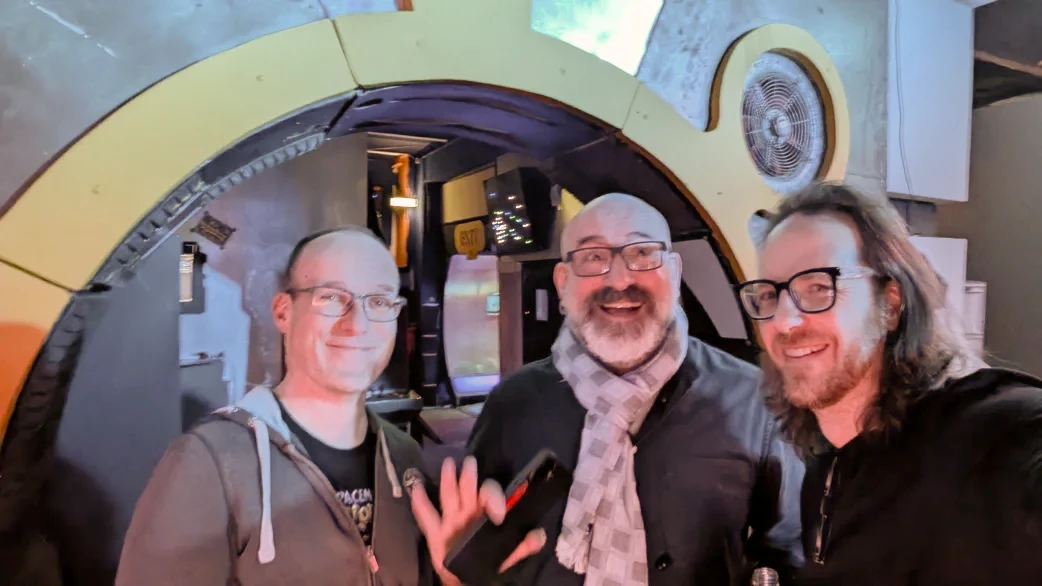
I was thrilled to meet Pixel Punx. Goerp on the left, jmin on
the right. (Photo by jmin)
jmin submitted a PETSCII graphic that, to me, just oozed elegance. It shows a repeating letter pattern, using only color changes to form the iconic Commodore "chicken lips" logo. No bitmap. No sprites. Just text-mode discipline.
Just like it said in another demo: "Make PETSCII Art, Not War!"
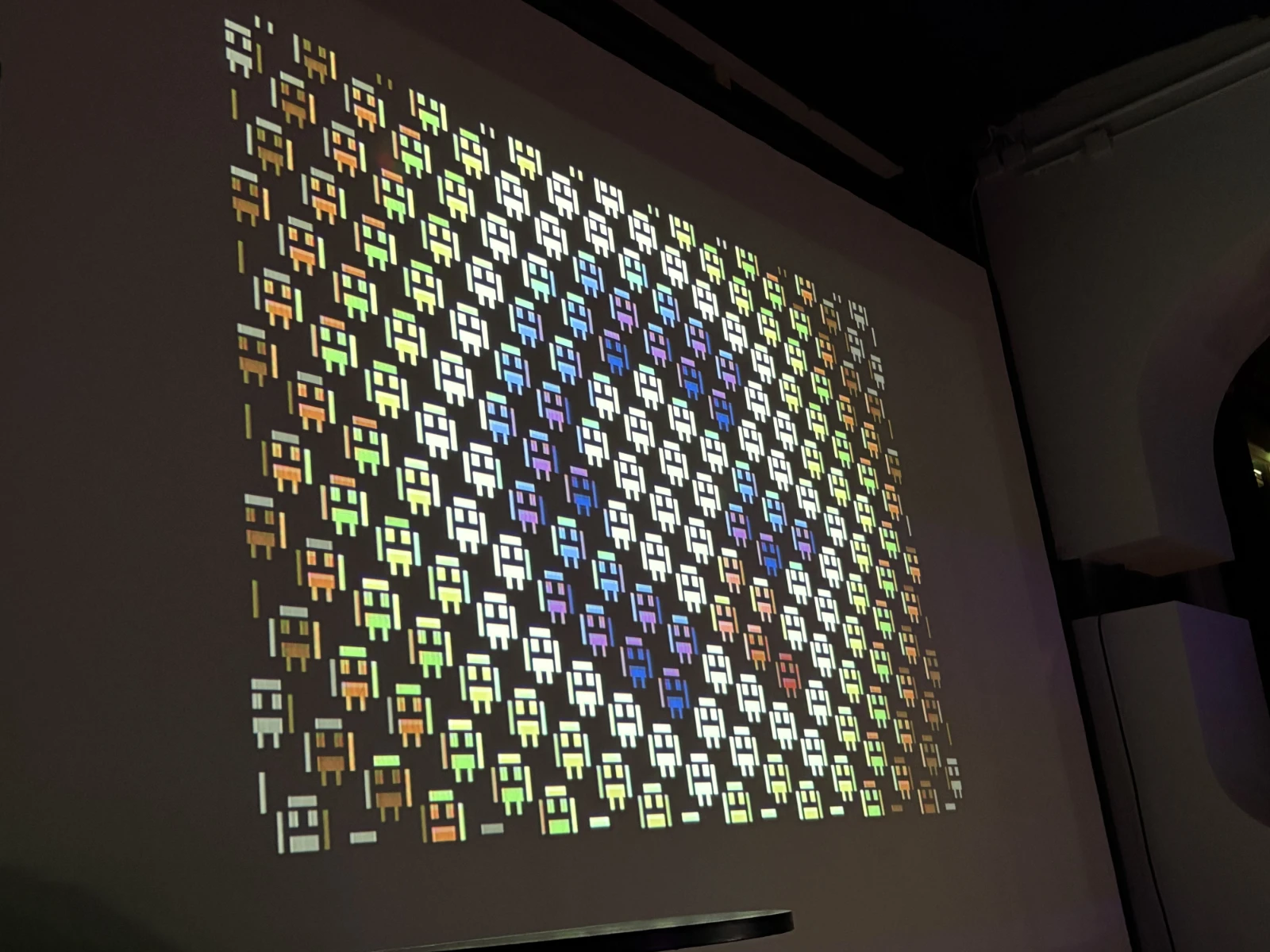
Jmin's amazing PETSCII submission.
It turns out that jmin actually knows Logiker from Vintage Computing Carinthia (VCC), the demogroup I worked with last year. Logiker submitted some contributions to the competitions at this demoparty. In particular, his PETSCII Lizard demo was a lot of fun.
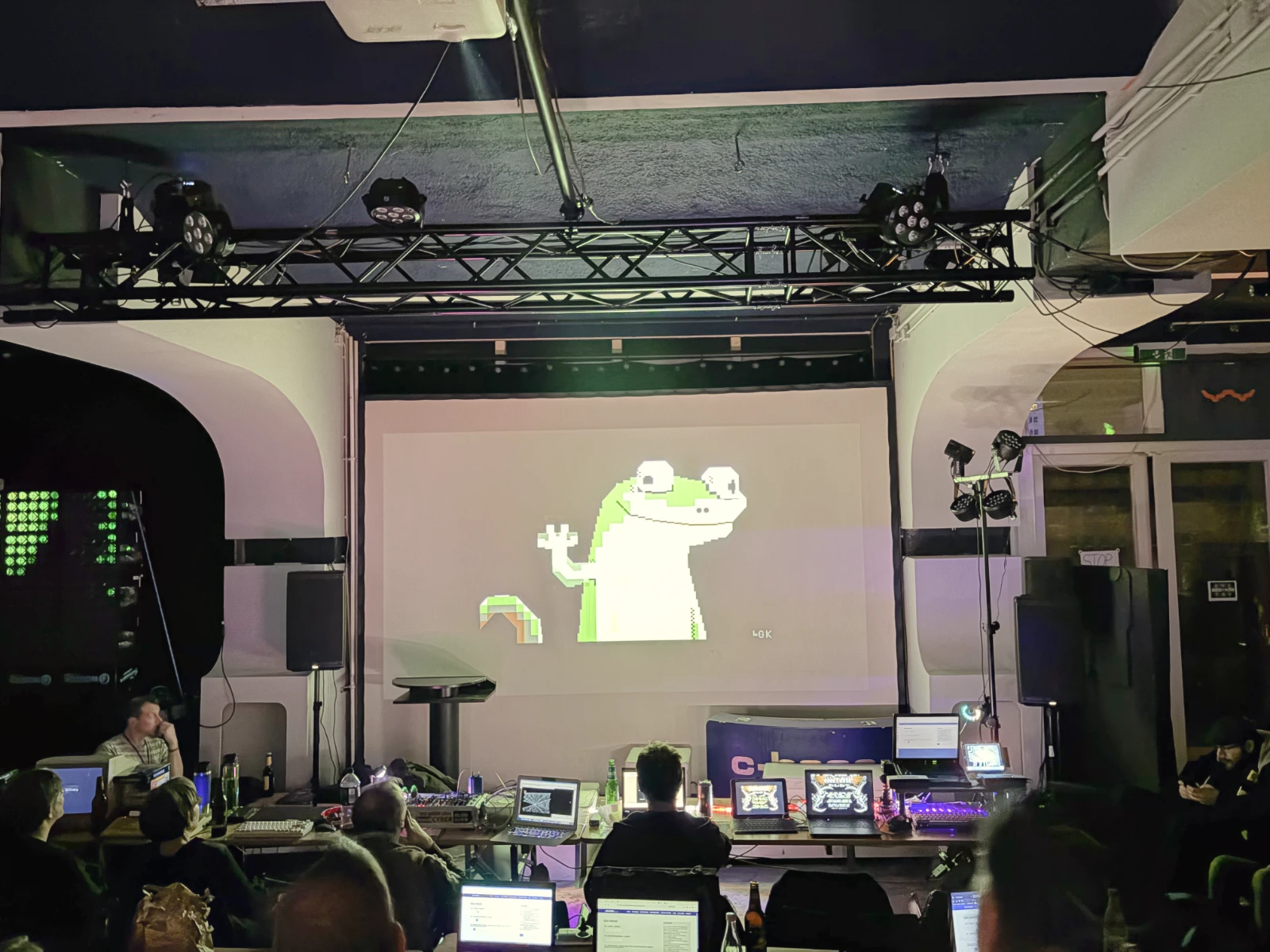
Logiker's PETSCII Lizard demo during the compo screening.
Protovision
At one point I found myself standing at a table covered in boxed software, magazines, cartridges, and even a black edition of the TheC64 Mini from Retro Games Limited.
Behind the table: Jak T Rip of Protovision. This is not a demogroup but a company.
Protovision has long been one of the key publishers keeping new C64 software physically available. The software comes in real boxes, real disks, real printed manuals! We spoke about the possibility that I might contribute graphics to a future C64 game.
It is one thing to make standalone competition graphics. It is another to contribute to an interactive work.
The ecosystem is small. But it is so very much alive.
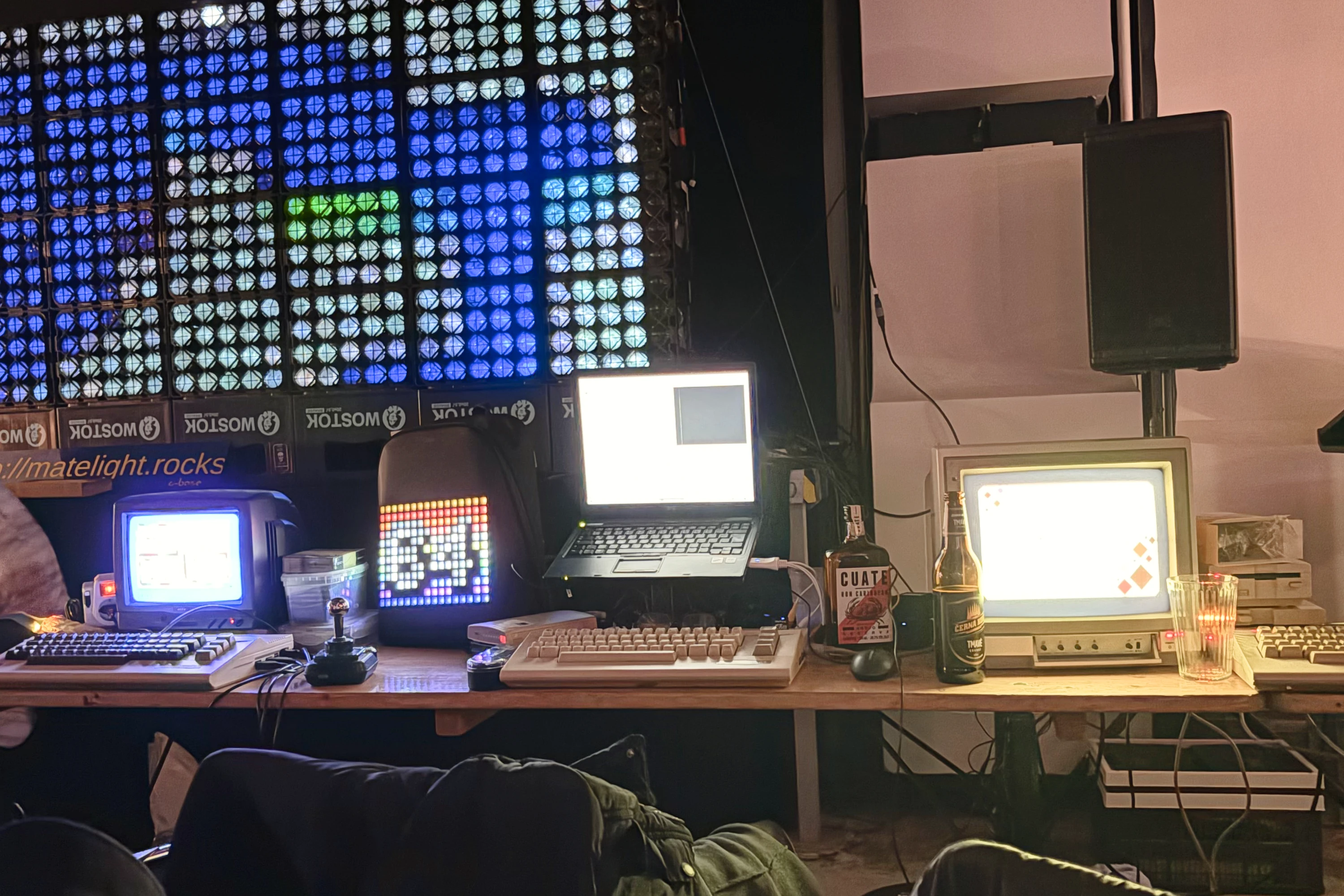
I think it is fair to say that there were some computers at the
BCC.
The Almond Bread Box
Qetu, never one to avoid a conceptual wink, brought along a nearly finished Commodore 128 demo to a strictly C64 demoparty. Personally, I would have found a release fine. After all, the C128 contains a C64 within it.
But some C64 hardliners at BCC might have protested.
Together with another scener, he also programmed Mandelbrot graphics: intricate fractals rendered patiently on 8-bit hardware. Watching infinity calculate itself on a machine with a 1 MHz CPU and 64 kilobytes of RAM is quite the philosophical experience!
Since the C64 is lovingly named the bread box ("Brotkasten" in German) and Mandelbrot literally translates to Almond Bread, maybe we can call Qetu's computer the Almond Bread Box (Mandelbrotkasten).
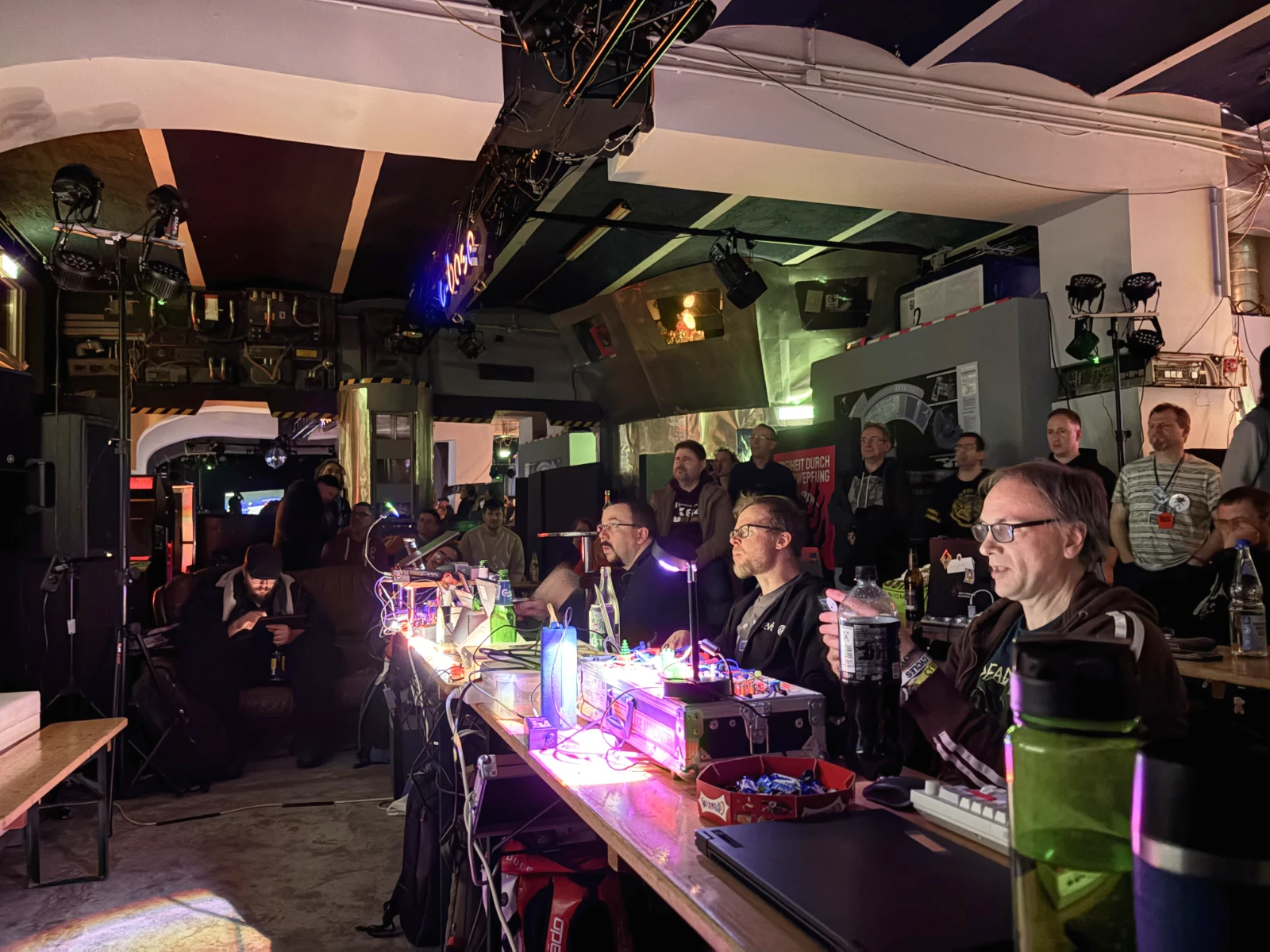
The audience watching the compos at BCC 2026.
Deadlines & Dragons
I had prepared my own contribution for the graphics competition: two dragons, one perched on the tongue of the other. I drafted and painted it in Procreate on the iPad Pro in grayscale. Then I coerced the image into C64 limitations via an ImageMagick CLI command. Finally, I finished it in Multipaint, cleaned it up, and colored it. (BTW, my demoscene handle is Bala-Koala.)
The C64 does not make it easy. I negotiated every pixel. But I had a great time doing it. Below are the steps of the process, from the initial sketch to the final image.
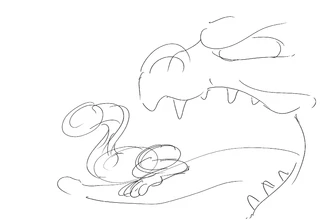
Step 1: I started out on the iPad Pro in Procreate using
the Apple Pencil to sketch the composition and the forms of
the dragons.

Step 2: I refined the contours and added more details to
the dragons.

Step 3: I continued refining the dragons and added shading
to give them more depth.

Step 4: I continued refining the dragons and added more
highlights and shadow details.
Step 4.5: Using Pixelmator I compressed the image to 160 pixels wide, which is the maximum width for a C64 image in regular multicolor mode at 160 x 200 pixels (though this can be done using any other photo editor will do the job). Please note that the pixels on the C64 in multicolor mode are rectangular at a 2:1 ratio.
Then I needed to reduce the number of gray shades used. Below is the command I used to convert the image to C64 limitations: four colors per 8x8 area of the image (actually three freely selectable colors and the background color). The command keeps the image in grayscale tones, applies an ordered dither with a 4x4 matrix and 3 color levels, and turns off the alpha channel. I then imported the resulting image into Multipaint to color it and make the final touch-ups. Since Multipaint is especially suited to create graphics for retro systems, the pixels in the imported image get displayed in the correct 2:1 aspect ration so the picture is no longer squashed.
magick dragons.png -colorspace Gray -ordered-dither o4x4,3 -alpha off dragons-dithered.png

Step 4.5: The original image on the left.
The dithered
image on the right after conversion.

Step 5: After importing the squashed image into Multipaint,
the pixels were displayed in the correct 2:1 ratio.
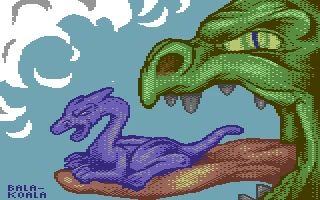
Step 6: I colored the image and added the final touches in
Multipaint.
I call it
Dragon Matrioshka.
Unfortunately, I missed the submission deadline by four hours. I was just too hung over from the previous karaoke night. Ryker took pity on me. He generously reopened submissions.
I was delighted when my rushed work was projected on the large screen. It didn't look too shabby. And I was surprised by the amount of positive feedback I got for it. Dragon Matrioshka got ranked eigth out of thirteen submissions in the graphics category.
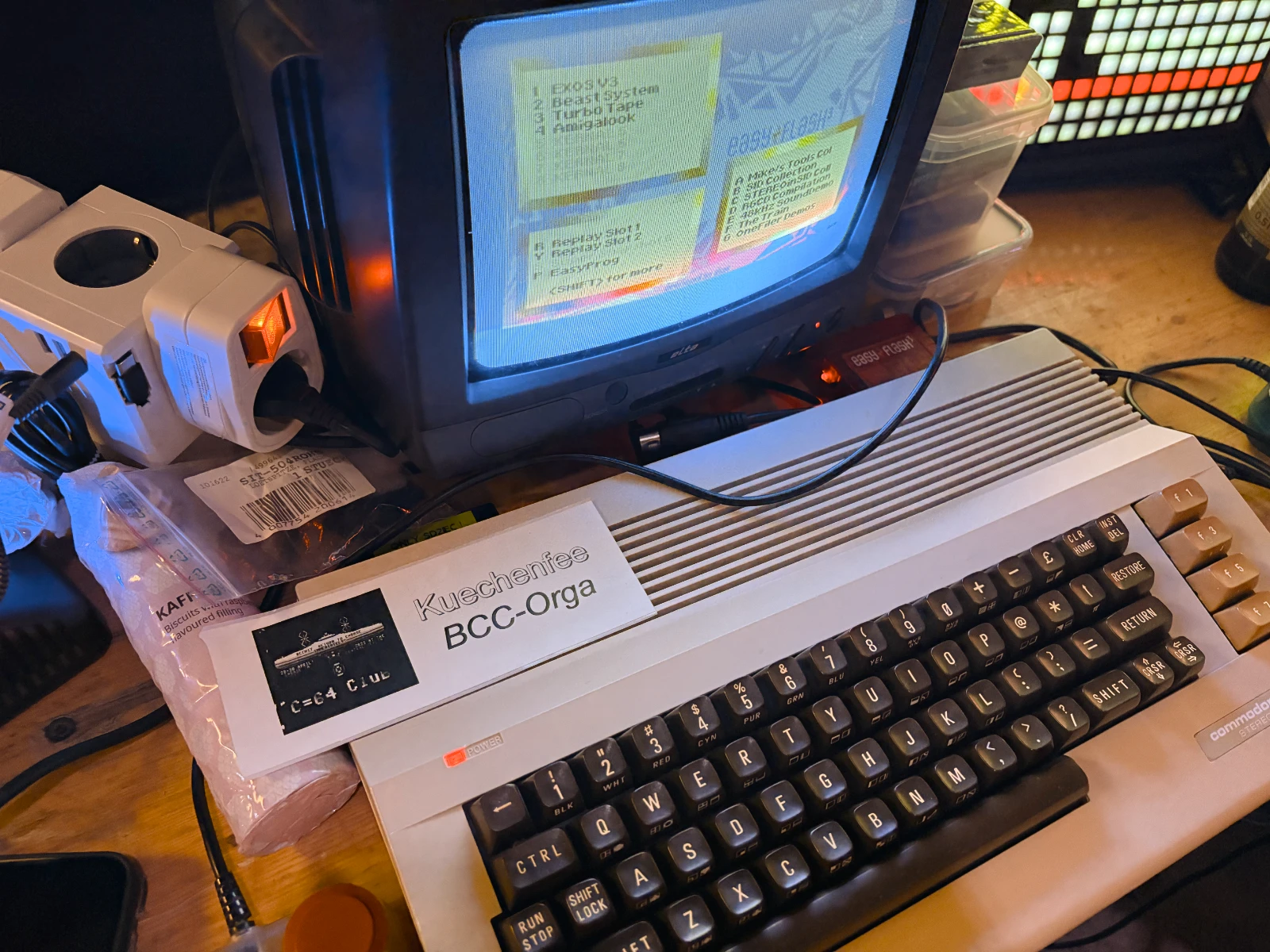
Kuechenfee's C64 with a cool CRT TV.
Tour de Base
One kind person from the C-Base team took around ten of us on a tour of the location. He had a hand puppet: a bat called Gaston. We entered some of the subterranean levels. It was surprising how expansive C-Base is. The place is real-life cyberpunk! Photos were forbidden, and I don't think I'm allowed to report on what we saw. But if you like, you can see some photos on Imgur.
Berlin’s famous crashed space station is known for its futuristic atmosphere, which is a relief... if the C-Base had actually been a sea bass, the scent of the server room would have been significantly more concerning. (I apologize for this silly joke. I just could not help myself!)
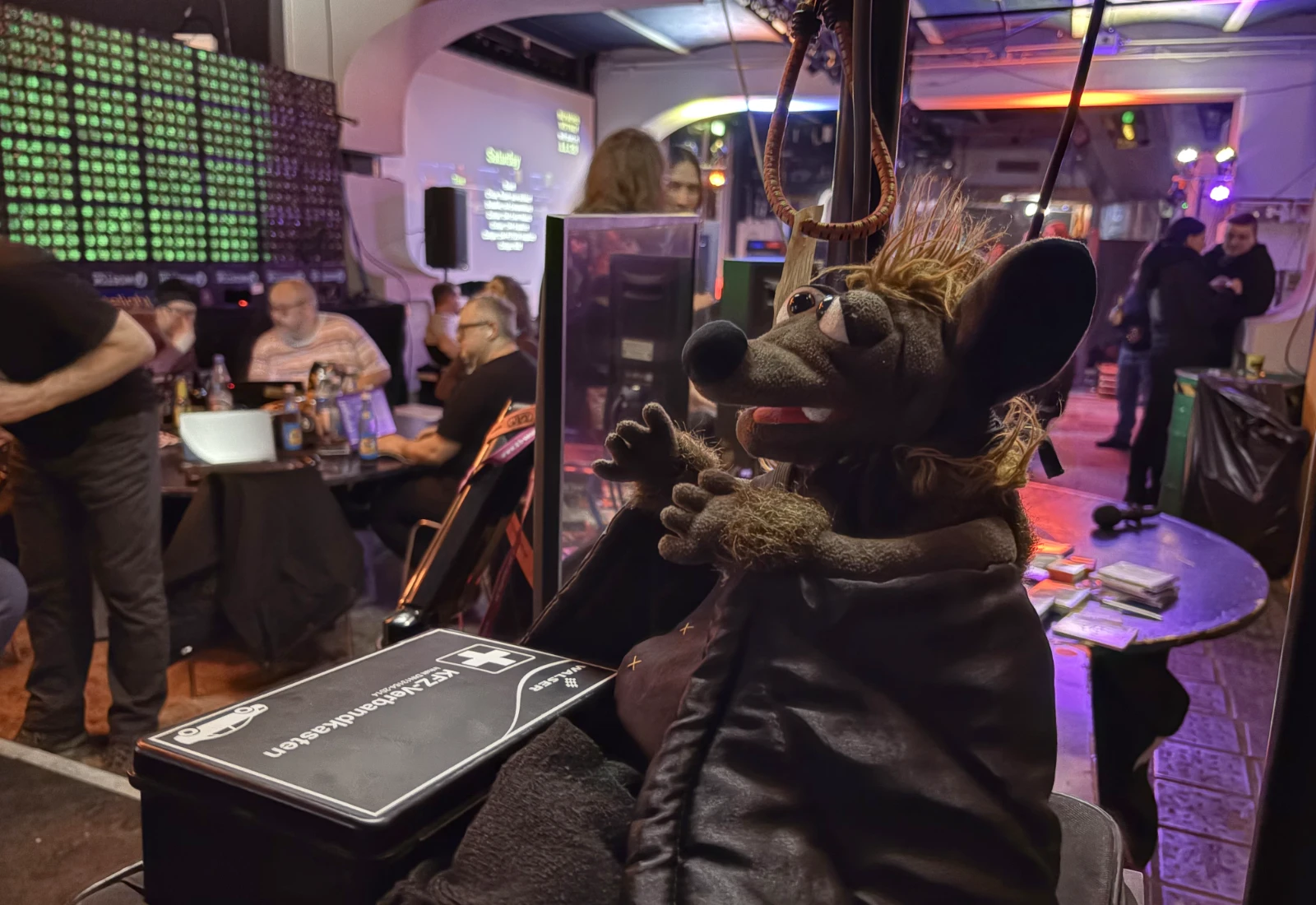
Gaston, the hand puppet bat used by the C-Base tour guide.
I found it so fascinating that I also got the beautifully designed book about the history of C-Base, called C-Booc: 20 Years C-Base. It is a treasure trove of stories and photos about the place and the people who have been part of it over the years.
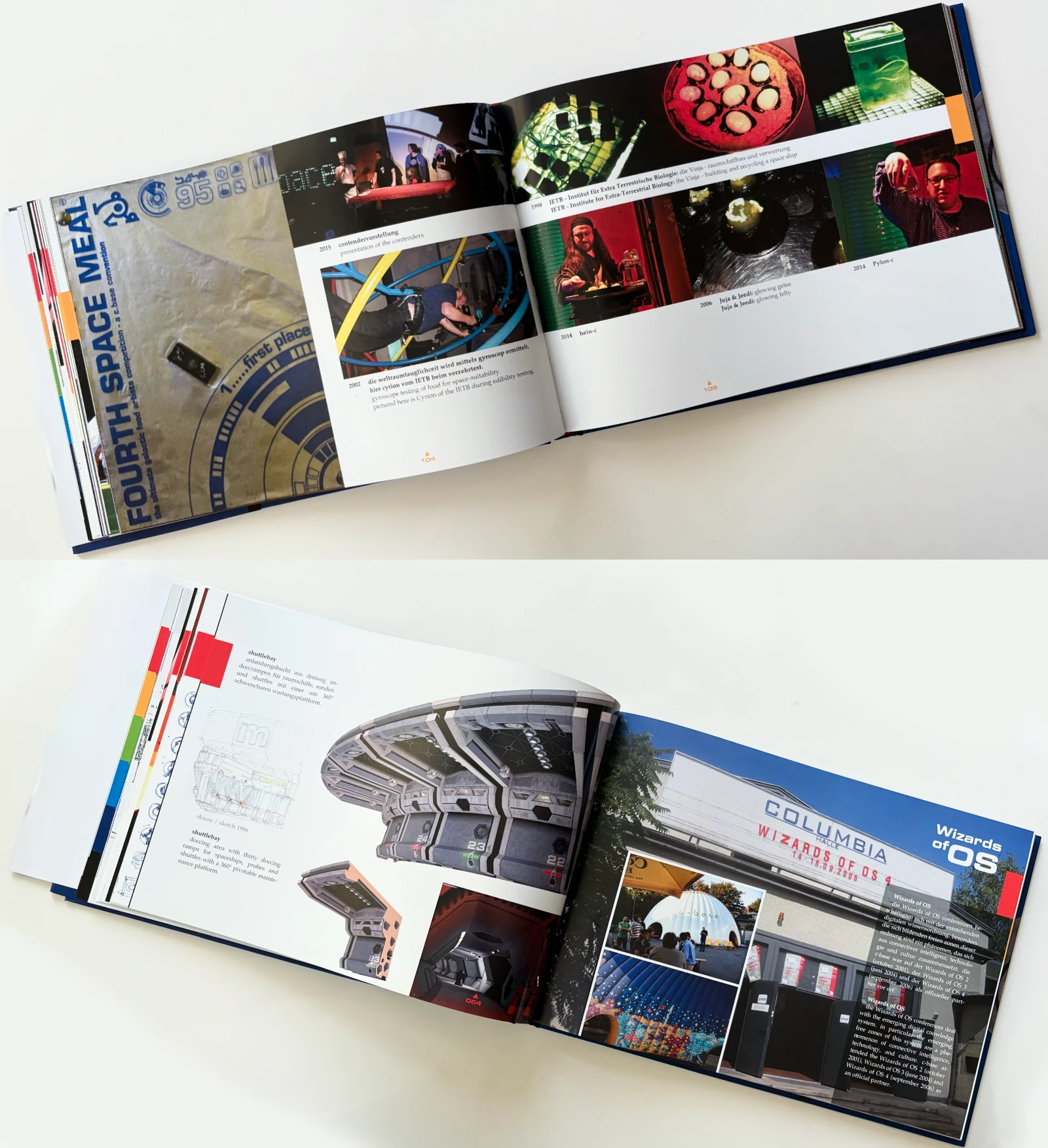
Some interior pages of beautifully produced book.
And I love the legends surrounding C-Base...
The denizens of C-Base call it a crashed spaceship, because according to its internal mythology, it is the fragment of a massive, time-traveling space station from the future! It crash-landed in Berlin centuries ago. And then the city formed around it.
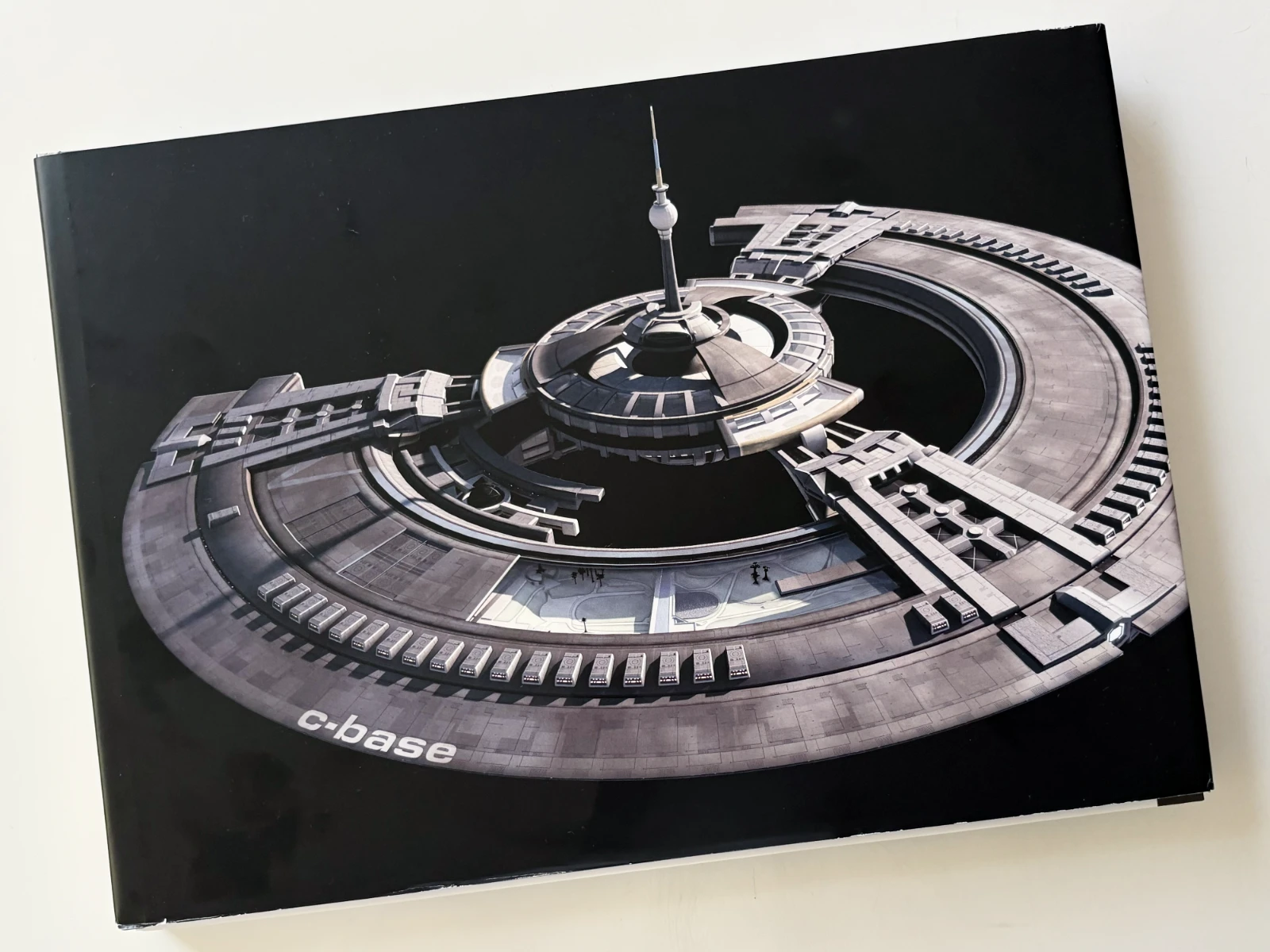
The cover of the book 'C-Booc: 20 Years C-Base'.
On the cover of "C-Booc", a 3D rendering shows the vessel in its imagined entirety: a gigantic flying saucer, vaguely shaped like the letter "C" because a segment of the hull is left out. Rising from its center is a tall antenna-like structure. This is unmistakably the Berlin TV Tower (Berliner Fernsehturm). Legend has it that this tower is the only visible part of the spacecraft still protruding above ground.
The rest of the station, the story goes, lies buried beneath Berlin. Under the streets, beneath Berlin's buildings, even below the Spree River. What visitors see today in C-Base is merely a small accessible segment of the wreck. The exposed pipes, metallic panels, and glowing control consoles are said to not only be decoration; they are part of an ongoing restoration effort. Members are, in a sense, maintenance crew. They are collecting technological artifacts (computers, servers, cables), attempting to reconstruct fragments of the ship’s original functionality. Even the name "C-Base" can be read as shorthand for a "cybernetic base station".
Seen that way, the aesthetic suddenly makes perfect sense. And perhaps that is why the BCC demoparty felt so fitting here. After all a crashed spaceship is, the ultimate retro-hardware... waiting to be restored like an old Commodore 64.
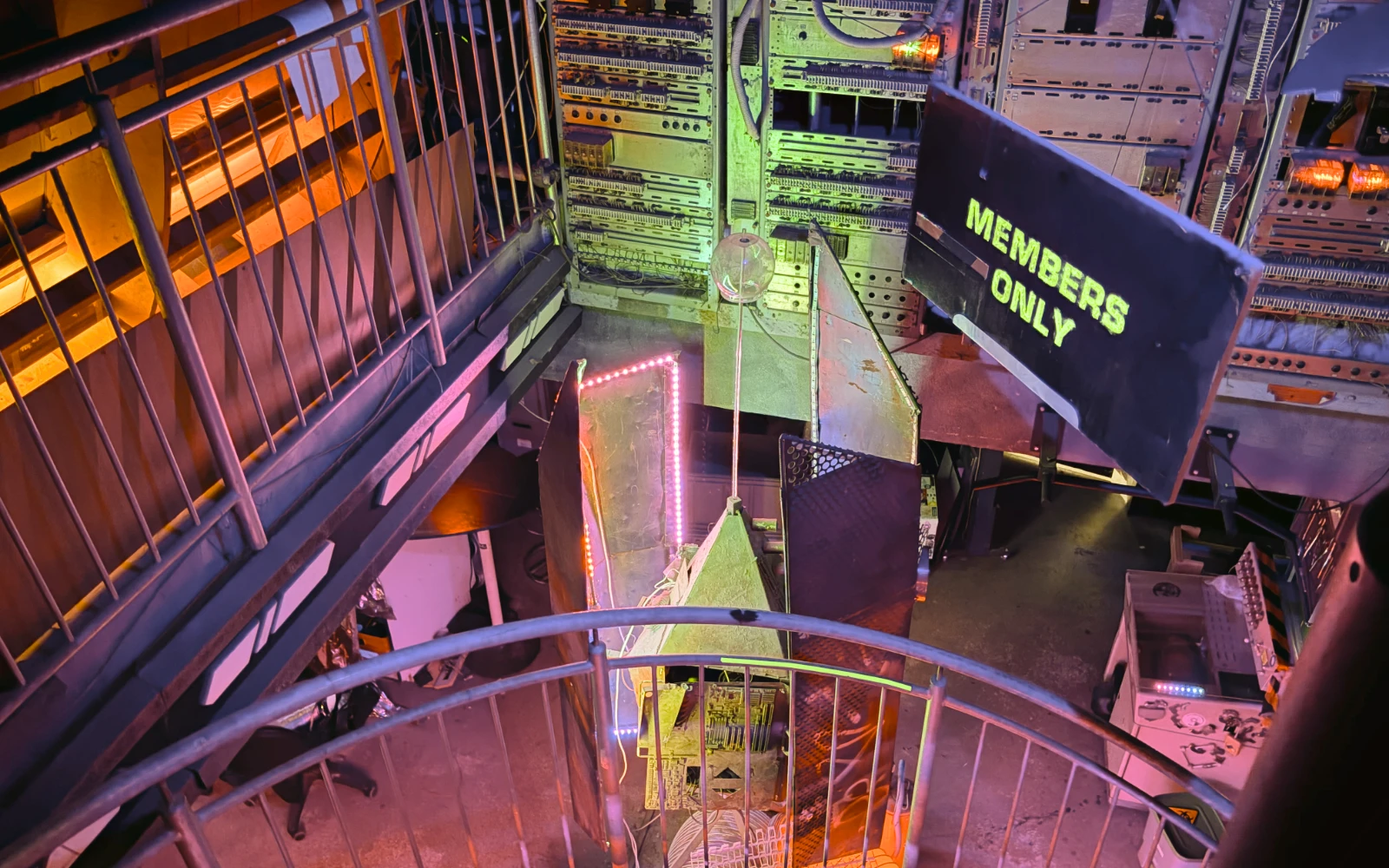
The secret lower levels of the crashed spaceship C-Base.
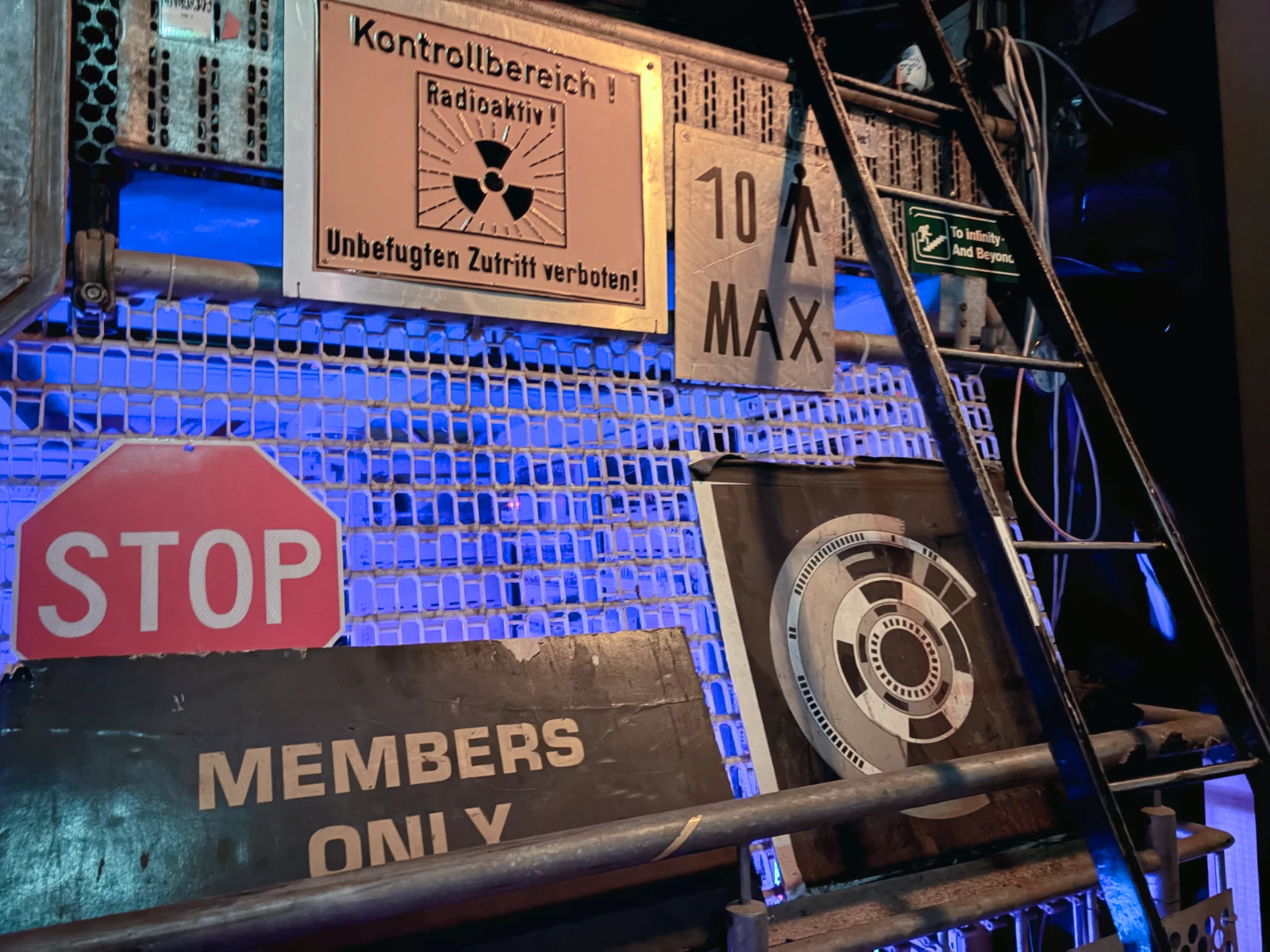
They really mean it.
Memory Reimagined: Rabenauge's Turrican Intro
The winner of the "Wild" category was not unlike the work the Boulder Dash level designer had done.
The demogroup Rabenauge had recreated the intro sequence of Turrican II: The Final Fight. They improved on the original that appeared on the Commodore 64 and made it what it should have been.
Anyone who grew up with the 16-bit versions remembers the manga-like introduction: comic panels, detailed character art, dramatic poses on the Amiga, Atari ST, and MS-DOS PC. On the C64, by comparison, the intro was monochrome and much simpler.
Rabenauge wanted more: What if the C64 had been given the intro it deserved?
The result was an act of aesthetic fidelity under technical constraint. Beautifully rendered multicolor graphics, carefully composed scenes, and a reimagining that felt authentic to the C64's vocabulary rather than an impossible imitation of 16-bit abundance.
Dalezy wrote the music, Insane coded the intro, and the admirable Titus created the many, amazing-looking graphics. They truly honored the C64. I must confess that I prefer some of the visual flourishes of this new version over the one on the Amiga!
Rabenauge presented the recreated intro as a standalone work. The game itself remains under copyright, and I think Rabenauge chose not to integrate their intro into the original program. Of course, I can imagine that in the future a particularly enthusiastic cracker might splice the new intro into the game and circulate it.
In that sense, Rabenauge's entry could be regarded as repairing history.
The World in 8 Bits
There were so many cool moments. Here are some examples.
I had a quick chat with Los Pat Moritas, one of the DJs at Revision. He graced us with his presence and is a kind Argentinian with great taste in music. He also brought along a demo he made with his friends at Confed: Capybara against nordelta.
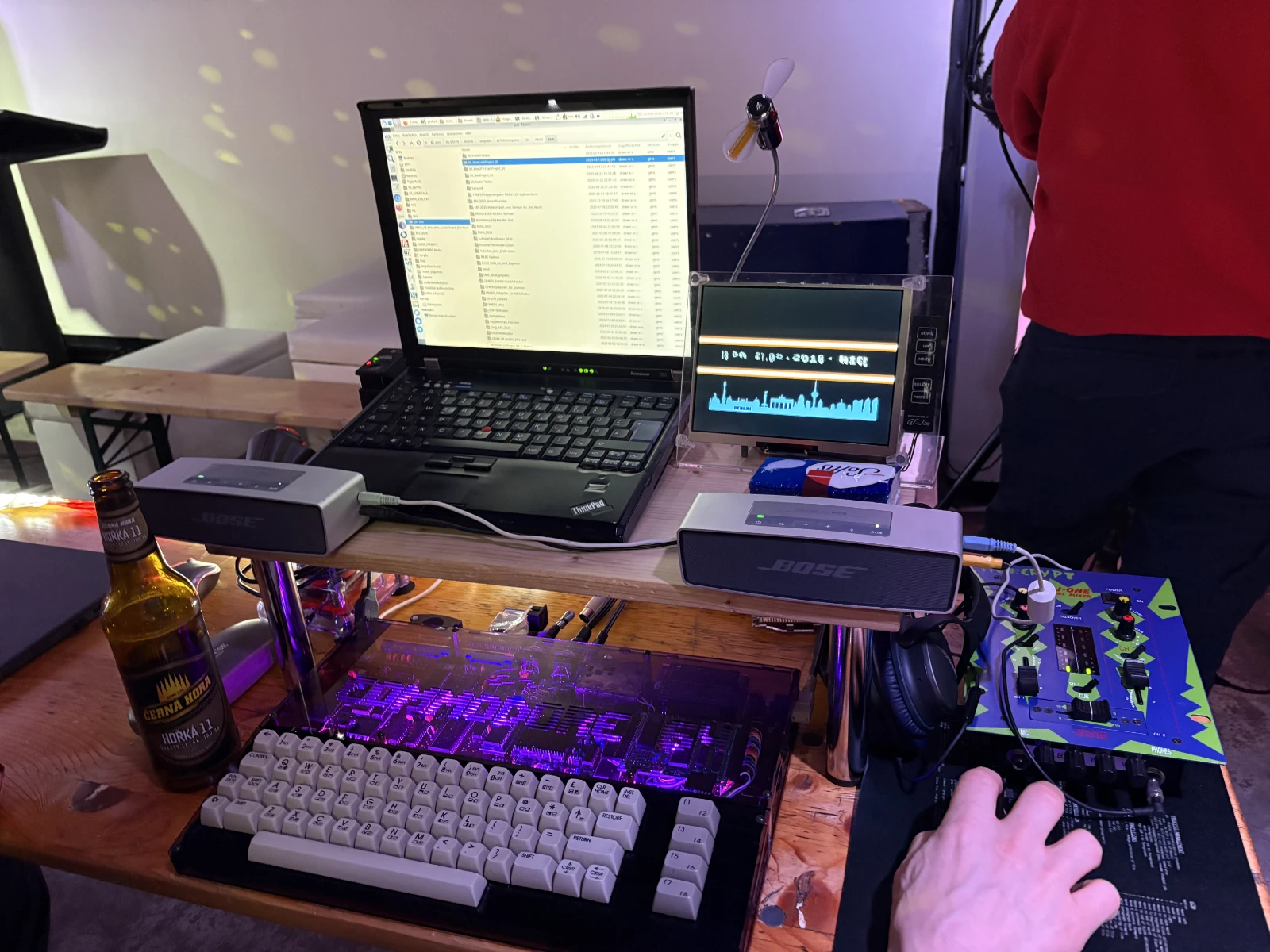
The "C" in this C64 setup stands for "Crazy" in the best kind of way! It is a C64 in a
custom case with a really cute LCD TV attached to it, used by
one of the participants at BCC 2026.
DocZX, one of the folks I met at 39C3, released their game Grünkohldiktator in the "Wild" category. Even though I followed along with some of the development at 39C3 and in one of our communication channels, I have no idea what this game is about, and at this point I'm just too afraid to ask.
I bonded with Bela not only through karaoke, but also through our shared dislike of Elon Musk. It was great to see him again. We had first met at Revision 2025. He was sat next to Qetu and lives in Berlin. I think Bela's demoscene handle is just lower-case bela (though I think it might be worth workshopping that name variation a bit more).
Which reminds me: two entries in the graphics competition featured Donald Trump: Crap-On-Repeat by Titus of Rabenauge, and ICE, ICE, Baby! by LZwerch of Mayday!. This gives me the chance to use a phrase I've always wanted to try: if I had a nickel for every time that happened, I'd have two nickels. Which isn't a lot, but it's weird that it happened twice at one demoparty. (And... no, I refuse to include the pictures in this article. You will have to click on the links to see them. Though I must admit that they are well crafted, I cannot support the pictured subject.)
I met Luisa, a graphician, demoparty organizer, and a mainstay of the German demoscene. Known for her work with Rabenauge and Poo-Brain, she is this rare combination of artistic instinct and deep commitment to the demoscene. And two fun facts… C-Base is located in a district of Berlin formerly known as Luisenstadt, and Luisa designed this year's BCC logo. I'm sure there is a profound connection. If only I could decipher it!
Talking with her about the use of AI in competitions, I realized how deeply AI has already become embedded in creative processes. Perhaps the demoscene should remain an AI-free space. Or perhaps the use of AI should be allowed in specific competitions and excluded from others.
We might have a solution for graphics competitions. We already have to provide multiple steps of the creative process when submitting a contribution. If we recorded a video of the entire drawing and painting process, we could demonstrate that no AI was involved. It's easy for me to say this, since I use Procreate. This wonderful app automatically records a time-lapse video of everything you do.
What I do wonder, though, is how the use of AI in demo code could realistically be monitored or verified.
I'm relieved that I'm not the person who has to think of a solution to that problem.
I had long conversations with Titus of Rabenauge about graphics techniques, comic books, 8-bit and 16-bit aesthetics, and how to work with limitations instead of against them. Then the conversation drifted to AI, to software development culture, to the infrastructural investment backlog of Deutsche Bahn and Germany at large. It seemed like we wanted to definitively solve all problems in the whole country in one evening.
(I firmly believe we could have found perfect solutions for all the things®, if only we hadn't been interrupted!)
Doing the Do
This year marked the twentieth BCC. The first one took place in 2007 and was interrupted only by the pandemic years. It was a worthy celebration, and the motto "20 Years - More of the Same!" proved surprisingly accurate. If this is what "more of the same" looks like, then BCC has clearly been an outstanding demoparty for a very long time.
BCC felt very different from the large demoparties I've attended in the past... and I'm glad I went. You can find the official results on Demozoo. But beyond rankings and releases, BCC was something else entirely: an opportunity to meet people, to reconnect, and to share our work. What unites us is a deep-seated curiosity and the shared willingness to sit in front of a machine with 64 kilobytes of memory and ask, "What else can we do?"
During one of his moderations, TheRyk put it perfectly: if someone under the age of twenty had wandered into C-Base and seen a group of middle-aged enthusiasts playing, programming, and creating on a machine from 1982, they might have declared us insane. But there is nothing insane about passion. There is nothing insane about joy. Holding on to the things that fascinate us is not regression but a form of commitment to the things we love.
Under the spaceship lighting of C-Base, surrounded by SID vibrations and the warm glow of pixels, I felt it clearly. I was doing the do. I was doing the thing I love, together with people who love it just as much. And in that moment, it just felt complete. Now that is a c-word, I can get behind!
Bonus: Even the Beatles Celebrated the Commodore 64 (I Like To Imagine)
Unless otherwise stated, all photos were shot by me.