Drawing as Meditation
The Ritual of Lines That Calm the Mind
I like drawing. I'm not particularly good at it, but it makes me happy. It slows me down, sharpens my attention, and teaches me to accept imperfection. This is not an article about getting better at drawing, it's about what happens while you draw. Join me as I work through four different graphics and share what I learned about the quiet power of making something slowly, with my hands.
December 2025
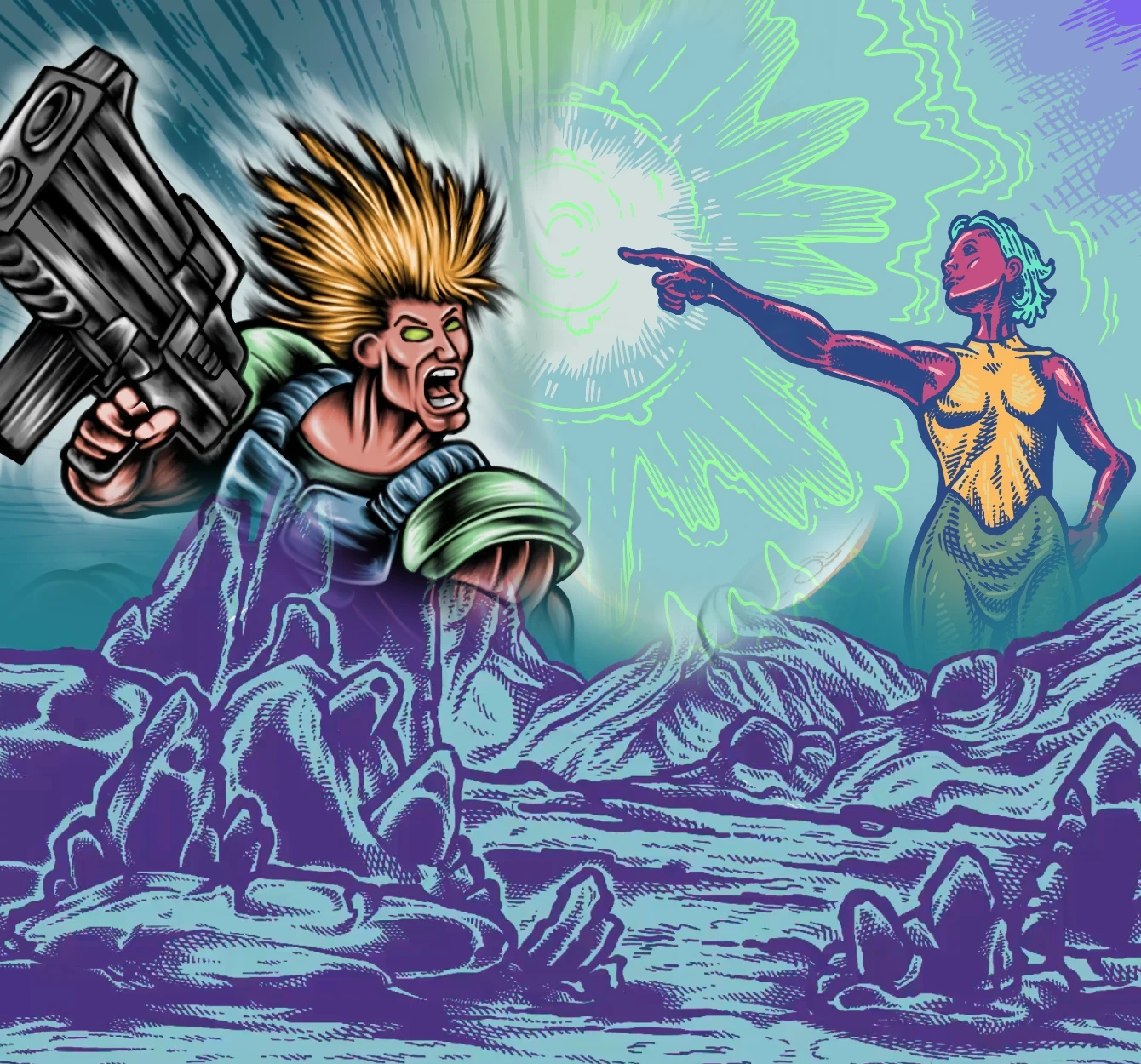
An amalgamation of three graphics, I produced for this article.
They have wildly different styles and serve different types of
meditative flow. We will look at them in detail.
More than twenty years ago, I spent some time living abroad. I had a tiny apartment, the kind with thin walls and a table that doubled as a desk and a dining space. That's where my drawing board went. I didn't know many people there. My days were quiet, filled mostly with work. My evenings and weekends I spent reading, running, and... drawing.
One evening, I had been working for hours on a comic page. It wasn't anything extraordinary, just ink, pencil, and paper. When I finally stopped, I remember leaning back and feeling an unexpected elation. The world outside my window was completely still. The air had that soft weight that comes just before night.
I was alone, but I didn't feel lonely. I felt at ease, even quietly exhilarated. It was as if some hidden part of me had just exhaled after holding its breath for too long. It felt good.
I remember this feeling. Not because of what I drew, but because of what drawing gave me: a moment of pure alignment. It's the same calm I still occasionally get when I sit down with a pencil, a pen or the stylus of a tablet. It is the quiet joy of being fully absorbed in something, and finding myself lighter when I return to reality. (Though to be fair, the older I get, the greater the physical effort gets.)
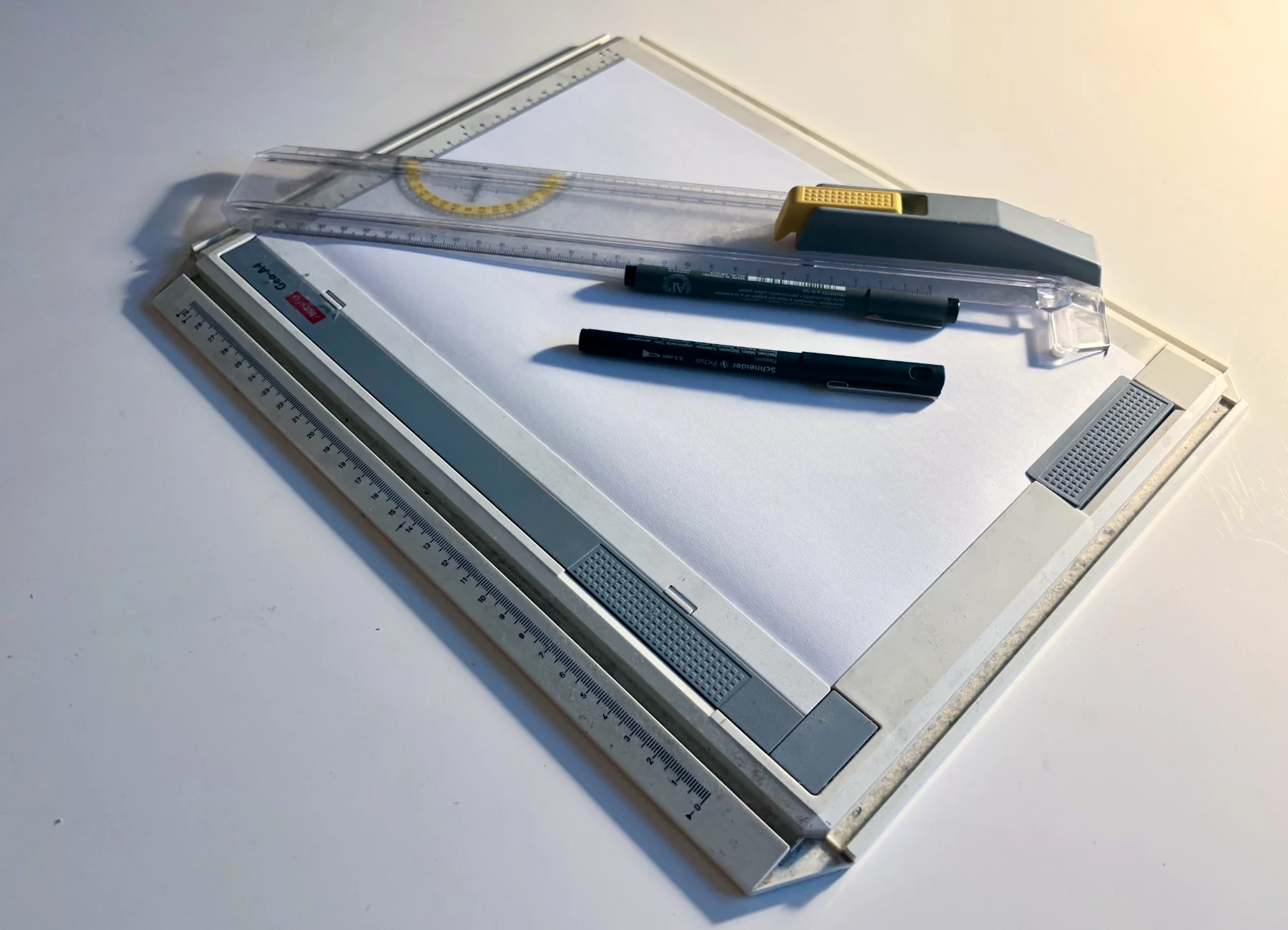
With a portable drawing board, you can draw anywhere.
It Came from Inner Space!
Some drawings start as ideas. Others start as escapes. For me, drawing has always been a bit of both. It is a place to go when the world starts to hum too loudly.
There's something deeply meditative about the act itself. The way the hand repeats its rhythm. The sound the pencil makes as it scrapes across paper or the tapping of a stylus on the glass screen of a tablet. Something that didn't exist before slowly emerging. Movement and thought meld in a line as it emerges from the tip of the pen.
At the beginning of this year, I wrote about the Baum Test. It's that curious psychological exercise where you're asked to draw a tree and then let someone analyze your subconscious. I realized how much of drawing is self-reflection. Even when you're not deliberately trying to be introspective, there always is that aspect. You draw, and in those lines, something of you inevitably appears. Sometimes a branch in your drawn tree bends where you didn't plan it to, and it feels oddly honest.
Flow and the Art of Forgetting Yourself
There's a term psychologists use for that deep state of concentration where you lose track of time: flow. It's not exclusive to artists. Coders, athletes, musicians, even surgeons talk about it. I just think that drawing might be one of the most direct ways to reach it.
In that state, the thinking mind loosens its grip. You don't plan, you follow. A bit like in Top Gun "Don't think, just do!" The body knows what to do, the same way it knows how to simply continue breathing even when you stop paying attention.
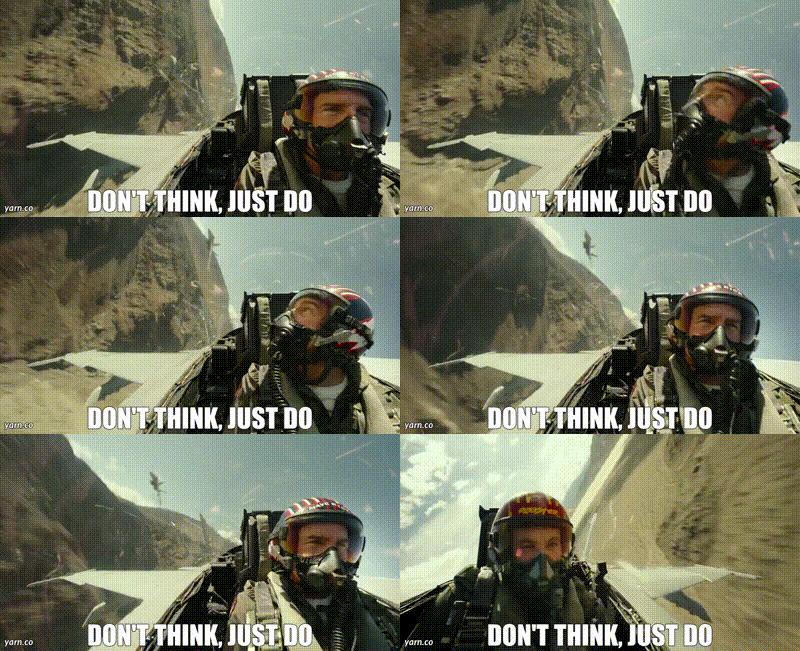
The motto "Don't think, just do!" also applies to drawing!
This
wisdom was espoused by Pete "Maverick" Mitchell in the movie Top
Gun.
More like Top Fun!
This personal experience aligns with growing scientific evidence about art's impact on stress and well-being. When researching this article, I found studies stating that such creative immersion can literally lower cortisol levels (the stress hormone that keeps us on edge). It increases heart-rate variability, a sign of physiological calm (see details about the studies below).
But beyond the data, there's feeling: after a drawing session, I'm not "done". I'm balanced.
The Beauty of Imperfection
When I was younger, I used to erase constantly. A stray line meant failure. A smudge meant starting over. Now, I think of these little flaws as part of the conversation. (To be fair, drawing digitally and having an "undo" function helps, as well.)
The same way in the Tree Drawing Test, a crooked trunk or lopsided crown is seen as revealing something psychological, in art those "imperfections" are often where authenticity lives. The line that wobbles is the one that feels most alive.
We spend so much time trying to correct ourselves, in life, in our work, in the art we create. I feel that we forget that imperfection isn't noise, it is tone.
To draw without erasing too much is a kind of faith in yourself.
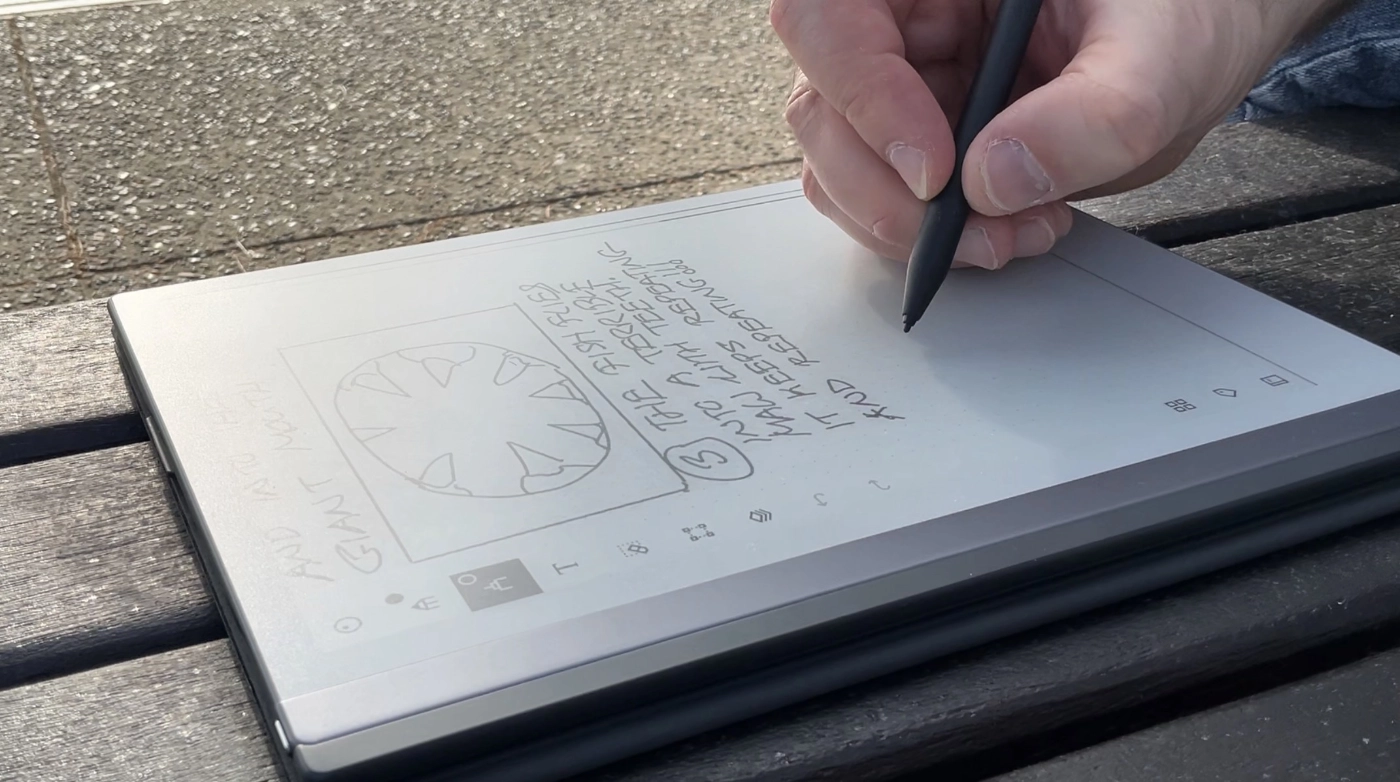
You can also draw digitally. These days it feels nearly like
drawing on paper.
Four Drawing Experiments
For this article I decided to draw four different graphics in different styles. These styles activate and demand different parts of my focus and my skill.
1. Extreme Jumpers
The first one is a tribute to the Rob Liefeld/Extreme Studios era: two figures hurtling toward each other, mouths open in the sort of yelling that can only mean unresolved teenage energy, while they strike absurdly impossible poses and brandish enough weaponry to start a small intergalactic arms race. The man is so muscled it looks like the swelling from an allergy, and the woman is a bodybuilding supermodel whose proportions could only have been approved by a committee of 90s comic-book fanatics.
Like in all of these pieces, I started with a loose sketch, then tightened the shapes, refined the linework, and weighted specific strokes while filling shadow masses with black. At first I leaned into cross-hatching to evoke the gritty texture of 1990s comics, and I like how hatching multiplies visual noise without adding more figures to manage.
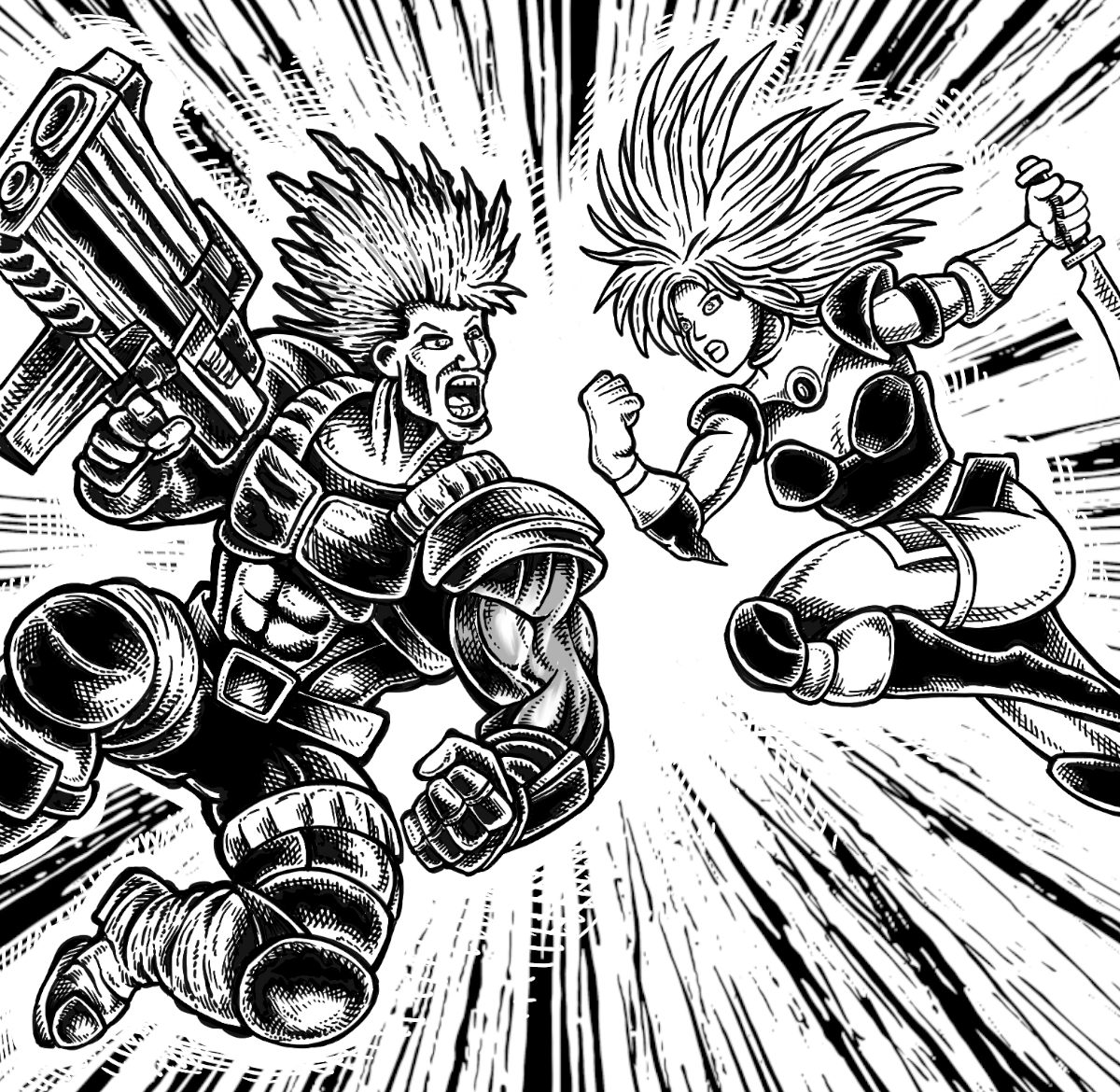
The original black and white version of the two extreme
fighters.
But then I changed course, spread the bold outlines into the colored areas, and let highlights and shadows become deliberate color choices, so the skin went slick enough to lose its texture.
I even grabbed a handful of speed lines from Envato Elements, pasted them into the background, and gave the whole thing that flying-through-the-air feel. It ended up brighter and smoother than a Liefeld purist would tolerate, but I liked the painterly sheen and the fact that I approached it systematically instead of letting the eraser be the ultimate authority.
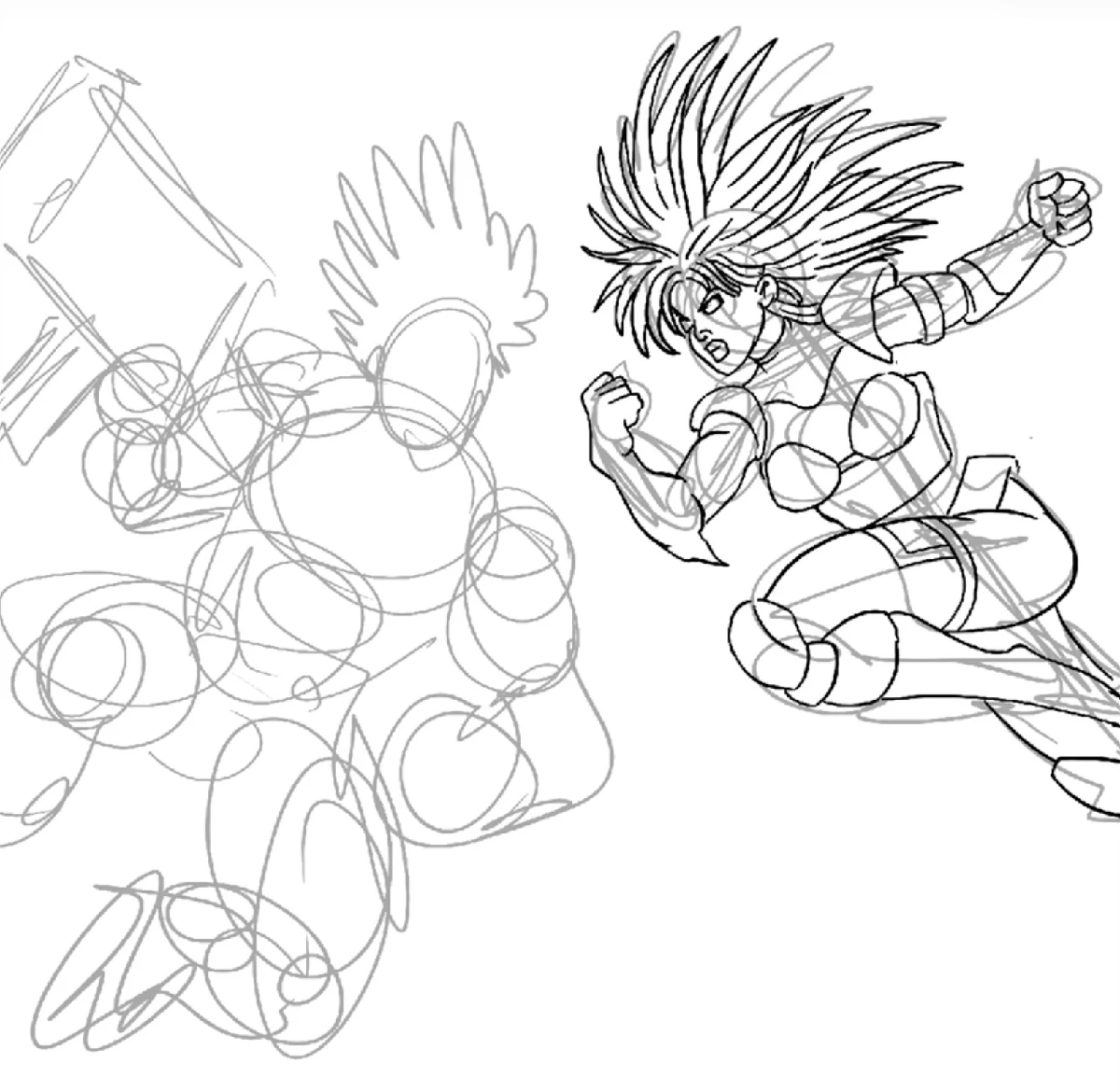
Step 1: Rough sketch mapped on a separate layer to lock in
the exaggerated attack pose.
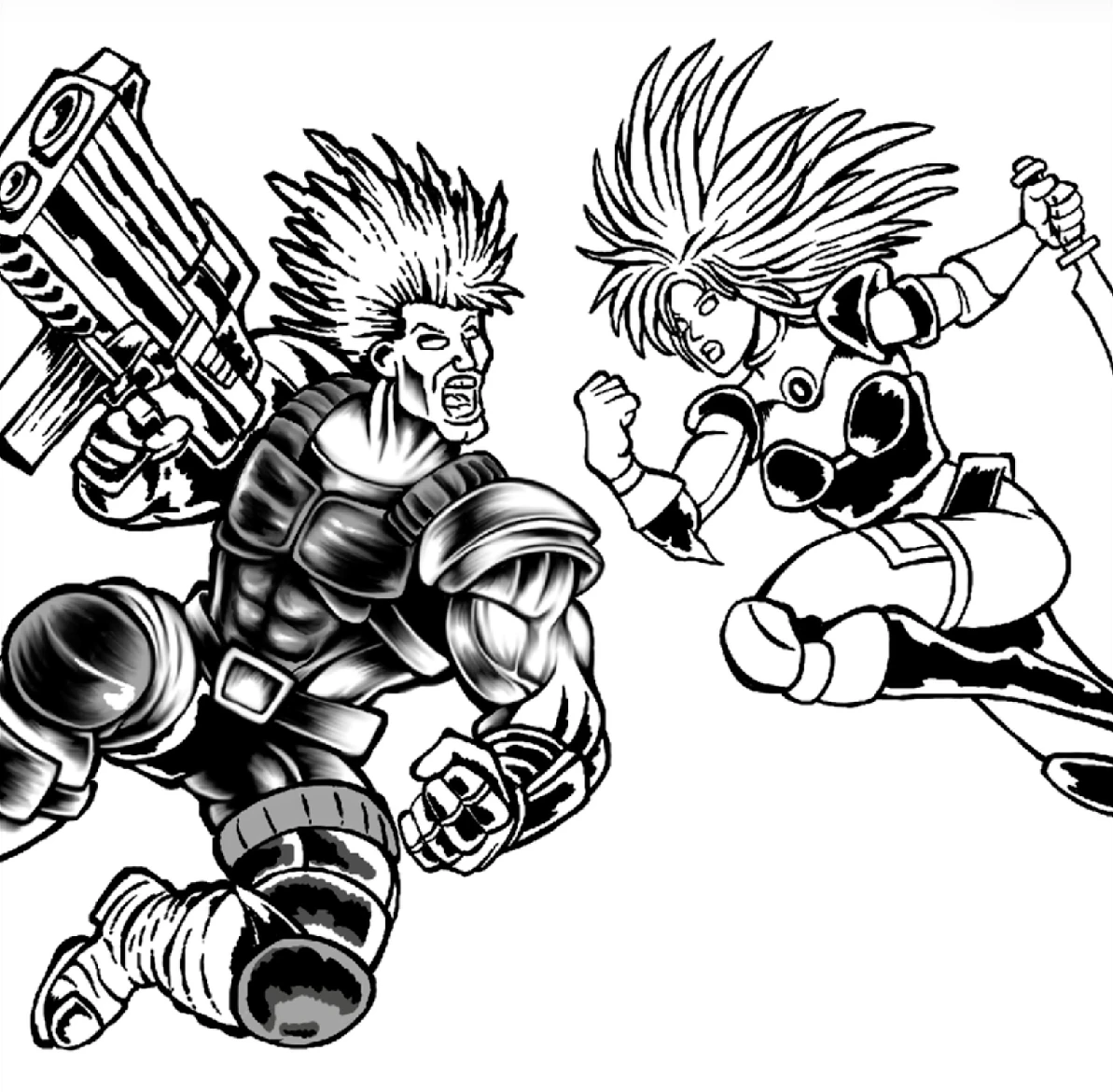
Step 2: Refined the linework and blocked in musculature
while the action still felt fresh.
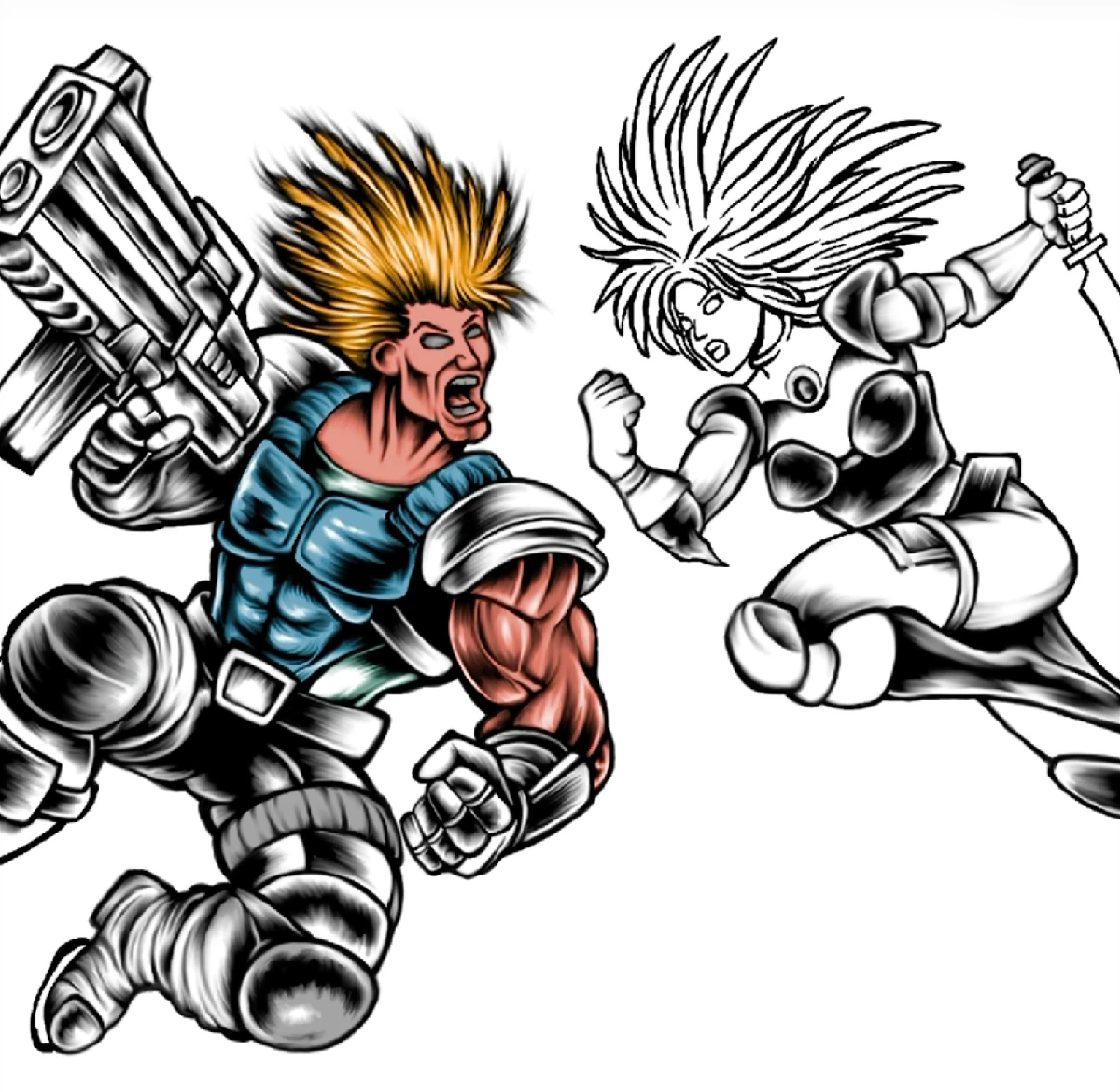
Step 3: Added color planes, smudged outlines into paint,
and penciled in painterly highlights.
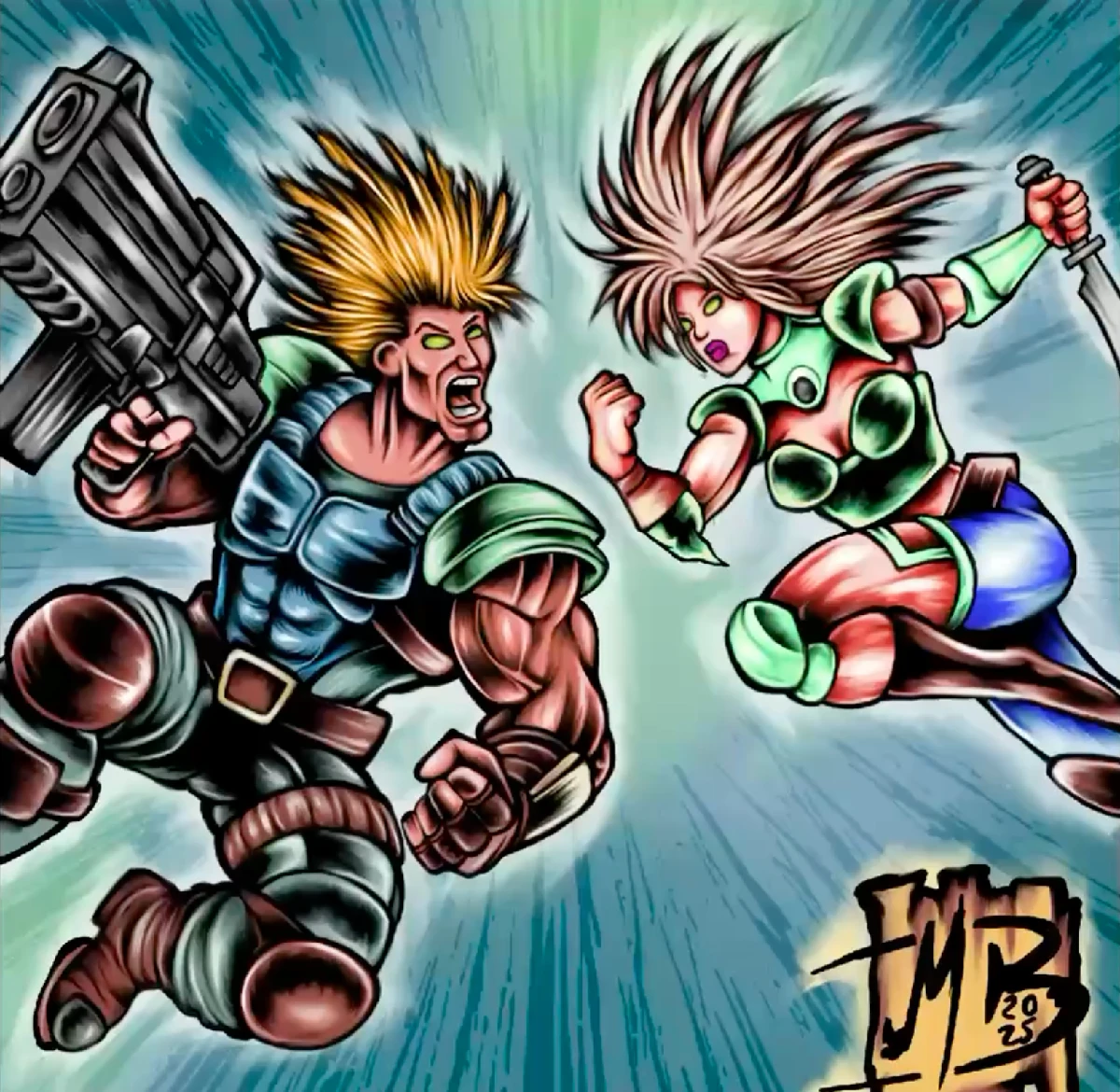
Step 4: Final polish with pasted speed lines and a quick
shader pass for the finish.
2. Gross-out Booger
My second drawing threw realism and proportion out the window in favor of the underground energy of Robert Crumb. I sketched a face that disrespected classical facial composition, stuck a finger deep into its nostril, and let the snot stream like it owned the composition. Nothing is elegant. The face and hand push into the frame and dare the viewer to look away.
This one got the full cross-hatching treatment. The original lines stayed stark, then I shifted them from black to a dark green and filled the figure with an acid-lime tone. Highlights came in even paler greens, complementary shadows added depth, and I layered in more hatching in the background. It felt free, messy, and delightfully disgusting: no realism, no rules, just raw energy and expression.
I wonder what the psychological test would conclude if I handed in this grotesque face instead of the prescribed tree.
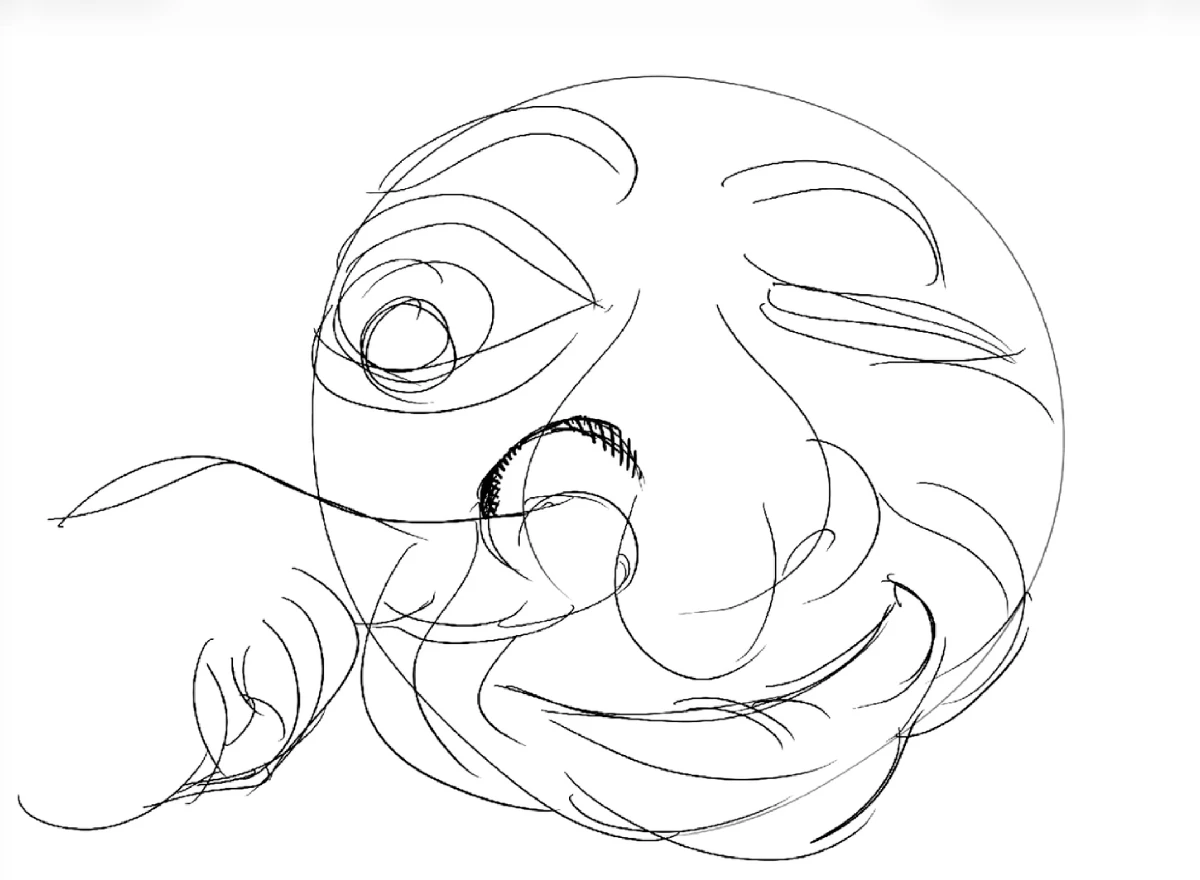
Step 1: Rough block-in on its own layer to trap that the
shape of the wobbly, ungainly face.
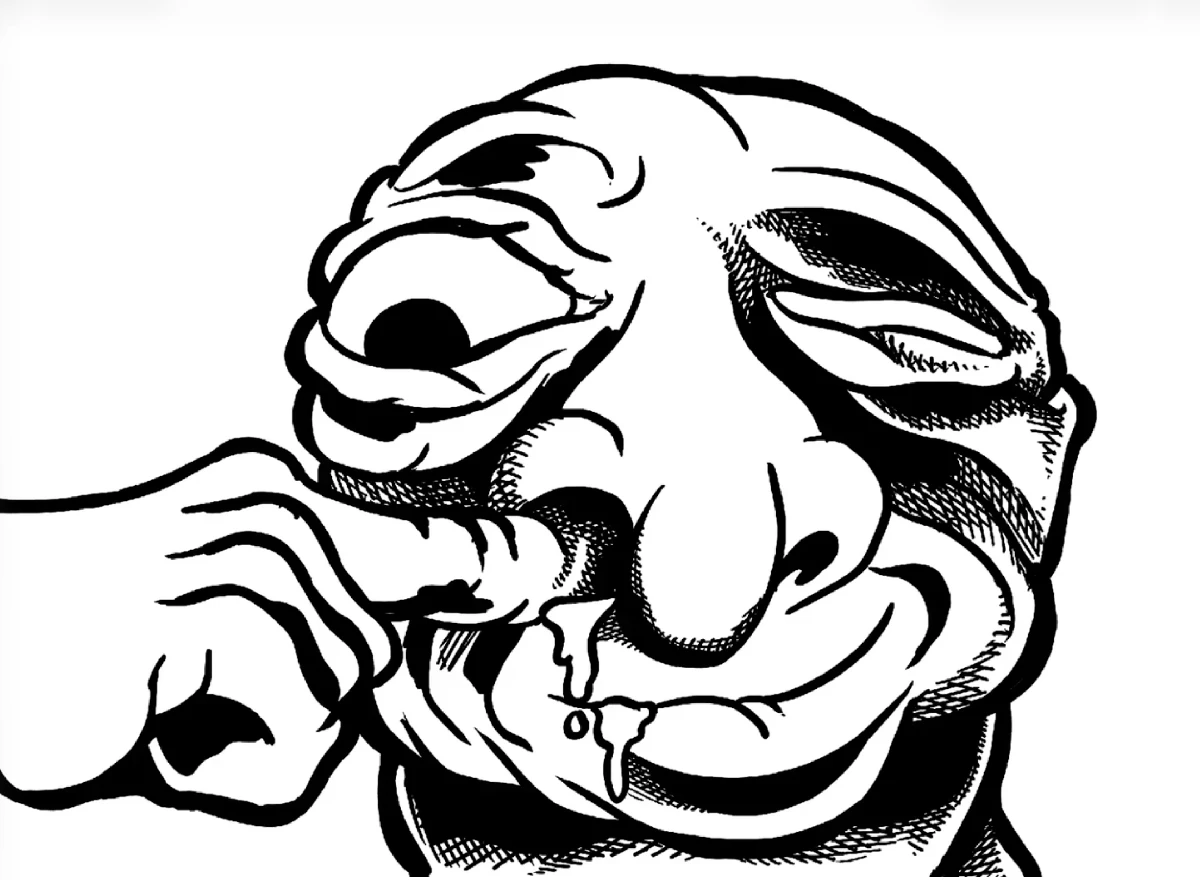
Step 2: Line refinement smoothed in the grotesque anatomy
while keeping the energy raw.
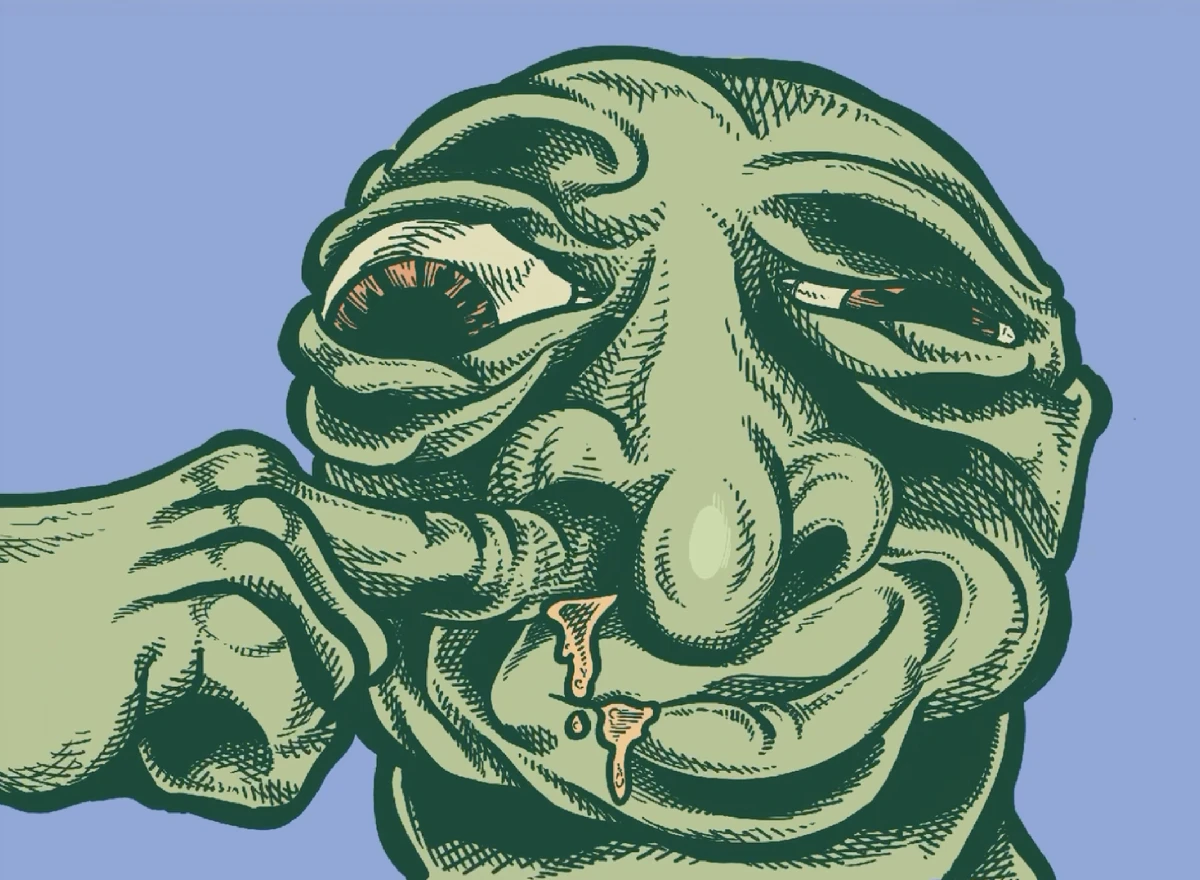
Step 3: Coloring stage slipped in greens and complementary
hues before throwing more hatch marks.
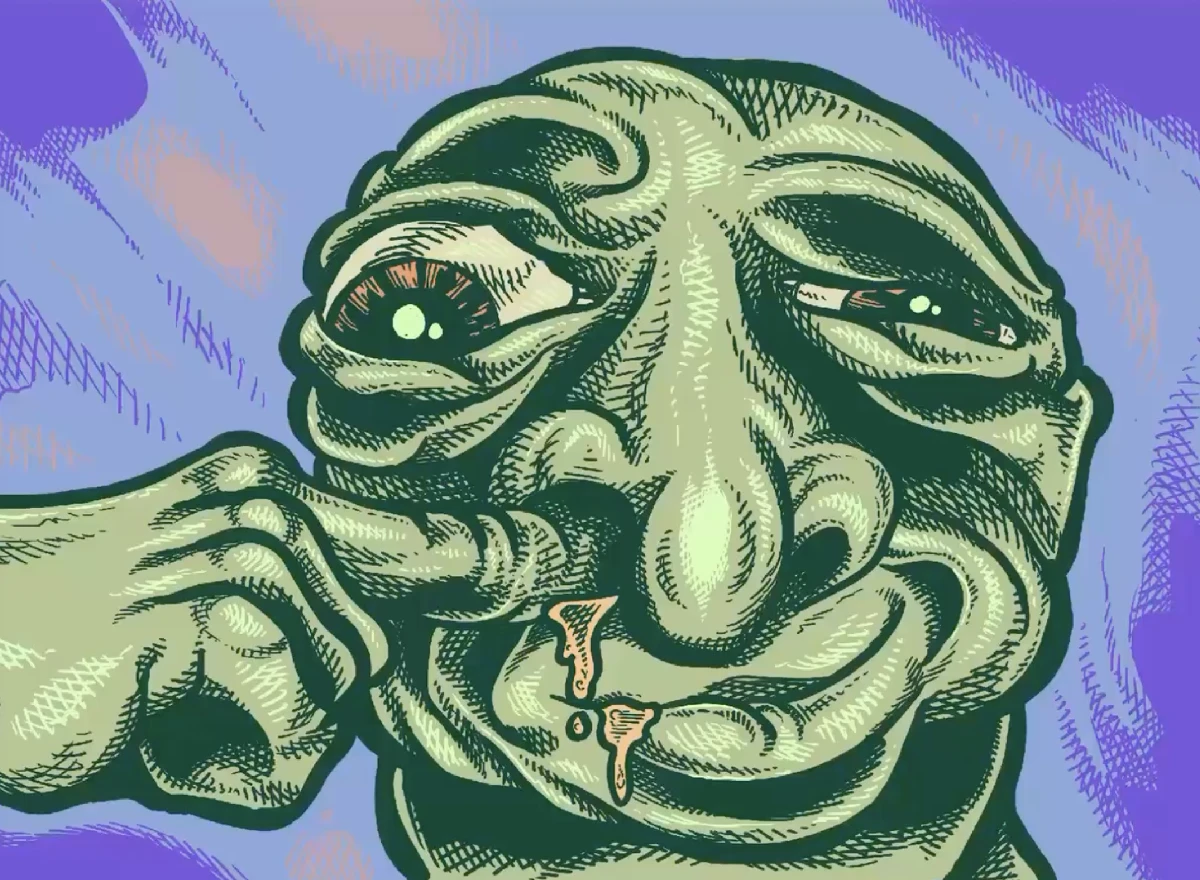
Step 4: Finishing touches, with the final layers of
cross-hatching and snot details.
3. Planetary Rockscape
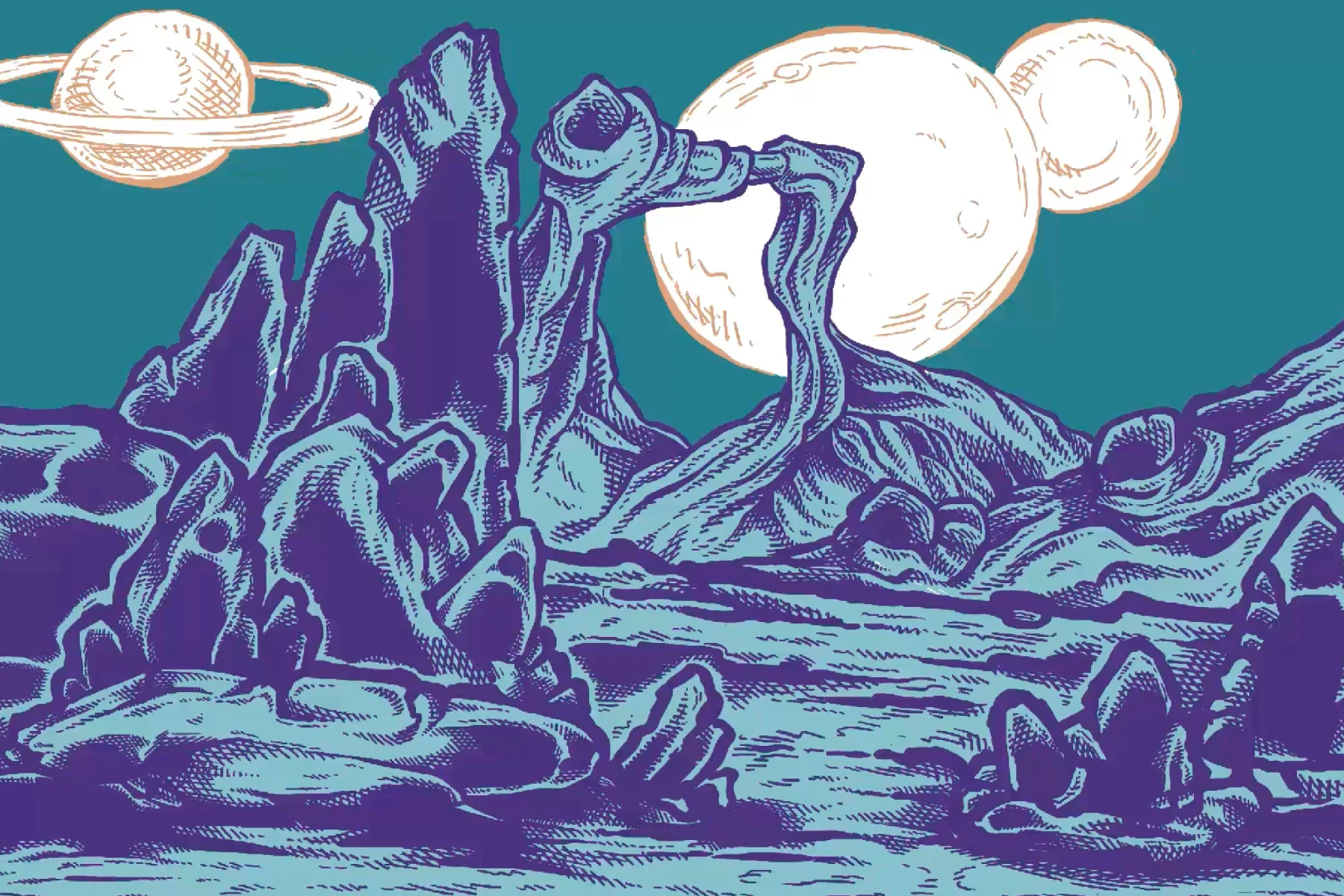
The third drawing, Planetary Rockscape, pulled me away from bodies, faces, and psychology altogether and dropped me onto an alien world. It depicts a barren landscape strewn with rocks and debris, with a monolithic rock formation looming on the horizon and distant planets glowing softly above like indifferent witnesses.
Technically I approached it much like the others: a loose rough sketch to establish the composition, followed by inked rendering to lock in the forms and textures. I limited myself to four colors, using them deliberately to separate planes of depth and atmosphere rather than chase realism. Everything was drawn on the iPad Pro in Procreate with an Apple Pencil, a setup that now feels second-nature.
What made this piece liberating was the subject itself. An alien landscape doesn't exist, so there's no external reference to obey, no photographic truth to measure myself against. I could channel whatever emerged. The rocks and scattered debris leaned into John Byrne's expressive rubble. Well-shaded, confident, and rhythmically placed rather than meticulously observed.
In that freedom, the drawing became less about depiction and more about sensation. Each rock was a small decision, each line a quiet affirmation that imagination, when given space, can be deeply calm. The landscape may be harsh and lifeless, but the act of drawing it felt oddly gentle, like walking through silence without needing to explain the destination.
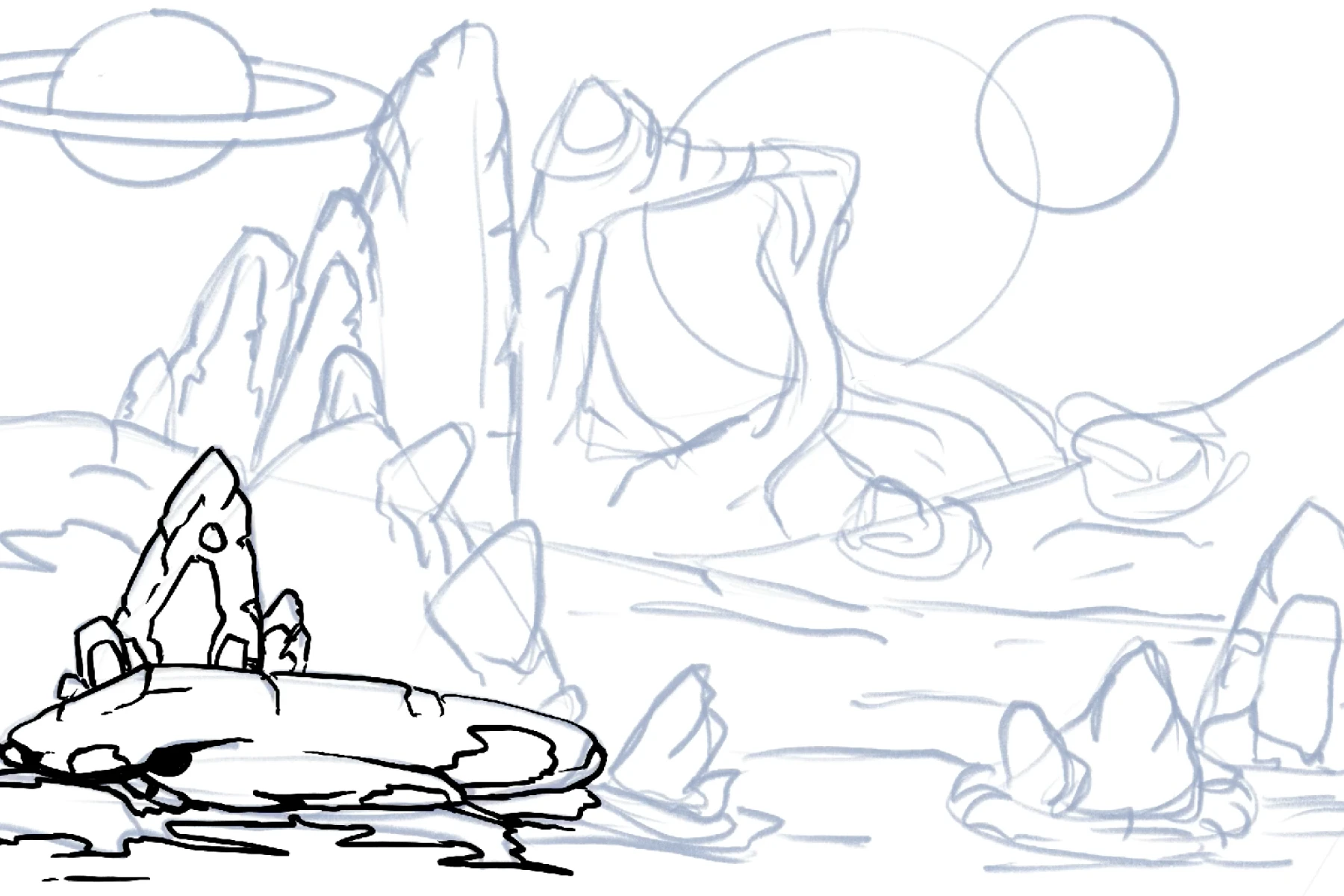
Step 1: Layered a loose sketch to chart the alien horizon
before committing to texture.
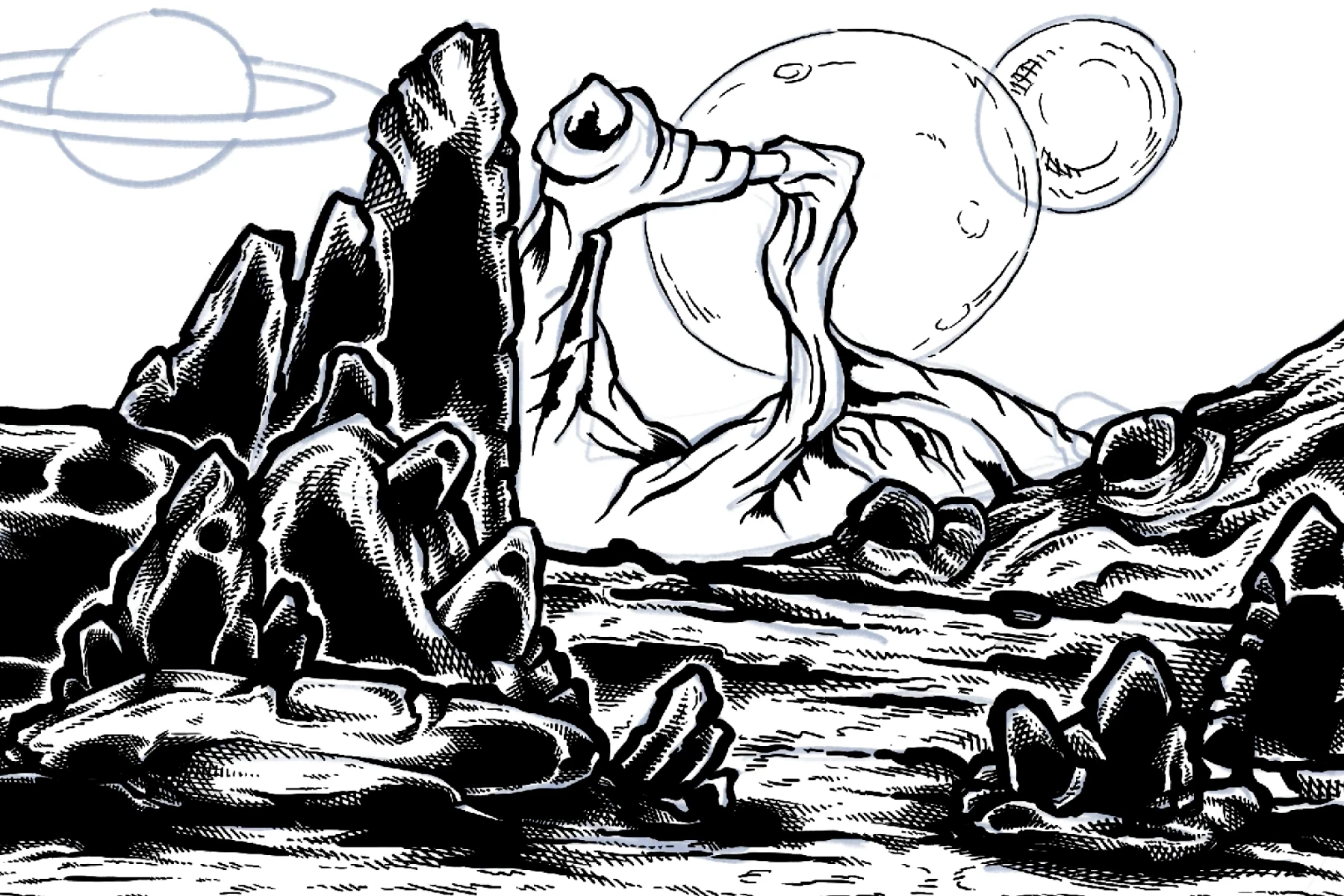
Step 2: Refined forms and textural marks so each rock had
rhythm without over-detailing.
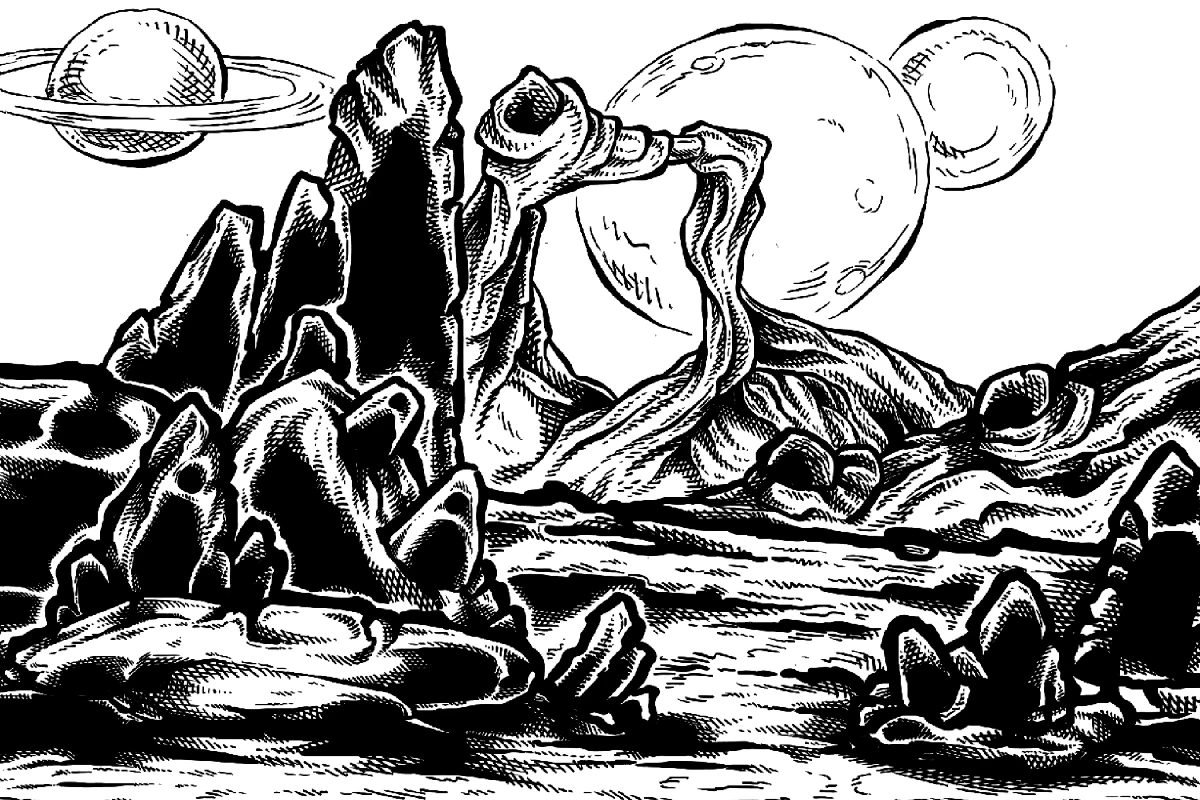
Step 3:Building atmospheric cross-hatching
Step 4: Color blocking the four-tone palette and final pass
for harmonization.
4. Neon Reach Unision
The fourth drawing returns to the human figure but places it in a symbolic space. A man and a woman reach toward each other with hands suspended in that charged moment just before contact. In the narrow gap between their fingers, an explosion of light erupts—a visual punctuation mark that turns anticipation into energy.
I began with a deliberately loose line drawing, using absurd and unexpected colors from the start to sabotage realism before it could settle in. Once the figures were placed, I refined the lines, rendered details, and focused on shape, contrast, and rhythm. I feel this is like a quiet structure that holds even the wildest compositions together.
For the final look, I limited myself to Procreate's predefined color palettes and pushed them toward a bold, neon-inspired spectrum. The exercise became a study in controlled excess: letting the colors scream while keeping them in tune.
The more extreme the colors became, the more discipline I felt was required elsewhere. The palette is intentionally unrealistic, yet I rendered the figures with care: the man appears naked, the woman's garments hover between costume and necessity. That tension felt appropriate; like the colors, the clothing resists realism without abandoning coherence, contributing to the peculiar energy of the scene.
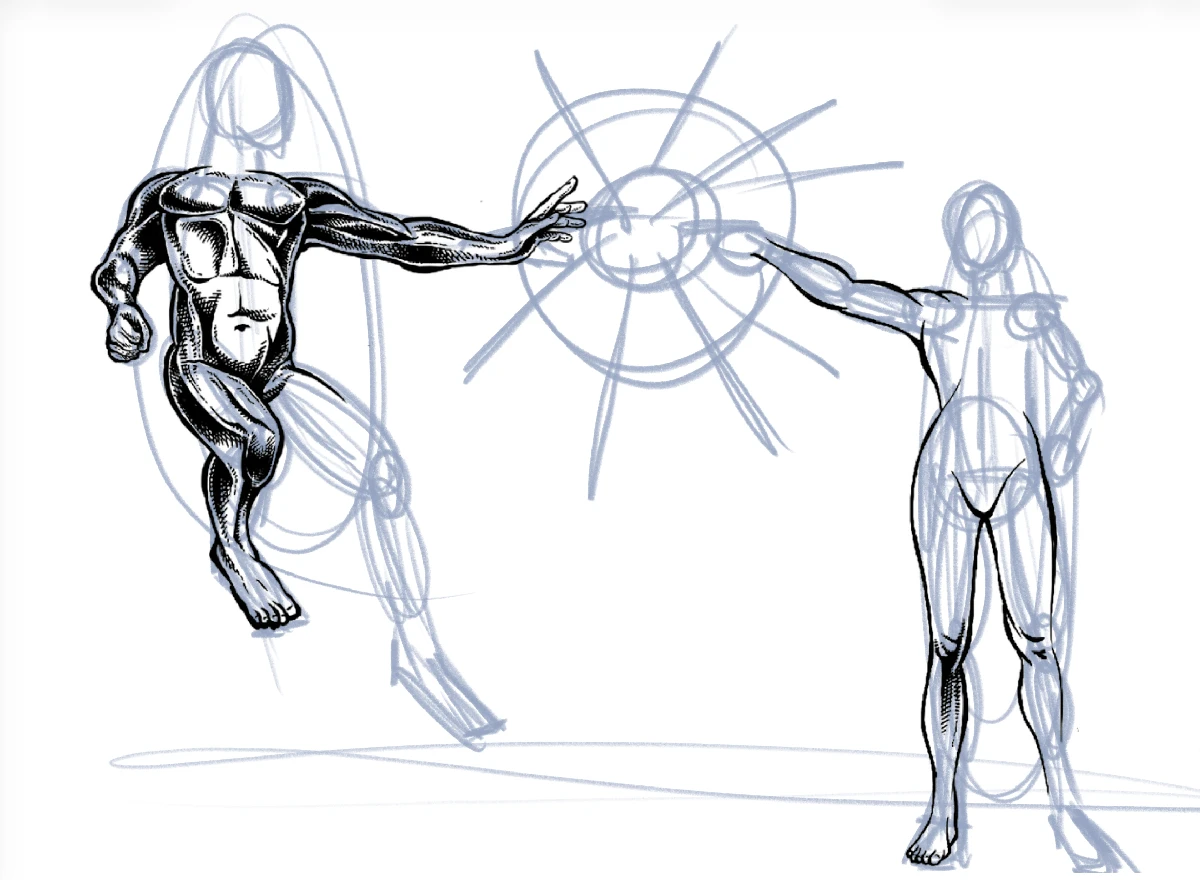
Step 1: Sketched the general shapes on their own layer so
they could "breathe".
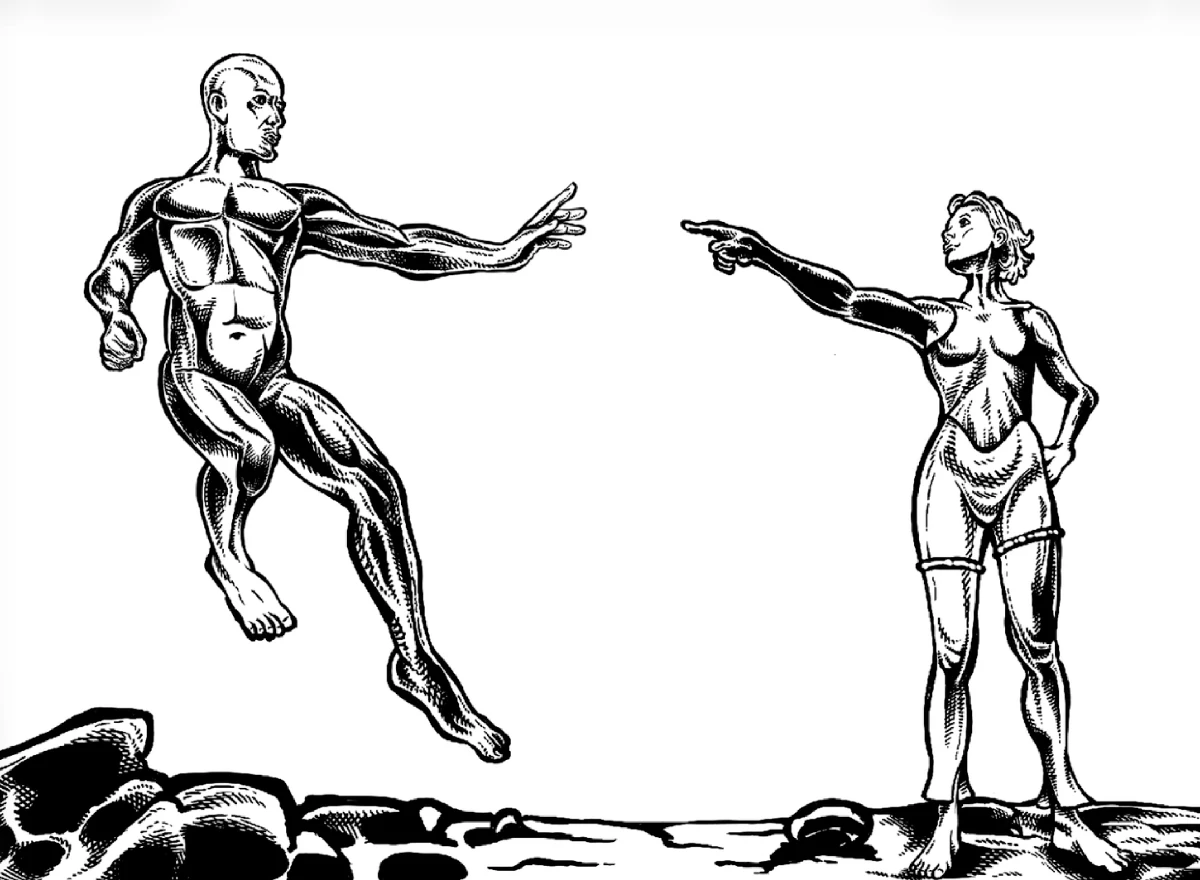
Step 2: Line refinement balanced tension while keeping the
symbolic reach intact.
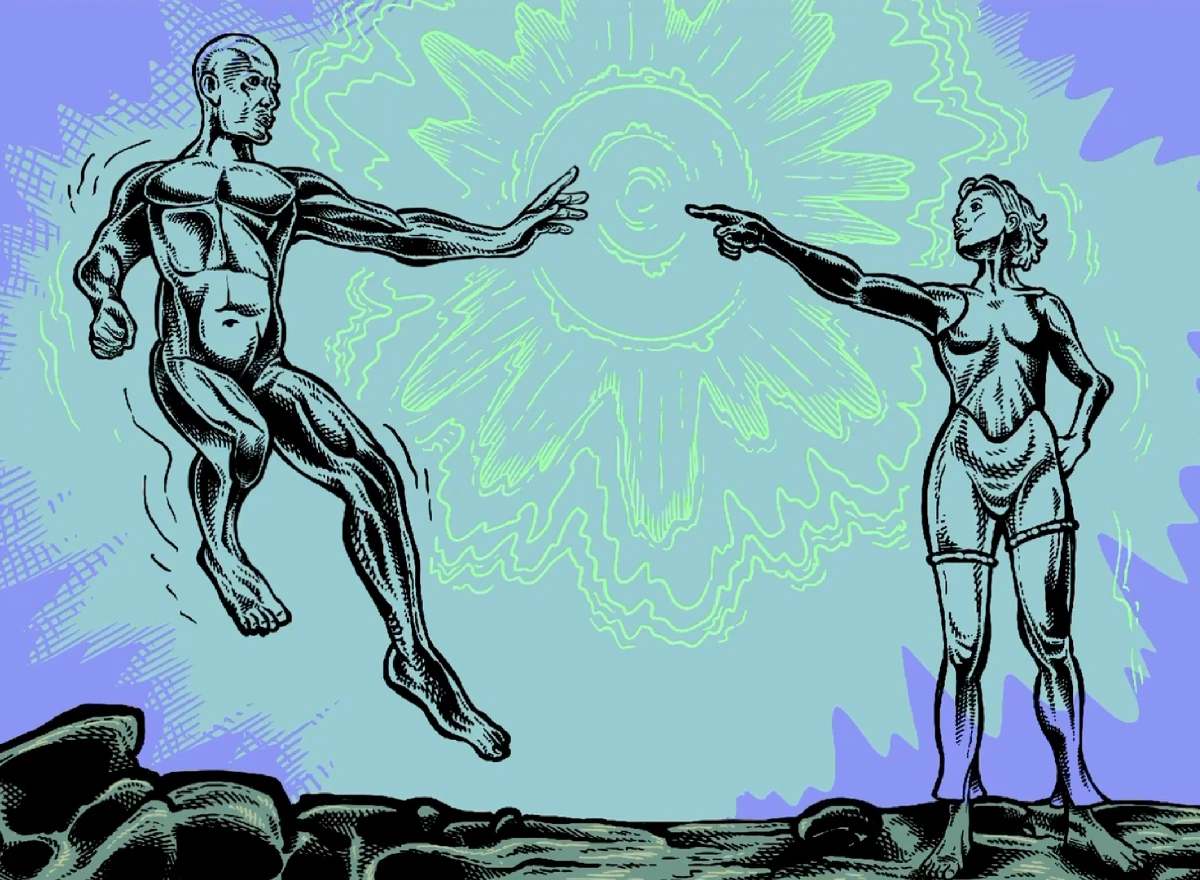
Step 3: Applied neon-focused colors and blended the
cross-hatching in the background before final coloring of
the figures.
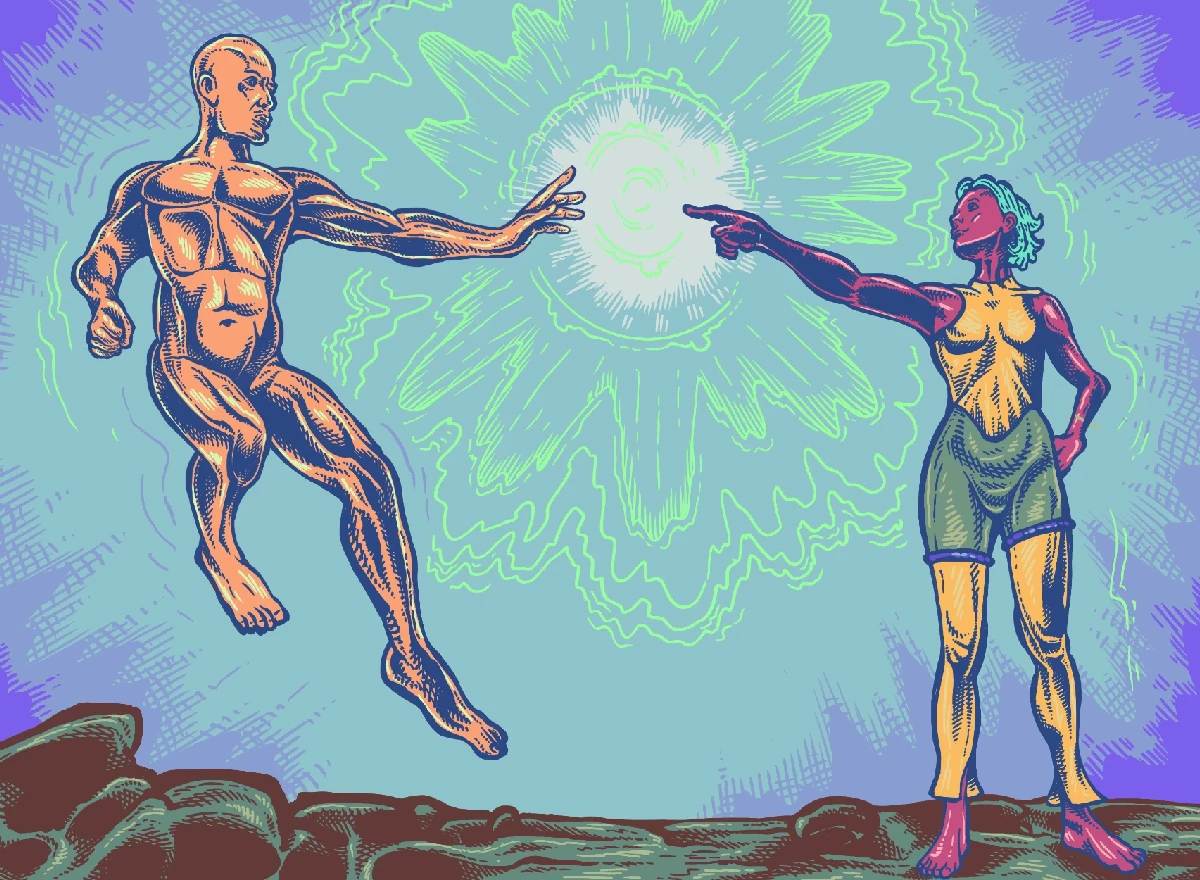
Step 4: Final finishing touches set the depth and polish
for the concluding scene.
Each of these experiments demanded different muscles of focus and attention. Yet all of them led me back to the quiet ritual of drawing itself: the slow breathing, the repetition, the meditative pause that feels like prayer.
I actually have a bonus fifth drawing, but I didn't finish it in time for this article. I call it "Faces in Wax and Smoke". Here it is. And I also have a speed-drawing video of it (and I even have a sixth bonus drawing that just didn't fit this article).
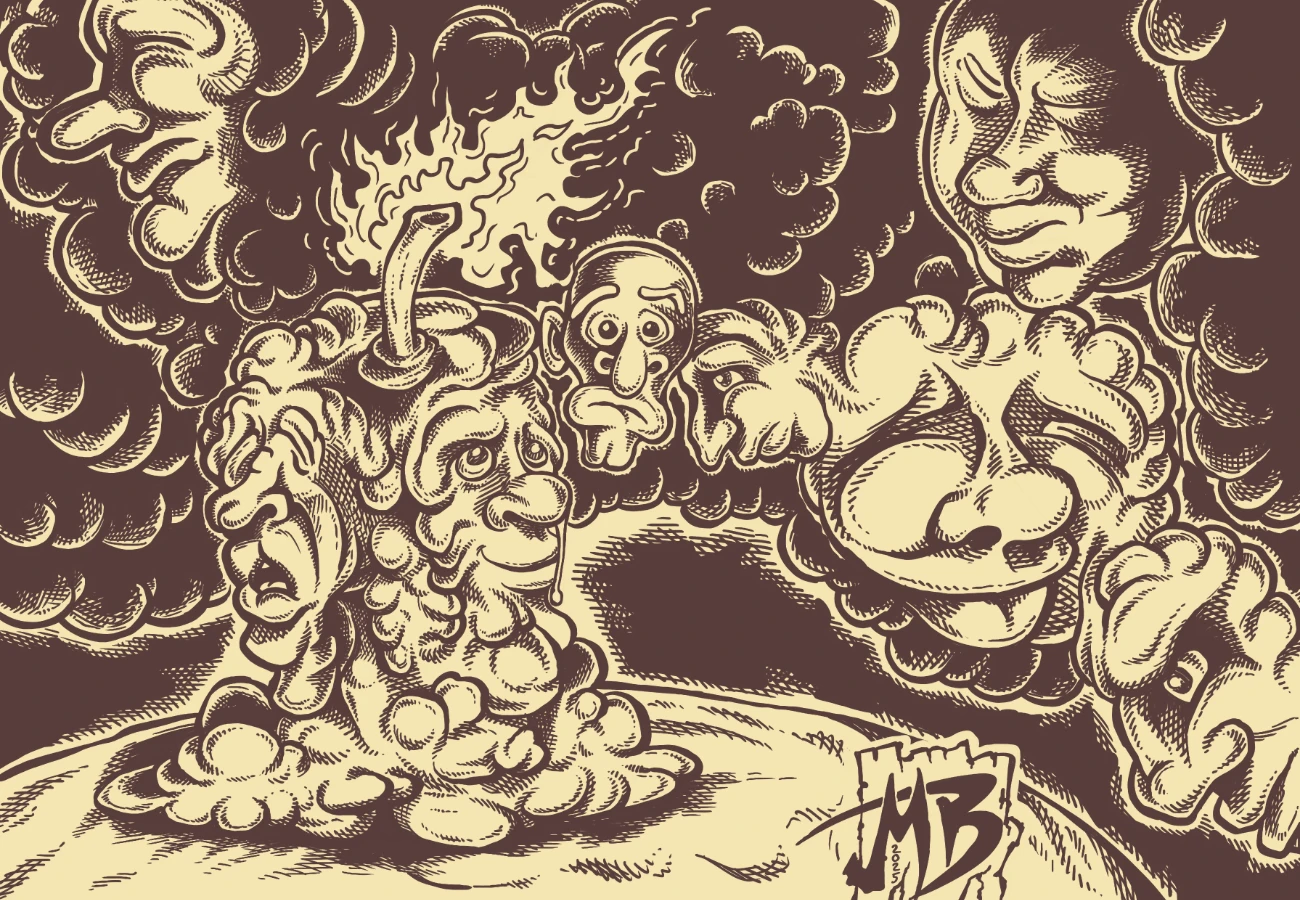
Faces in Wax and Smoke: A little sureal bonus drawing I started
but didn't finish in time for this article.
Drawing as a Form of Prayer
In my Baum Test article, I joked that psychologists might interpret my digitally drawn tree as a sign of optimism (or maybe mild overthinking). But behind the humor was something more serious: drawing always felt a bit spiritual to me.
Not in a mystical or religious way (I'm not a particularly religious person) but I've always admired the dedication that strong faith can bring. I feel there's something noble about devoting yourself entirely to a single pursuit and having the discipline to show up regularly for something larger than yourself.
I like the romantic idea of a monastery, not necessarily as a place of worship, but as a place of focus. The idea of a retreat where one can dedicate time and care to a single cause really appeals to me. Drawing sometimes feels like that to me: a small, private ritual of focused attention.
A drawing can feel like a prayer. It completely demands your presence.
Japanese monks draw circles, ensō, in one breath. I draw a crooked tree, or comicbook characters. In their own ways, both are an attempt to touch stillness while imbuing the drawing with movement.
From Stress to Stillness
I've found growing scientific backing for what artists have long intuited. In a study from Drexel University, participants who engaged in 45 minutes of visual art-making showed a significant reduction in salivary cortisol levels (even without prior experience).[1] Another study linked drawing and painting to increased parasympathetic activity, the body's "rest and recover" mode. [2] A 2024 review of neuroscience research concluded that art-making "significantly reduces stress hormones and promotes self-regulation, regardless of artistic skill." [3]
But data aside... you can actually feel it. After a session of drawing, the heartbeat slows, breathing deepens, and the inner noise fades into something like silence. Each line becomes a soft pulse of calm.
A nice place to draw: an empty piece of paper is just full of
opportunities!
When Machines Can Draw, They Can't Draw For You!
We now live in an age where machines can generate pictures.
An AI can produce a portrait or a landscape in seconds, faster, cleaner, sometimes even more "perfect" than a human. It can mimic a style, blend influences, and generate endless variations. The results are getting better every day. There are so many use cases for AI generated art and so many possibilities that have only opened up due to their low barrier for entry. And yet, something essential is missing.
The difference isn't in the result. The results can be amazing. It's in the process.
When we draw, we participate in something physical, temporal, and deeply personal. We use the fine motor skills of our hands and arms to turn thought impulses into visible form. Our lines carry hesitation, rhythm, intention. These are traces of the small human errors that make the act meaningful. The AI produces what we might expect from the end of the process, but it never experiences the becoming of it.
It cannot replace what the act of drawing gives you as a person.
Maybe that's the paradox of our moment: the more our tools can produce art, the more we are marginalized as an active participant in the process of crafting the result. I think this reminds us that some of the real value of art lies in the making, in the human attention, patience, and stillness it requires.
Lines That Lead You Into Silence
If the Baum Test tries to uncover what your tree says about you, then meditative drawing asks a quieter question: What happens when you stop asking altogether... and just draw?
You follow the line. You listen. You breathe.
At some point, the drawing stops being a thing you produce and becomes a place you enter. Thought loosens its grip. Judgement fades. Time thins out. What remains is movement... steady, imperfect, and alive.
What I learned through these drawings is this: the value of drawing isn't hidden in the image at the end, but in the state you pass through while making it.
That state doesn't require talent. It doesn't care about style. It doesn't reward speed or perfection.
It rewards attention.
In a world that constantly pulls us toward efficiency, optimization, and instant results (even toward machines that can generate images for us) the act of drawing remains stubbornly human. It asks for your hands, your breath, your patience. It gives nothing back immediately, but it gives something better: a brief return to yourself.
Maybe that's why the simplest lines matter most. They don't need to explain anything. They don't need to impress anyone. They just are.
And sometimes, that's enough.
"Drawing is, at its core, the art of making stillness visible."
- Quote from an unknown wise person (possibly Batman)