Finding Peace in the Process
How to Survive the Perfect Demoparty
In late August 2026, I joined hundreds of sceners at my fifth Evoke demoparty: the night sky was full of programmable drones, a wasp made off with a chunk of somebody's sausage, and I slept on the floor. We managed to submit two demos across two groups, and I conjured a Phoenix from ten colors. What follows is my long, fond, and slightly rambling account of all of it.
August 2026
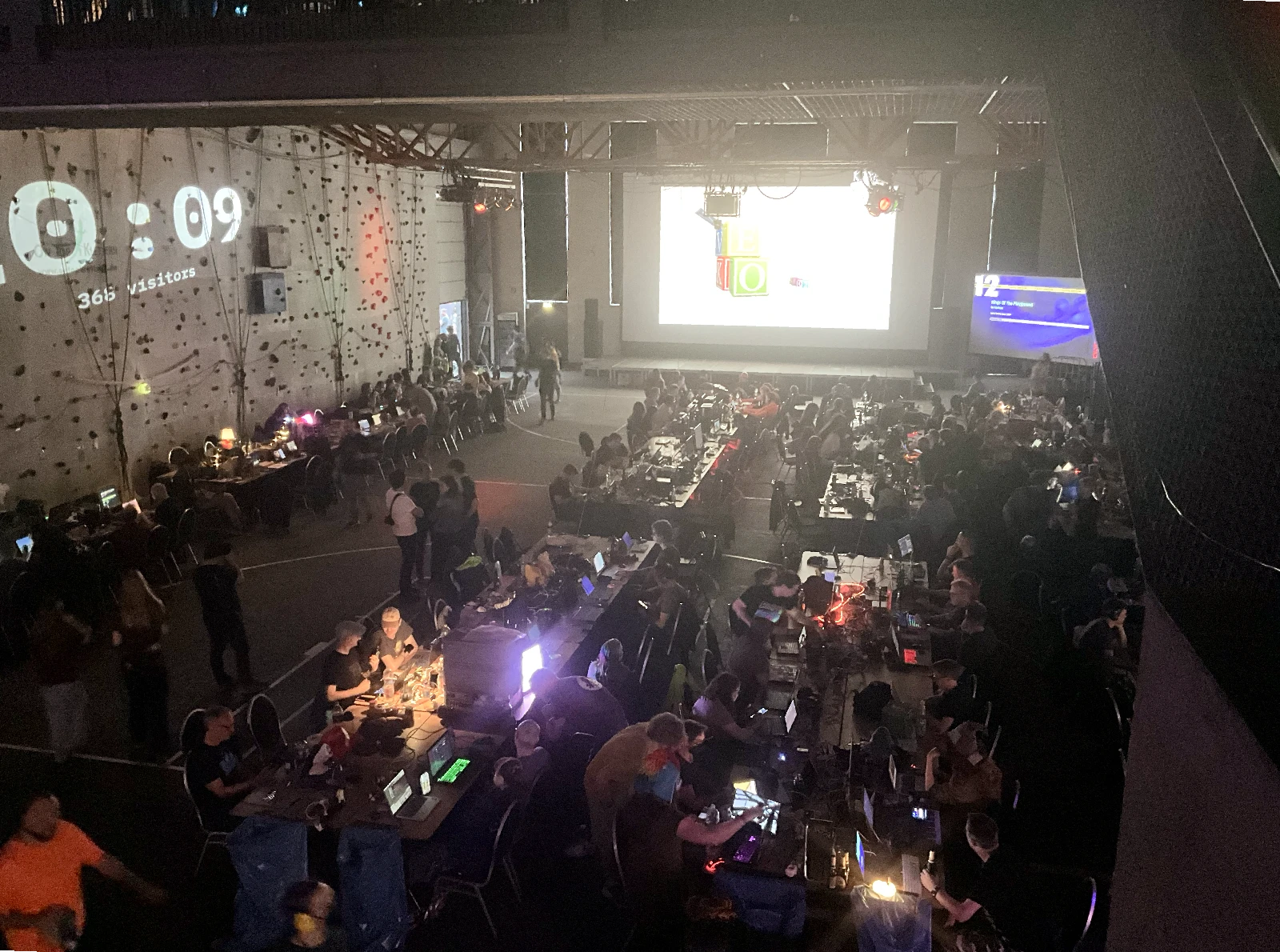
The main hall of the AbenteuerhallenKALK during Evoke 2026. (On
the second day, the counter on the wall hit around 450
visitors.)
Evoke is one of the true cornerstones of the demoscene. It has been running regularly since 1997, and since 2002 it has been organized in Cologne by Digitale Kultur e.V..
This was the 27th edition, held over the weekend of August 21st to 23rd at the familiar AbenteuerhallenKALK, that wonderfully gritty industrial hall in the Kalk district that feels purpose-built for this kind of beautiful event. The motto was "Find Peace in the Process".
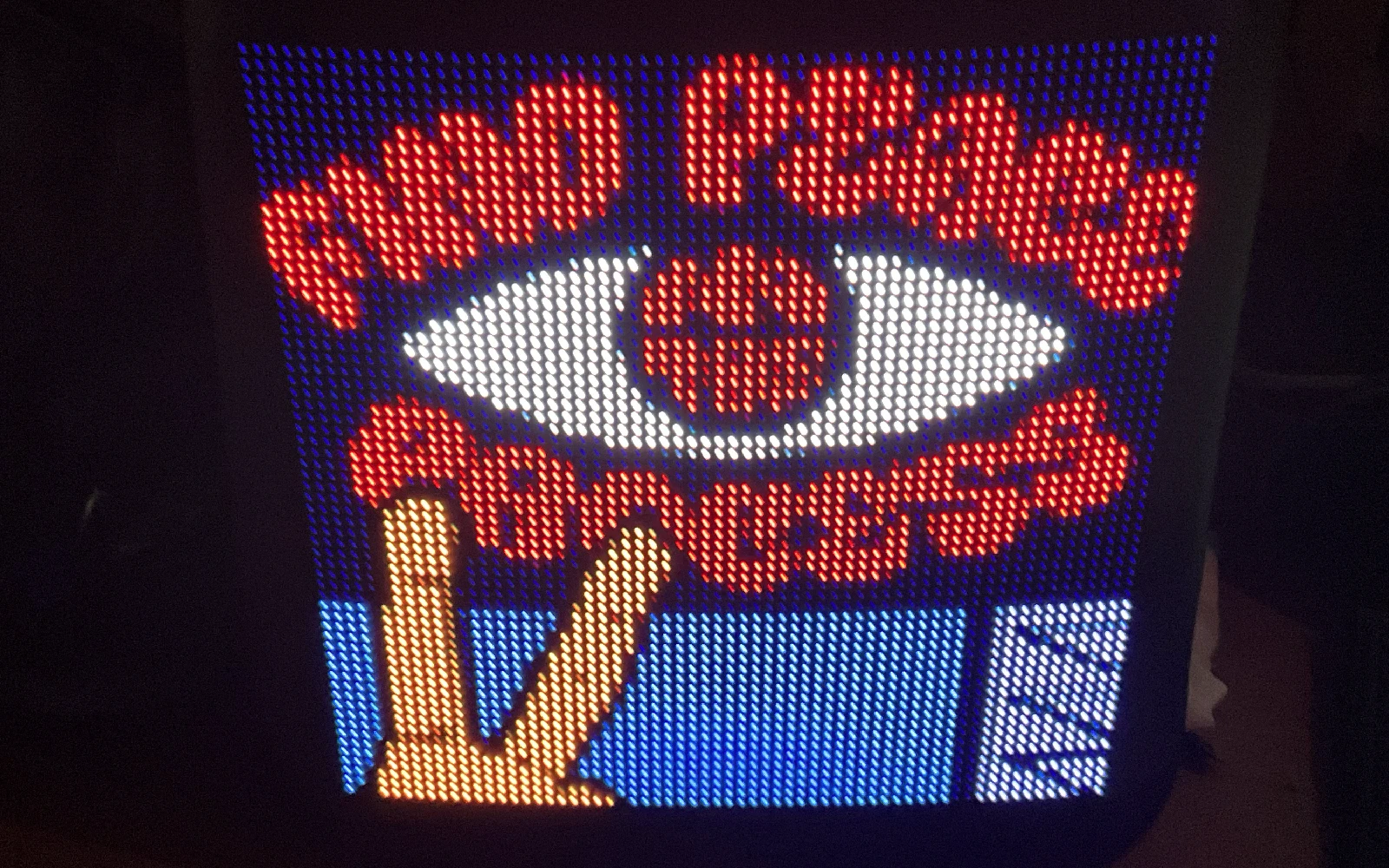
The motto in LEDs: Find Peace in the Process.
I want to start with a brief description of the mood. Before coming to Evoke, the world outside the hall felt especially burdonsome this year. The war in Ukraine has ground on into yet another grim chapter, the conflict around Iran remains unresolved, the whole planet's climate is melting into bits, and the news has a terrible way of kicking your mind in the butt.
Seen against all that, a weekend spent among people who pour themselves into making beautiful, useless, joyful things felt like an escape and a stubborn act of defiance. Peace, it turns out, is worth finding wherever you can, and sometimes you find it in the simple process of pushing pixels late at night.
This was my fifth Evoke in a row, and it might be my last for a while, since I am not sure I will manage to make it next year. So this time I paid attention. I tried to soak up every drone, every sausage, and every serendipitous conversation. Here's my personal account of this delightful event.
This is a demoparty report written from my own personal perspective. I am not affiliated with the Evoke organizers, and the article is not endorsed by them. That being said, I very much hope I have not written anything they would object to. I certainly did not follow everything at the demoparty in detail, so other people will have had quite different experiences of the same weekend.
A quick word about the photography. Mine, as you have probably gathered, is enthusiastic rather than competent. Kaydee, on the other hand, actually knows their way around a camera and has put together an excellent collection of photos from the weekend. These are Kaydee's own shots, not the official gallery from the Evoke team, which is still to come, so do go and have a look.
A Street Named After My City
I arrived in Cologne early on Friday morning and, as has become my ritual, let myself simply wander. I have grown very fond of the city, and of the Kalk district in particular, that old working-class district with its mix of lived-in streets, new buildings and old industrial spaces. On my walk from Messe Deutz to the Köln Arcaden, I turned a corner more or less at random and found myself standing on a street called Thessaloniki-Allee*.
For a moment I thought all my years of drinking had finally caught up with me and I had lost my mind.
A street in Kalk, in walking distance from the AbenteuerhallenKALK, named after Thessaloniki, the very city where I actually live. What are the odds!?! I usually count myself a believer in coincidences, but this one felt strangely personal. And it only took me five visits to find out about this.
I think the great watchmaker in the sky was having a laugh at my expense. Darnit!
So excited, and frankly so daft, that the only photo I managed to take of the sign came out hopelessly blurry and completely useless. So rather than inflict it on you, here is the actual spot on Google Maps, in case you would like to see it for yourself.
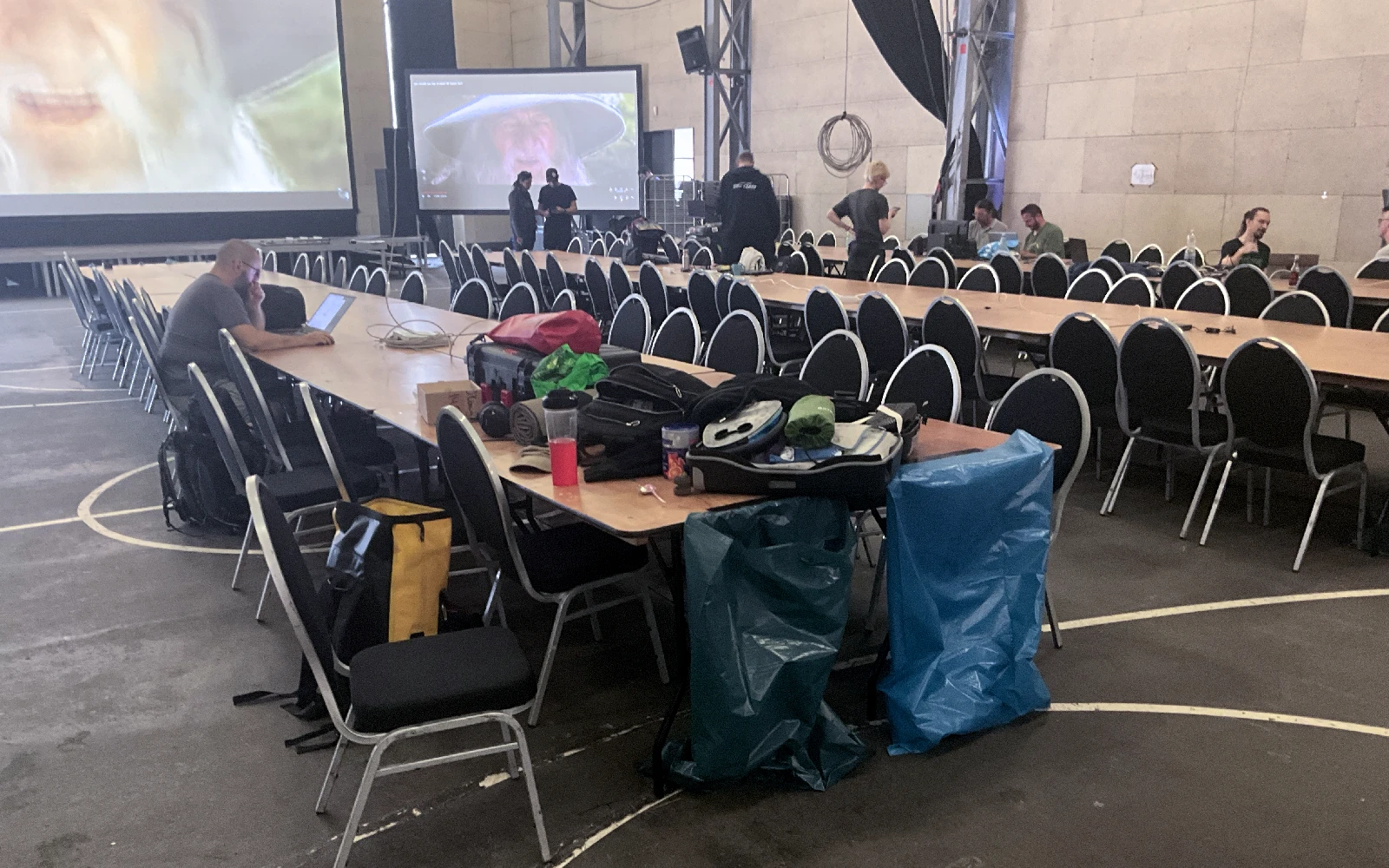
The calm before the storm, the hall a little before the doors
officially opened.
Peace, Love and Demos
The organizers had summed up the weekend perfectly in their own invitation: "Peace, Love and Demos! We invite you to join us in Koln-Kalk for our annual celebration of Demos, Intros, Wilds and everything else that excites the Demoscene." There would be digital art, music, barbecue, and, last but by no means least, the company of passionate, like-minded creatives.
Doors opened at four in the afternoon. By half past five the barbecue, brought to us as ever by the good people of NARC, was sending up its first hopeful clouds of smoke. The opening ceremony rolled into a "Peaceful Demoshow", which felt like a gentle, thoughtful way for the organizers to set the tone and honor the motto...
And then the evening started and it built toward its first spectacle.
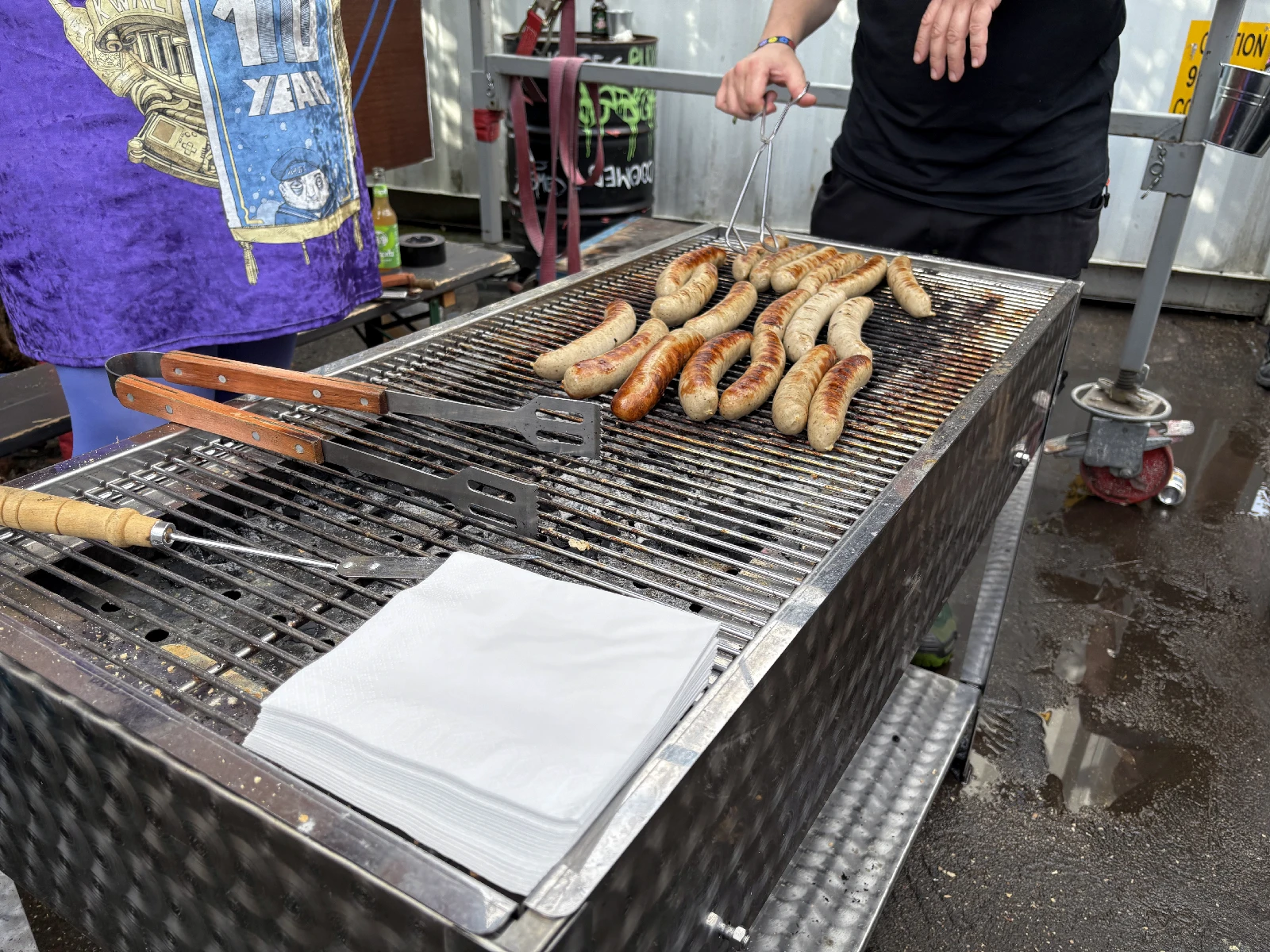
The NARC barbecue soldiering on, gamely, after a hearty
downpour.
Live Coding: The Copper Showdown
I am always, without fail, thoroughly impressed by the Copper Showdown.
Four demo coders sit at four workstations on the second stage, a DJ plays behind them, and a big screen alternates between each contestant's live code and the result it produces. The lounge area in front of the stage fills with people who follow along and, at the end, vote. These folks write code under time pressure, in public, with everyone watching both their thinking and their output in real time.
It is astonishing, and I admire anyone capable of it enormously.
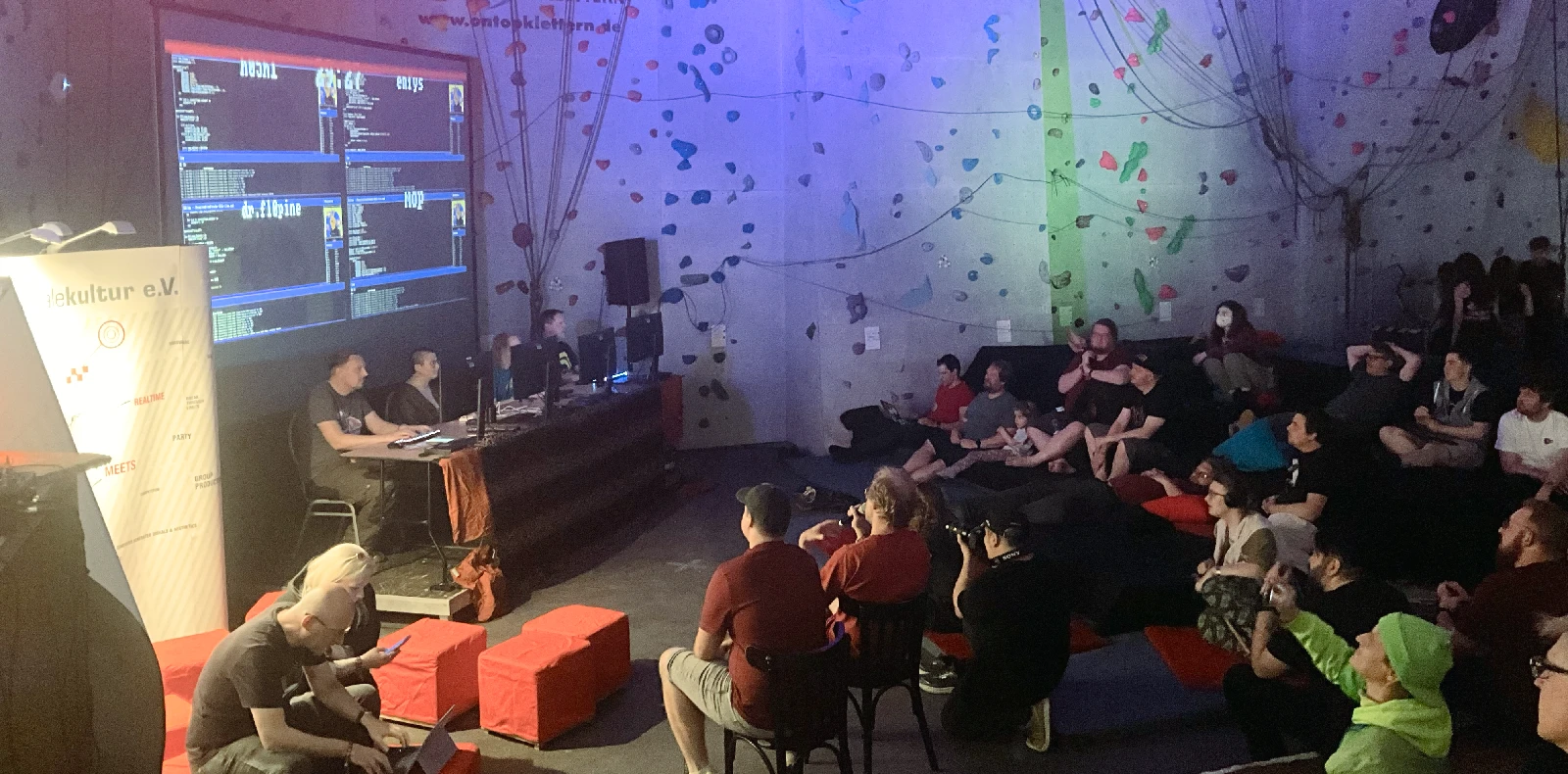
Coding live, on stage, under the clock, with your screen
projected for everyone. Pure courage.
The tool is an editor built by Akronyme Analogiker, an IDE with an integrated Amiga emulator that lets you write so called Copperlists in Lua and watch them run against the emulated chipset in the background. The concept is loosely inspired by Bonzomatic. Copperlists are famously simple to grasp and brutal to master: they have only three instructions, MOVE, WAIT and SKIP, and they operate directly on the path of the CRT beam. You wait for a beam position and then make the Amiga's hardware do something, like change a color. That, in a nutshell, is how copper bars are made.
I won't even pretend that I understand any of this, I'll only try to find a way to work a mention of Banksy's Kissing Coppers into this section, simply because I can. You're welcome 😁
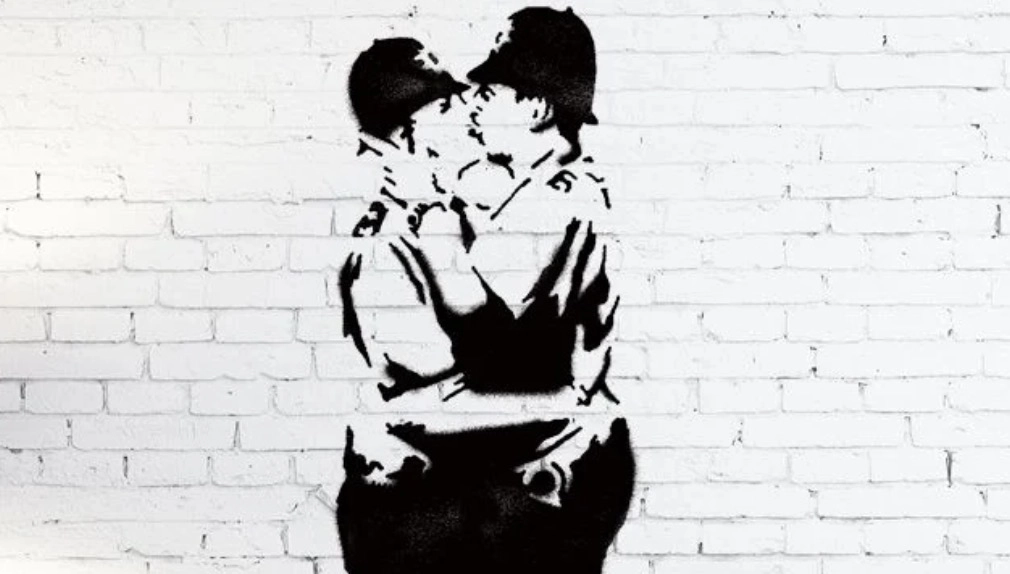
Pictured here, a different kind of copper showdown (Banksy)
This year the semi-finals featured h05h1, Enfys, Flopine and mop2. The finals came down to Flopine and mop2 duking it out, and in the end mop2 took the crown. Watching people conjure motion and color from three tiny instructions, live and unafraid, is one of my favorite things in the entire scene.
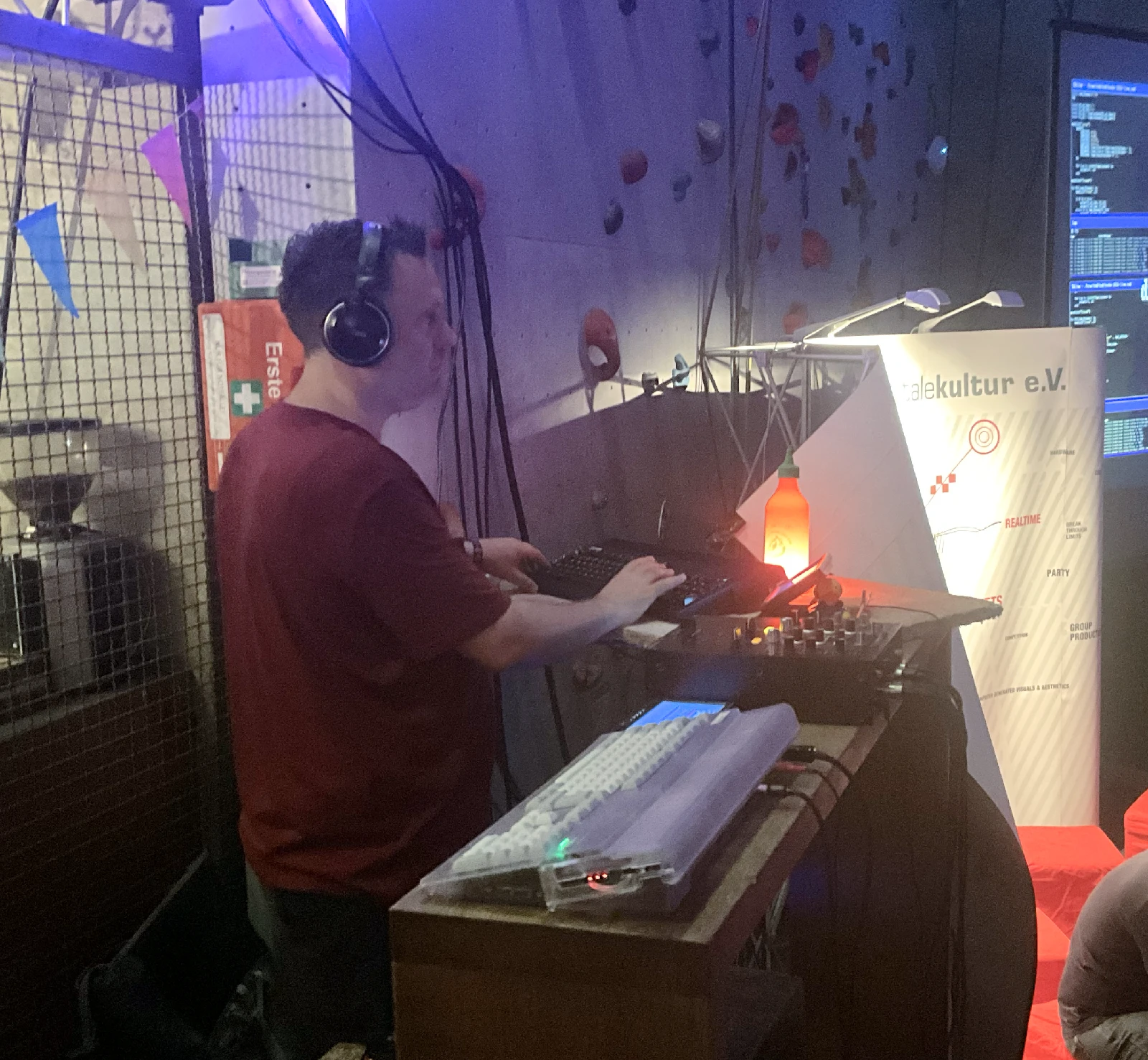
The Copper Showdown even had a DJ driving the beats from a pair
of Amigas.
The Drone Light Show
Last year the organizers treated us to the very first drone show at a demoparty, a hundred illuminated drones drawing shapes over the hall while we all stood in the courtyard with our necks craned. This year they went one incredible step further and turned it into a proper competition, the Drone Light Show, where sceners were allowed to program the flight paths and light patterns themselves.
I managed to chat with Canmom, whom I admire as an ingenious scener, and who was one of the clever, brave few to actually submit a choreography for the drones. She did not end up winning, but in my heart of hearts every single participant in the drone show was a winner. There is honestly no other way to put it. They are simply that smart and that talented. I also absolutely adore Canmom's website at canmom.art. It is exactly the kind of wonderful, independent website I love checking in on, and Canmom's epic article about Revision 2025 is a particular favorite of mine.
We all stood outside in the inner courtyard of the AbenteuerhallenKALK, a wonderfully whacky crowd of beautiful nerds staring up at the night sky, as the colorful lights ascended into the heavens, took their positions, and began to dance the dance of lights. They formed shapes and 3D objects, scrolling texts, animals, and, yes, at one point, a human's derriere. Pardon my French.
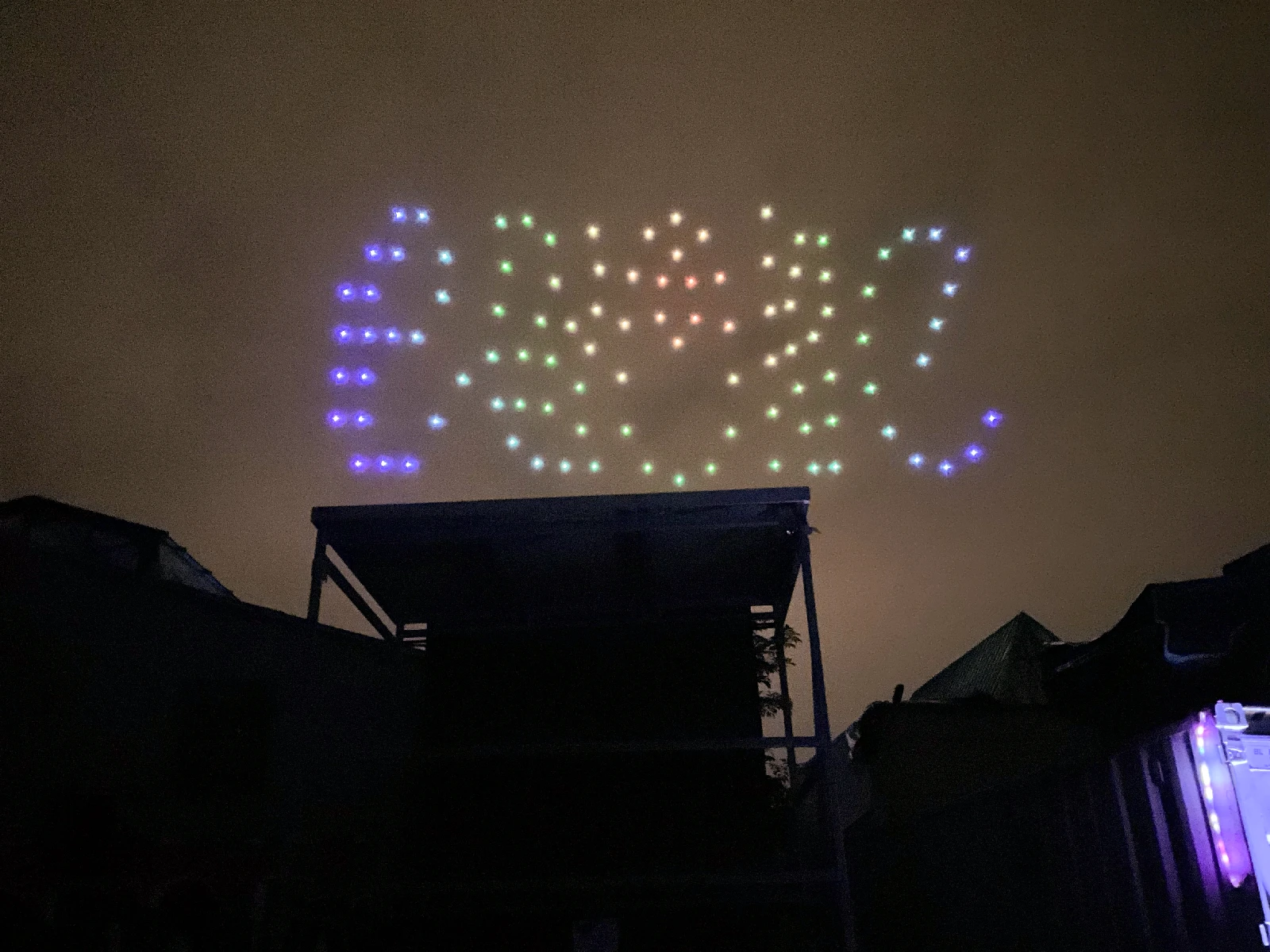
The drone light show over the AbenteuerhallenKALK. I shot this
one myself; once the really good photos from the Evoke
organizers are available, I will add them here.
This video was shot by Canmom, and I am using it with her kind
permission.
Watch on Youtube
A peek behind the curtain of the drone compo. The rules were an interesting example of engineering pragmatism, and I want to share a few, because they capture how much thought goes into something at Evoke.
- Remote submission only: a Blender file plus a rendered 1080p video preview, emailed to the organizers.
- You had to use their template and exactly Blender 4.1.1, and you had 100 drones to play with.
- Hard physical limits: a minimum 2 meter distance between drones, a maximum horizontal speed of 7 m/s, and strict caps on climb, descent and acceleration. Stay inside the geofence.
- Running time between 20 and 90 seconds, with a preselection that favored shorter entries, because the whole show had to fit into a fixed slot of roughly fifteen minutes.
- And a delightfully honest warning: it was possible, though unlikely, that they might lose a drone during the show, exactly as happened the year before.
The organizers also documented their nail-biting quest for the permits, a genuine bureaucratic waterfall involving the neighbours, the German Airspace Authority, the Office for Public Order, and the city. The status log ended, on the 14th of August, with three of the most joyful words a compo organizer can write: "We are go."
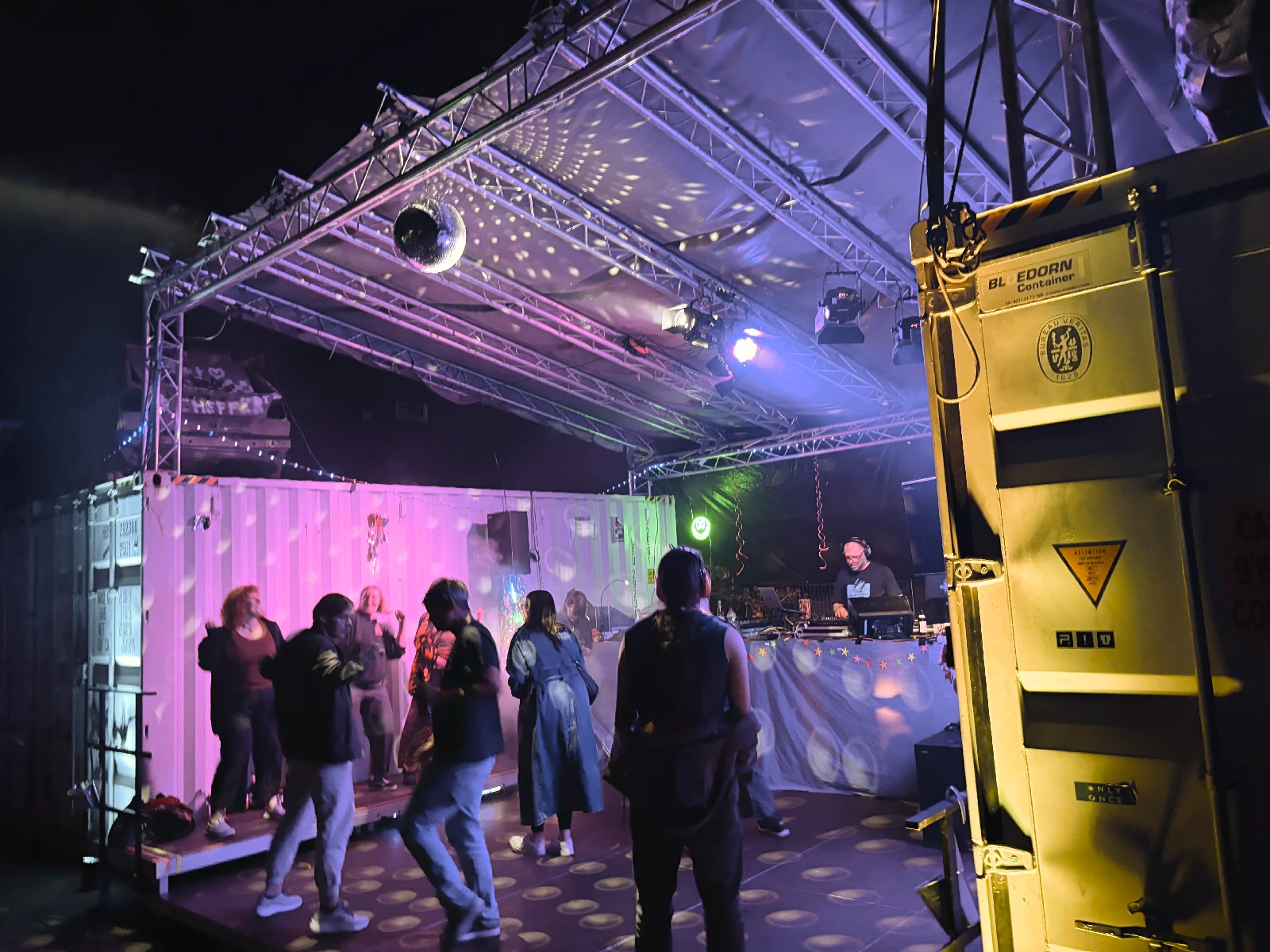
The open-air dancefloor in the courtyard, where a good part of
the night happened.
Two Groups, Two Demos, One Proud Phoenix
Now to the part where I actually did some work, credited under my scene handle Bala-Koala. This year I was lucky enough to be part of two different demogroups, alongside Pararaum, and we submitted two demos. Normally Evoke lets you submit only one entry per competition, but both of ours landed in the same compo, the Alternative Platforms competition because there is no dedicated old school demo competition.
We got away with it because they were made by two different team configurations: a Commodore Amiga demo as The 7th Division, and a Commodore 64 demo as VCC, short for Vintage Computing Carinthia. Rules lawyering, demoscene style.
We might have delivered even more, if I am honest. I have been slowly chipping away at a PC demo ever since the Goulash Programming Nights back in 2025, and I simply had not finished it in time. I am determined to see it through, and I hope to finally submit it at another demoparty.
Night of the Living Fungus, on the Amiga
Our Amiga demo is a horror comic called Night of the Living Fungus, and what you see in this article is only part one. There is a good deal more to the story, but we ran out of both disk space and time, so we made the deliberate choice to release only this first part and to end it, shamelessly, on a cliffhanger. We had talked about it on and off for a while, and Pararaum had even painted two pictures of the fungus-ridden landscapes, but we only started working on it in earnest at the end of July.
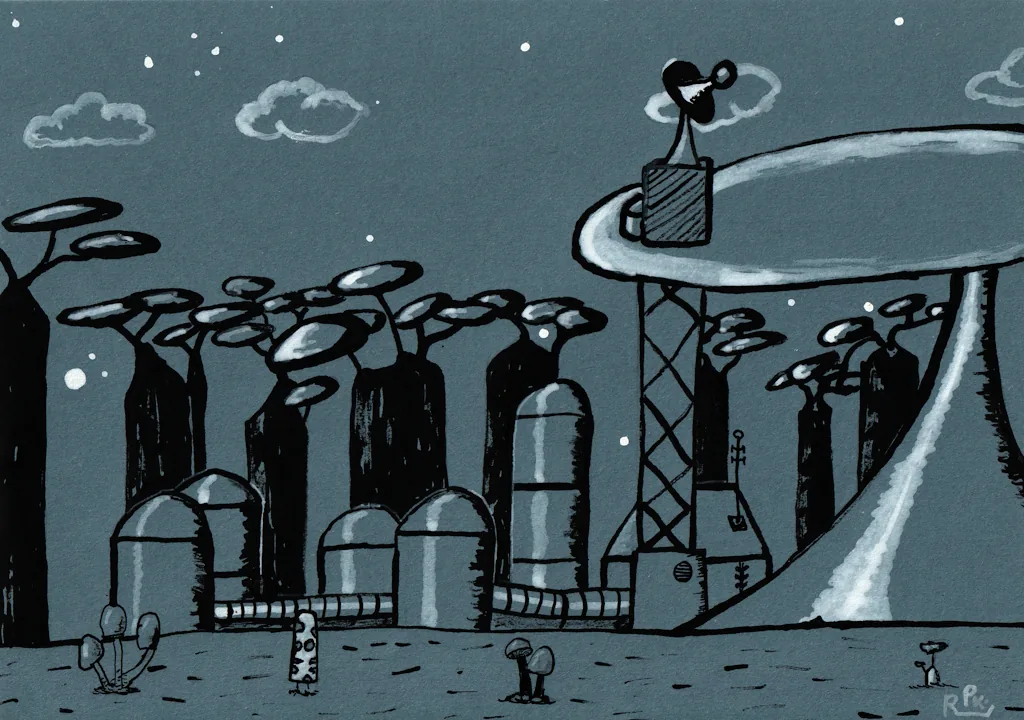
One of Pararaum's two original paintings of the fungus
world: a processing station overrun by towering fungus. I
used it as the basis for the planet-surface panels in the
demo.
Let me start with our technical decision I am most proud of, because it is unusual. The whole demo runs in the Amiga'sf 640 by 256 mode with 16 colors, which is not a graphics mode you see much in the Amiga demoscene. Its pixels are not square. They are twice as tall as they are wide. We chose it on purpose. It was designed as the flicker-free productivity mode for displaying 80 columns of text, which made it perfect for a comic that needed room for speech bubbles and captions without the lettering eating large parts of the screen.
The sixteen colors were exactly right too, because we gave each screen a single color ramp of fourteen tones drawn from one overall color group: a red screen, a teal screen, a green screen, a blue screen, a purple screen, and so on. One mood, one palette, one panel at a time, all rendered in a cross-hatched comic style that tips its hat to the late 1980s and early 1990s.
One practical footnote: the 640 by 256 screens reproduced in this article have been resized to match that mode's correct aspect ratio, so they look the way they do on a real Amiga rather than squashed.
Pararaum did the coding, and he does it properly: an elaborate build chain on GitLab, VSCode, everything written in C, and full-blooded use of the Amiga's hardware. He opened the demo with a title screen that bills the whole thing as "An Amigastravaganza in 640 x 256", added a greetings screen halfway through where the greetings scroll upward while a distorted parallax waterfall cascades downward behind them, and closed with a credits scroller. Logiker of VCC contributed a sprite that we tacked on at the very end, happily flying back and forth. The music was written by MaZe. We loved it, but he was less taken with it himself and did not want to be credited, though he kindly agreed we could use it. Then, through a small mix-up with some commits, we ended up crediting him anyway, entirely by accident. He took it in good humor.
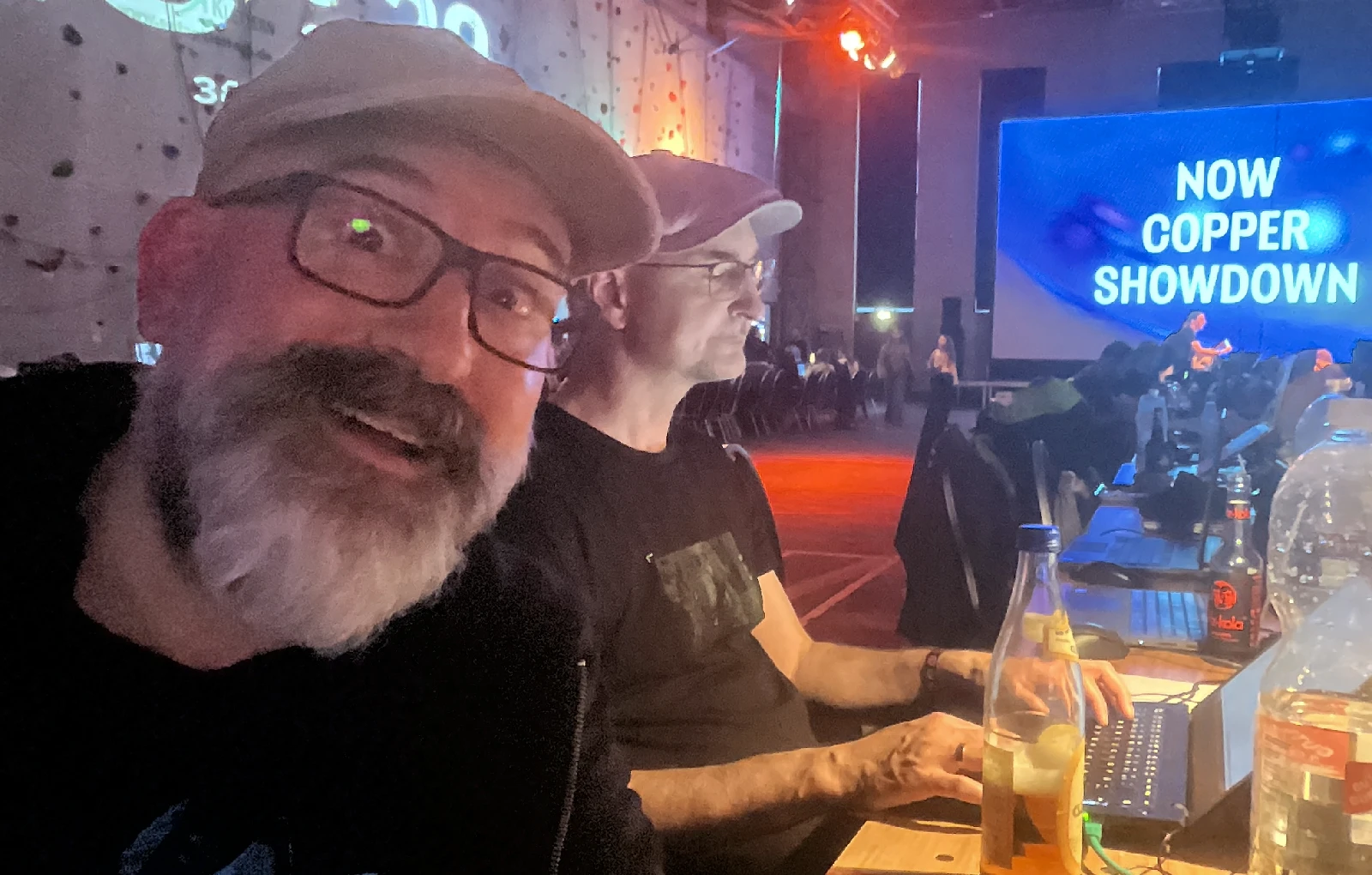
Pararaum hard at work saving the demo. I am, as you can see,
doing nothing useful and only making silly faces. (Pararaum blurred at his own request.)
My own contribution was the art, and this is where I get to gush about my absurd little pipeline, which happened entirely on an iPad. I drew the panels in Procreate, colored them in Pixelmator Pro, and converted them using ImageMagick in the iSH command-line shell, all on the tablet.
The real joy, though, was a newly released Amiga emulator for the iPad called Amigo, which let me run the real Deluxe Paint V on an emulated Amiga 1200 with an emulated Motorola 68040, so I could refine and convert the graphics in the very program they were destined for. Drawing Amiga art in real DPaint, on an iPad, on a train. What a time to be alive.
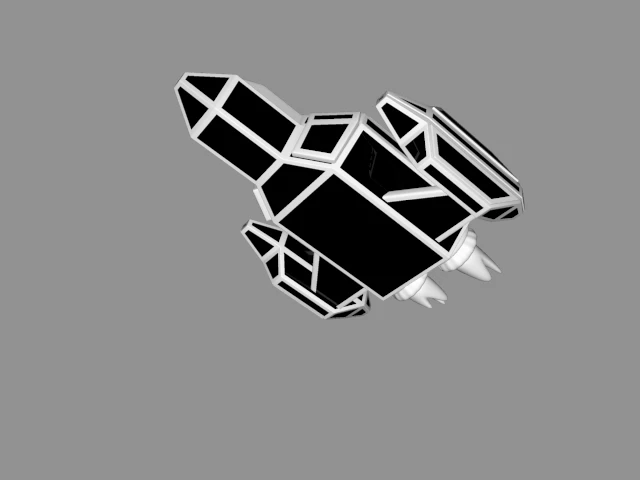
One small introspection about how the ship was drawn. Rather than redrawing the spacecraft freehand from every angle, I found a simple 3D model of a spaceship and rendered it in Cheetah 3D on the Mac in whatever position each panel needed, then used those renders as a reference to draw over. It kept the ship consistent as it banked, dived and landed across the story. If you are curious, you can take a look at the bare 3D model.
There was, of course, a catch. We had tested the demo strictly in Amiga emulators and never once on real hardware. Big mistake!!! After we submitted it, the compo organizer kindly informed us that our masterpiece was glitching on the actual Amiga they were using as the compo machine.
Pararaum went to work under real pressure and fixed most of the problems. A few glitches stubbornly remained, but they looked so intentional, so much like a deliberate artistic choice, that we simply left them in and told no one. You did not read that here.
Here, then, is part one of Night of the Living Fungus, panel by panel.
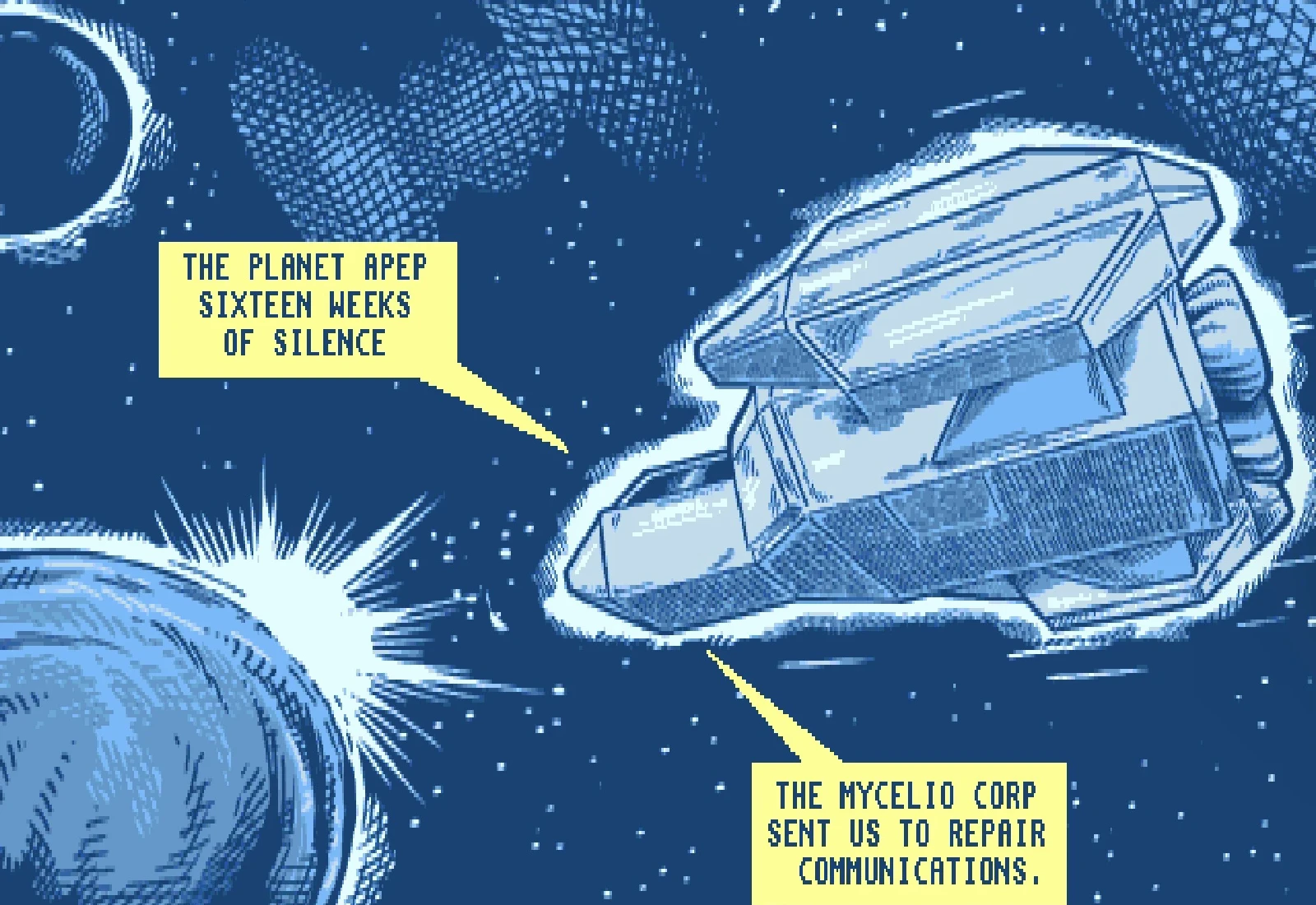
Screen 1: The establishing shot, and the first outing for
the blue ramp: fourteen tones of one color doing sky, hull,
engine flare and planet all at once. The ship is drawn after
a reference of my Cheetah 3D render.
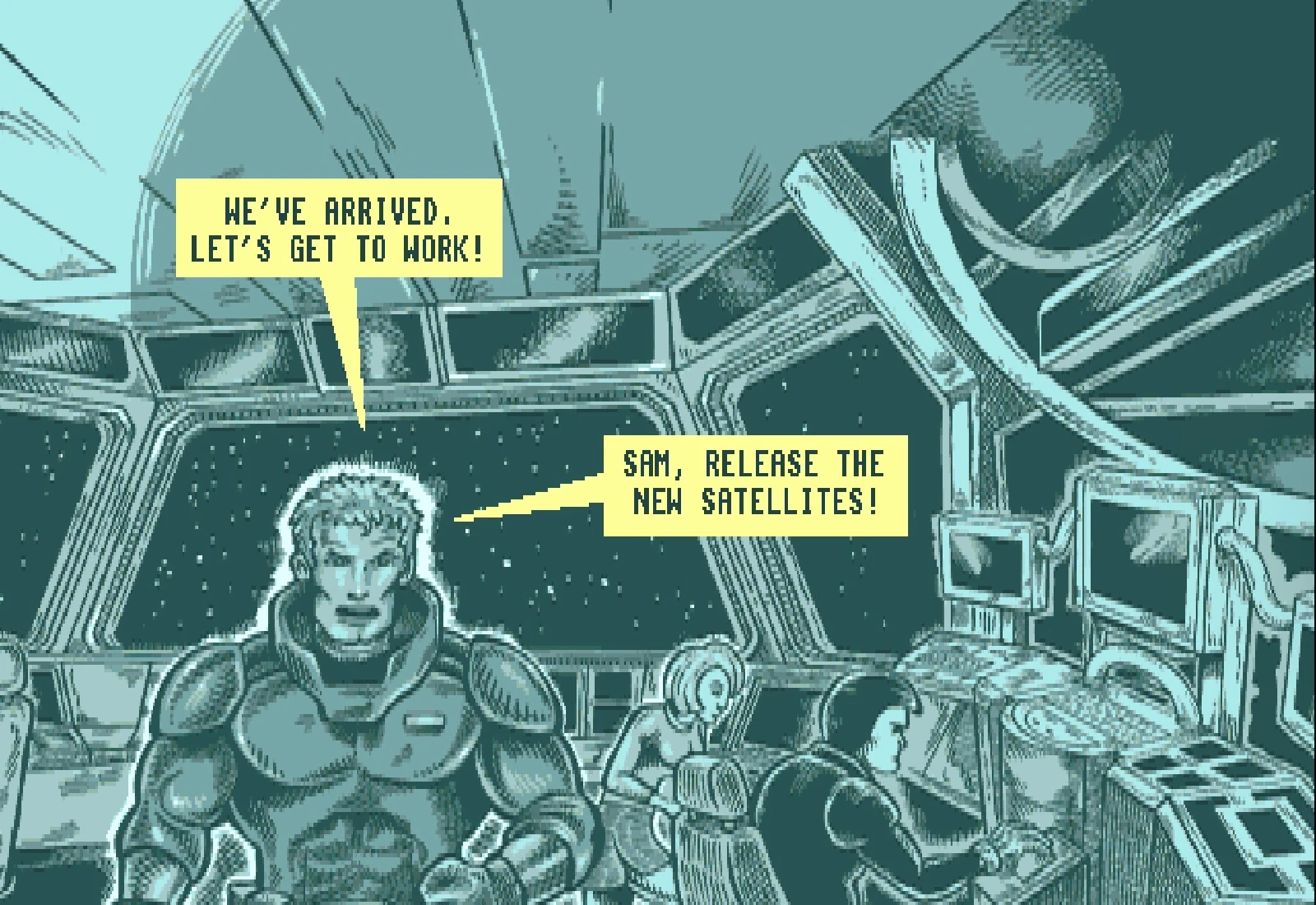
Screen 2: The bridge, in teal. Most of the work here went
into the curve of the canopy, because a bad perspective is
the fastest way to make an interior feel like cardboard.
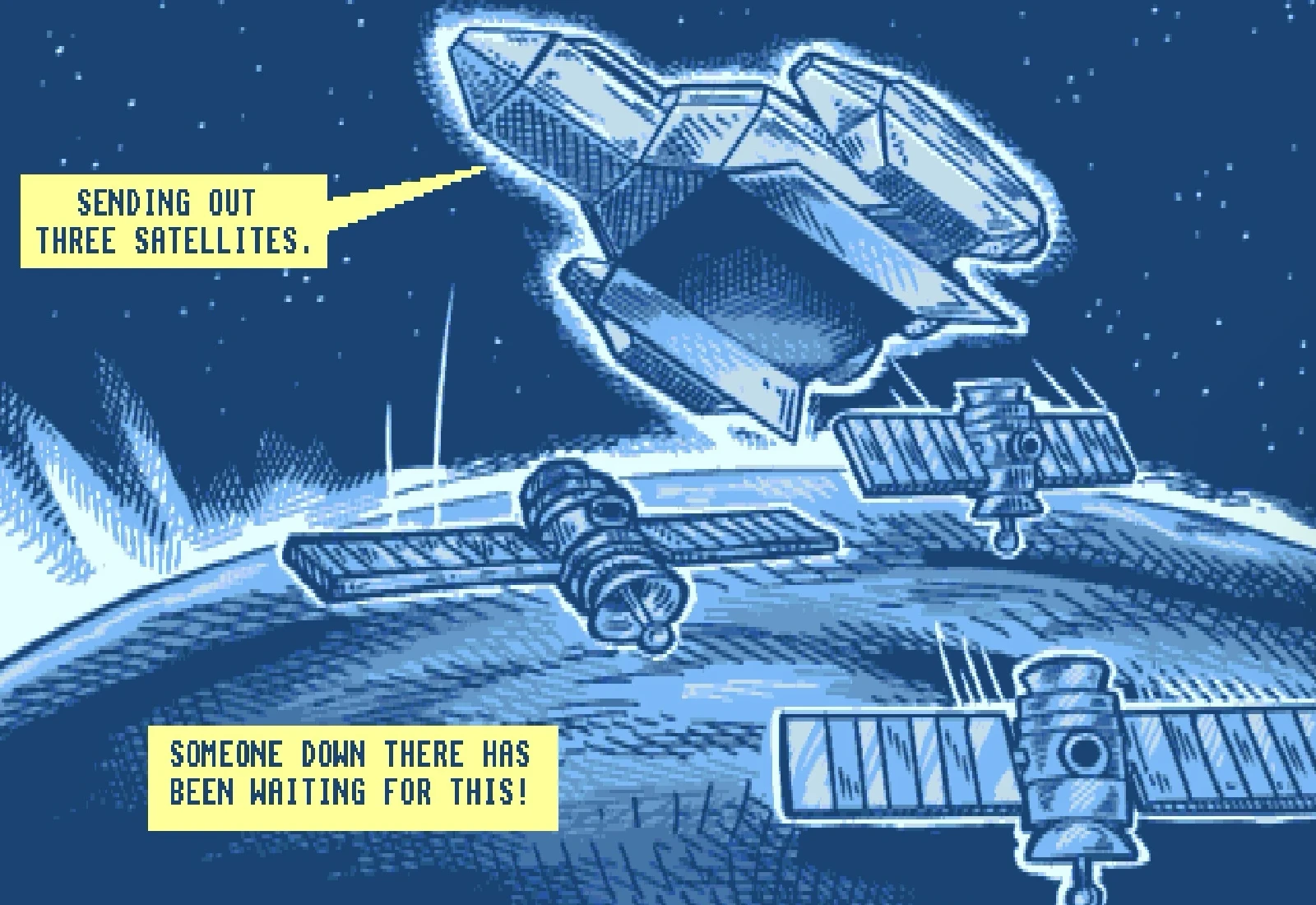
Screen 3: Back to blue for orbit. The satellites were a
good exercise in setting hard, geometric shapes against the
soft hatched terrain below them.
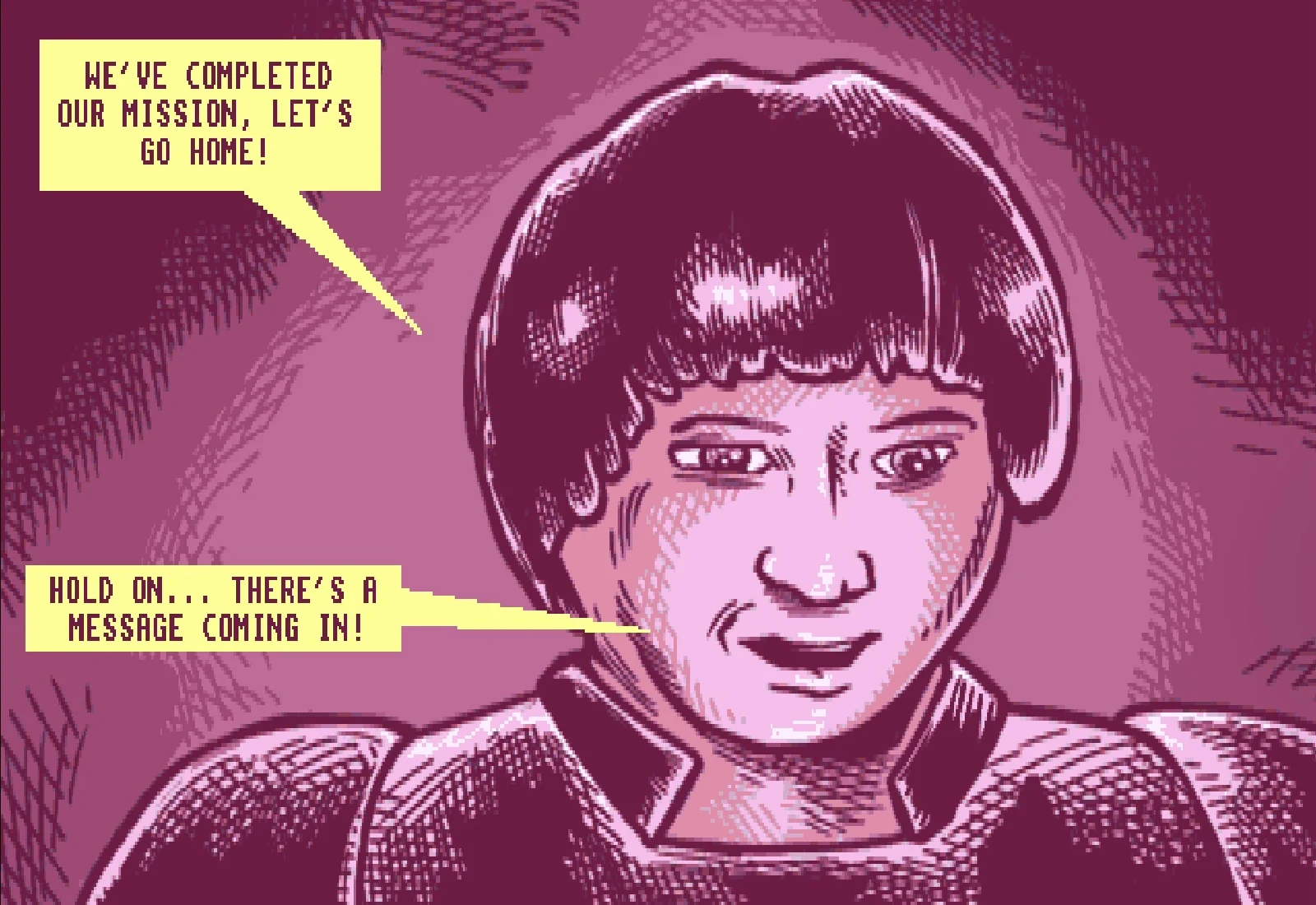
Screen 4: A face filling the frame. Non-square pixels
flatter a close-up like this one: the hatching on the cheek
stays readable because of the high resolution.
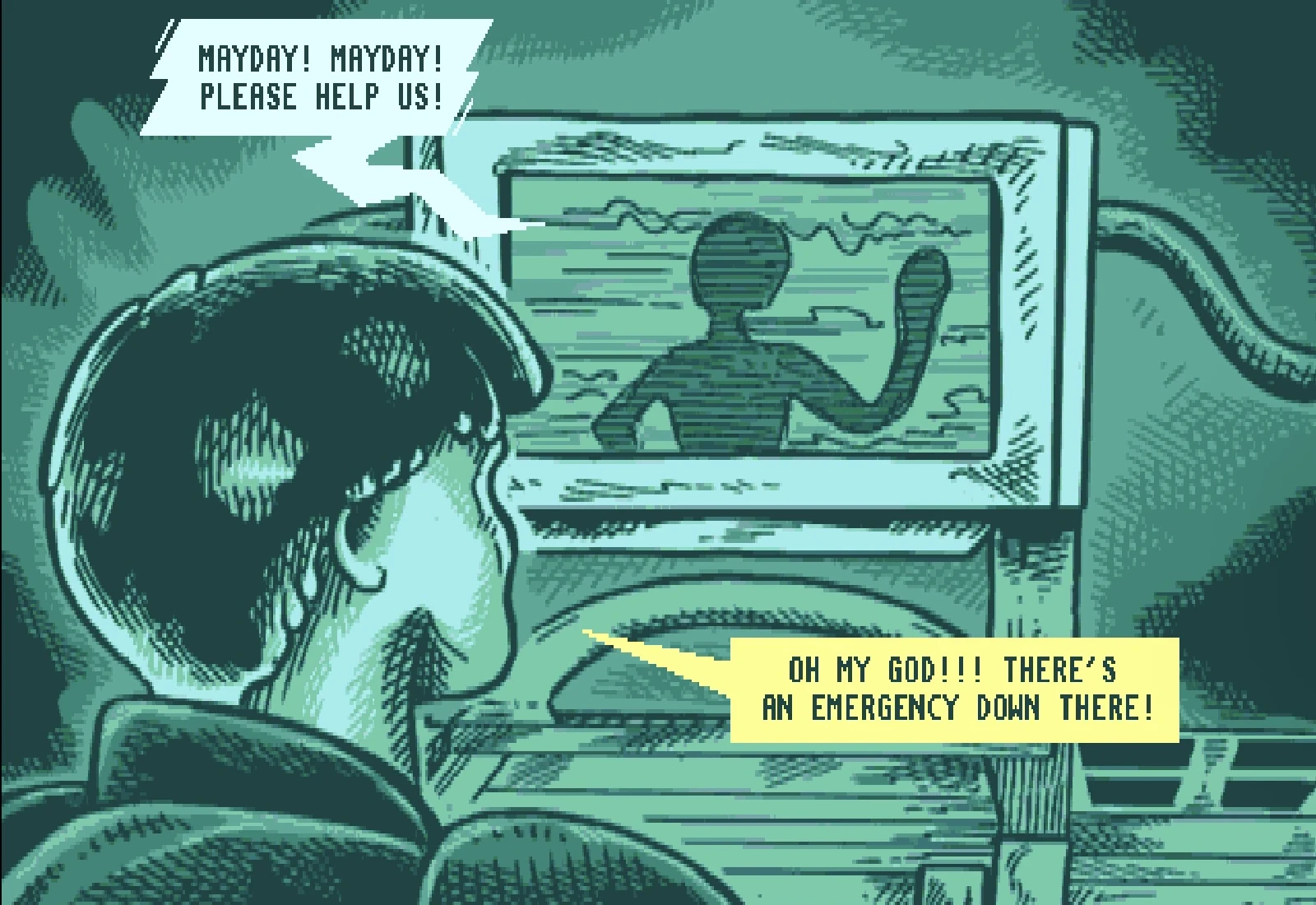
Screen 5: An over-the-shoulder shot. Whatever is on that
monitor is nothing but scan lines and a silhouette, and the
jagged white balloon marks it as a transmission rather than
a voice in the room.
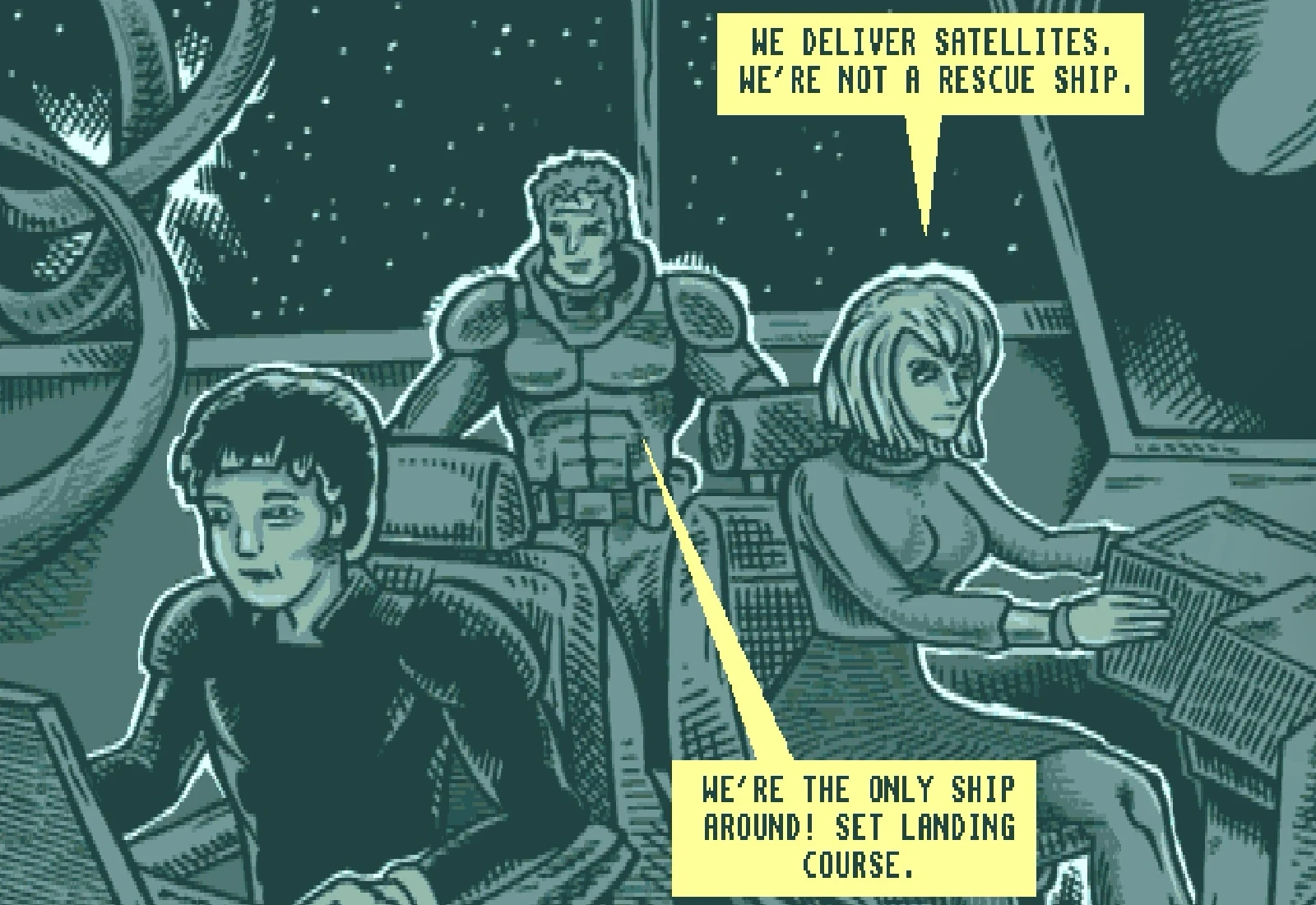
Screen 6: One of the panels where all three of our heroes
share the frame. Blocking a conversation in a wide shot is
far harder than in a close-up.

Screen 7: Re-entry with speed lines. The hatching went a
bit far in this image.
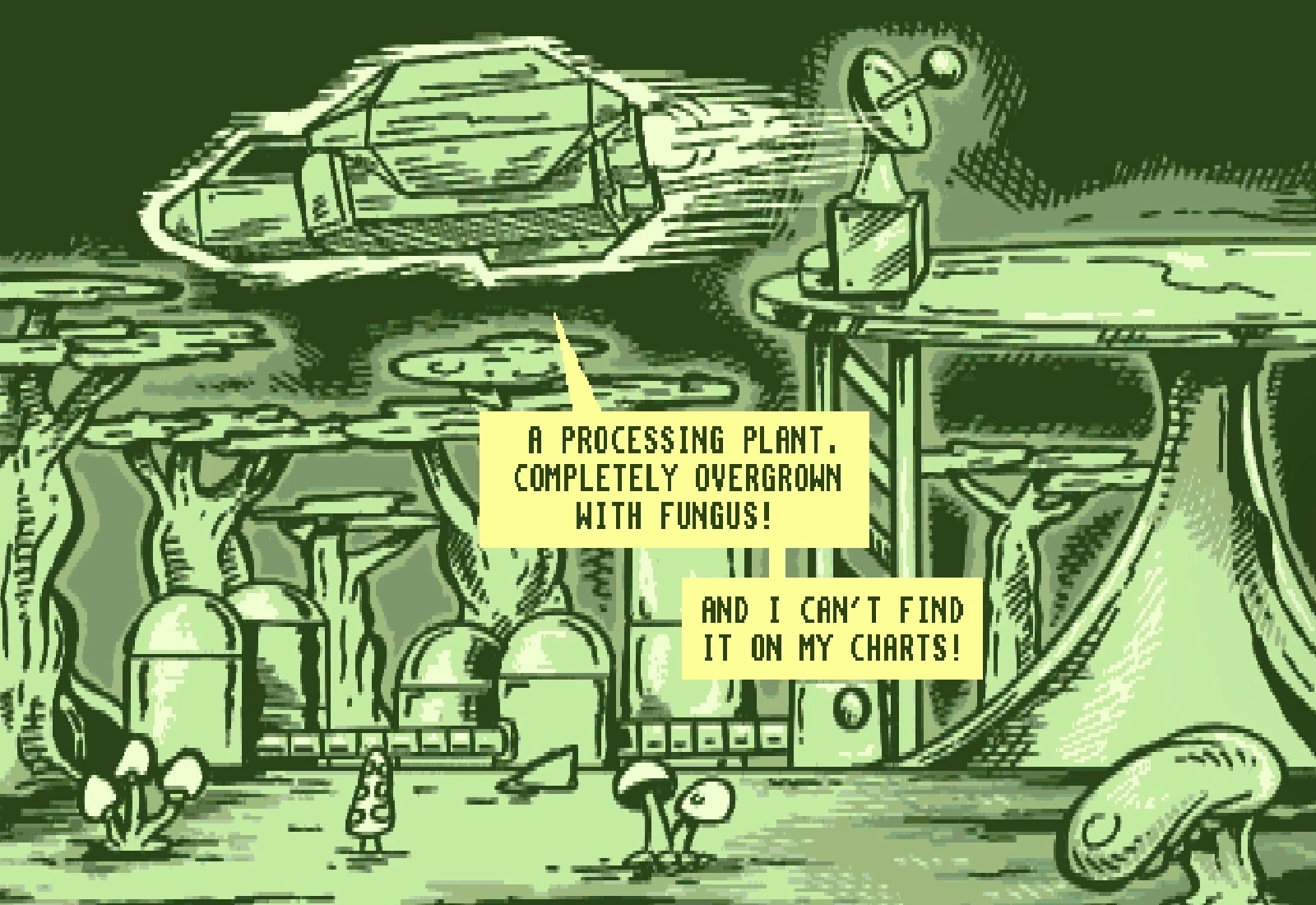
Screen 8: This panel I drew after a painting that Pararaum
made in spring this year. The mushrooms in the foreground
are there purely for scale, so the industrial plant behind
them looks enormous and long abandoned.

Screen 9: Purple for fury. This is the panel where the
cross-hatching is extreme... as in
Rob Liefeld's Extreme studios.
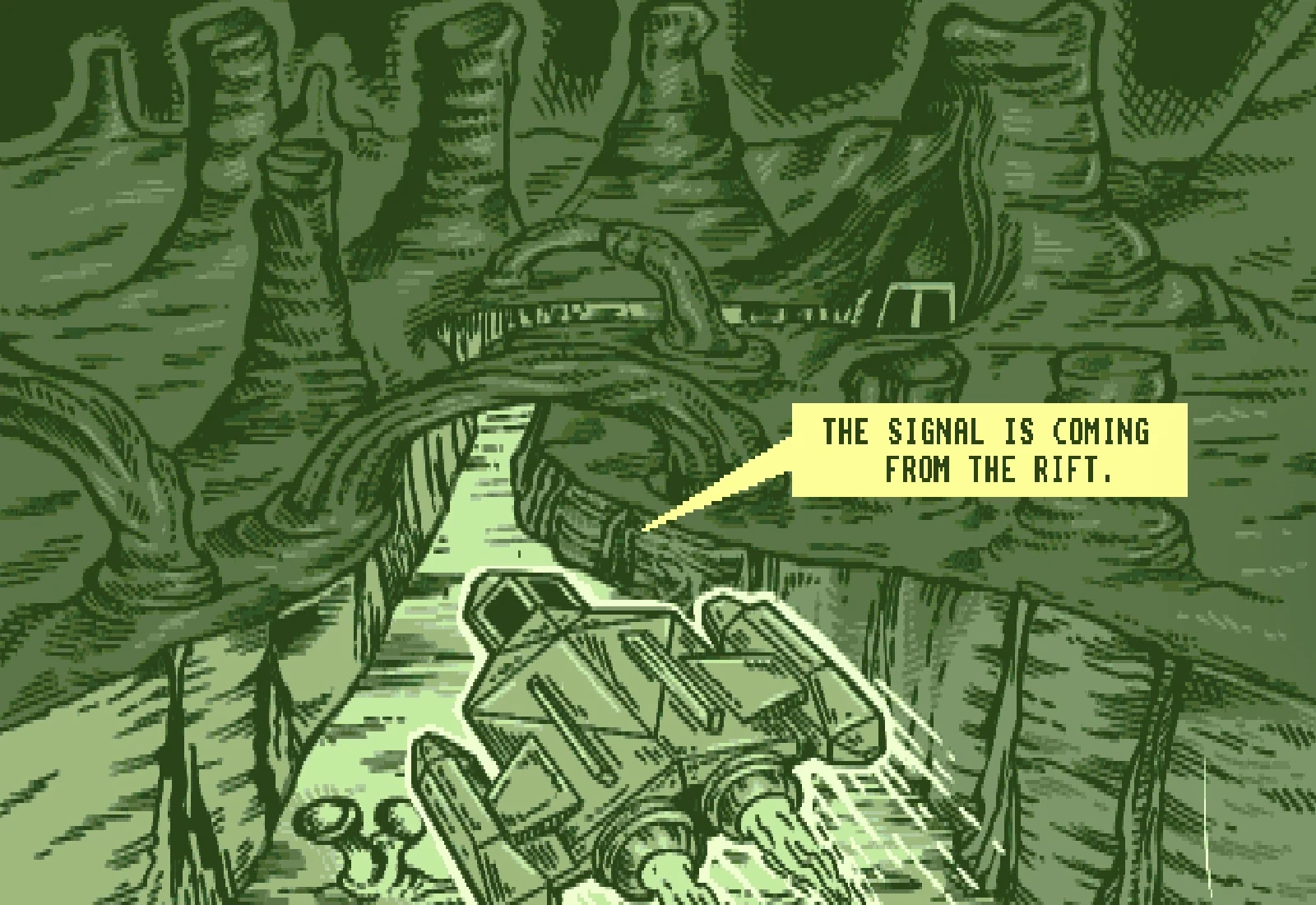
Screen 10: One-point perspective straight down the rift.
This image is also based on one of Pararaum's paintings.
Giving the main rift a lighter color tears a gash across the
screen for the eye to follow.
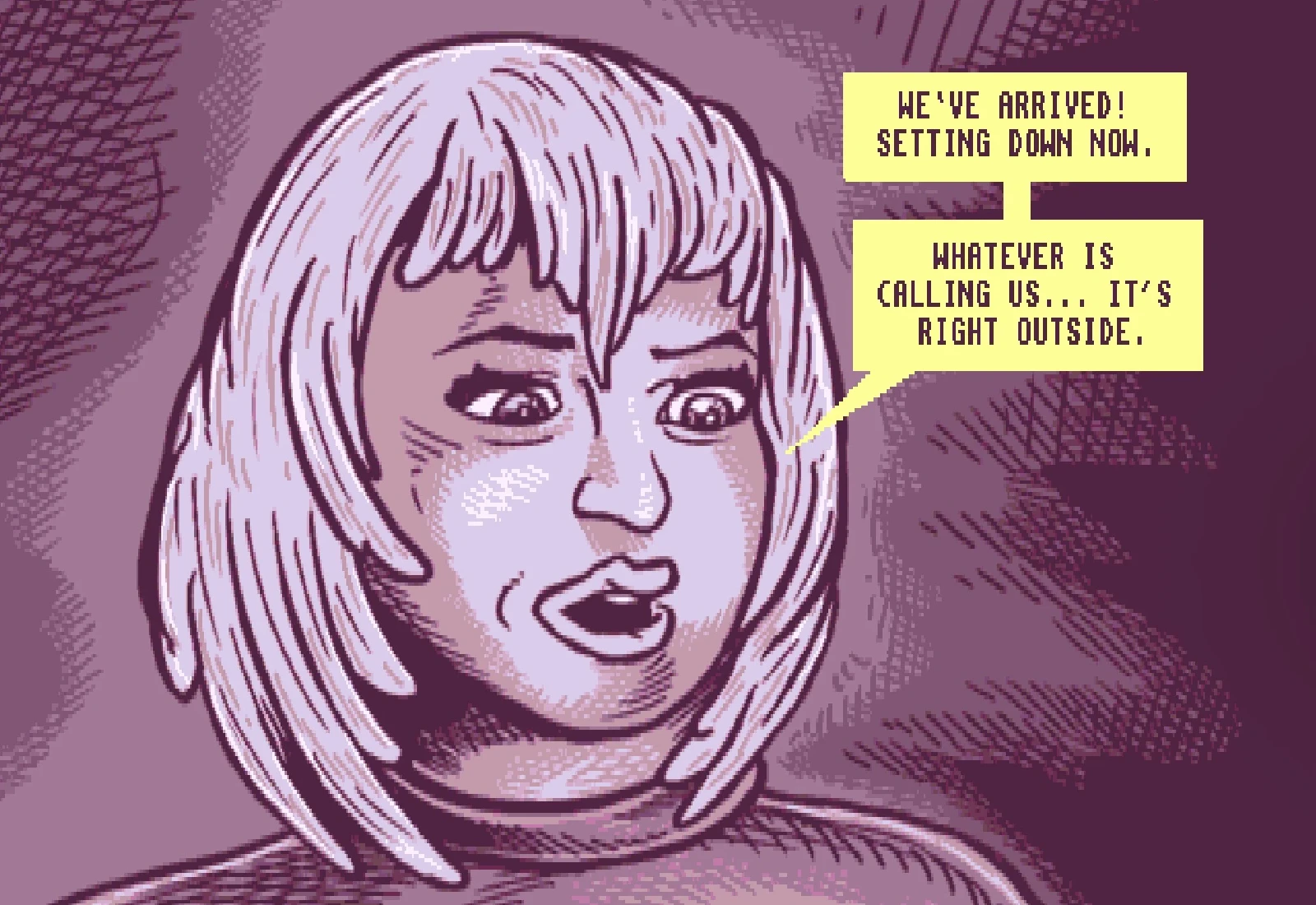
Screen 11: Lilac, and the softest linework in the comic. I
wanted her wide-eyed here, since she is the one with her
hands on the controls.
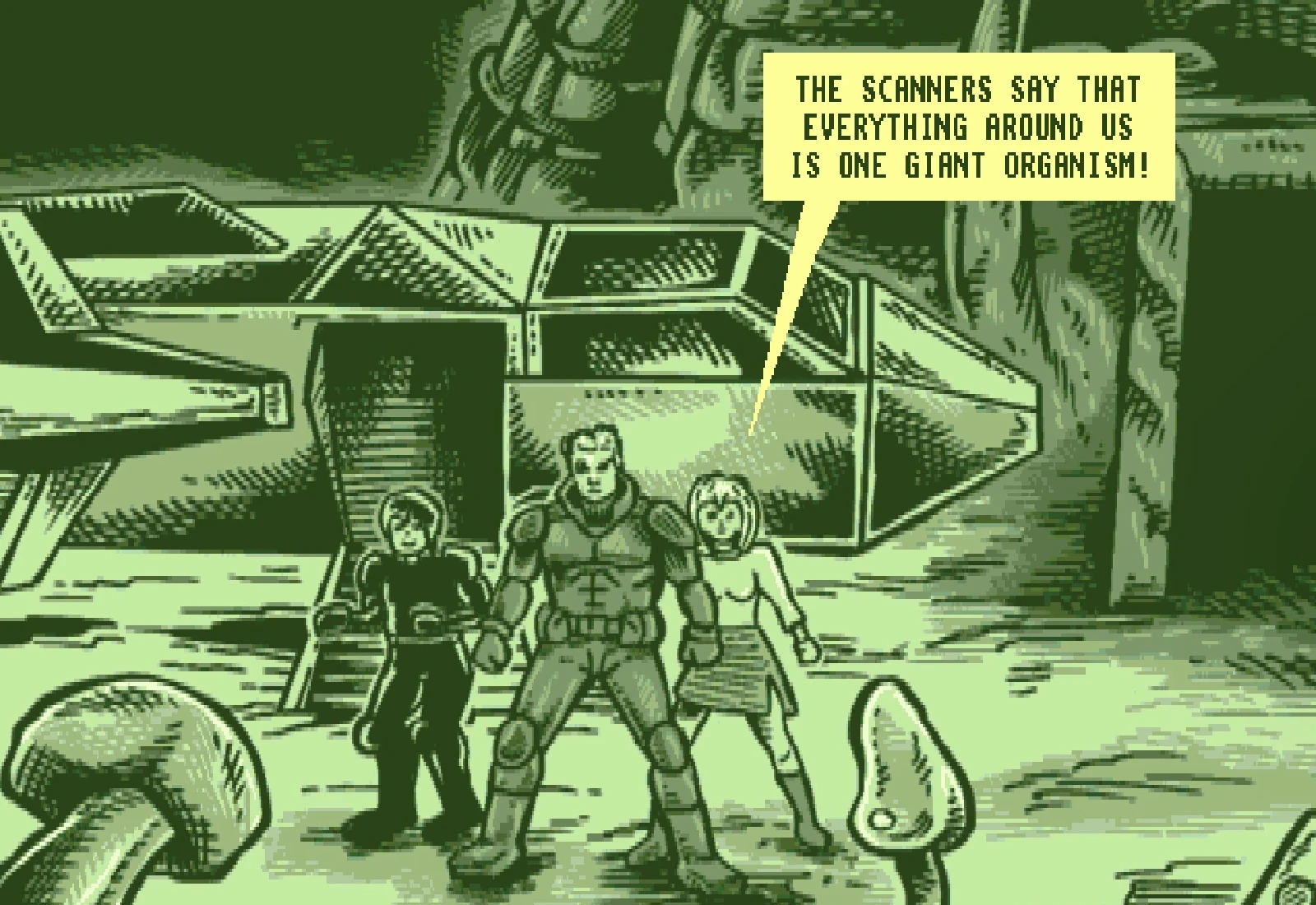
Screen 12: The crew, small in front of their own ship.
After so many panels of cockpit it felt right to let them
step outside into the landscape.
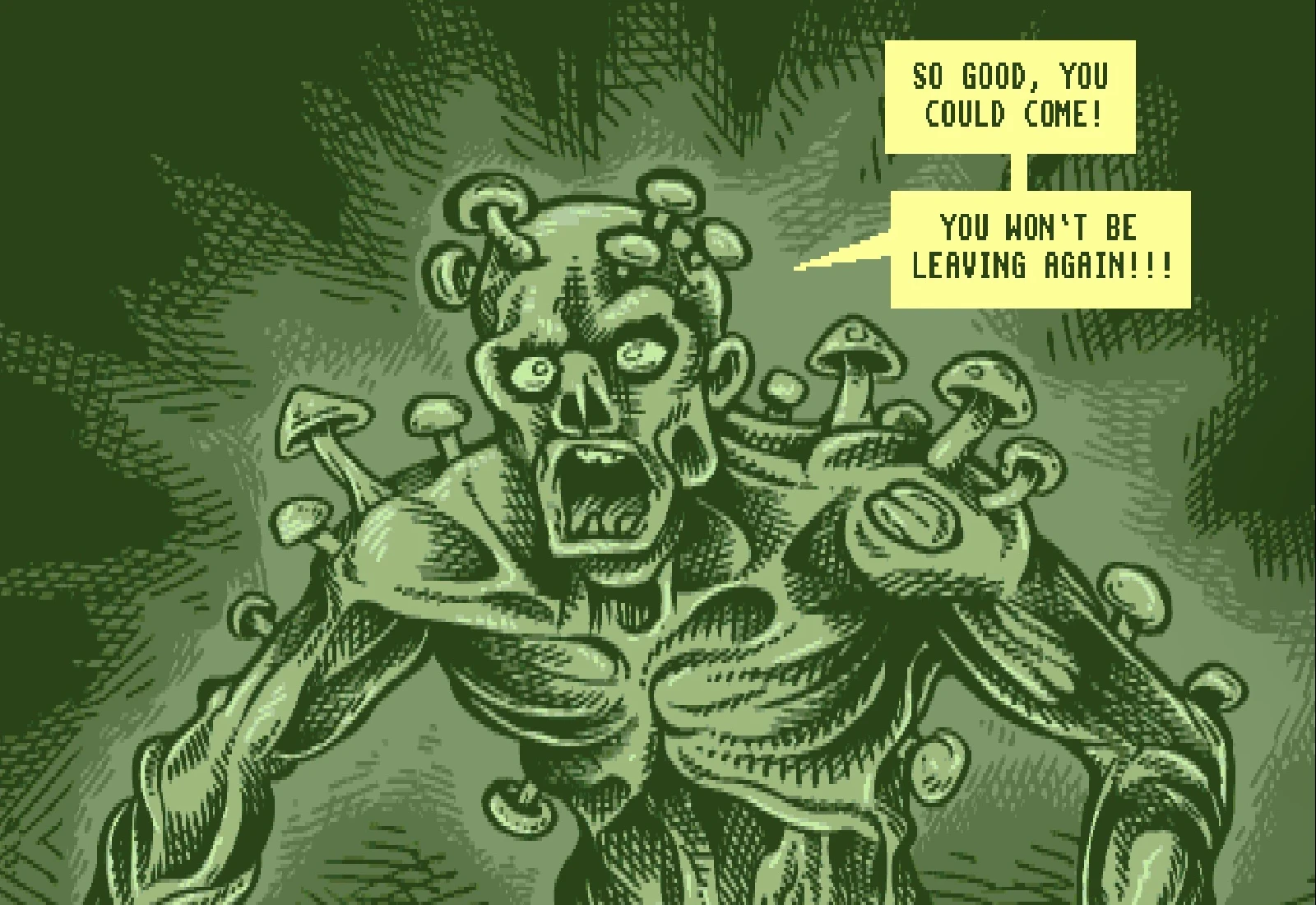
Screen 13: The reveal. The zombie with mushrooms growing
out of the body.
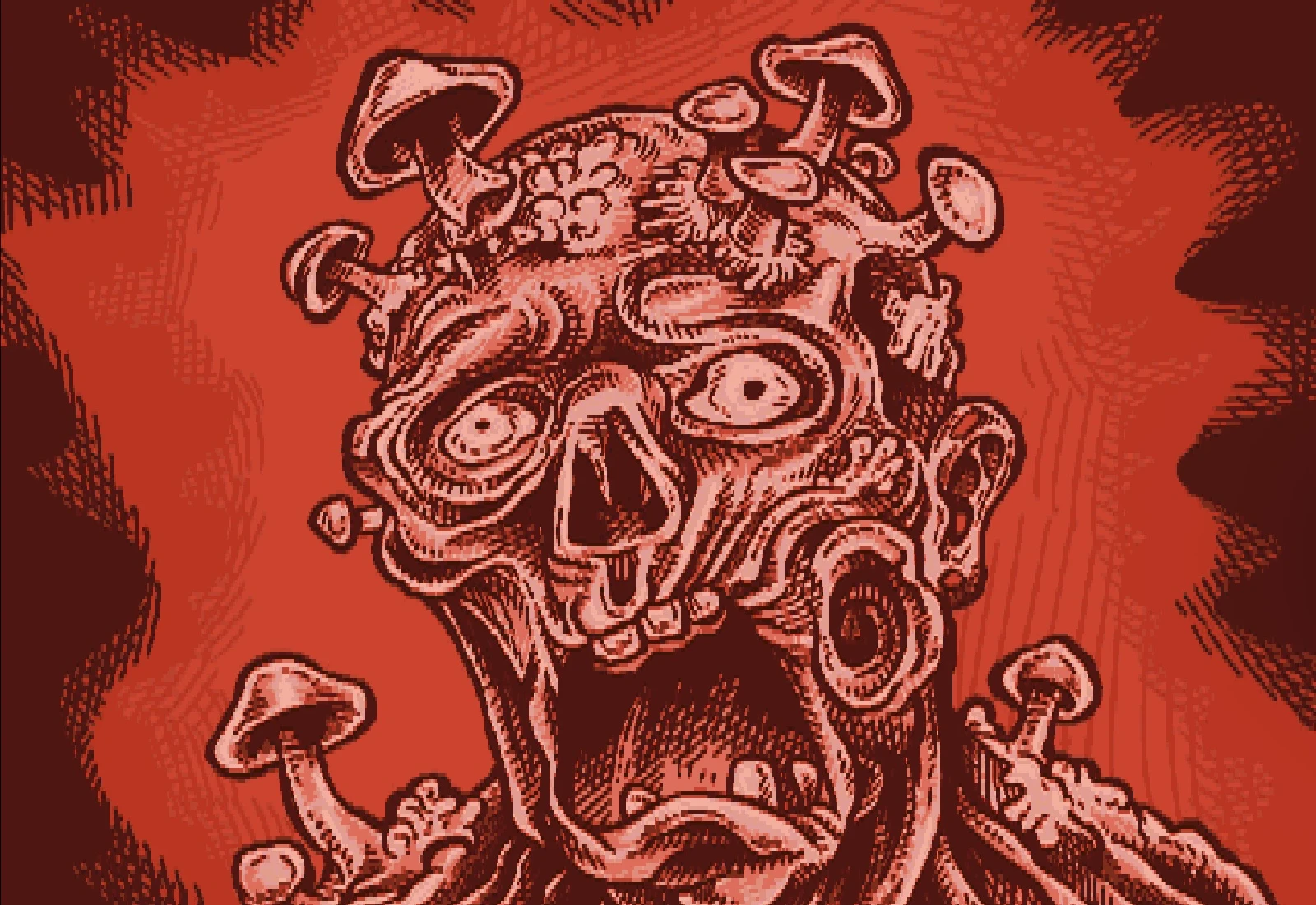
Screen 14: Red, saved for the very last shock screen and
used only once. Then the cliffhanger, the credits scroller,
and you have to wait a year for part two.
When it went up on the big screen, the higher resolution really paid off, and the panels looked crisp and dramatic. We finished fifth out of twelve in the Alternative Platforms competition, which genuinely surprised and delighted us. The competition was stiff: there was a Haujobb entry on a Sega Saturn, something on an Apple TV, and productions on the fantasy consoles TIC-80 and PICO-8.
The deserving winner, which I will happily gush about further down, was a little TIC-80 demo about a runaway drone.
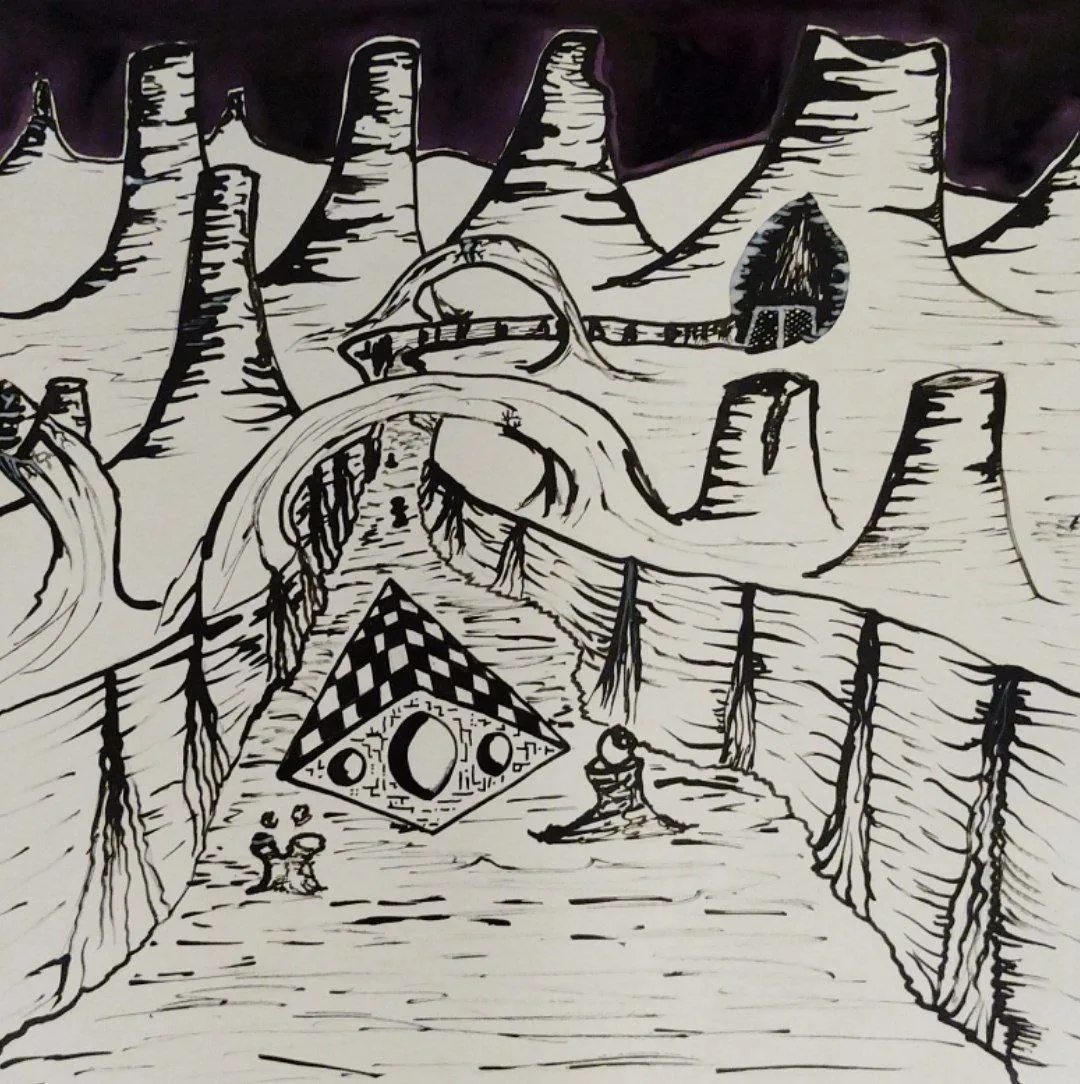
The other of Pararaum's originals: a flight through a chasm
between the great rock spires. I
redrew it too for the demo's planetary surface.
Animated Squiral, on the Commodore 64
Our other entry was a C64 demo called Animated Squiral, released as VCC.
Let me be completely honest: it was based on an idea by Pararaum and Logiker, I joined the project quite late, and for most of the time I worked on it I had absolutely no idea what was going on. I was, in effect, an art robot, dutifully drawing whatever I was asked to draw while the actual concept stayed a mystery to me until nearly the end. We worked on it on and off between May and June, with Pararaum shouldering the brunt of the work.
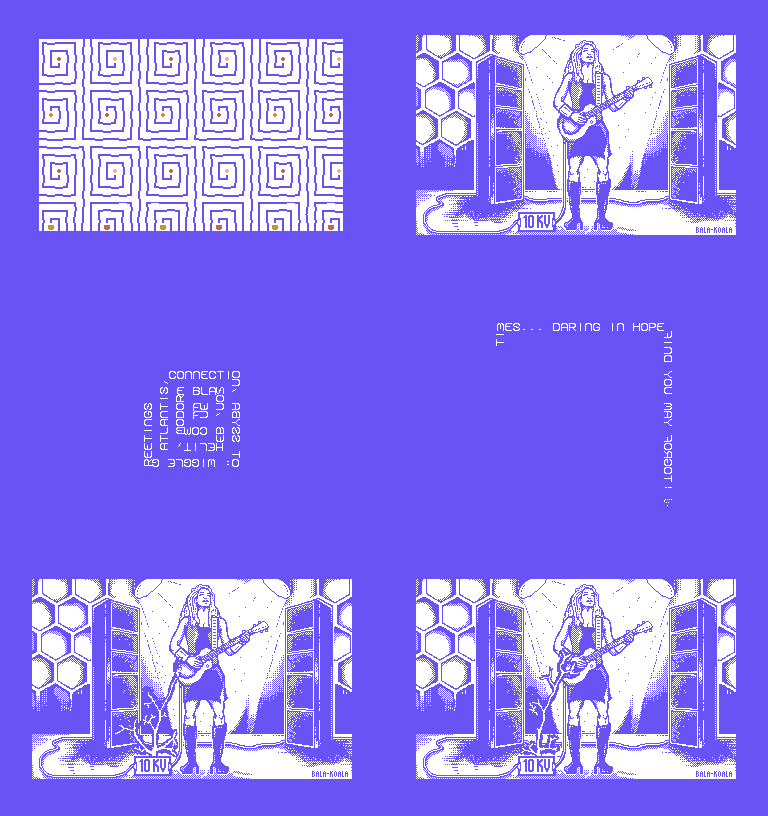
An animated glimpse of Animated Squiral, cycling through
the squirals, the singer, the greetings and the credits.
Here is how it unfolded from my baffled point of view. I knew it was a C64 demo, and because I had once helped Pararaum with the C64's two-color high-resolution mode, we agreed I would draw two images in that 320 by 200 hi-res mode. Pleasingly, hi-res on the C64 uses square pixels and the only real constraint is two colors per area, so I did not even need Multipaint to get going. The brief was a rock-and-roll lady singer on stage with a guitar. My first attempt was, I admit, inspired by the scene in Forrest Gump where Forrest watches Jenny perform on stage with a guitar, except mine was dressed, and there was a touch of Joan Baez in there too, even if she ended up looking like neither. To save myself some labor on the stage, the speakers and the lights, I only drew the left half and mirrored it for the right.
Pararaum felt my first singer was too tame and asked for something more rock and roll, maybe some leather. So I gave her leather and refined the stage. I still had no idea where any of this was heading. The only clue, and it was a deeply suspicious one, was that they asked me to place a "10 KV" electrical box on the stage right next to her. I filed this away nervously.
I also spent an embarrassing amount of time convinced that the word "squiral" was simply a misspelling of "squirrel", which is, famously, a word that gives many German speakers trouble in English.
I was wrong.
The "squiral" is the opening screen: a whole field of them, each one a cross between a square and a spiral, winding tightly inward. I had taken them for sprites. They are not. As Pararaum explained it to me, the squirals are built entirely in PETSCII, the Commodore 64's own character graphics. The thing that makes this a challenge rather than a party trick, is that animating them means moving both the screen and the color memory at the same time, within a single frame. On a C64 there is normally not enough time in one frame to shift both.
Pararaum found a way to bend time anyway, and absolutely stuck the landing.
And then the penny slowly dropped. I was getting the drift in quite a macabre way about the plot of the demo. The plan was: the squirals dance on the screen, then the lady singing on her stage, then Pararaum wanted her transformed into a skeleton. Still playing the obedient art robot, I redrew her in the identical pose but with a bald skull for a head and skeletal arms and legs. I had a hunch it might have something to do with that ominous 10 KV box, but I could not be sure. Then I saw the next build: the singer stands there unharmed, then abruptly switches to her skeletal form, as if she had been smoldered on the spot. In the next iteration, Pararaum had electric lightning crawling up out of the box toward her, flipped the colors a few times to sell the electrocution, and left her standing as a smoking-skulled skeleton, still fully dressed. She had been fried mid-solo.
It is gloriously silly and I love it.
There were more effects layered in besides: a text-mode squiral snaking outward from the center of the screen, and a big yellow head bouncing around with spiraling eyes. By this point I had cheerfully given up all hope of understanding the thing. The credits screen shows a silhouette inspired by Uma Thurman's character from Kill Bill, brandishing a katana forged by Hattori Hanzō.
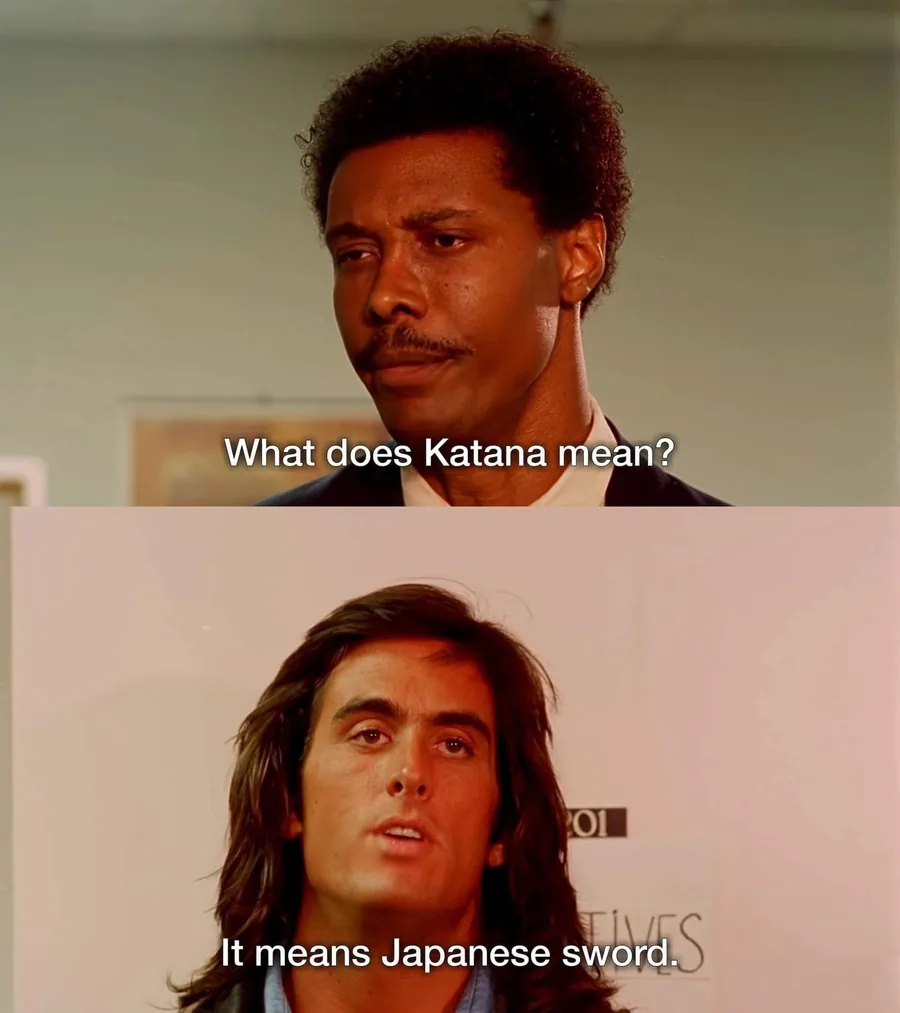
And should anyone doubt the terminology, the cinematic
titan Samurai Cop readily confims it:
katana, we are reliably informed, means Japanese
sword.
The music was a wonderfully rocking soundtrack by Nordischsound, and I have to say it: Nordischsound never ceases to amaze me. His talent, the exceptionally high quality of his music, and how utterly frictionless and effortless his work appears to be. His track is the thing that lifts our visuals up and turns the whole assembly into a real demo.
The full credits, for the record, were code by Pararaum, Wil and Logiker, graphics by Bala-Koala, which is me, and Logiker, and music by Nordischsound. You can find the release on CSDb.
The finished demo in motion: the squirals, the doomed singer
and her 10 KV box, and the Kill Bill credits, all carried by
Nordischsound's soundtrack.
Watch on Youtube
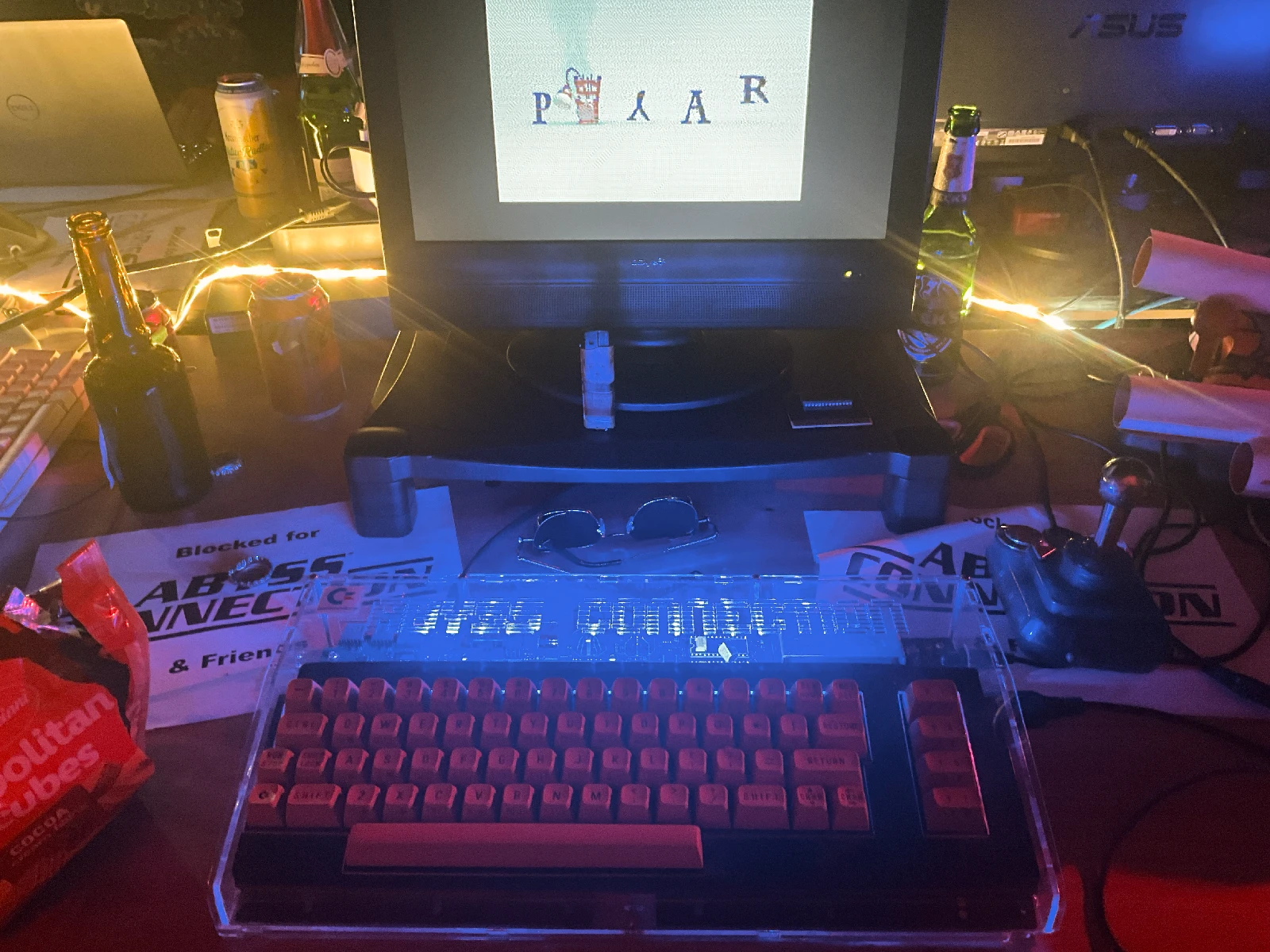
A gorgeous C64 in a transparent case, because the demoscene
loves its hardware on display.
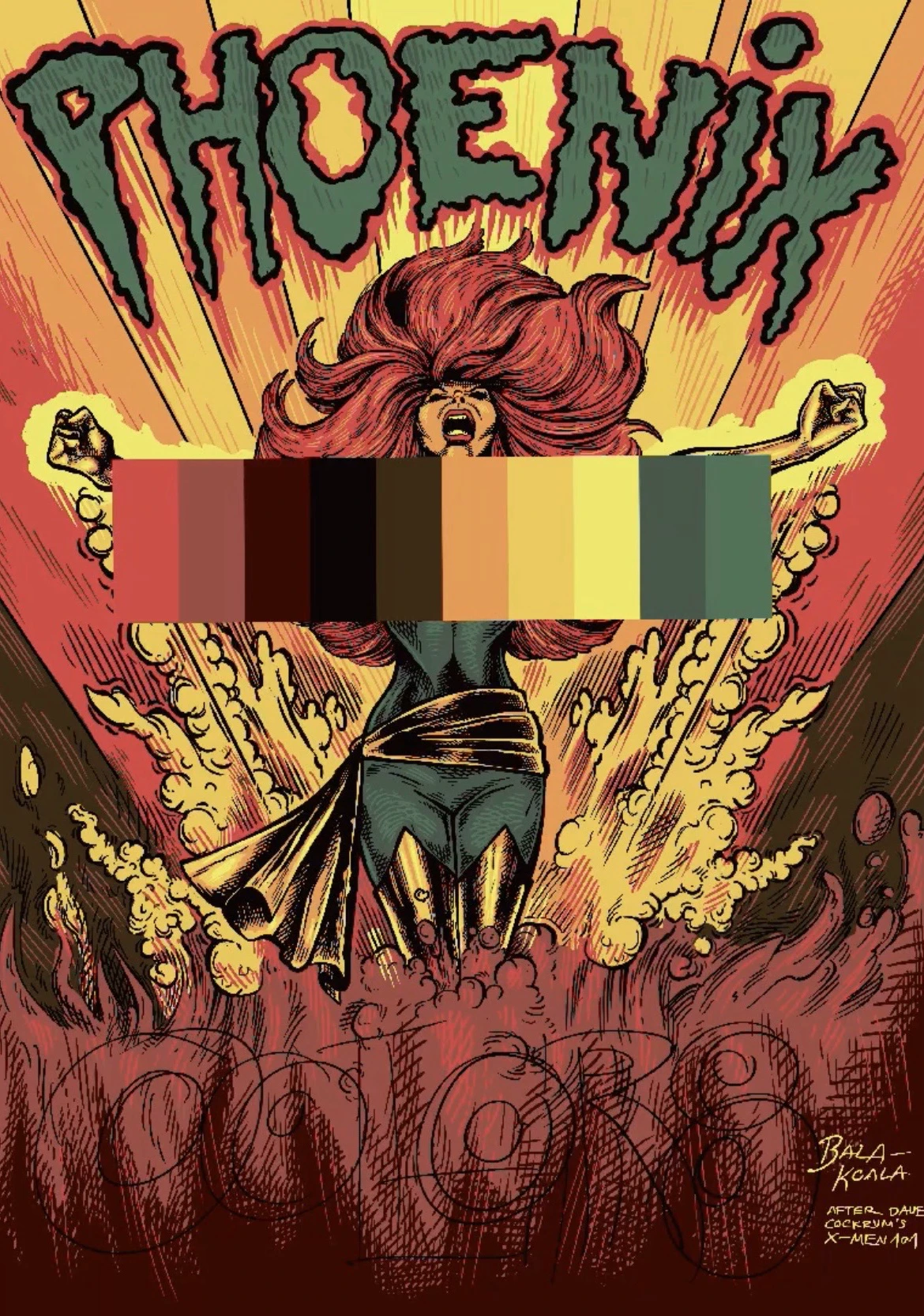
Phoenix Colors
My third submission was for the Pixel Graphics competition, and it is the one I was happiest with. It is called Phoenix Colors.
The premise of the compo is a lovely constraint: you may only use a predefined color palette. Fewer colors are fine, but you may not reach for any others. The interesting "trick" is that the rules never specify a resolution. Most people assume you are meant to work at some retro resolution like 320 by 256 or 800 by 600, but you are not actually limited at all. So I drew a rather high-resolution image using nothing but the allowed colors.
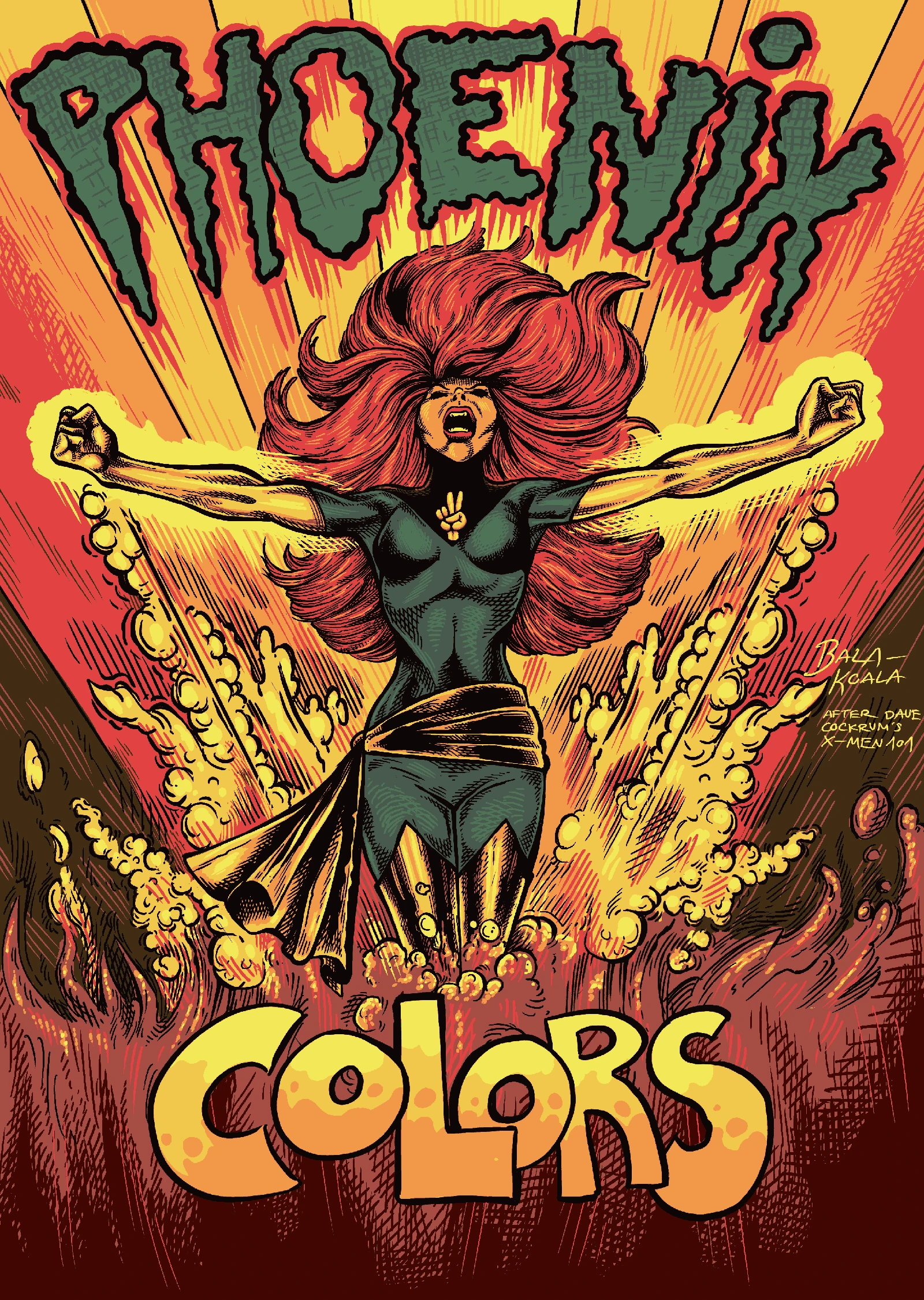
Phoenix Colors, the final image, every pixel snapped to one of
the ten mandatory colors.
The moment I saw the palette, I knew exactly what it was made for: Dave Cockrum's Phoenix, from Marvel's Uncanny X-Men. The fiery red, the gold hues, two tones of green, and a dark color for the outlines. Phoenix has red hair often wreathed in flame, gold gloves and a gold sash at her waist. It was as if the mandatory palette had been chosen specifically for her. I decided to model my drawing on Cockrum's cover for X-Men number 101, her first appearance, where she bursts out of the water after saving the X-Men from a crashing space shuttle. The ten colors I was working with were:
#E14343   #A64C44   #400601   #0D0706
                #402C14   #F29849   #F2C84B   #F2E857
                #48594D   #4F7358

The mandatory palette for the competition: ten colors and not
one other. You can find the
original palette on the Evoke website.
I drew it on the iPad Pro in Procreate with the Apple Pencil. I blocked in a rough skeleton, sketched the form lightly on top, refined the lines, and inked progressively in a darker color to give the outlines weight and the figure some cross-hatched solidity. Then I stacked many color layers beneath the dark lines and colored strictly within the palette, using some of those colors not only as flat fills but also as cross-hatching, to give the whole thing more plasticity. I signed it and added a small note that it is modelled after Cockrum's cover.
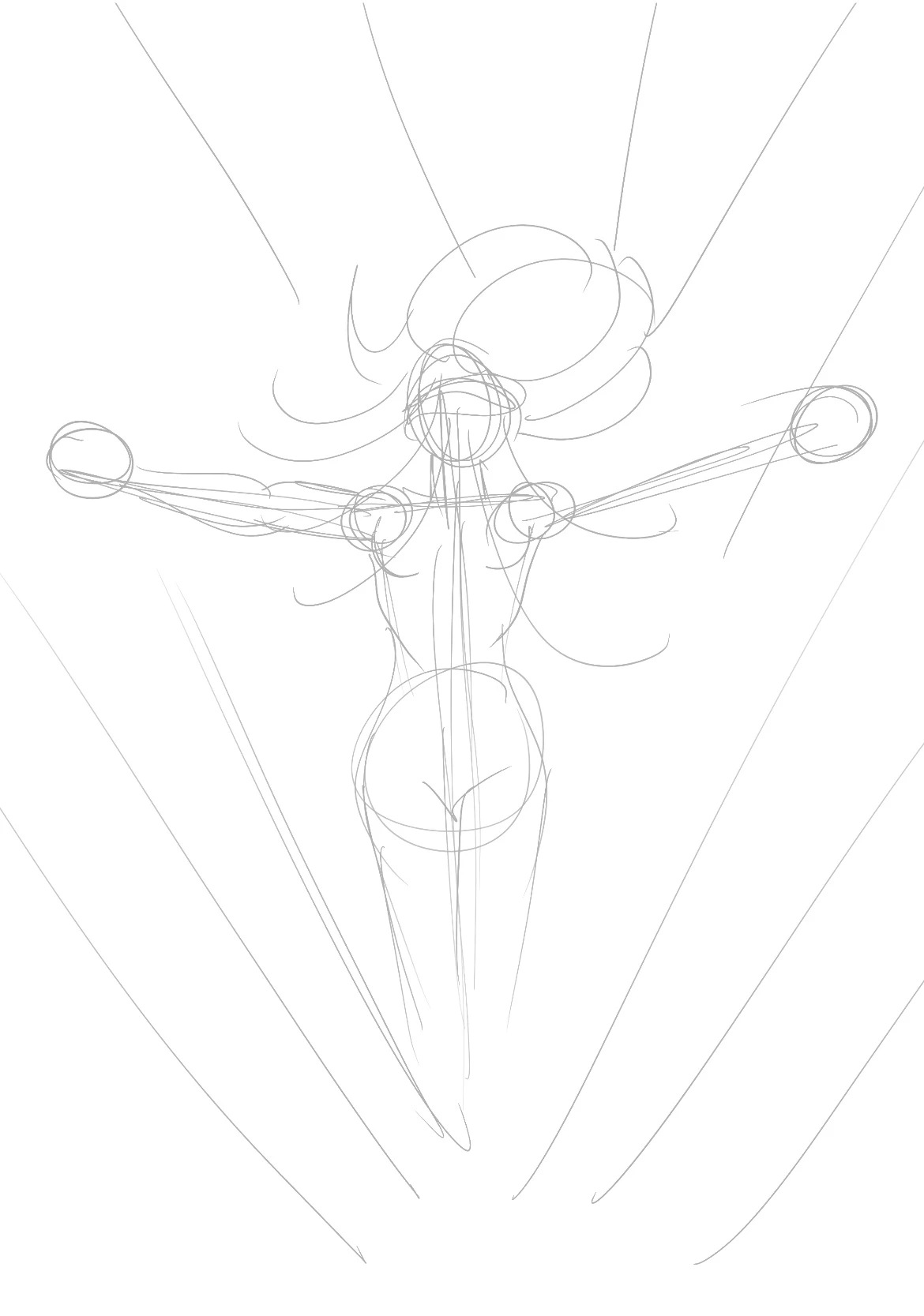
Step 1: the rough skeleton.
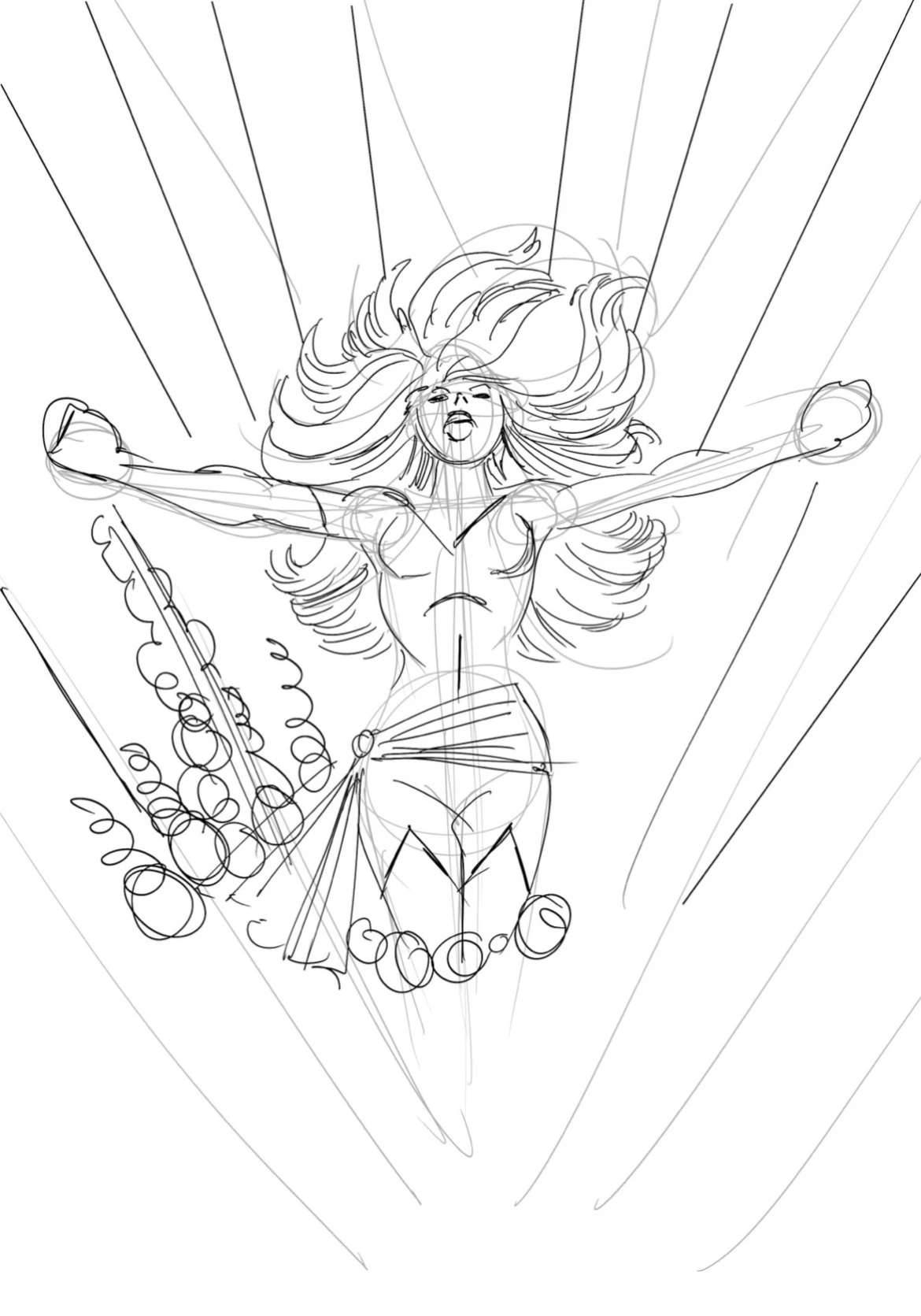
Step 2: sketching the form.
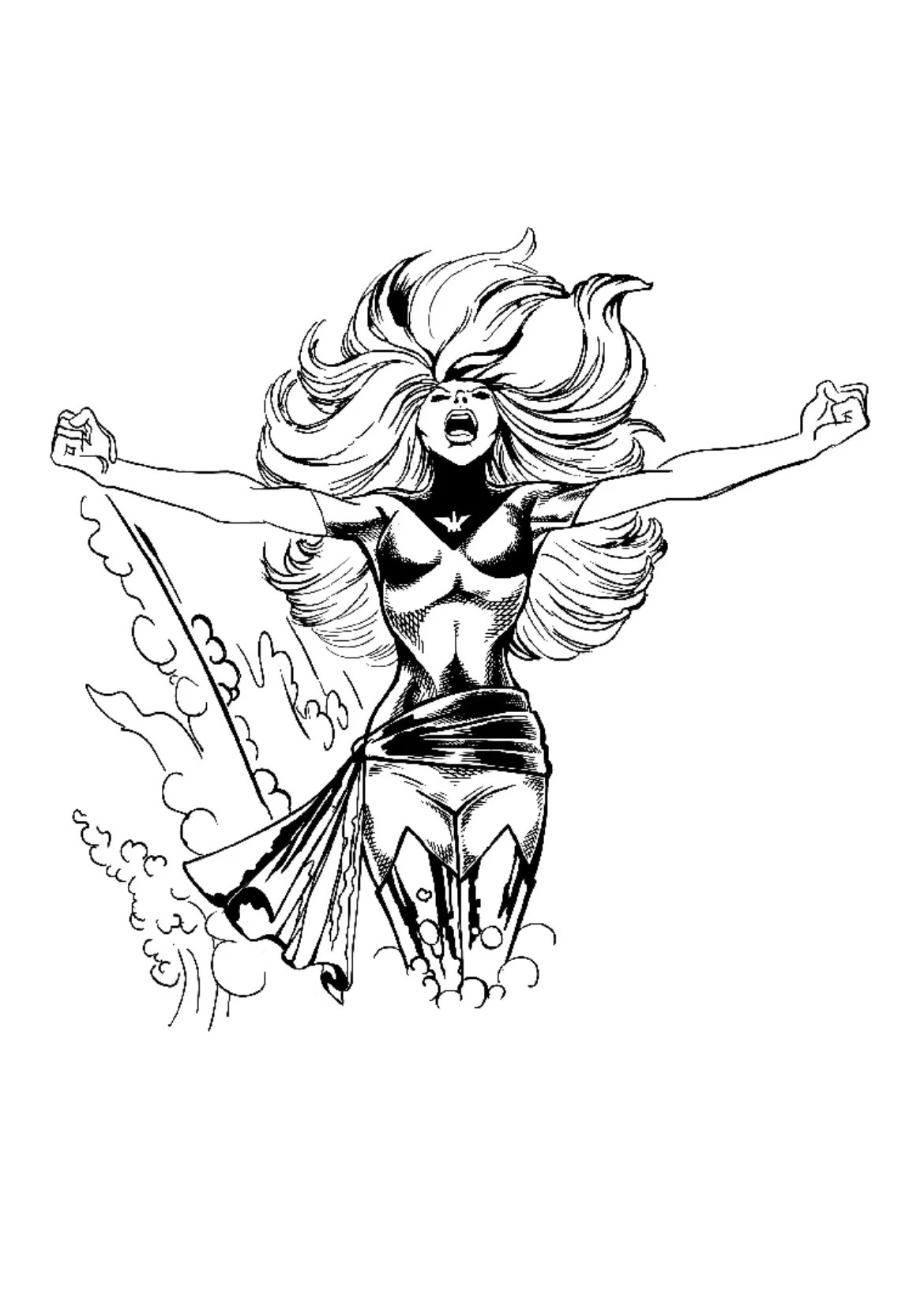
Step 3: inking the outlines.
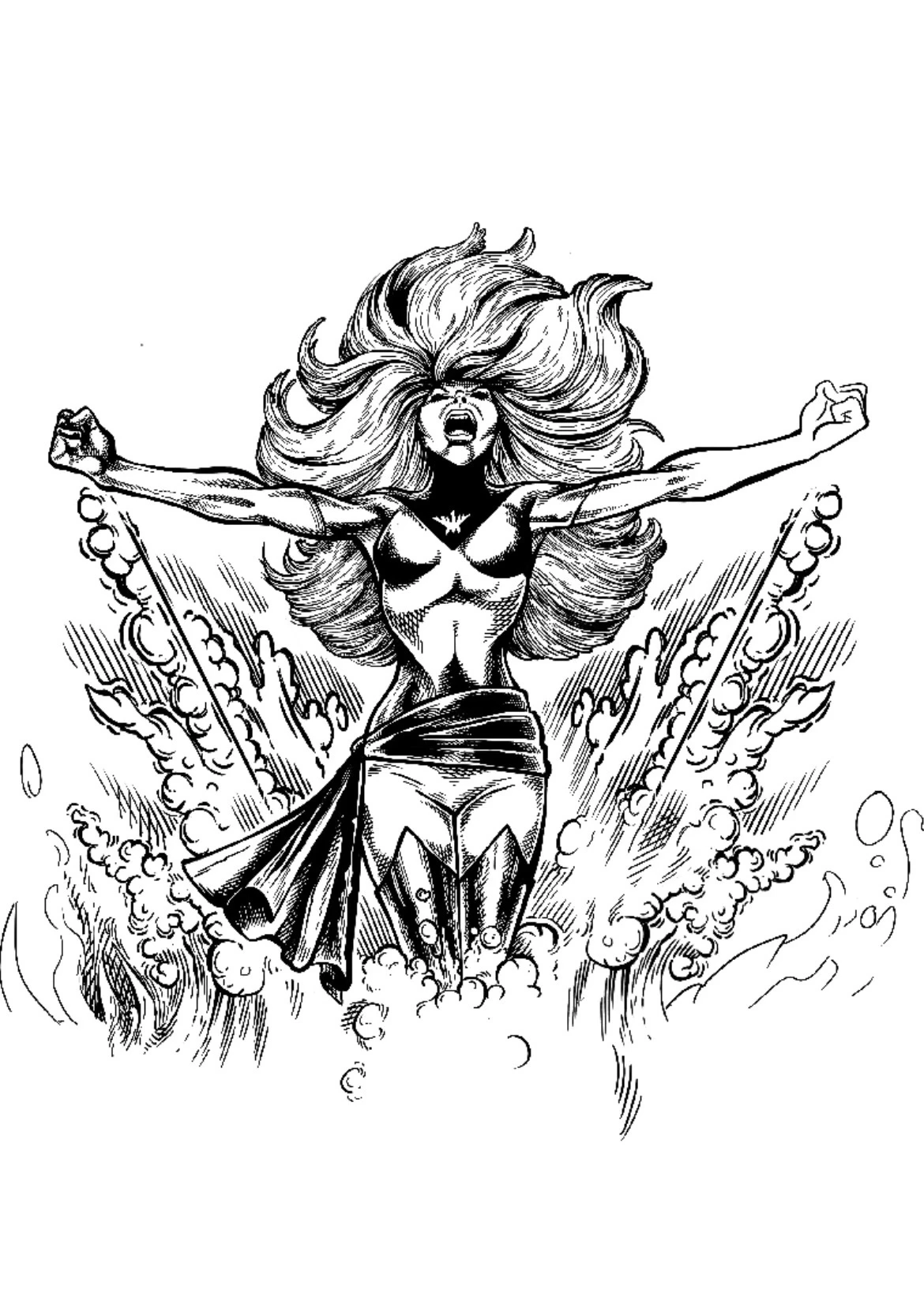
Step 4: cross-hatching for weight.
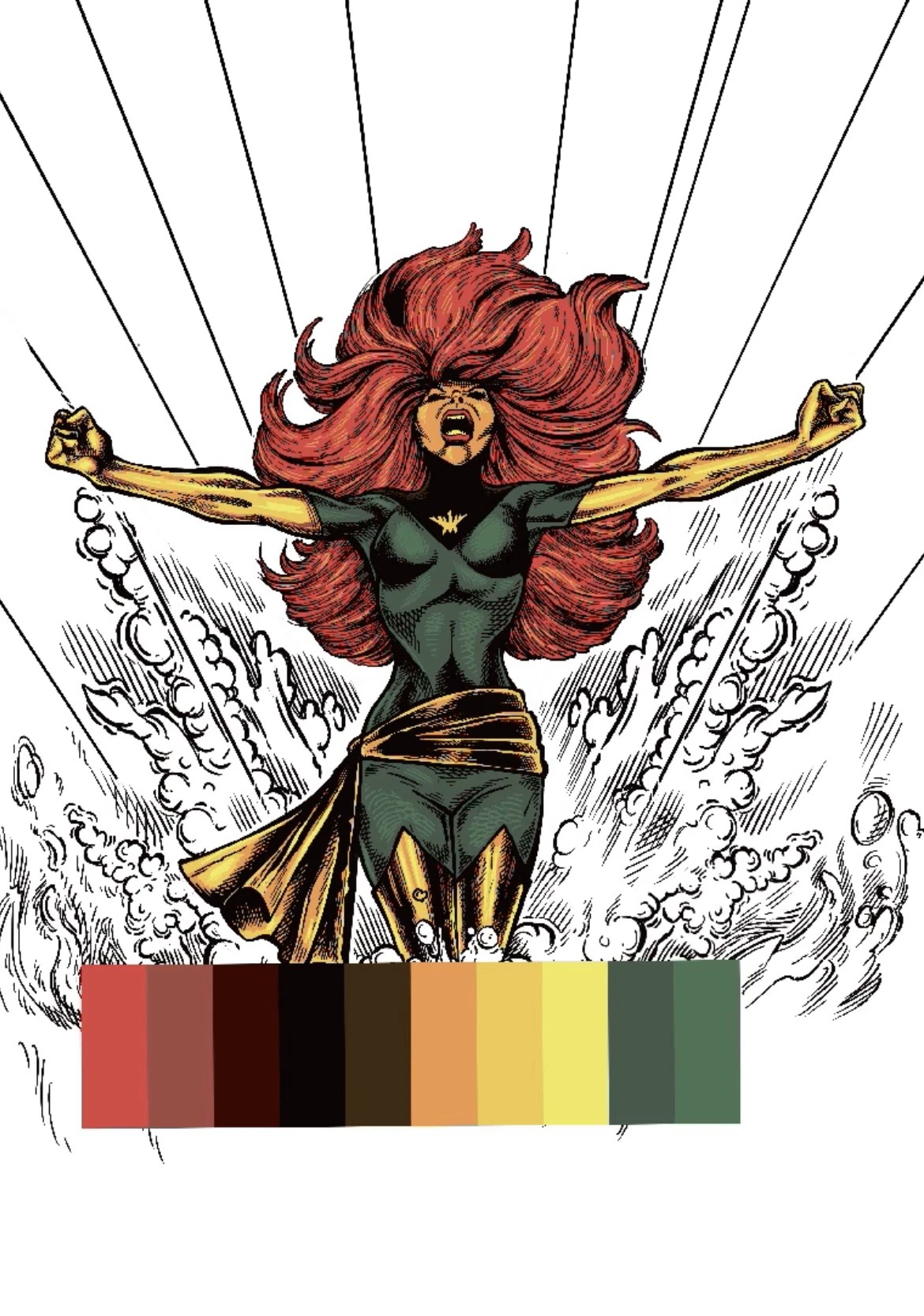
Step 5: coloring within the palette.
Step 6: the finished coloring.
Now for the technical part I am humbly proud of. Procreate, being a modern painting app, insists on anti-aliasing the lines and blending colors, which means it happily produces shades that are not in the palette at all. To force every single pixel back onto one of the ten allowed colors, I quantized the image on the command line with ImageMagick, then checked every color afterward in a pixel-art app called pixquare. Here are the commands, in case they are useful to a fellow palette-wrangler:
magick -size 1x1 \
  xc:'#E14343' xc:'#A64C44' xc:'#400601' xc:'#0D0706' xc:'#402C14' \
  xc:'#F29849' xc:'#F2C84B' xc:'#F2E857' xc:'#48594D' xc:'#4F7358' \
  +append palette.png

magick phoenix-uncorrected.png +dither -remap palette.png phoenix-corrected.png
The first command paints ten one-pixel swatches and stitches them side by side into a tiny palette image. The second remaps my artwork onto exactly those colors, with dithering switched off, so that no in-between shades can sneak in. To prove none of us used AI, the competition required at least six steps of the process plus the final image, and my Procreate recording made those easy to export.
And now the part I am a little less proud of, which is the saga of how it all went sideways, entirely through my own bad luck and fumbling rather than anyone else's fault. There had been a mix-up with the announced submission deadline, and the corrected one turned out to be a full eleven hours earlier than I had first planned around. The organizers communicated the new deadline clearly, and I simply had to hustle fast, which is fair enough.
Then, after I submitted, one of the orgas took the time to message me on Discord to point out that some of my color values were not quite right. I was actually grateful for the care they took, because I must have fumbled a hex value somewhere in my ImageMagick command. I rechecked every color, re-quantized, went through each one in pixquare, and resubmitted.
Here is where the invisible little demoscene gremlins that like to sabotage releases struck. On resubmission, the party system glitched and would not let me attach a preview image for the voting. I did not worry much, because I had already uploaded a preview earlier. But when the compo screening arrived and voting opened, my entry had no preview image in the voting system at all. Everyone could see a preview in the other entries but not in mine. I messaged the orga again, and he was immediately and generously helpful, fixing it as quickly as he could.
By the time the preview was added, though, most voters had understandably moved on to the next competition. I guess these little gremlins are simply part of running an event like this, and the team handled mine with real grace.
I came in sixth out of eleven. I will admit I was a little disappointed, because I had hoped for better, and I do think the missing preview cost me a few votes. Still, I was proud of the picture, and that matters more.
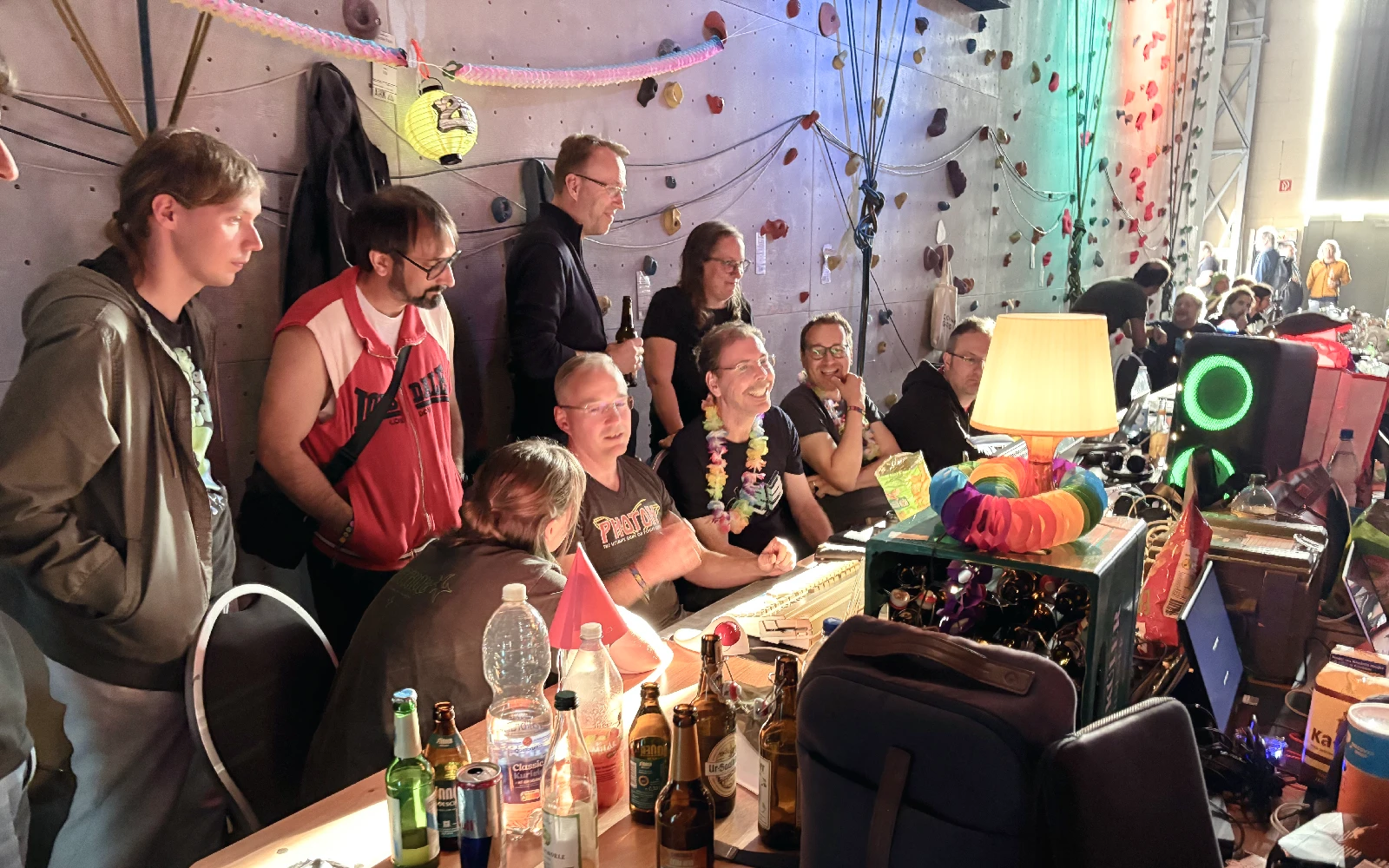
Sceners gathered in front of an Amiga in the kind of blissful
wonderment I completely understand. And to top it off, they were
listening to one of my favorite songs by Björk:
All Is Full of Love.
Screenings of Every Competition Entry
You do not have to take my word for any of this. The organizers put together a pretty good super-cut of the competition screenings, every participant's entry shown on the big screen, complete with music. Here is the whole thing in one go.
Not every moment of the evening was lighthearted. Late on, during one of the compo screenings, a person in the audience suddenly collapsed and lay on the floor, clearly feeling very unwell. The organizers reacted instantly, calling emergency services and fetching a soft mat to lay them on. I was astonished at how quickly the ambulance arrived.
The paramedics checked the participant over, groggy and out of it but conscious and alive, and carried them out on a gurney. They did not seem especially alarmed, so I dearly hope it turned out to be nothing serious. It was a small, sobering reminder to look after one another and each other's limits, and a real credit to how calmly and quickly the orgas handled it.
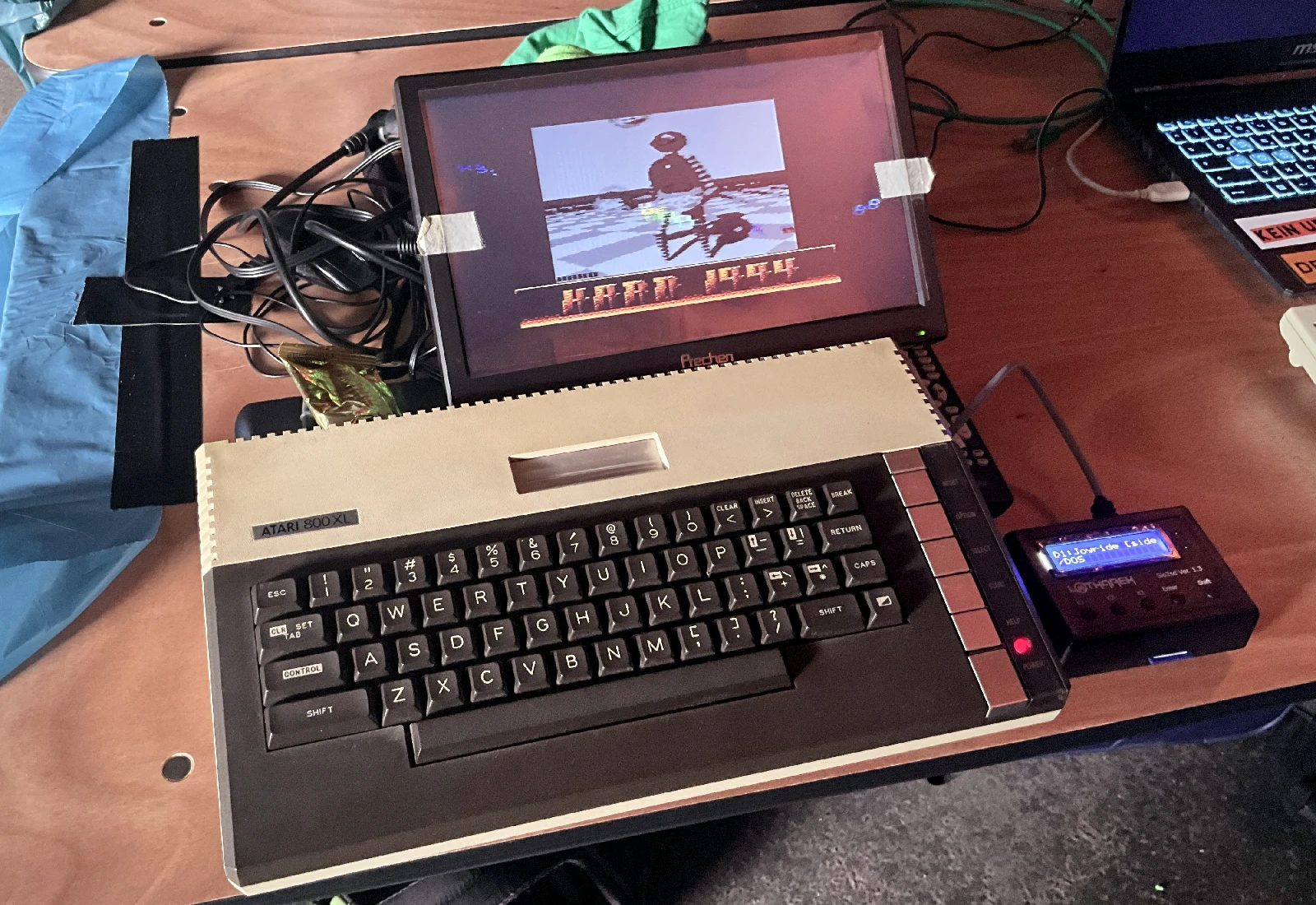
Zeki's Atari 800XL wired up to a modern LCD and SD storage. Old
dog, new tricks (I mean the Atari not Zeki).
Scene Encounters
As always, the demos are only half of Evoke. The other half is the people, and this year brought me more good company than I could have hoped for.
It was, as ever, a pleasure to share a table with my good friend Qetu. We keep crossing paths at demoparties and at events around the Chaos Computer Club, and he always turns up with something wonderful. This year he had connected an analog computer to an oscilloscope and patched the cables so cunningly that he could draw an Amiga Boing Ball on the oscilloscope's little screen. He even made it bounce from one corner to the other, and from a few steps back it really appeared to have a checkered pattern rolling across it, though up close it is a weave of crossing lines. I love how enthusiastically and precisely Qetu explains his work to anyone who stops by his table and asks about it.
If you are wondering how on earth an analog computer can paint a bouncing ball on a scope, the trick is a lovely piece of old electronics.
In its X-Y mode, an oscilloscope stops plotting voltage against time and instead lets one input voltage place the point horizontally and another place it vertically, so the trace lands wherever the two voltages tell it to. Feed a sine wave into one axis and the same sine shifted by ninety degrees, a cosine, into the other, and the trace draws a circle, the simplest of the Lissajous figures. On an analog computer, a simple quadrature sine generator can be patched with only three wires. To make the flat circle appear as a three-dimensional ball, you modulate the sinewave amplitudes with a slow triangle wave, so the outline bows into sphere-like meridians. Because a triangle ramps up and down at a constant rate, the passes come out evenly spaced, and their crossings weave the grid that reads, from across the room, as a checkerboard rolling around the ball.
The scope holds each pass on its screen while the next one is drawn, so the trace never reads as a moving dot at all, but as one continuous, standing figure.
To make the ball bounce, you simply add slow, gently reversing offset voltages to both axes, nudging the whole figure around the screen. It is, in the most delightful way, mathematics you can see.
If you want to go down this particular rabbit hole, the Pico Technology explainer on X-Y mode and Oscilloclock's write-up on circle graphics are great places to start.
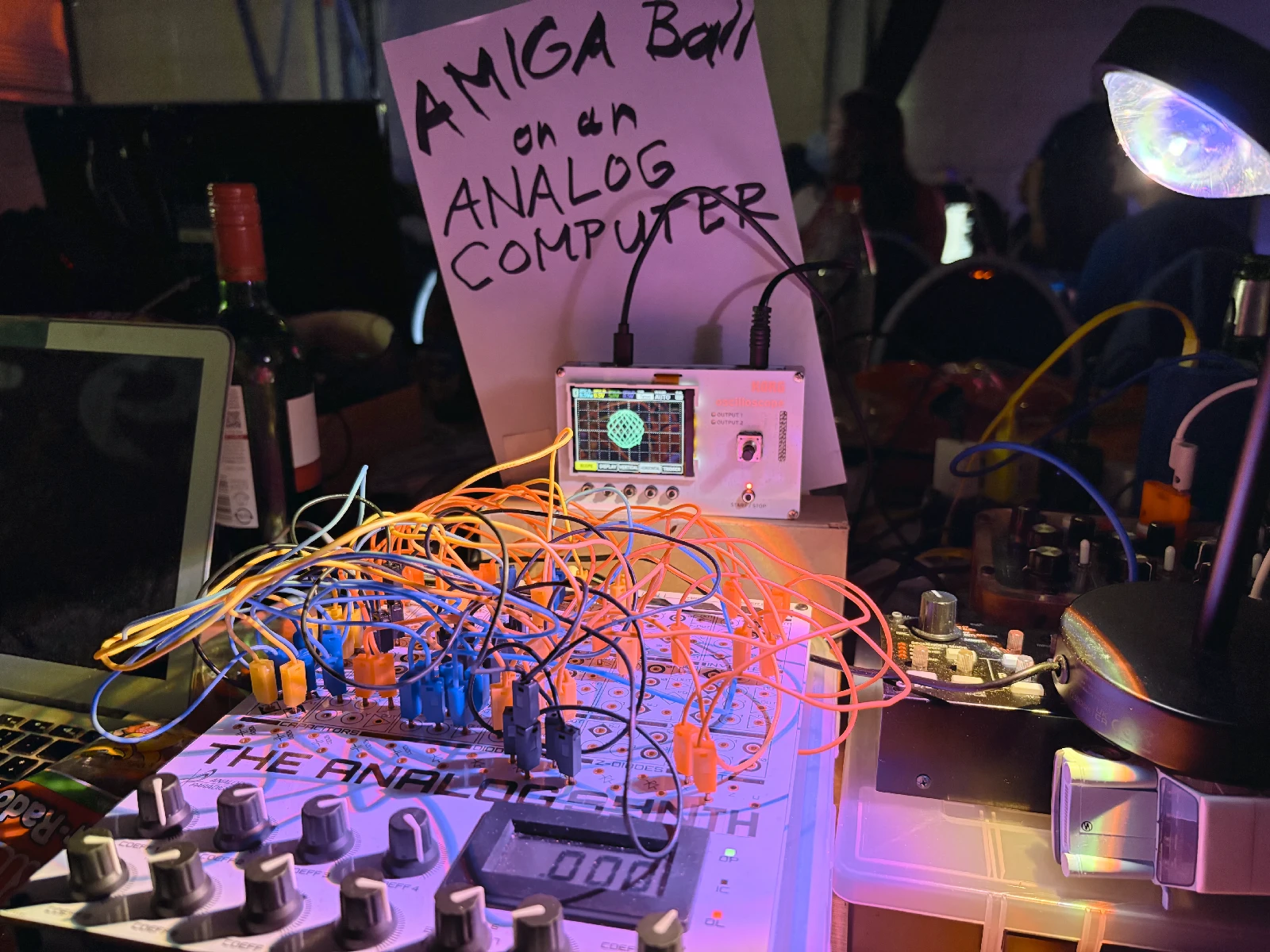
Qetu's analog computer driven Boing Ball, drawn in light on an
oscilloscope. Calculations you can see.
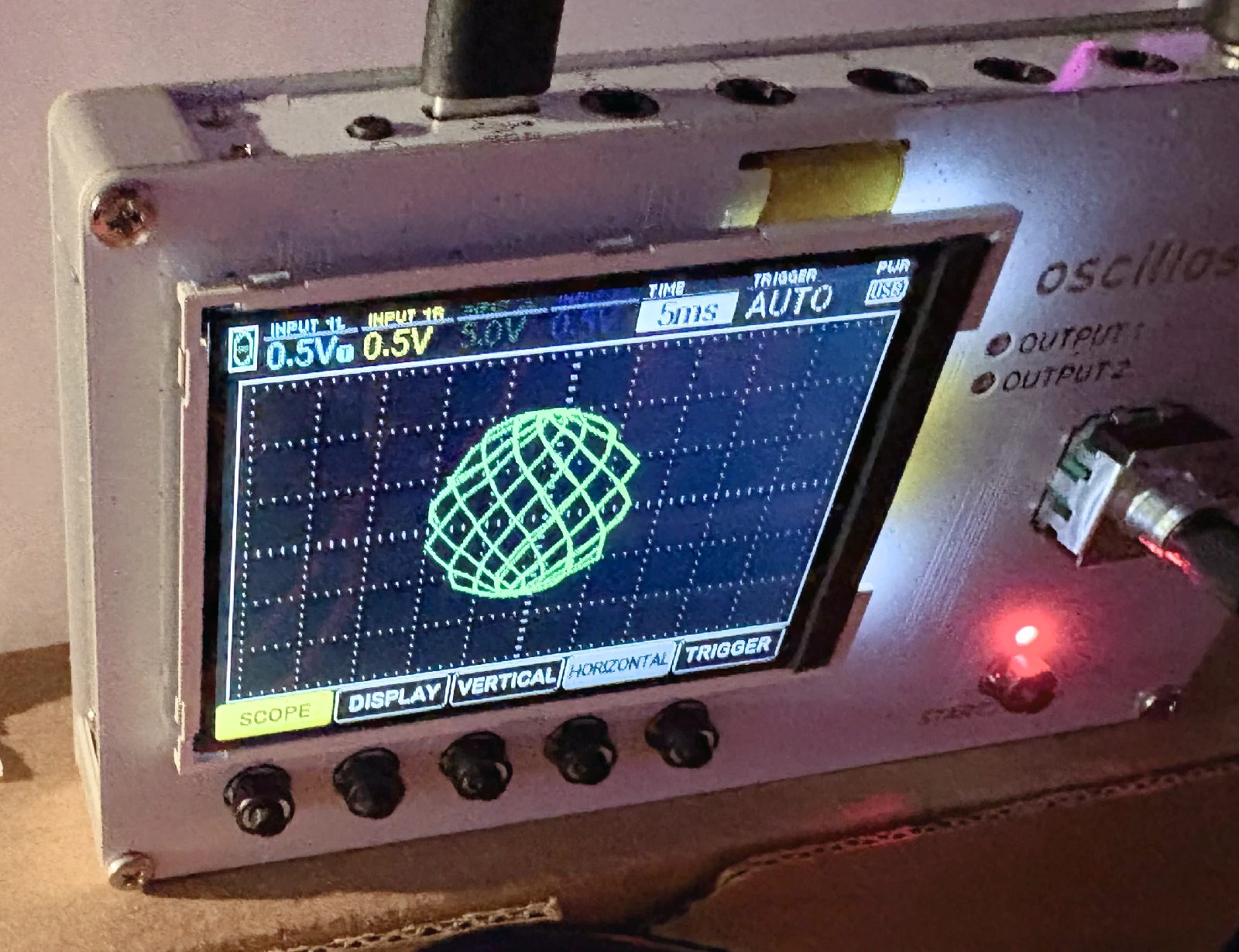
A closer look at the oscilloscope doing its impossible little
dance.
Another person I am always delighted to run into is Harvey, that is Holger Weßling, who in his professional life is a writer and has authored many books about retro machines and about the devices made by Retro Games Ltd. He is preparing two new books right now, and I am especially looking forward to one of them, because it is about the upcoming TheA1200 from Retro Games Ltd, which is turning out to be a genuine Amiga now that the tangled rights around Amiga intellectual property have finally been sorted out. The big, long-running dispute between Hyperion and Amiga Corporation was settled in 2026, clearing a path that had been blocked for years. The broader ownership picture is still complicated, but the key problems seem to have been resolved.
Holger had set up his t-shirt and joystick stand out in the inner courtyard. I spent a happy time there chatting. And I even bought a Star Wars t-shirt, because I had, as usual, not packed enough clothes (and I liked the t-shirt too).
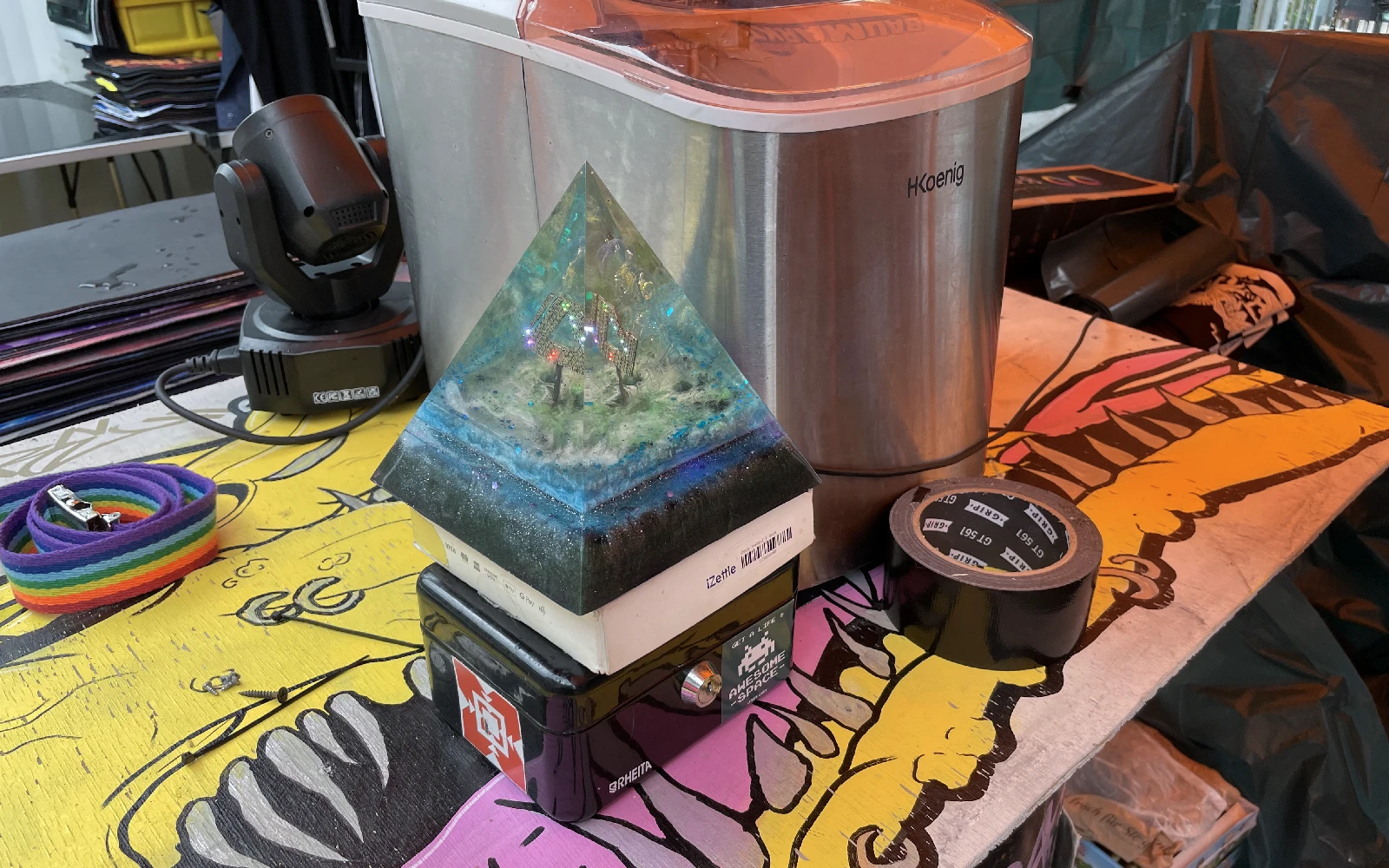
Next to Holger's courtyard stand, another purveyor of t-shirts
had a real award from the Deadline demoparty lying around on
his stand.
A quick word, too, for the official Evoke shirt this year, which was sold not at the courtyard t-shirt stands but over at reception. The design was genuinely lovely: a peace dove clutching a knife above the words A Peaceful Message, with the party's motto printed down one side, find peace in the process, the phrase that lent this report its title.
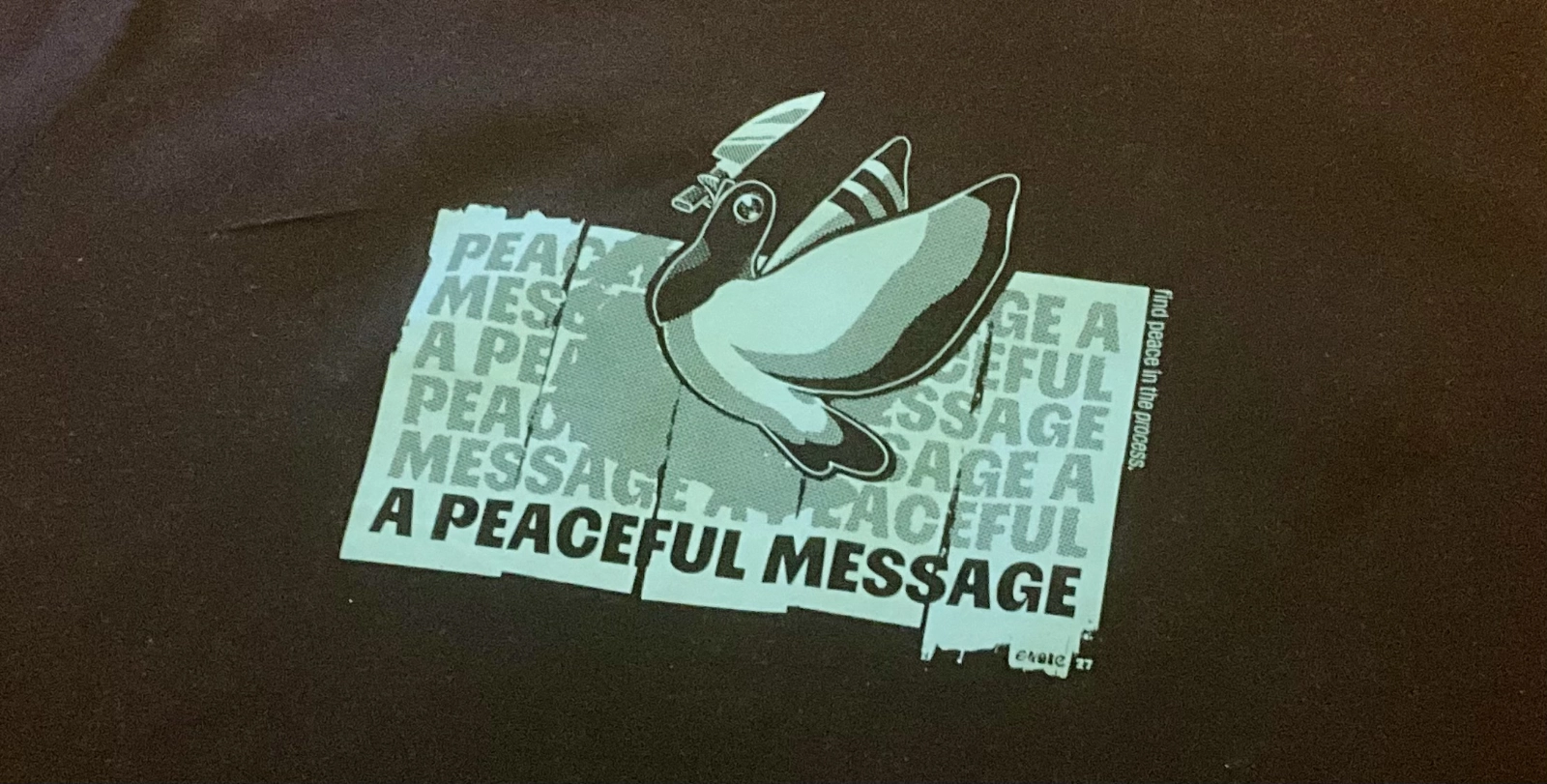
This year's official Evoke shirt: a peace dove with a
switchblade, “A Peaceful Message,” and the motto
“find peace in the process” running down the
side.
Harvey also did me a real kindness by connecting me with Drees from the AMID demogroup. I had been keen to work with them, so I was very glad Drees was at Evoke this year. We chatted for at least an hour during the barbecue. He is a lovely person, and he has built a real, warm community around AMID, which I am happy and proud to be joining. Drees also spun a DJ set in the small hours, as DREES DENARO, but I confess I missed it entirely, because that was precisely when I had crept off into the dark hall in search of some desperately needed sleep.
Sorry, Drees. My air matress was calling.
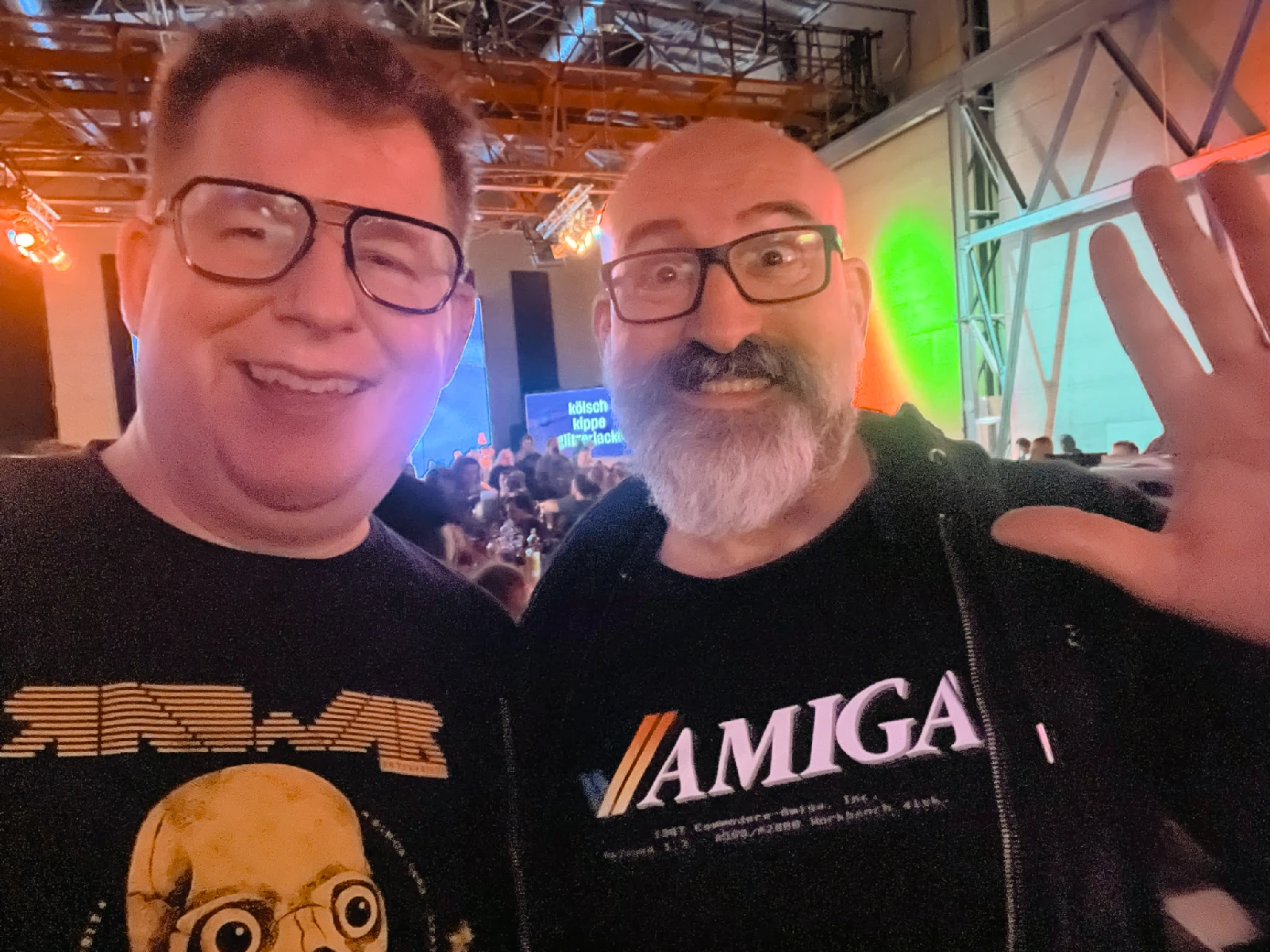
Drees and me at Evoke, plotting future AMID mischief.
We met the next day for the sausage BBQ in the inner courtyard.
While Drees and I were deep in conversation and eating our way through our sausages in a bun, a wasp kept pestering us. Eventually we decided to simply hold still and let the creature land wherever it felt it ought to. It chose the sausage in Drees's bread roll. It then set to work with real diligence, carving into the soft inner meat and removing an ambitiously large chunk. When it finally flew off, it wobbled visibly under the weight of its haul.
I think about that wasp more than I care to admit. In fact, I am nearly convinced the wasp deserved an award of its own.
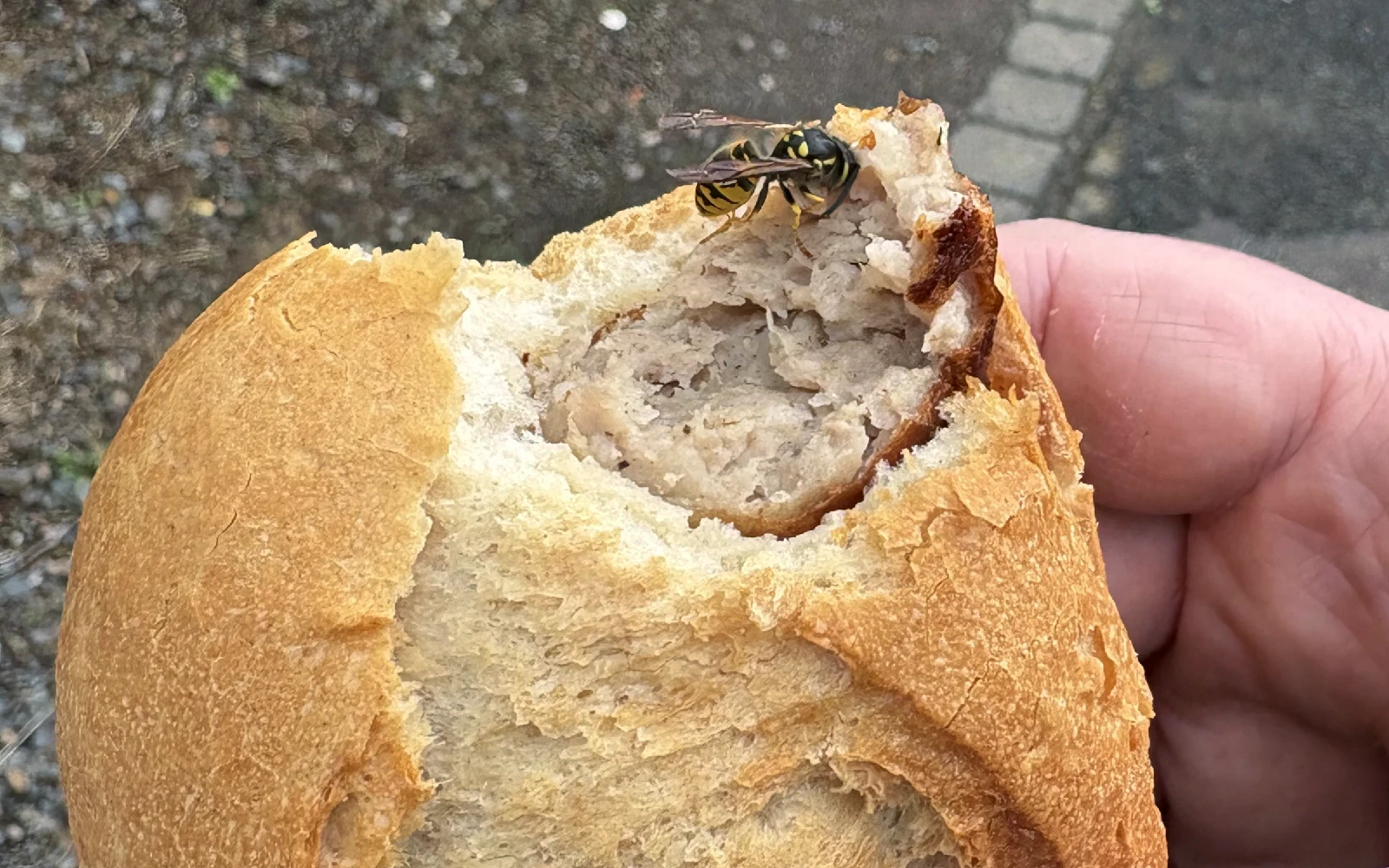
Exhibit A: the wasp, mid-heist, liberating a chunk of Drees's
sausage.
I also had the joy of meeting Steffest, the wonderful pixel artist and the creator of dpaint.js, which gave the world, and the demoscene, an online tool for pixeling and retro graphics that runs on any machine with a web browser. I love tinkering with dpaint.js on my iPad, and it supports the pencil beautifully.
When Steffest asked me whether there was any feature I would like added, I had a small crisis of etiquette. On the one hand, asking for something rather implies the tool is lacking, and I did not want to suggest that. On the other hand, it would have been rude not to answer. So I mentioned the one thing I really long for: support for non-square pixels, which would let me make graphics for the Amiga's 640 by 256 mode with ease.
You can see, I hope, why that particular feature was on my mind this year.
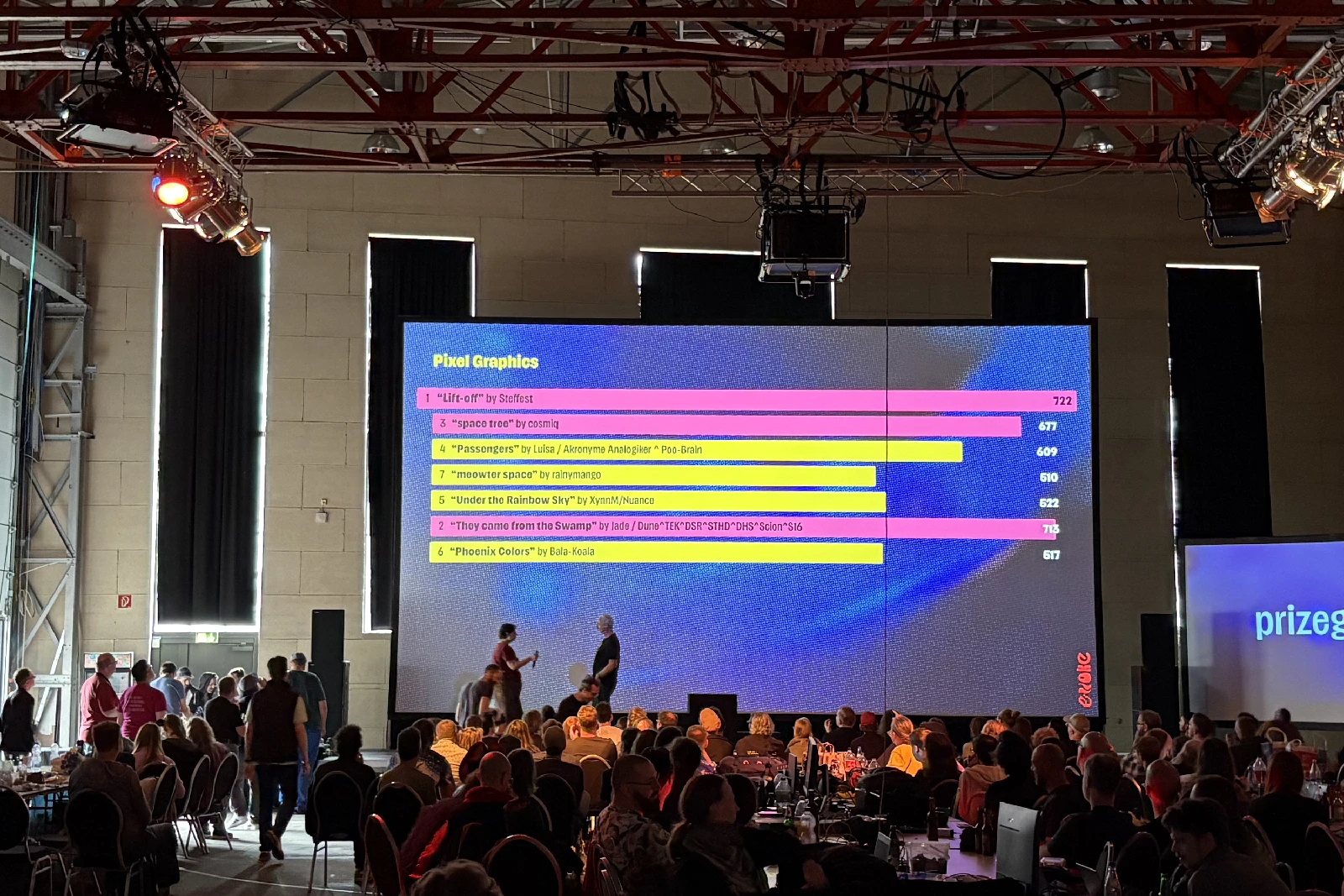
Steffest, the deserving winner of the Pixel Graphics
competition, receiving his first-place award.
And in the middle of it all, I attended Droid Boy, that is Thomas Riedel, giving a fascinating seminar about humanoid robots. As he told it, that very same day there had been a large, sports-like robot demonstration event in China, and, for the first time, a humanoid robot on legs, with no cables and only an internal power source, had reportedly run faster than the fastest human who ever lived, faster than Usain Bolt. He walked us through the current state of consumer-ready robots, which is both thrilling and terrifying, and left me wondering how long it will be before these machines start turning up in ordinary households.
I had to slip out of the talk early, for the best possible reason: lunch with Pararaum and with Harekiet, one of the developers of DOSBox. How amazing is that!?!
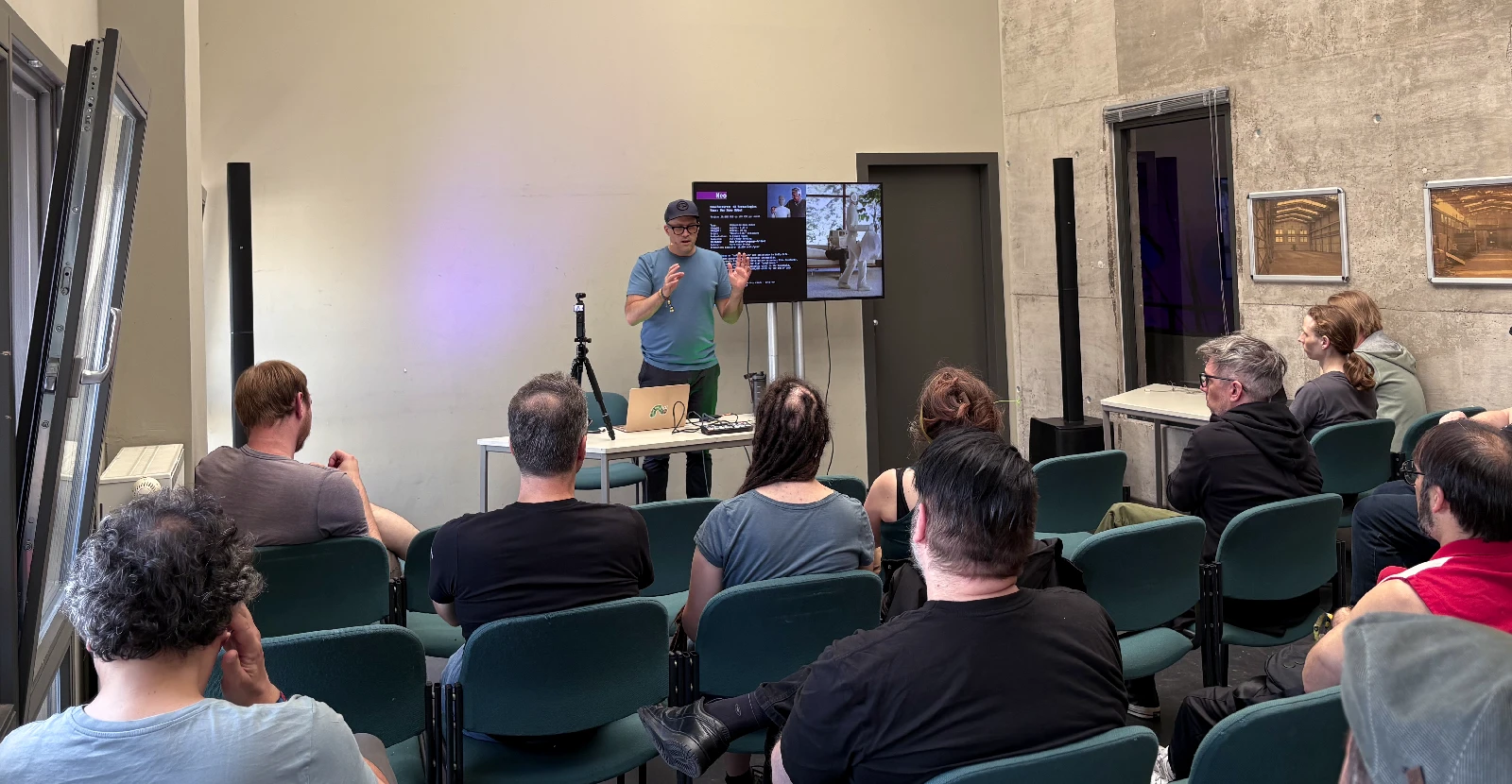
Droid Boy walking us through the slightly alarming state of
humanoid robots.
Am I Getting Too Old for This?
I have to confess something I am a bit embarrassed about.
During the screening of the music competitions, I sat there feeling distinctly grumpy, convinced that none of the music actually spoke to me, that I did not really like any of it. At some point I leaned over to Qetu and asked, half seriously, whether I had simply gotten old and out of touch, or whether the music was, objectively, not good. He kindly pointed out that it might be a matter of the acoustics and the sound settings in the hall. The Evoke crew normally gets the sound spot on, and usually it is excellent, but this year it may have been slightly off in places, or we may simply have been sitting in a corner with unfortunate acoustics.
I felt enormously relieved that it was not entirely my fault, or entirely my age.

I slept in this hall this year. (I took this photo in
2023.)
Which brings me to the other way I put my age to the test this year.
For the very first time, I slept in the hall. Every previous year I had booked an AirBnB or a hotel right before the party, because some stubborn part of me had decided I was simply too old to bed down on the floor of a vast hall with fifty other people. This year I had booked an AirBnB too, but it was canceled at the last minute, right as I was about to travel. So I pulled myself together, packed my air mattress, a pump, and an insulating mat, and took on the challenge of the skating hall next door to the main party hall.
It turns out I am not too old for it after all. I set up my little camp, pumped up the mattress, and made do with a blanket that doubles as a poncho, since my sleeping bag was too bulky to bring on a flight. I was honestly surprised by how good the sleep was. Not spectacular, but far better than I had originally feared. The hall was wonderfully dark, and everyone around me was remarkably considerate, keeping their voices low and flicking on their phone flashlights only when truly necessary. It helped enormously that the party music is silent in the early morning hours, which I do not believe happens at Revision, where I am fairly sure the music keeps playing on until dawn.
There was another unexpected comfort. We had showers at our disposal on the first floor, which is a genuine boon when you are camped out in a hall for a whole weekend. Better still, they came with strong water pressure and reliably warm water. That is not something you can take for granted everywhere, but the AbenteuerhallenKALK delivered.
The only real trouble was that while the quality of my sleep was surprisingly good, the quantity was not. I would drop off around three and be awake again by eight. On the first night I could simply drift back to sleep. But on Sunday morning some cheerfully diabolical DJ decided that eight o'clock was the perfect time for a music set, and honestly, you have to admire the commitment. I'm sure I was not the only person they woke.
The summer heatwave had broken by the time Evoke began, so the nights turned a little cold, though it may just have been me, since some folks lay on their mats with barely a scrap of cover.
One particularly tough dude lay flat on his back on the bare ground, fully dressed, and slept the sleep of the righteous. I am simply not suited for that, and I admire that person's talent, inner peace, and tenacity more than I can say.
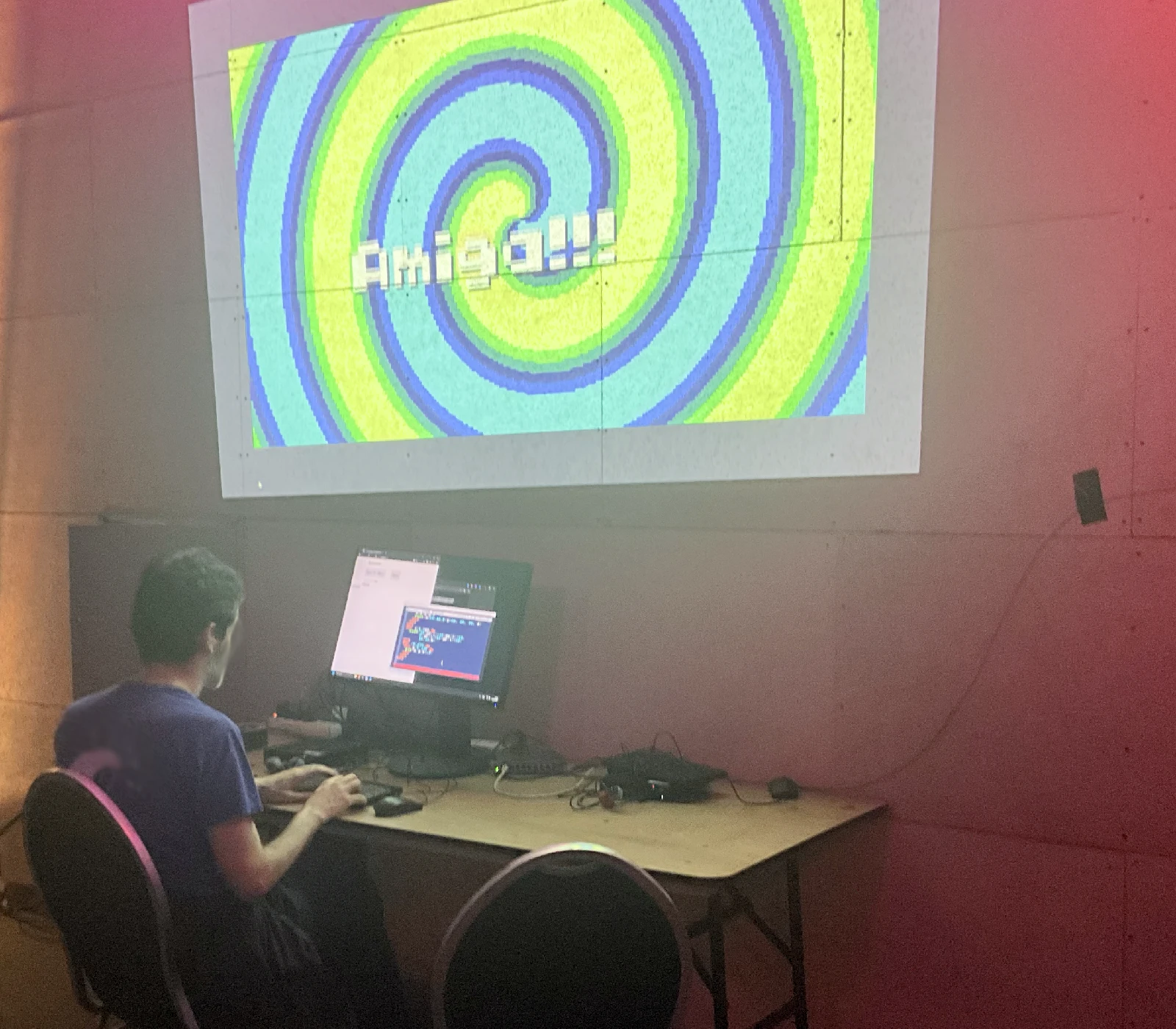
The TIC-80 development corner.
The Demo That Got Away
Of everything I saw this year, the demo that impressed and charmed me the most was "The One That Got Away", and it totally deserved to. It is a TIC-80 demo by the legendary Gasman, working under the pseudonym Wavesitter.
It is a completely delightful little narrative about last year's drone show. It follows one of the drones that drifted away from the swarm, then goes on to chronicle the small side quest and adventures it had around Cologne before finding its way back to the other drones, returning to the formation just in time for the show. In a year when the drones went from a spectacle we watched to a competition some of us could program, a demo that imagines the secret inner life of a single runaway drone felt like the perfect, whimsical full circle. I could not stop smiling.
There is, however, a small confession to make. Bursting with enthusiasm, I marched straight up to Gasman to praise the demo and congratulated him warmly on his wonderful PICO-8 production. It is, of course, a TIC-80 demo as I realized later. Hashtag embarrassing. I am unworthy!
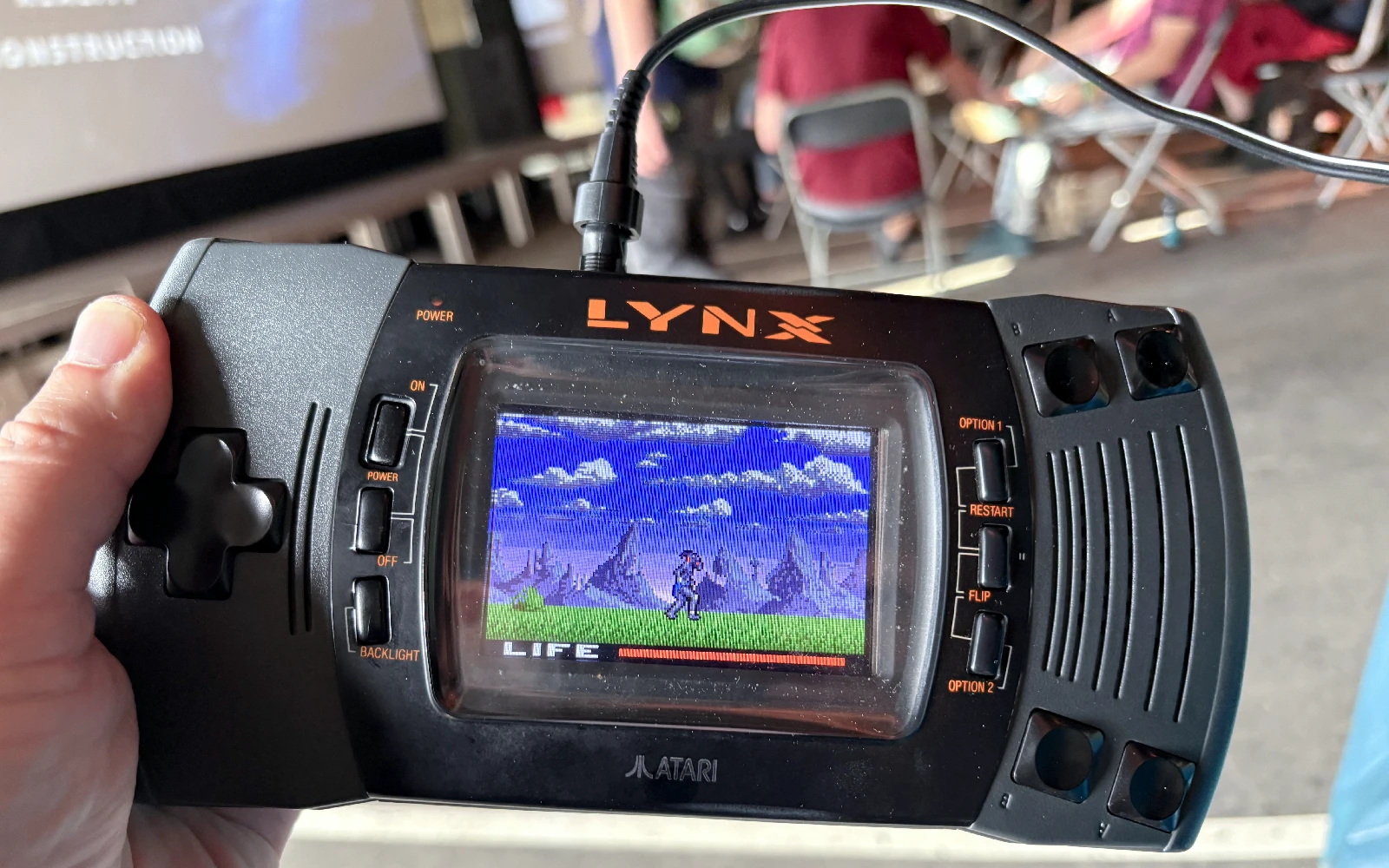
Zeki's modified Atari Lynx, here running Shadow of the Beast, a
thing of beauty.
A Breath of Fresh Air
Quite an unexpected and moving encounter this weekend was meeting a new demoscener who goes by RainyMango.
This was her first demoparty of any kind, anywhere, and she had already submitted an artwork to the Pixel Graphics competition. Her work is so good, and so perfectly suited to the demoscene, that she placed seventh in the compo, right behind my Phoenix drawing at sixth.
We chatted for a while, and it emerged that my little demoparty reports, the ones I publish on this very website, were one of the reasons she had come to Cologne for Evoke in the first place (the main reason, of course, is that demoparties are awesome!).
I want to be careful not to take too much credit, because she clearly has the pop-culture instincts, the enthusiasm, and the sheer energy for the scene all on her own. She totally geeked out over Zeki's modified Atari Lynx when she watched the Bad Apple demo running on it, so I am quite sure she would have found her way to the demoscene regardless. But it fills my heart with joy to think that something I wrote helped her make the decision a little faster.
RainyMango amazed everyone, herself included, when the jury awarded her the prize for best newcomer. During the prize-giving on the final day she took to the stage with a wonderful mix of joy, astonishment, and perhaps just a touch of embarrassment.
If you ask me, she thoroughly deserved the award.
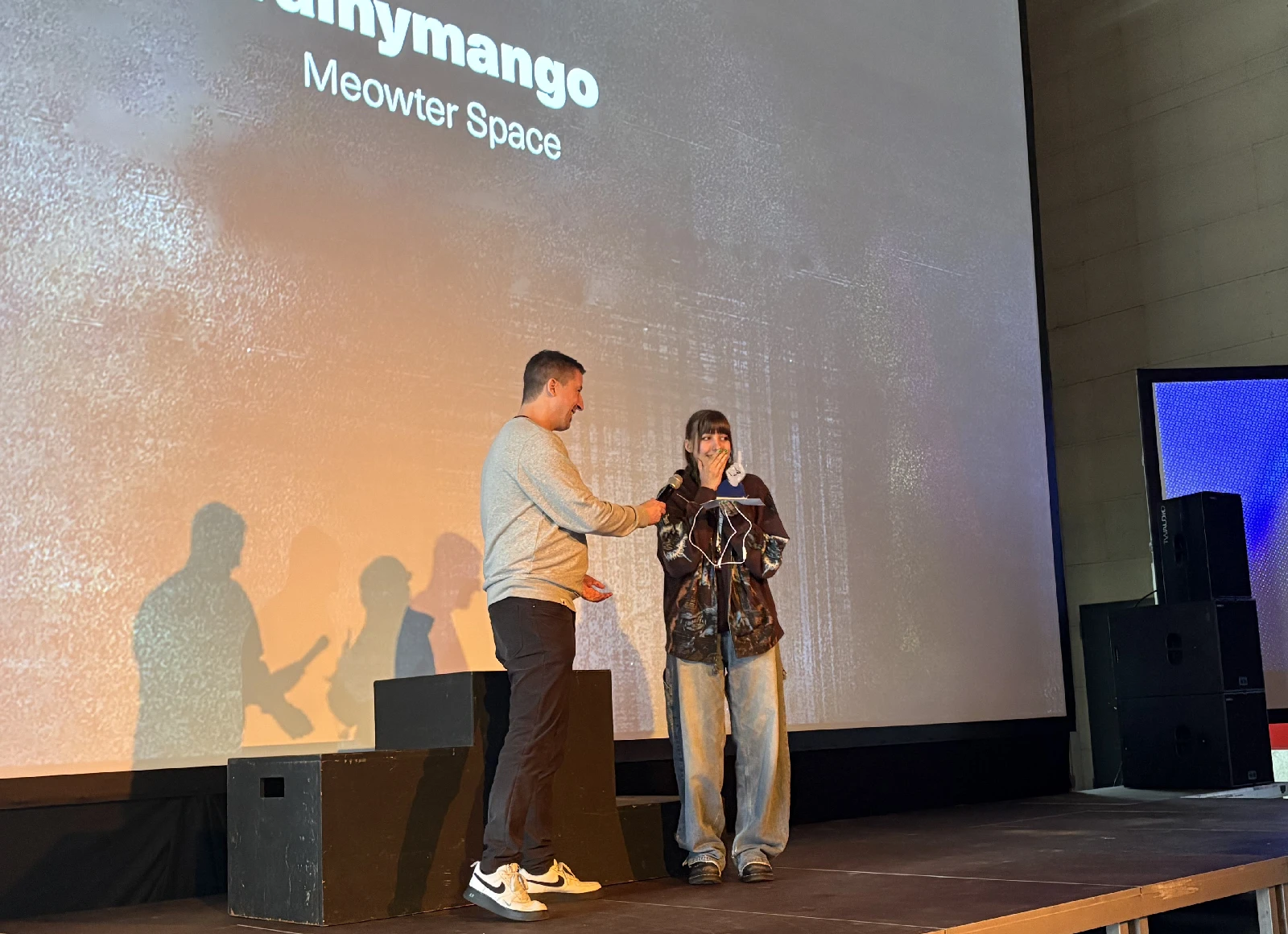
RainyMango receiving the best newcomer award. Someone looks a
bit surprised.
A Sunday at the Computer Museum
After the prize-giving ceremony on Sunday, the party was officially over, but the organizers still had one more treat tucked up their sleeve. The Computer Museum Cologne opened its doors just for us Evoke participants in the afternoon. I really do appreciate that they did this on a Sunday, and it was pleasingly easy to reach from the AbenteuerhallenKALK.
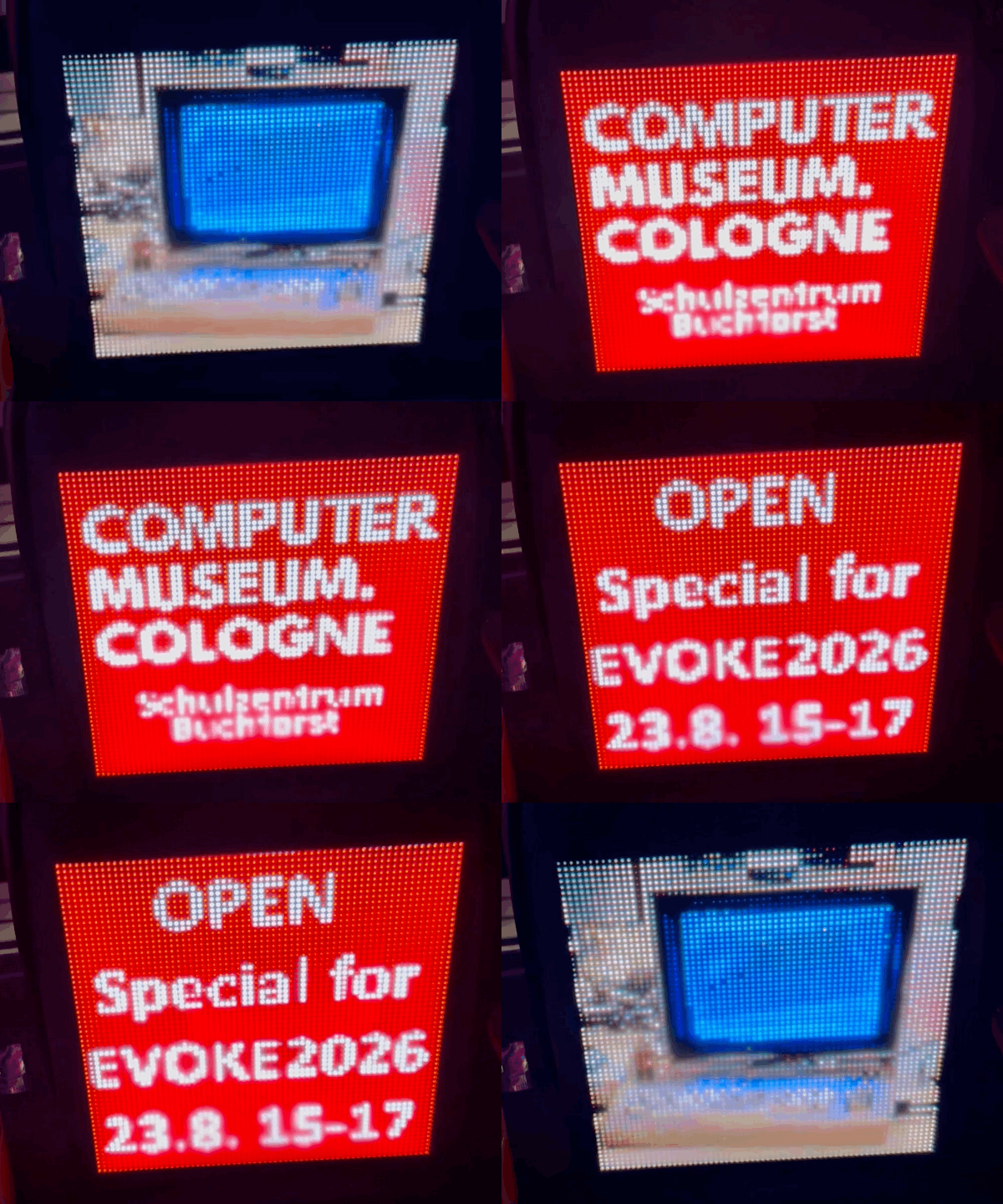
The animated invitation that lured us over to the museum in the
first place.
The museum, the Computermuseum Cologne, or CMC, is located in a school, the Schulzentrum in Cologne-Buchheim. It was started by a computer-science teacher, Nihat Sevinc, who wanted to bring old machines closer to his pupils, and it grew from a personal collection and a lot of enthusiasm into a real museum where students can not only marvel at rarities like the Commodore 64 and the very first Macintosh, but actually work on them. It is a hands-on time journey through the history of computing, built largely from donations, with a lovely emphasis on the people behind the machines.
We had a grand old time. There were wonderful Commodore PET machines, C64s, Amigas, Atari STs, a whole flock of PDAs, even a NeXTstation, and a broad selection of Apple computers spanning every era. The museum team welcomed us with open arms and showed us around. Pararaum, Zeki and I drifted through it together, and it gave us a calmer chance to talk, both among ourselves and with Canmom and with first-timer PiBaron, who had amazingly won the PC Demo competition with "Return to the Void" on Windows.
And here serendipity struck once more: PiBaron is from the UK but, like me, has Bulgarian roots. What a coincidence. The great watchmaker in the sky was clearly not done joking about.
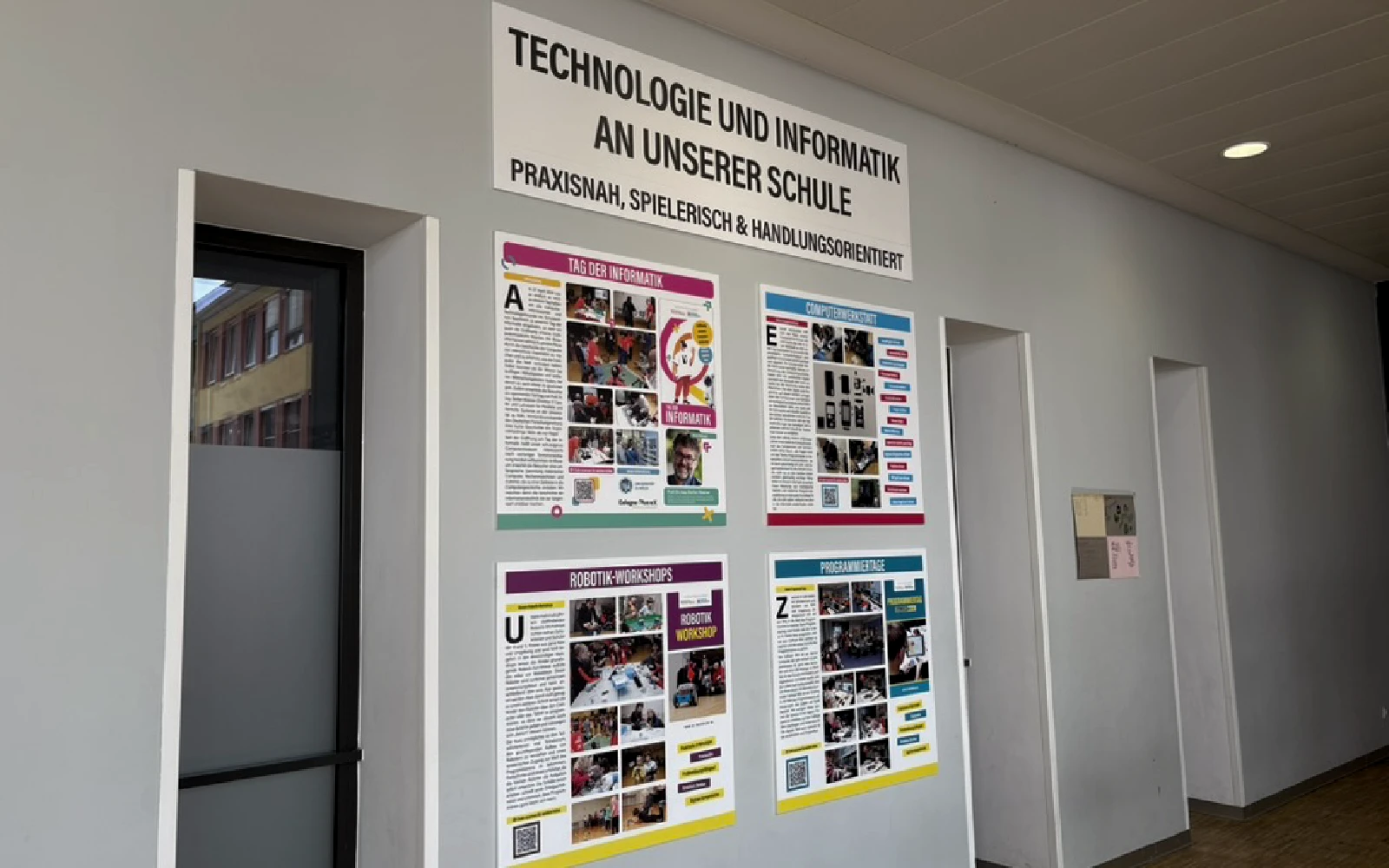
The school's IT department, unexpectedly doubling as a
museum.
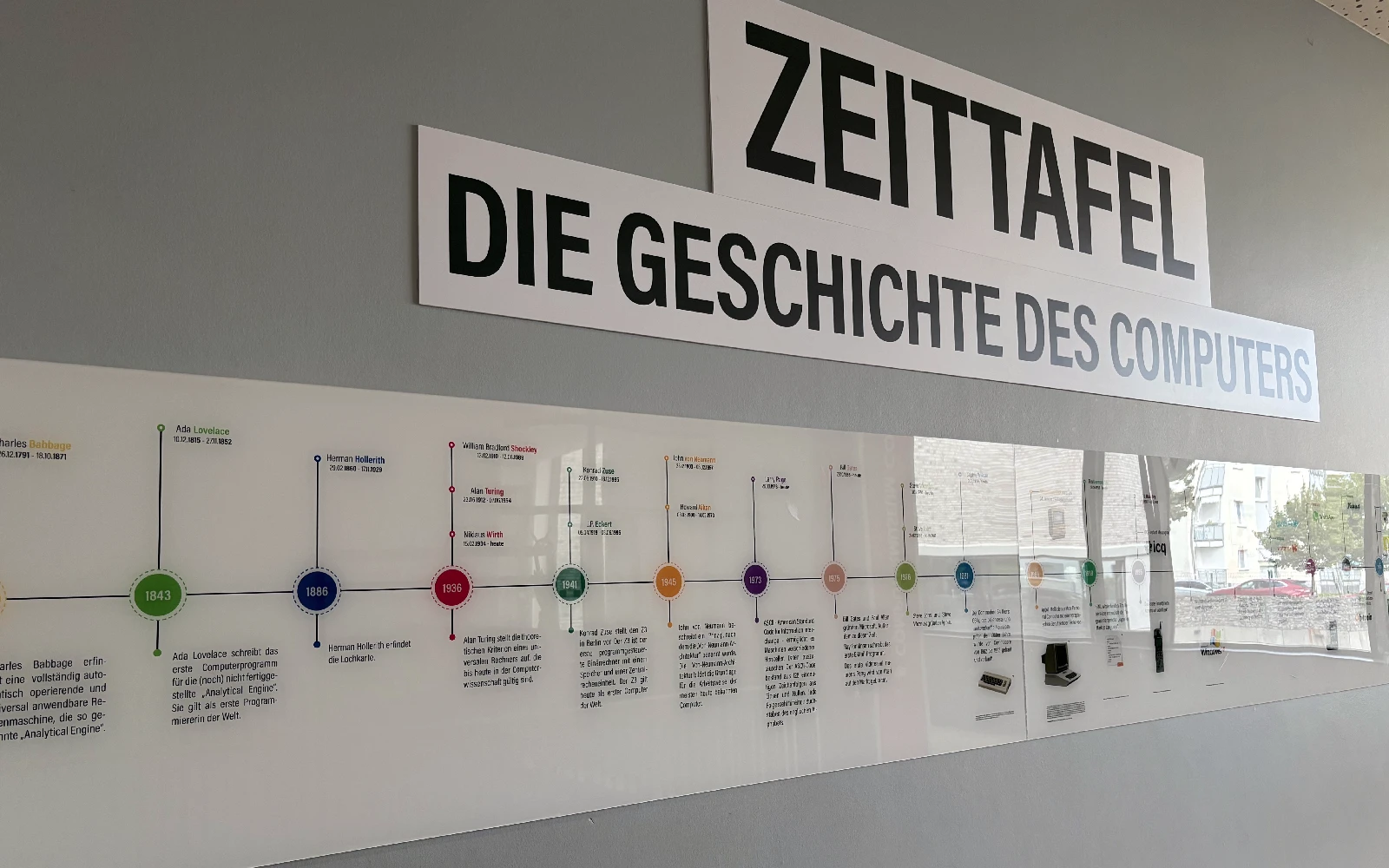
A timeline of computer history running the length of the
school wall.
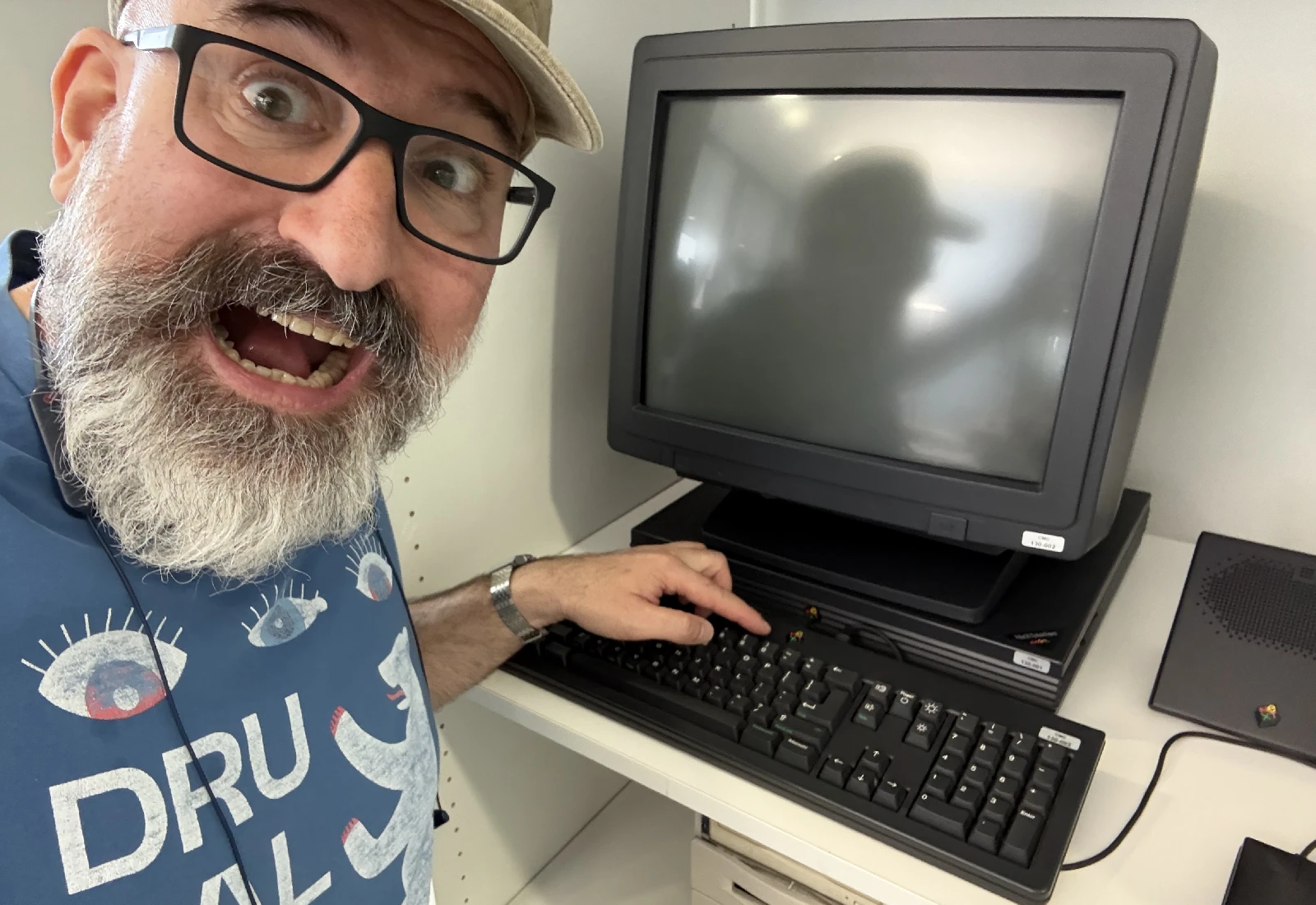
Me, failing entirely to contain my excitement at a
NeXTstation.
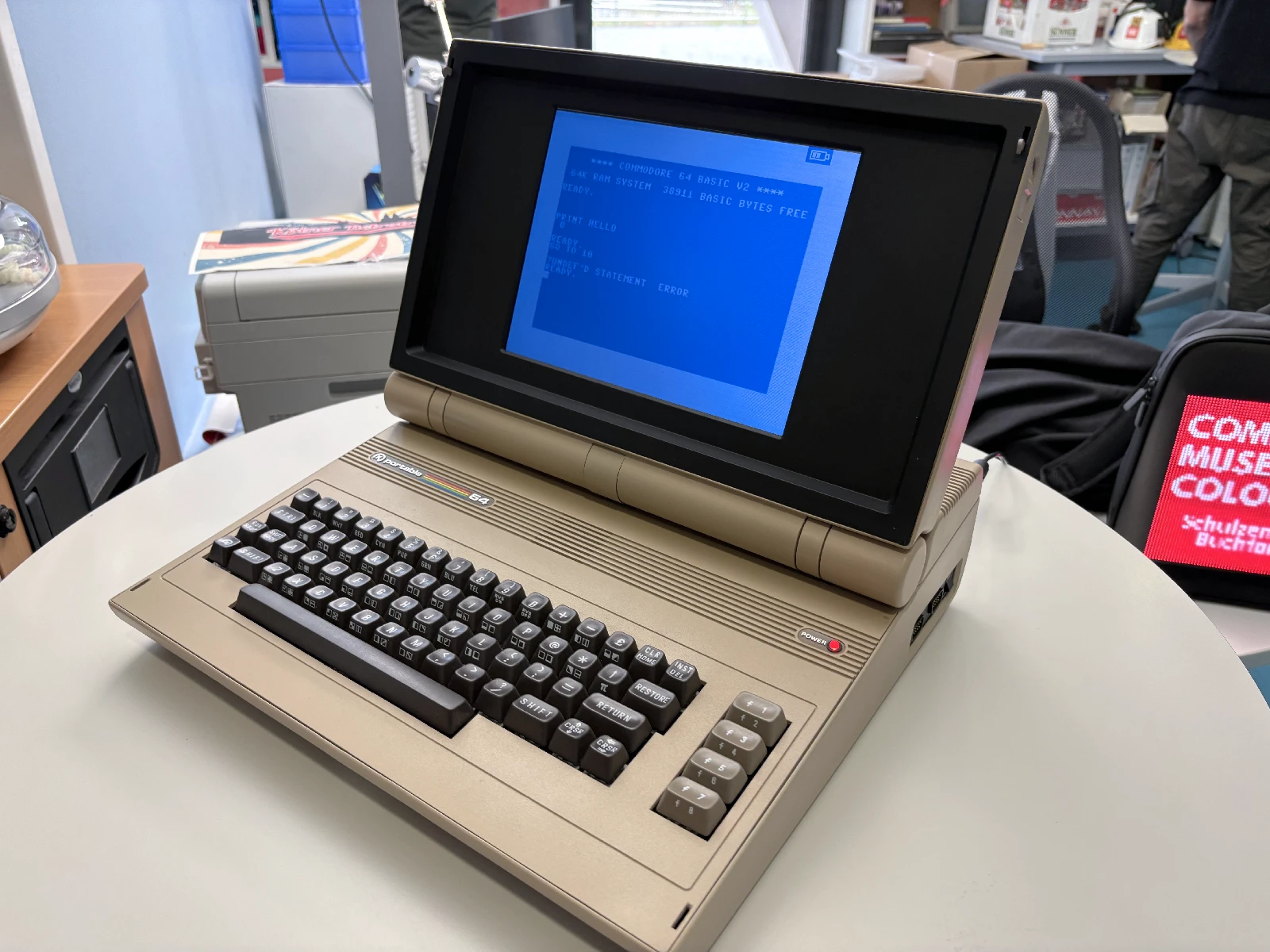
A Commodore 64 reborn as a laptop, complete with its own
LCD.
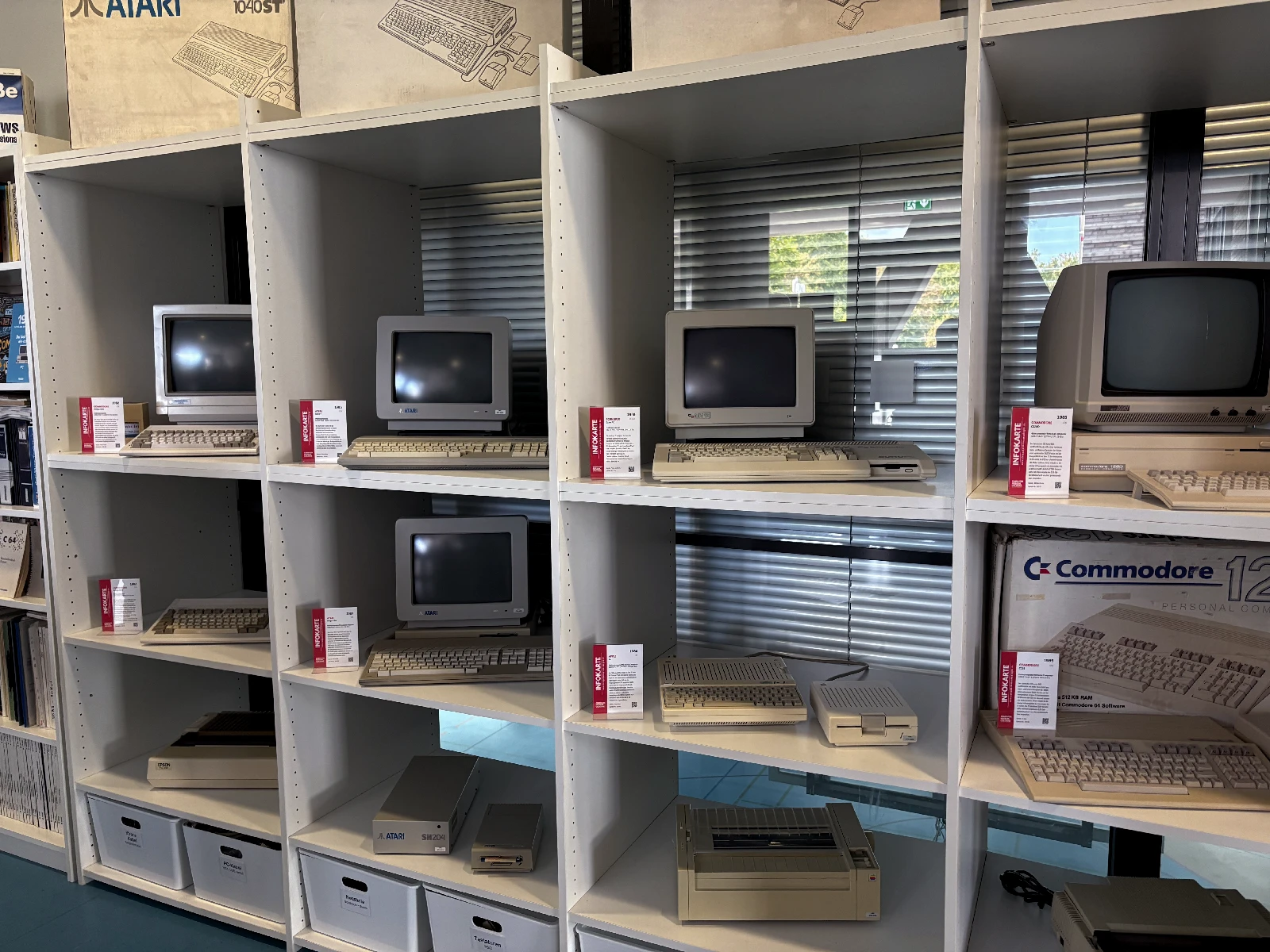
A Sunday afternoon among the machines at the Computer
Museum Cologne.
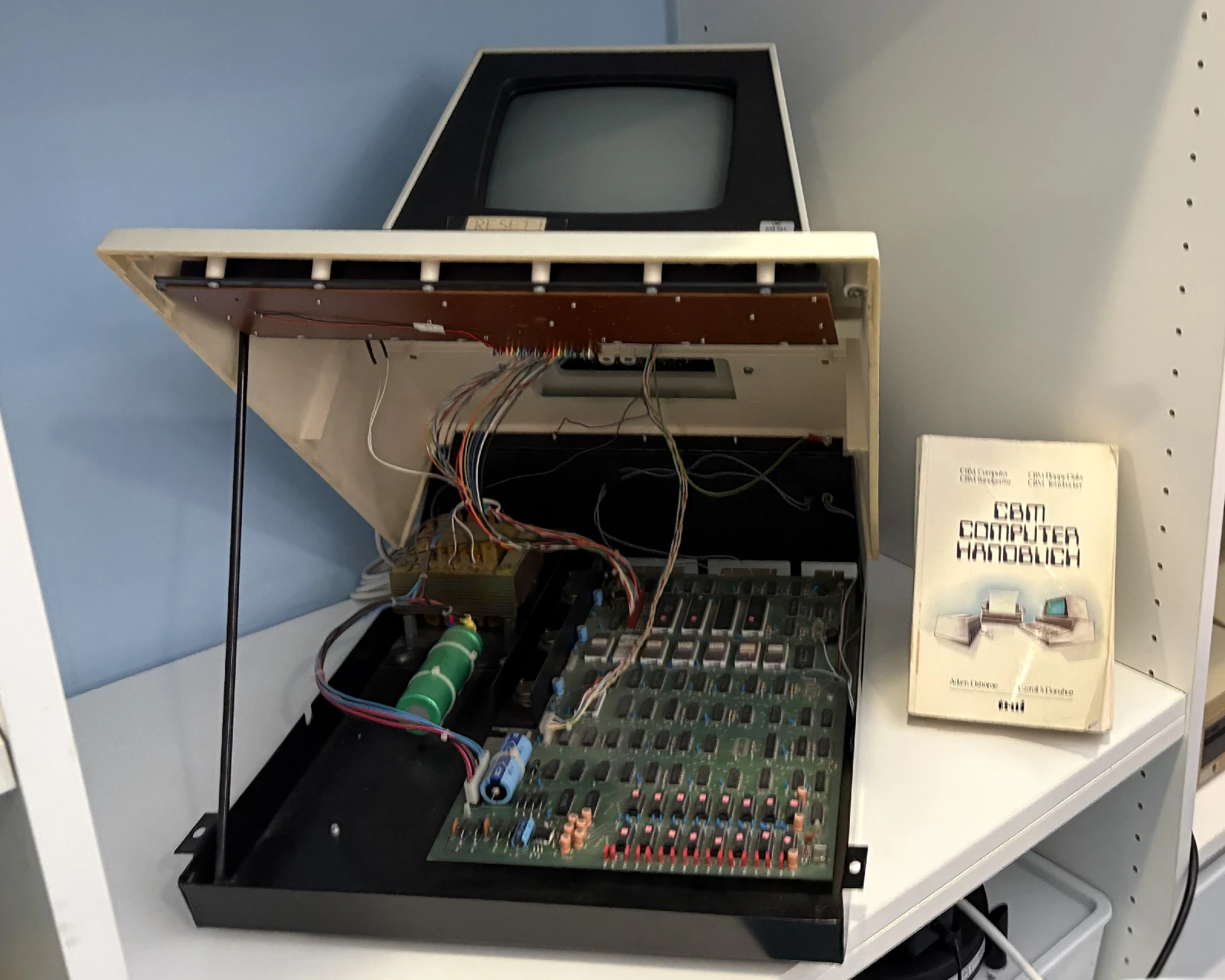
An opened Commodore PET with its mainboard laid bare.
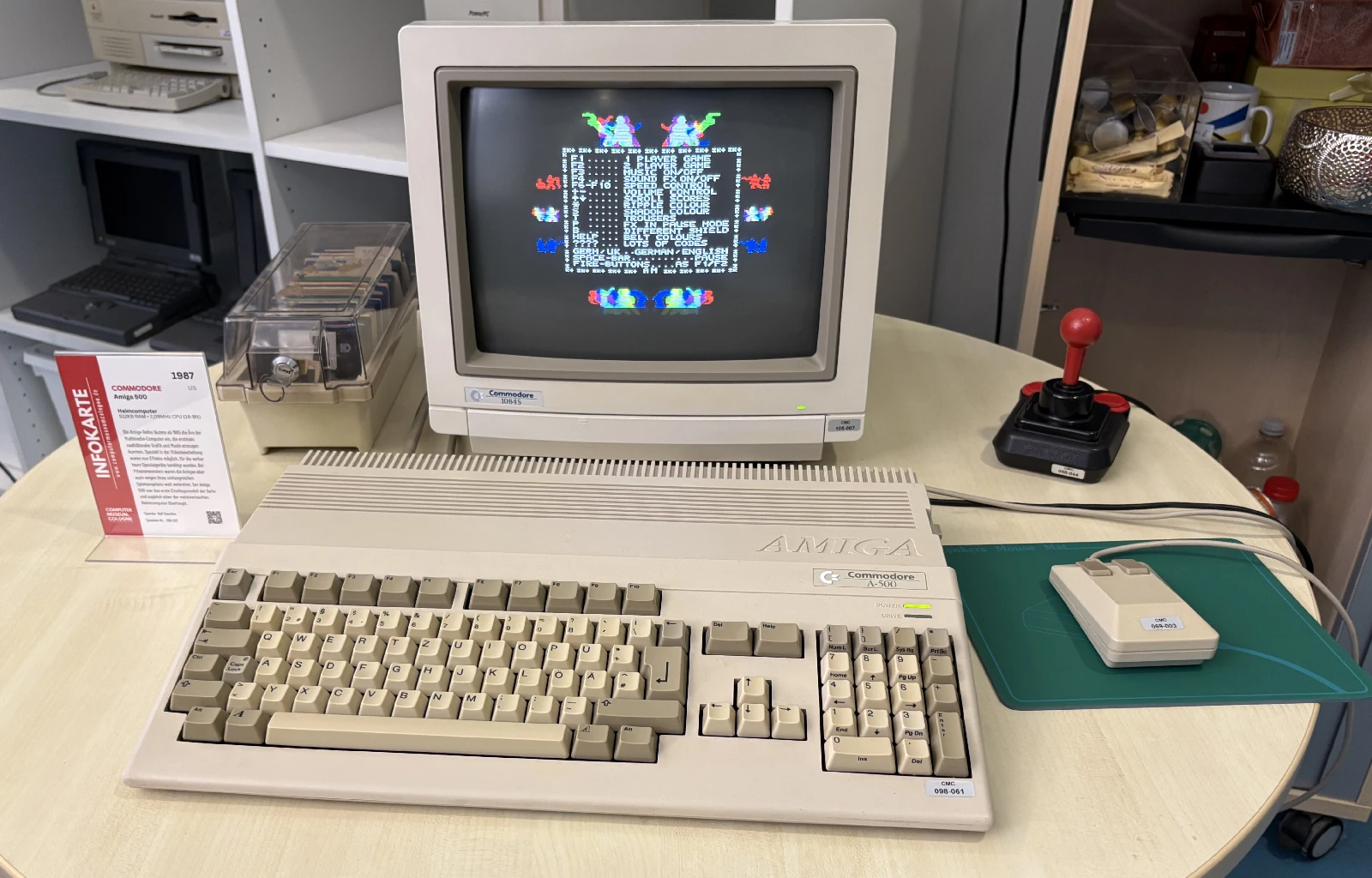
A Commodore Amiga on display. Naturally, I lingered.
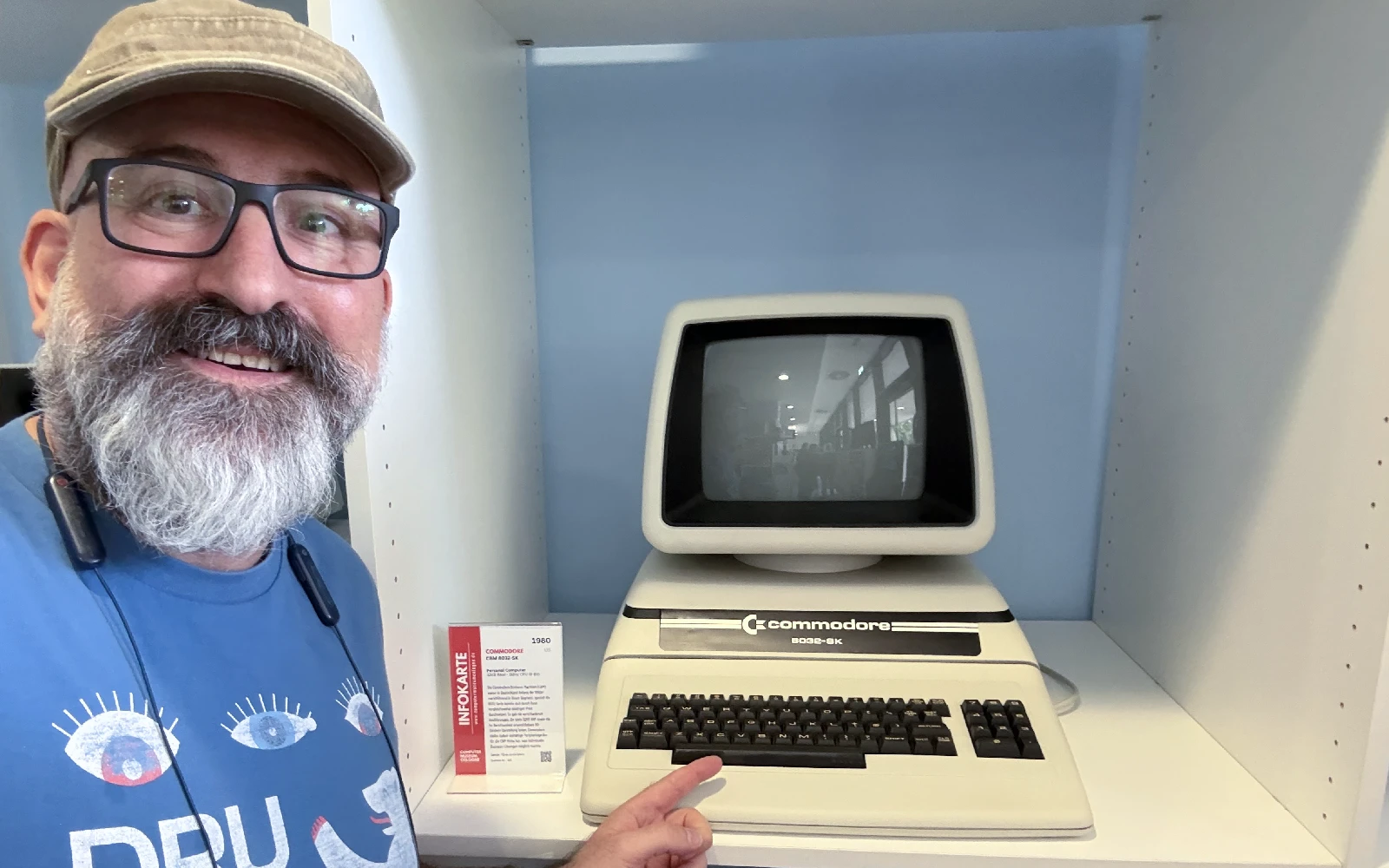
Pointing out a Commodore business machine to anyone who
would look.
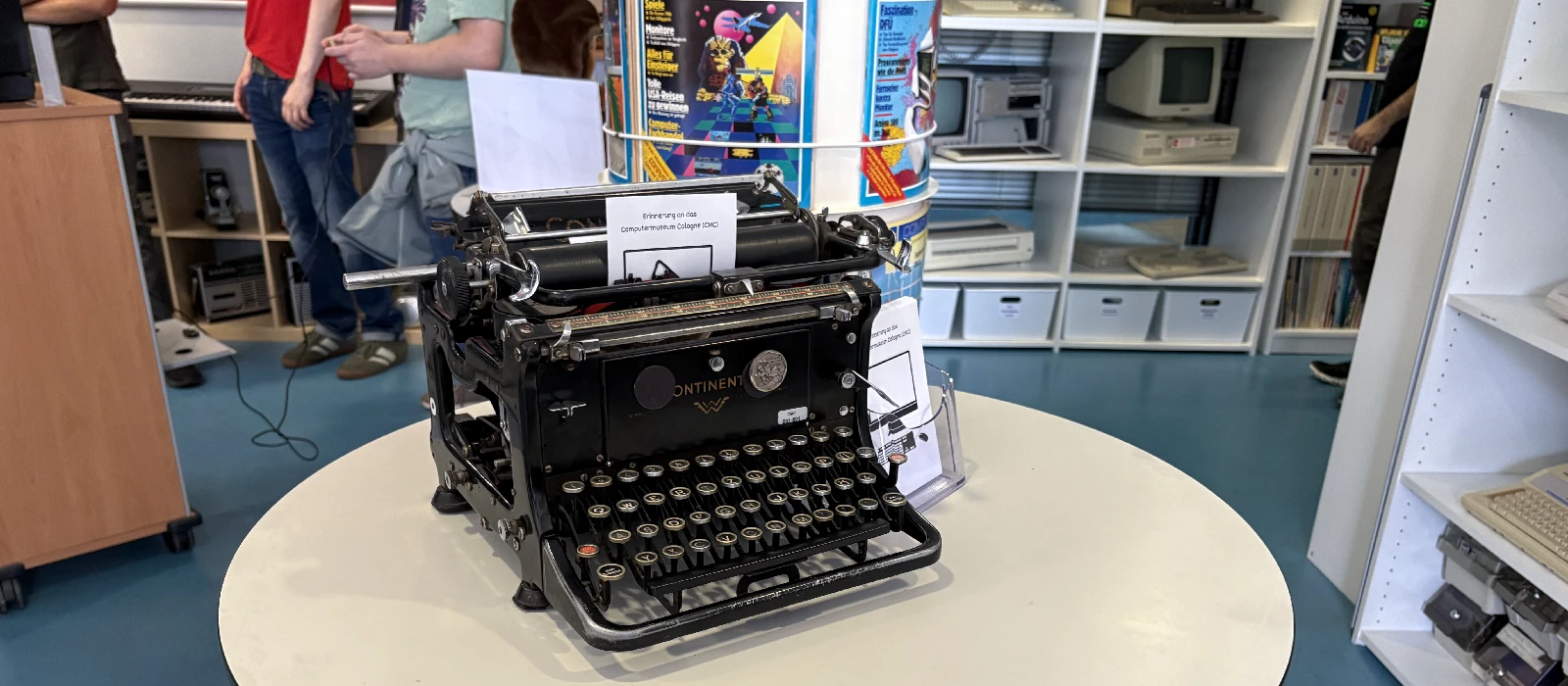
An old Continental typewriter, distant ancestor of every
keyboard in the hall.
Special thanks to the crew of the Computer Museum Cologne for their hospitality, for giving up their Sunday and their time, and for the generous guided tour they walked us through. They welcomed a whole wave of demosceners with real warmth and patience. What they have built is a genuinely great initiative: a private collection and an enormous amount of love turned into a real, living museum that deserves to be far better known. What makes their welcome even more generous is that the museum was on its summer break at the time and interrupted it specially for us: their crew came by Evoke on the Saturday, and then opened their doors on the Sunday just for the demoscene.
They even went to the trouble of putting together a blog post about their visitors from Evoke, which you can read on the museum's own blog, and they have said they are already looking forward to taking part again at Evoke's thirtieth anniversary next year.
The Official Round-Up
The official website of the event lives at 2026.evoke.eu, where the organizers not only do a wonderful job of the announcements but also put together a detailed round-up with great photos and videos. I also have to applaud the site's gorgeous design this year, crowned by a hand raising two fingers in a peace sign, a perfect little emblem for the Peace, Love and Demos spirit of the whole weekend.
The full results of all the competitions can be found on Demozoo.
And for photos while the official Evoke gallery is still on its way, Kaydee has a lovely collection from the weekend and Andersson has wonderful photos of the outdoor events. These are Kaydee's and Andersson's own, not the official Evoke set.
Iconic group Tristar & Red Sector (TRSI) has also shared their first-hand account of Evoke. AnyBody wonderfully captures the atmosphere of community creativity at Evoke. Read the full article on the TRSI website: Evoke 2026 Party Report – Pixels, Patterns and Plenty of Cologne.
And a heartfelt thank you to the whole Evoke team and the army of volunteers behind Digitale Kultur. Running a party this warm, this smoothly, and this ambitious, from the barbecue to a fully permitted drone light show over the city, is an enormous labor of love, and it shows in every detail.
You made all of this possible, and you did it with grace and generosity. Thank you.
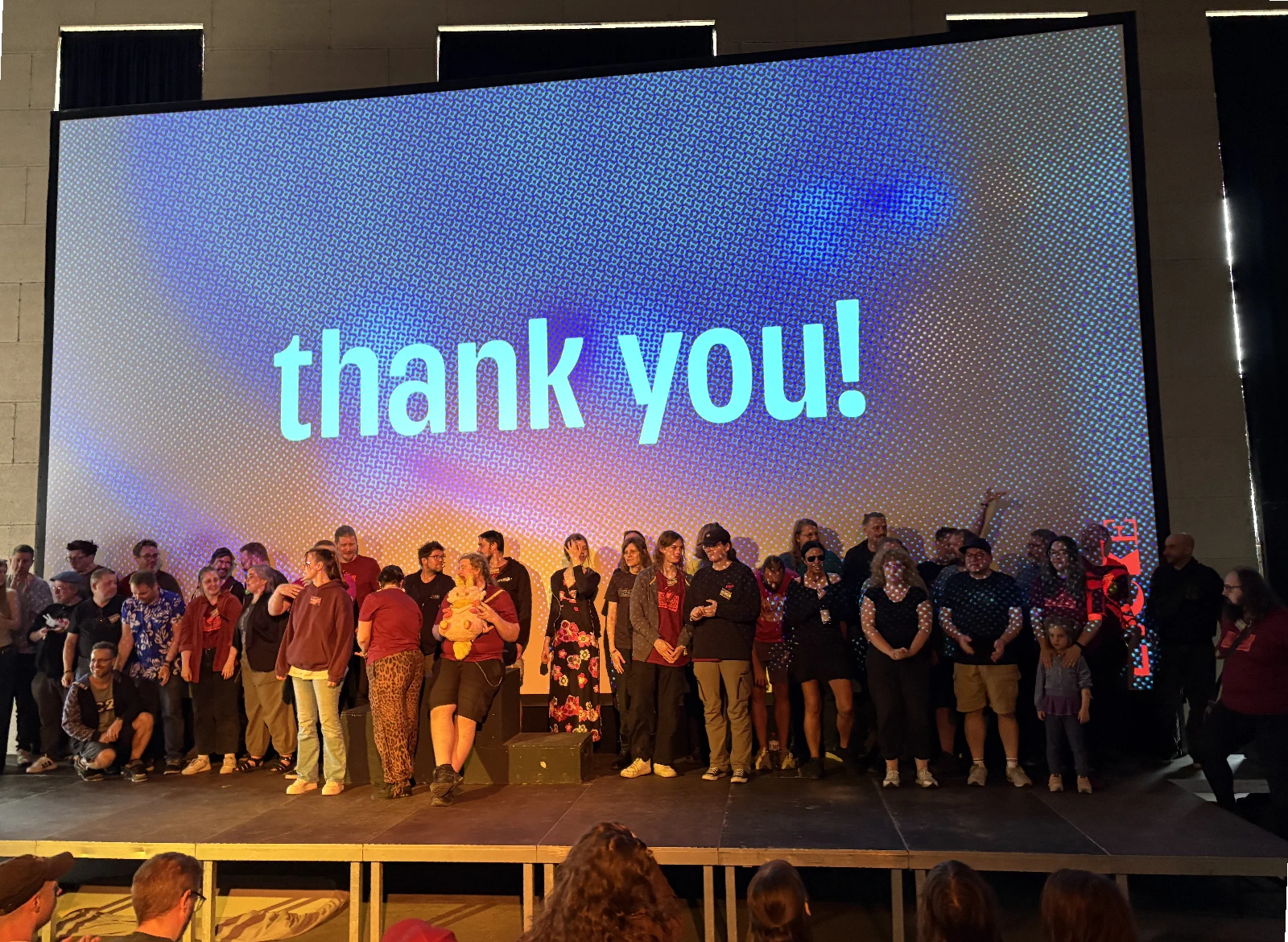
The organizers taking a well-earned bow on stage as the party
drew to a close.
Flying Home
I flew back home late in the evening, tired in the good way, with the deep and simple feeling of having been part of something wonderful, surrounded by such talented and enthusiastic people. That feeling is the real reward.
I sometimes worry that when I write about something as curiously specific as a wasp stealing a chunk of sausage, or a street sign, or a 10 KV box, some readers might imagine that nothing else happened. A great deal else happened. Some of it was personal, and I would rather keep it to myself. Some of it I have simply forgotten. And some of it I judged not especially interesting or new, given how many Evoke reports I have now written. These are simply the moments that stayed with me.
This was my fifth Evoke, and it may well be my last for a while. The Chaos Communication Camp comes around only once every four years, and the next gathering falls in August 2027. Its exact dates have not been announced yet, but I have already made my choice. A summer is limited, and so am I, and rather than split myself between the two, I am giving my time and energy to the Camp. If this was my Evoke to pause on, it was a really fine one to pause on.
The motto asked us to find peace in the process, and, against the noisy and often frightening backdrop of the wider world, I think I did. I found it in crowd of beautiful nerds, in a runaway drone with a secret life, in the dark and considerate hall at three in the morning, and in a friend patiently explaining an oscilloscope to anyone who would slow down long enough to listen.
Thank you for letting me share a glimpse of it.
See you in the process. Peace out!
All photos in this article were taken by me. Where people are visible, I've done my best to obscure their faces out of respect for their privacy, unless they have already made themselves public on the official Evoke website or Twitch stream.
* When I posted this article on Reddit, the scener Faxe kindly brought to my attention that Thessaloniki has been one of Cologne's twin cities since 1988, and Thessaloniki-Allee. The street was officially named in 2004, is one of a whole cluster of streets in this corner of Kalk named after Cologne's partner cities. Barcelona-Allee runs close by, and there is even a sculpture, Kosmische Union ("Cosmic Union"), standing in honor of those partnerships. So Thessaloniki-Allee was not the universe honoring me. The great watchmaker in the sky can have a laugh. I'm charmed regardless. ↩