ST-News Disk Mag
A Digital Archaeological Analysis of Its Evolutionary History and Cultural Impact
ST-News was one of the first disk mags I ever read. And what a catch it was! A true labour of love, made by enthusiasts for enthusiasts. That infectious passion completely captured my heart. All issues of ST-News are preserved on its creator Richard Karsmakers' website, and a few years ago I set out to write a paper about this disk mag for my university studies. It never quite happened... until now. Here is the revised and expanded version of that original article (I kept the pretentious title).
May 2026
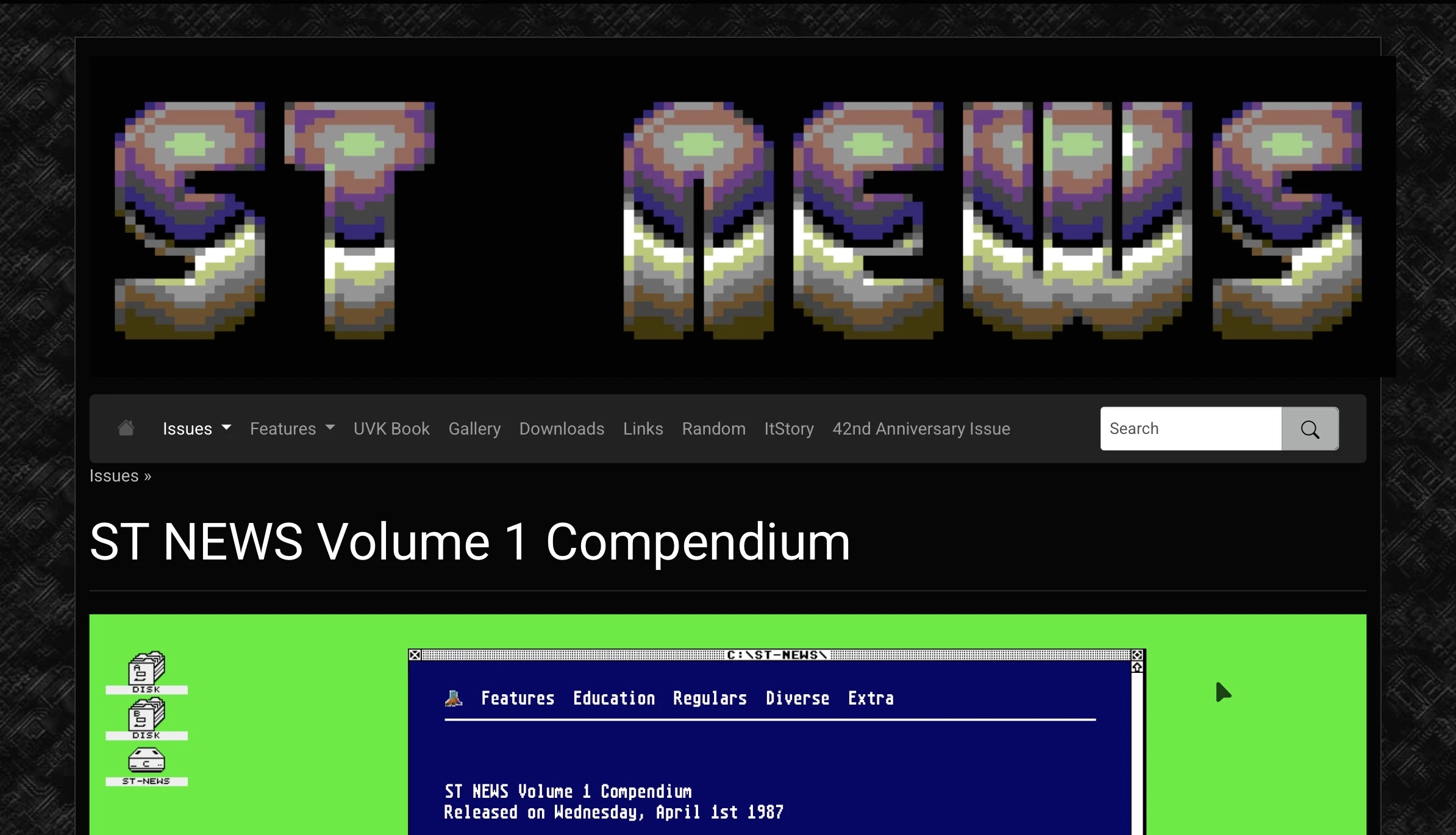
The ST-News website, preserving the very first issue for posterity (and all others too).
In the 1970s and 1980s, disk magazines were mostly amateur-made media distributed on floppy disks through mail order or public domain libraries in computer clubs. Together with Bulletin Board Systems (BBS), those dial-in computer mailboxes that predated the web, disk mags were the primary medium for digital subcultures in the mid-1980s. They represented a fundamental shift in how technical knowledge and artistic expression were distributed and shared. They formed the identity of early digital communities.
Among the various publications that appeared on the Atari ST platform, ST-News stands out as probably the most remarkable artifact of this era. It documented a decade of rapid technological change and the professionalization of the European computer scene from 1986 to 1996. I wanted to understand the significance of ST-News beyond my mere personal affection for it... so I decided to analyze the intersection of the Atari ST hardware architecture, the specific programming environments of the time, and the social dynamics of the demoscene that provided both the magazine's staff and its core readership. And honestly? Most of all it was just plain fun.
If you are interested to explore the original issues of ST-News, you can find an archive hosted at st-news.com. This is a truly wonderful preservation effort, providing public access to the complete run. In this article I'd like to attempt an examination of the magazine's history, technical development, and cultural legacy. For this I'll be drawing on historical records, editorial reflections, and technical documentation. The primary source for everything here is the disk mag itself. It is, of course, a very personal and biased view. If that's okay with you then welcome to ST-News! Let's jump into the past.
The Genesis of ST-News and the Atari ST Ecosystem
The birth of ST-News was deeply tied to the specific market conditions of the mid-1980s and the Atari ST personal computer. Following the acquisition of Atari's consumer division by Jack Tramiel, the company released the Atari 520ST, a 16-bit machine designed to compete with both the aging 8-bit market and the upcoming Commodore Amiga. The architecture of the ST, led by Shiraz Shivji, utilized the Motorola 68000 CPU and a bitmapped graphical user interface (GEM), providing fertile ground for high-resolution graphics and sophisticated software that surpassed the capabilities of the previous generation. Its operating system, TOS, was developed by Digital Research, and its user interface was built around windows, icons, the mouse, and drop-down menus. All very modern for its time.
It took a while for the Atari ST to make its way to Europe, so it was something of a surprise when the young Dutchman and proud ST owner Richard Karsmakers released the first issue of ST-News already in the summer of 1986. The disk mag's content didn't yet run a standalone application. Instead, it was a 35-kilobyte document formatted for 1st Word, the leading word processor for the Atari ST. The initial distribution relied on "user meetings," where enthusiasts would physically copy disks, just as public domain software (and, ahem, pirate releases) were passed around. 1st Word was a practical choice since the early Atari ST lacked any specialized viewing software.
Early Technical Transitions and the Influence of GFA Basic
ST-News did not remain a 1st Word text file for long. When the Canadian commercial disk magazine F.A.S.T.E.R. was released as a standalone multimedia application in late 1986, it was a revelation to Karsmakers. F.A.S.T.E.R. used a GEM-based user interface that let readers navigate articles via menus, and it immediately showed Karsmakers the direction ST-News needed to go. He wanted ST-News to be just as good... or even better!
The main challenge was that the Atari ST shipped with completely inadequate programming tools. The original ST Basic was widely criticized as "simply horrible." It lacked the performance and flexibility required for a high-quality multimedia magazine. The solution arrived in the form of the third-party GFA Basic, a powerful and fast BASIC interpreter that allowed developers to access the ST's hardware directly and use GEM routines with relative ease. This shift enabled Karsmakers and his early collaborators to build a custom shell that could weave together text, graphics, and music into a single, cohesive experience. It marked the end of ST-News as a mere text file, and the beginning of something much more exciting.
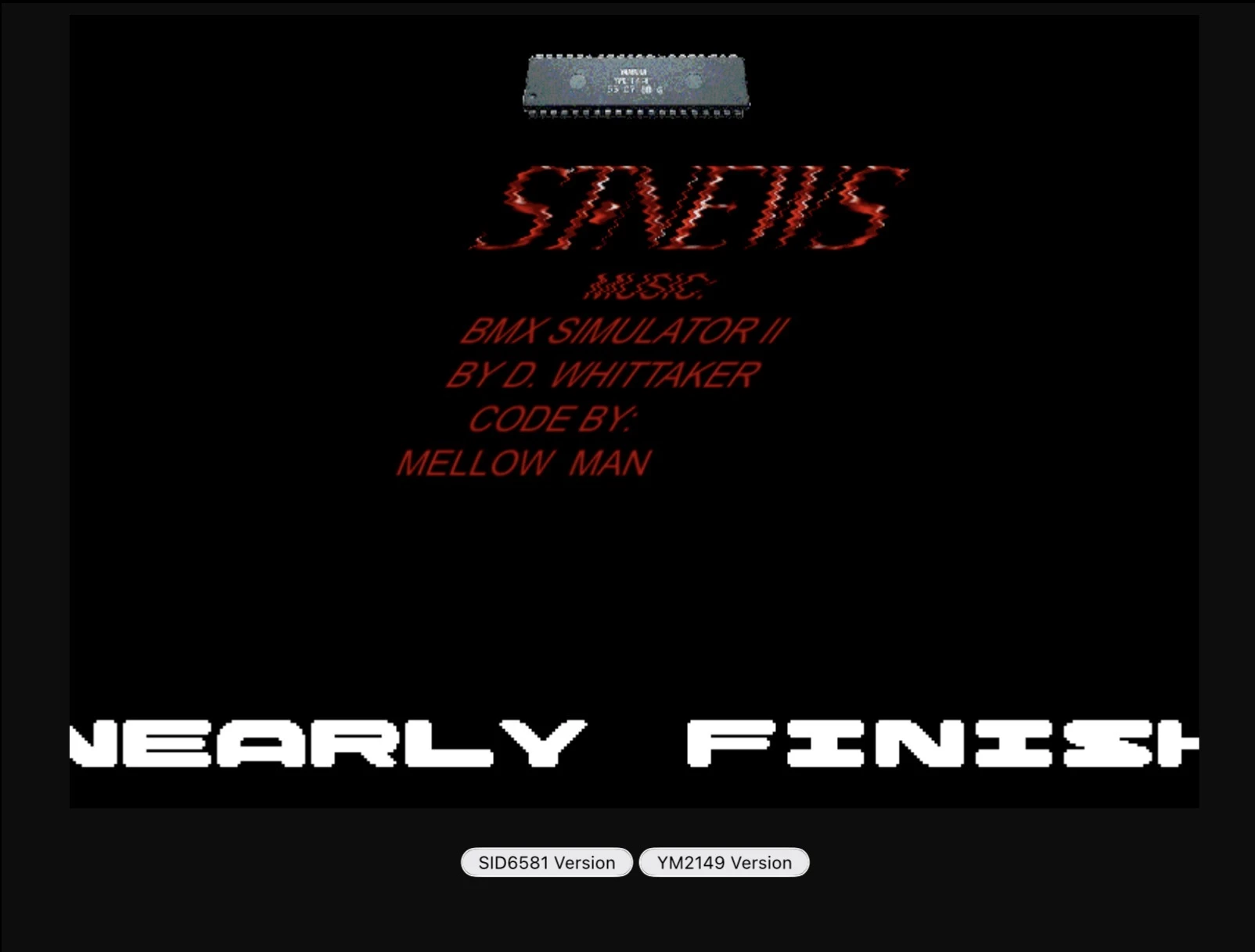
The iconic scrolling text screens that became a hallmark of the ST-News experience.
| Feature | ST Basic (Original) | GfA Basic (ST-News Standard) |
|---|---|---|
| Performance | Interpreted, slow execution | Compiled/Fast execution |
| GEM Integration | Rudimentary and difficult | Comprehensive and native |
| Multimedia Support | Limited | High (Music, Sprites, Scrolling) |
| Legacy | Largely abandoned by 1987 | Preferred tool for editors and games |
Maturation and the Volume 2 Era
Volume 2 of ST-News (eight issues across 1987) marks the publication's transition from a hobbyist experiment into a professional-grade disk mag (though it was still very much made by honest-to-God enthusiasts). By this point, the magazine had adopted a sophisticated user interface and was beginning to attract an international audience.
During this period, the editorial team expanded to include Stefan "Digital Insanity" Posthuma, a former Commodore 64 programmer who brought a wealth of technical expertise to the table. Posthuma's contribution was vital: he optimized the magazine's engine. He replaced slow GFA Basic routines with high-performance assembly language code for critical tasks like the scrolling message screens that had become a staple of the demoscene aesthetic. This technical synergy between Karsmakers' editorial vision and Posthuma's coding skills allowed ST-News to outshine many of its competitors.
Editorial Philosophy and Cultural Influences
The identity of ST-News was inseparable from the personal interests and subcultural affiliations of its editors. They shared a love for heavy metal and synthesizer music, action cinema, and the works of Douglas Adams. This gave the magazine a unique editorial "voice": authoritative and irreverently funny in equal measure. The influence of Douglas Adams in particular permeated every corner of the magazine, manifesting in the recurring use of the number 42, references to Wowbagger the Infinitely Prolonged, and the creation of the "Ultimate ST-News Reference Guide."
This distinct personality was a key differentiator from the mainstream "paper" magazines of the era. While publications like the US print magazine ST Log maintained a professional, corporate tone, the ST-News disk magazine was a direct line into the underground scene, a platform where the boundaries between developer and fan, professional and amateur, were constantly and gleefully blurred.
What Types of Articles Were Featured in ST-News?
Written with an infectious, late-night energy, blazing passion, and a healthy dose of sharp Dutch wit by Richard Karsmakers, Stefan Posthuma, and a global network of contributors, ST-News became the pulsing heartbeat of the Atari ST underground community.
(It's worth noting that the commercial print magazine ST Format, which bundled a cover disk packed with playable game demos and software samples, quickly became the main organ of the "official" Atari ST community in Europe. ST-News and ST Format operated in very different registers: one was the slick, newsagent-friendly face of the platform; the other was its beating underground heart.)
Here are some of the types of articles you could find in a typical issue.Game & Application Reviews
ST-News delivered brutally honest, deeply passionate reviews of the latest ST software. No corporate marketing fluff here!
- The Gaming Front: First-hand accounts of booting up visual powerhouses from Psygnosis, arcade masterclasses from Gremlin Graphics, or quirky little games from Hewson, complete with breakdowns of gameplay mechanics, frame rates, and whether a game truly pushed the ST hardware to its limits.
- The Power Tools: Beyond entertainment, the magazine offered deep-dive reviews of the hardware and applications shaping the digital frontier. This ranged from art packages and desktop publishing suites to cutting-edge dev packages and MIDI applications, evaluated by people who actually used them to create.
Exclusive, Intimate Interviews
ST-News excelled at tracking down the absolute royalty of the 16-bit era, featuring candid, technical, and often hilarious conversations with legendary programmers, visionary creators, and the chip-music gods. This culminated in the LateST NEWS Quest, where Karsmakers and Posthuma set out to interview the greatest personalities related to the Atari ST across the UK and Europe (more on that below).
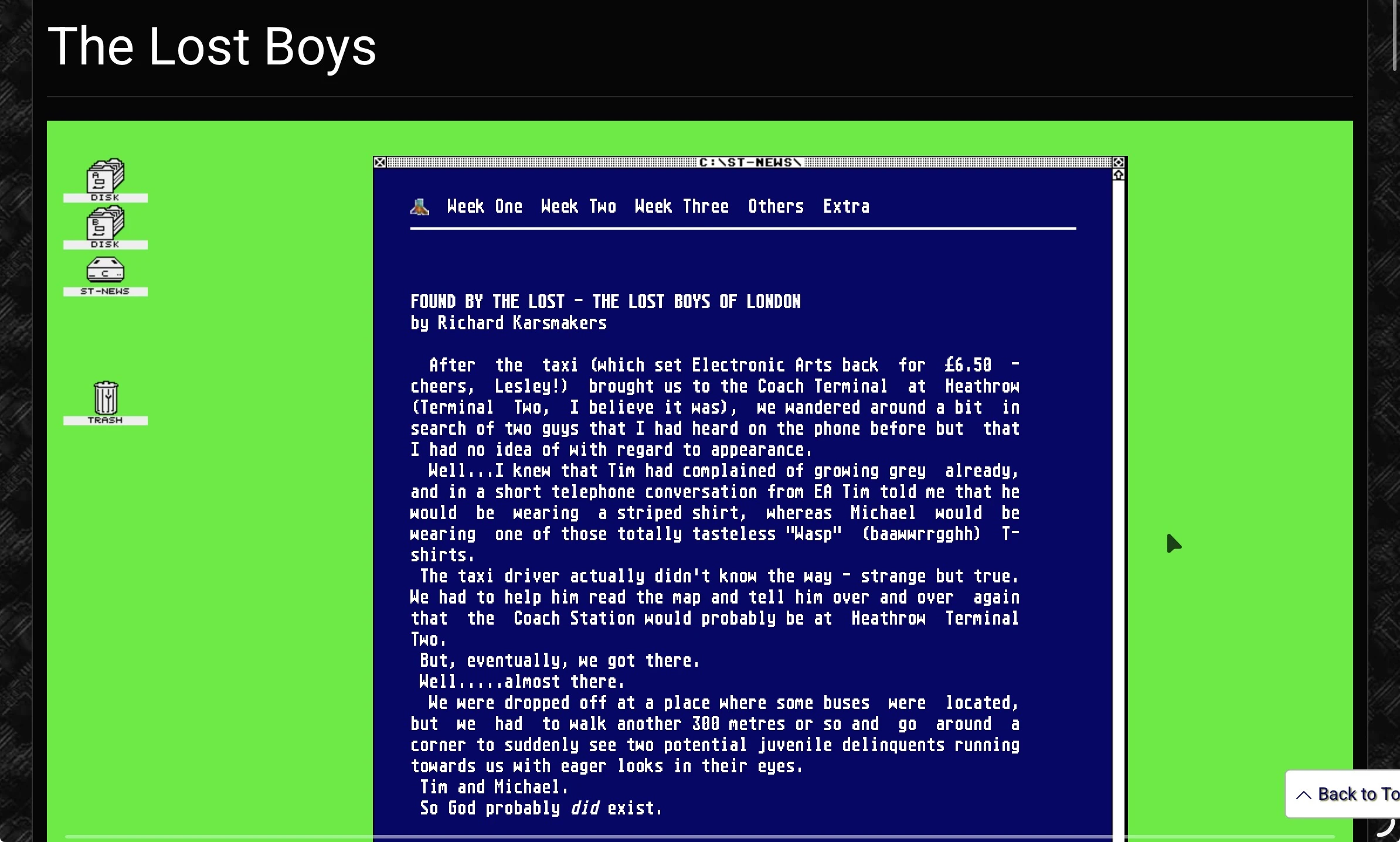
ST-News interviewing The Lost Boys. This was the kind of exclusive access that made the mag unmissable.
Definitive Text Adventure Solutions
Back in the late '80s and early '90s, when you got hopelessly stuck in a sprawling, atmospheric interactive fiction masterpiece by Infocom, Magnetic Scrolls or Sierra-Online, there was no internet to save you. ST-News regularly published comprehensive, step-by-step walkthroughs guiding you through the parser traps of Zork, Guild of Thieves and King's Quest with considerable flair.
Electric News from "The Scene"
ST-News was its premier investigative broadcast on the Atari ST demoscene. It became the ultimate underground news source for the computing counter-culture. Wild, chaotic, first-person party reports chronicled road trips and international demoparties, detailing the sleep-deprived triumphs of legendary groups like the Lost Boys. And up-to-the-minute "code war" updates covered who released the latest mind-bending megademo, who cracked what, and which coder just achieved an "impossible" hardware raster trick.
And there was so much more. Many articles didn't fit into any neat category. Some were stream-of-consciousness deliveries, some were short stories, others were long and charmingly rambling appreciations of writers like J.R.R. Tolkien or Douglas Adams. Wonderful, the lot of them.
The Demoscene and the Professionalization of Hobbyism
For me, the most central theme in the history of ST-News is its symbiotic relationship with the Atari ST demoscene. This is the grassroots movement of coders, artists, and musicians who competed to create non-interactive "demos" that pushed the computer's hardware to its absolute limits. ST-News became the primary chronicler of this community, providing space for interviews with prominent sceners and reviews of the latest demo releases. The magazine was mainly affiliated with the first demosceners on the Atari ST: The Exceptions (TEX). Karsmakers even became a member and contributed scrolling text to their legendary B.I.G. demo (Best in Galaxy). All of this while they remained anonymous, having been involved in the earlier cracking and piracy scene.
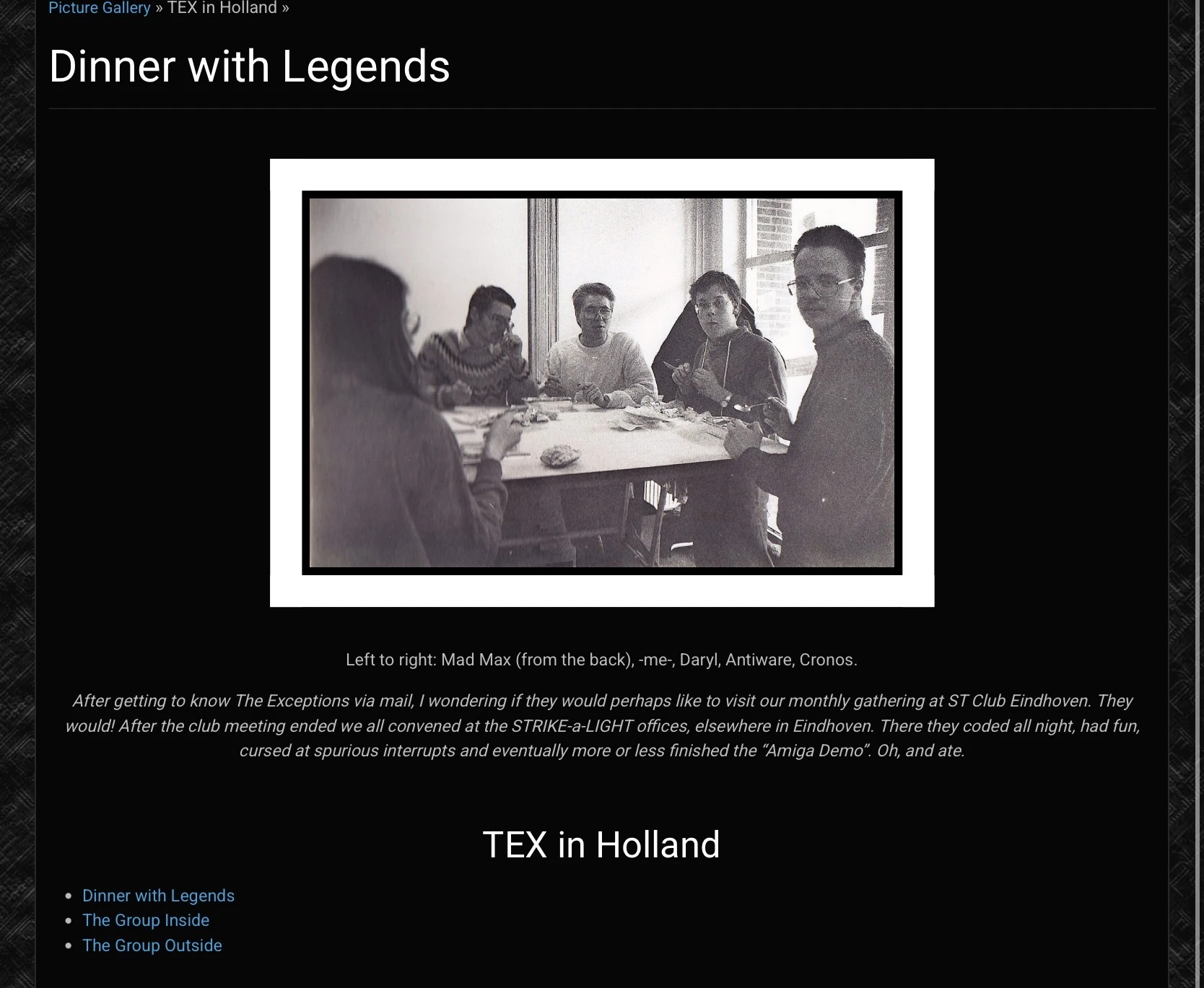
ST-News meets The Exceptions. The close relationship between the mag and TEX was central to both.
The disk mag's involvement with the scene culminated in the ST-News International Christmas Coding Convention (STNICCC), held in December 1990 in Oss, Netherlands. Organized by the ST-News staff, the convention brought together nearly every major European ST coding crew, including The Lost Boys (TLB) and The Exceptions (TEX). It facilitated the release of monumental megademos and remains a legendary moment in the history of digital subcultures.
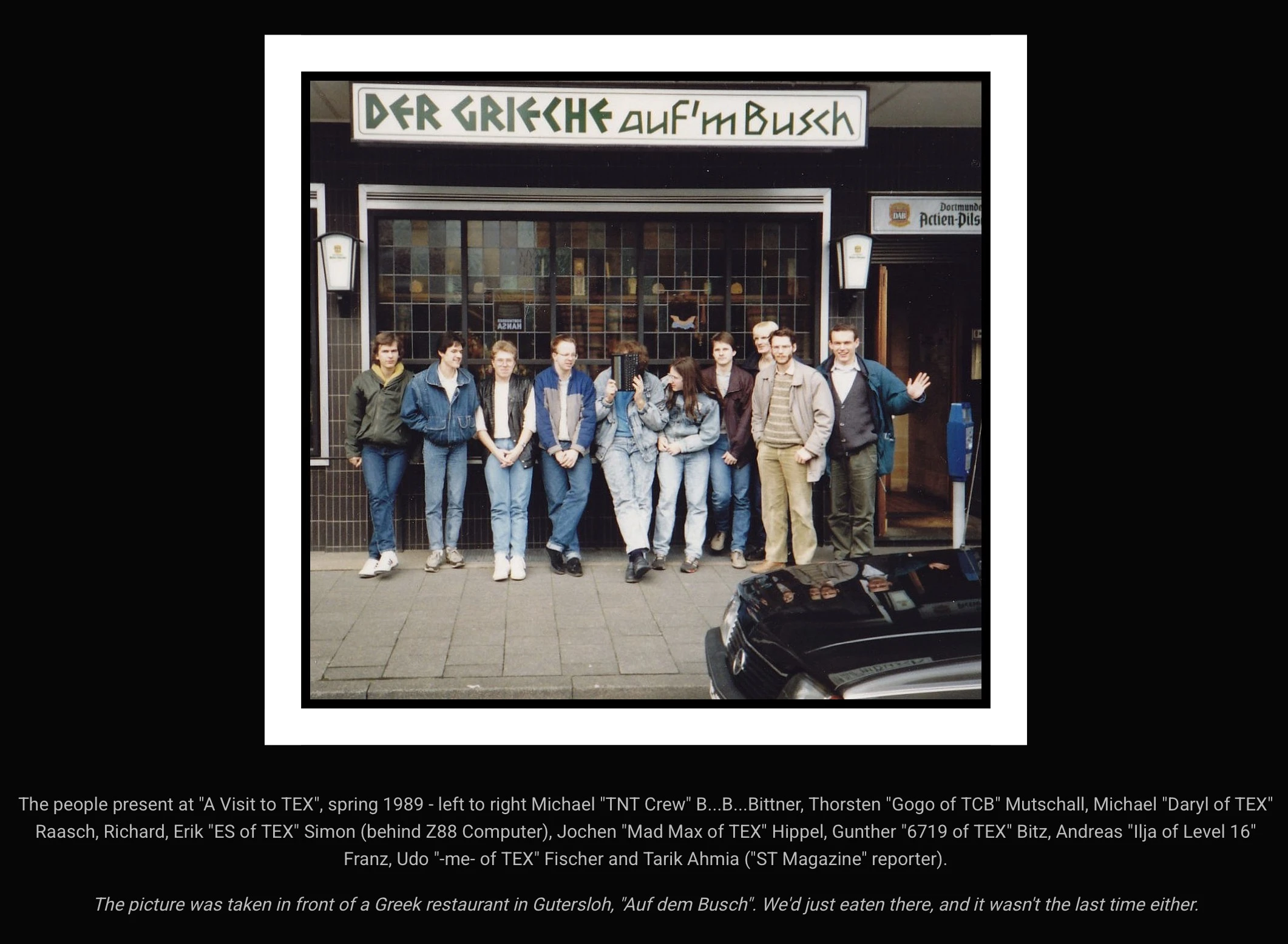
The kind of legendary gathering that ST-News both documented and inspired.
The Z88 of Richard Karsmakers
In an era long before ubiquitous Wi-Fi, smartphones, or modern laptops, Richard Karsmakers pioneered a brilliant form of mobile journalism using Sir Clive Sinclair's Cambridge Z88 portable computer.
Weighing less than a kilogram and running for up to 20 hours on four standard AA batteries, the Z88 was a superb lightweight writing tool for a tech reporter on the move. Karsmakers would carry the sleek, silent-keyed device straight into the loud, chaotic environments of European demoparties and Atari user meetings. Using its built-in word processor, PipeDream, he could type up detailed, real-time impressions, party reports, and interview notes right on the spot. Once the event was over, he'd connect the Z88 to his Atari ST via a null-modem cable and transfer the raw text files across. It was an elegantly simple, low-friction workflow that gave his reports an unmatched "live from the scene" immediacy.
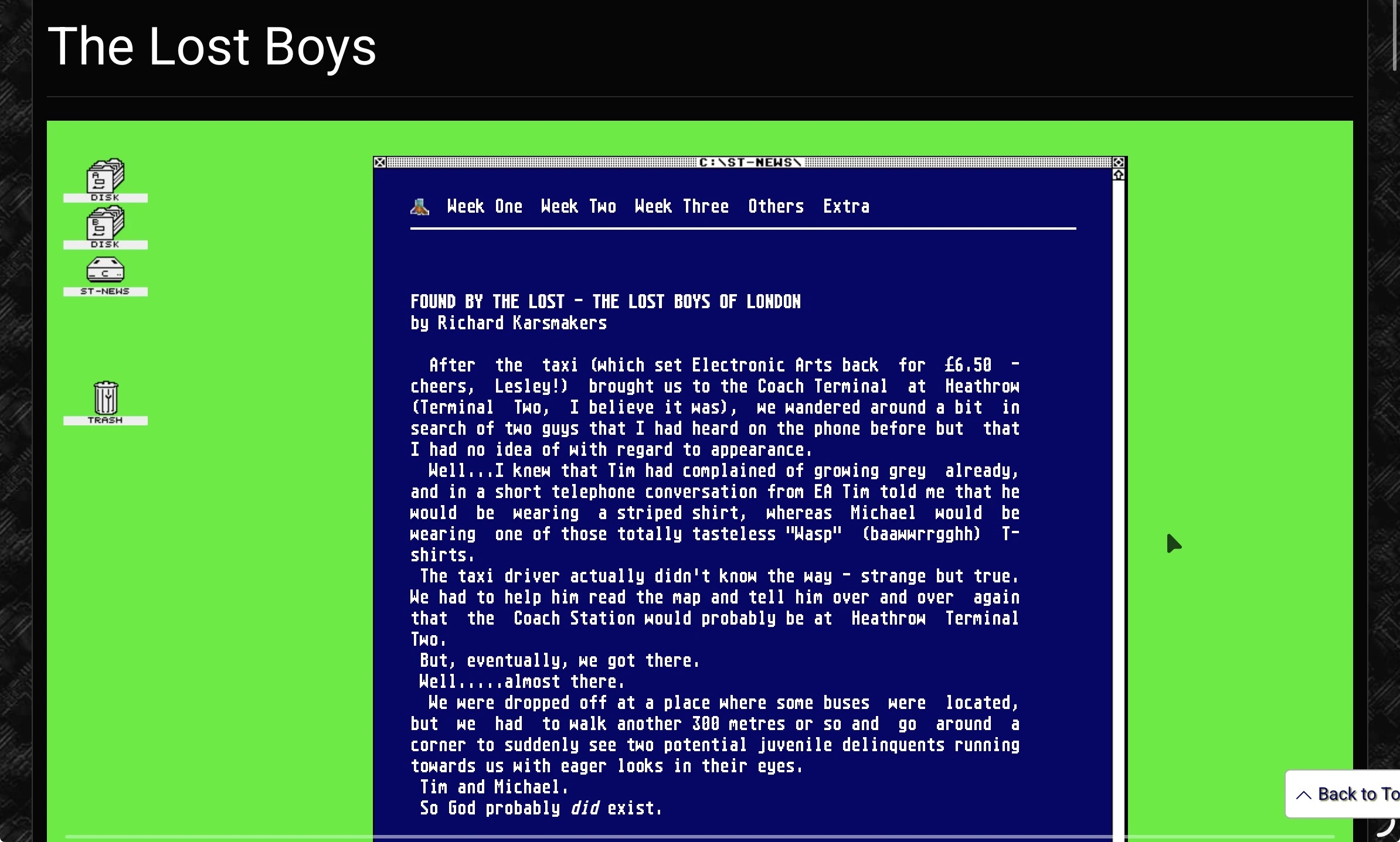
The Cambridge Z88. Karsmakers' trusty mobile journalism companion, decades before the term existed.
It was so wonderfully ahead of its time that I channeled that exact retro-tech spirit at 39C3 in December, using my AlphaSmart Neo2! There is something uniquely focused and satisfying about using a dedicated, distraction-free writing tool in the middle of a massive hacker congress. It forces you to experience the event through a completely different, highly deliberate creative lens.
The Role of Music and Jochen Hippel
Music was an essential component of the ST-News experience, providing a continuous aural backdrop to the reading process. Jochen "Mad Max" Hippel was a prolific music programmer known for his work with The Exceptions (TEX), and he became a regular contributor to the magazine. His ability to convert complex Commodore 64 SID tunes to the ST's YM2149 sound chip was remarkable, lending ST-News a professional quality that rivaled commercial games. Hippel later went on to compose original music for Thalion Software.
| Composer | Group | Notable Contribution to ST-News |
|---|---|---|
| Jochen "Mad Max" Hippel | TEX / Thalion | Provided music from Volume 2, Issue 5 onwards |
| Rob Hubbard (Conversions) | N/A | Early issues featured conversions of his classic tunes |
| Various Scene Musicians | Various | Occasional guest tracks and demo soundtracks |
The LateST NEWS Quest and the UK Industry
In the late summer of 1989, Richard Karsmakers and Stefan Posthuma embarked on a two-week investigative trip to the United Kingdom, which they dubbed the LateST NEWS Quest. This journey was documented in Volume 4, Issue 4, structured as a chronological travel diary, a notably unconventional format for the time. During the Quest, the team visited the offices of the UK's most influential software houses, providing a rare behind-the-scenes look at the industry.
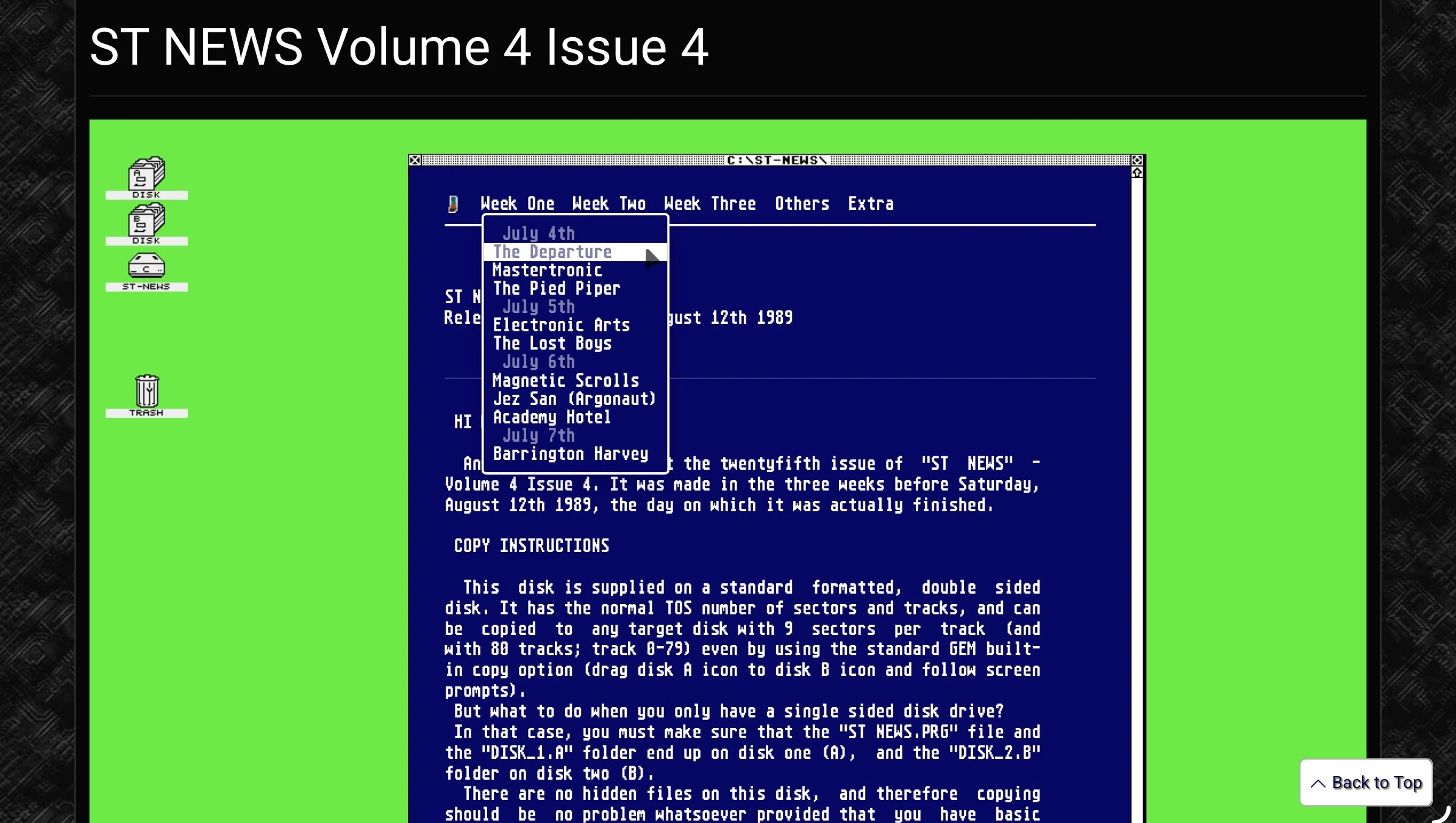
Volume 4, Issue 4: the LateST NEWS Quest, a legendary two-week tour of the UK games industry.
The Quest demonstrated just how fluid the talent pool was at the time. Many of the professional developers they interviewed were former sceners or hackers who had been recruited for their technical skills. This professionalization was further exemplified by the magazine's own staff. Richard Karsmakers eventually secured a position at Thalion Software, a company founded by The Exceptions and dedicated to creating high-quality Atari ST, Amiga and PC games.
The Ultimate ST-News Reference Guide: A Taxonomy of the Era
One of the most valuable resources in the ST-News archive is the Ultimate ST-News Reference Guide, an encyclopedic record of the people, places, and programs that shaped the magazine over its ten-year lifespan. The guide is divided into four parts, each offering deep insights into the 16-bit era.
Part 1: Foundations and Early Community
This section details the early Dutch computer clubs such as the SHN (Stichting Homecomputer Nederland) and ACN (Atari Computerclub Nederland). Many of the magazine's initial contacts were formed there. It also covers the "Ultimate Virus Killer" (UVK), a utility developed by the ST-News team that became an essential tool for protecting Atari ST users from malicious code.
Part 2: Technical and Artistic Contributors
The guide lists a wide array of technical tools, profiles key contributors like Jochen Hippel, and documents the emergence of the "Fax Wars". This was a series of gloriously over-the-top humorous exchanges between coding crews that exemplified the playful yet competitive spirit of the scene.
Part 3: The Peak Years and Industry Ties
This part focuses heavily on the LateST NEWS Quest and the magazine's interactions with the commercial industry, including visits to companies like Electronic Arts and Virgin Mastertronic. It chronicles the magazine's transition into an internationally recognized publication.
Part 4: Conflicts, Conventions, and Conclusions
The final section addresses the "SAG War". This ended up being a controversial dispute with the Stichting Atari Gebruikers (Foundation of Atari Users), and provides a detailed account of the STNICCC 1990 convention. It also covers the "Sunset" of the magazine as the Atari platform declined in the mid-1990s, concluding with the final issue in July 1996.
Technical Preservation and the st-news.com Archive
The current accessibility of ST-News is the result of a concerted effort to migrate the original Atari ST data to a modern web format. The website st-news.com serves as a fantastic digital museum, using web-based tools to replicate the experience of reading the magazine on original hardware. This includes conversion tools to render the original text and the integration of emulators for those who want to experience the original executable files.
The archive includes a "Compendium" of Volume 1 and individual listings for Volumes 2 through 11. Each issue is presented with its original articles, allowing historians to trace the evolution of the magazine's content and design. The site also features "Bonus Materials" and a scheduled "42nd Anniversary Issue," planned for release in 2028, a final tribute to the magazine's enduring legacy.
| Volume | Key Development | Notable Issues |
|---|---|---|
| Volume 1 | Foundation; 1st Word format | Compendium Issue |
| Volume 2 | UI maturation; Arrival of Mad Max music | Issue 8 (The User's Target) |
| Volume 3 | Dominance in the ST scene; Douglas Adams influence | Issue 6 (Dedicated to Adams) |
| Volume 4 | The LateST NEWS Quest; Diary structure | Issue 4 (UK Trip) |
| Volume 5–10 | Transition to Falcon and TT support; High-end graphics | STNICCC Special Issues |
| Volume 11 | The final issues; Reference Guide release | Issues 1–2 (The End) |
The Enduring Legacy of ST-News
The history of ST-News provides an astonishing window into the 16-bit computing revolution. It was more than a mere software publication. It was a true cultural hub that spawned a generation of digital creators. The magazine's commitment to technical excellence, its role as a chronicler of the demoscene, and its journey from hobbyist project to professional endeavor mirror the broader maturation of the computer industry itself.
The archive at st-news.com enables a genuinely deep techno-archaeological study of this transition. By preserving the editorial voice, the technical innovations, and the social connections of the era, ST-News continues to serve as a vital piece of digital cultural heritage. As the demoscene is increasingly recognized as significant intangible heritage, the role of disk magazines like ST-News in documenting and sustaining these communities becomes ever more important. The planned 42nd Anniversary Issue in 2028 is a testament to the enduring passion of its creators and the persistent relevance of the Atari ST platform in the collective memory of the digital age.