Multicolor Mayhem
My Ten Days as a Commodore 64 Art Robot on a Deadline
In late September 2026, Drees of the C64 group AMID asked me to draw the pictures for a demo about a camper van in a jungle and a T. rex. The Deadline demoparty in Berlin was about ten days away. This is how I turned into an art robot, fought the Commodore 64's multicolor mode in Multipaint, and followed from a distance as Thunder in Paradise ranked fifth in the ORWOhaus.
October 2026
Thunder in Paradise by AMID, Deadline 2026.
Watch on Youtube
A Sausage at Evoke
It started in Cologne, in a queue for sausages. At Evoke 2026 in August, my friend Harvey, who is a member of AMID himself, brought Drees and me together. He knew I was keen to work with the group, and he made sure we met in person for the first time. The next day Drees and I stood in line together at the barbecue in the courtyard, got our sausages in a bun, and talked about making a demo together.
I was not a complete beginner on the Commodore 64. Almost a year earlier I had learned the machine's graphics peculiarities the hard way, drawing for the Ski Jumper demo with Vintage Computing Carinthia, which I wrote up in From Zero to Koala. At Evoke itself I had just squeezed a Phoenix out of ten colors for the graphics competition. So I knew what C64 graphics would require.
I had simply never been asked to race against the clock like this one. It was stressful and kinda fun too.
The Script Arrives
In the last days of September the message came over Discord. Drees had a demo for Deadline 2026 in Berlin, held from October 2 to October 4, and he wanted pictures. Let me be clear about whose demo this is. Thunder in Paradise is the brainchild of Drees. He came up with the story, he directed it, he coded and supervised the effects, and he coordinated a surprisingly large crew of AMID team members across a surprisingly short stretch of time. My part was to be the art department's robot: take a scene description, produce a Commodore 64 picture, hand it over, then make the next one.
The story starts a bit like a road movie. A camper van sets off for the Deadline demoparty, takes a wrong turn into a jungle full of carnivorous plants, meets a tyrannosaurus rex, and is rescued by a pterosaur that flies the whole van over the clouds and sets it down in front of the ORWOhaus, the building in Berlin where the party is held.
The last screen is a postcard: greetings from the island. I definitely don't know what this all means, but I think it is meant to be a love letter to the party, told with dinosaurs. Because adding dinosaurs makes everything better.
The title is a nod to 1990s television. Thunder in Paradise was an action series from the makers of Baywatch, starring Hulk Hogan as Randolph "Hurricane" Spencer, a former Navy SEAL who solves cases from a tropical beach resort with the help of Thunder, a high-tech speedboat. It ran for just one season of 22 episodes in the United States in 1994, but in Germany it had a second life: RTL started showing it in February 1995 as Thunder in Paradise – Heiße Fälle, coole Drinks, which translates roughly as "hot cases, cool drinks."
Drees told me that the show gave the demo both its name and its setting. The palms, the jungle, and the island on the closing postcard all come from that same patch of paradise. The camper van stands in for the speedboat, and for all I know he might see himself as Hulk Hogan.
Deadline itself deserves a word. It is a multi-platform demoparty that has been held in Berlin every year since 2014, run by a long list of volunteers. The 2026 edition went by the motto "ApoCalypso" and had twenty-one competitions, from oldschool and PC demos to tracked music, themed photos, fast painting, and a Klemmbaustein competition for builds made of plastic bricks (Lego). Commodore 64 demos are only one part of a much wider spectrum of productions.
The party's location is just as remarkable. The ORWOhaus on Frank-Zappa-Straße in Berlin-Marzahn is a seven-storey industrial building from the 1970s, built for ORWO, the East German maker of photographic film.
After reunification it stood mostly empty, until music bands began renting rooms there in 1998, happy to find a place where they could rehearse at any hour. In 2004 the building faced closure over fire safety, and the musicians fought back: they founded an association, won political support, and raised the money to bring the house up to code. Today that association still runs it, independent of commercial investors, with around a hundred rehearsal rooms, studios, workshops, and a concert hall.
A demoparty in a self-run music house in a former film factory. I would have loved to go there. But my work obligations kept me from attending.
Getting Started
Before anyone drew anything, the team had to get into the same room, and the room was Discord. The kickoff was a bit of a chore. Getting everyone onto the server with the right permissions took forever, and it took longer still until everybody could join a call with video and audio working without a hitch. But we managed, and then the work began.
Drees had put together a script we could follow, scene by scene, with room for improvisation along the way. But we had a plan for who would do what. Time was tight on every side. The party was close, the graphics had to be finished well before it so that Drees could build his effects on top of them and fit everything into memory. The team also had to test the demo on real hardware, and I had a lot going on at work. On top of that, I was already stretching myself thin: at the same time I was working on another C64 demo with my friends at Vintage Computing Carinthia, the VCC demogroup.
Ten days sounds like a lot until you remember that I have a full-time job, and then count the screens I needed to draw. The demo needed a road, a jungle clearing, a T. rex close-up, a view through the camper's windshield, a T. rex reveal, a cliff with a T. rex on it, the ORWOhaus, and a postcard, plus first designs for the sprite sets of the camper van and a pterosaur. Eight full-screen pictures and two sprite sets. Thankfully _Ook took my miserable sprite designs and turned them into something usable.
So I went into art robot mode. One scene at a time, in story order, no polishing until everything existed in some form. Every finished picture went to Drees the moment it was exported, so that he could start coding against it while I drew the next one. If a picture was good enough to fulfill its purpose, it was done. Perfectionism was not an option.
I have no illusions that my work is capital-A "Art". But I kept thinking of a quote that is often credited to Leonardo da Vinci, but most likely goes back to the French poet Paul Valéry: "Art is never finished, only abandoned."
The Fear of Touching the Window
I am a firm believer that limitations will often bring out the best in creativity. But there are limits. Sometimes the limitations become irritating obstacles.
The fight with the C64's multicolor mode is always the same fight. This bitmap mode gives you 160 by 200 pixels, each one twice as wide as it is tall, like a little brick. The C64 has a palette of sixteen fixed colors. The catch is that you can't freely use them anywhere in your picture. The screen is divided into blocks of 4 by 8 of those wide pixels, and every block can hold only four colors, one of which is the single background color shared by the whole picture. If you add a fifth color into a block, the machine simply refuses and changes one of the other colors in that block.
Multipaint enforces all of that while you paint, which is exactly why I use it. However, it does not get many updates and can be quite unstable at times on modern Windows systems, particularly on a Surface Pro running Windows 11 on ARM.
There are some wonderful advantages to using Multipaint. It exports straight to Koala format, the .kla files Drees needed, and to a .prg that runs in the VICE emulator or on a real C64. So every picture could be tested properly.
My workflow was the one I had settled on for the Ski Jumper demo, only faster. Each scene began in Procreate on the iPad as clean black ink line art, bold contours and solid blacks. Thick line art "survives" the trip down to 160 by 200 pixels far better than shading does. Still in Procreate, I reduced each drawing to two pure colors, black and white, and exported it at 320 by 200 pixels, which cropped the picture slightly along the way because the iPad work area has a slightly different aspect ratio.
Then I moved to my 12-inch Surface Pro and its pen and imported the black and white image into Multipaint. Multipaint converted it to 160 by 200, because in the C64's multicolor mode every pixel is twice as wide as it is tall, so two of my pixels side by side became one. From there I colored it cell by cell, nudging lines and moving edges whenever a block needed a fifth color. The ink stage took minutes. The coloring of each cell took hours.
And since this was the first demo I worked on with AMID, I didn't want to deliver anything that wasn't polished. I crafted the scenes carefully and refined them before I considered them finished. That said, I liked some of the results, but I was often unhappy with others.
My Surface Pro runs Windows 11 on ARM, and Multipaint on that machine is really buggy. It crashes when you resize its window. This happens every single time... not just occasionally.
So even though the application ran in a small window on my Surface Pro, I made a habit of never, ever touching the window, and drew in whatever size it opened with. Ten days is not enough time to lose a picture due to a flaky application.
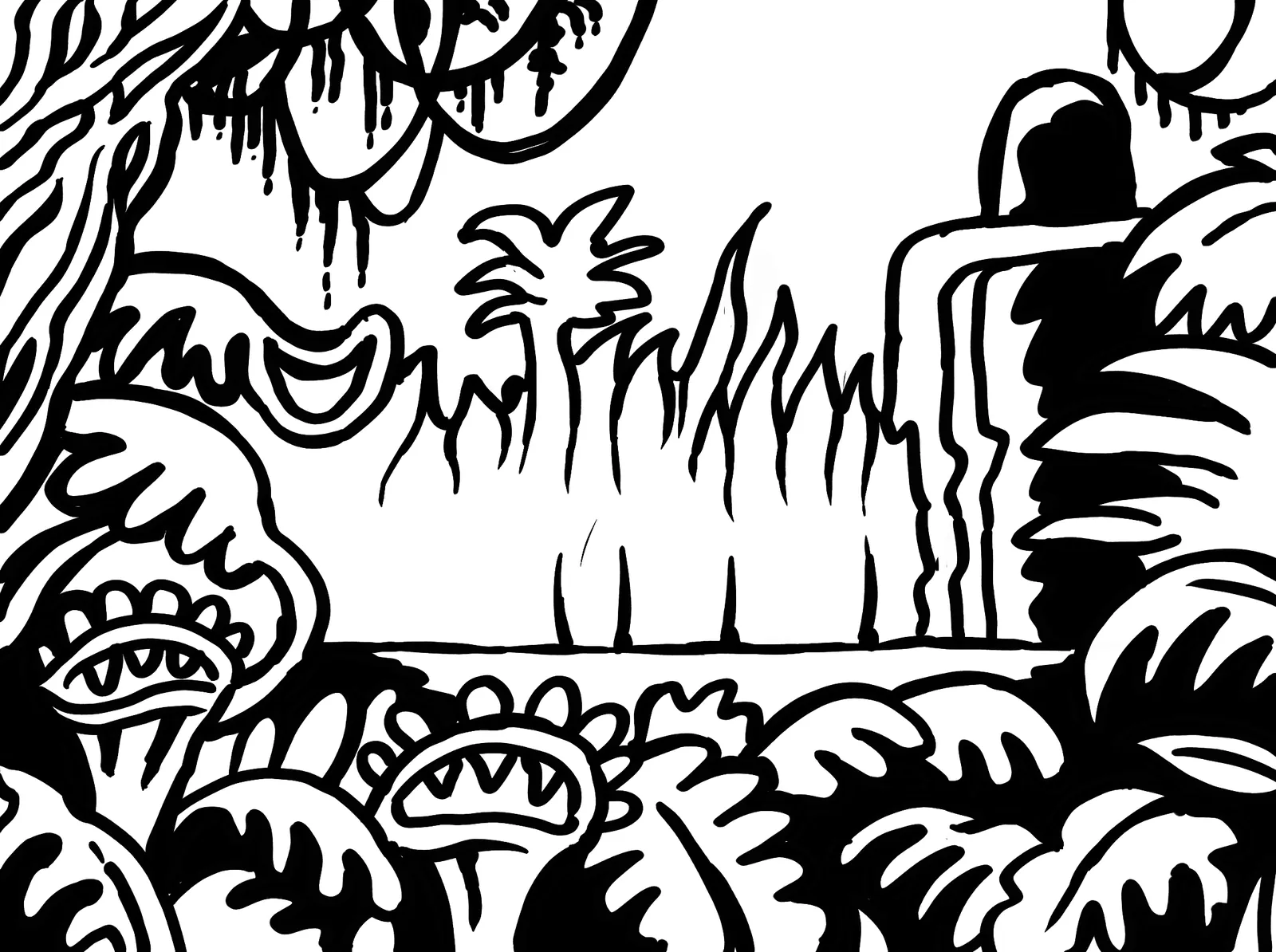
Step one for every scene: bold black ink in Procreate, no shading. This is the jungle clearing.
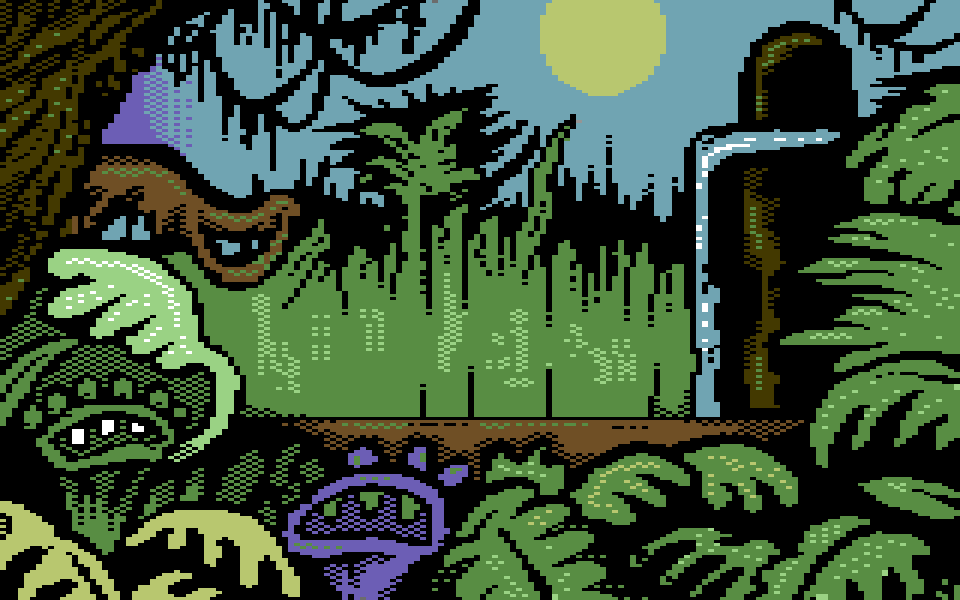
Step two: exported from Procreate in black and white at 320 by 200, converted by Multipaint to 160 by 200 double-wide pixels, and colored there, four colors per cell. In the demo, Drees's rotating vector object spins in front of this one.
The Pictures, Scene by Scene
1. The Coast Road
The journey opens on the coast road: palms, mountains, a setting sun, and an empty road for the camper sprite to drive along while the credits fade in over the sky. I kept the upper half calm on purpose, so that the credit text would stay readable.
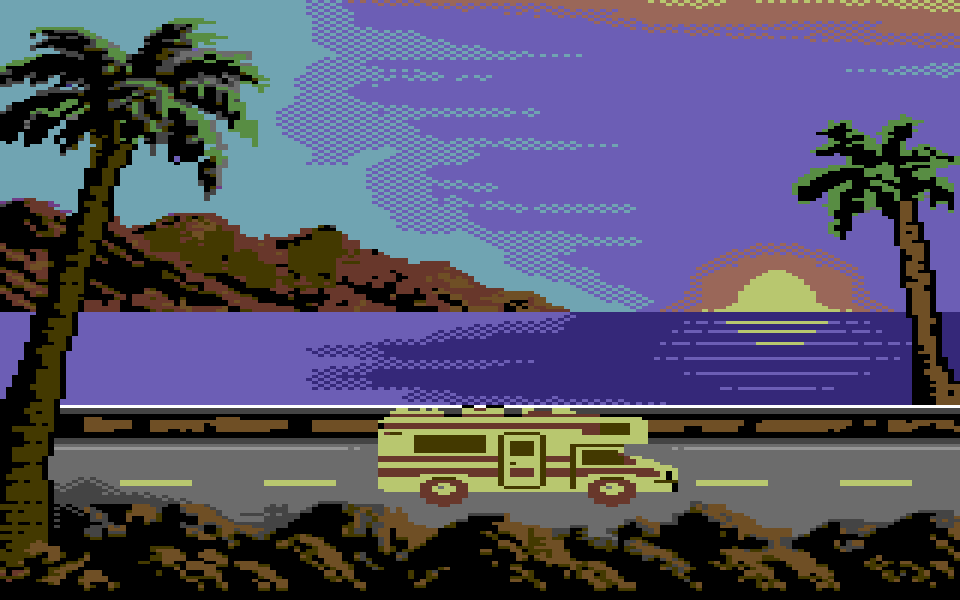
The opening picture of Thunder in Paradise: a camper van on a sunset coast road, 160 by 200 chunky pixels, sixteen colors, four per cell. But this camper van... it is so stretched out. Later, _Ook, another AMID team member, created a much better sprite for the camper van.
2. The Jungle Clearing
Then the wrong turn. Carnivorous plants with teeth, dripping vines, a waterfall, and a sun that is already a little too pale. This is the picture from the two workflow steps above, and in the demo it becomes the backdrop for a scroller and a Deadline vector sign.
3. The T. rex Close-Up
And then, out of nowhere, it is right there. Open jaws, a skull in the undergrowth, a carnivorous plant grinning from the corner. This is the scariest screen and my favorite. In the demo, Drees added animated drool and a flashing palette, which turned a still picture into a jump scare.
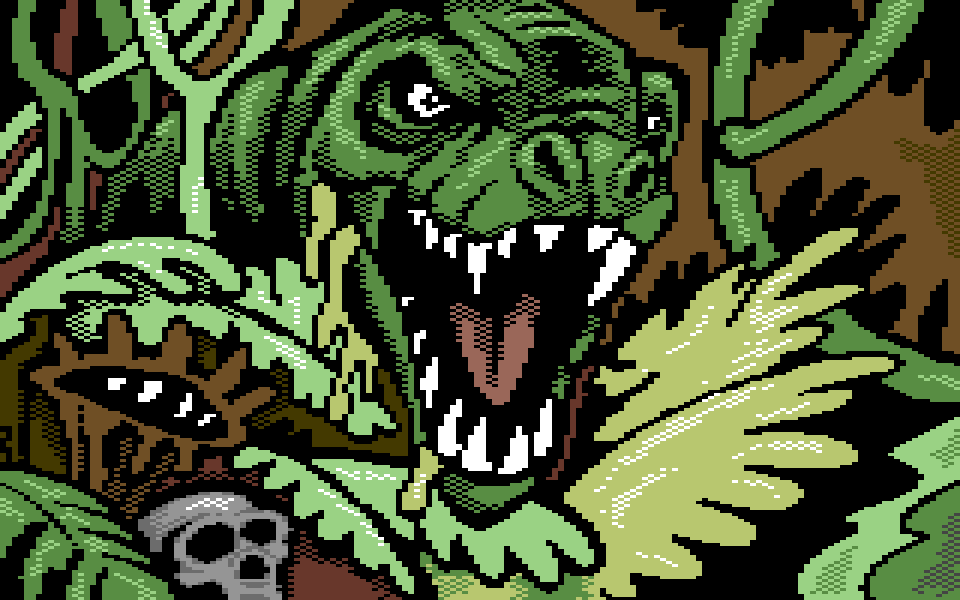
The finished close-up. Green, brown, and a lot of teeth.
I recorded the whole drawing of this one, so you can watch the T. rex crash through the jungle stroke by stroke. It starts as a loose, scribbly sketch in Procreate on my iPad Pro, just enough for me to find the angle of the head and the wide-open jaws. Then I go over it again in clean, bold contours, add the details, and fill in the heavy blacks that give the foliage and the shadows their weight. The skull and the grinning carnivorous plant come in last, tucked into the undergrowth.
Everything you see here is still black ink on white. I only added the colors later, in Multipaint, once the drawing had been squeezed down to the Commodore 64's 160 by 200 double-wide pixels.
A walkthrough of drawing the T. rex close-up in Procreate on the iPad, from rough sketch to bold black ink.
Watch on Youtube
4. Through the Windshield
Inside the van, our travelers panic. The view through the windshield is vines on every side, and the windshield itself is a flat purple rectangle on purpose: it is a blank for Drees to fill. In the demo he put a plasma effect inside the windshield. Sometimes the best thing a picture can do is leave a hole.
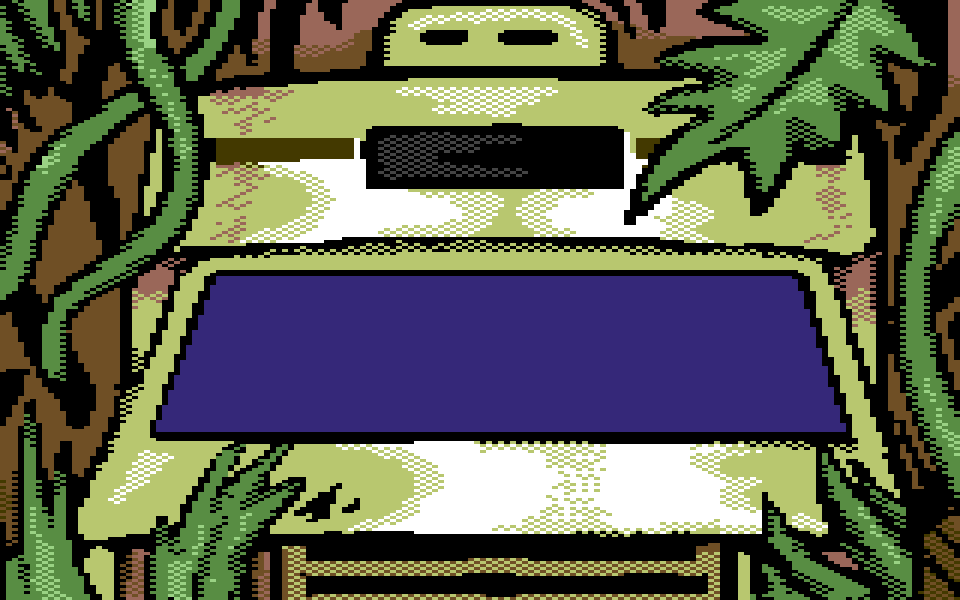
The windshield scene. In the demo, the plasma effect runs inside the purple windshield.
5. The T. rex Reveal
The van escapes the close-up, and the dinosaur follows. Now we finally see the whole animal: a full-body T. rex stepping out of the undergrowth between the palms, mouth open, coming after the camper. After the jump scare of the jaws, this is the moment the travelers understand exactly what is chasing them.
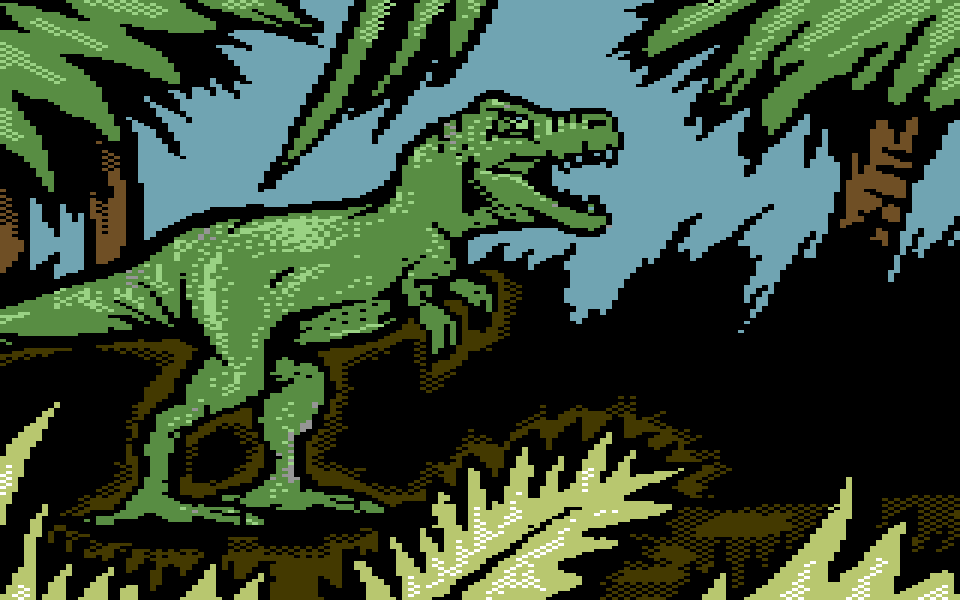
The T. rex reveal: the whole dino, on the move.
6. The T. rex on the Cliff
The showdown. The T. rex on a rocky outcrop, a small purple creature hiding in the ferns, and plenty of open sky on the right, because that is where the camper sprite drives in and where the pterosaur lifts it away.
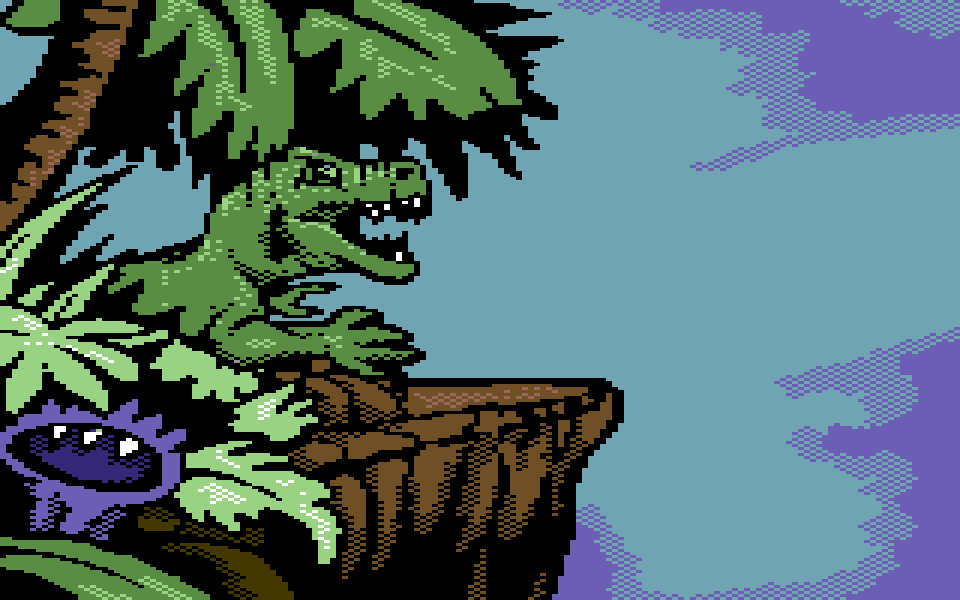
The cliff. The empty sky is for the camper and pterosaur sprites.
7. The ORWOhaus
At the destination at last. After all that jungle, the ORWOhaus was actually a pleasure to draw. I simply slapped a photo of the building in the background of Procreate and traced over it. I simplified some things and added the legendary name on the facade in a place that would not be visible from this perspective. In the end, my approximation of the grey GDR-era concrete block came out fine, with its straight lines, repeating windows, and a staircase for a pterosaur to land on.
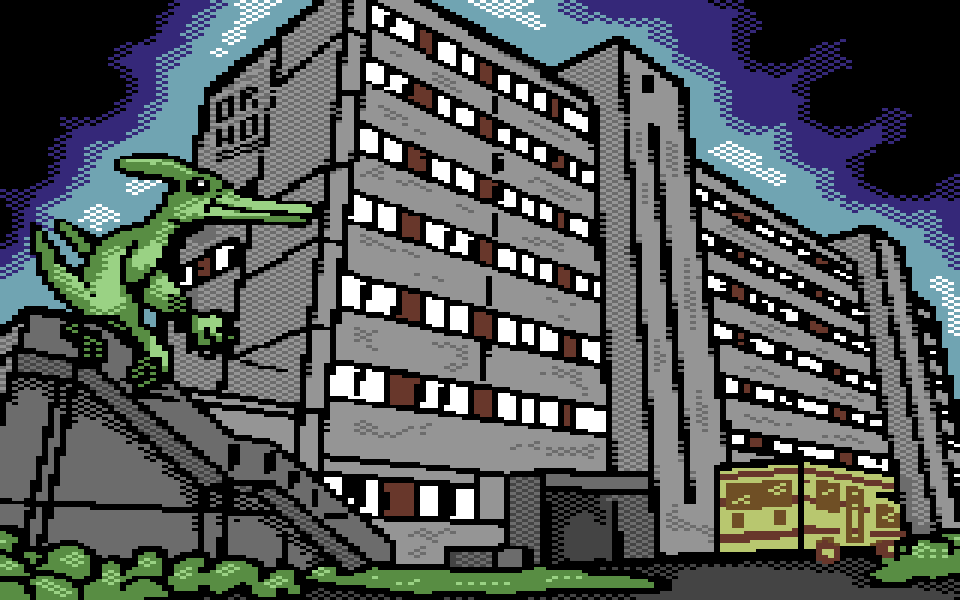
The ORWOhaus as the demo uses it: pterosaur on the stairs, camper parked, party time.
8. Greetings from the Island
The last screen is a postcard held up by a thumb, with a fish where the stamp should be. In the demo the building shatters into the postcard, then an iris closes around the fish, which floats off on its own before the greetings scroll. I have no idea why any of this is happening, but then again... I just work here.
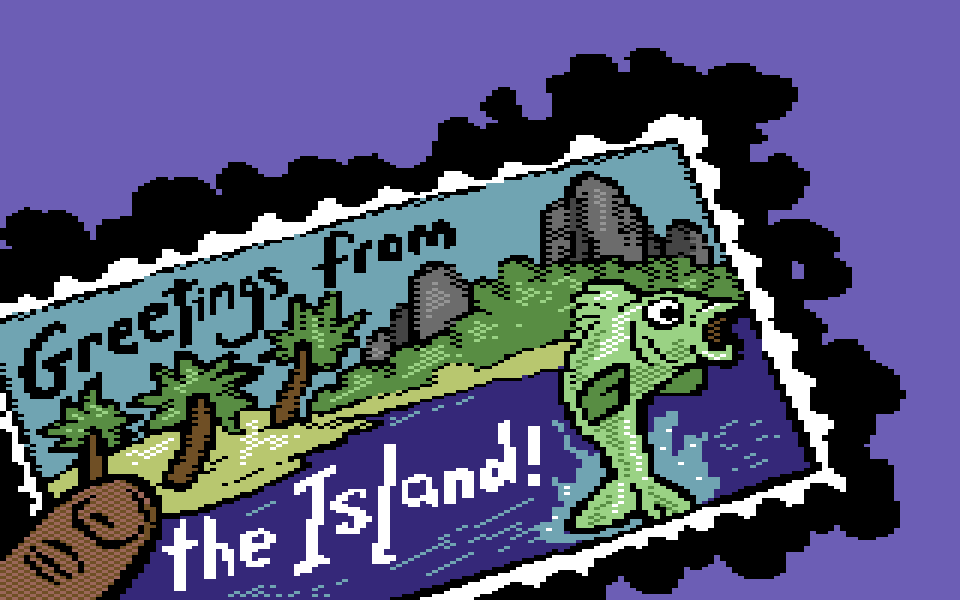
The postcard that ends the demo.
A Camper Van of Great Importance
The camper van was not a random choice. It is something of a mainstay at AMID. Drees, for his part, comes to DoReCo, the Dortmunder Retro Computer Treffen, a meeting of retro computer fans that has existed since 2005. Despite the name, DoReCo is no longer held in Dortmund. It started out in Dortmund pubs and moved around the region over the years, and since 2025 its regular meetings have taken place in Arnsberg, in the Sauerland, the hilly, wooded region east of Dortmund. The name stayed behind in Dortmund. The hobbyists moved on.
Two things had to move through all of this: the van and the pterosaur. C64 sprites are small, 24 by 21 pixels each, so the camper is a row of several sprites side by side, in a plain version and one with a rocket flame. The pterosaur has a flying pose and a standing pose, because it lands on the ORWOhaus stairs at the end. Both had to stay recognizable at that size and inside the sprite color rules, which are stricter still than the bitmap's.
The van is where I fell flat on my face. I drew the first camper sprite in Pixelmator Pro on the Mac, with square pixels, and it looked fine there. On the C64, where every multicolor pixel is twice as wide as it is tall, the same van came out stretched, lumpy, and frankly terrible. _Ook of AMID took my attempt and turned it into a much nicer and far more practical sprite, with the right proportions for the van and the layout that Drees's code actually needed. The camper you see driving through the demo is his.
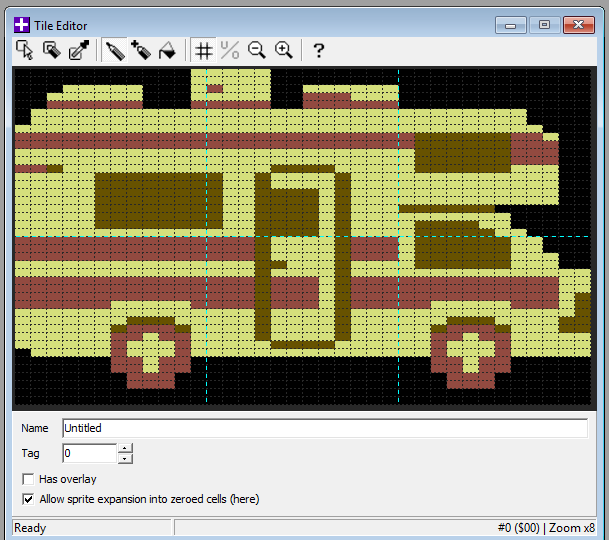
_Ook's reworked camper van in the tile editor. The dashed lines mark where it is split into six sprites.
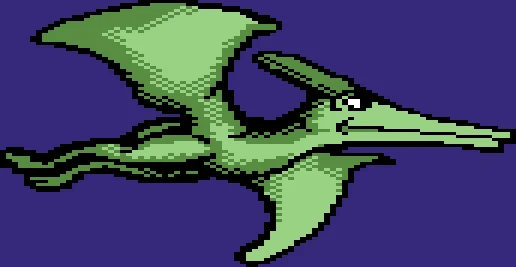
The pterosaur sprite in flight.
Deadline, From a Distance
I couldn't attend Deadline 2026 in person, but I followed the competition via the live stream. I absolutely love Berlin, and a weekend at Deadline was the plan, but work would not allow it.
Drees was a bit ill, so he couldn't attend in person either, but _Ook was there representing our team. He submitted Thunder in Paradise at the demoparty. It was quite exciting to see our demo run on the big screen. On the last day we found out that our work had placed fifth in the oldschool demo competition.
We were up against some very stiff competition, and we still came fifth! How amazing is that? Look at who placed ahead of us: New Horizons by Otomata Labs on custom hardware won, Subway Arts by 99.9% came second, Bytes of the Art by Desire on the Amiga came third, and Choppa by Tristar and Red Sector Inc. came fourth. Those are serious groups with serious productions, and our ten-day dinosaur road movie landed right behind them with 329 points, fifth out of twenty entries and the third C64 demo in the field.
I, for one, was very happy with that result. The full results are on Demozoo's Deadline 2026 page, and our demo has its own page on AMID's website and entries on Demozoo and on CSDb. If you want to run it yourself, the disk image is on scene.org, ready for the VICE emulator or a real Commodore 64. (I have TheVIC20 from Retro Games Ltd.)
It was a good weekend for AMID all round. Marzieh won the textmode graphics competition with Emerald Oasis, Alysius came third in oldschool music with Beyond the Lightwave, and _Ook, fresh from rescuing our van, built a LowRes Multicolor Flamingo out of plastic bricks that took second place in the Klemmbaustein competition. Harvey entered a 256-byte intro, A Color Thing, in the same oldschool demo compo as us.
When the credits fade in at the start of our demo, they read: Directed by Drees. Art department: Bala-Koala, Bulldog, Drees, Ook, and Stallone. VFX supervisor: Drees. Musicians: Chrisdo, Drax, Fanta, Jo22, and No-XS. Encoding supply: Akustikrausch. FQC masters: Harvey and Sir Alex. Continuity by Spindle, the loader by LFT.
I am happy with how everything turned out, and I'm proud to be part of AMID, the team that made the demo possible.
- Deadline demoparty, Berlin
- Thunder in Paradise on Demozoo
- Deadline 2026 results on Demozoo
- Thunder in Paradise on CSDb
- Thunder in Paradise on pouët
- Thunder in Paradise on AMID's website
- Download the demo (.d64 disk image) from scene.org
I Think I Learned Something...
I learned three things in this experience. First, line art is the fastest way to a C64 picture: if the drawing works in black and white at 160 by 200, I can add the colors rather quickly. Second, draw to match the requirements. The empty sky on the cliff, the blank windshield, the calm upper half of the road: the best pictures in this demo are the ones that left room for Drees. Third, being an art robot might be stressful due to the time pressure, but the process is oddly restful. With no time to agonize, I drew quite a lot in those ten days, and I don't think the pictures are terrible.
All that's left is to express my special thanks to Harvey for bringing us together. Thank you to Drees for our conversations, the story, and the coordination. Thanks also to _Ook for rescuing the van. And also my heartfelt thanks to everyone at AMID for letting me ride along as a little koala.