An Evil Kryptonian in a Pleated Skirt
Superman's Brainwashed Stint as a Warrior of Apokolips
Most of us know Superman: the cape, the symbol, and the sturdy moral compass. These days, the evil Superman is almost a genre of its own, but back in the 1980s it was a rare sight. So it was quite something when, in 1987, he stood in the smoke of an alien hell-world, convinced that he was the loyal warrior son of the biggest tyrant in the universe. Not a dream, not a hoax, not an imaginary story: Superman, son of Darkseid.
November 2026
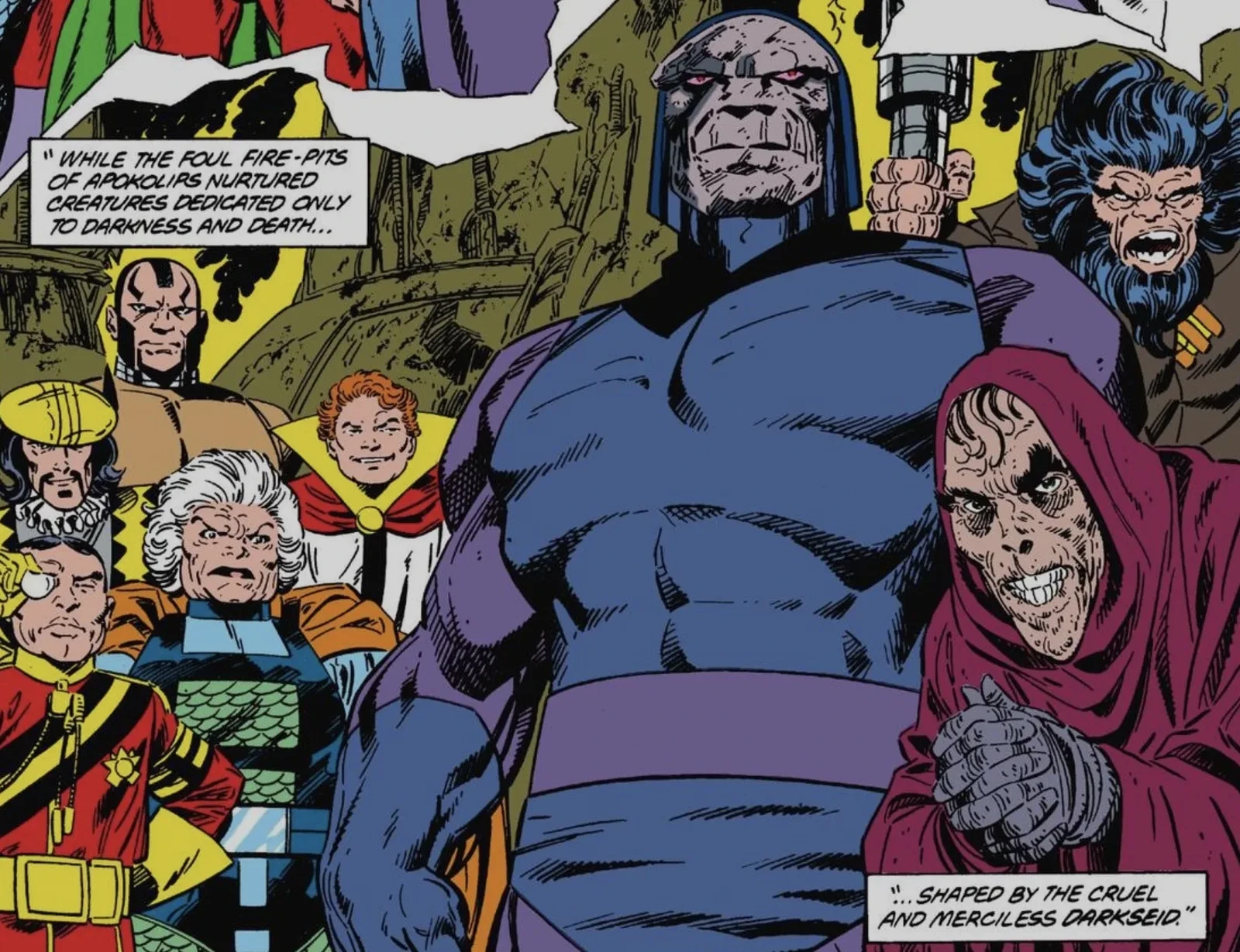
Granite-faced
and endlessly patient, Darkseid looms over the denizens of Jack Kirby's Fourth World.
The story runs through three issues: Superman #3 ("Legends from the Darkside!"), The Adventures of Superman #426 ("From the Dregs"), and Action Comics #586 ("The Champion!"). John Byrne, who had just rebuilt Superman from the ground up in his Man of Steel miniseries, wrote and drew the first and third chapters. The middle chapter came from the other team in the Superman office: writer Marv Wolfman and artist Jerry Ordway, the regular team on Adventures. Together the issues tell one continuous story in which Darkseid abducts Superman, hollows him out, and refills him with something that suits Apokolips better.
I should confess my bias up front. There is a lot I love about comics beyond superheroes. But I am also a Superman fan, and the Superman I love most is the cosmic one, the Superman who leaves the Metropolis skyline behind and flies out to where the stars are. I am a big fan of Jack Kirby's New Gods, with their epic struggles and their unashamed theatricality. And John Byrne is one of my favorite comic book artists and storytellers. So when everything I liked about superhero comics lined up in a single month of 1987, I was absolutely thrilled. This article is what happens when that kind of luck is left to marinate for a few decades.
First, a Word About Legends
The story is a tie-in to Legends, DC's first line-wide crossover after Crisis on Infinite Earths had wiped the slate of the entire universe. Legends itself was a six-issue miniseries (November 1986 to May 1987), plotted by John Ostrander, scripted by Len Wein, and drawn by John Byrne (who else), a man who at this point in his career apparently regarded sleep as optional.
Back in 1986, when I heard that a line-wide crossover would run on the New Gods, with Darkseid as its villain and Byrne on pencils, I could not have been happier. The premise is delightfully interesting: instead of punching Earth's heroes, Darkseid decides to make humanity stop believing in them.
He sends his honey-tongued minion Glorious Godfrey to Earth, where the god poses as television demagogue G. Gordon Godfrey and whips up so much anti-superhero hysteria that the President bans costumed heroics outright. The event had massive consequences for the DC Universe: both the modern Suicide Squad and the much-loved Justice League International walked out of the crossover.
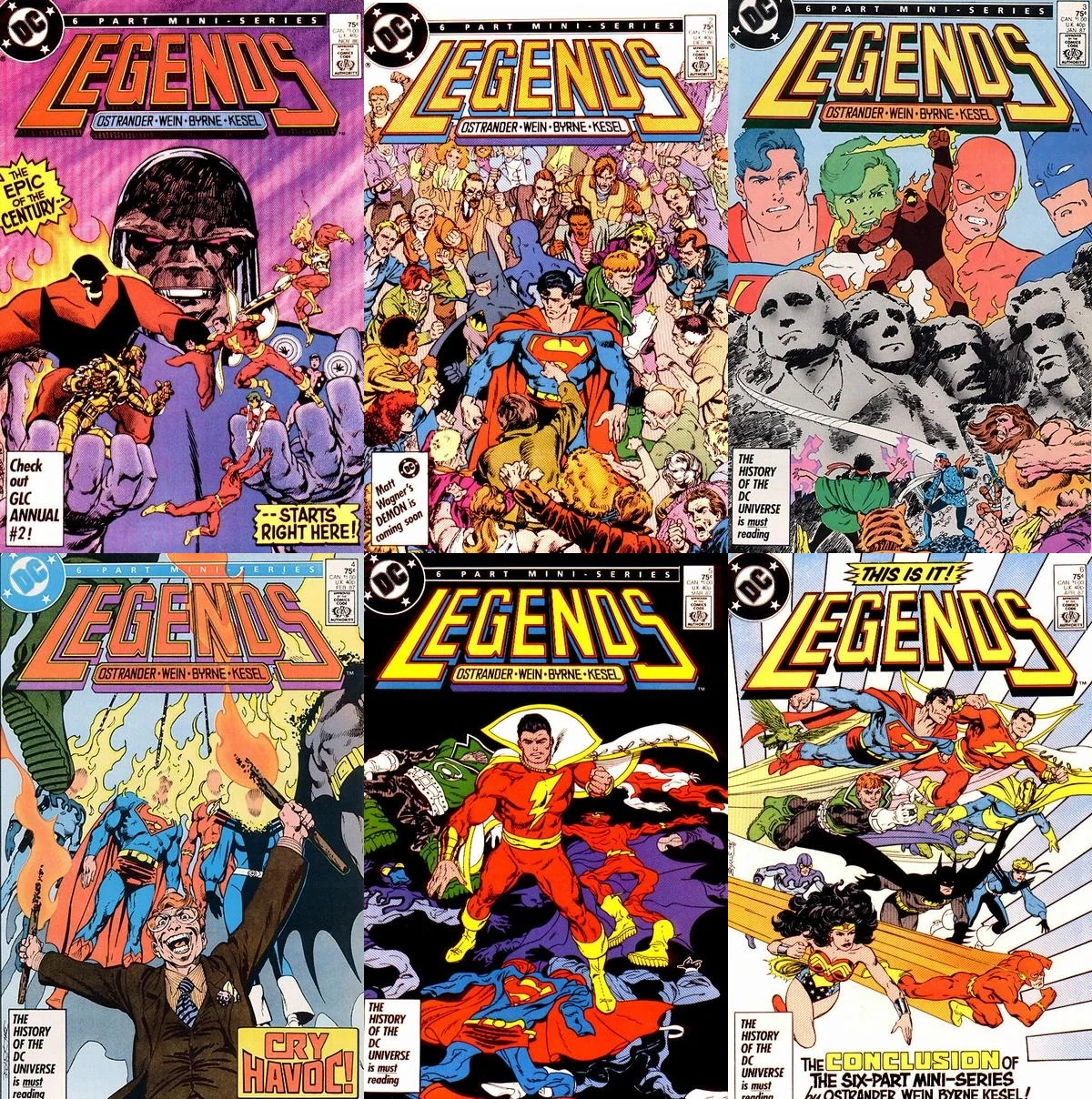
The
full six-issue run of Legends (1986–87), DC's first post-Crisis crossover, by John
Ostrander, Len Wein, John Byrne, and Karl Kesel.
And a Word About Darkseid and the New Gods
Darkseid comes from Jack Kirby's legendary "Fourth World" saga of the early 1970s. I have had a great appreciation for that mythology since I first read it, so give it thirty seconds of your time.
When the old gods perished in a cataclysm, two new worlds rose from the ashes. New Genesis is a gleaming garden utopia ruled by the gentle Highfather. Apokolips is its dark twin: an entire planet run as a furnace-slum, its surface scarred by glowing fire pits, ruled by Darkseid, who is granite-faced, endlessly patient, and devoted to a single goal. He seeks the Anti-Life Equation, a cosmic formula that would let him switch off free will itself, everywhere, forever. To delete the human ability to choose.
The two worlds keep an uneasy truce sealed by an exchange of sons: Darkseid's boy Orion was raised on New Genesis and grew into its fiercest champion, while Highfather's son grew up in Granny Goodness's nightmarish Apokoliptian orphanages and escaped to become Mister Miracle, the universe's greatest escape artist. Sprinkle in Orion's sunny best friend Lightray, living computers called Mother Boxes that communicate mostly in "ping," and thundering teleport tunnels called Boom Tubes, and you have the full Kirby toy box this story gets to play with, and that is the toy box I wanted to see Superman thrown into.
If some of these names ring a bell even for readers who have never opened a Kirby comic, that is because the New Gods of Apokolips have since made it to the big screen. Both the 2017 film Justice League and its 2021 director's cut, Zack Snyder's Justice League, feature them as the villains, with Steppenwolf and his Parademons doing the invading, Mother Boxes as the prize, and Darkseid himself finally stepping into frame in the longer cut.
What We're Here for (and What We're Not)
To be clear about the mission: I am not going to march through all twenty-two chapters of Legends. Godfrey's talk-show crusade matters to us only as a backdrop. My business is with these three Superman issues, for three reasons.
- The first is personal: three Superman books crossing into a New Gods story, with Byrne drawing two of them, is about as close to a comic made for me as 1987 was going to get.
- The second is storytelling: they are a bold experiment for 1987, since Superman loses his memory, his powers, his identity, and a few other things I'll get to.
- The third is philosophy: they accidentally contain a full semester's syllabus on personal identity, free will, manipulation, propaganda, and the queasy ethics of editing someone's memories.
I'll take the issues one at a time, plot first and then the philosophy each one smuggles in, before a final chapter steps back for the wide shot: the creators behind the relay, what the whole story adds up to, and the ripples it left in the Superman mythos.
A word on that boldness. Today, the evil Superman is almost a genre of its own, from Red Son and Injustice to Homelander in The Boys and Brightburn. In the 1980s, it had seen far less mileage. Superman III had put an evil Superman on the big screen in 1983, after a dose of synthetic Kryptonite turned him into a stubbled bar-room bully, but in the comics a dark Superman was a one-issue Red Kryptonite gag, undone before the last page.
Three issues of a Superman who does not know he is Superman, fighting for the wrong side, was something else entirely.
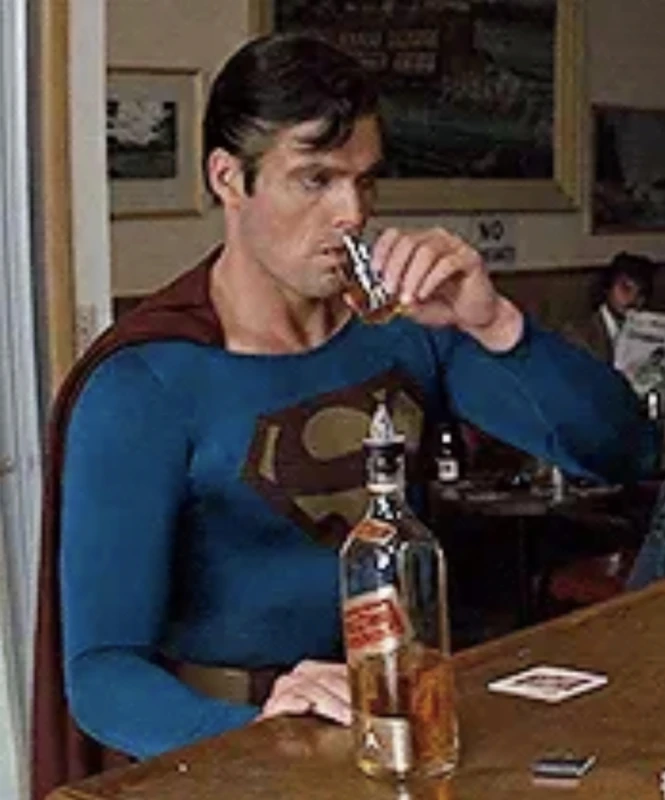
Superman
III (1983): one dose of synthetic Kryptonite later, Christopher Reeve's Superman takes to the
bar.
One last piece of trivia I savor before diving in. This was the first time DC ran a single story straight through all three Superman titles in one month, with Superman, Adventures of Superman, and Action Comics functioning as consecutive installments of a weekly serial. Looks like the experiment was successful.
By 1991, DC had formalized the relay-race approach with the famous triangle numbering, that little cover glyph holding a year and a number and telling readers exactly which order to read the Superman books in. So the next time you enjoy (or curse) tightly interlocked superhero continuity, remember: a brainwashed Superman on Apokolips helped invent it.
Superman #3: "Legends from the Darkside!"
Written and penciled by John Byrne, inked by Terry Austin. Legends Chapter 17. Cover date March 1987.
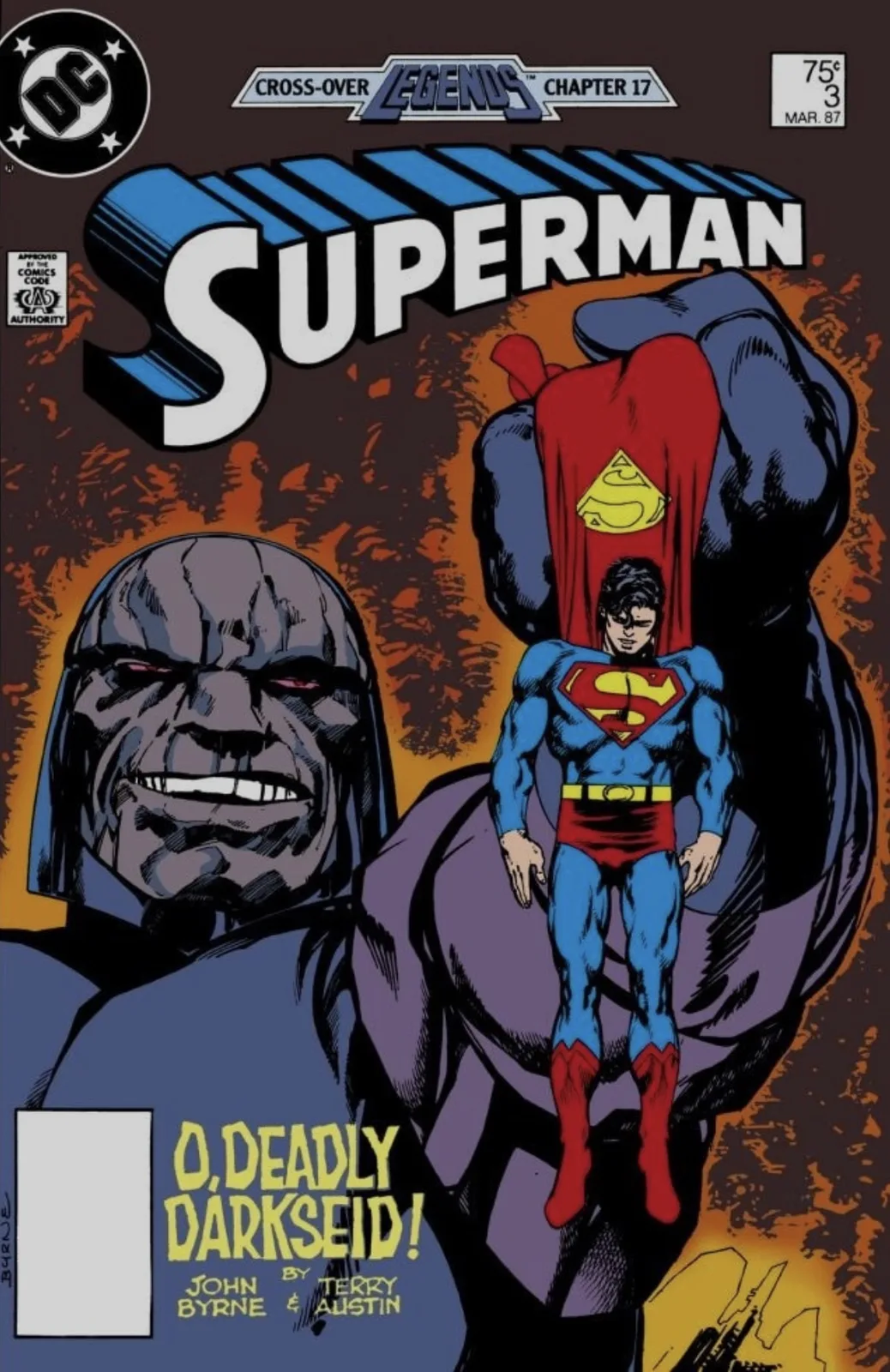
Superman
#3 (March 1987), “O, Deadly Darkseid!” Cover by John Byrne and Terry Austin.
The Plot: Clark Kent Has a Very Bad Commute
The issue opens on Lois Lane working on the biggest story in town. She has landed an interview with G. Gordon Godfrey, the mysterious orator whose anti-superhero crusade has swept the country.
The interview goes nowhere. Godfrey deflects every personal question and pivots, again and again, to his sermon about the menace of super-humans, whom he wants gone from the face of the Earth. Lois walks away with no biography and one unsettling observation: this man's power to persuade doesn't feel like charisma. It feels like the power of persuasion wearing charisma as a disguise.
Meanwhile, Clark Kent is having the worst commute in Metropolis history. Two sizzling beams of energy chase him through the streets, and here Byrne gives us one of those small, perfect character beats, the kind that made me a Byrne fan in the first place. The President has ordered all superheroic activity suspended, so Clark, being Clark, refuses to change into Superman even while being hunted by what appear to be death rays.
He runs. He ducks into the sewers like an ordinary fugitive. And the beams find him anyway, at which point they turn out not to be death rays at all but a delivery service: Darkseid's own Omega Beams, dialed to transport rather than kill. Clark Kent is snatched across the cosmos and deposited, dazed, in a palace on Apokolips.
He lands in the middle of a performance. Darkseid, with the enigmatic Phantom Stranger standing by, erupts in fury: his trap was set for Superman, and it has caught only a puny human journalist. He accuses the Stranger of meddling in his affairs, then, for good measure, blasts the useless mortal out a palace window while the Stranger looks on with suspicious serenity, knowing the fall won't harm this particular mortal. It is all theater, and Byrne plays it well. Darkseid is a god, and gods do their homework. He knows perfectly well that the rumpled man he just defenestrated is Superman, and everything is proceeding exactly to plan.
(Continuity spotters may enjoy that Superman recognizes Darkseid on sight here, a little pre-Crisis echo that Byrne himself would retcon into a proper first meeting more than a decade later in Jack Kirby's Fourth World #20.)
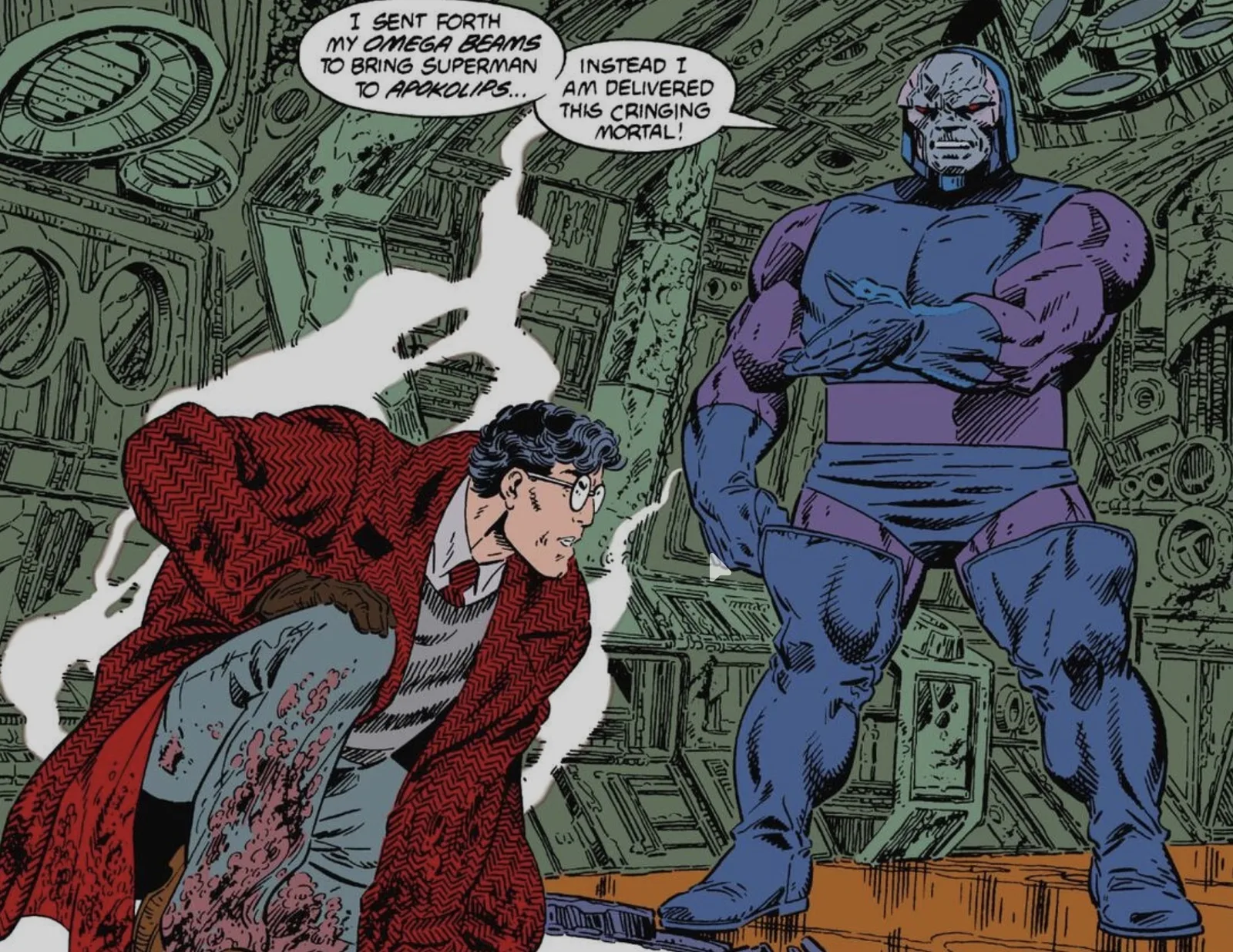
Delivered
across the cosmos by Omega Beam, a rumpled Clark Kent lands before an outwardly unimpressed Darkseid.
Superman comes down in Armagetto, the slum of slums on Apokolips, where the desperate, half-feral locals, the downtrodden masses Darkseid affectionately calls his Hunger Dogs, welcome the well-fed stranger by mobbing him. He fights loose, pulls a scavenged cloak over his suit to blend in, and takes stock: no way home, on a planet where the streetlights are pits of fire. But he is Superman, and his resolve will not be easily extinguished.
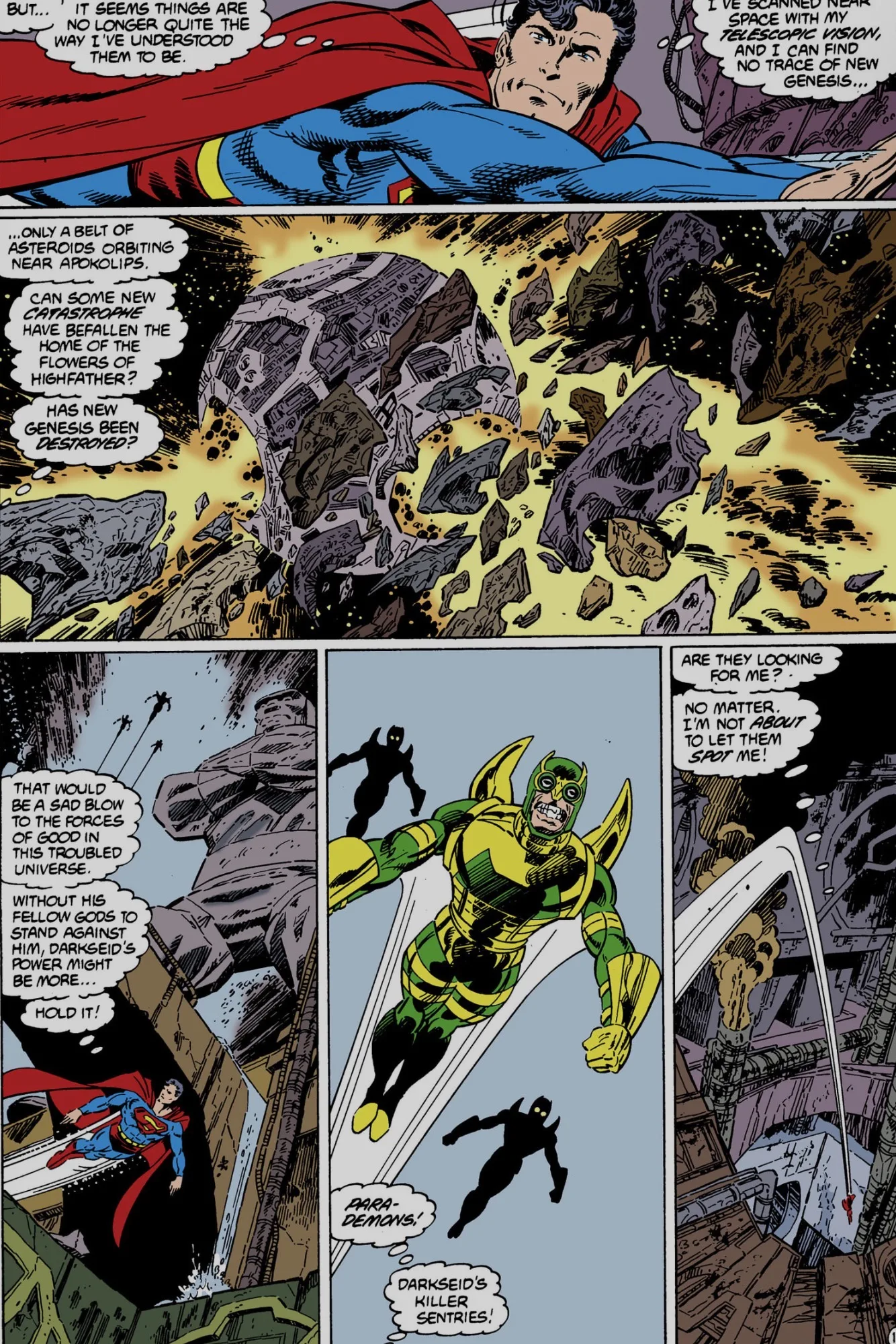
Adrift
on the wrong side of the universe: Superman over the fire-scarred hell-world of Apokolips.
Coming upon a squad of Darkseid's shock troops about to execute a woman in public, he wades in and frees her, scattering her tormentors. On Apokolips, kindness is about as inconspicuous as a marching band, and the reprisal arrives at scale: a hulking armored monstrosity called a Pacifier. Superman tears the thing open like a tin of sardines, only to find that it is a suit of mechanized armor piloted by a creature of Apokolips.
The creature latches onto Superman's face, and the battle ends with him tumbling into one of the planet's fire pits, a furnace with enough raw power to carbonize even a Kryptonian.
And that is where the issue leaves him: the Man of Steel, swallowed by fire on a planet that does not know joy. What comes out, as the next chapter reveals, is a man who doesn't know his own name, doesn't know his own history, and doesn't know that his body can do impossible things. A blank, on the worst possible world for blanks. To be continued. Even knowing how it ends, that page still gets me.
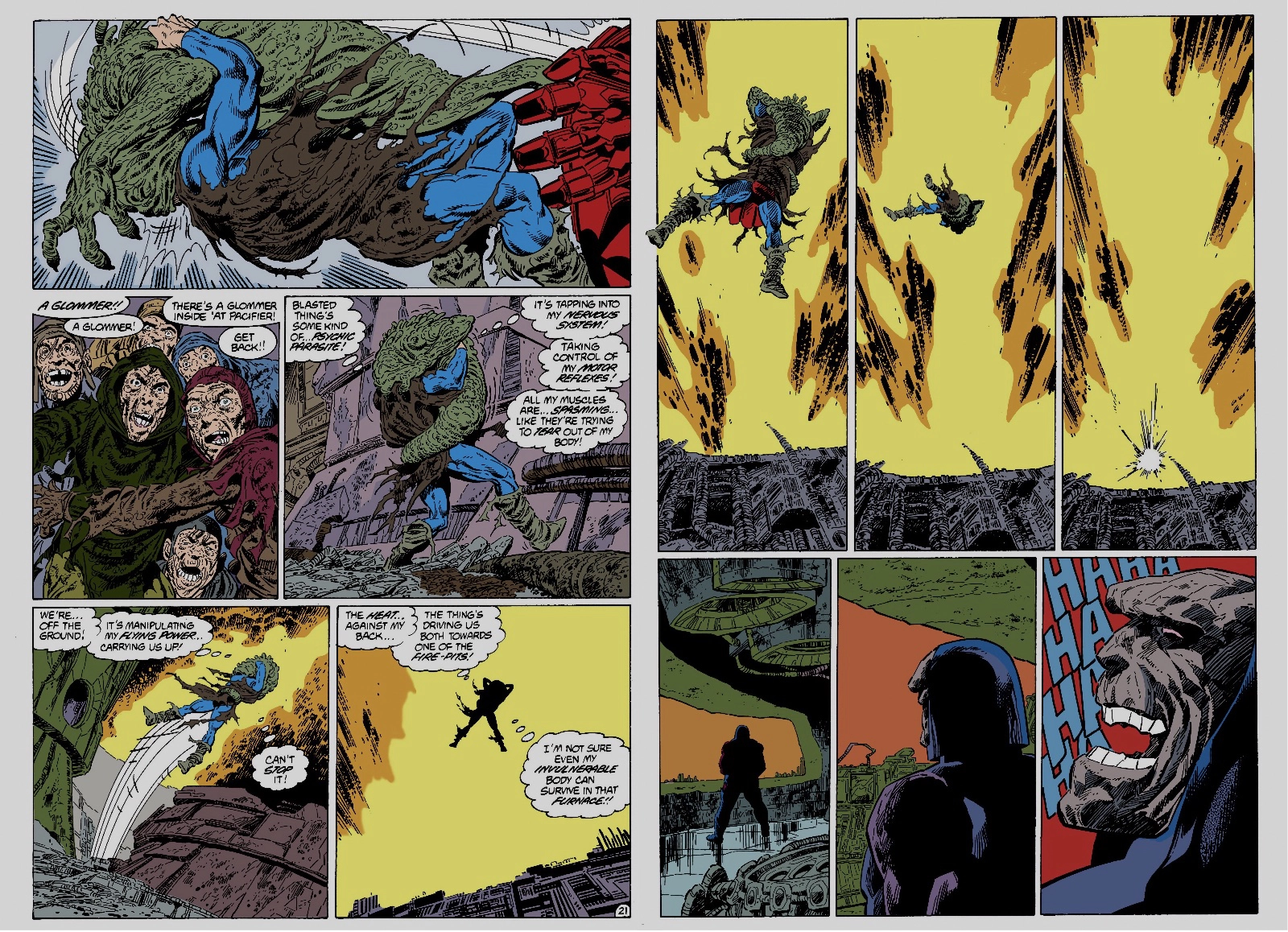
Looks
like everything is going according to plan for Darkseid.
The Philosophy: Shadows, Statutes, and a Bonfire of the Self
Lesson one: the demagogue doesn't need to be right, only loud. Look at Darkseid's opening move in Legends. It is not an invasion or a doomsday weapon. It is a pundit. Godfrey's target is not the heroes themselves but the public's belief in them, and Plato saw this trick coming about 2,400 years ago. His Republic warns of the demagogue who wins not by knowing the truth but by knowing the crowd, and his famous cave allegory describes prisoners mistaking shadows on a wall for reality, shadows cast by puppeteers they never see.
Godfrey is like a cave puppeteer with a broadcast license. The Victorian philosopher W. K. Clifford would pile on: he argued it is morally wrong, for anyone, anywhere, to believe things on insufficient evidence, because sloppy believing is a public hazard, like sloppy shipbuilding. Metropolis flunks Clifford's test in about one news cycle. What chills me is how ordinary this is. Faith in heroes, like faith in institutions, is given freely, which means it can be talked away. The Omega Beams are not Darkseid's most dangerous weapon in this event. Talk is.
Lesson two: Clark's obedience is the whole ballgame. That chase scene is worth a second look.
Clark Kent, hunted through the streets, will not put on the cape, because the government, however wrong-headedly, has asked heroes to stand down, and he respects that. You can debate the wisdom of it. Socrates, in Plato's Crito, refused to escape his own execution because he felt he owed obedience to the laws that had raised him; the civil-disobedience tradition running through Thoreau and King answers that unjust rules deserve resistance, not deference. But set the debate aside and look at the structure of the moment: Superman's restraint is chosen. His powers are leashed by nothing but his own consent to live inside a community's rules.
That is free will operating at full strength, the faculty of wanting one thing and choosing another. And there is a certain amount of irony, because the villain of this story has devoted his eternal life to abolishing exactly that faculty. On this page, Clark chooses not to be Superman. Very soon, he will have no choice because Darkseid will take it from him.
Lesson three: the fire pit is a bonfire of the self. Byrne could not have picked a better instrument than a pit of fire: the hero goes in, and what comes out has been reduced to ash and reborn as a blank.
This is where the story opens the question it will spend two more issues on. The philosopher John Locke argued that personal identity rides on memory. You are the person whose past experiences you can remember, which is why we don't jail people for what they did in dreams they've forgotten. Take Locke seriously and the conclusion is startling: the man pulled from that pit is not Superman. He certainly has the same body, the same cells, and the same costume (well, tatters), but no memories, so, in Locke's thinking, he is no Superman.
So... is that right? I don't think so, and neither, it turns out, does the comic. To be fair, it is a superhero story. Is there something underneath memory where a self might live? The next issue answers with one of the loveliest beats in the whole saga, because the very first thing this blank, nameless man does on the cruelest planet in creation is start helping people.
But that's Chapter Two.
The Adventures of Superman #426: "From the Dregs"
Script by Marv Wolfman, pencils and inks by Jerry Ordway; co-plotted by Wolfman, Ordway, and John Byrne. Legends Chapter 18. Cover date March 1987.
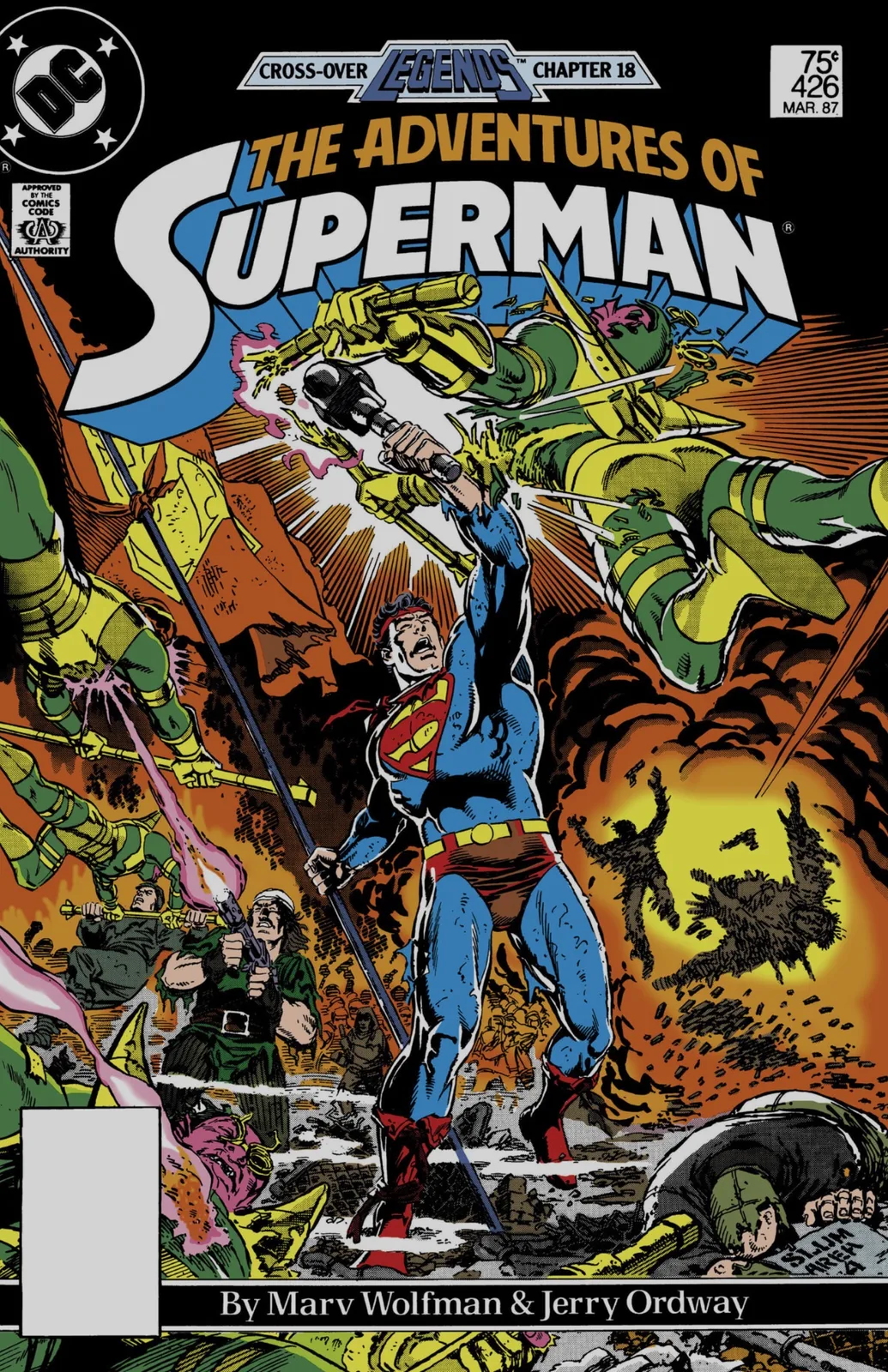
The
Adventures of Superman #426 (March 1987), “From the Dregs.” Cover by Jerry Ordway.
Fittingly for a relay-race story, the middle leg was itself a hand-off. Byrne passed the amnesiac he'd created to the regular Adventures team, and the three of them plotted the chapter together, with Wolfman scripting and Ordway drawing every grimy, glorious inch of Armagetto. His Apokolips is, for my money, the best-looking hell in comics.
The Plot: A Savior, Made to Order
The issue opens at the bottom of the world. A Hunger Dog named Graggin fishes a body out of the fire pit, a big, broad-shouldered stranger in a red and blue costume who has no business being alive, and hauls him back to the huddled Lowlies of Armagetto. And there, out of the crowd, steps a woman: radiant, warm-eyed, improbably kind for a planet where kindness is a rounding error. Her name is Amazing Grace, and as she nurses the stranger back to consciousness she makes an announcement to the gathered wretched. Finding this man is no accident. This man is their savior.
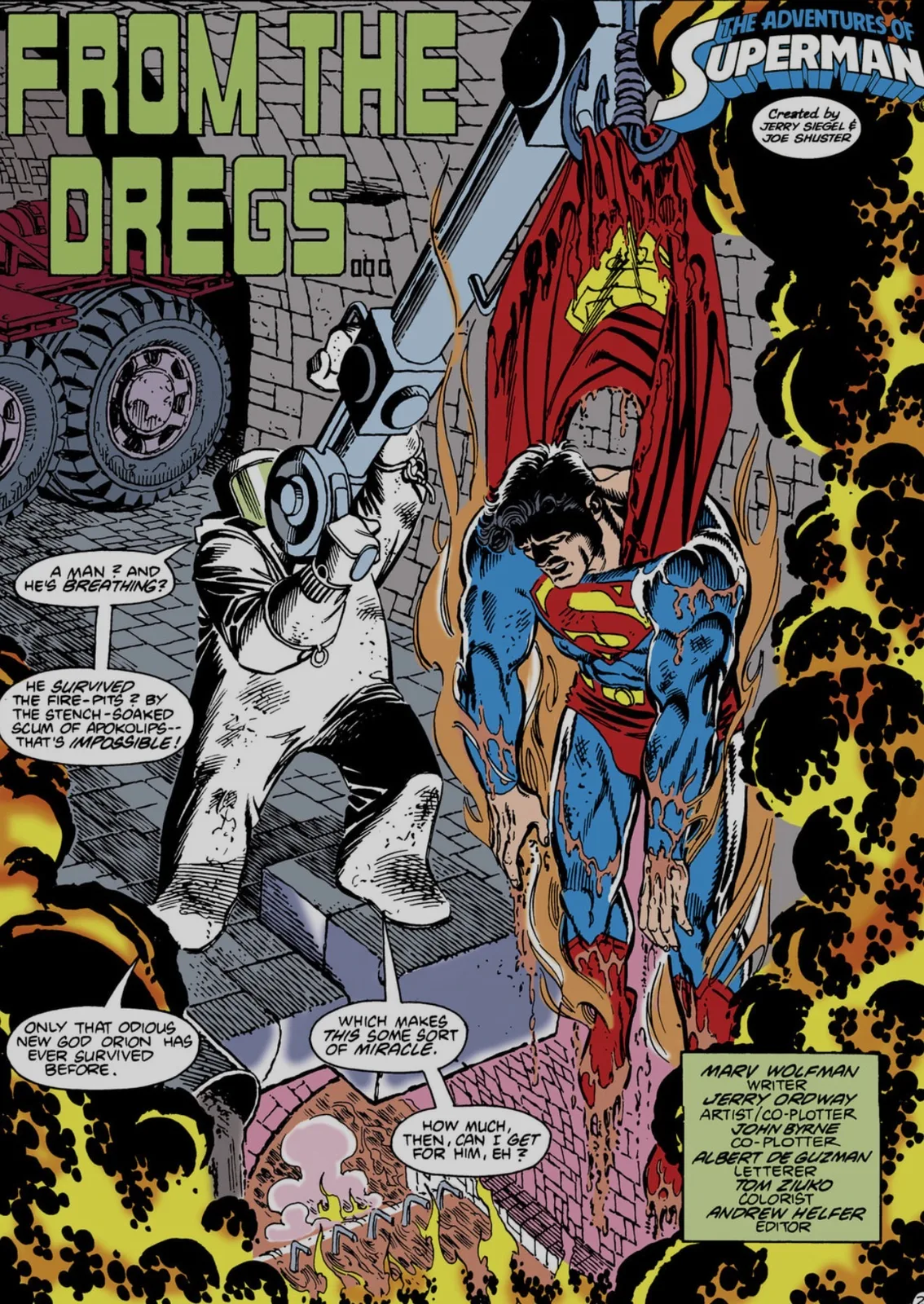
“From
the Dregs”: a Hunger Dog drags the stranger, alive against every law of Apokolips, from the fire
pit.
The stranger can't exactly argue. He remembers nothing: not his name, not his world, not the small detail that he is one of the most powerful beings alive.
His superpowers flicker at a fraction of their strength, randomly surfacing rather than on command. But when a troop of Parademons descends on the slum, instinct is enough. The nameless Superman throws them back, and suddenly the savior talk doesn't sound like talk anymore. Hope, actual unauthorized hope, begins to spread through Armagetto like a wildfire. The S on his chest, even in its diminished state, becomes the symbol of the savior.
Grace stays close to her savior. Very close. In one of the boldest moves a mainstream Superman comic had made to that point, the two become lovers. It is not implied. It is an actual relationship, tender and real, between the Man of Steel and a woman he's known for a very short time. Remember that detail, because it becomes important later, in the worst possible way.
What follows is the uprising.
The savior leads the Hunger Dogs against Darkseid's forces in open revolt, and the battle is brutal and costly, and they win. For one impossible moment, the gutter of the universe throws a victory party. It is the page I keep coming back to: the S-shield on a rag banner, and a slum that dared to cheer.
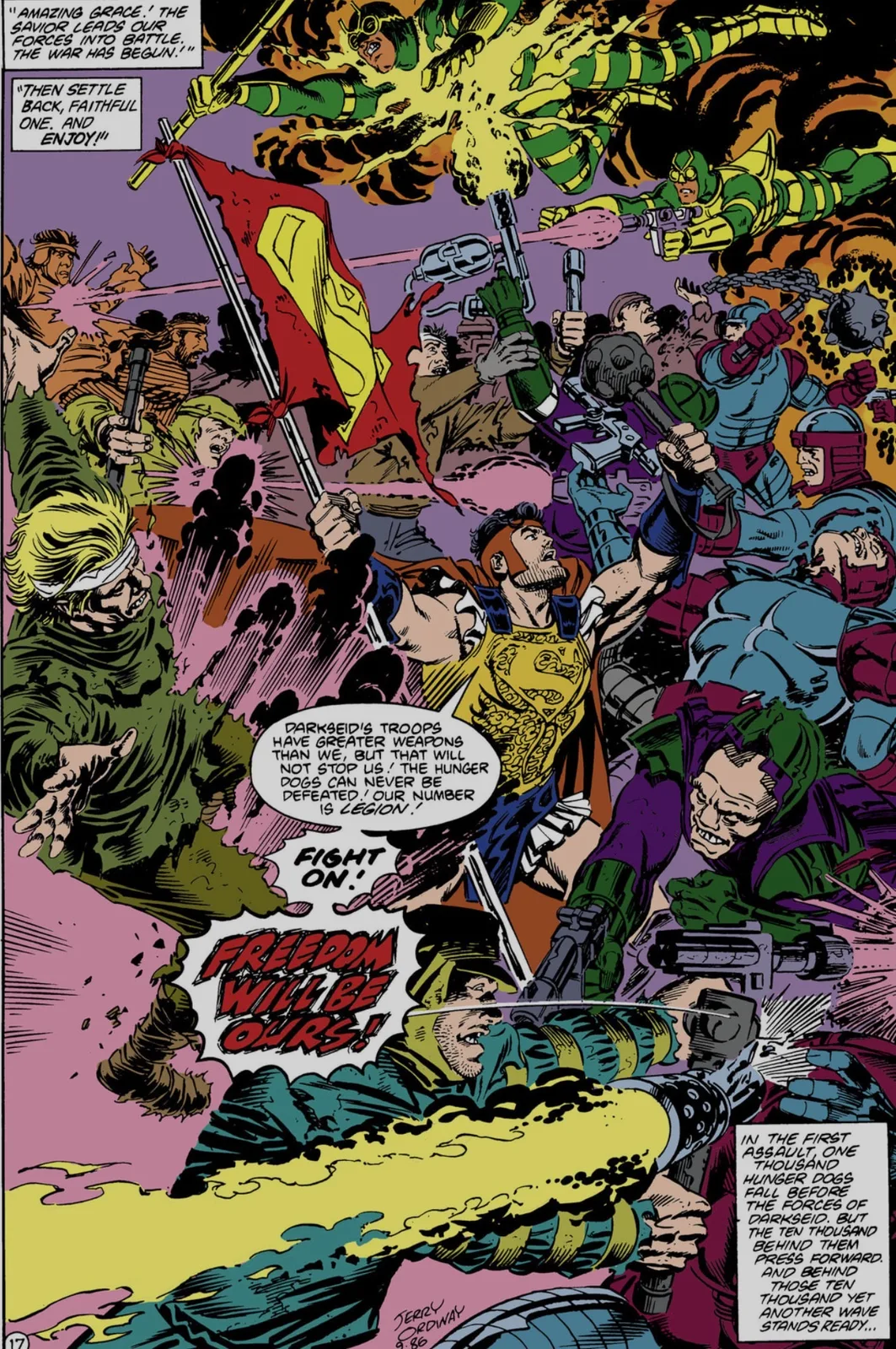
The
savior raises a makeshift S-shield banner and leads the Hunger Dogs into open revolt against Darkseid's
troops.
Which is, of course, when everything falls apart. As the rebels celebrate, Grace drops her deception. She is no resistance leader but a willing agent of Darkseid, and, in a delightfully horrible twist, the sister of Glorious Godfrey, the silver-tongued demagogue currently talking Earth out of its heroes.
Persuasion is the family business, one sibling to each front of Darkseid's war. Her gentle influence over the savior was never merely charm; it was power, and with a final hypnotic push she sways him fully to her side while a vastly larger Parademon force swoops down and slaughters the celebrating Hunger Dogs. It was a rebellion grown in a lab and harvested on schedule.
The comic even lets us re-read the previous chapter: Superman's tumble into the fire pit was staged from the start, with Grace herself planted as the damsel whose "rescue" would pull him in.
The issue closes with Grace escorting the hollowed-out hero into the palace, where Darkseid looks upon the savior of Armagetto and smiles the smile of a chess player picking up your queen with your own hand. He has a word for this magnificent creature standing before him. The word is son. (Meanwhile, brief cameos on New Genesis move Orion and Lightray toward the board, but that's a story for next issue.)
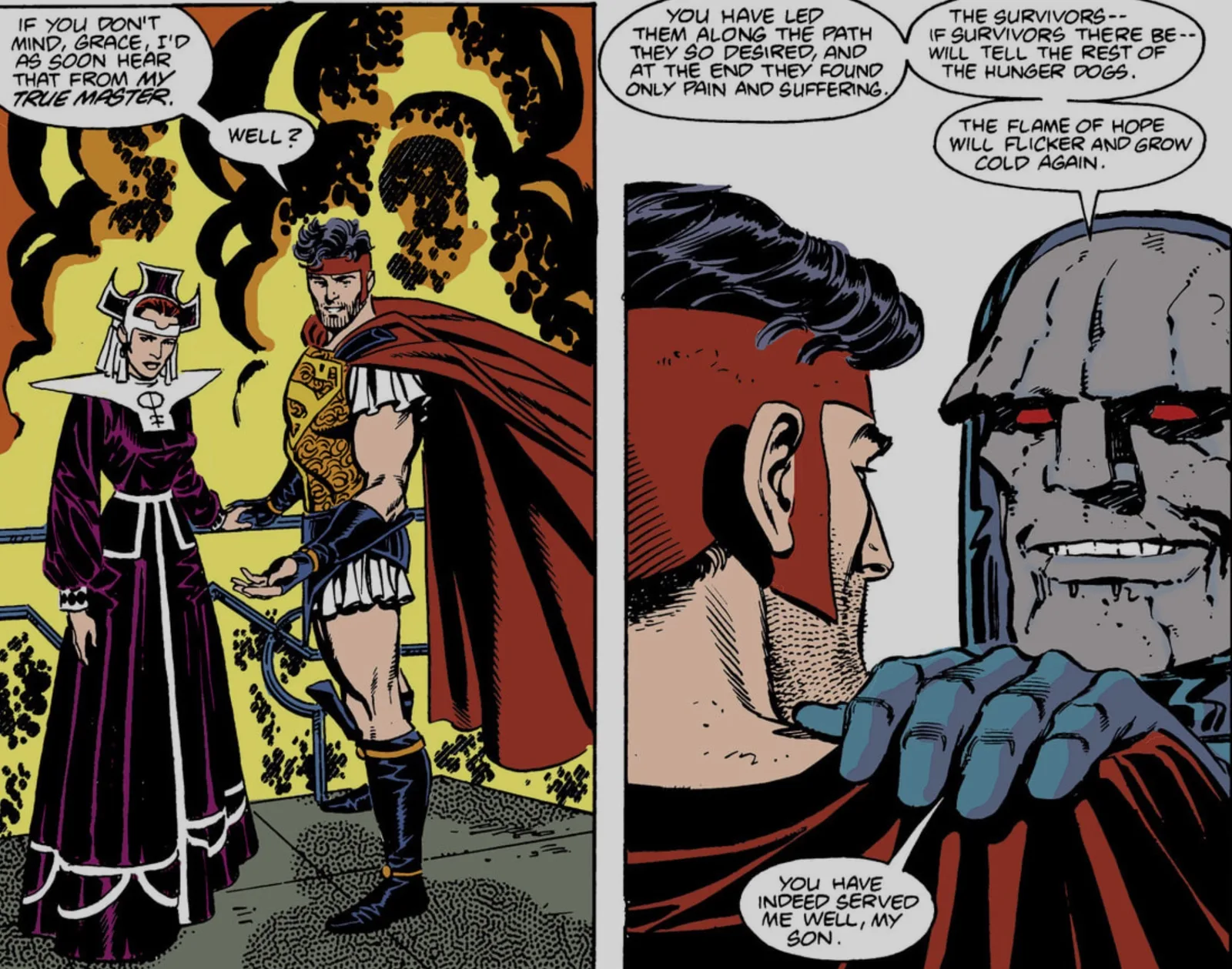
Amazing
Grace delivers her conquest to the palace, and Darkseid claims the hollowed-out hero with a single word:
son. (It is more than a little creepy to see Darkseid smile.)
The Philosophy: What's Left When Everything Else Is Gone
Lesson one: the brave officer reports for duty. Chapter One left us with Locke's uncomfortable math: no memories, no Superman.
This issue files the classic objection to that math. The Scottish philosopher Thomas Reid asked us to picture one life in three snapshots. A boy is flogged for raiding an orchard. Years later, a young officer wins his first battle and still remembers the flogging. Decades after that, an old general remembers the battle but has long forgotten the flogging. If memory is what makes you the same person, then the officer is the boy, and the general is the officer. But the general has no memory of the flogging, so he is not the boy, even though he is the officer who is. Locke's rule contradicts itself, which is the kind of result that gets a theory sent back for repairs. Reid concluded that identity must rest on something deeper than the chain of recollection, and Aristotle had already named the candidate two millennia earlier: character, the trained disposition, built by repetition, that acts before the mind can deliberate. We are what we repeatedly do. And what does the blank man from the pit repeatedly do? He shields strangers before he can so much as name himself. Kindness, it turns out, is stored in the soul's muscle memory, not in the diary. On the question of where the self lives, this comic casts its vote loudly: in the habits, not the archives. I agree.
Lesson two: Sartre's cruelest laboratory. Existentialism's slogan is that existence precedes essence. In plain words: nobody is born with a fixed nature. We show up first, and then we make ourselves into whoever we are, one choice at a time.
An amnesiac on Apokolips is the perfect test of that idea. He has no past to fall back on, so no essence. He is free to become anything. And everything around him, from the fire pits to the shock troops, rewards cruelty and punishes kindness. If a person really is nothing but the sum of his choices, this is the place where he should choose to become a monster. Instead, what does he make of himself? Superman again, minus the branding.
You can read that result two ways. The hopeful reading is that freedom, exercised honestly, leads to goodness all by itself. The skeptical reading is that the book does not believe in its own experiment: it assumes a bedrock Superman-ness underneath the memories, which no fire pit can burn off, so he was never really free to become anything else.
The story grins and takes both: he chooses freely, and he always chooses the same. Condemned to be free, and apparently also condemned to be nice.
Lesson three: the puppeteer's finer art. But the ending poisons the laboratory, and this is the issue's darkest teaching. Grace never handcuffs anyone. She revives the blank man, gives him a name ("savior"), gives him her love, and gives him a cause. She writes everything that goes into him, and with a goddess's touch of mesmerism, she also writes what he wants.
Why does that matter? The philosopher Harry Frankfurt argued that you act freely when you act on desires you yourself stand behind. By that standard, the savior looks free: nobody forces him, and every choice feels like his own. The catch is that the desires themselves were planted by somebody else. His endorsement is real, but what he is endorsing was installed. Philosophers invent elaborate thought experiments with hidden controllers to test whether such a person counts as free. Amazing Grace is the seminar handout with better hair.
And here is Darkseid's masterstroke. He is the god who scours the cosmos for the Anti-Life Equation, the power to switch off free will. This issue shows that he barely needs it. Give a person a story, a lover, and a cause, and his free will marches itself into the trap. Even the uprising was part of the script, staged so that crushing it would hurt more. Camus wrote "I rebel, therefore we exist," meaning that the act of rebellion is where solidarity and meaning are born. Darkseid turns that very act into a weapon.
It is the thought in this arc that unsettles me most: the most efficient attack on freedom isn't force, it's authorship. Remember that too, because next issue the man with the installed desires gets his powers back, a new father, and a body count.
It gets worse before it gets better.
Action Comics #586: "The Champion!"
Written and penciled by John Byrne, inked by Dick Giordano. Legends Chapter 19. Cover date March 1987.
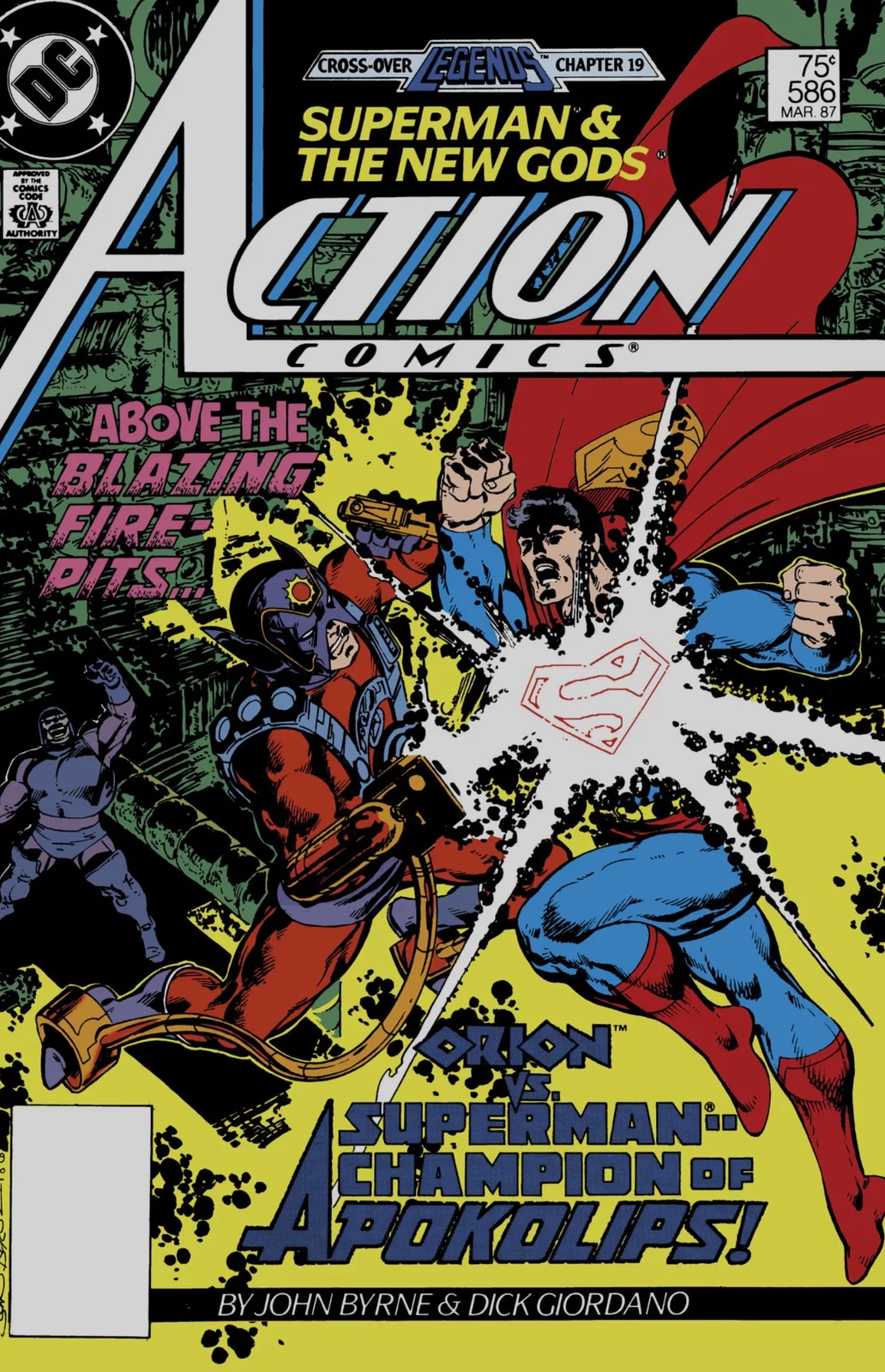
Action
Comics #586 (March 1987), “The Champion!” Cover by John Byrne and Dick Giordano.
The Plot: The False Son Versus the True One
The finale opens in transit. Orion and Lightray of New Genesis are streaking toward Apokolips, Orion the scowling god of war on his Astro-Harness, Lightray the one New God who seems to actually enjoy being one, on a mission to retrieve a fallen hero.
Down below, that hero is being put through his paces. Granny Goodness is drilling Apokolips' new favorite weapon, the man the slums called their savior, while Darkseid and Amazing Grace watch from the shadows. For his new role, the savior has been dressed as a prince of Apokolips, complete with a wrinkly little pleated skirt, not unlike the one Zeus wears in Thor: Love and Thunder. Grace, of all people, voices doubts: the amnesia from the fire pit cost Superman much of his strength, and she wonders whether the conditioning is safe. Darkseid waves her off: Granny will restore that strength. But watch how the strength actually comes back, because it is, to my mind, the sharpest idea in the whole arc. Granny's drills don't do it. Darkseid does, and all it takes is a sentence. When the savior humbly offers his “poor power” in service, Darkseid tells him that his power is the greatest on Apokolips, and the savior feels it flood back through him and lifts into the air. (Granny asks why he didn't do that sooner. Darkseid admits it was dangerous: waking up that much of the man's mind might wake his memory too.)
In other words, the strength was never gone. It was locked in a mind that no longer knew what it was. Granny wasn't giving Superman his powers back; she was giving him a story. Convince the man, down to his bones, that he is the son of Darkseid, and the strength of a god's son simply follows. The body believes what the self believes. The lie doesn't merely redirect his powers; the lie is the power supply.
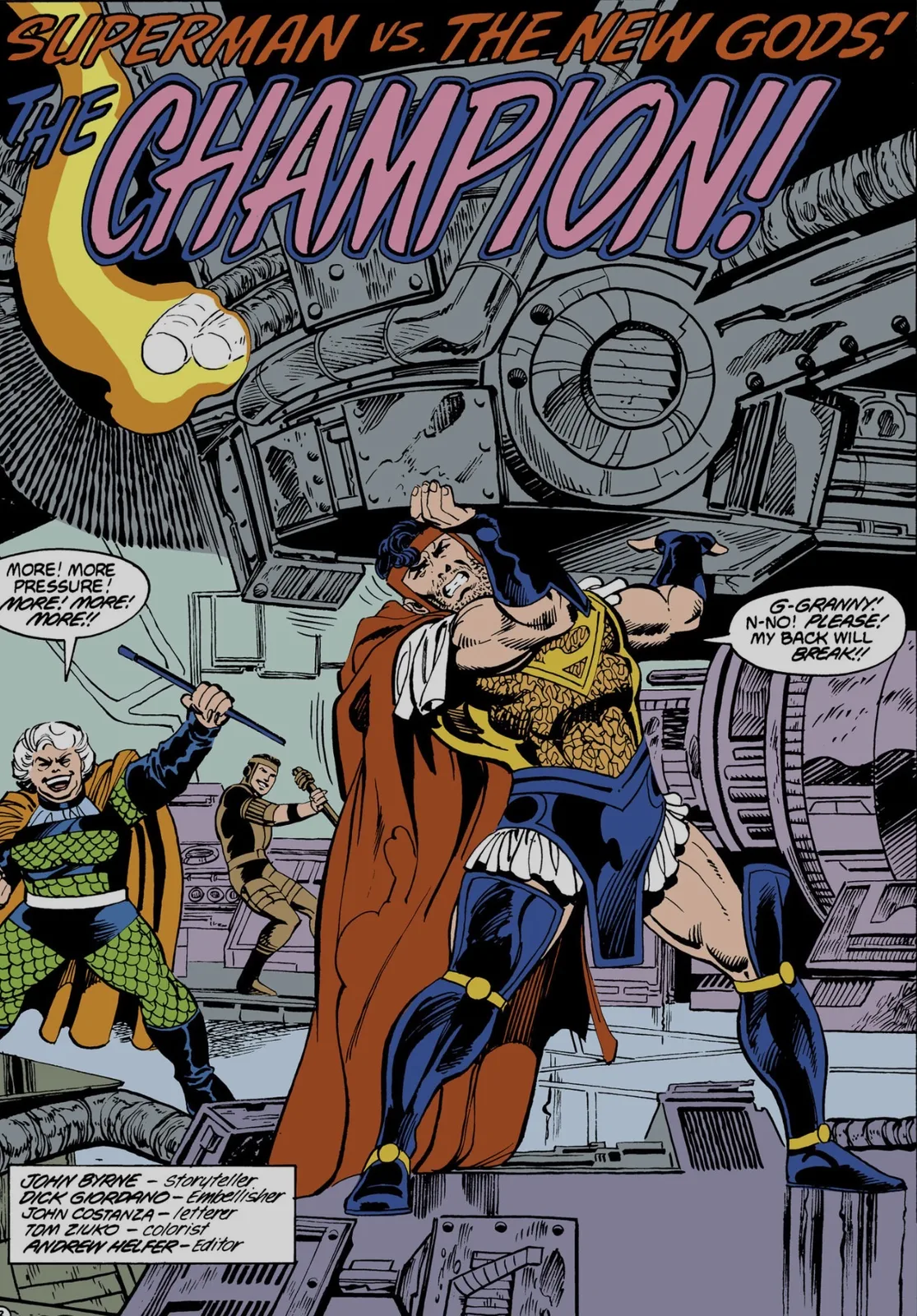
“The
Champion!”: Granny Goodness drills Darkseid's new weapon, feeding him a story rather than his
strength.
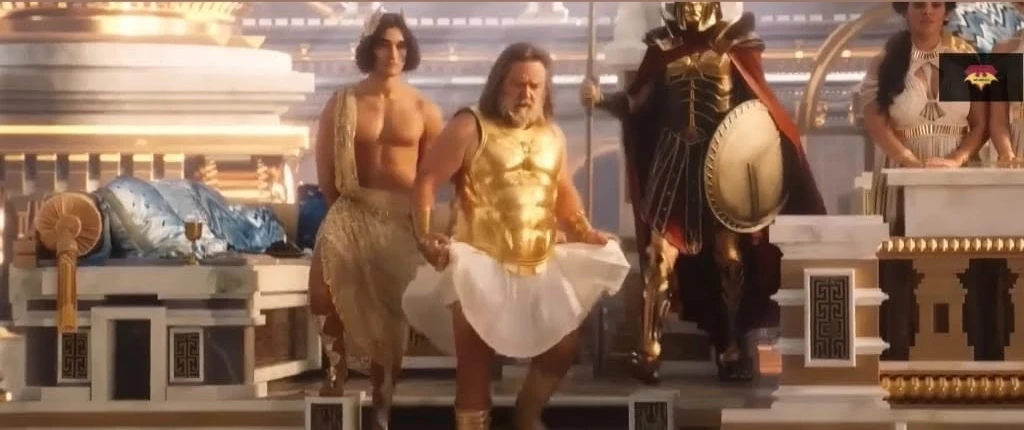
Russell
Crowe's Zeus and his pleated skirt in Thor: Love and Thunder (2022). Apokolips, it turns out,
shops at the same tailor.
Darkseid, in a rare chatty mood, also confirms to Grace what the first chapter all but spelled out: he saw through the Clark Kent disguise the moment his prize arrived. And when Grace cringes apologetically, he sneers that her groveling reminds him of her brother, a small, sharp cameo of contempt for the family currently running both fronts of his war.
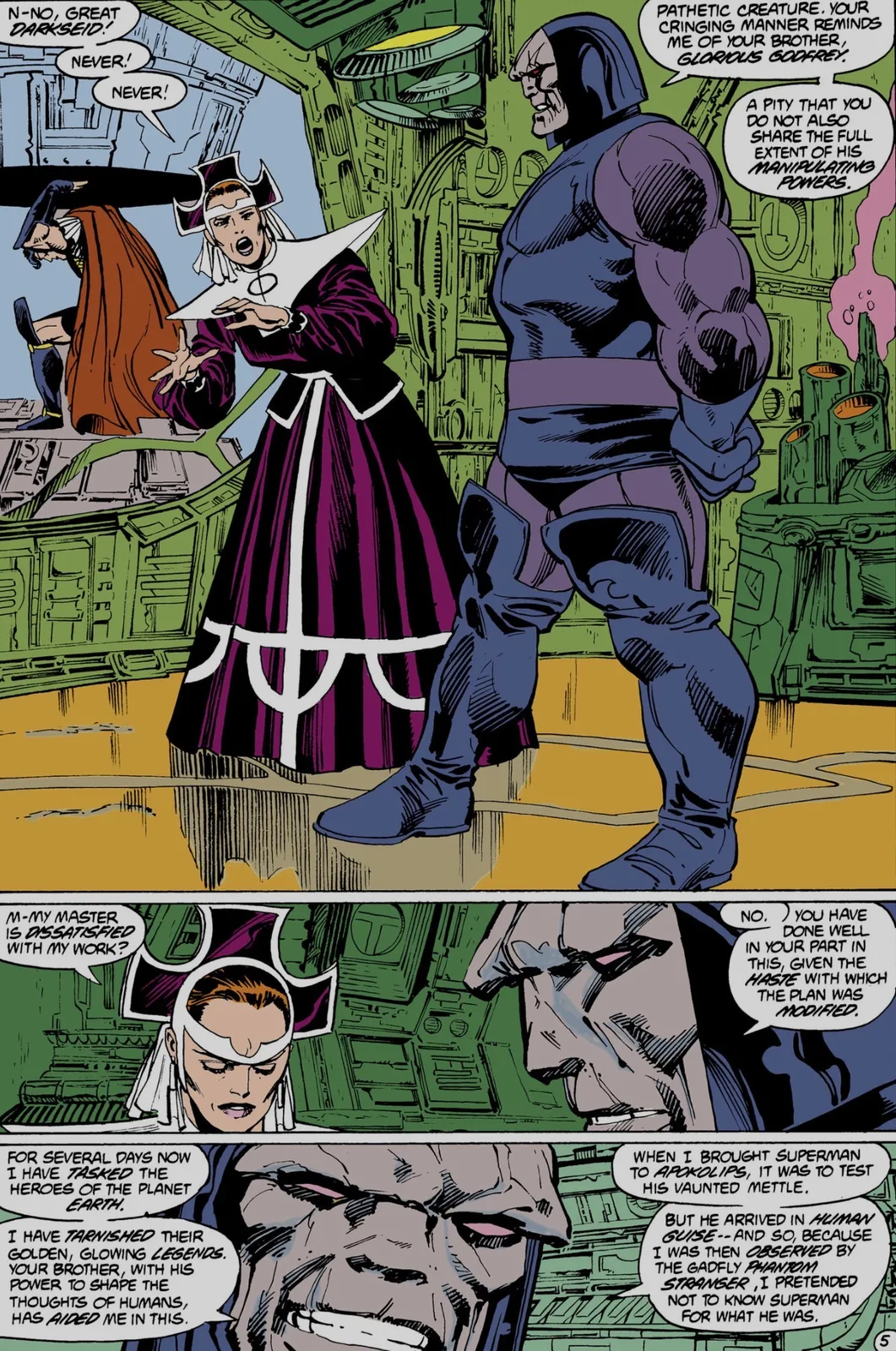
Darkseid
berates a groveling Amazing Grace, sneering that her cringing manner recalls her brother, Glorious
Godfrey.
Then the intruders arrive, and the savior is unleashed. High above Apokolips, Superman slams into Orion, and Byrne stages the fight as a thesis statement, which is the Byrne I love best, cosmic bodies colliding with ideas attached: the false son of Darkseid, a good man forged into a weapon, against the true son of Darkseid, a born weapon who chose to be good.
Meanwhile Grace tries her mesmerism on Lightray, and very nearly gets him, reaching places in the cheerful god's soul he'd kept firmly locked, before he wrenches free through sheer willpower and snaps her spell with a blinding burst of light, responding to emotional confusion, in the grand superhero tradition, by detonating.
The rescue itself comes as a ping. Orion brings his Mother Box to bear on Superman's broken mind and restores what Darkseid unmade, though not all of it. Deliberately, mercifully, and more than a little terribly, the small living computer edits as it heals. The love affair with Grace: gone. The rebellion he helped raise and then helped bury: gone. The knowledge that thousands died because of what he did under her influence, and every ounce of guilt that would come with it: gone.
What remains is the abduction, the pit, and the burning awareness that Darkseid stole him and used him like a tool.
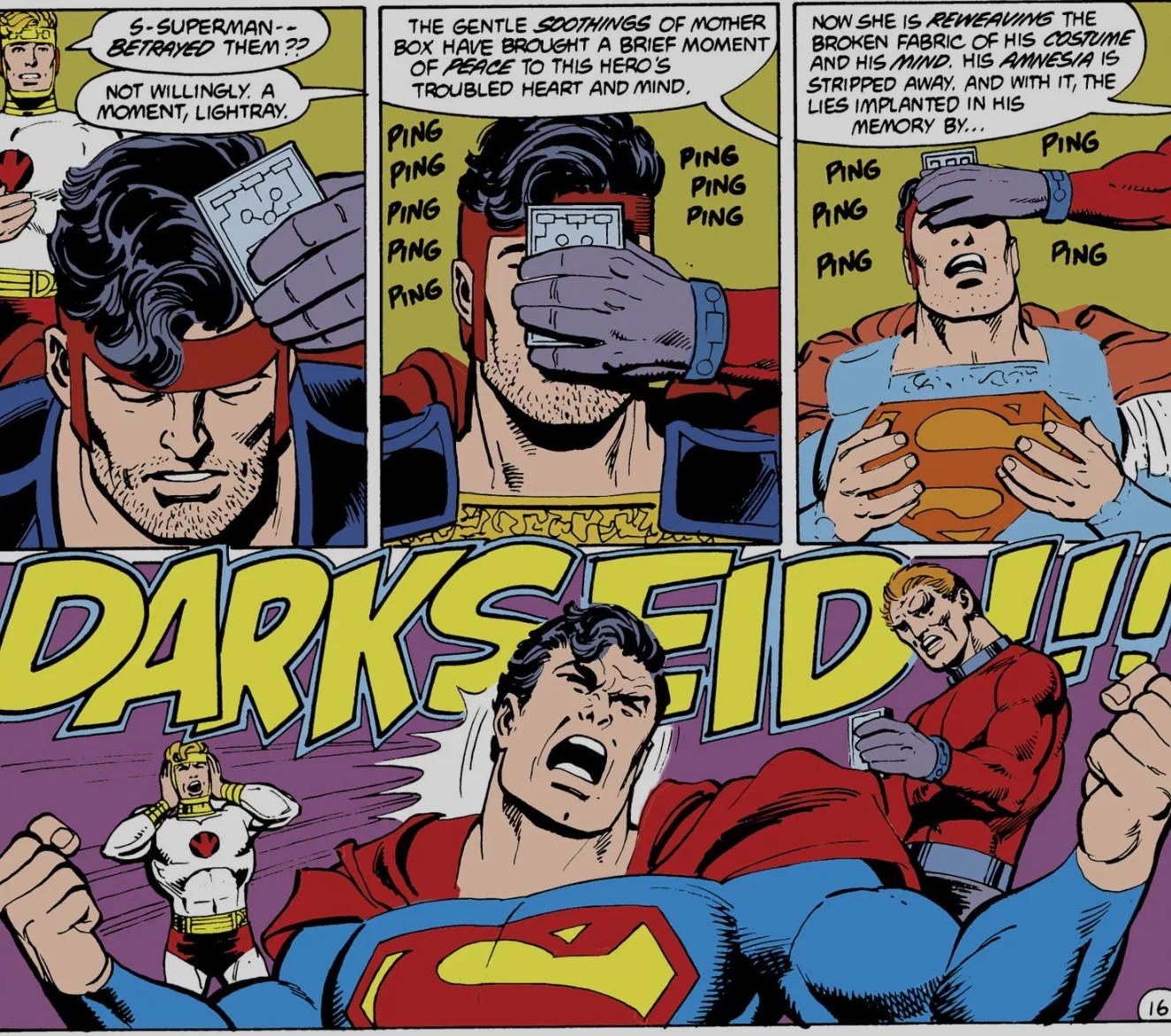
Orion's
Mother Box “pings” the implanted lies away, and Superman's first clear thought erupts as a
name: Darkseid.
It's enough. Superman comes back to himself... and he is volcanic! His roar of realization announces to all of Apokolips that the game is up.
What follows is the most bruising fight of the young post-Crisis era, the Man of Steel against the god of Apokolips, toe to toe. The finishing move is pure poetry.
Darkseid unleashes his Omega Beams, the same twisting, seeking rays that abducted Clark from a Metropolis sewer, now dialed back to kill, and Superman dodges the beams that never miss, baiting them on a chase across Apokolips until they slam into their own maker, Darkseid.
The instant Superman gains the upper hand, the scorched lord of Apokolips ends the bout in the most Darkseid way imaginable: he opens a Boom Tube under his inconvenient guest and drops him back on Earth, then permits Orion and Lightray to depart.
On Earth, almost no time has passed. The entire odyssey, from sewer to savior to son to escape, fits inside a single day, and Superman rejoins the Legends storyline that same evening, none the wiser about the gaps in his memory. Somewhere behind him, one person keeps every moment he no longer has. And Orion, a god of war not given to compliments, files his assessment of the departed guest: not a warrior, not a god, something rarer. A champion.
The Philosophy: Guilt, Gaps, and the Hero Who Must Not Change
Lesson one: whose hands did the killing? Thousands are dead on Apokolips, and the arc dares us to say whose fault that is.
Aristotle got here first, as usual. In the Nicomachean Ethics he named two things that make an action involuntary. The first is compulsion: the push comes from outside the person. The second is ignorance: the person does not know what he is actually doing. Involuntary actions, he ruled, deserve pardon and pity rather than blame. Brainwashed Superman ticks both boxes with a flourish. He didn't know who he was, and the will steering his body was installed by professionals.
Modern philosophers have built a whole cottage industry around exactly this scenario. Derk Pereboom's famous manipulation cases imagine a team of neuroscientists who design a man's desires so that he "freely" commits a crime, and then ask whether anyone really believes he is responsible for it. Darkseid and Grace simply are those neuroscientists, with better production design. So the verdict feels easy: the guilt flows upstream, to the people who wrote the will.
But the arc won't let us off that cleanly. The same month, on Earth, Godfrey's mesmerized public is voting its heroes out of existence. If Superman is innocent because somebody else authored his will, how innocent is a crowd whose will was authored by a talk show? The uncomfortable answer is that responsibility follows the authorship of the will, and authorship, unlike a fire pit, comes in degrees. The more completely someone else wrote your will, the less of the blame is yours. Superman's was rewritten wholesale. The crowd's was merely nudged.
Lesson two: the kindest forgery. Now for the moment this whole article has been circling: was Orion right to edit the man he saved?
I find the case for yes moving. The guilt Orion erased was itself Darkseid's forgery: grief for crimes that were never truly Superman's. Deleting it is less like censorship than like returning stolen property.
The case against, for me, won't go away. Nobody asked Superman. Philosophers of narrative identity like Marya Schechtman argue that a self just is the story a person can tell about their own life. By that measure, a censored chapter isn't a neutral blank. It is a hole in the structure. And this particular hole has a custodian: Amazing Grace remembers everything he doesn't, which is about as eerie as intimacy gets.
Bernard Williams added the sharpest point. Imagine a truck driver who, through no fault of his own, kills a child. He is blameless, and yet he rightly feels something a mere bystander doesn't. Williams called it agent-regret, and he argued that this residue is part of taking your own agency seriously: it was still your hands on the wheel. Erase the guilt and you spare the man, but you also deny him the chance to come to terms with what happened through him.
And look, finally, at how the rescue works. To undo the villain's edit of a mind, the rescuers perform an edit of their own. The difference is love. The method is identical. The comic, to its credit, leaves that queasiness sitting right there on the page. (It even hands the narrative-identity crowd a bonus exhibit. On Apokolips, Superman's powers returned because of the story he believed about himself. In this arc, the story you tell about yourself doesn't merely describe you. It runs the engine.)
Lesson three: the hero who must not change. Why does the story erase itself?
Here the best guide is Umberto Eco, whose 1972 essay "The Myth of Superman" argued that a serial mythic hero is caught in a paradox. To remain a myth, he must stay fixed and recognizable, what Eco called inconsumable. He cannot marry, age, kill, or pile up consequences, because every consequence uses up a little of him, and a used-up hero is a finished story. So the serial must forever return him to the starting line.
With that in mind, watch what the Mother Box actually does. It takes everything 1987 continuity could not keep, a lover, a body count, a season as a tyrant's son, and disposes of it inside the fiction, dressed up as an act of mercy. Eco's law of the genre walks right onto the panel and cosplays as a plot device. That is the final lesson of this strange, bold month of comics: when the reset button shows up as a character's compassionate choice, you are watching the genre confess its own rules.
And yet the arc sneaks its real answer out under the wire, in the two mirrored sons. Orion, Darkseid's son by blood, chose the light: parentage is not destiny. Superman, Darkseid's forged son, kept helping people with his mind burned blank: memory is not identity.
What survives the fire pit, the mesmerism, and even the Mother Box is the same stubborn thing it has been all along, and that thing is character. The myth machine can erase what happened to Superman. It cannot seem to erase him.
Behind the Panels, Beyond the Story
Three issues, one month, one very bad vacation. I've walked the plot and squeezed philosophy out of every fire pit; what's left is the view from outside the story: who actually made this thing, what it adds up to, and what it left behind in the Superman mythos.
A Tense Office, a Smooth Relay
Here's the arrangement as it stood in early 1987. John Byrne wrote and drew Superman and Action Comics while also penciling the Legends miniseries itself, because apparently the man photosynthesized. As a Byrne fan I had a great deal to read in 1987, and I am still not sure how he managed it. Marv Wolfman wrote The Adventures of Superman, with Jerry Ordway on art. How that arrangement came to be is a story Byrne has told at length on his own forum, and it's worth retelling, with the caveat that it is very much his telling.
In Byrne's account, Wolfman was offered the second chair on the relaunch. Before accepting, he pitched his big idea for Lex Luthor over the phone, take it or leave it. The pitch: Luthor reinvented as the world's richest man, ruling from a palatial mountain estate outside Metropolis, with Lois Lane as his mistress, drawn to power. Byrne says he needed about three nanoseconds to refuse the Lois part. He kept the world's-richest-man seed and grew it into the corporate Luthor we know, blending, by his own description, a few famous billionaires of the age (Trump, Turner, Hughes) with a healthy pinch of the Devil. Byrne also suggested the title Adventures of Superman, tipping the hat to the old George Reeves TV series.
Years later, Byrne learned that Wolfman had claimed credit for creating the new Luthor and had collected a creator bonus for it. That sore point clearly never fully healed. Byrne sums up the first year of shared custody as a "most unsatisfactory" collaboration, after which Wolfman departed and Byrne took over Adventures himself. Wolfman, for the record, has always maintained that the businessman Luthor was his. Who really built him is one of comics' enduring little Rashomon stories, and I wisely decline to referee it.
Jerry Ordway remembers the era more warmly. Fresh off inking Crisis on Infinite Earths as one of George Pérez's hand-picked finishers, he'd been given a soft promise of a seat at the relaunch. He spent 1987 pitching plots from the artist's chair, and he credits Wolfman with setting a good tone for the book's first year. Years later, Ordway would run the Superman titles himself, and that career began with exactly the kind of co-plotting our middle chapter shows. Look at the credits of Adventures #426: script by Wolfman, plot by Wolfman, Byrne, and Ordway. The artist was already writing.
Whatever friction existed in that office, the tense marriage worked for one remarkable month: three names on one seamless relay. Editor Andrew Helfer, whose name sits in the credit boxes, was presumably the one making sure nobody dropped the baton.
I should be honest about one thing. On the specific choices that make this arc so striking, the love affair and the deliberate memory wipe, the creators have left almost nothing on the record. No interview I could find asks Byrne about Amazing Grace or Wolfman about the uprising. What the record does preserve is method and motive. Byrne has described his reboot homework as sifting fifty years of contradictory Superman, from the comics and serials to the Fleischer cartoons, George Reeves, and Christopher Reeve, and keeping only what stayed consistent throughout. Keep that in mind.
Byrne's lifelong devotion to Jack Kirby is documented everywhere: he would go on to systematize the Fourth World's cosmology (his "Godwave" concept), write the Genesis event, and eventually write and draw Jack Kirby's Fourth World outright. A man that steeped in Kirby, handed Superman, was always going to route the new mythology through Apokolips, and he did it by month three. For a reader who shares that devotion, as I do, that was the best possible news.
One War, Two Fronts: What the Whole Thing Means
Seen from a distance, the arc has a neat shape. Legends is Darkseid against a planet's belief in its heroes, and his weapon is a voice: Glorious Godfrey, talking Earth out of its faith. The Superman tie-in is Darkseid against one hero's belief in himself, and his weapon is a voice too: Amazing Grace, talking a man out of his own soul. Brother and sister, the same gift, one assigned to each front. It is one war, and it is fought over hope.
Which is why the Anti-Life Equation belongs at the center of my reading of this story. Darkseid's eternal quest is for a formula that deletes free will wholesale. The Godfrey siblings are the hand-crafted version of the same product: Grace edits belief one mind at a time, Godfrey one broadcast audience at a time. Across three issues Darkseid never once tries to simply destroy Superman. He tries to reauthor him. The arc understands the character better than many stories that followed: Darkseid's true enemy is not the Man of Steel's strength but the part of him, the part of anyone, that chooses.
And what does the experiment prove? The story subjects its hero to three escalating erasures. The fire pit takes his memory, Grace takes his desires, the Mother Box takes his history, and each time the same stubborn residue survives: the disposition to help. That is the arc's finding, replicated three times under laboratory conditions. It rhymes almost exactly with what Byrne said his reboot method was: boil away fifty years of contradictions and keep the consistent core. The Man of Steel did editorially what the fire pit does dramatically. Strip away Superboy, Kandor, Krypto, the Fortress full of keepsakes, and, this arc adds, memory, powers, even the name, and what remains is the essential Superman, the guy who helps. The Apokolips story isn't a detour from the 1986 relaunch. It is the relaunch's mission statement, wearing a tattered cape.
Even the title of the final chapter is making an argument. On Apokolips, Superman is not the strongest being in the room, not the oldest, not remotely the most divine, and the story defines his category anyway, through Orion's parting verdict. Not a god. Not a warrior. A champion, meaning one who fights for someone. If you want post-Crisis Superman in a single word, there it is, delivered by a war god who would know.
Ripples: The Consequences of These Three Issues
In continuity terms, this was the first post-Crisis meeting of Superman and Darkseid, and it set the template for one of DC's defining rivalries: the god who wants to unmake choice against the man who is nothing but choice, all the way down. Byrne kept pulling the thread. A few months later came the infamous Big Barda storyline in Action Comics, in which the vile Sleez of Apokolips puts Superman and Barda in front of a film camera. Asked point-blank on his forum whether an adult film was actually made, Byrne replied, with a completely straight face, that it was whatever the reader wants it to be.
Action Comics #600 threw an anniversary-sized Superman and Wonder Woman against Darkseid, with George Pérez along for the ride. A decade later Byrne wrote the Genesis event on his Godwave chassis, then took over Jack Kirby's Fourth World. There he added a retroactive wrinkle: an earlier, forgotten first meeting between Superman and Darkseid. That explained a small oddity in Superman #3, where Clark had recognized Darkseid on sight despite supposedly never having met him.
The arc's reverence for Kirby ran deep from the start. It even treats the destruction of New Genesis from Kirby's late Hunger Dogs graphic novel as canon. Three months into a brand-new universe, and Kirby's gods were already part of the foundations.
Then there's the loose thread the mythos never quite tied off: Amazing Grace remembers. Every moment the Mother Box took from Superman, she keeps: the rebellion, the palace, all of it. Canon largely left her alone; she drifted back into Darkseid's inner circle as a minor player, her secret intact. It may be the unexploded bomb of the Byrne era. Somewhere on Apokolips is a woman holding memories of Superman that Superman does not hold of himself.
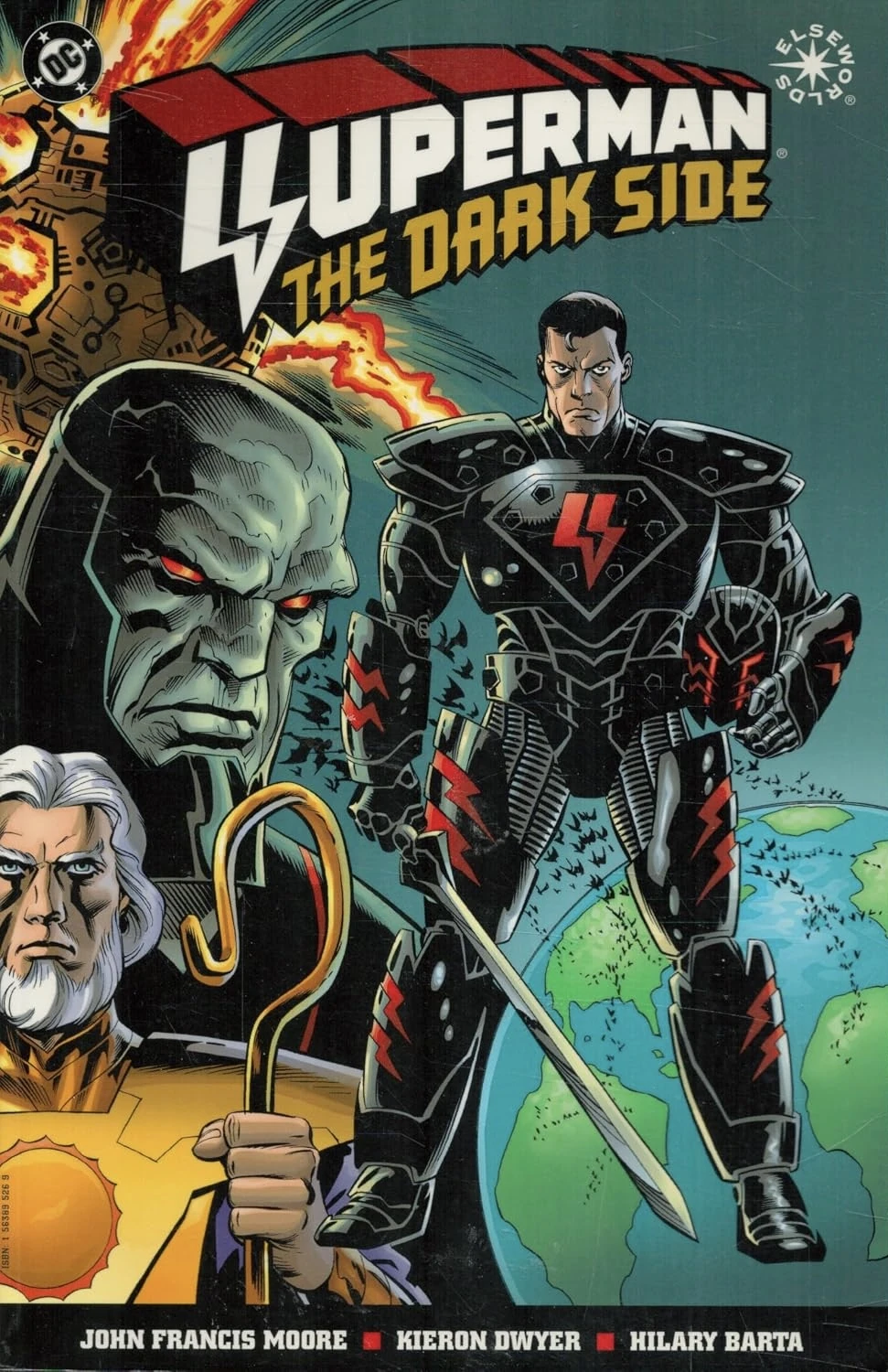
Superman:
The Dark Side.
There is a family footnote to this story, too. A little over a decade after the crossover, in 1998, DC's Elseworlds imprint published Superman: The Dark Side, a three-issue miniseries (August to October 1998) written by John Francis Moore, penciled by Kieron Dwyer, and inked by Hilary Barta. Dwyer happens to be John Byrne's stepson: Byrne was married to Dwyer's mother, and the two later worked together on Danger Unlimited.
Where Byrne's 1987 story asked what it would take to turn Superman into a warrior of Apokolips, The Dark Side skips the brainwashing and twists Superman's origin instead. In its alternate history, the rocket from Krypton never reaches Kansas. The New God Metron intercepts it and delivers the infant Kal-El to Darkseid, who raises the boy in isolation as his son and his weapon. This Superman grows up without a conscience. He lays waste to New Genesis on behalf of his "father" and then turns his attention to Earth, a planet full of people who would have been his friends in another life. Eventually the conditioning breaks, because even this Superman is good at the core, and he leads the New Gods against Darkseid. The dying Lightray pours his own power into him, charging Superman for the final blow.
It is, in effect, the 1987 story run in reverse. Byrne hollowed out a hero and refilled him. Moore and Dwyer start with Superman as a weapon and let the story find, very late, the man inside. That the pencil art came from Byrne's own stepson makes it, for me, a wonderful and satisfying rhyme.
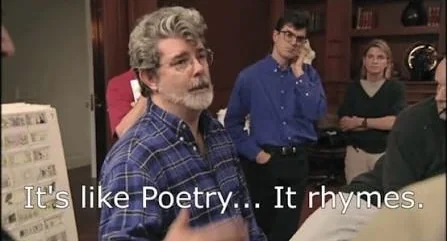
George
Lucas on the set of The Phantom Menace, explaining to his crew that Anakin destroying the droid
control ship echoes Luke destroying the Death Star: “It’s like poetry, so that they rhyme.
Every
stanza kind of rhymes with the last one.” The moment comes from the 2001 documentary The
Beginning: Making Episode I
and has since become one of the most quoted things Lucas ever said.
The arc's biggest echo, though, arrived on television. When Superman: The Animated Series needed a finale in 2000, it reached for this exact template. In "Legacy," Darkseid brainwashes Superman into his personal weapon, complete with training under Granny Goodness, and then, where the comic kept its captive on Apokolips, the show floors the accelerator and sends him out to conquer worlds in Darkseid's name. Fans have pointed straight back to the 1987 three-parter as the blueprint, and it is hard to disagree.
What Byrne, Wolfman, and Ordway ran as a bold one-month experiment became the mythos' go-to nightmare: the greatest hero, manipulated by the worst father.
And, of course, the humble publishing legacy mentioned at the start. A story weaving through the three Superman titles like a relay race felt novel here, but it became the everyday architecture of the Superman line. In the 1990s it was formalized in the so-called "triangle era," when every Superman title carried a numbered triangle on its cover so that the four books read as a single weekly story. If you'd like to read the full story yourself, the whole arc is easy to find, collected in Superman: The Man of Steel Vol. 2, in the 2020 Man of Steel Vol. 1 hardcover, and in the aptly titled Superman vs. Darkseid paperback.
So Superman flies home missing a piece of himself. Grace keeps it. Darkseid nurses an Omega-shaped scorch mark and a grudging new respect. And I keep the one thing the Mother Box couldn't file off: the knowledge that underneath the memory, underneath the powers, underneath even the name, there is a man whose very first instinct in hell was to help somebody. Fifty years of contradictory continuity, one consistent core. Byrne's editorial method, Darkseid's eternal frustration, and the reason the myth is still flying all turn out to be the same answer.
The Comics
The three chapters of the story, the crossover that frames them, and the Elseworlds echo, on the DC Database:
- Superman #3 – "Legends from the Darkside!" (March 1987)
- The Adventures of Superman #426 – "From the Dregs" (March 1987)
- Action Comics #586 – "The Champion!" (March 1987)
- Legends #1–6 – the 1986–87 crossover miniseries these issues tie into
- Superman: The Dark Side #1–3 – the 1998 Elseworlds miniseries in which Kal-El is raised by Darkseid
Related on This Site
If you enjoy this kind of close reading of a cosmic 1987 comic, the same year gave us Steve Englehart's run on the Silver Surfer, which I cover issue by issue in The Freest Being in the Universe, free to read online in six parts, and in the story of how it became a book, From Blog Posts to a Book on Amazon.