The Freest Being in the Universe
Part 1
What a Cosmic Hero Taught Me About Love, Grief, and Becoming Yourself
This is the first instalment of my book The Freest Being in the Universe, serialised here on the web one part at a time. It gathers the book's Introduction together with its opening chapter on the Silver Surfer's first twenty years — the two long decades of exile that made the character Steve Englehart would finally set free.
July 2026
Get it on:
Amazon.com →
Amazon.de →
Amazon.co.uk →
This article series is the full text of the book.
If
you'd like to support the author, please feel free to purchase
a physical copy or the Kindle ebook.
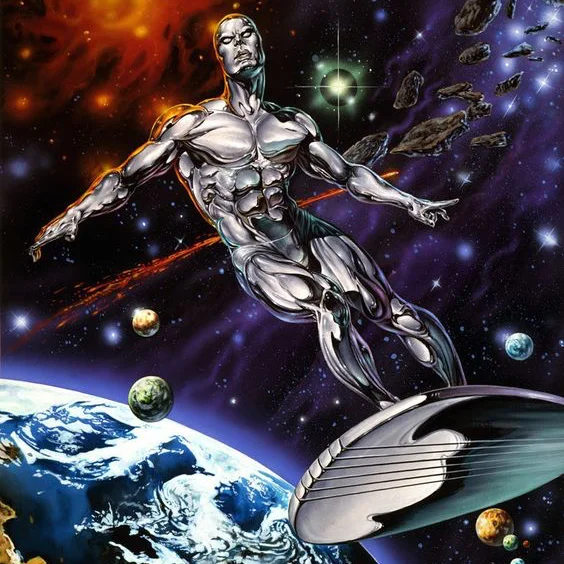
A gorgeous rendition of the character created by Jack Kirby and Stan Lee at Marvel Comics, painted by Joe Jusko.
Introduction: A Chrome Man on a Surfboard, and Why He Matters
The Silver Surfer is probably one of the strangest characters ever to headline a mainstream comic book. He is also one of the most instantly recognisable. A silver man, entirely nude and entirely smooth, no seams and no features but two blank reflective eyes, riding a surfboard through the vacuum of space at faster than the speed of light. Say it out loud and it sounds like a joke, or a hallucination, or an advertisement for something you'd regret buying. And yet you know him on sight. You could pick that gleaming silhouette out of any crowd of costumed heroes, because there is nothing else in the entire medium that looks like him.
It is even questionable whether you can call him a super hero at all. He has no secret identity, no city to protect, no rogues' gallery of bank robbers to foil, no day job to rush back to. He rarely goes looking for a fight and spends much of his existence actively trying to avoid one. He does not really save the day so much as wander into cosmic catastrophes, grieve over them, and deliver a soliloquy. He is closer to a wandering monk, or a Romantic poet, than he is to the typical super hero. The costume, in his case, is just skin.
What he is, unmistakably, is a cosmic hero. He belongs to the far, strange, science-fiction corner of the Marvel universe: the corner of world-devouring gods and living planets, of star-empires and soul-gems and abstractions the size of galaxies who personify Death and Eternity. He does not fit in a police procedural or a high school. He fits out there, in the deep black between the stars, which is precisely where he is happiest and precisely where most of Marvel's characters would simply die. That is his native habitat, and it is a big part of why I love him.
Because I should say it plainly: this is a hero very dear to me. I have carried the Silver Surfer around in my head for a long time — that impossible image, that mournful voice, that particular ache of a being who has all the power in the universe and would give every watt of it away to be left alone in peace. He is melodrama, yes. He is absurd, yes. He is also, when the right person is writing him, one of the most genuinely moving ideas comics has ever produced.
And there is one run of his adventures, largely forgotten now, that I want to spend this book with.
The Silver Surfer's longest-running series (the one that finally made the character work as the star of his own book) began in 1987. And the run that started it all, that opened that series and set its tone and its stakes, was written by Steve Englehart and drawn in turn by three very different artists: Marshall Rogers, whose deep space glowed like stained glass; Joe Staton, who kept the machine running warm through the middle; and the sensational Ron Lim, who arrived like a second sunrise and went on to become, for a whole generation of readers, simply what Marvel's Silver Surfer looks like.[1] It is an obscure stretch of comics today, overshadowed by the Thanos epics it directly made possible, and that obscurity is a small injustice I would like to correct.
Because what Englehart and his collaborators built across those thirty-odd issues is genuinely sprawling: a tale of attempted cosmic murder, of a conspiracy of immortals plotting to assassinate a god; of a galactic war between two empires that had forgotten how to be themselves; and, underneath both, of one silver man's long, painful, exhilarating journey toward figuring out who he actually is when the cage finally opens and no one is telling him what to want. All of this braided together and paid off with a bookkeeper's precision, so that a throwaway detail in one issue becomes the hinge of a story twenty issues later.
In this book I want to do two things with that story.
First, I want to recap the plots and analyse them: to walk through what actually happens, issue by issue, arc by arc, and show you how the pieces fit. Half the pleasure of this run is watching a master craftsman set a hundred small dominoes and then set them in motion. You do not need to have read a single one of these comics to follow along. That is what the recaps are for.
But I hope you will read them anyway, because I recommend this run without reservation. Englehart's Silver Surfer is not homework. It is pure fun — fast, light on its feet, and full of cosmic adventure, the kind of comics you tear through grinning and then start again. Everything I write here is meant to deepen that pleasure, not to stand in for it. Think of the recaps as an open door, not a substitute for walking through it. If this book sends you off to track down the actual issues, it will have done the best thing it possibly could.
But second, and more importantly, I want to ask what we can learn from these stories — what they have to say about how to live, and which philosophy, if any, they represent. Because for all the gods and gems and exploding stars, this is in its core a story about very human things: about freedom and what we do when we finally get it; about identity, and how much of it survives when everything external is stripped away; about sacrifice, and grief, and love that doesn't last and matters anyway; about the difference between power and wisdom; and about the stubborn recurring lesson that beyond every binary you're handed — this side or that, order or chaos, even life or death — there is nearly always a third thing, and the third thing is where the meaning lives.
I'll draw on the great traditions where they genuinely fit and where they help — a little Stoicism, because no character in fiction is more obviously a walking Stoic parable than a free spirit locked inside an inescapable barrier; a little existentialism and absurdism, because a man remaking himself in an indifferent cosmos is exactly Camus's territory; a little Buddhist non-attachment, because letting go is the Surfer's oldest and hardest discipline. But I'll wear all of it lightly. This is not a philosophy textbook. It is an appreciation of a beautiful, strange, half-forgotten comic — and an honest attempt to mine it for its wisdom.
We begin before Englehart, though, because you cannot understand where this run takes the Surfer without understanding where it found him. So the first chapter steps back to 1966, to a stowaway on a flying surfboard who was never supposed to exist, and to the twenty long years of exile that made him the character Steve Englehart would finally set free.
Come and meet him.
A Note on Copyright and Fair Use
The Silver Surfer, Galactus, the Fantastic Four, and all related characters, names, likenesses, and story elements are trademarks and copyrighted properties of Marvel Characters, Inc., a subsidiary of The Walt Disney Company. This book is an independent, unofficial work of critical commentary and analysis. It is not authorised, licensed, endorsed by, sponsored by, or affiliated with Marvel, Disney, or any of their subsidiaries or affiliates.
It is the work of a lifelong admirer of these comics, and nothing in it is intended to compete with, substitute for, or diminish the value of the original works. On the contrary, its sole purpose is to interpret them and to send readers back to them. The ebook and the physical book reproduce none of the comics themselves: they contain no artwork, panels, covers, or other images, and every scene is conveyed solely through the author's own descriptive prose. Such brief textual quotations as appear are used for the purposes of criticism, review, and scholarship, with attribution, as permitted under the fair-use and fair-dealing provisions of copyright law.
All rights in the underlying works remain with their respective owners. No infringement of those rights is intended, and any use of protected material is limited to that which is necessary for legitimate commentary and critique.
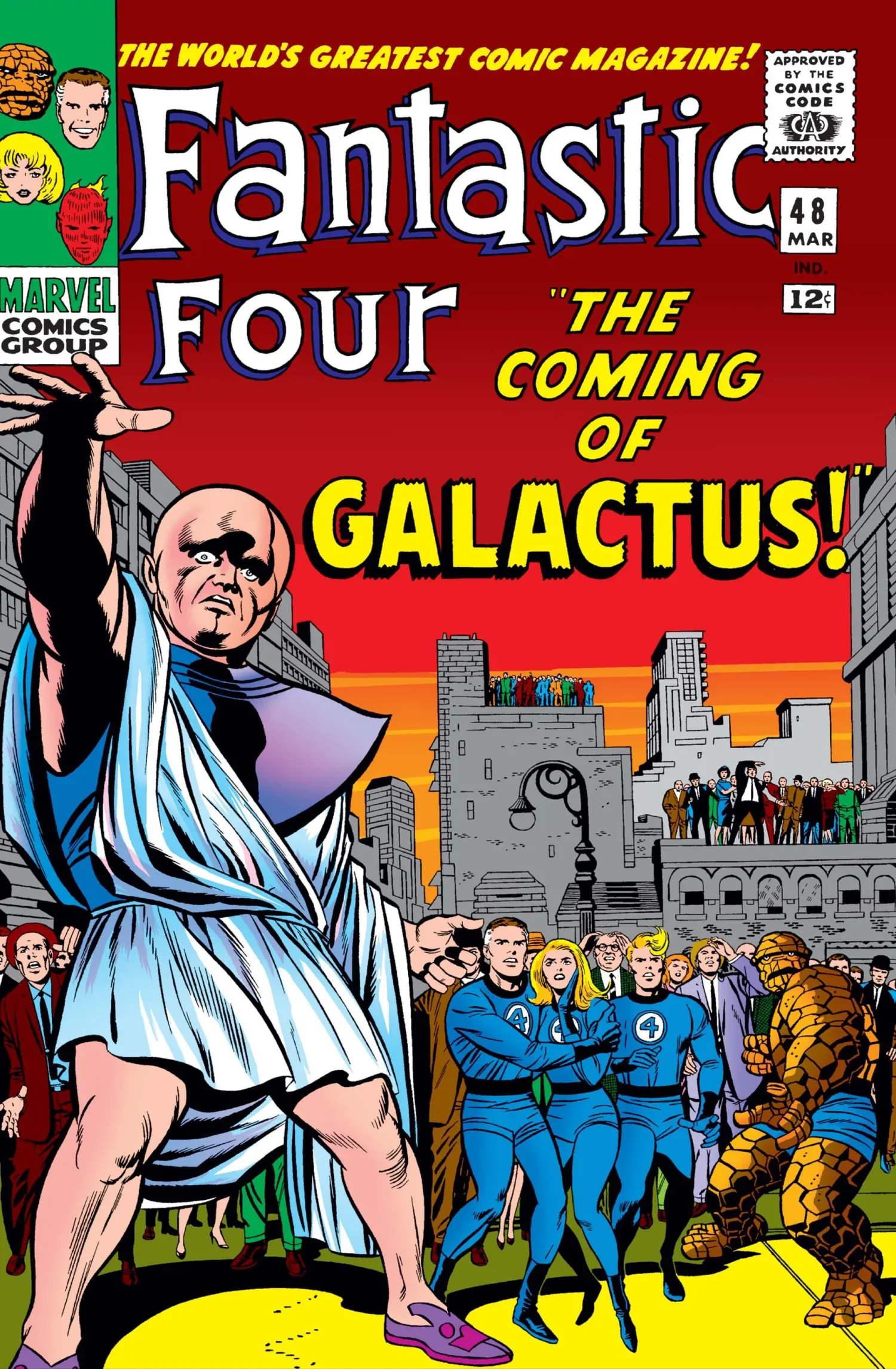
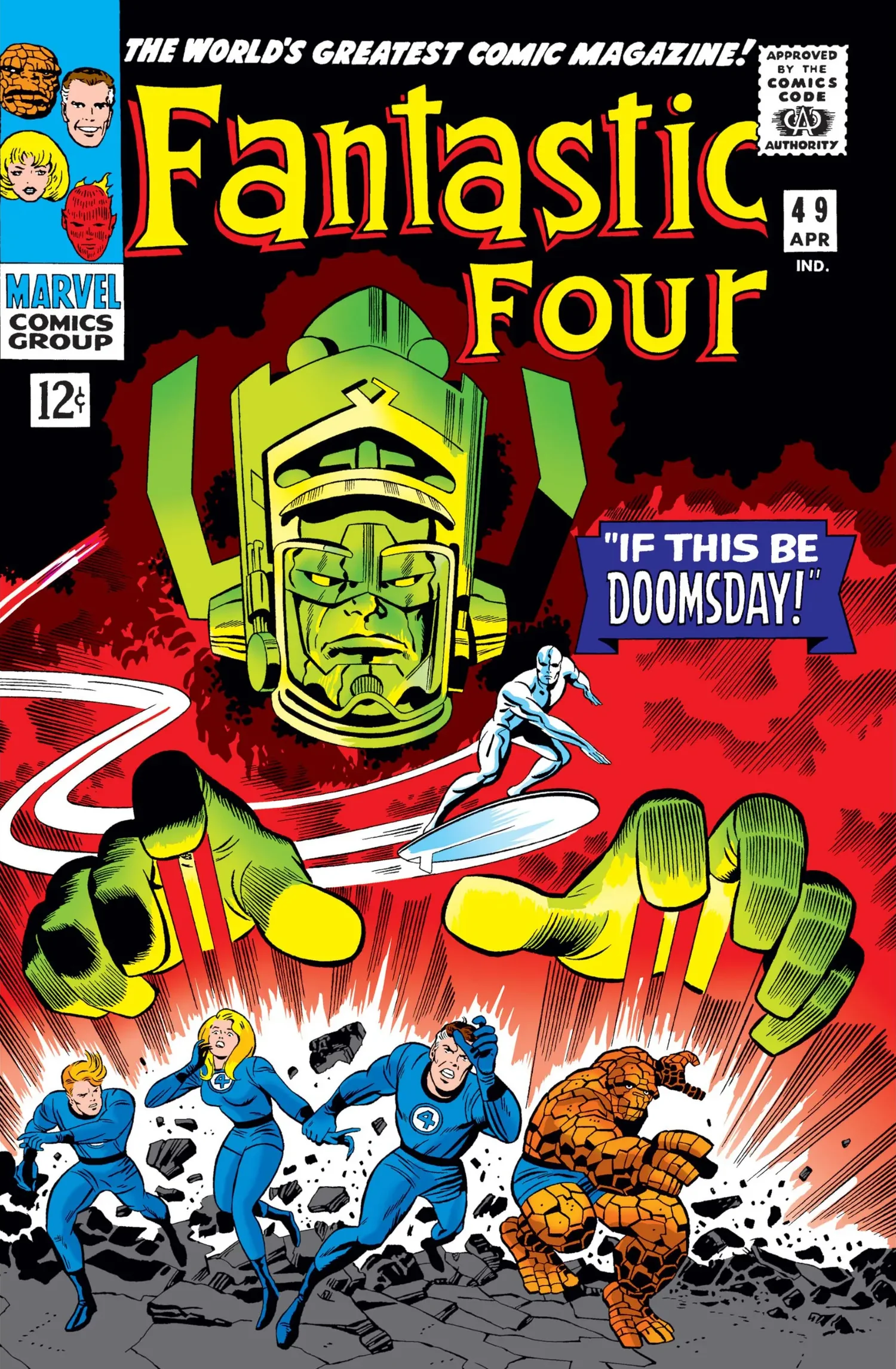
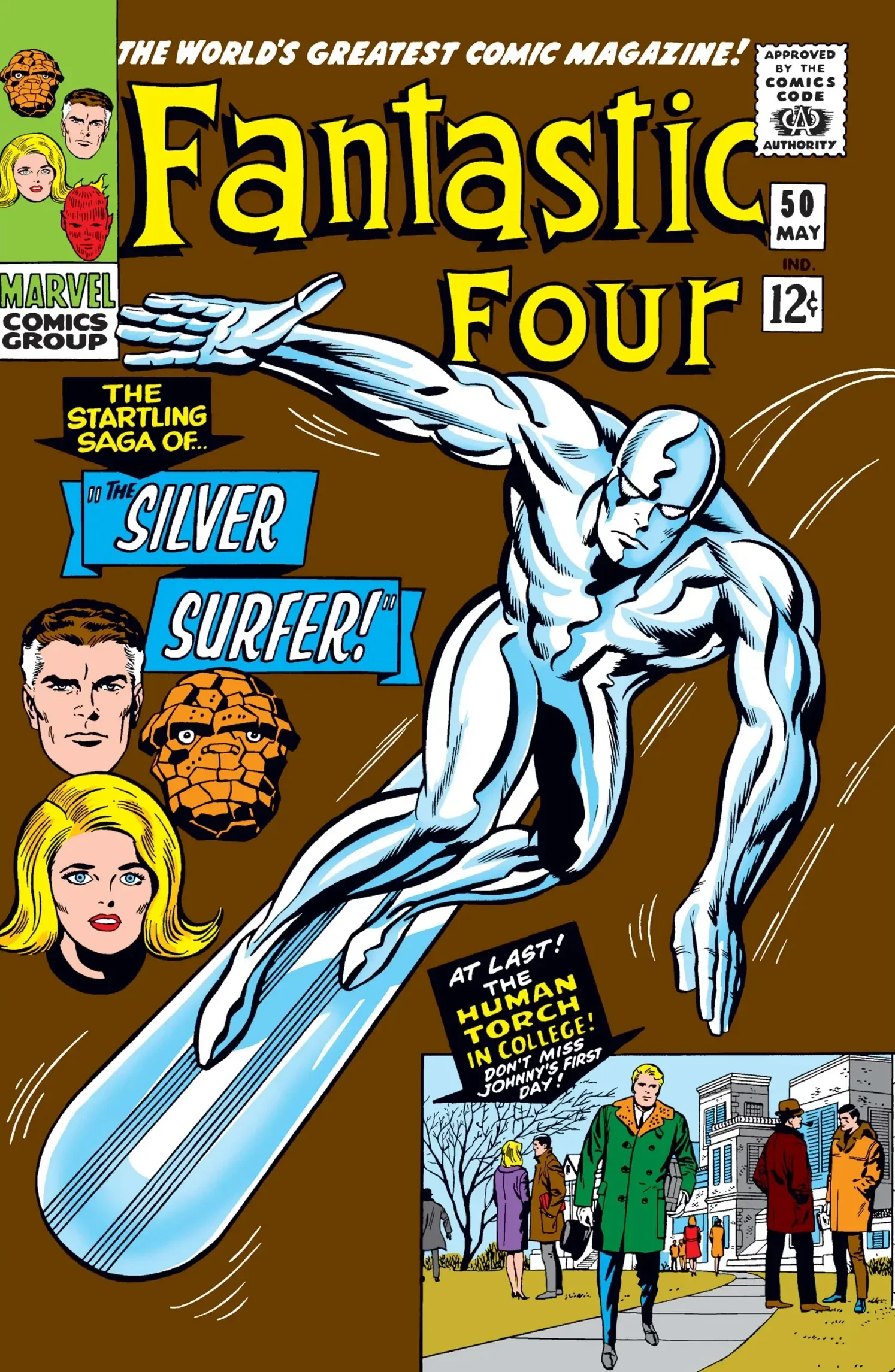
The Galactus Trilogy - Fantastic Four #48–50 (1966), where the Silver Surfer and Galactus first appear.
Sentinel of the Spaceways: The Silver Surfer's First Twenty Years
How a stowaway on a flying surfboard became Marvel's conscience — a tour of every major Silver Surfer appearance from 1966 to 1987
On paper, he should not work. A chrome-plated man who rides a surfboard through outer space and speaks like a Romantic poet sounds like a gag strip, a one-panel parody of Silver Age excess. And yet, in this phase of his existence, the Silver Surfer became something no other Marvel character quite managed: a wandering conscience among the stars. Where other heroes punched their way to the last page, the Surfer grieved his way there — mourning human cruelty, marvelling at human kindness, and delivering soliloquies about both while hovering thirty metres above a battlefield. He was melodrama refined into something genuinely moving, and nearly sixty years on, he remains one of the most beautiful ideas comics ever produced.
The Power Cosmic
The Surfer's power source has one of the great names in all of fiction: the Power Cosmic. It lets the Surfer absorb and channel vast amounts of ambient cosmic energy: firing concussive blasts, restructuring matter at the molecular level, healing the injured, and sensing events across enormous distances. He needs no food, water, air or sleep, and survives unaided in the void of deep space. His board, forged from the same silvery material as his skin, responds to his thoughts, obeys him even at a distance, and carries him at faster-than-light speeds.
In raw wattage he sits near the very top of Marvel's hero power scale. But what actually distinguishes him is the soul attached to all that voltage. The Surfer is a being of nearly limitless power who would genuinely rather not use it — a pacifist philosopher trapped in the body of a weapon. That tension powers every good story he has ever been in.
The Question of the Surfer's Wardrobe
One small mystery has trailed the character since 1966, and it is exactly the sort of thing a reader notices once and then can never quite un-notice: is the Silver Surfer wearing anything at all?
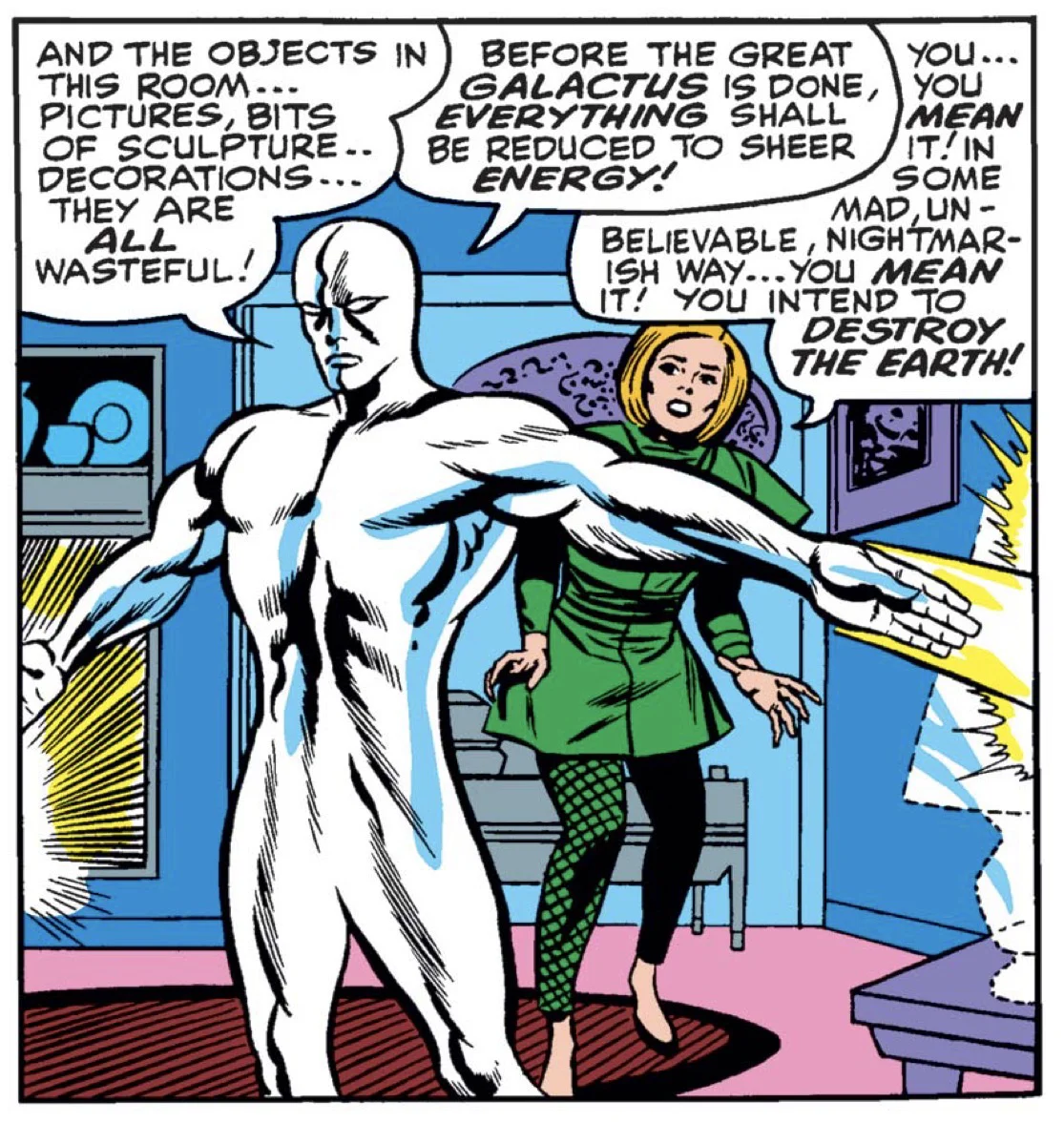
Jack Kirby drew the Silver Surfer without pants in his first appearance...
On the face of it, no. He is a nude figure sheathed head to foot in gleaming silver, the anatomical specifics rendered conveniently, diplomatically indistinct. But the comics have never been entirely settled about it. Creator Jack Kirby's original Surfer carries the faint suggestion of trunks, a soft contour at the hip that historians generally put down to the modesty standards of the mid-1960s, and artist John Buscema kept a version of that hint alive in the solo series.[2] Other artists, in other decades, have gone back and forth: some inking in the lines of a swimmer's briefs, others smoothing him into a seamless chrome blank with nothing to suggest and nothing to see.
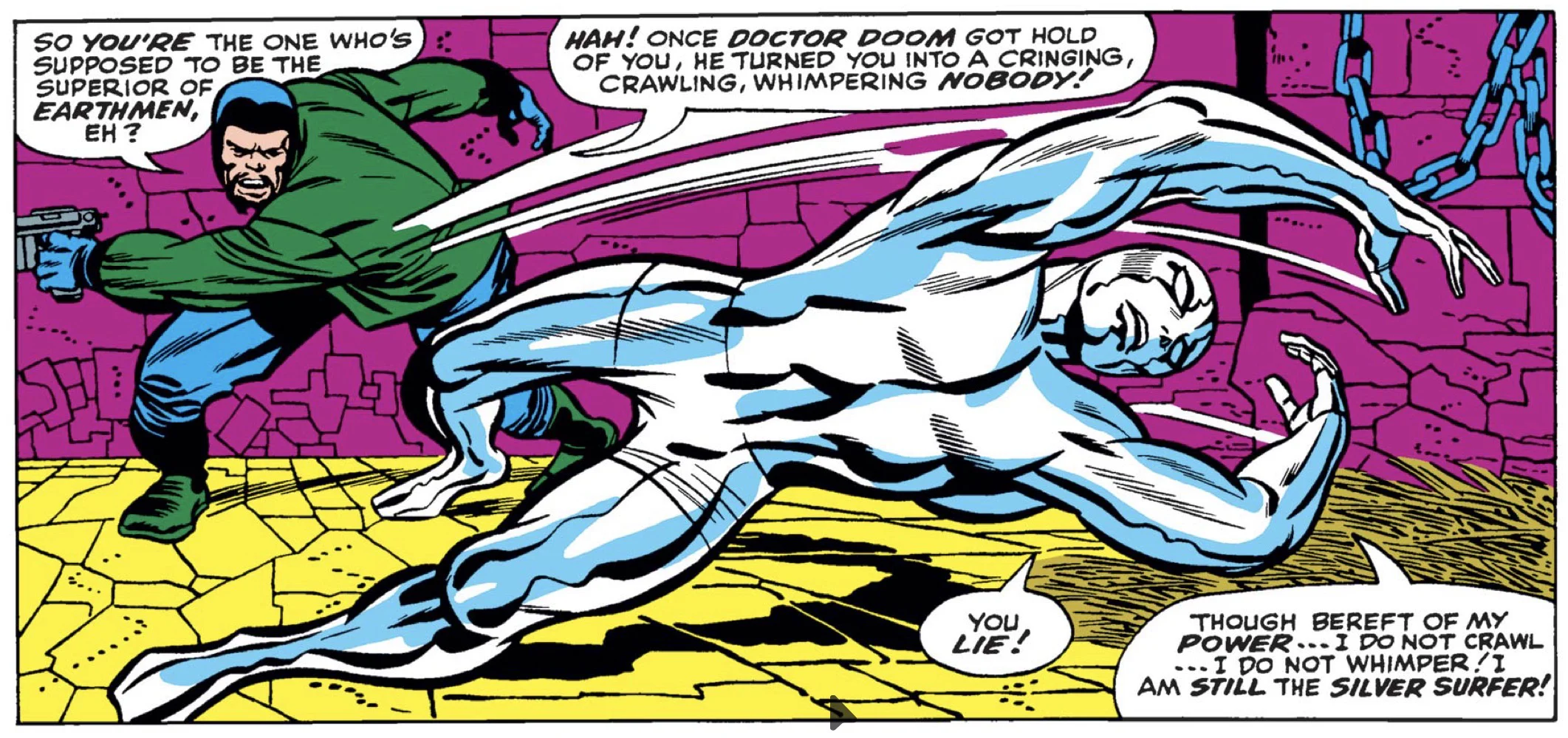
...but in a later appearances Kirby added lines to indicate that our cosmic hero is wearing them.
Where the question has come to rest is the tidiest answer of all, and the one Kirby half-implied from the start. The silver is not paint over bare skin but a kind of skin in itself, a cosmic second surface that covers him completely and quietly retires the whole matter. He may, technically, be naked — though it is not fair to call him a space exhibitionist, because that same silver is also a nearly invulnerable hide that shields him from the vacuum of space, the fury of stars, and every other cosmic hazard he sails through. If clothing is what protects us from the elements, then the Surfer is, just as technically, wearing a form of garment.
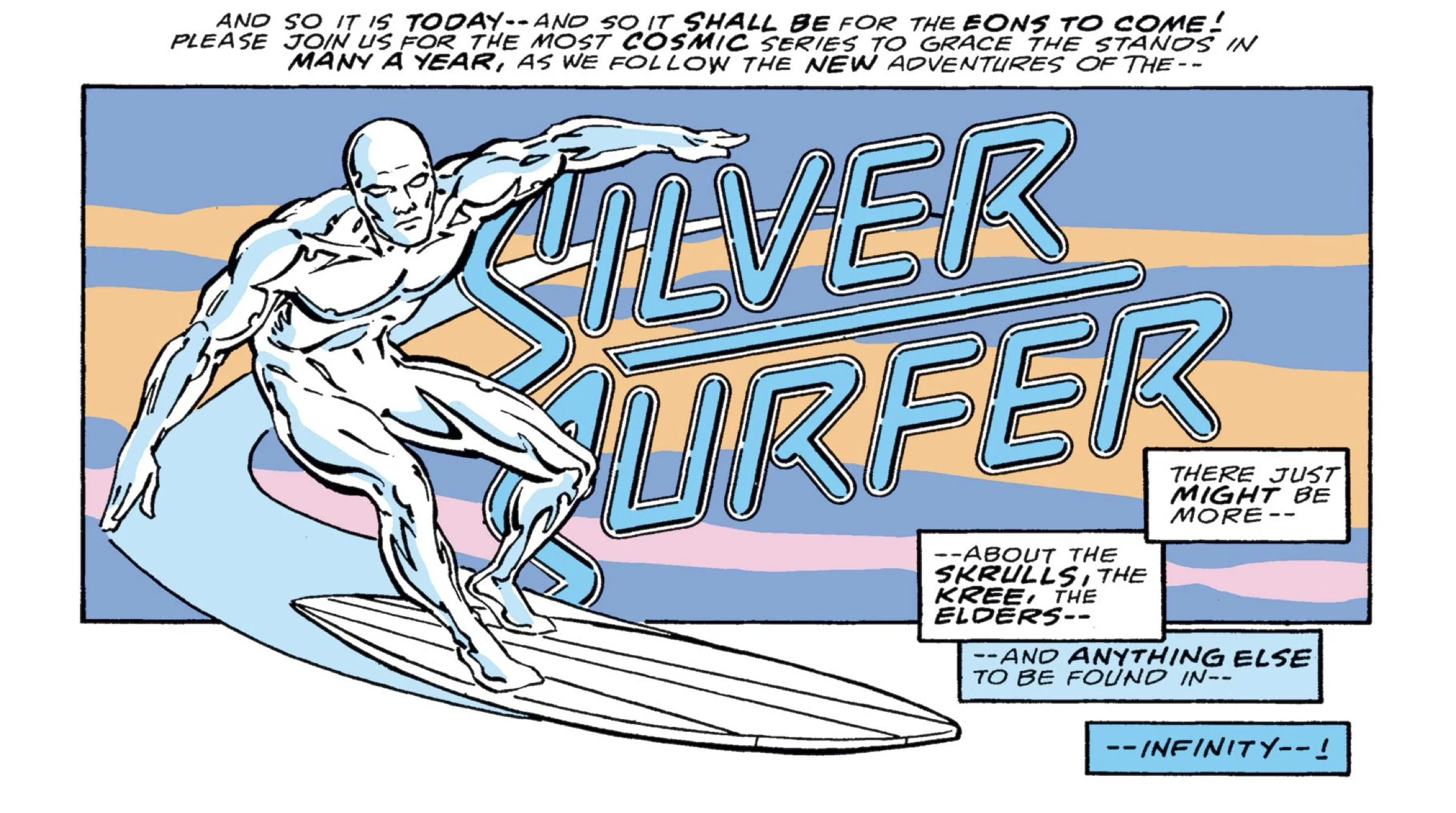
After all was said and done, the Silver Surfer would no longer need to wear pants by the time his third ongoing series started.
A Stowaway in the Pages of Fantastic Four
The Surfer's creation is one of the most delightful accidents in comics history. By the mid-1960s, Stan Lee and Jack Kirby were producing Fantastic Four, Marvel's flagship title and the comic that had launched the company's superhero age in 1961. It followed a bickering surrogate family of adventurers: the brilliant, elastic Reed Richards (Mister Fantastic); Sue Storm (the Invisible Woman); her hot-headed younger brother Johnny (the Human Torch); and gruff pilot Ben Grimm, transformed into the rocky, super-strong Thing — all four mutated by cosmic rays on an ill-fated test flight into space. The two men made the book via the famous “Marvel Method”: they would rough out a plot together, Kirby would draw the entire issue from that synopsis, inventing scenes and details as he went, and Lee would then script dialogue over the finished pages.
For Fantastic Four #48 (March 1966), the agreed plot was suitably enormous: the FF versus Galactus, a god-like cosmic entity who devours whole planets.[3] But when Kirby's pencilled pages arrived at the Marvel offices, they contained something the two men had never discussed. Lee later recalled his baffled first reaction to finding, in the middle of their carefully planned epic, what he described as “a nut on some sort of flying surfboard”.[4]
Kirby's logic was characteristically sound: a being as monumental as Galactus would not simply arrive. He would have a herald who flies ahead of him. As for the board, Kirby had noticed the surfing craze sweeping California's youth culture, and explained with typical bluntness that he drew a surfboard “because I'm tired of drawing spaceships”. He couldn't very well draw an ordinary teenager surfing, so he put a man from outer space on the board instead.[5]
Lee, once past the initial shock, fell hard for the character. There was something noble in the way Kirby drew that gleaming figure, and Lee decided this was the character through whom he would philosophise — a wide-eyed outsider who could comment on humanity's failure to appreciate the Eden it lives in. What Lee had at first regarded as a throwaway gag, he eventually transfigured into a Greek chorus.
There is a lesson hiding in that origin, and it is the first this book will offer, because it is about creativity itself. The Silver Surfer exists because a great artist got bored and improvised. Kirby, tired of drawing the expected thing, drew the unexpected one instead, and then trusted it. Nobody planned him. Nobody asked for him. The most soulful character in Marvel's cosmos arrived in a story about something else. It is worth remembering, whenever we are told that good things come only from careful plans, that some of the best things we ever make are the ones we allow ourselves to stumble into. And the real skill is often not the planning but the recognising: Lee's willingness, once the surprise landed on his desk, to see what it could become instead of what it was supposed to be.
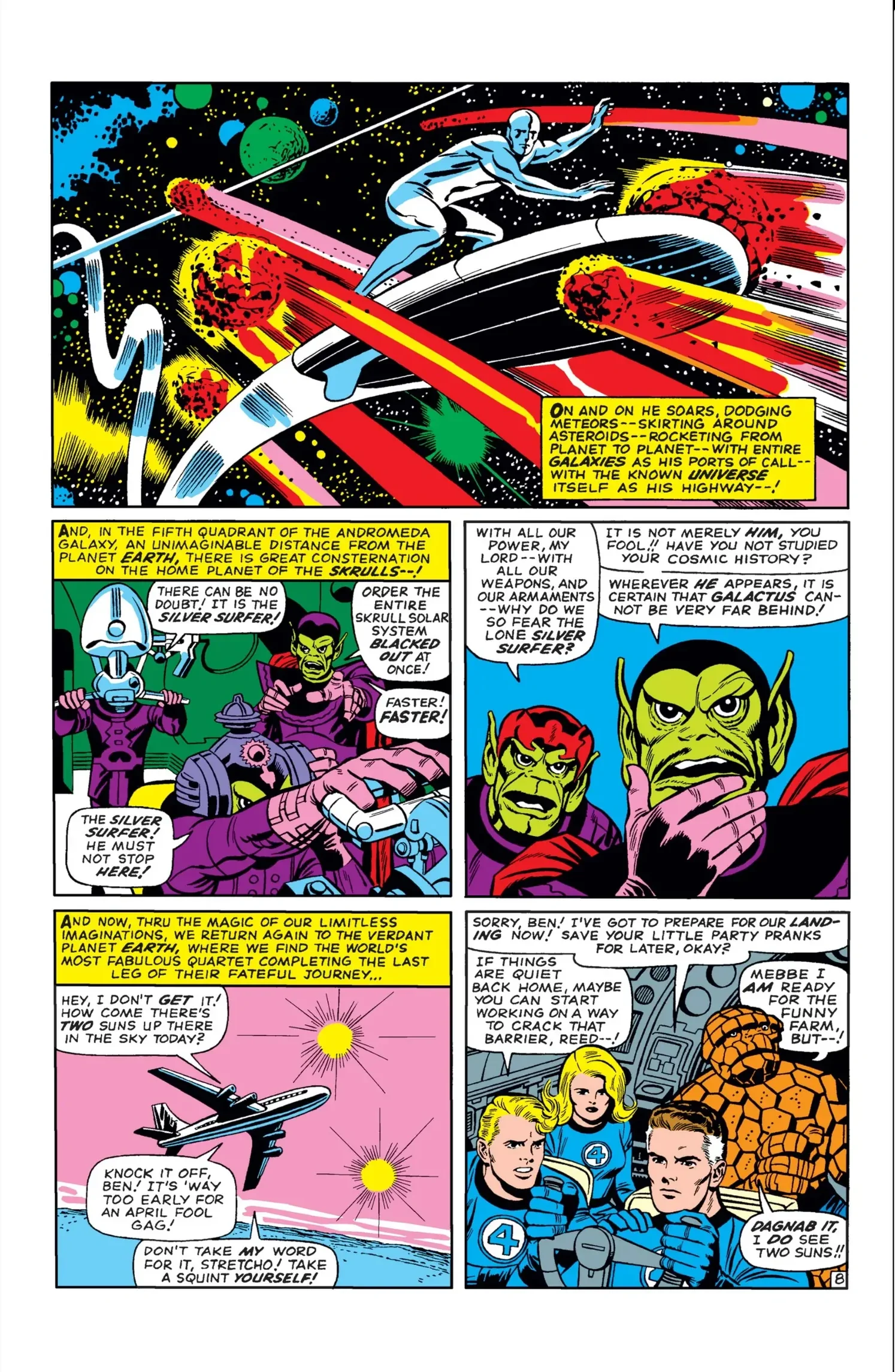
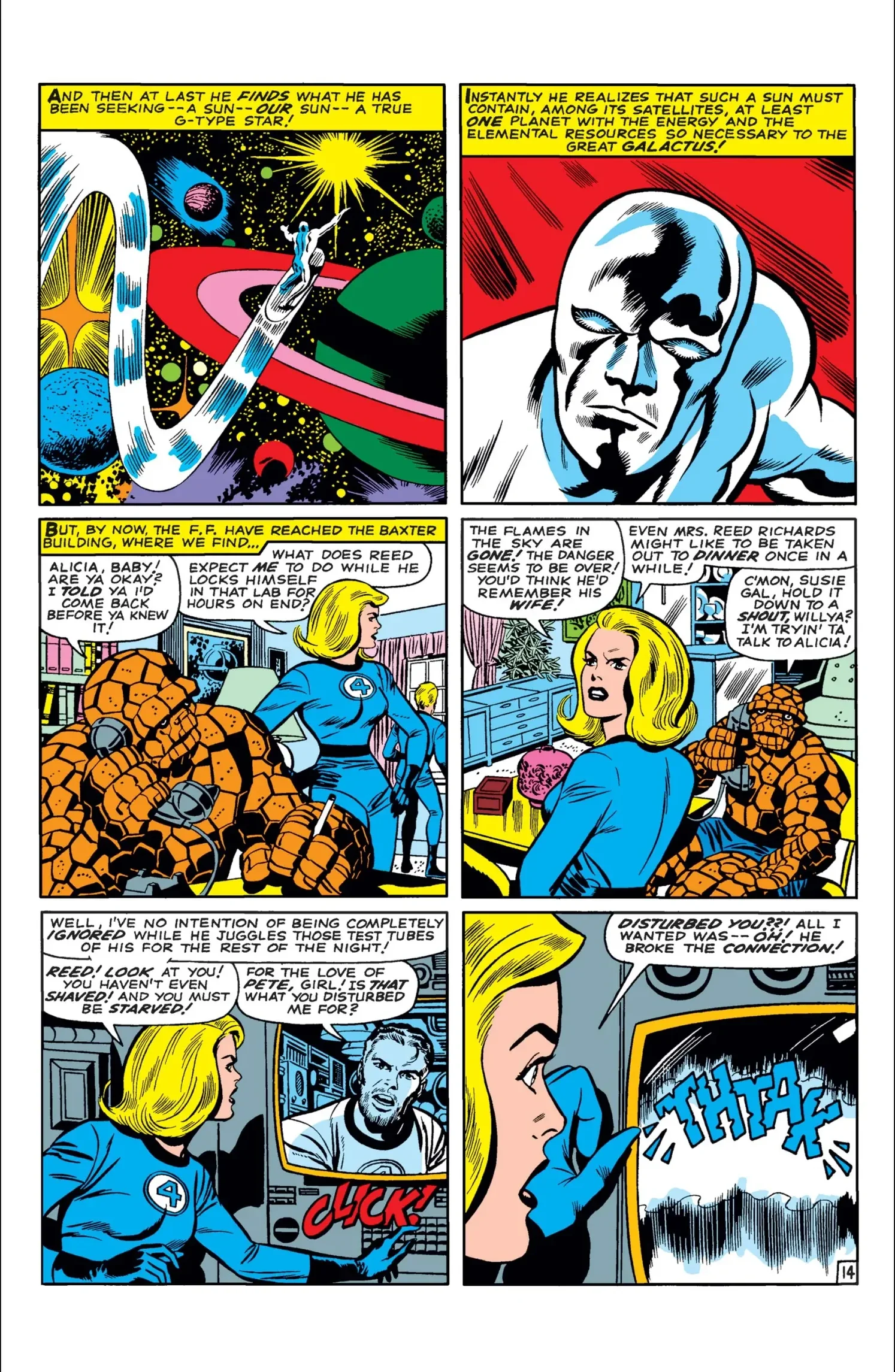
The very first appearance of the Silver Surfer in the pages of Fantastic Four.
The Galactus Trilogy (Fantastic Four #48–50, 1966)
The story fans would christen “The Galactus Trilogy” remains one of the towering achievements of the Silver Age of Comics. The Watcher, Uatu, attempts to hide Earth from the approaching herald — and fails. The Surfer lands, summons his master, and Galactus arrives to feed.
Then comes the pivot on which the character's entire existence turns. The Thing knocks the Surfer off the Baxter Building, and the Surfer crashes through the skylight of Alicia Masters, the Thing's blind girlfriend, a sculptor of extraordinary empathy. Nursing the fallen alien, Alicia senses the goodness in him and pleads for her world. Something long dormant awakens in the Surfer, and he does the unthinkable: he turns on Galactus. With the Watcher's help, the Human Torch retrieves the Ultimate Nullifier — the one weapon even Galactus fears — from the world-devourer's own ship, and Reed Richards uses it to force a stalemate. Galactus departs, sparing Earth.
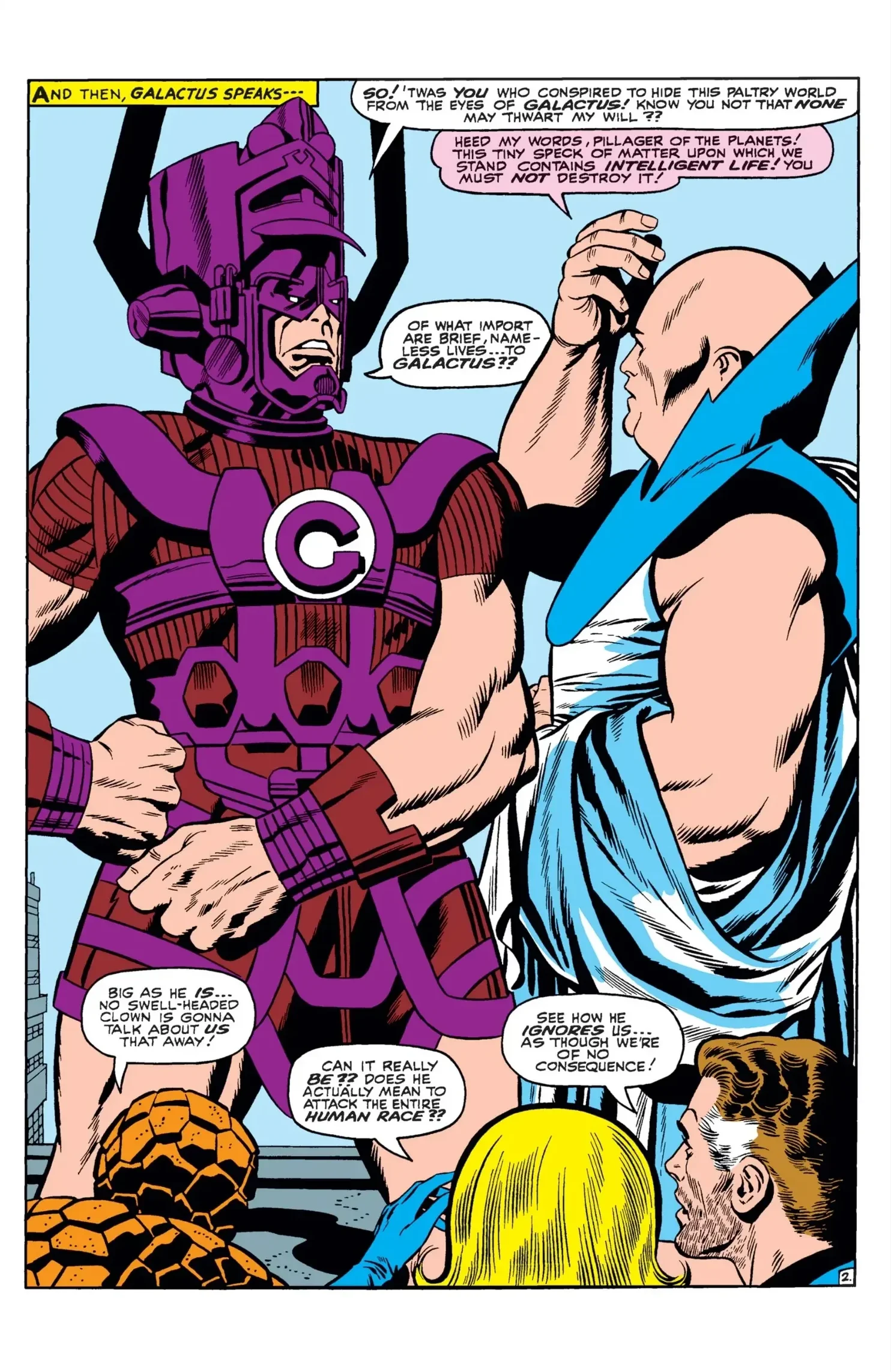
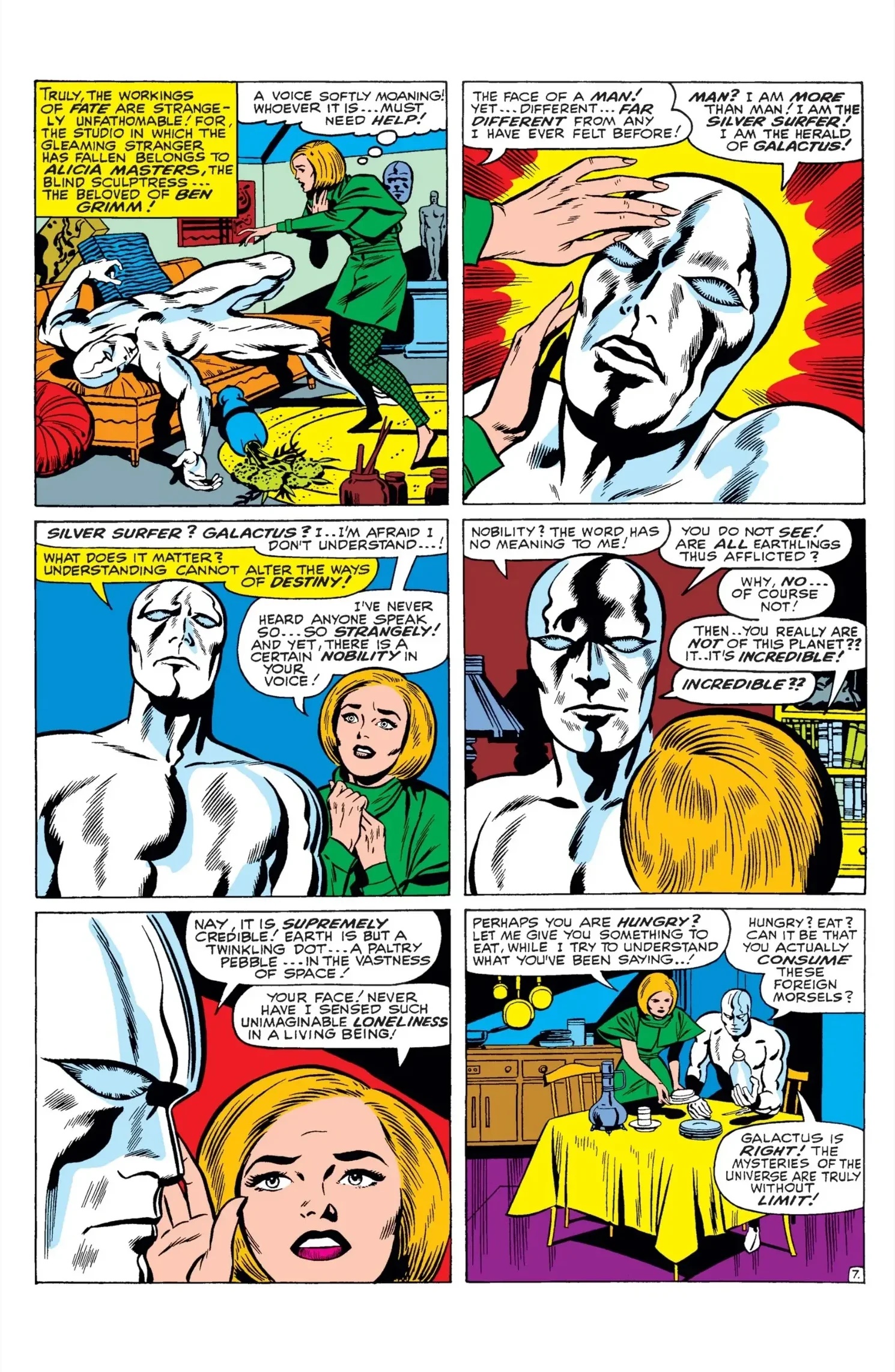
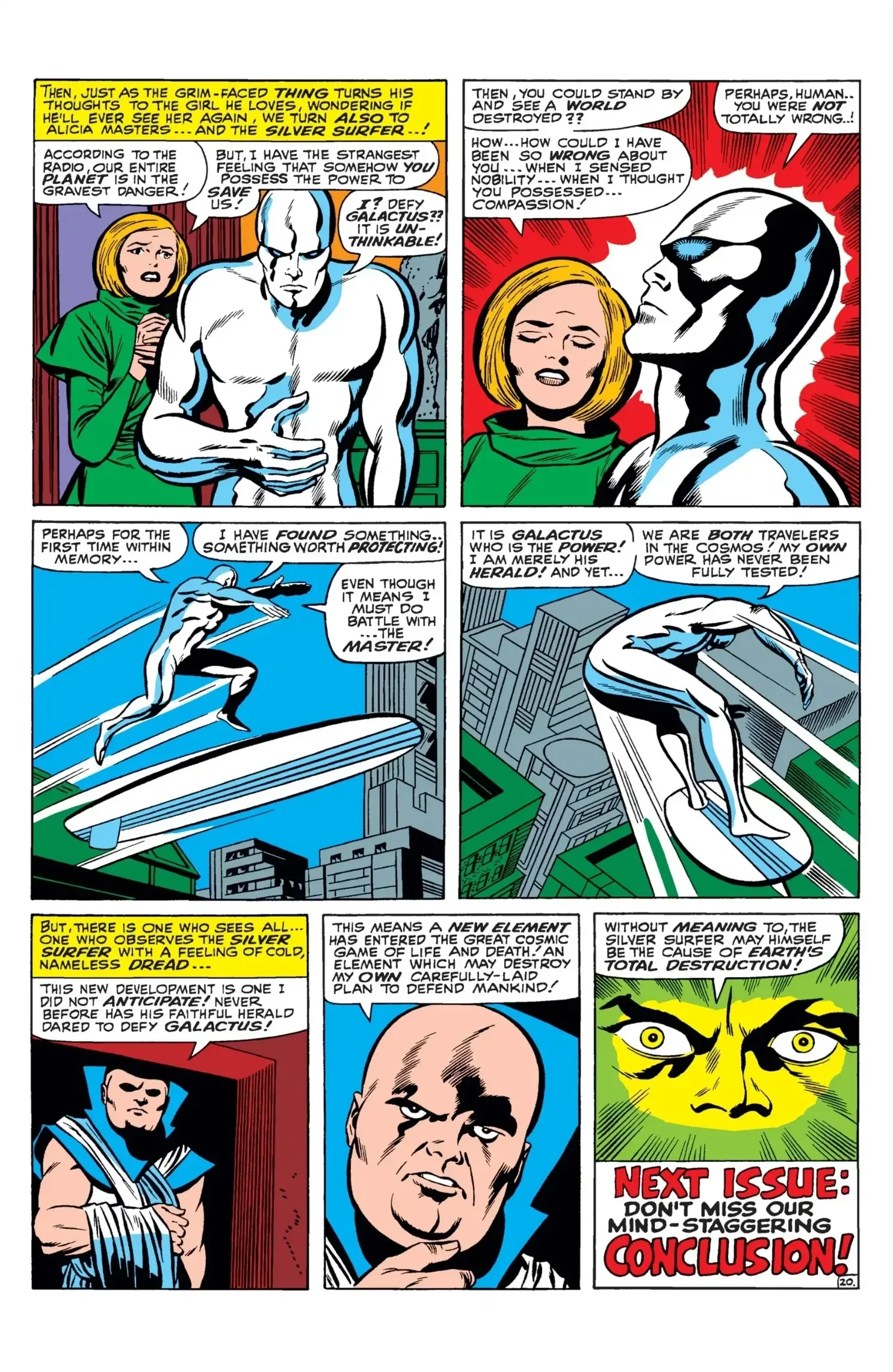
Fantastic Four #49: Alicia Masters reaches the being beneath the silver.
It is worth pausing on how the Surfer's conscience wakes, because the story is making a statement about where morality actually comes from. It is not an argument that converts him. It is not power, or logic, or a threat. It is a blind woman who cannot even see the gleaming figure she is tending, and who reaches him precisely because she cannot be dazzled by the surface. She perceives only the being underneath. The Surfer has spent an unknown span of time as an instrument, flying ahead of Galactus and feeling nothing, and what thaws him is a single encounter with one person's kindness and one person's fear. Morality, the scene suggests, is not a rule you deduce in the abstract; it is something that switches on in the presence of another creature you are made to see. He does not decide to care about humanity in general. He meets Alicia in particular, and the general follows. That is very nearly the whole of ethics, smuggled into a monster fight: we are woken to the worth of everyone by our encounter with someone.
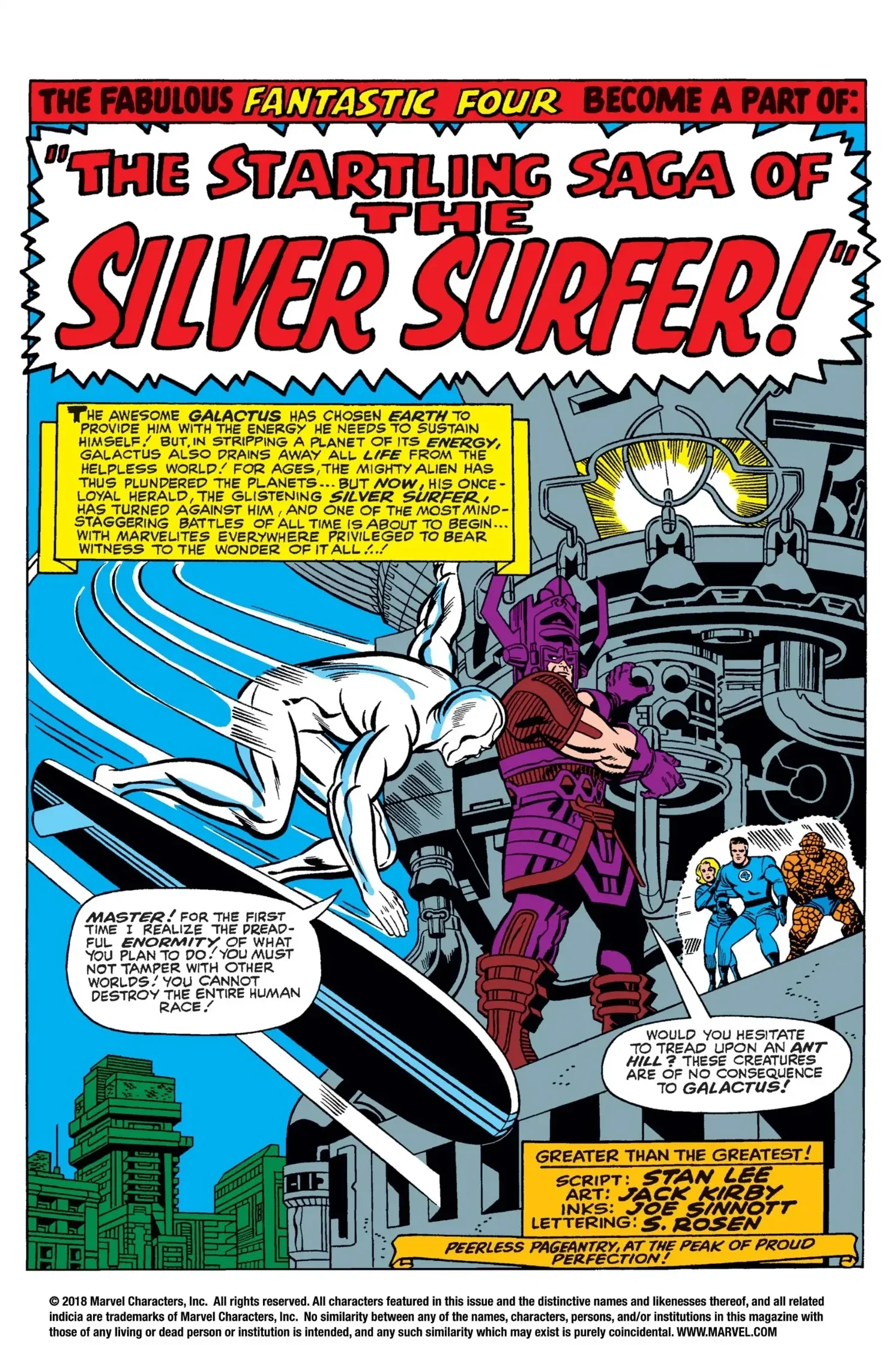
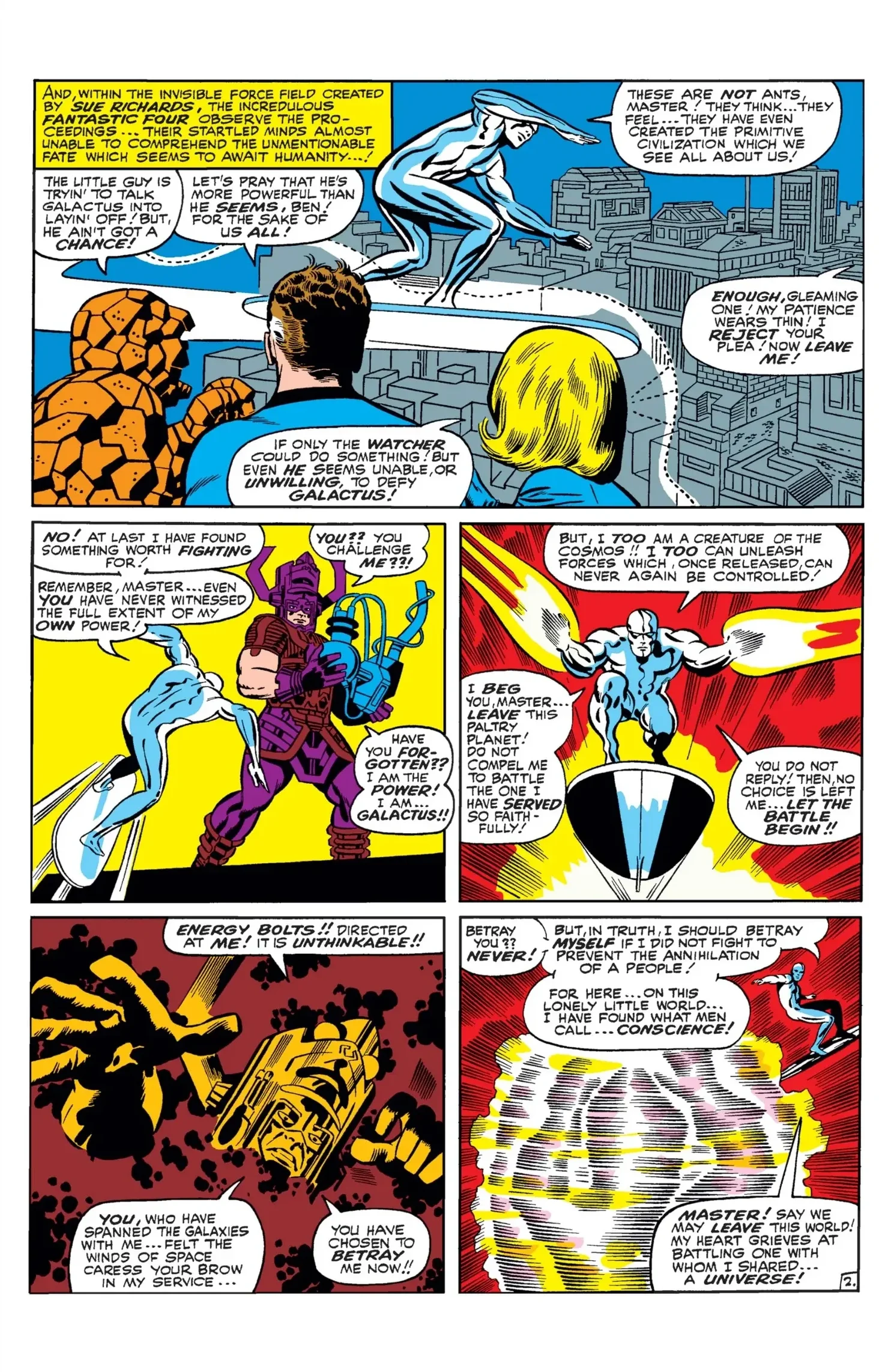
Fantastic Four #50: the Surfer turns on Galactus to save the Earth.
But Galactus does not forgive. As punishment for the betrayal, he erects an invisible barrier around the planet, one keyed specifically to his former herald. The skies are closed. The freest being in the universe has become a prisoner of Earth — and that exile would be the engine of every Silver Surfer story for the next twenty years.
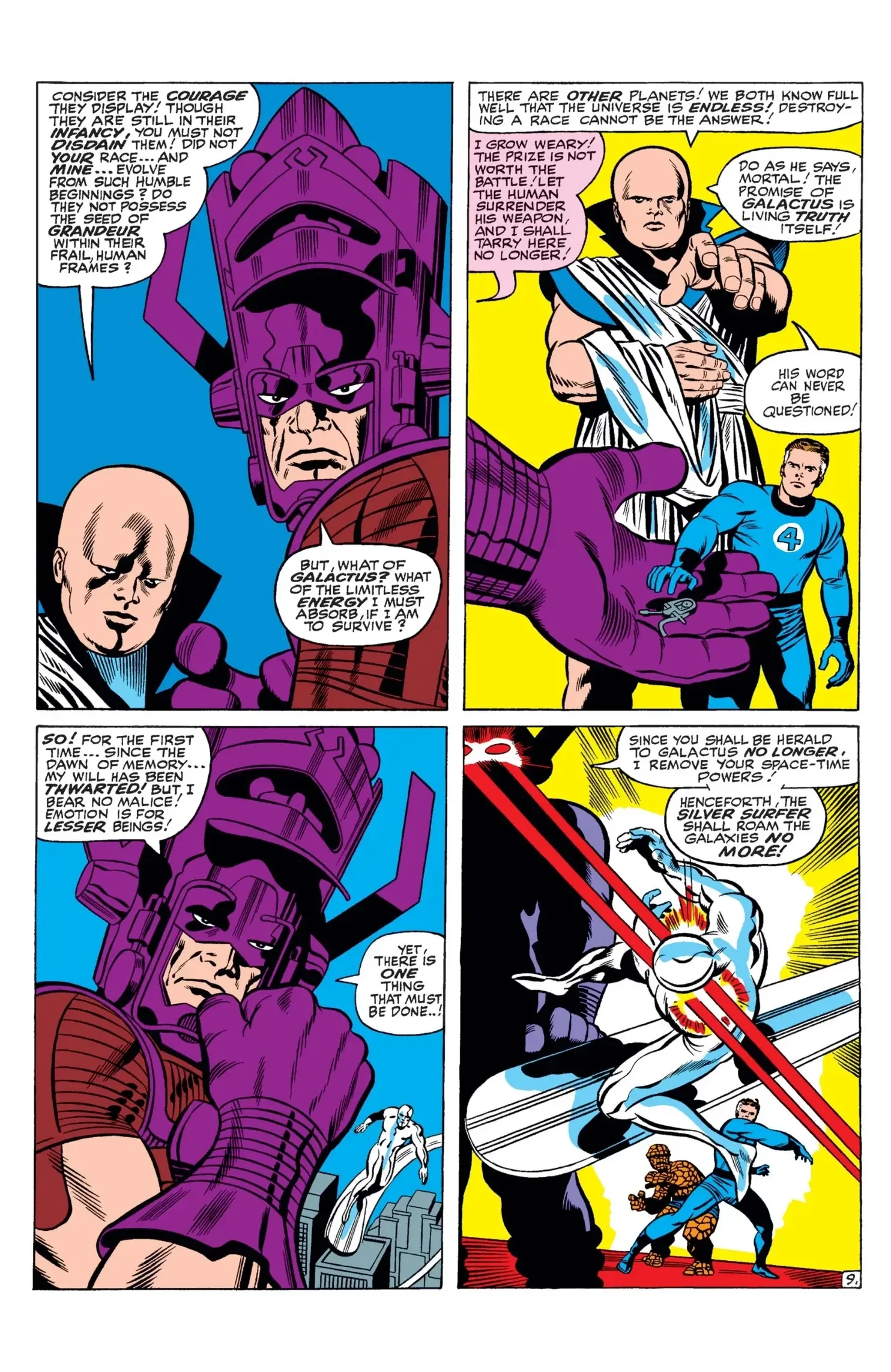
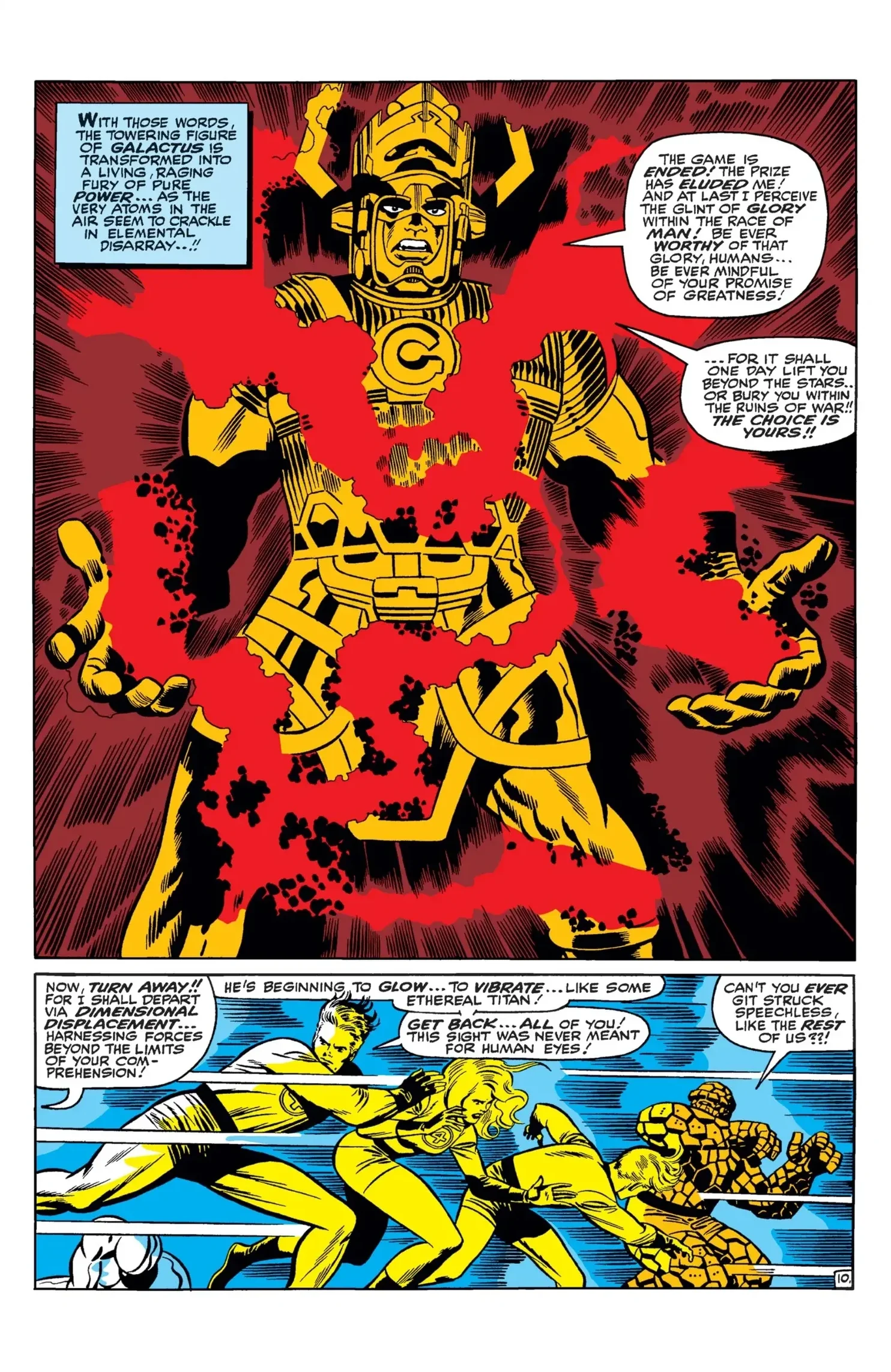
Fantastic Four #50: Galactus departs, and the barrier closes around the Surfer.
Here the character locks into the shape he will remain in for two decades. It is a shape the Stoics would have recognised instantly. The Surfer cannot remove the barrier. No amount of power will breach it, and he spends years learning this the hard way, hurling himself at the sky and bruising his soul against it. What he can govern is what he does inside the cage: whether he curdles into bitterness or keeps his compassion intact, whether the wall owns his mind as well as his body. Epictetus, himself a former slave, drew exactly this line: some things are up to us and some are not, and nearly all our suffering comes from confusing the two.[6] The Surfer's whole tragic dignity in these early years is the dignity of a being who keeps being handed the one situation he cannot change and must decide, again and again, who to be within it. That, and not his Power Cosmic, is the real superpower on display.
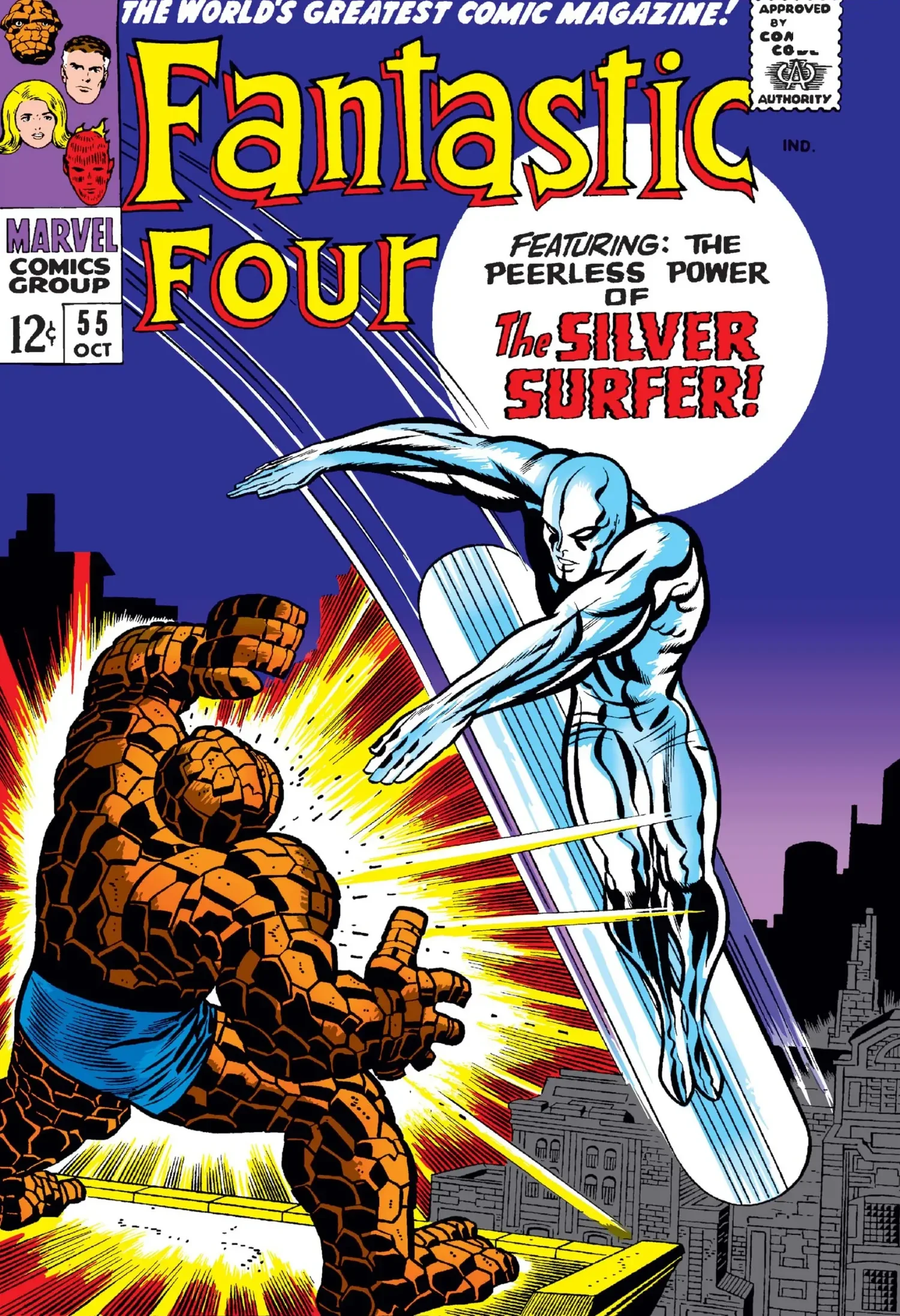
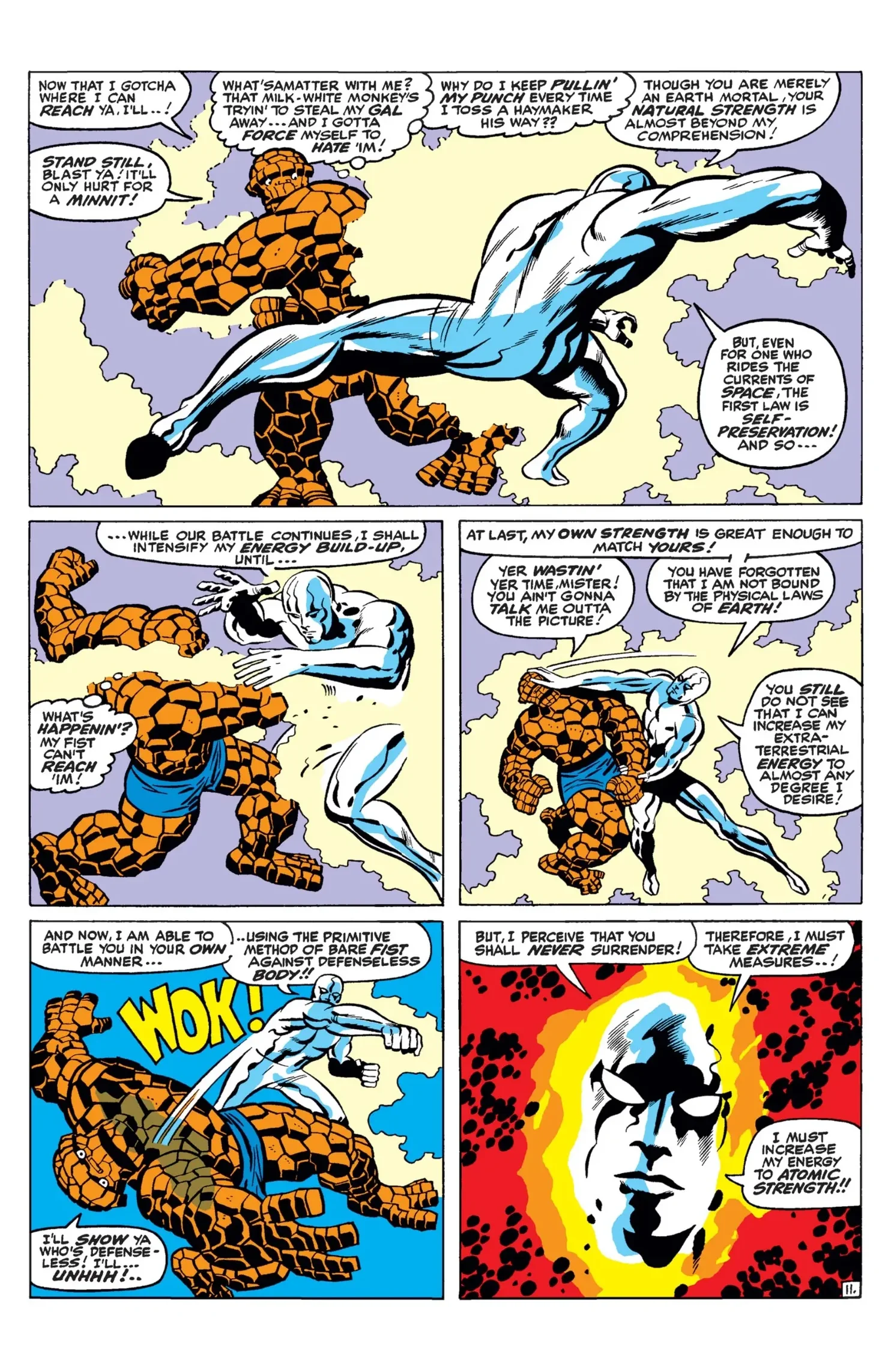
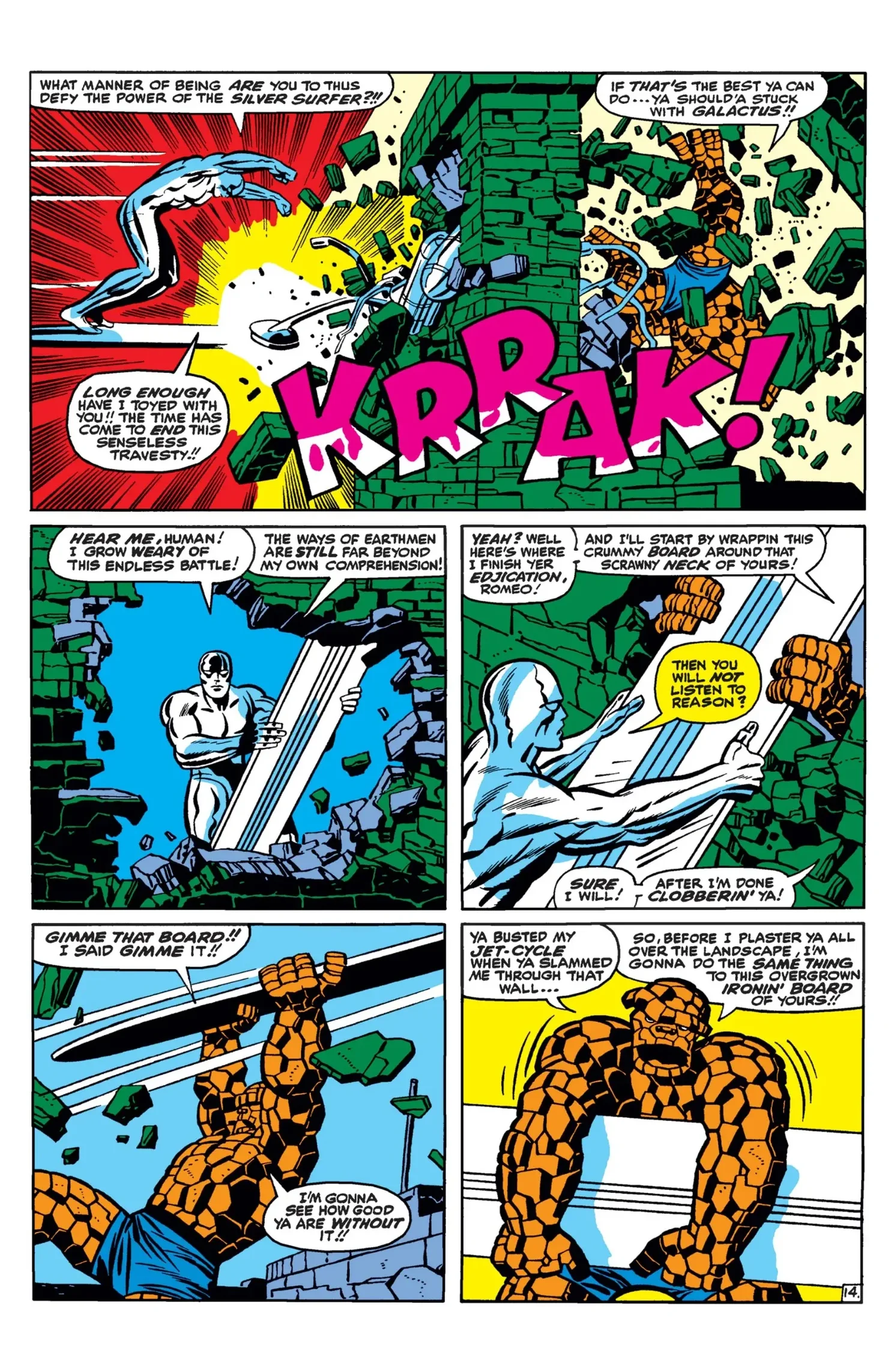
Fantastic Four #55 (October 1966): the Thing, jealous, picks a fight with the Surfer.
Earthbound with the Fantastic Four (1966–1968)
The Surfer immediately became a beloved recurring guest in Fantastic Four. Lee and Kirby got remarkable mileage out of the tragedy they'd built.
In #55 (October 1966), the Thing (perpetually insecure about Alicia's tenderness towards the shining stranger) picks a jealous brawl with him, one of those gloriously pointless Marvel hero-versus-hero slugfests that ends in mutual respect and mutual bruises.
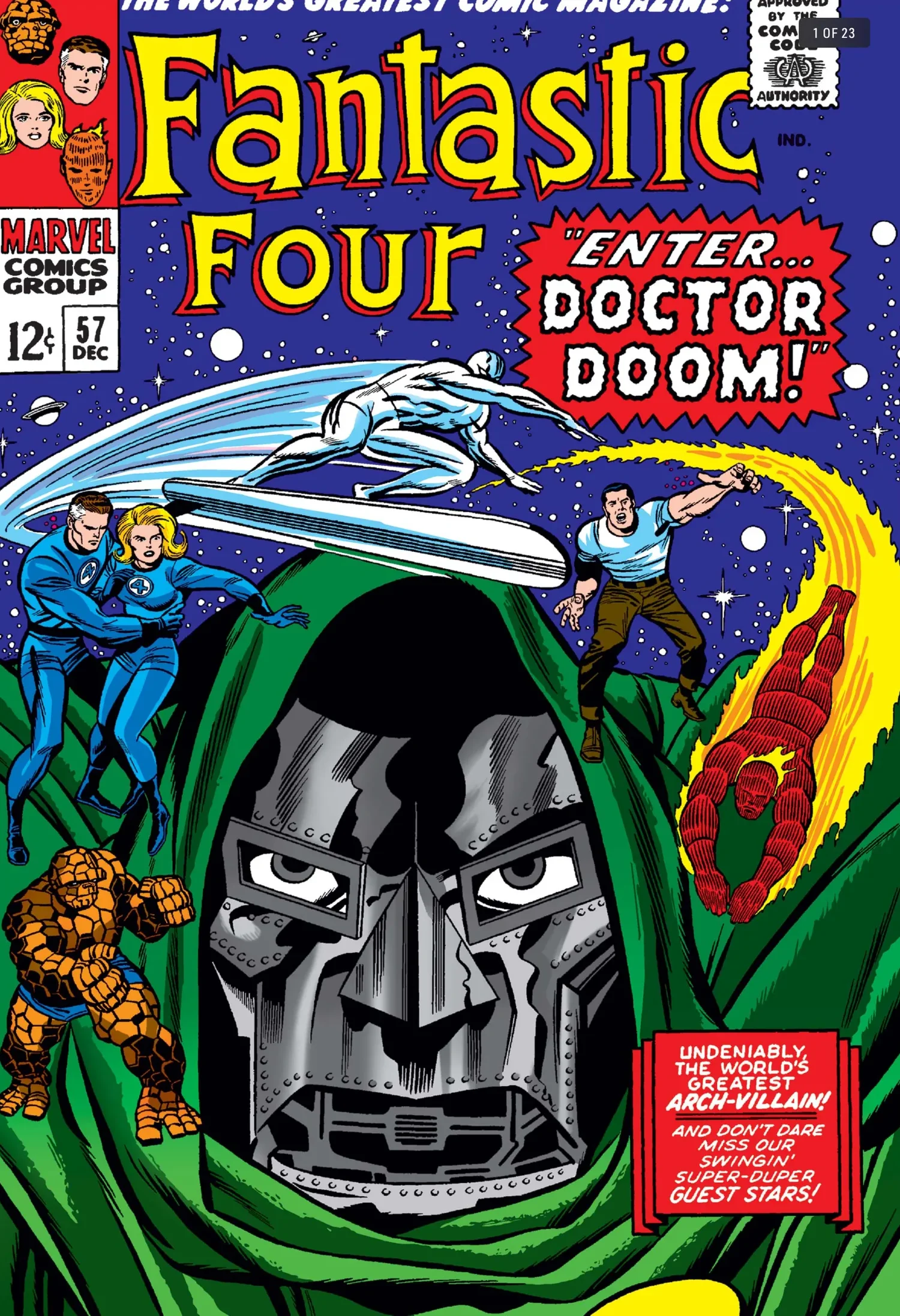
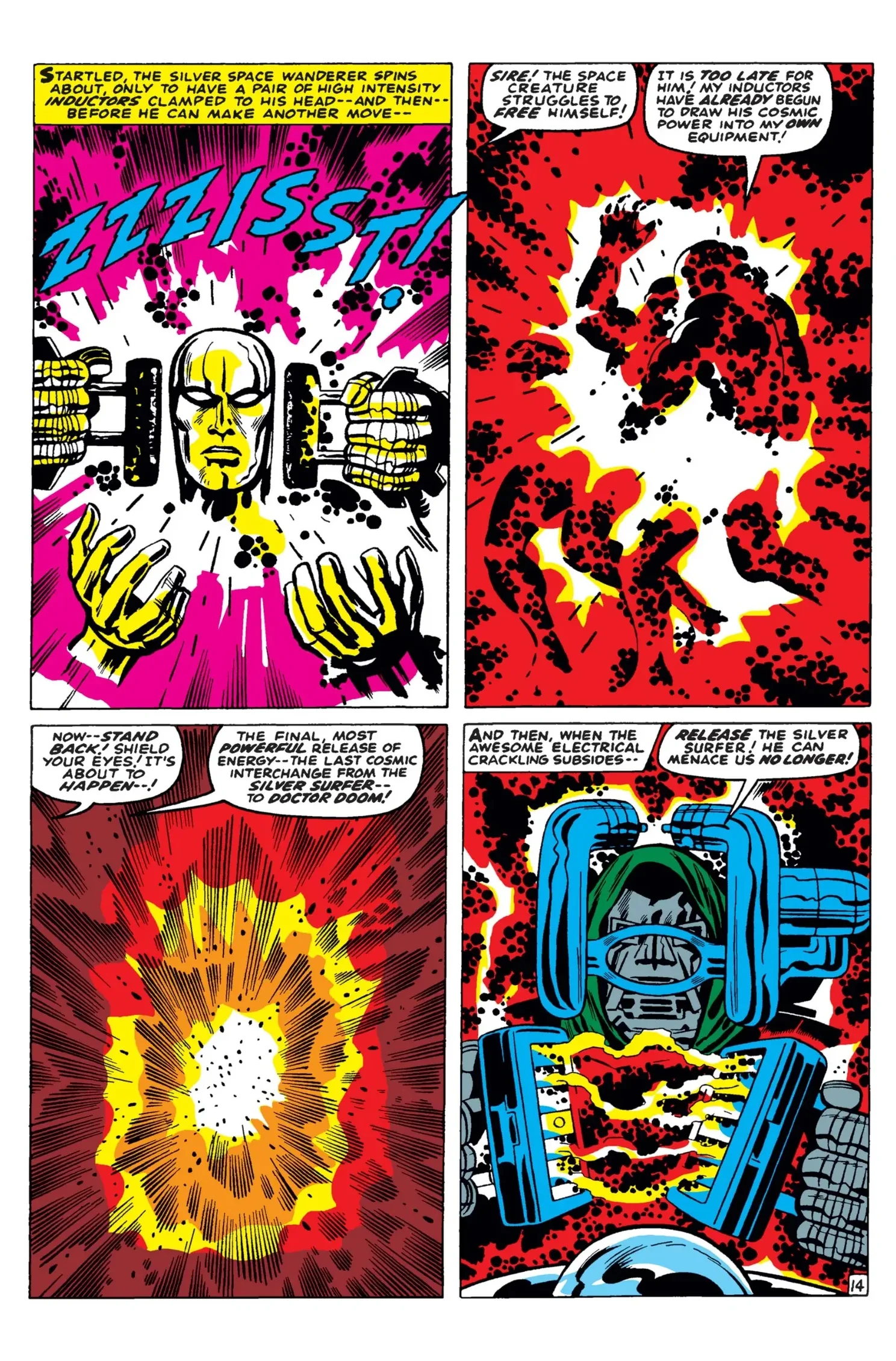
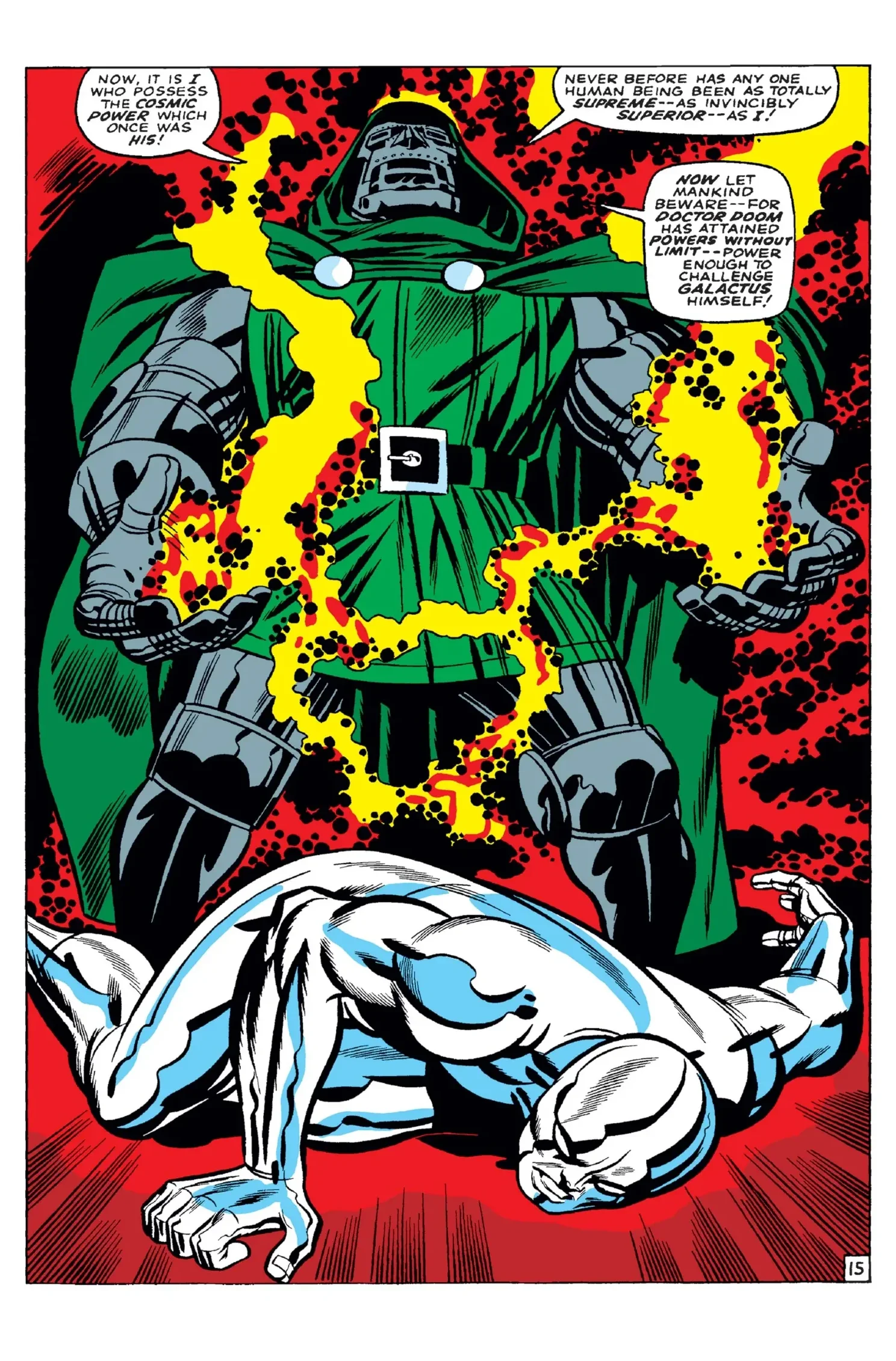
Fantastic Four #57: Doctor Doom lures the exiled Surfer to Latveria.
Then comes the first great exploitation of the Surfer's naivety. In #57–60 (December 1966 – March 1967), Doctor Doom lures the exiled alien to Latveria with a show of hospitality, then siphons the Power Cosmic into himself with a specially built device.[7] Doom on the Surfer's board, drunk on stolen omnipotence and terrorising the globe, is one of Kirby's most deliciously villainous visions. The resolution is pure Lee-and-Kirby elegance: goaded into pursuing his enemies at full speed, Doom streaks up out of the atmosphere and slams into Galactus's barrier. Recognising the Surfer's power, the barrier strips it from the thief entirely.
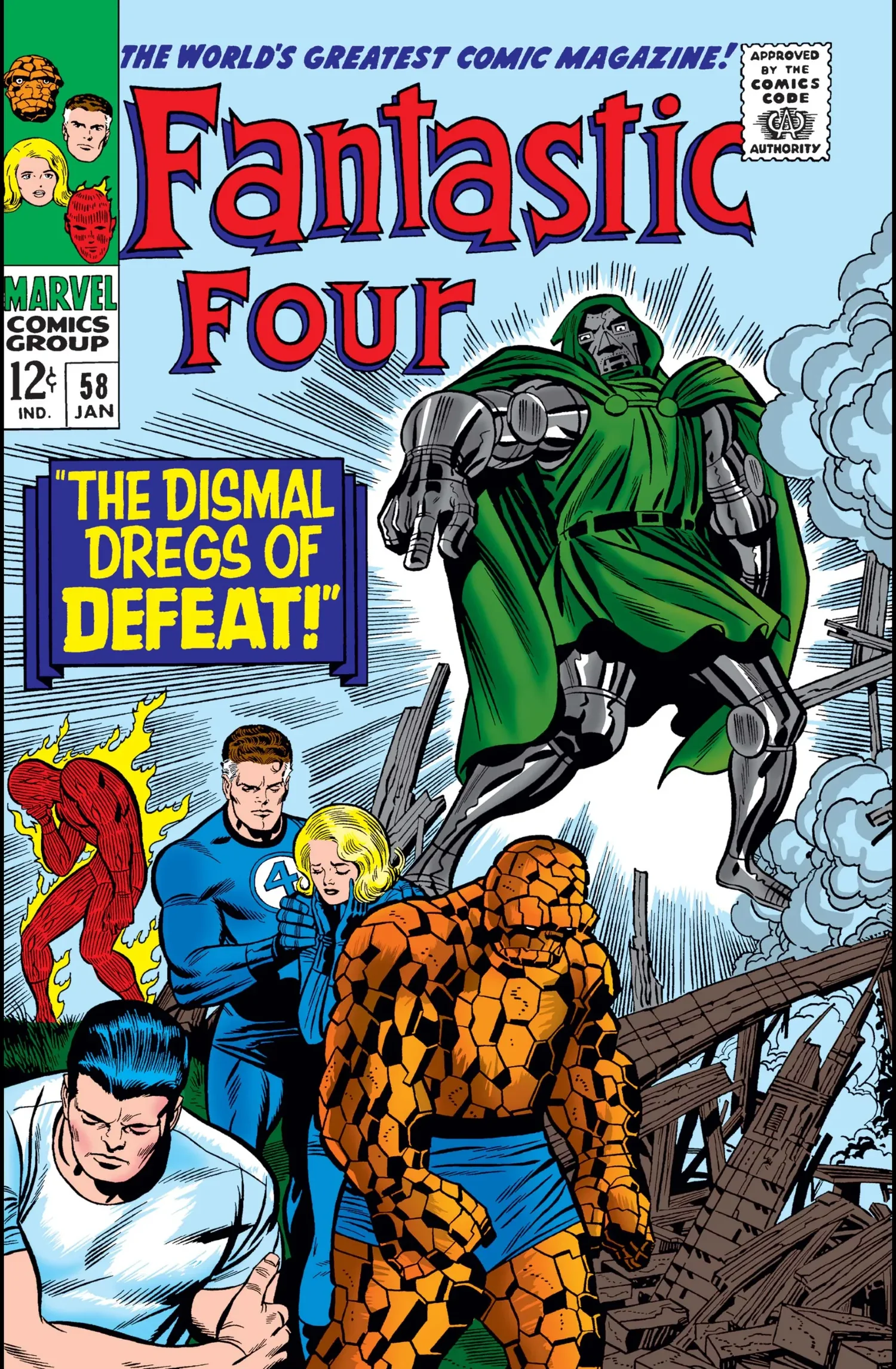
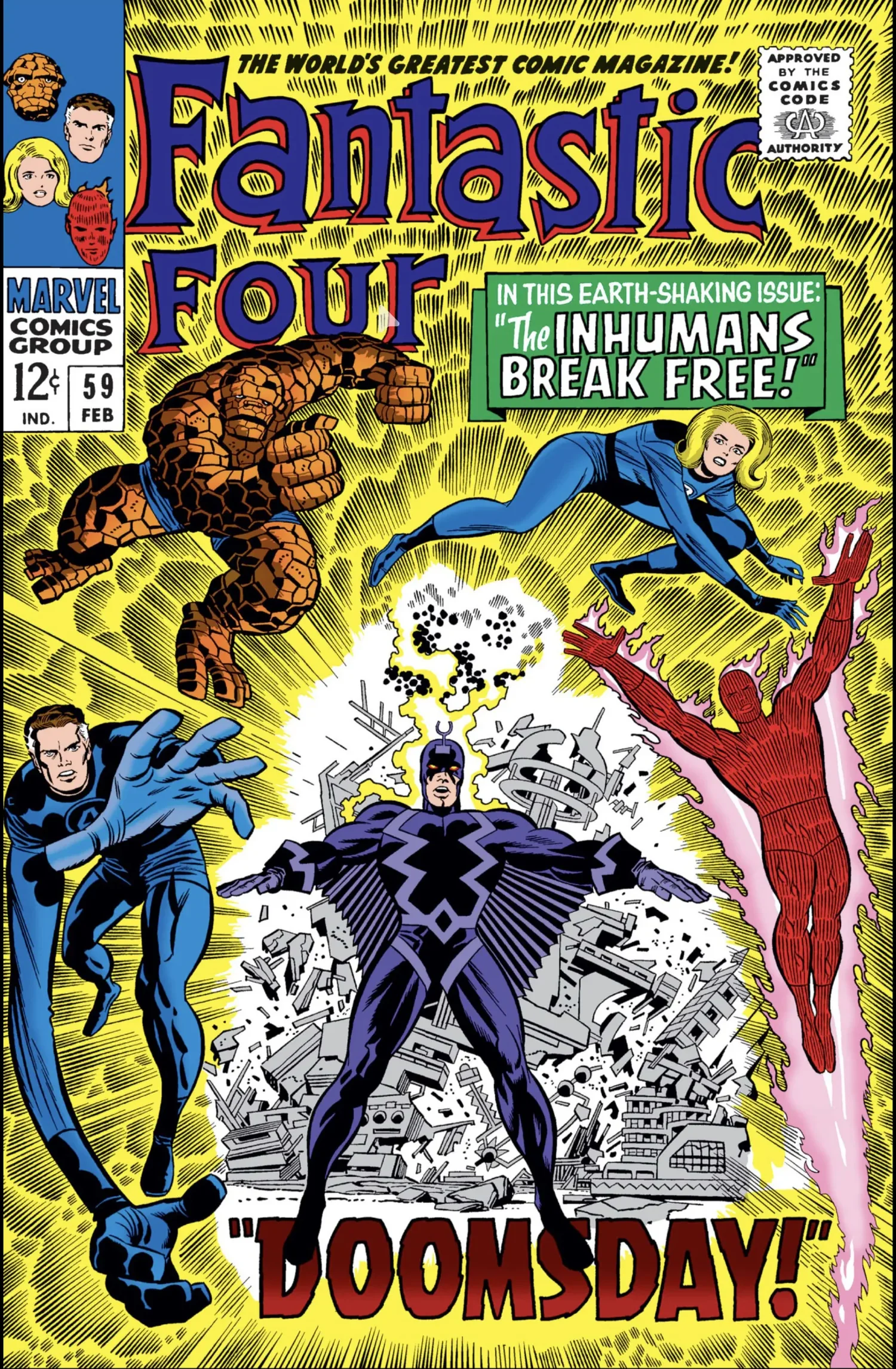
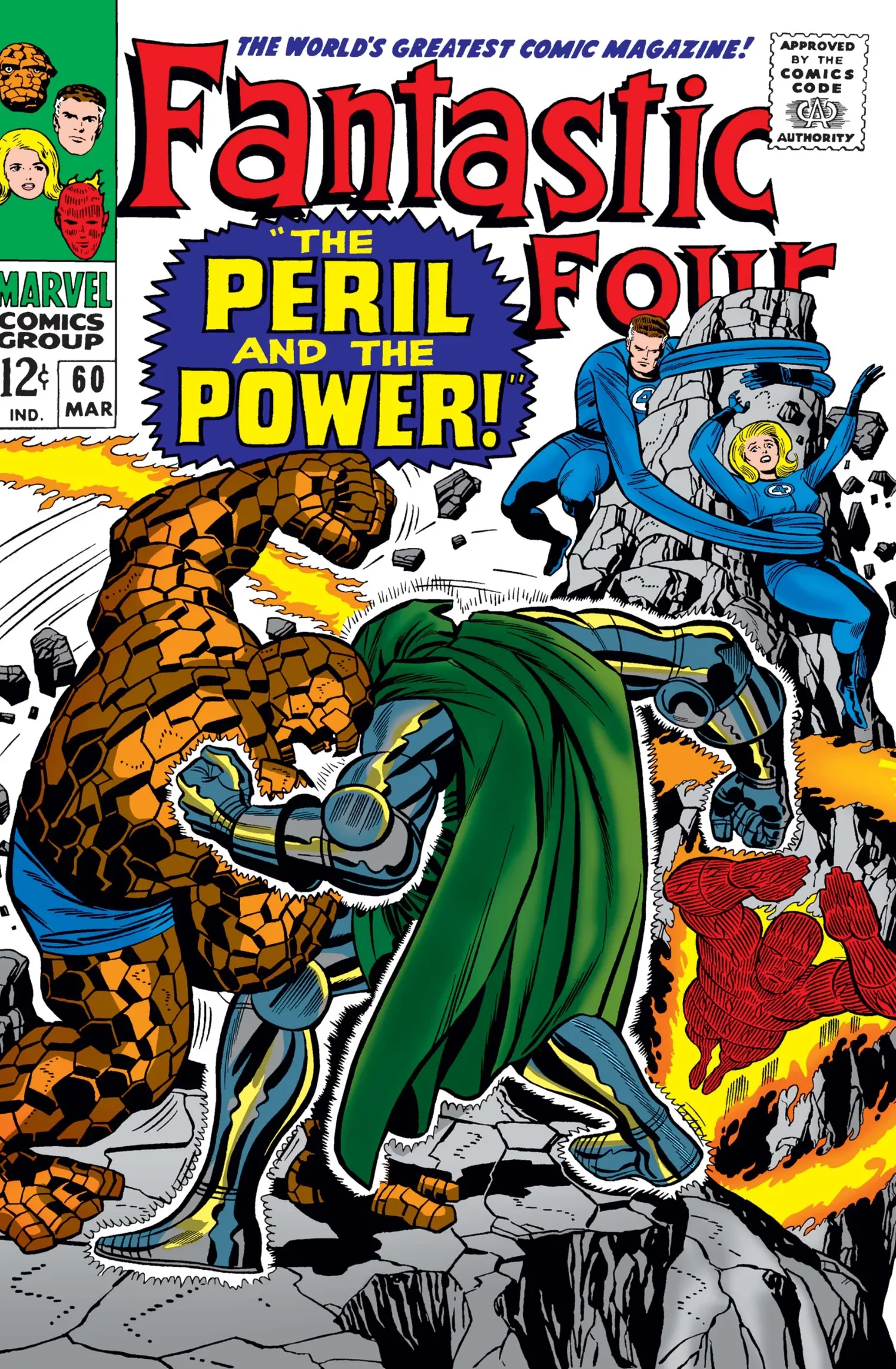
Fantastic Four #58, #59 and #60: the barrier strips cosmic Doom of his stolen power.
In #72 (March 1968), the Surfer himself becomes the threat. Despairing that humanity will never abandon its wars, he reasons that people only unite against a common enemy, and appoints himself that enemy, attacking the world for its own good. The FF have to batter some sense back into him. It's a story that could only be told with this character: an assault motivated entirely by love.
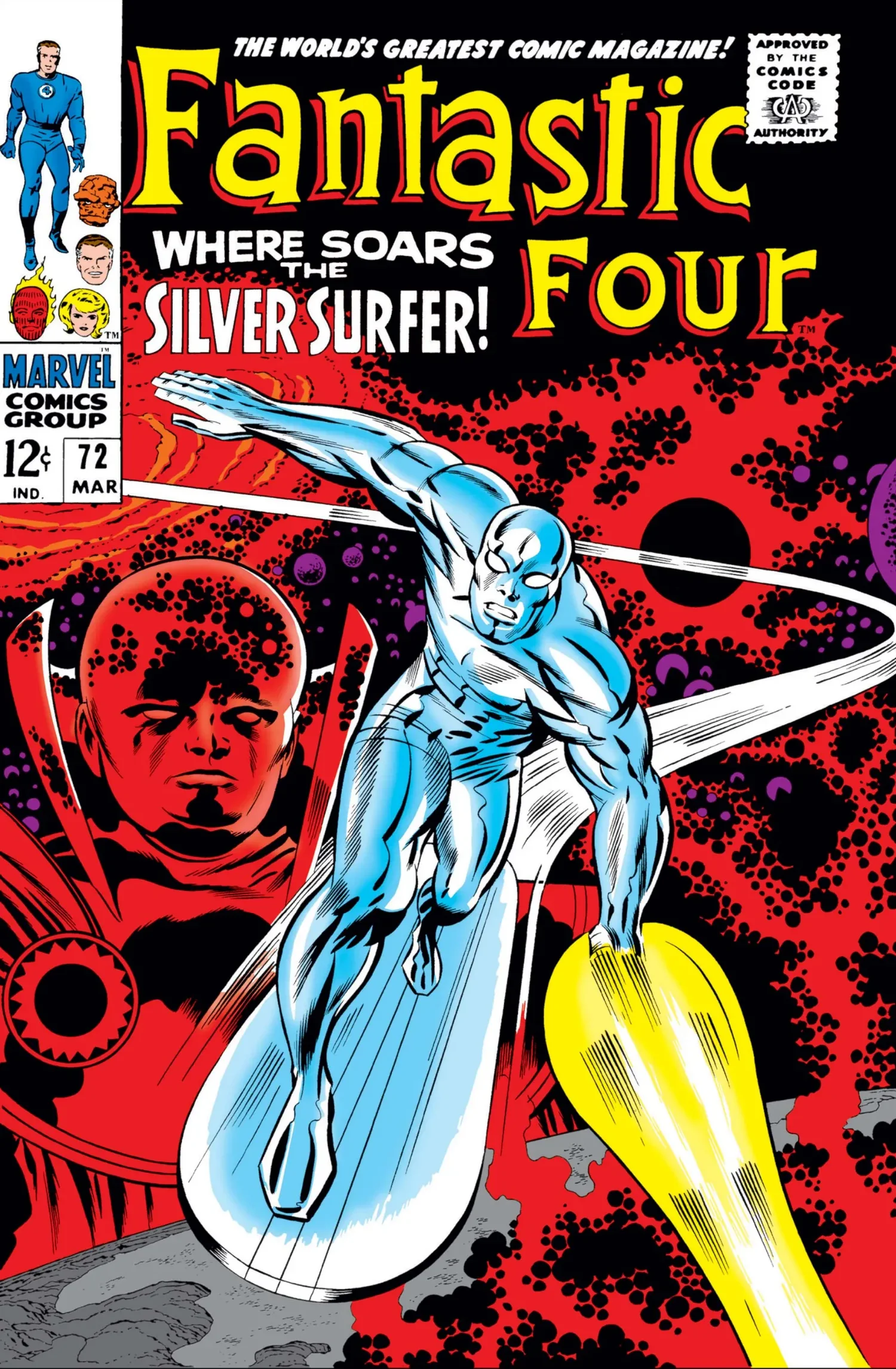
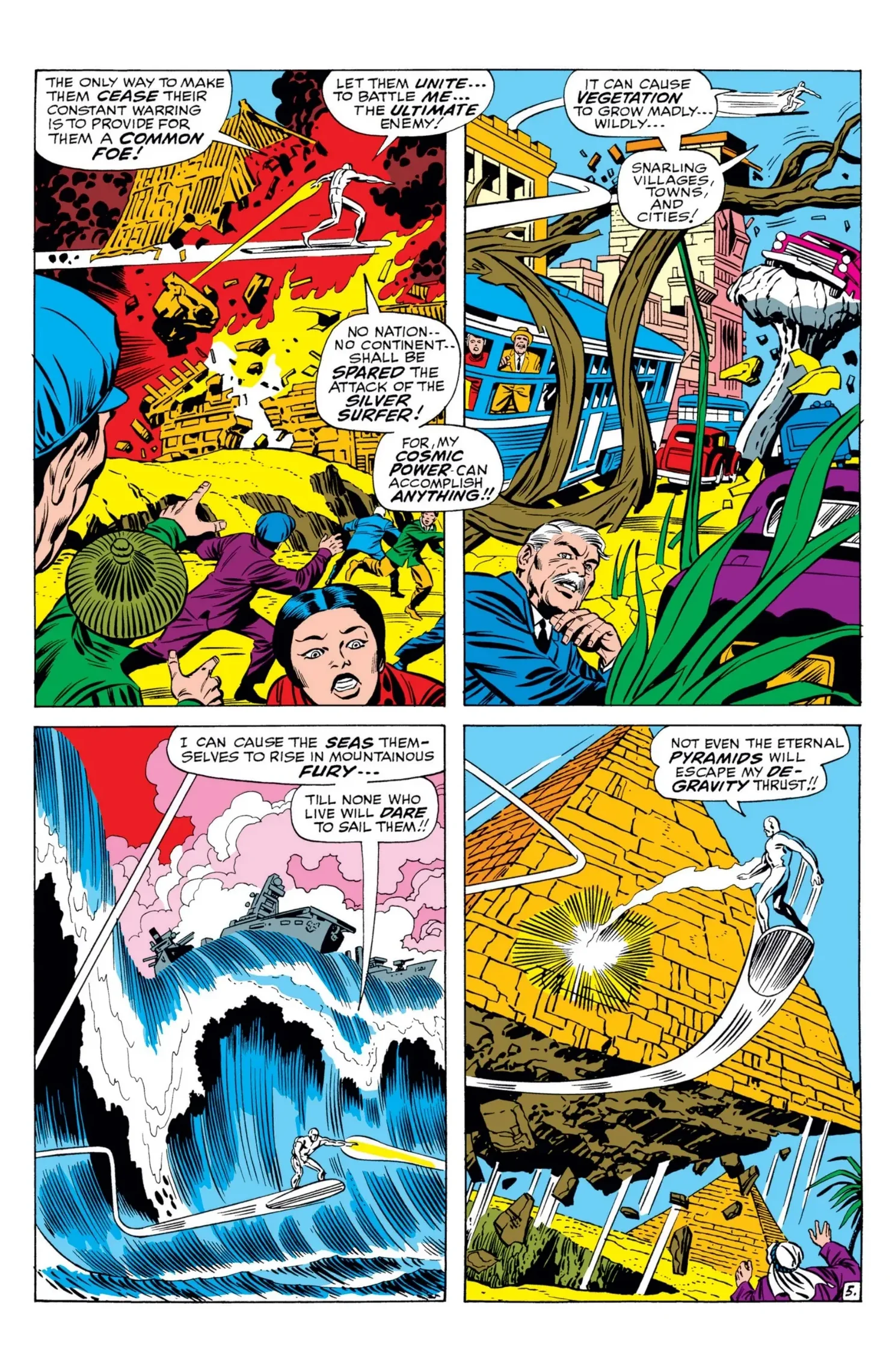
Fantastic Four #72 (March 1968): the Surfer, in despair, turns on humanity for its own good.
And it is a genuinely useful cautionary tale, because it is the exact failure mode of the compassionate. The Surfer here is not cruel; he is the opposite of cruel. He simply becomes so certain he knows what is good for humanity that he stops asking humanity and starts deciding for it. The moment you appoint yourself the enemy people need, however pure your motive, you have slipped from serving others to overruling them. It is the tyranny of the person who cares too much and trusts too little, and history is littered with it on scales far larger than one silver man over Manhattan. The lesson the FF beat back into him is worth keeping: good intentions do not exempt you from consent, and love that refuses to ask what the beloved actually wants is not as loving as it feels.
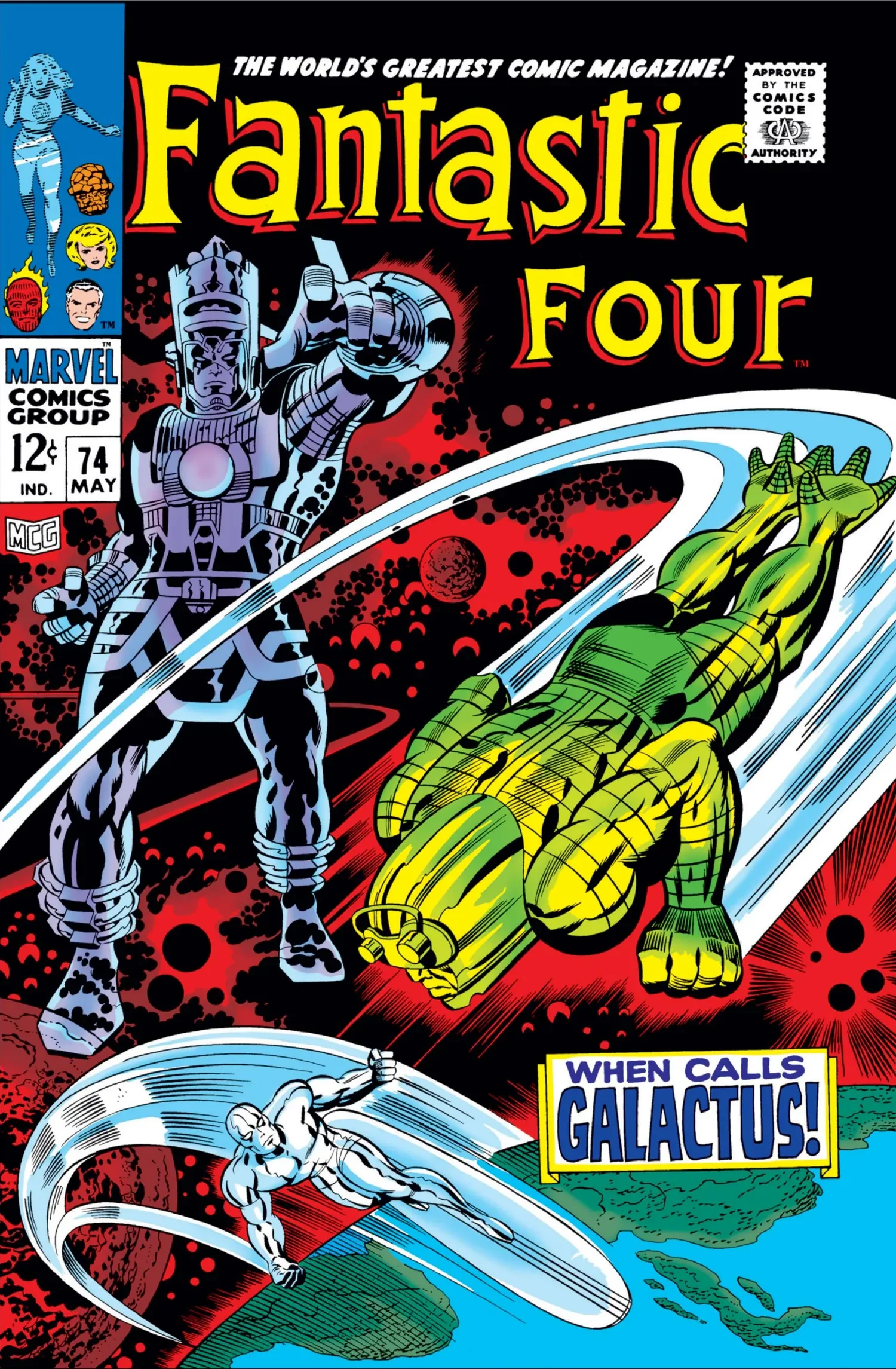
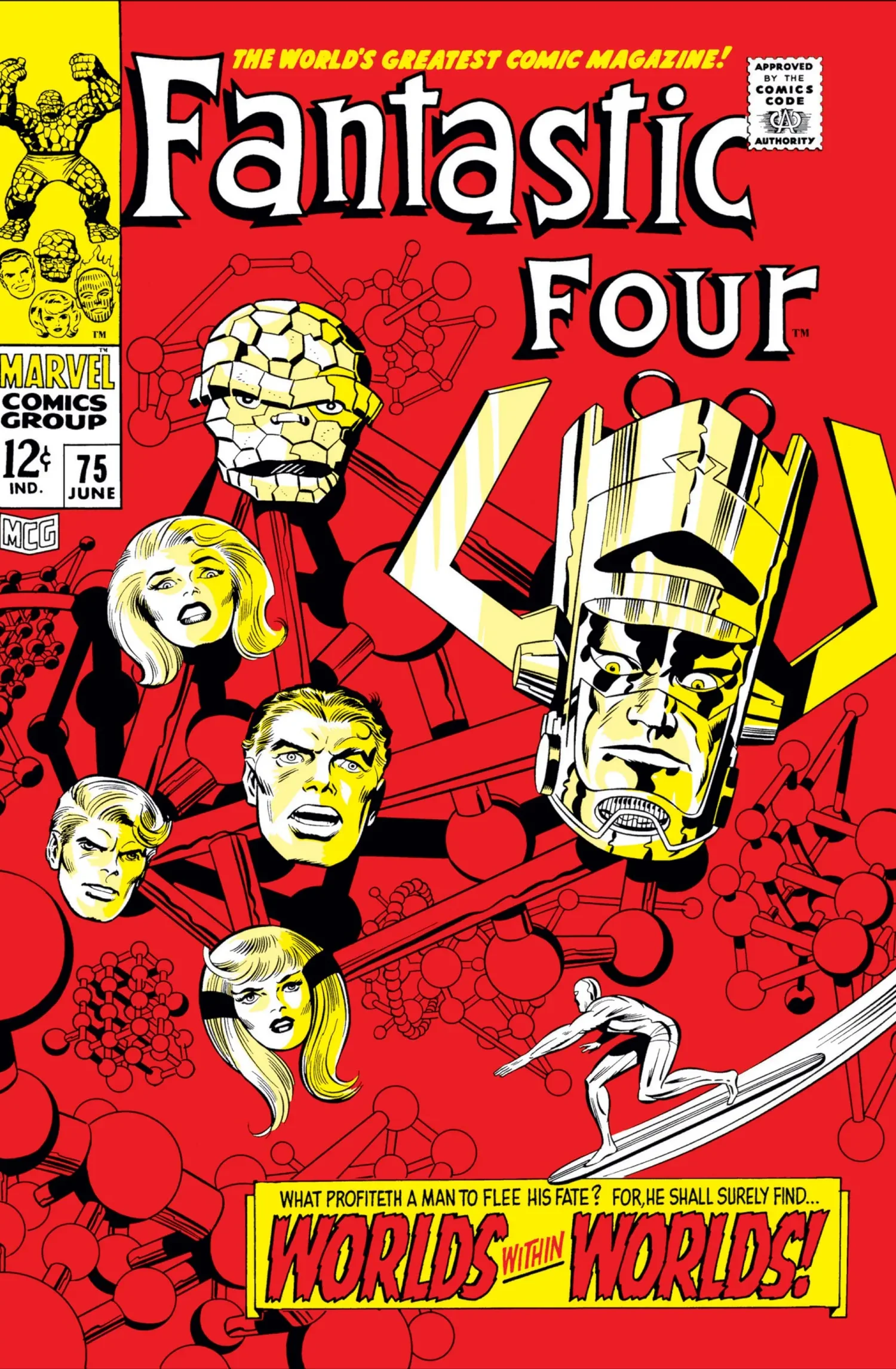
Fantastic Four #74–75 (1968): a starving Galactus returns, demanding his herald back.
The era climaxes with #74–77 (May–August 1968). Galactus, starving, returns to Earth's orbit and demands his herald back. The Surfer refuses to help destroy any more worlds. Using Reed's laboratory equipment, he shrinks out of existence entirely and escapes into the Microverse, where for the first time since his exile he can taste the open space he's been denied. It's a heartbreaking character beat buried inside a cosmic romp. Galactus sends his Punisher robot, menaces Manhattan, and forces the FF to shrink after their friend in Reed's Reducta-Craft, where they tangle with the tyrant Psycho-Man. The Surfer finally returns and agrees to find Galactus a substitute world to spare Earth. Then, having served, he asks for his freedom. Galactus refuses and teleports him back inside the barrier, so that he will always know where to find his herald. Cosmic beings can be remarkably petty.
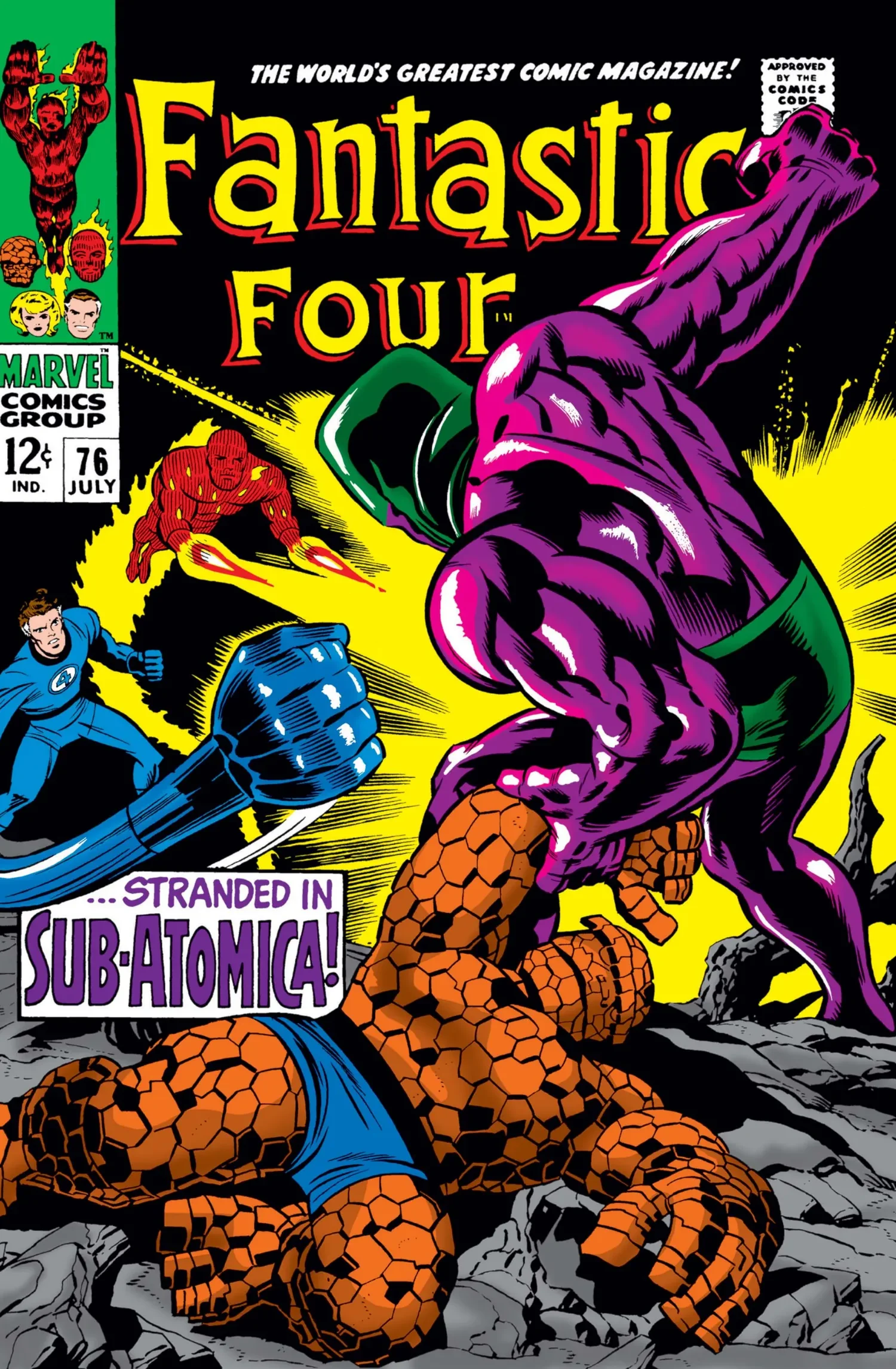
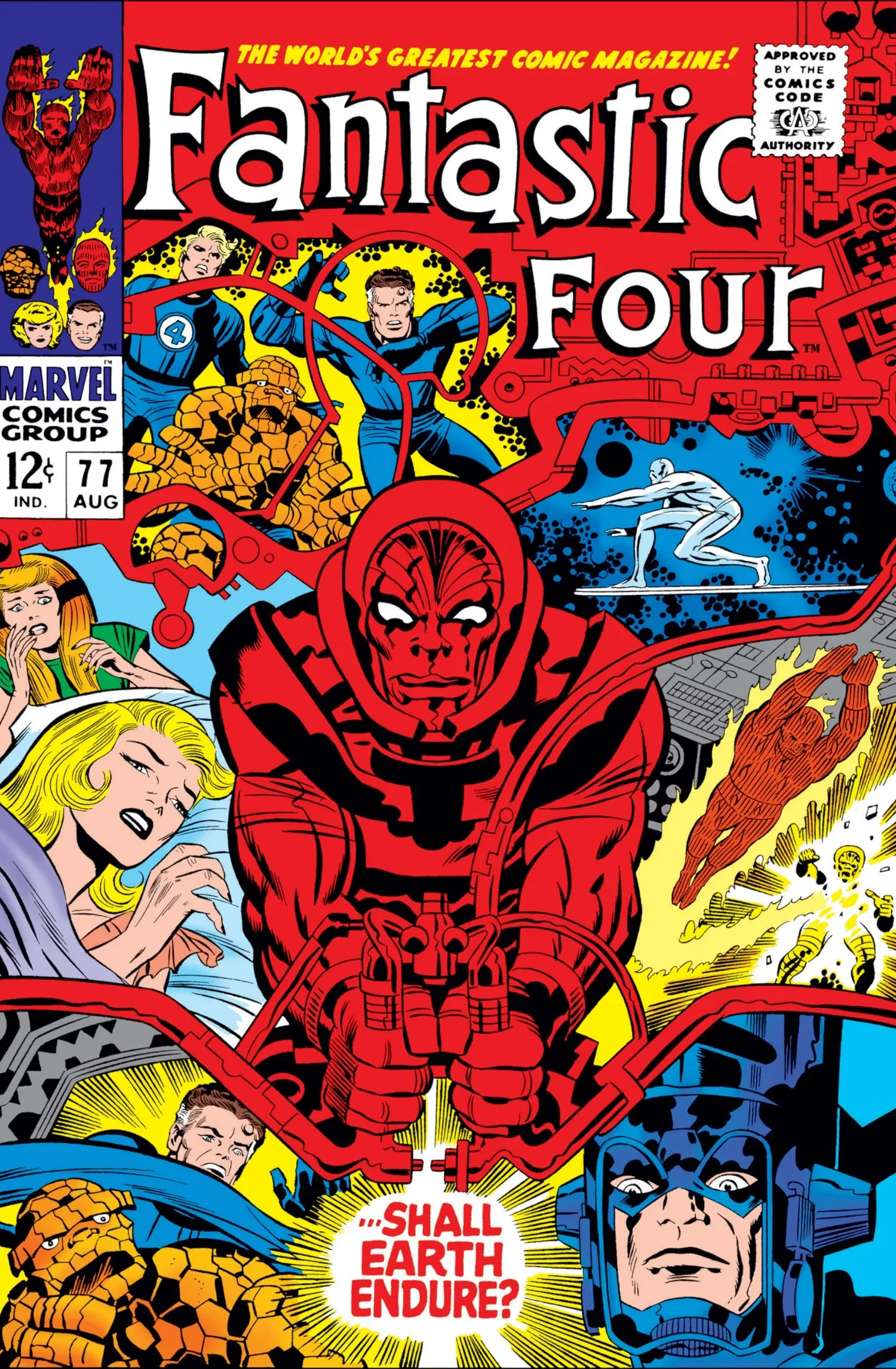
Fantastic Four #76–77 (1968): the chase into the Microverse.
His Own Book at Last — And an Origin (The Silver Surfer #1–18, 1968–1970)
In August 1968 the Surfer graduated to his own title, and Lee treated it as his prestige project: the first seven issues were double-length, the art went to John Buscema, and the scripts represent Lee at his most ambitious, purple and heartfelt.[8]
Issue #1, “The Origin of the Silver Surfer!”, finally told us who the man on the board had been. He was Norrin Radd of the planet Zenn-La, a utopia so ancient and complete that it had curdled into stagnation. It was a world with nothing left to strive for. Norrin was the malcontent of paradise, a restless dreamer among the satisfied. His one great tie to that becalmed world was Shalla-Bal, the woman he loved above all else. When Galactus arrived to consume Zenn-La and every defence failed, it was Norrin who flew up to the world-ship and struck the bargain that defines him: he would become the devourer's herald, roaming the cosmos in search of other worlds for Galactus to drain, if only Zenn-La — and, with it, Shalla-Bal — were spared. Galactus agreed, and remade him in gleaming silver. But the price was total. To save his home and his beloved, Norrin Radd had to surrender not only his humanity but Shalla-Bal herself, leaving her behind on Zenn-La and sailing off into the void as the servant of the very being who had come to destroy them. He saved his love by losing her. It is one of the great tragic origins in the medium, a superhero backstory built not on an accident but on a sacrifice.
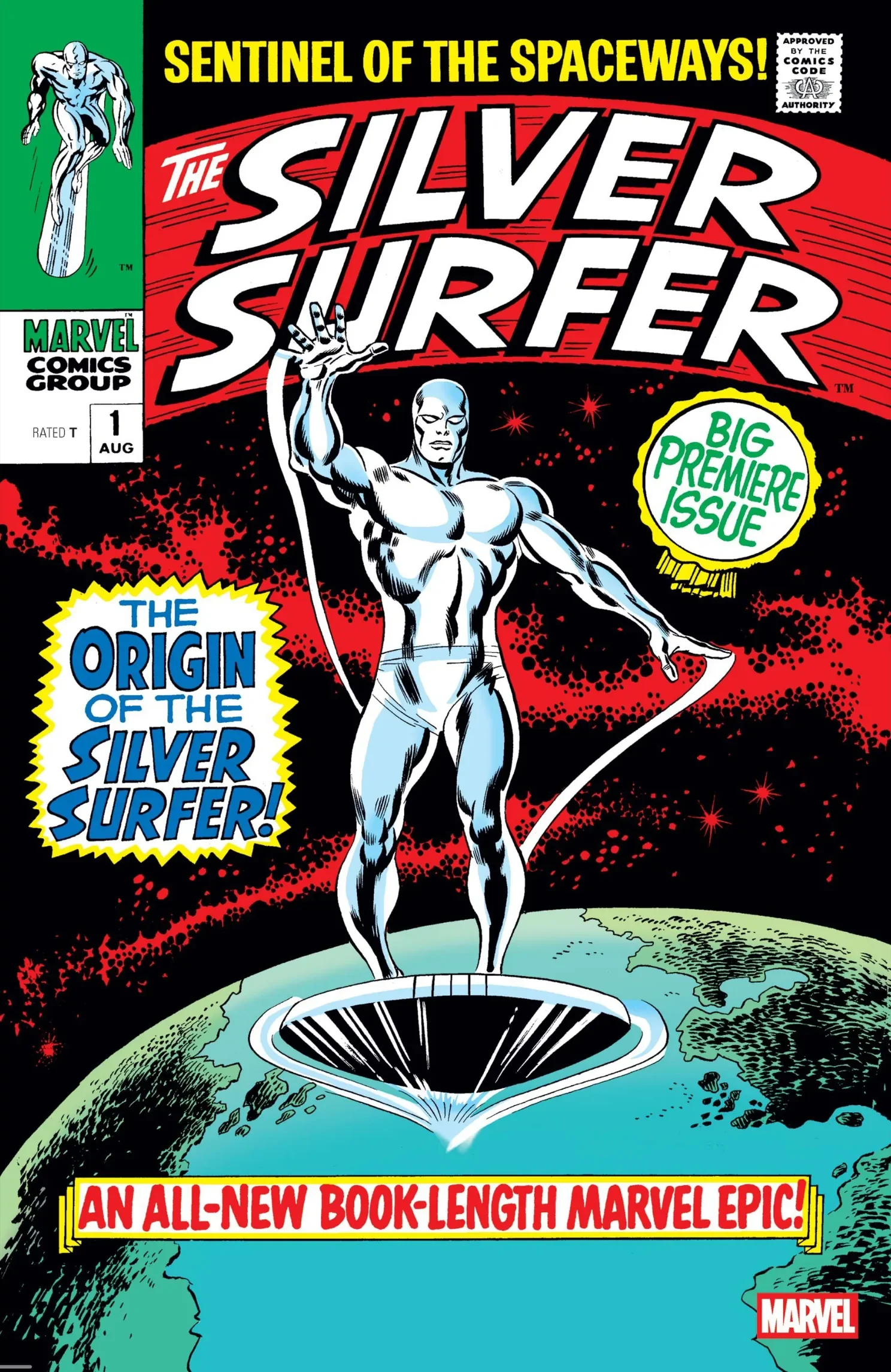
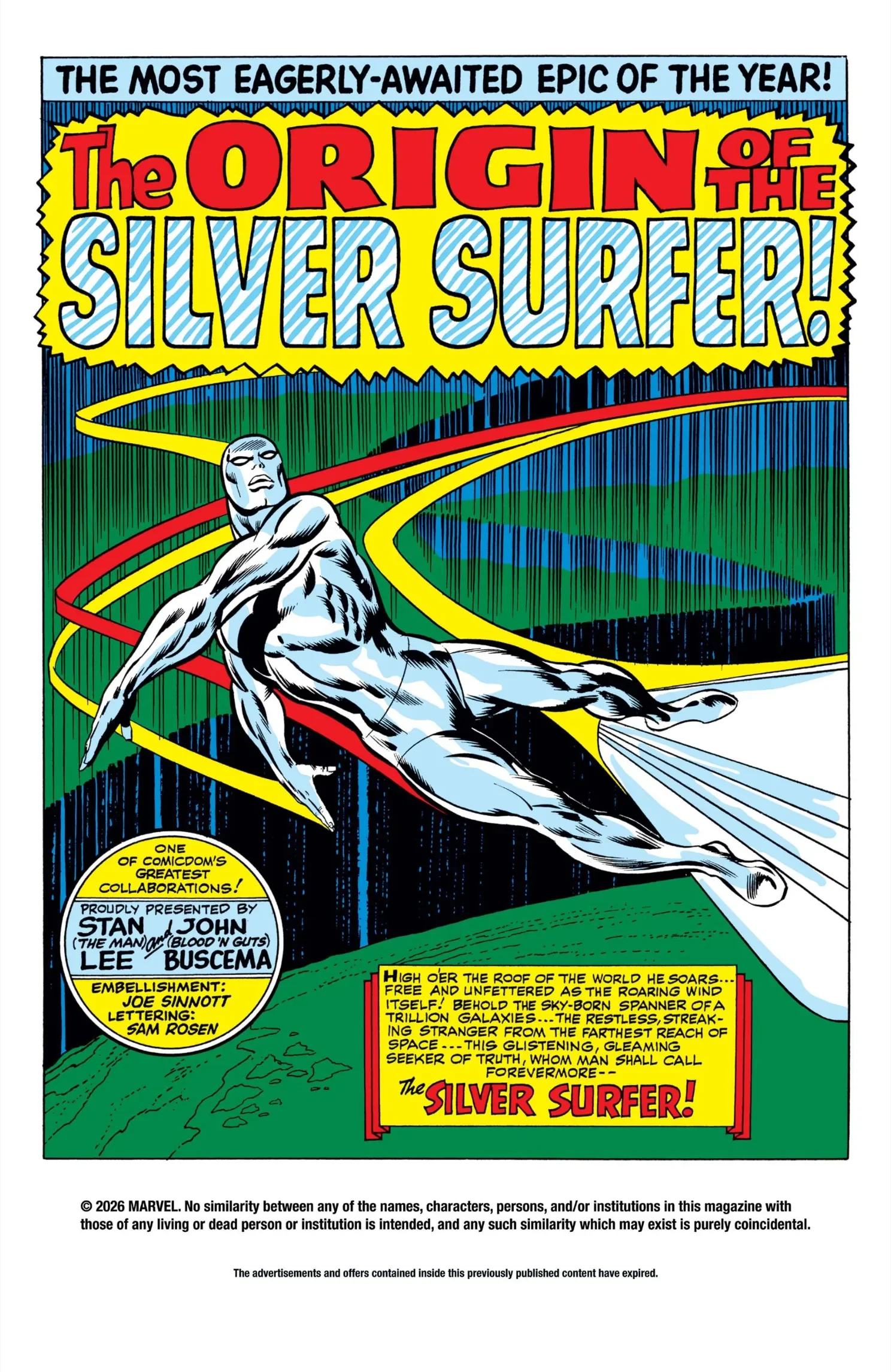
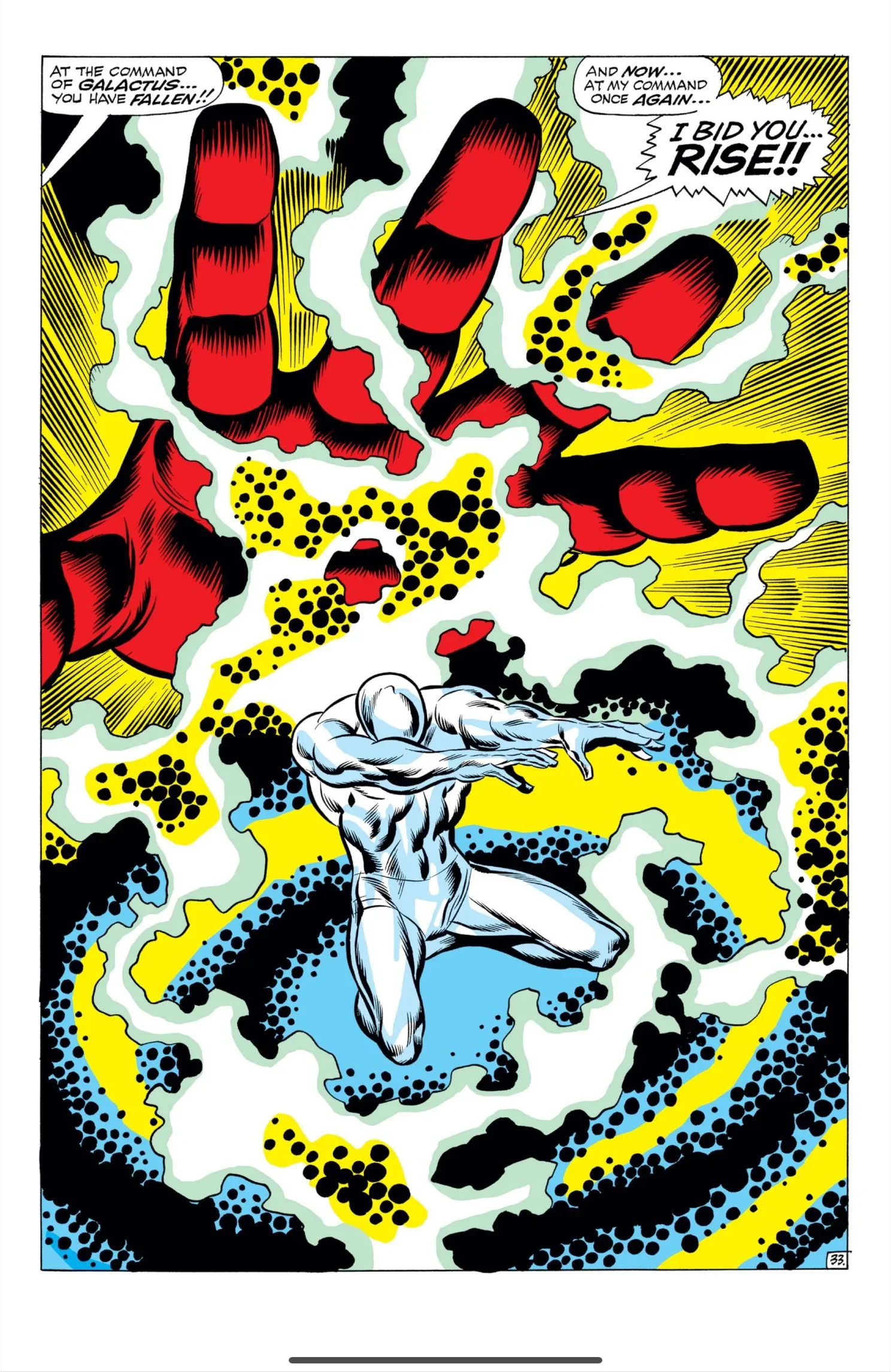
The Silver Surfer #1 (August 1968): the origin of Norrin Radd of Zenn-La.
Two lessons are folded into that origin, and they sit in tension with each other in a way the whole rest of his story will try to resolve. The first is that a paradise with nothing left to strive for is not actually a paradise. It is a beautifully upholstered dead end. Zenn-La has solved every problem and, in solving them, has quietly stopped being alive; its people are comfortable and complete and going nowhere, and the one man who feels the wrongness of it is dismissed as a malcontent. But Norrin's restlessness, the very thing his contented world has no use for, turns out to be the one thing that can save it. There is a case to be made (the existentialists made it most prominently) that a life is meaningful in proportion to what it reaches for, and that a person with no discontent left has not arrived at peace so much as at sleep.[9] The dreamer who cannot be satisfied is often the only one awake.
The second lesson is what he does with that restlessness, and it is the pattern that will define him forever: offered no good options, he does not freeze and he does not despair. He flies up. The bargain he strikes is monstrous (he agrees to help murder other worlds to spare his own), and the story never lets him off that hook. But the act itself, the choosing of a terrible price over passive ruin, is the first instance of the thing that makes him a hero rather than a victim: in the face of a catastrophe he did not cause and cannot escape, he takes an action and owns its cost. Sacrifice, here, is not something done to him. It is something he chooses, eyes open, and it is the difference between a tragedy and a mere misfortune.
There is a bittersweet footnote to that origin. Kirby, the character's creator, had conceived the Surfer quite differently: as a genuinely alien being, born of the cosmos, who learned emotion and morality from Alicia Masters. Lee's Norrin Radd backstory, devised with Buscema and without Kirby, overwrote that intention, and the episode became one more crack in the most important creative partnership comics has ever known.[10] Kirby would pencil only a single issue of the solo series: the last one.
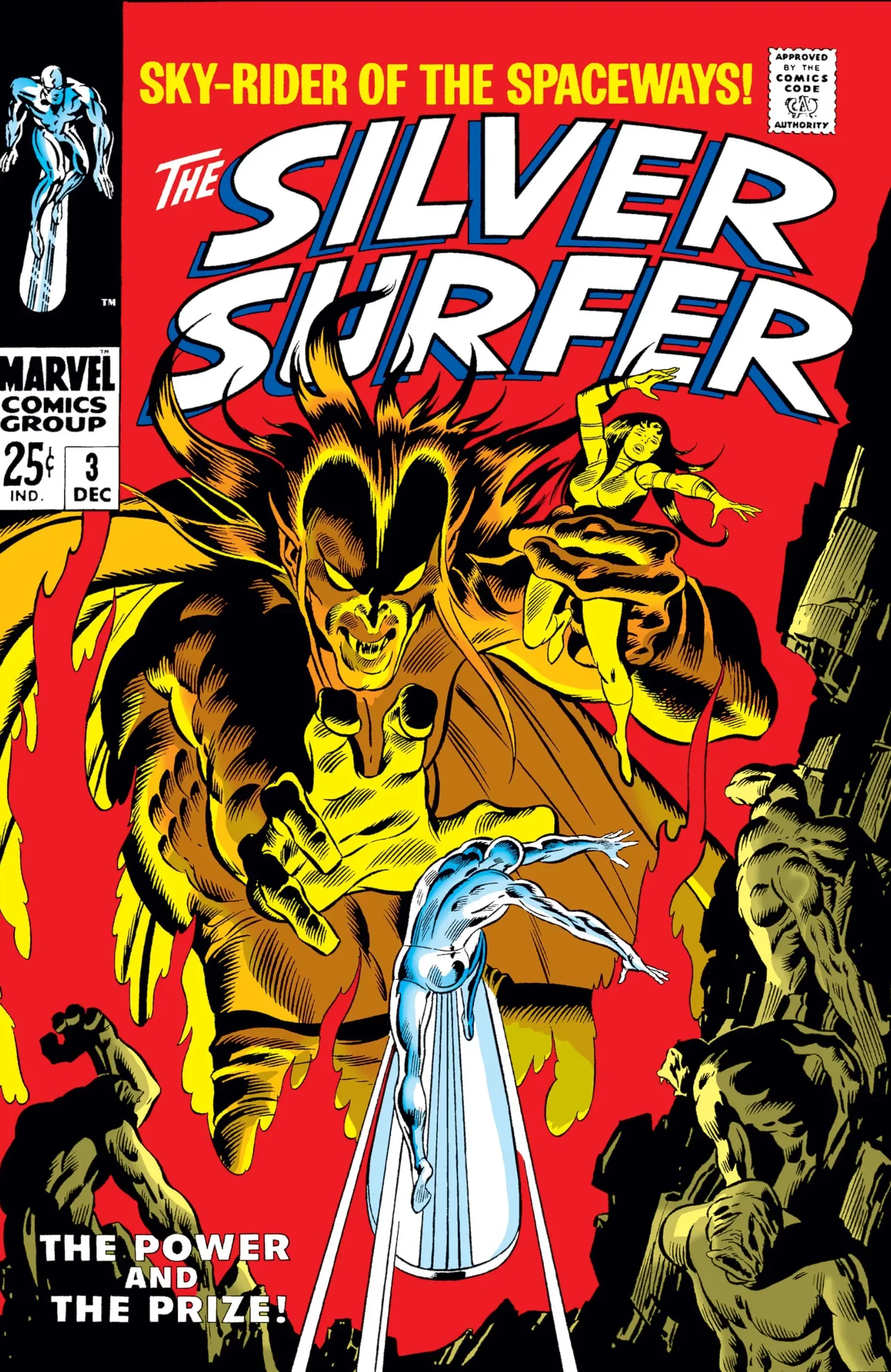
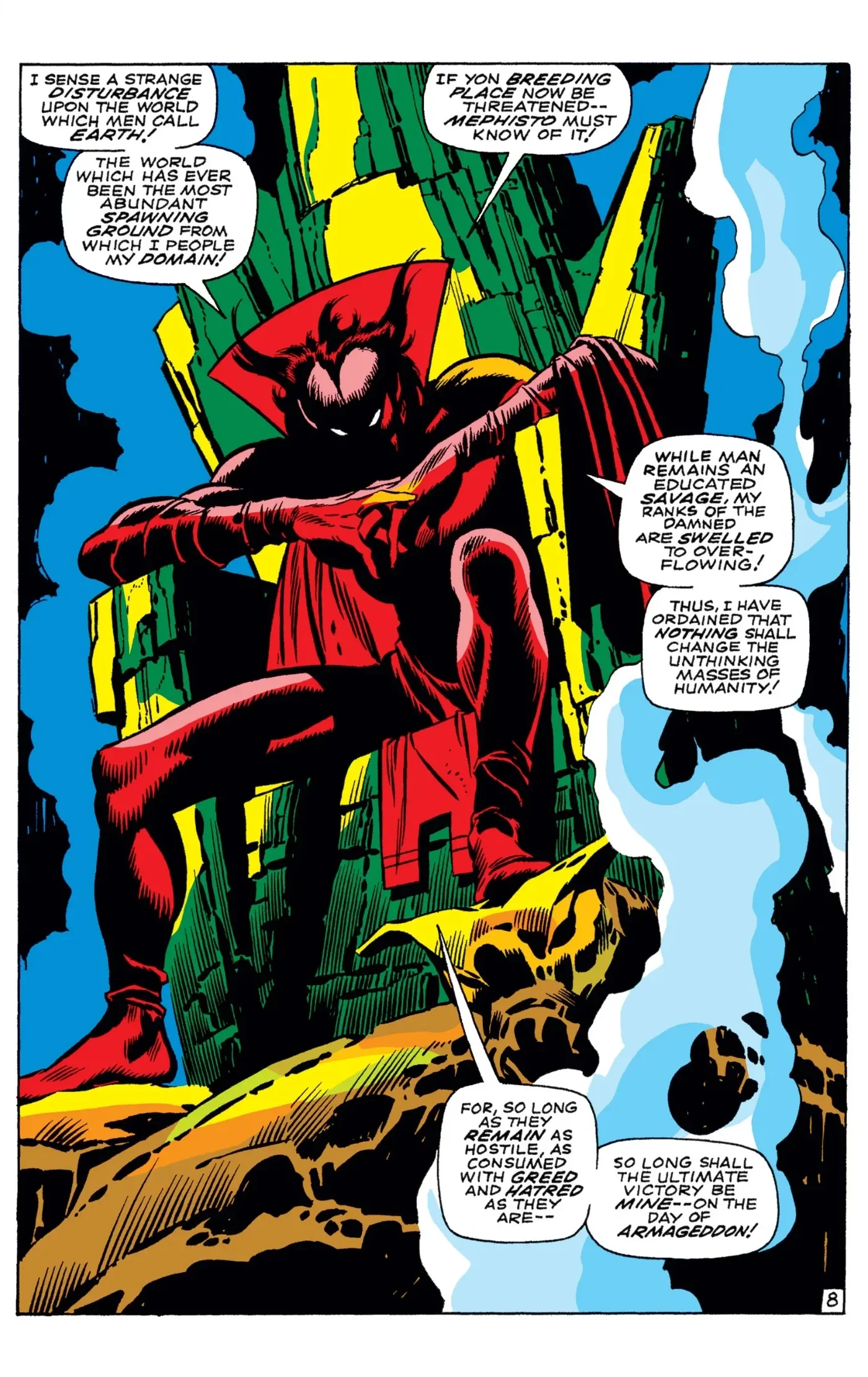
The Silver Surfer #3 (December 1968), which introduced Mephisto.
The series itself is a treasure. Issue #3 (December 1968) introduced Mephisto, Marvel's devil, who senses in the Surfer's incorruptible soul the one prize worth having and spends the series scheming for it, frequently using Shalla-Bal as bait. Issue #4 (February 1969) is the jewel of the run: Loki, the Asgardian god of mischief, tricks the Surfer and the thunder god Thor into a duel neither has any real cause to fight. It is the one issue where John Buscema's artwork — inked by his brother Sal Buscema — melds so completely with the pseudo-Shakespearean cadences of Lee's script that a simple tale of misguided combat is lifted into something genuinely operatic.
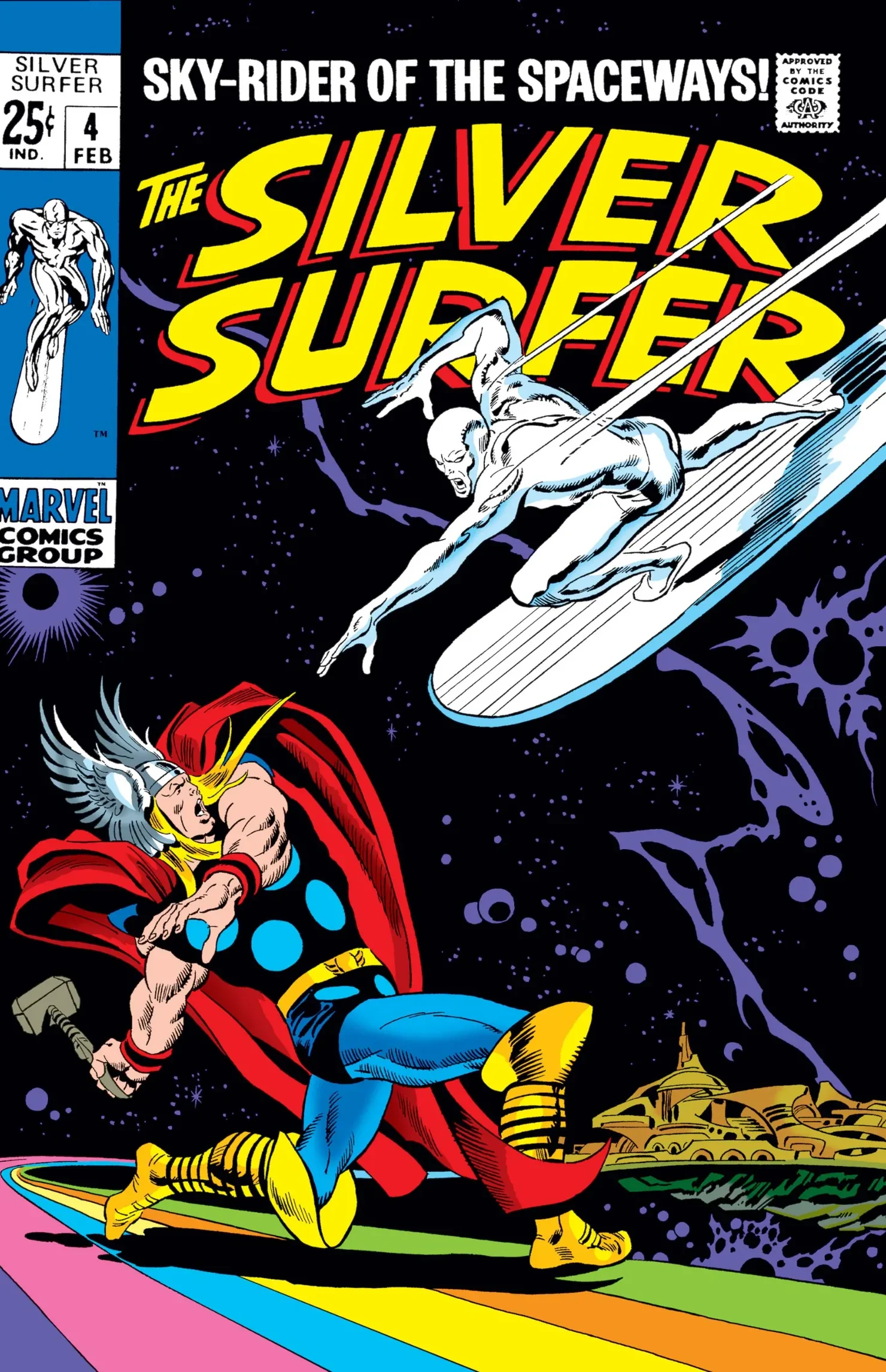
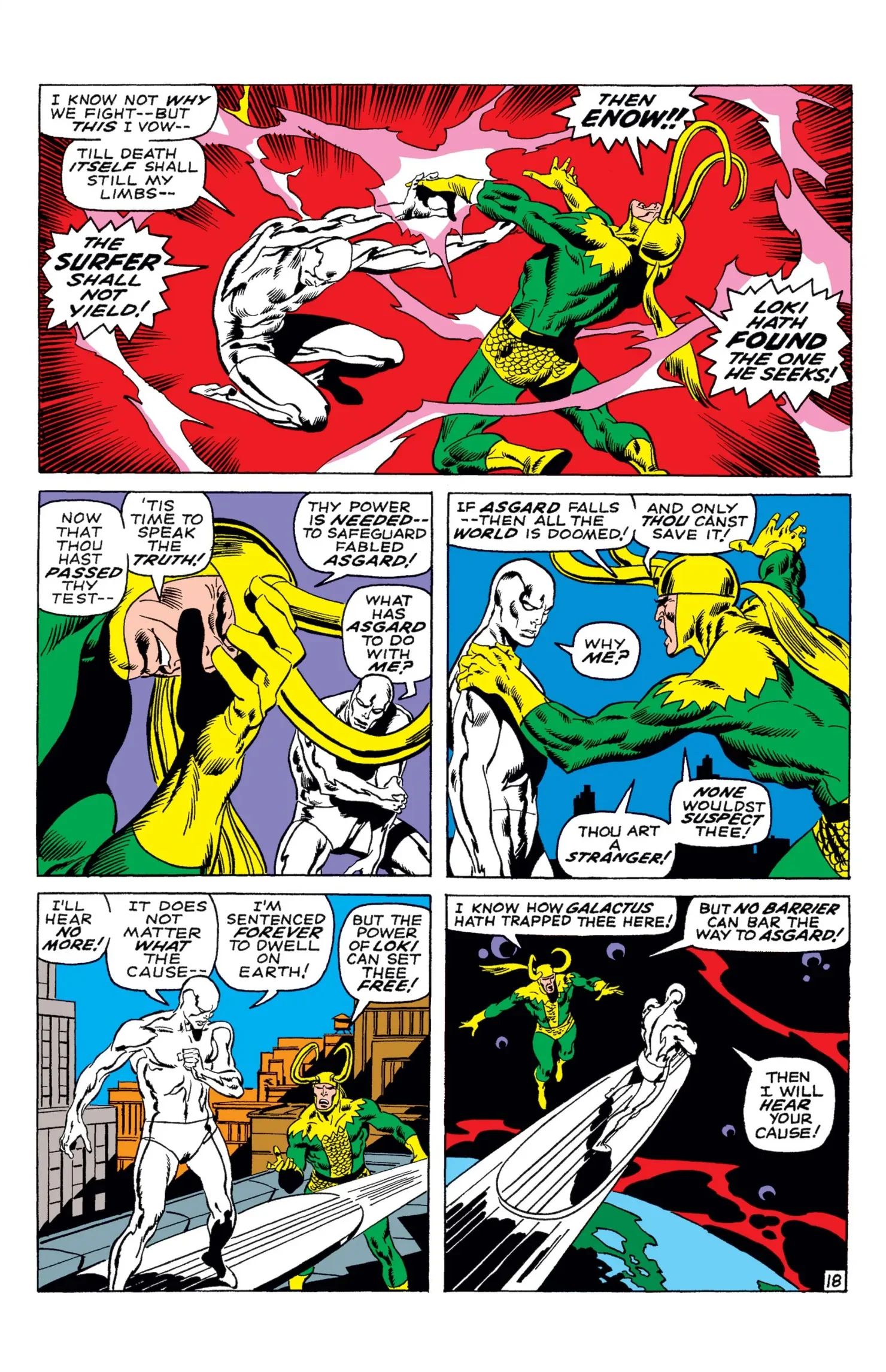
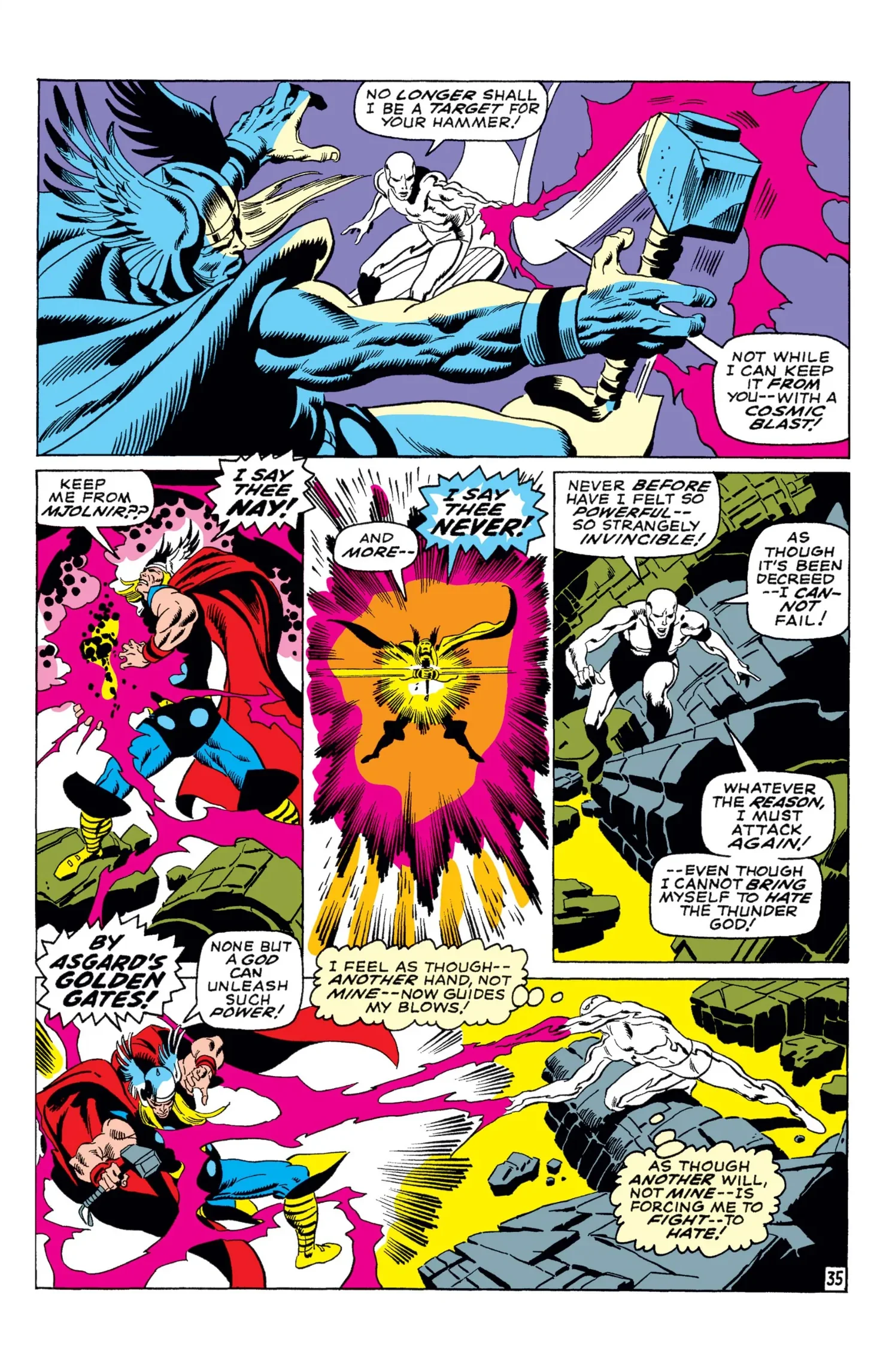
The Silver Surfer #4 (February 1969): the celebrated, Loki-orchestrated duel with Thor.
Many regard it as some of the finest work Buscema ever produced outside his celebrated run on Conan the Barbarian, and its cover remains one of the most famous of the era. Spider-Man dropped by in #14. But for all its ambition, the book never sold to match, and it was cancelled with #18 (September 1970), a Kirby-drawn finale that ends with an embittered Surfer vowing to stop turning the other cheek. The cliffhanger was never resolved. The sentinel of the spaceways was homeless again.
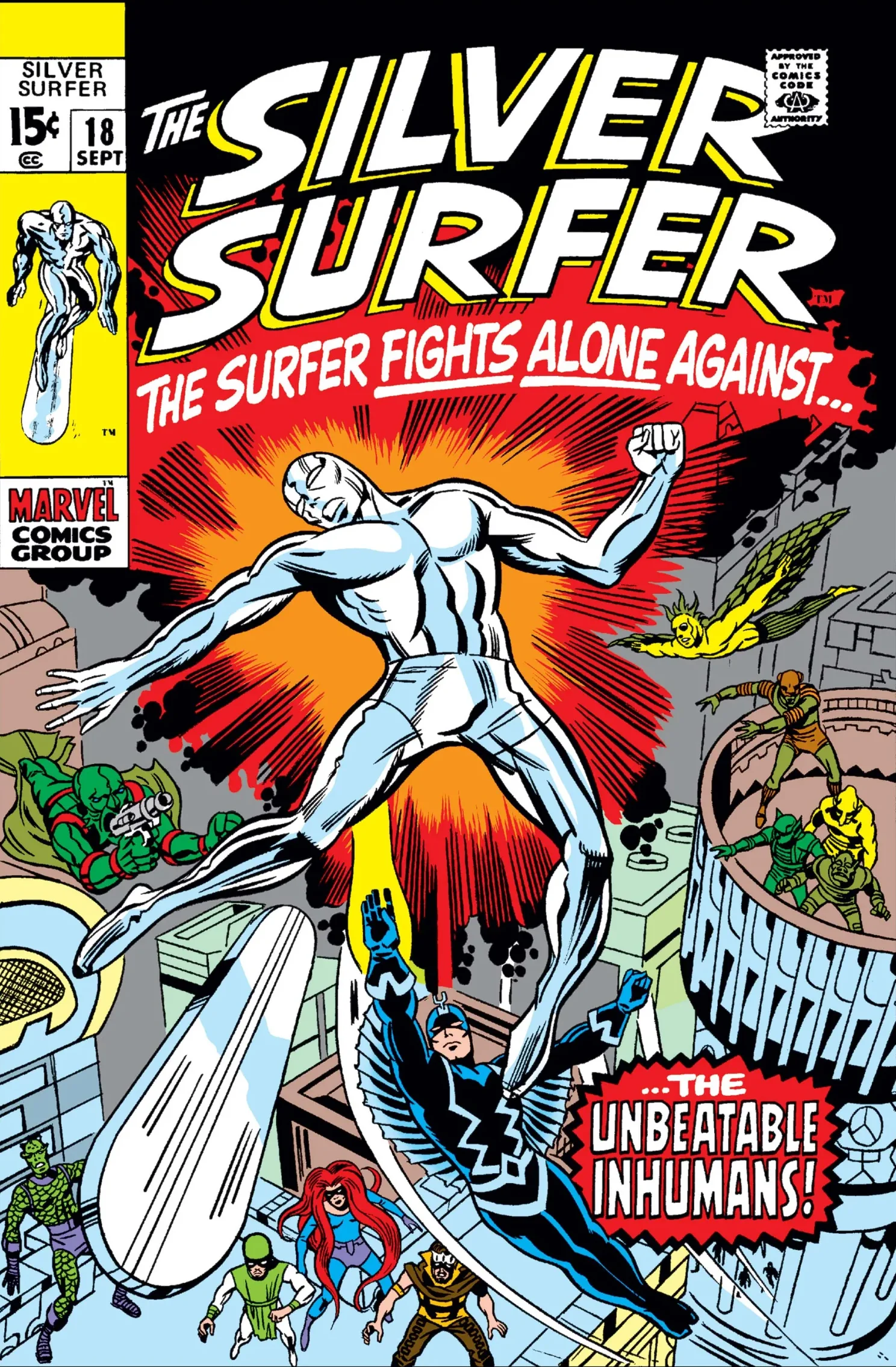
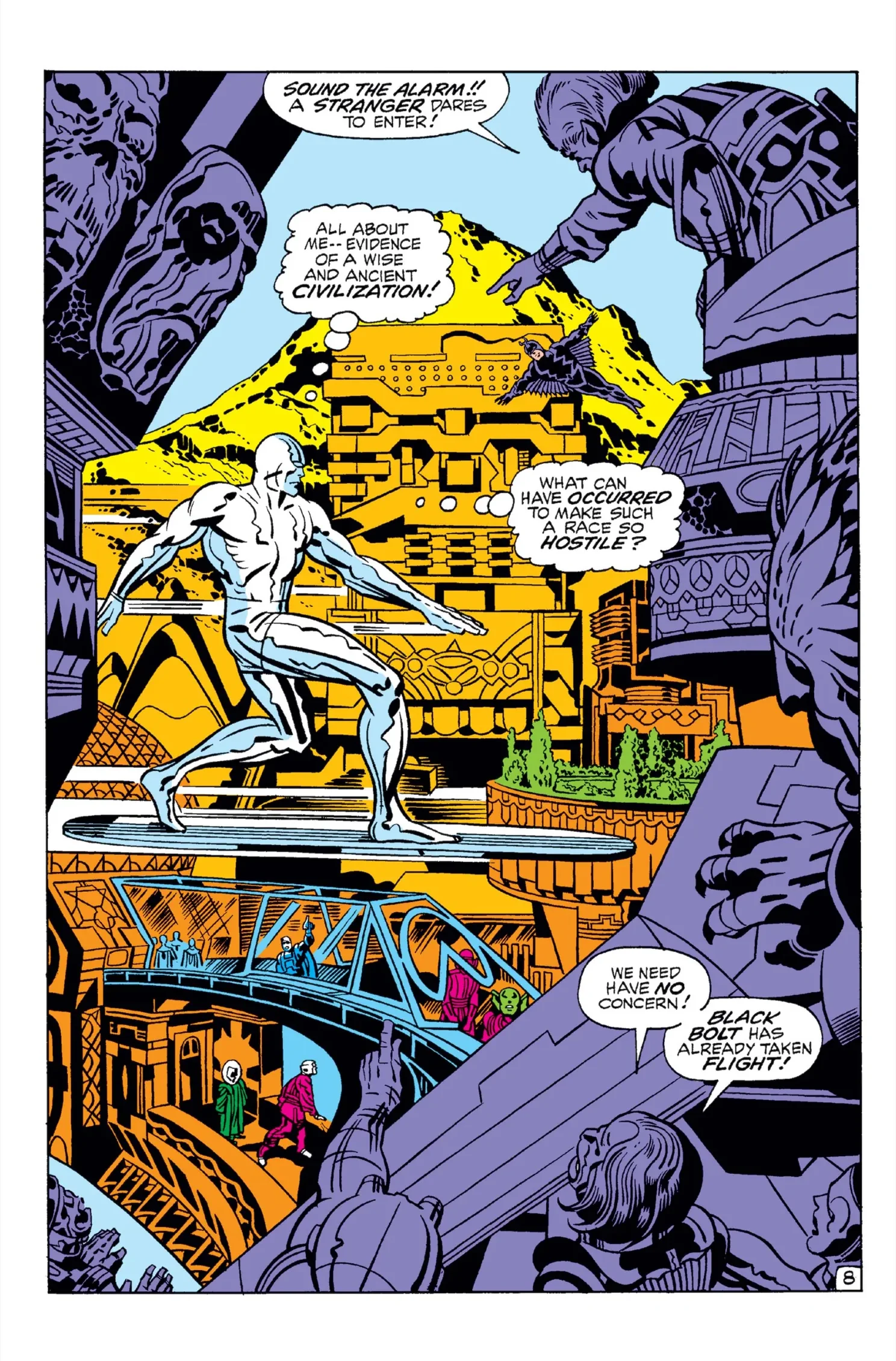
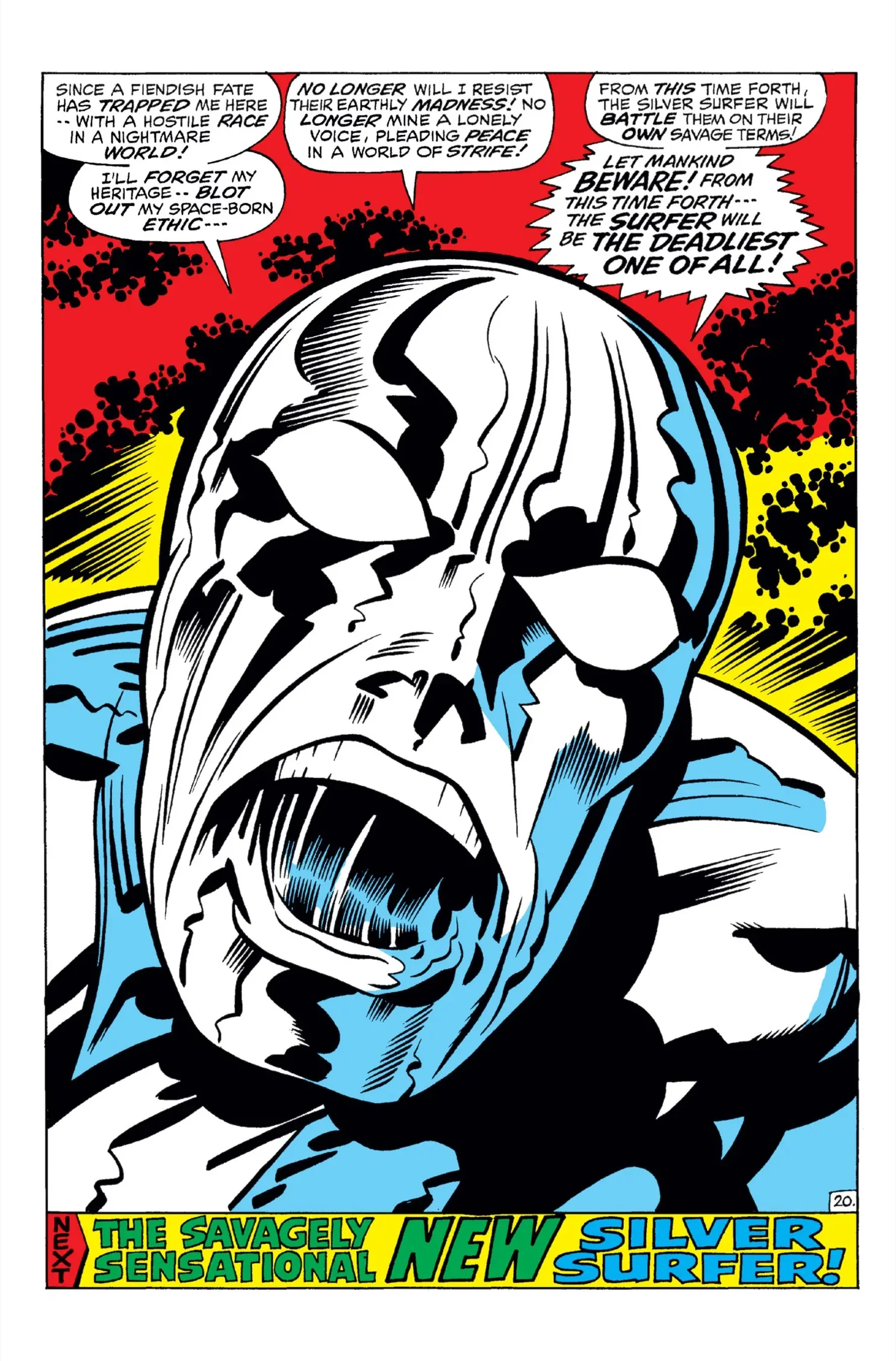
The Silver Surfer #18 (September 1970): the Kirby-drawn finale, and the book’s cancellation.
Stan's Embargo and the Wilderness Years (1970–1976)
Lee had grown so attached to the Surfer that he did something almost unheard of at merrily collaborative Marvel: he asked, as editor, that no other writer use the character, intending to write every Silver Surfer story personally. The trouble was that Lee (increasingly busy as Marvel's publisher and public face) had almost no time to write any. The result was an informal embargo that kept one of Marvel's most beloved characters in a display case for most of a decade.
You can see the embargo's fingerprints all over the founding of the Defenders. In Sub-Mariner #34–35 (early 1971), Roy Thomas had teamed Namor, the Hulk and the Surfer as the “Titans Three”[11], a gloriously grumpy trio who smash a dangerous weather-control experiment, accidentally liberate a small island nation from its dictator, and trade blows with the Avengers along the way. It was a hit pairing, and when Thomas formalised the concept in Marvel Feature #1 (December 1971), the Surfer should have been a founder. Instead, Namor tries to summon him on-panel, and he simply doesn't come. Lee's edict kept him out, and Doctor Strange took the slot alongside Namor and the Hulk.
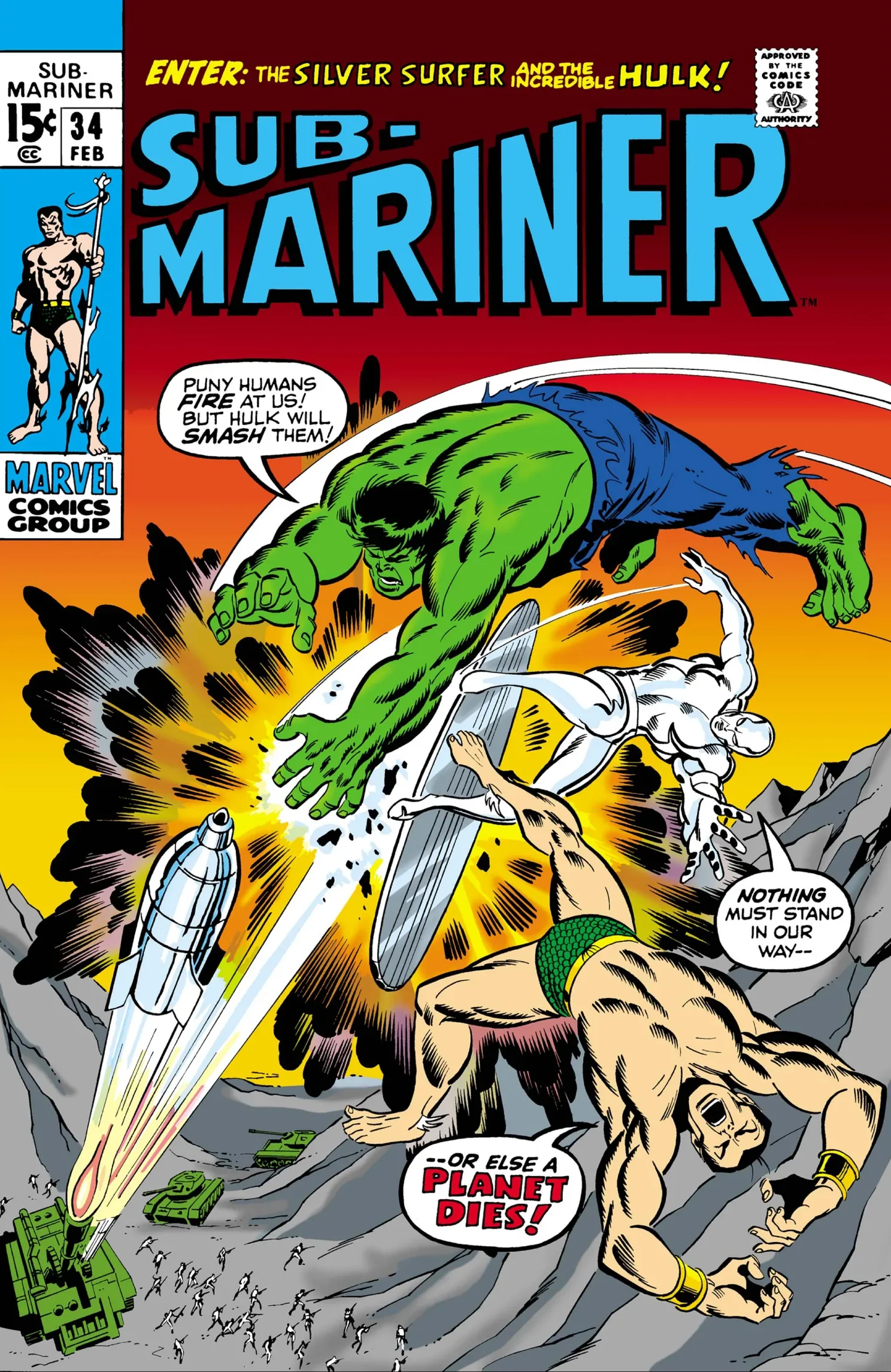
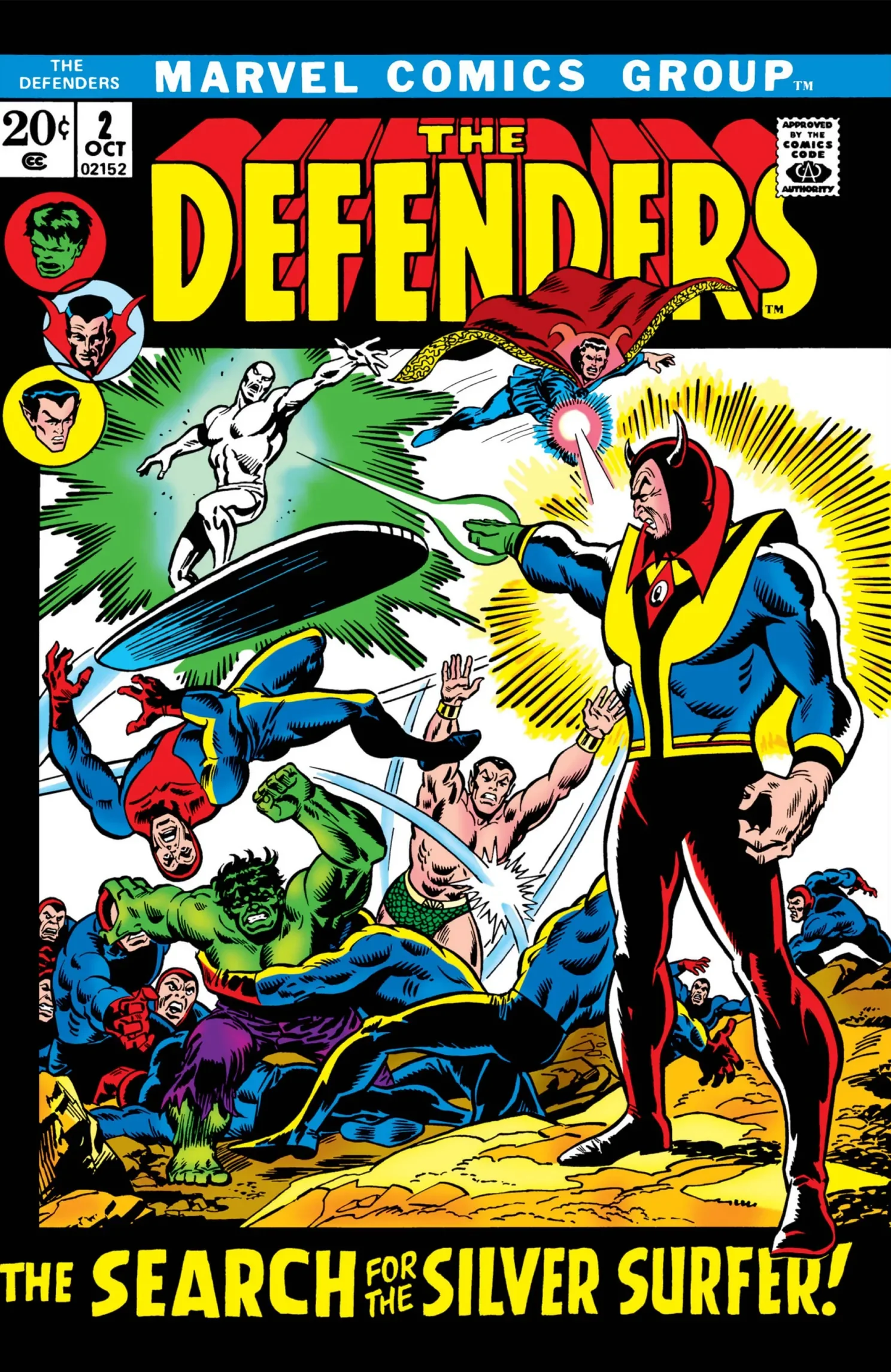
Two incidental appearances: the “Titans Three” in Sub-Mariner #34 (1971), and the Surfer joining The Defenders #2 (1972).
The loophole arrived with the team's own title. New Defenders writer Steve Englehart (remember that name) pitched Lee directly on bringing the Surfer aboard, and got a yes. The Surfer joins in Defenders #2 (October 1972) and drifts in and out of the book's early years, lending his power to the Avengers/Defenders War crossover of 1973 before fading from the roster for the better part of a decade.
His one great mid-decade showcase came back where he started. In Fantastic Four #155–157 (early 1975), the Surfer attacks the FF in Central Park, because Doctor Doom is holding Shalla-Bal.[12] The backstory is agonising: the Surfer had recently hurled himself at the barrier with everything he had, actually pierced it, felt his power desert him on the far side, and crashed back to Earth, landing, of all places, in Latveria, where he saw a poster of the nation's new queen and recognised his lost love. Doom has wiped her memory, and he blackmails the Surfer into battling the FF — all the while secretly siphoning the Power Cosmic into an android of his own, the Doomsman II. The woman then tearfully reveals she is not Shalla-Bal at all, but a brainwashed Latverian peasant named Helena; the freed Surfer helps the FF destroy the Doomsman.
And then the final page twists the knife: Mephisto, gloating from his realm, reveals that she truly was Shalla-Bal all along. The entire charade, Doom included, was his puppetry, staged purely to torment the Surfer's soul. Few Bronze Age stories are this deliciously cruel.
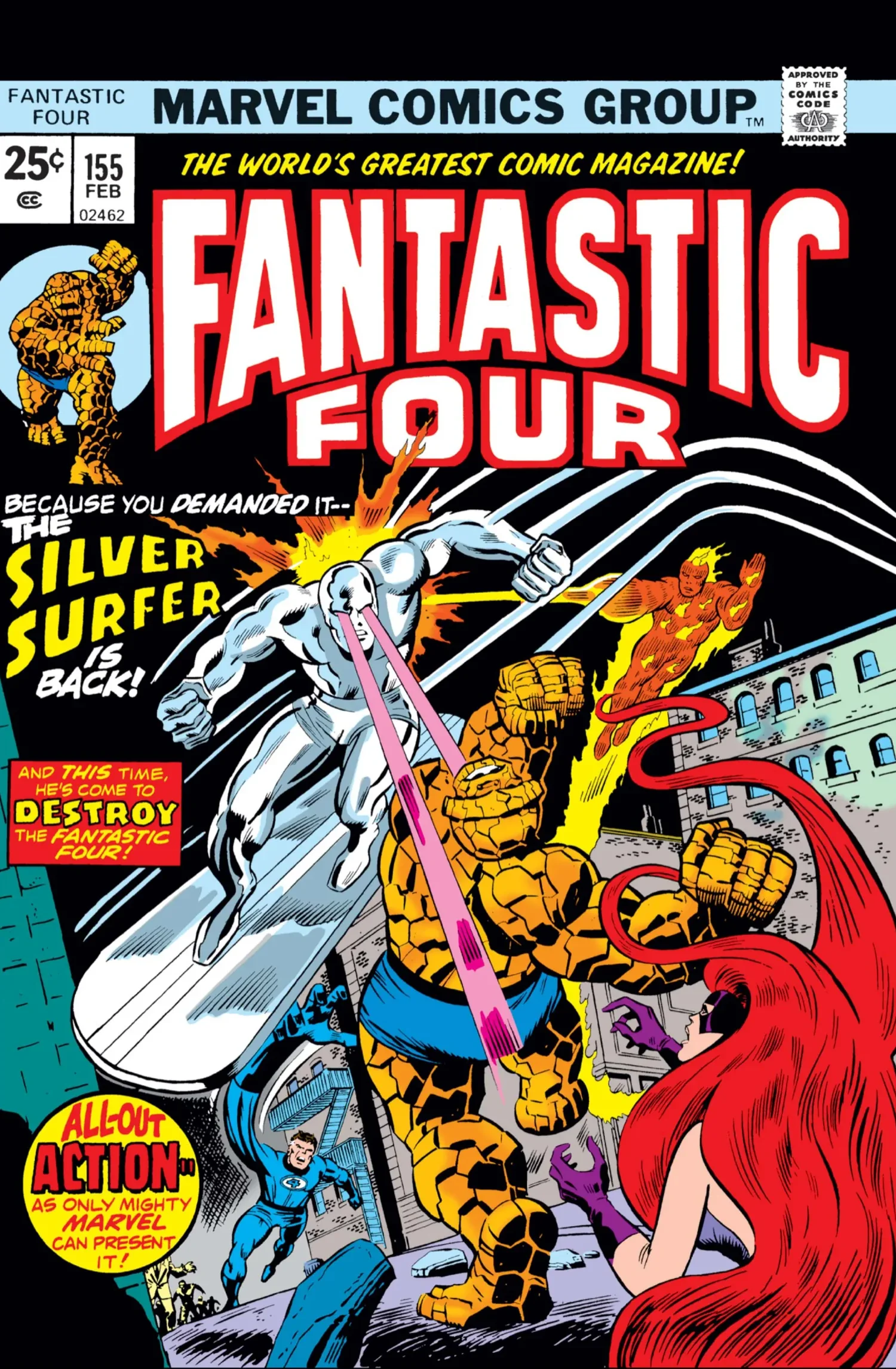
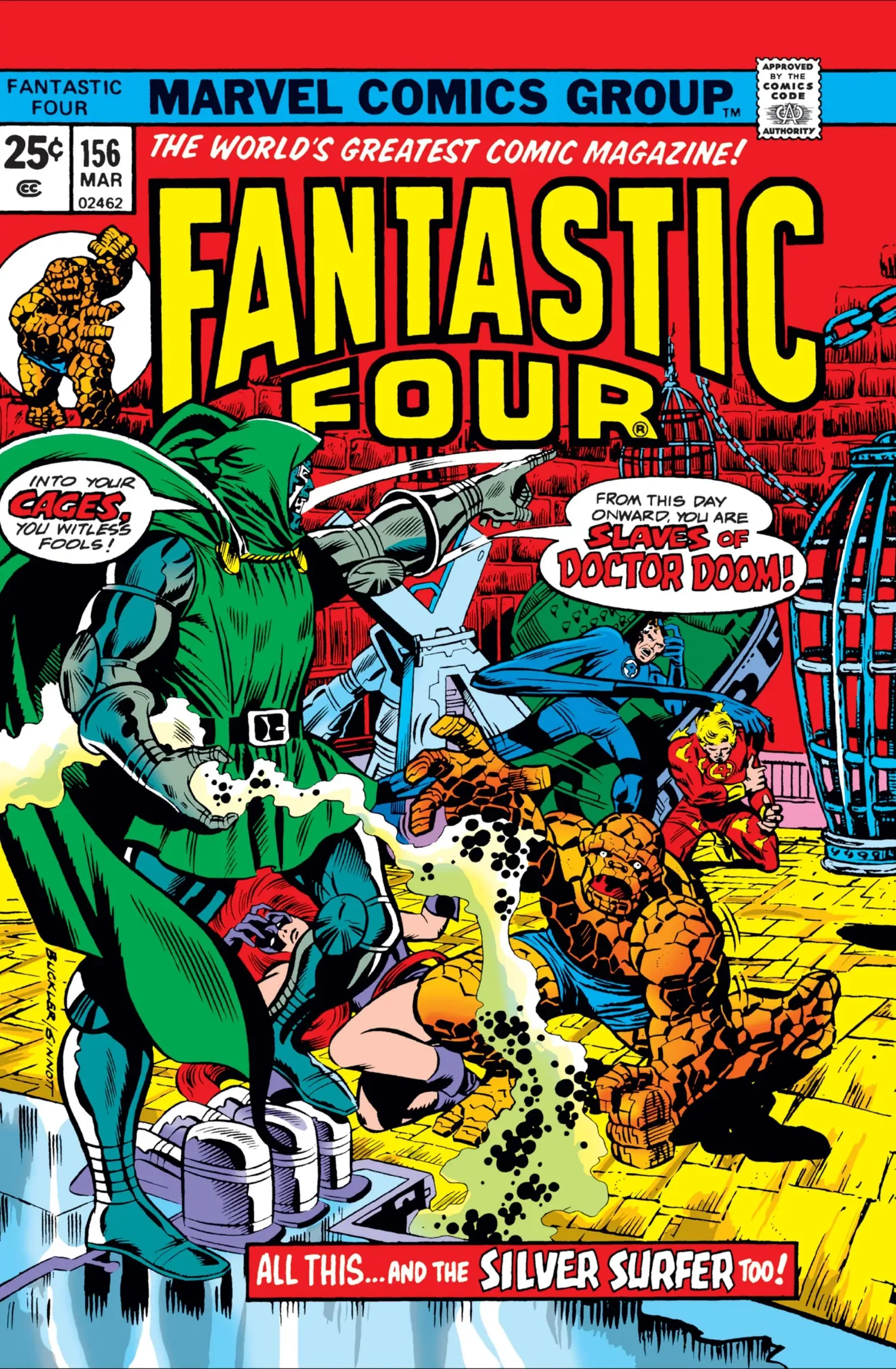
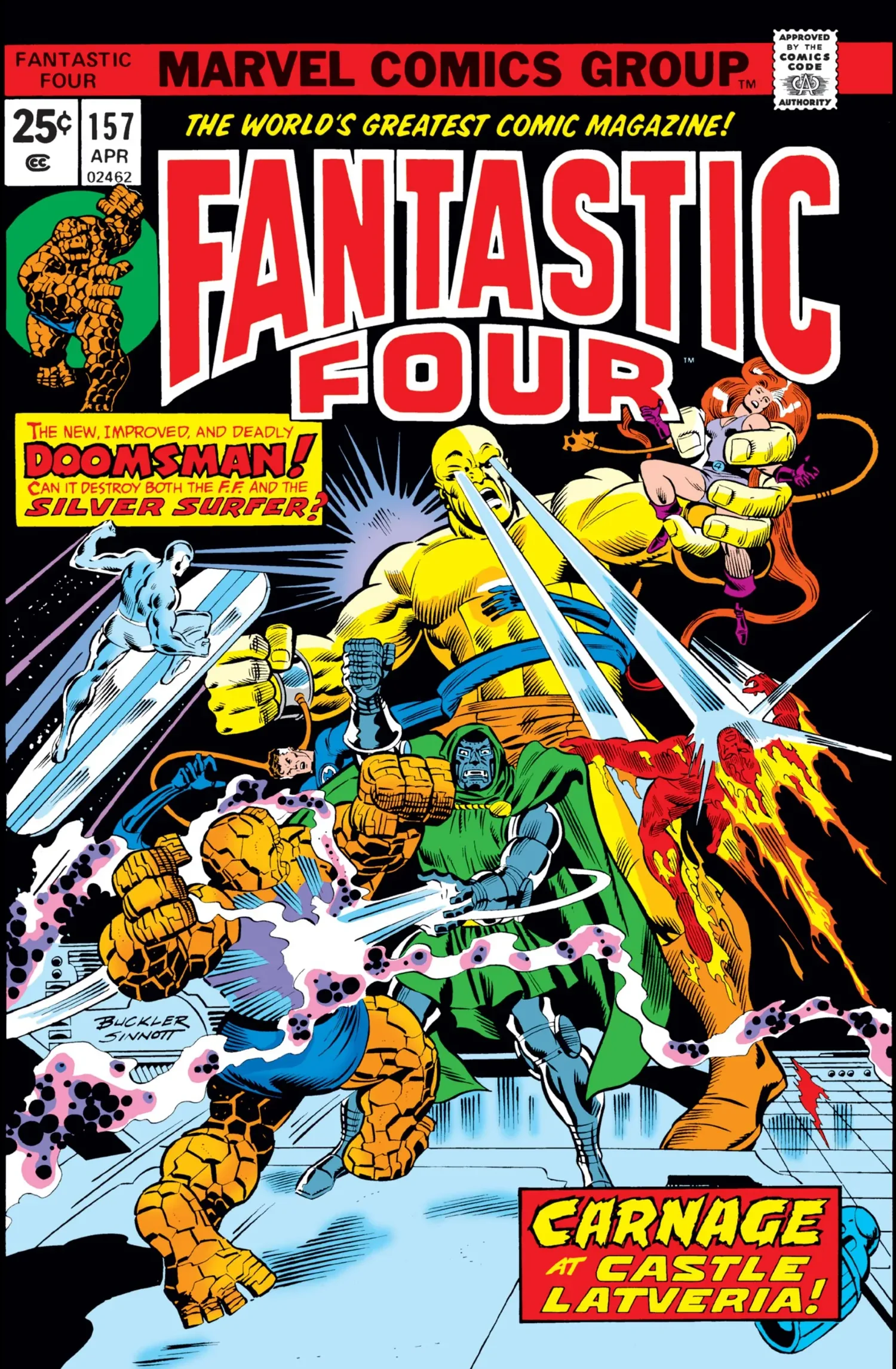
Fantastic Four #155–157 (1975): Doctor Doom, the Surfer, and the tragedy of “Helena.”
Oddities and Farewells (1978–1983)
The late seventies produced one genuine landmark. In 1978, Lee and Kirby reunited one final time for The Silver Surfer: The Ultimate Cosmic Experience, published as a Fireside trade paperback and widely regarded as one of the first true American graphic novels.[13] It retells the Surfer's coming to Earth as a self-contained fable (with the Fantastic Four written out entirely), and it is Lee and Kirby to the hilt: the narration overflows with Lee's flowery prose and grandly exaggerated dialogue, and while Kirby's draughtsmanship is as powerful as ever, his blocky, monumental style had by 1978 come to feel anachronistic, a Silver Age idiom marooned in the Bronze Age. The book was reportedly conceived with one eye on Hollywood; rumours of a Silver Surfer film, supposedly starring Olivia Newton-John as Shalla-Bal, swirled for years without result. It sits outside regular continuity, a strange and lovely artefact of what might have been.
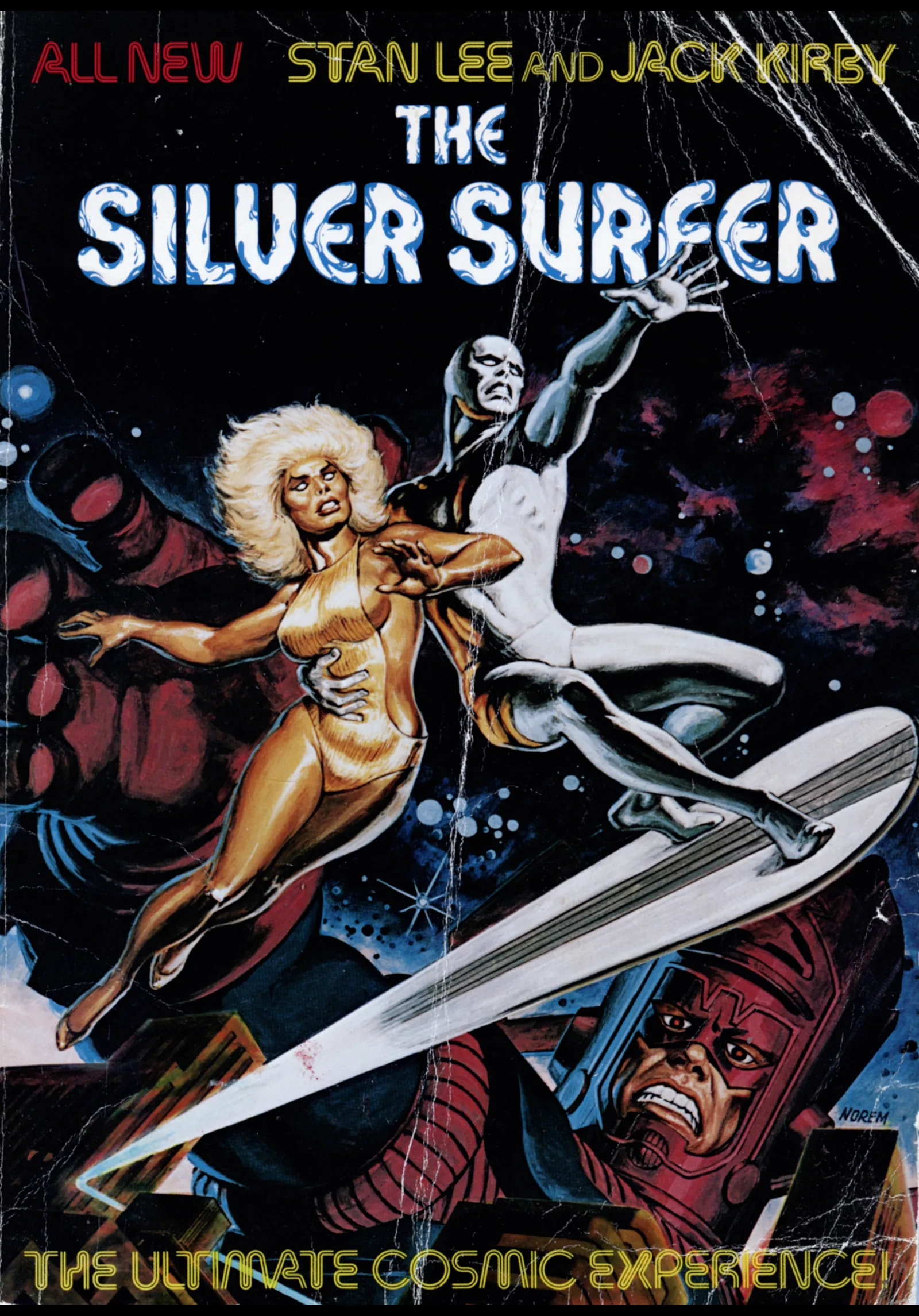
The Surfer beyond the page: the 1978 Lee/Kirby graphic novel The Ultimate Cosmic Experience
It eventually became clear that no Silver Surfer movie would materialise, at least not on the terms anyone in 1978 had imagined. The character would instead reach the screen slowly and in other forms. He first flickered into animation in the 1994 Fantastic Four cartoon, which adapted the very Galactus saga that had introduced him, before graduating to his own animated series, Silver Surfer, two decades after the graphic novel in 1998. Live action came later still: nearly thirty years after the book, he made his cinematic debut in Fantastic Four: Rise of the Silver Surfer (2007), the second of the two Fantastic Four films directed by Tim Story. None of these — not the cartoons, not the film — had any place in them for Olivia Newton-John.
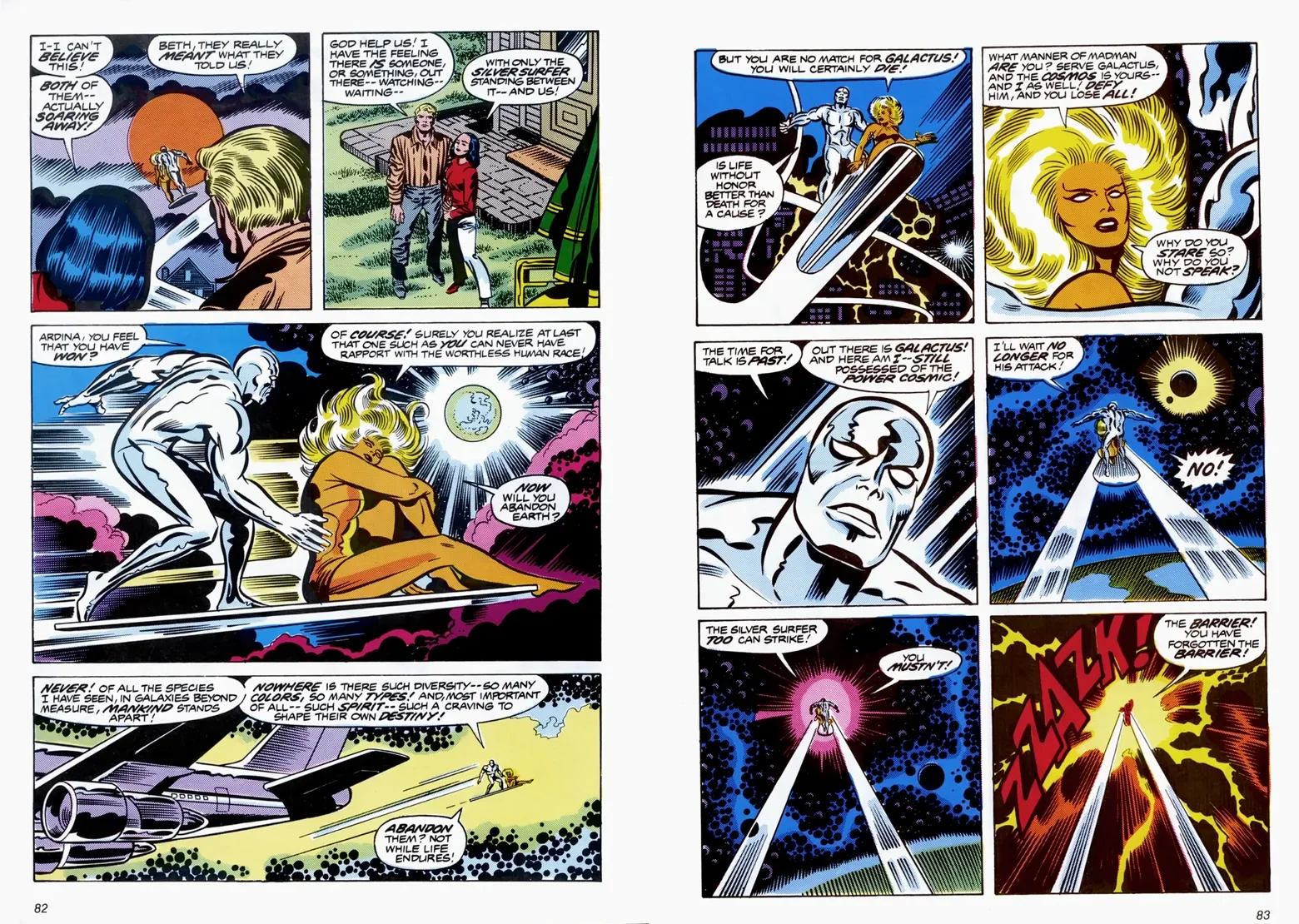
In Lee and Kirby's graphic novel, the Surfer finds a cosmic love interest.
In 1982 came a one-shot special by Lee and John Byrne (officially Silver Surfer volume two, all by itself), and it is essential reading for anyone tracking the character's mythology.[14] With the FF's help the Surfer briefly escapes the barrier and races home to Zenn-La, only to find it a lifeless husk: Galactus, in retribution for his herald's betrayal, had consumed the world's life-energies (mercifully warning its people first). Learning that Mephisto has abducted Shalla-Bal, the Surfer voluntarily returns to his Earthly cage to rescue her. And as the demon flings her back across space, he imbues her with a spark of his Power Cosmic. With it, Shalla-Bal restores life to Zenn-La and takes her place as its empress. In forty-eight pages, Lee and Byrne resolved the 1975 Helena mystery, devastated the Surfer's homeworld and redeemed it, and reaffirmed the character's defining trait: given one taste of freedom, he trades it away for someone he loves.
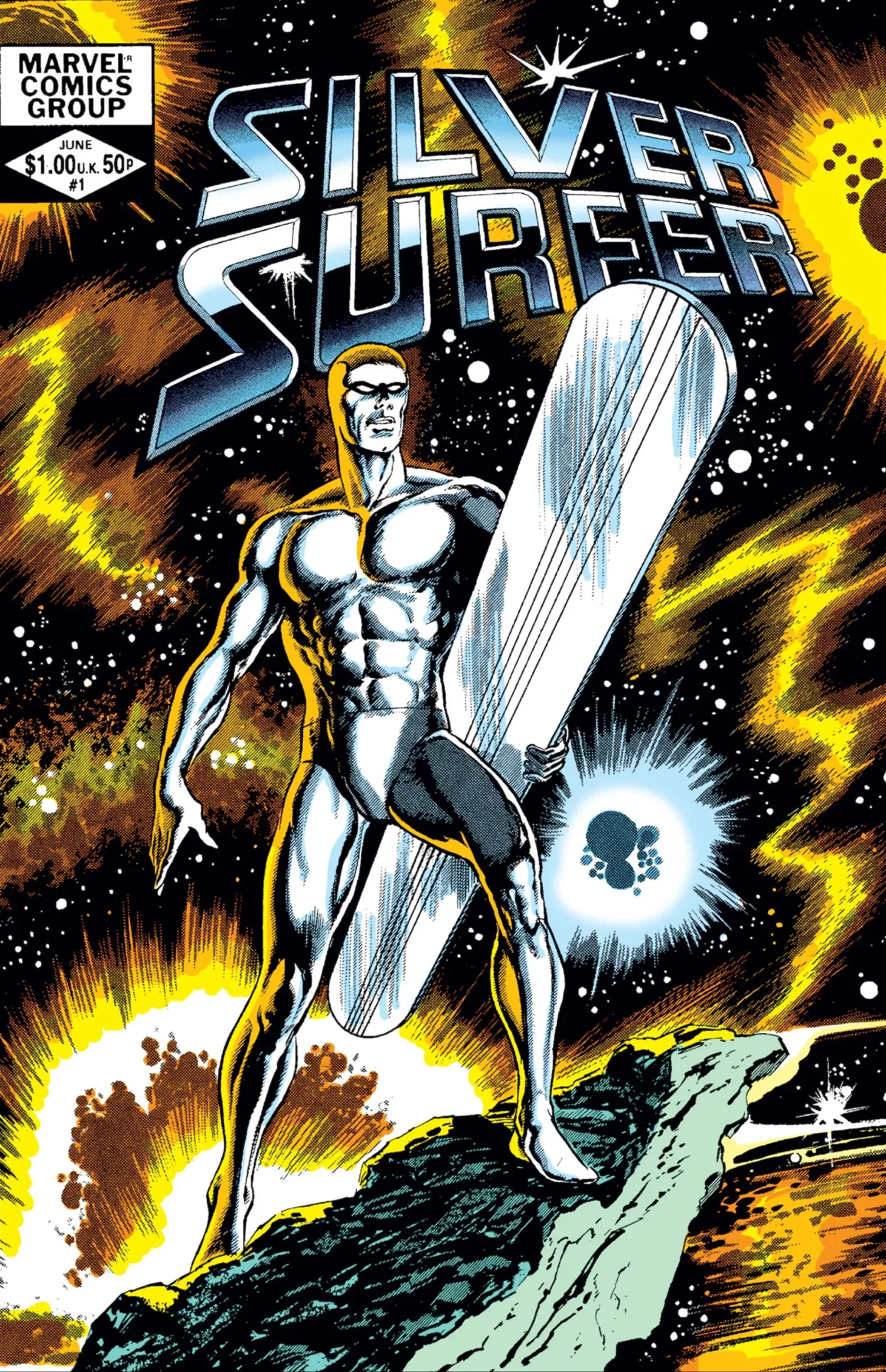
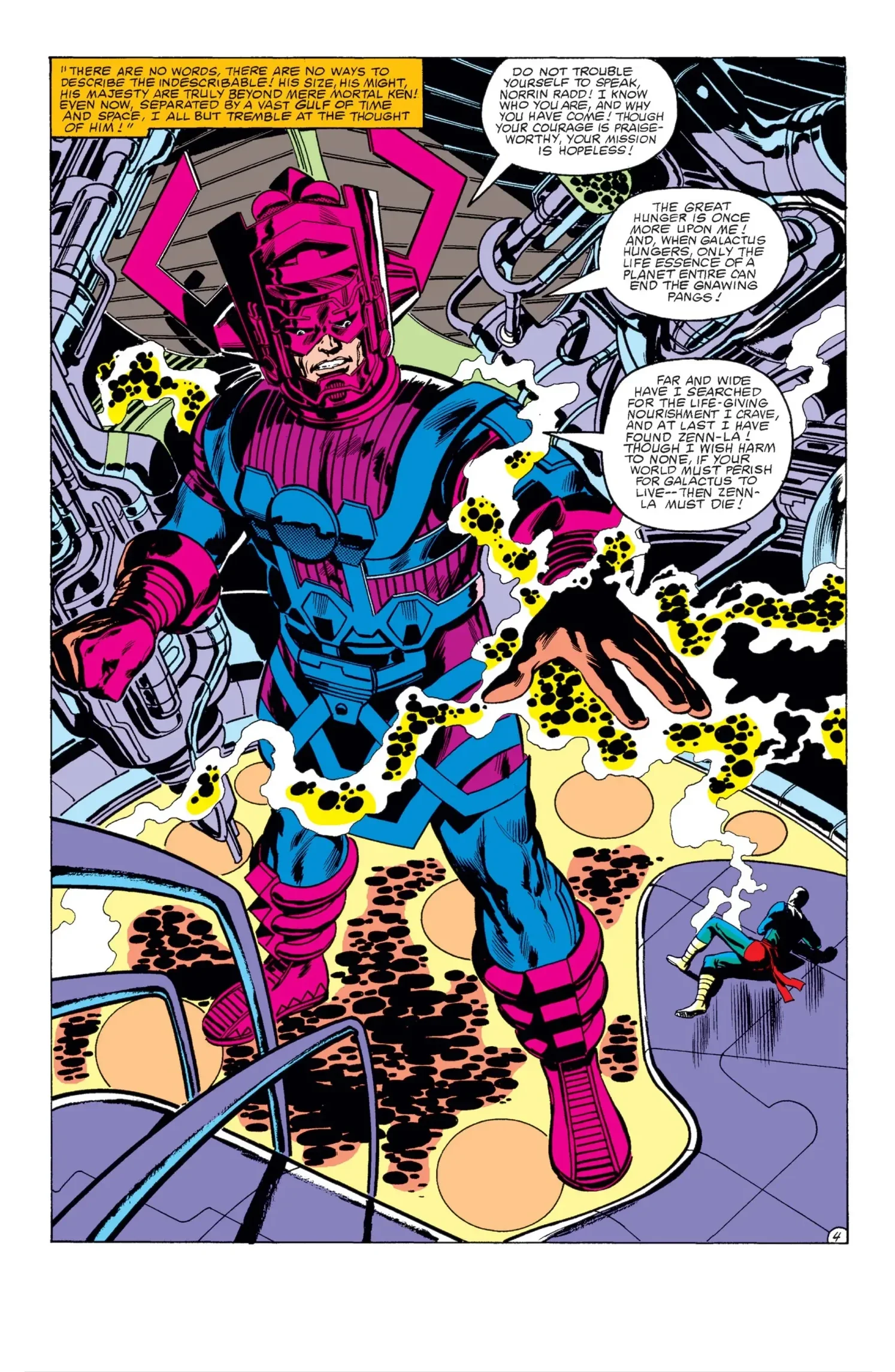
Silver Surfer vol. 2: the 1982 Lee/Byrne one-shot (please note that the Surfer is back to wearing pants).
The Defenders, meanwhile, gave him a proper send-off. He returned for the team's demonic war against the Six-Fingered Hand, the storyline that climaxed in the anniversary spectacular #100 (1981), with the “non-team” battling Mephisto's kind in Hell itself. But his tenure ended in #125 (1983),[15] when a prophecy foretold that the four original Defenders united would one day doom the Earth. Doctor Strange, Namor, the Hulk and the Surfer walked away, and the book became The New Defenders without them.
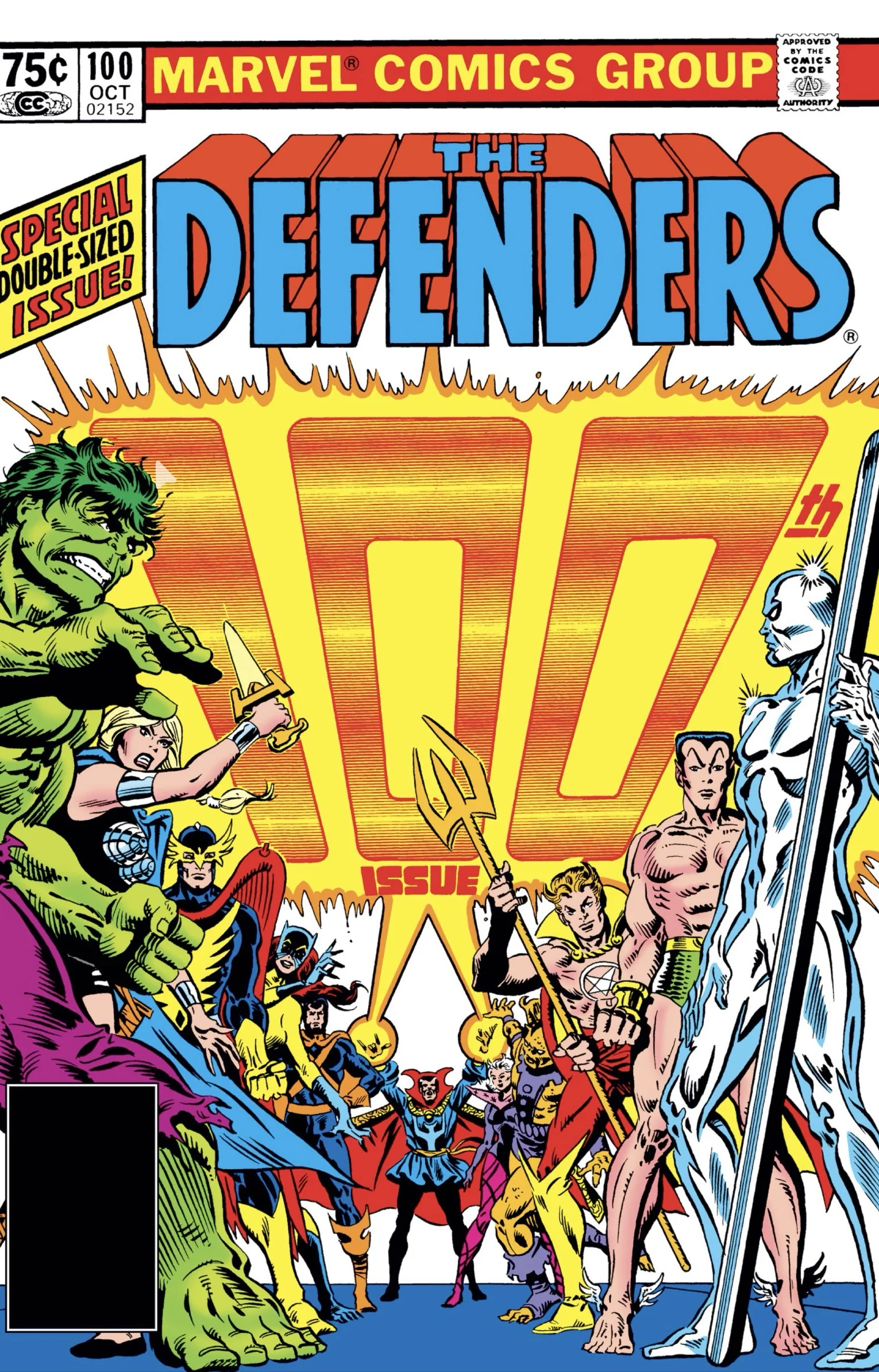
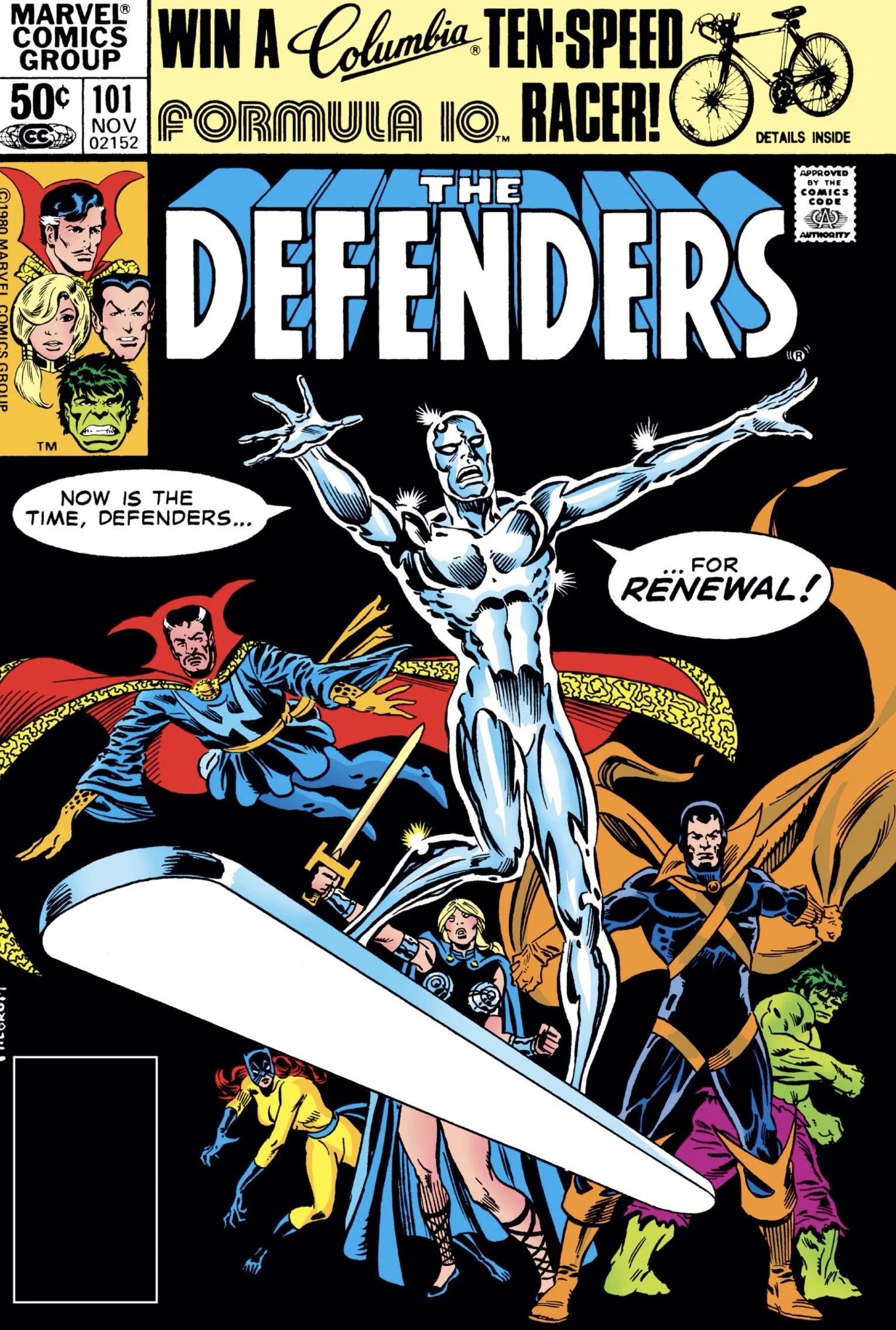
Silver Surfer in the Defenders series (again please note that the Surfer is not wearing any pants while extravagantly posing).
The Embargo Lifts
And then, at last, the ice broke. By the mid-1980s Lee was in Los Angeles developing Marvel's Hollywood ambitions, a new editorial generation ran the comics, and Editor-in-Chief Jim Shooter decided that one of the company's most iconic characters had spent quite long enough in the vault. The long-standing understanding that the Silver Surfer was reserved for Stan Lee was completely lifted, and Shooter approached a writer with history: Steve Englehart, the very man who had talked Lee into loaning the Surfer to the Defenders fifteen years earlier.[16] Lee, for his part, admitted to a pang of disappointment that he would no longer be the character's sole chronicler, an entirely human reaction from the man who had poured so much of himself into that shining figure.
For the first time in twenty-one years, someone other than Stan Lee would write the Silver Surfer's solo adventures. In 1987, with the marvellous Marshall Rogers on art, a new ongoing series launched, and the sentinel of the spaceways was about to get everything he had ever wanted.
But before we follow him out through the barrier at last, it's worth gathering up what these first twenty years have already taught us, because Englehart's whole run is, in a sense, an answer to the questions this era leaves open.
What the First Twenty Years Teach Us
Look back over these two decades and the same handful of ideas keep surfacing, each one a small piece of practical wisdom dressed in cosmic clothes.
Freedom is mostly interior. The defining fact of the Surfer's early life is a wall he cannot break, and the defining question is not how do I escape? but who am I while I cannot? He is, for twenty years, the most powerful prisoner imaginable, and the story keeps insisting that the barrier around the planet matters less than the barrier he might build around his own heart. That is the oldest Stoic consolation there is, and it is no less true for being old: the world will hand you circumstances you cannot change, and your one reliable liberty is the stance you take inside them.
Restlessness can be a virtue. Norrin Radd is saved, and saves others, precisely because he could not be content in a perfect world. We are often taught to treat our discontent as a flaw to be medicated into stillness. His story suggests the opposite: that the ache for something more, the refusal to call a comfortable dead end “enough,” is sometimes the most alive thing about us, and occasionally the only thing that will get us off a doomed and pleasant planet in time.
And the hardest wisdom is telling the two apart. Set those first two lessons side by side and they seem to contradict each other outright. One counsels acceptance: make peace with the wall you cannot break. The other counsels refusal: never call a comfortable dead end “enough.” Is the Surfer meant to submit to his circumstances or to strain against them? The story's answer is that he is meant to do both — and that the whole of practical wisdom lies in knowing which situation is which. On Zenn-La, facing a stagnant paradise that could still be changed, restlessness was the virtue and contentment would have been a kind of death. Behind Galactus's barrier, facing a prison that genuinely cannot be broken, acceptance is the virtue and endless raging would only wall his heart as surely as the sky walls his body. This is the oldest and most demanding of the Stoic distinctions, the one later smoothed into a prayer: the serenity to accept what cannot be changed, the courage to change what can, and the wisdom to tell them apart. The Surfer's tragedy, and his grandeur, is that he is forever made to make that call with everything at stake and no guarantee he has read the situation right.
Sacrifice is only heroic when it's chosen. The Surfer's origin and his every subsequent turn — the herald's bargain, the exile accepted to save Earth, and, in the 1982 one-shot, the freedom he finally tastes and then immediately trades away to rescue Shalla-Bal — all rhyme on the same note. What redeems these losses from mere victimhood is that he elects them. He is never simply robbed; he pays. There is a hard dignity in that, and also a warning, because a person who reflexively gives everything away for love can be exploited by a universe full of Galactuses and Mephistos who have noticed the pattern. The early Surfer has the virtue in full and the wisdom only in part. Learning the difference is much of what still lies ahead of him.
We are woken to the world by particular people. The Surfer's conscience does not awaken to humanity in the abstract; it awakens through one person, Alicia. Compassion, in this story, is never a principle arrived at by reasoning. It always begins with a particular person.
And power is not the same as grace. The mightiest beings in these pages — Galactus, who imprisons his own former servant out of wounded pride; Mephisto, who tortures a soul purely for sport; even the lesser cosmic entities who prove “remarkably petty” — make the same point again and again: raw power ennobles no one. The Surfer is the moral centre of these stories not because of his strength but in spite of it. His goodness is the one thing all that power cannot explain, and for that reason it is the one thing most worth watching.
Hold all six of those in mind, because the man Steve Englehart inherited in 1987 has learned some of them and not others. The story of his liberation is, at heart, the story of a soul finally given room to finish the lesson.
That, as they say, is where our story truly begins.
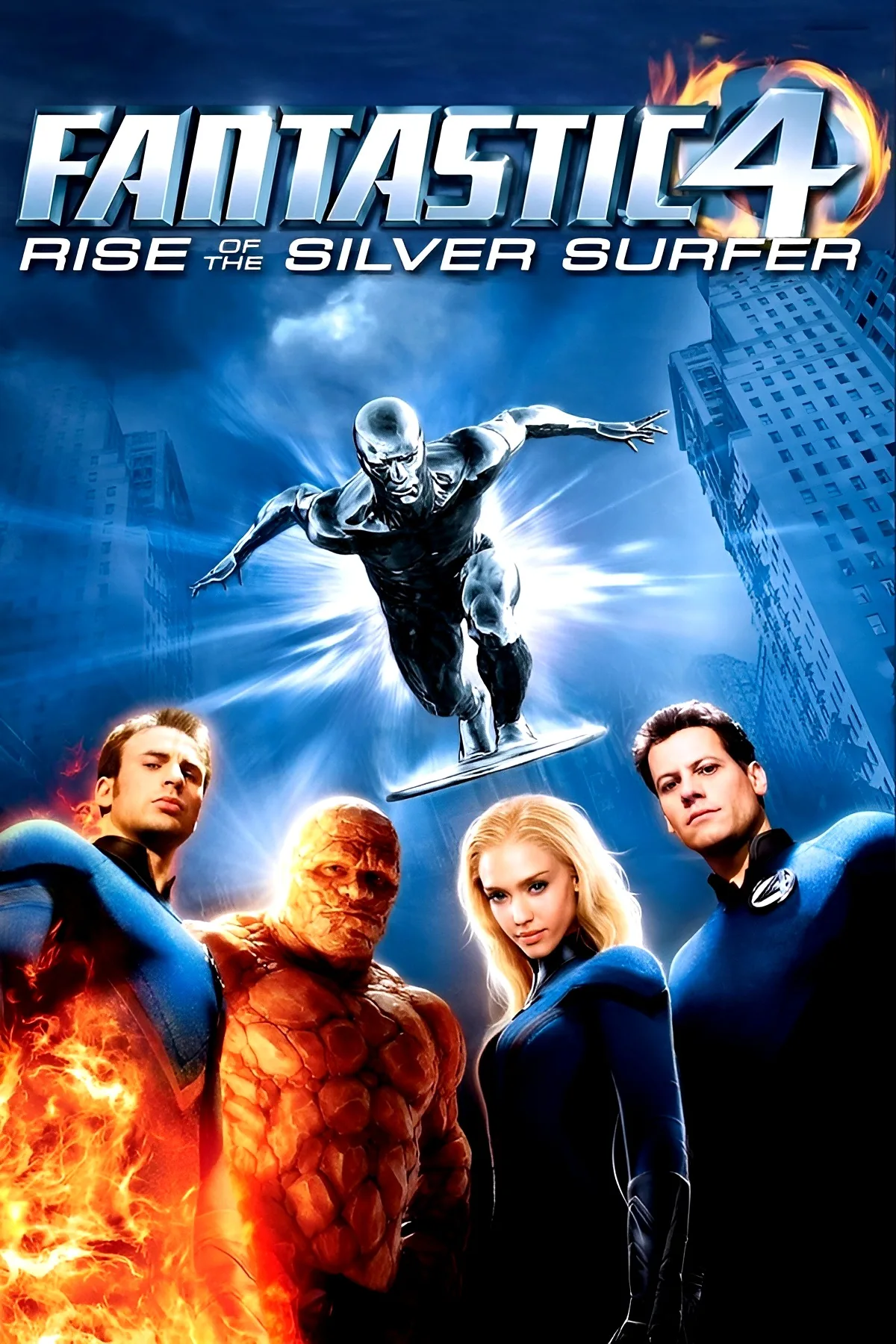
The Surfer in the 2007 movie Fantastic Four: Rise of the Silver Surfer
Frequently Asked Questions
What does Part 1 of The Freest Being in the Universe cover?
Part 1 is the introduction. It steps back to the Silver Surfer's first twenty years, from his 1966 debut in Fantastic Four and his creation by Stan Lee and Jack Kirby, through his early solo series, up to the eve of Steve Englehart's 1987 run.
Who created the Silver Surfer?
The Silver Surfer was created by Stan Lee and Jack Kirby, first appearing in Fantastic Four #48 to #50 in 1966. Part 1 surveys the character's history before Steve Englehart and Marshall Rogers relaunched him in his own ongoing series in 1987.
Is The Freest Being in the Universe free to read online?
Yes. The complete book is free to read here on marincomics.com, all six parts, richly illustrated. If you would like to support the author, you can also buy the paperback or Kindle edition on Amazon.
What is The Freest Being in the Universe about?
The Freest Being in the Universe is Marin Balabanov's chapter-by-chapter appreciation of Steve Englehart's cosmic Silver Surfer, volume 3, issues #1 to #31, published from 1987 to 1990. It recaps every issue and asks what the stories teach us about freedom, identity, grief, and finding a third path beyond false either-or choices.
Notes and Sources
- The run examined in this book is Silver Surfer vol. 3 #1–31 (Marvel, July 1987 – January 1990), written by Steve Englehart. Marshall Rogers pencilled (and coloured) #1–10 and #12 plus the #21 fill-in; Joe Staton pencilled #11, #13, and #14; Ron Lim took over from #15 and became the series' definitive artist. Vol. 3 went on to run for 146 issues, the longest-running Silver Surfer series to date. Issue-level credits throughout this book are drawn from the Grand Comics Database (comics.org), the Marvel Database (marvel.fandom.com), and Steve Englehart's own commentary at steveenglehart.com. ↩
- On Kirby's original design carrying a faint suggestion of silver trunks — usually attributed to the censorship norms of the mid-1960s — and John Buscema retaining the detail in the solo series, see ScreenRant, “Marvel's Silver Surfer Pays Homage to Its Legendary Artists” — screenrant.com. Later depictions have alternated between hinting at briefs and rendering the figure entirely smooth; the prevailing modern reading treats the silver as a seamless, protective “skin” rather than exposed anatomy. ↩
- Fantastic Four #48–50 — “The Coming of Galactus!” (#48, March 1966), “If This Be Doomsday!” (#49, April 1966), and “The Startling Saga of the Silver Surfer!” (#50, May 1966). Written by Stan Lee, pencilled by Jack Kirby, inked by Joe Sinnott. The three issues are known collectively as “The Galactus Trilogy”; the Silver Surfer and Galactus both debut in #48. On the “Marvel Method” of plotting used by Lee and Kirby, and the trilogy's production, see the Grand Comics Database (comics.org) and The Galactus Trilogy, Wikipedia — en.wikipedia.org. ↩
- Stan Lee's recollection of first seeing Kirby's unplanned addition — “There, in the middle of the story we had so carefully worked out, was a nut on some sort of flying surfboard” — is widely reproduced from Lee's own accounts of the character's creation. See Silver Surfer, Wikipedia — en.wikipedia.org. ↩
- Jack Kirby's explanation that he added a herald because a planet-devouring god should not simply arrive, and drew a surfboard because he was “tired of drawing spaceships,” is drawn from Kirby's interviews (most often cited to The Comics Journal #134, February 1990) and is summarised at Silver Surfer, Wikipedia — en.wikipedia.org. ↩
- Epictetus, Enchiridion (Handbook), opening: “Some things are within our power, while others are not.” Epictetus was born into slavery, which sharpens the resonance with an all-powerful being confined behind an unbreakable barrier. Standard translations include the Robin Hard edition (Oxford World's Classics). ↩
- The Surfer's key Silver Age Fantastic Four appearances, all by Lee/Kirby/Sinnott: #55 (Oct. 1966, the brawl with the Thing); #57–60 (Dec. 1966 – March 1967, Doctor Doom steals the Power Cosmic); #72 (March 1968); and #74–77 (May–Aug. 1968, Galactus's return). Cover dates per the Grand Comics Database (comics.org). See also Marvel, “What Happened When Doctor Doom Stole the Silver Surfer's Board” — marvel.com. ↩
- The Silver Surfer vol. 1 #1–18 (Aug. 1968 – Sept. 1970), written by Stan Lee. John Buscema pencilled #1–17; Jack Kirby pencilled the finale, #18. Issue #1 (“The Origin of the Silver Surfer!”, Aug. 1968) was double-sized and introduced Norrin Radd, Zenn-La, and Shalla-Bal; #3 (Dec. 1968) introduced Mephisto; #4 (Feb. 1969) staged the Loki-orchestrated duel with Thor; #14 (March 1970) guest-starred Spider-Man. See Silver Surfer (comic book), Wikipedia — en.wikipedia.org — and comics.org. ↩
- The idea that meaning is bound up with striving and self-creation rather than arrival runs through existentialist thought — e.g. Jean-Paul Sartre's account of the human being as “condemned to be free” in Existentialism Is a Humanism (1946), and Friedrich Nietzsche's earlier warnings against the complacency of the “last man” in Thus Spoke Zarathustra (1883–85). ↩
- On the Lee/Kirby dispute over the character's origin — Kirby conceiving the Surfer as an alien-born being who learns morality on Earth, versus Lee and Buscema's later Norrin-Radd-of-Zenn-La backstory devised without Kirby — see CBR, “The Biggest Change Stan Lee Made to Silver Surfer's Original Origin Story” — cbr.com — and the Jack Kirby Museum, “Rough Surfing” — kirbymuseum.org. ↩
- Sub-Mariner #34–35 (Feb.–March 1971, Roy Thomas / Sal Buscema) first teamed Namor, the Hulk, and the Surfer as the “Titans Three”; Marvel Feature #1 (Dec. 1971, Roy Thomas / Ross Andru) formally founded the Defenders, with Doctor Strange filling the slot Stan Lee's embargo denied the Surfer; Steve Englehart brought the Surfer into the team in Defenders #2 (Oct. 1972). See Defenders (comics), Wikipedia — en.wikipedia.org. ↩
- Fantastic Four #155–157 (Feb.–April 1975), pencils by Rich Buckler, inks by Joe Sinnott; the writer credit for the arc is generally given to Roy Thomas (some sources cite Len Wein). The story's final twist — that the amnesiac “Helena” truly was Shalla-Bal, and the whole affair Mephisto's doing — is confirmed in the issues themselves. See comics.org. ↩
- The Silver Surfer: The Ultimate Cosmic Experience (1978), by Stan Lee and Jack Kirby (inks Joe Sinnott), published by Simon & Schuster's Fireside Books imprint — Marvel's first original graphic novel and the last Lee–Kirby collaboration. Sources disagree on the exact month (May vs. September 1978). See en.wikipedia.org. ↩
- Silver Surfer vol. 2 (one-shot, cover-dated June 1982): John Byrne (plot/pencils), Stan Lee (script), Tom Palmer (inks). The Surfer finds Zenn-La consumed, defeats Mephisto, and imbues Shalla-Bal with a portion of the Power Cosmic, with which she restores Zenn-La and becomes its empress. See Shalla-Bal, Wikipedia — en.wikipedia.org. ↩
- The Defenders #100 (Oct. 1981) climaxed the war against the Six-Fingered Hand; the four original “non-team” members (Doctor Strange, the Silver Surfer, the Hulk, and Namor) departed with the roster overhaul of #125 (Nov. 1983), which retitled the book The New Defenders. See Defenders (comics), Wikipedia — en.wikipedia.org. ↩
- On Stan Lee's informal reservation of the character and Editor-in-Chief Jim Shooter lifting it to assign the 1987 ongoing series to Steve Englehart, see Englehart's own account at steveenglehart.com and CBR, “1987 and All That: Silver Surfer #1-6” — cbr.com. ↩