Moving Through Light
A Novel Set at a Demoparty, and the Twenty Versions It Took to Write
I wrote a novel. It is called Moving Through Light, it is set at a demoparty, and it is out now as a paperback and as an ebook. It is a mystery about a demo group nobody has ever met, a story about grief and about learning to make things again, and my love letter to the demoscene. It also took twenty versions to get right. Here is what the book is, who its heroine is, and how a short story grew into a novel.
November 2026
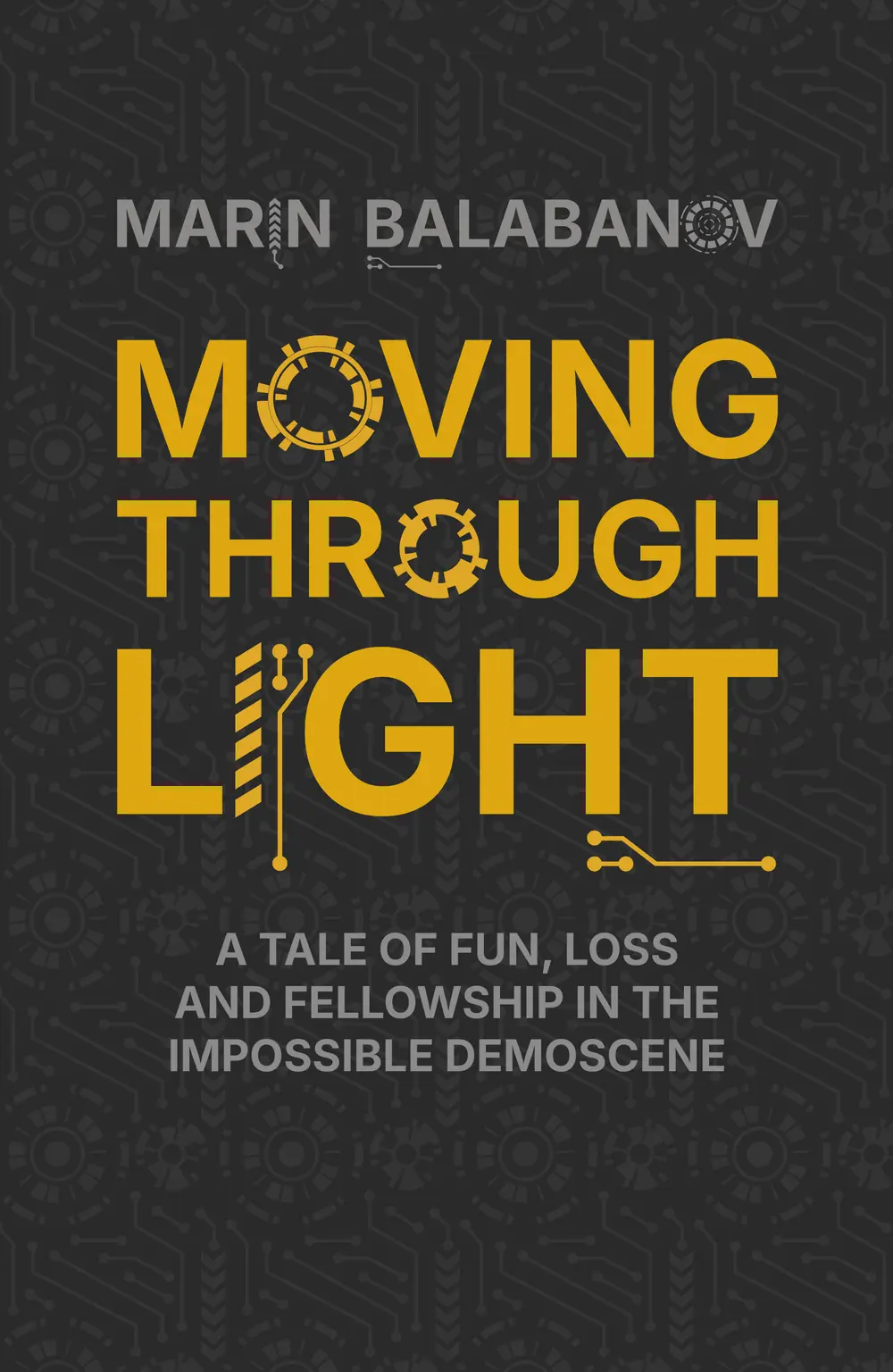
The cover of Moving Through Light.
Get the paperback on:
Amazon.de →
Amazon.co.uk →
Amazon.com →
Get the Kindle ebook on:
Amazon.de →
Amazon.co.uk →
Amazon.com →
On any other Amazon store, search for “Moving Through Light Balabanov”.
Read the prelude and the first two chapters →
The Story
Rahel Rift is a pixel artist from Linz who has shown no one her work since the night her partner died. A year later, she takes the train to Düsseldorf for Conjunction, a demoparty in an old redbrick mill: four days of code, graphics, and music, several hundred people, cutting-edge hardware, and machines that should have been scrapped decades ago doing things they were never built to do. She brings a sleeping bag, a battered laptop, and an external drive she has not opened in a year.
She has not come only for the party. For three years, she has been writing a blog about the Gabble Ratchets, a group nobody has ever met. Their demos surface on forgotten hard drives and dead servers, carry no names, and do what the hardware cannot. On opening night, one of their pieces from 1993 appears on the big screen, and Rahel sees at once that someone has changed it. They are in the building.
What follows is a search through diskmags, IRC logs, and thirty-year-old footage of a dancer who never knew what became of it. It is also a weekend of Nutella sabotage, a streaker in the middle of the live coding showdown, an overclocked PC on fire, and the kindness of strangers who know exactly what it is to stay up all night making something nobody asked for.
I will not give away more than that. The mystery has an answer, and it is a quieter, more human one than the legend suggests. If you liked the hunt for the footage in William Gibson's Pattern Recognition, you may feel at home here.
Rahel Rift
Rahel is just under thirty. By day, she takes apart broken user flows for a living, because she cannot walk past a broken system and leave it unexamined. In the scene, she is a pixel artist: sixteen colors, placed by hand and dithered until a sky appears that should not be possible.
She is not a star. She has never won a compo. Her best result was a third place, years ago. Otherwise her pictures came fourth and fifth, and were passed from screen to screen for years all the same. As the book puts it: “In the scene, the results were read out once and the work stayed.”
People tend to underestimate her, and she has long since stopped minding. She sits at the back, where she can see everything and nobody expects anything of her. I did not want a prodigy or a chosen one. I wanted someone careful, stubborn, and dryly funny, with a grief she has arranged her whole life around not looking at. For three years, she has poured her curiosity into that blog, because it is easier to research other people's work than to open the drive in her own bag.
One early reader called her the kind of character most authors would not make a protagonist, because she is so hard to make interesting. He meant it as praise, and I am happy to take it that way.
What It Is Really About
On the surface, the book is a hunt for a legend. Underneath, it is about what grief does to the urge to make things. Rahel has not stopped being an artist. She has stopped being able to show anyone, and those turn out to be very different conditions.
It is about the stories we tell ourselves to get through: how someone died, what we might have prevented, who is to blame for a bad night. Several people in the book carry a version of that, and some of its kindest moments are the ones where nobody asks.
And it is about belonging. Anyone who has stood at the edge of a room where everyone seems to know each other will recognize Rahel's fear that someone will turn around and tell her she was never one of them. The book's answer is not a triumph. It is smaller, and I hope truer: you belong where you keep showing up and keep making things.
None of this makes it a gloomy book. A demoparty is a funny place, and grief has never stopped anyone from laughing at a jar of Nutella in the wrong place.
Four Days in an Old Mill
More than the mystery, I wanted to capture what a demoparty feels like from the inside. The hall with its layers of sound: the music from the big speakers, the fans, and “the chatter of people explaining things to one another at the speed of enthusiasm.” The crash space in the climbing hall next door, which smells “of chalk and sleep and the warmth of a hundred people unconscious in an enclosed space.” The Club-Mate, the compo deadlines, and the organizer who opens the party by telling several hundred people to “look after each other as you look after your computers.”
The machines are characters too: an Atari Mega STE at the very start, four men crowded around a single Amiga 500, an Atari Falcon doing something it should not be able to do, an analog computer patched with cables. But the scene is not a museum, so there is also a live coding showdown on current graphics cards. On the same floor, one person coaxes a new effect out of a home computer that is decades old while another writes shaders in real time in front of a cheering crowd. I wanted both in the book.
Between the chapters, ten short interludes tell the older story in the scene's own formats: a party invitation as a text file, an infofile, a diskmag review from 1994, an IRC log from 1998, a pouët thread. Readers from the scene will know these forms on sight. Everyone else gets a glossary.
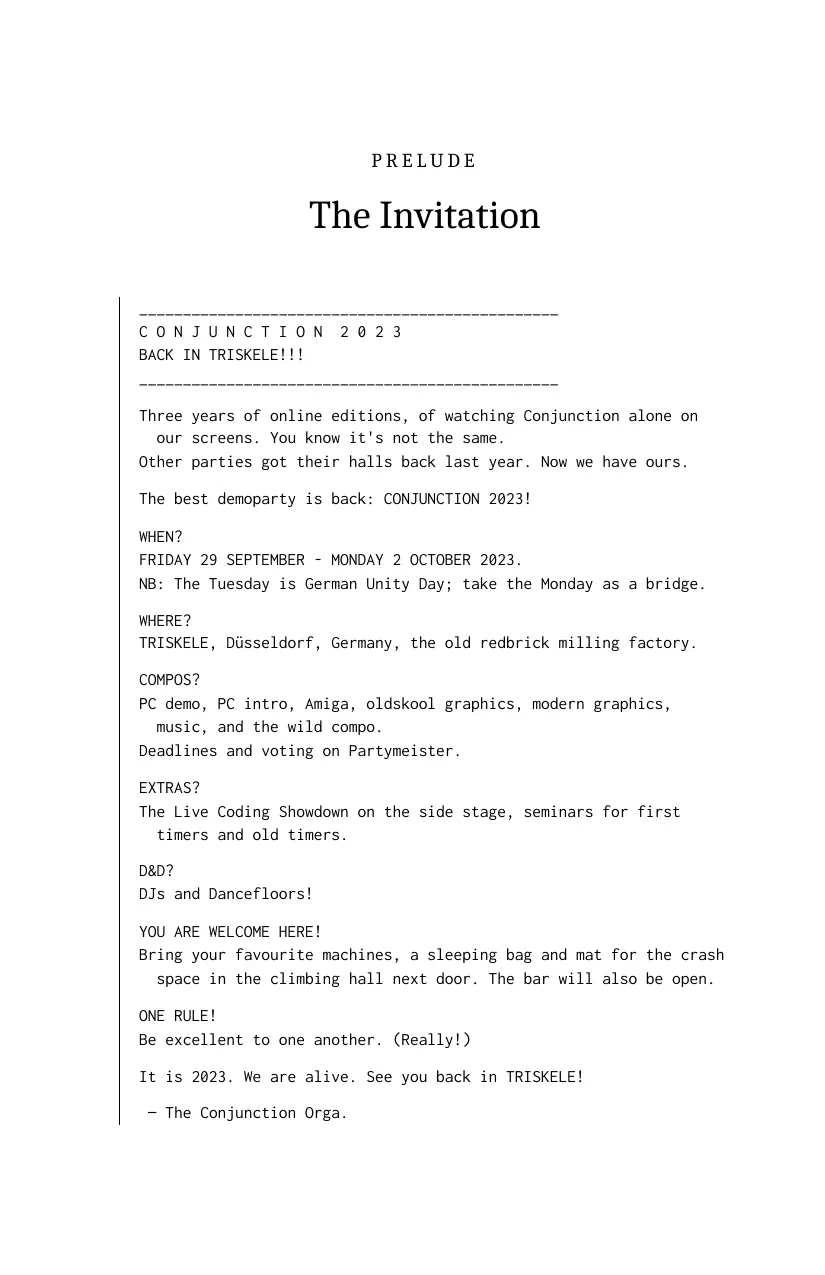
The Prelude: the party invitation.
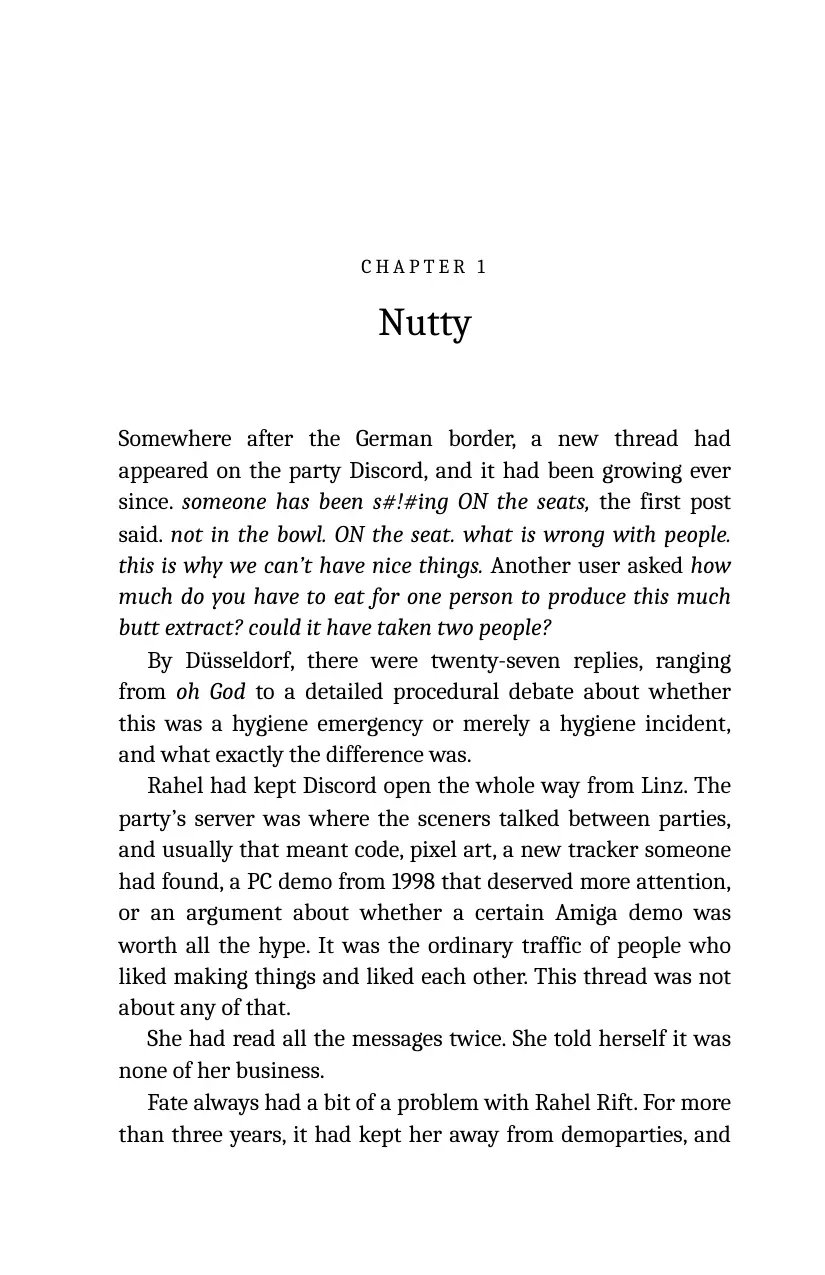
The opening of Chapter 1.
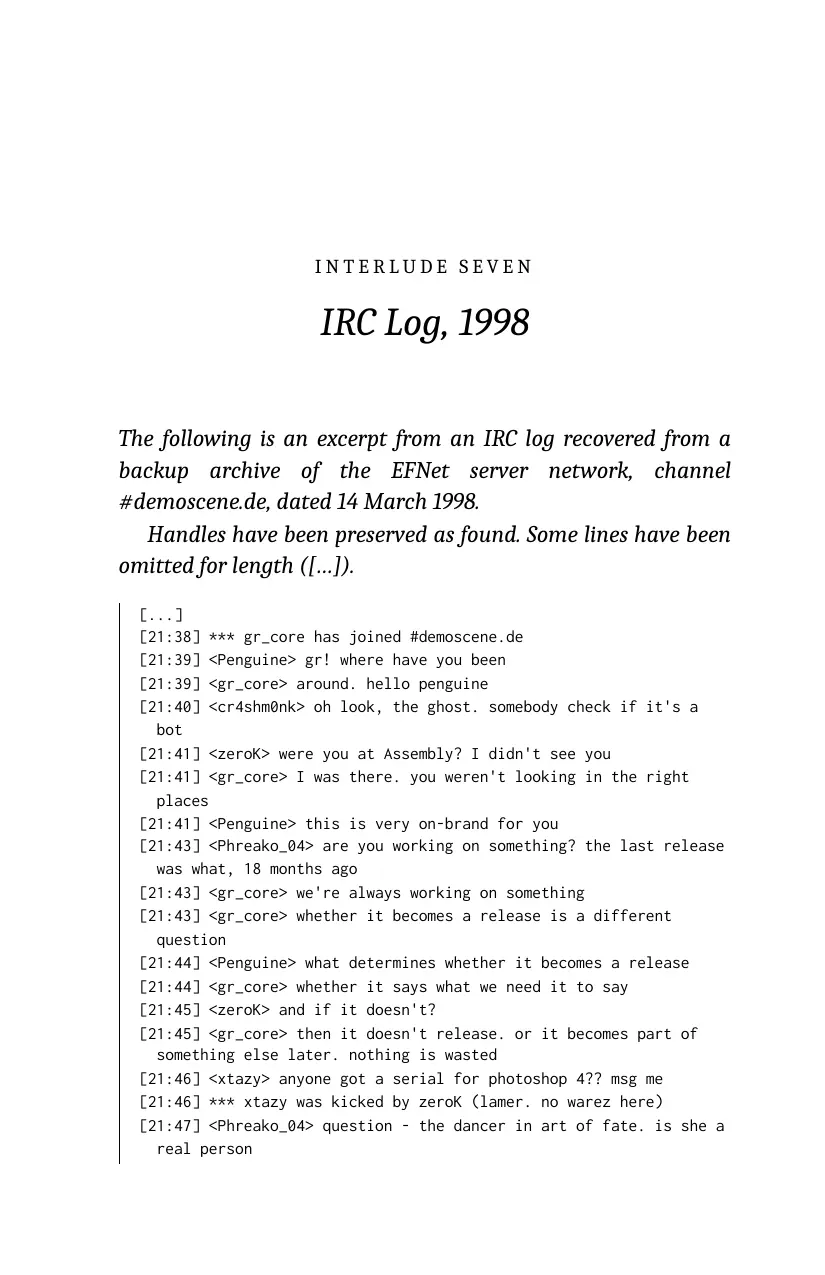
Interlude Seven: an IRC log from 1998.
Why It Is a Love Letter
The demoscene is a gift culture. People spend months of nights on a production, show it once on a big screen, and give it away. Near the end of the book, Rahel describes it to a newcomer as a culture that decided, together, “that the worth of a thing was not its price but its making.” I have not found a better way to say what I love about it.
I love the joy of the constraint: being told that the hardware cannot do this, or that it has to fit into four kilobytes, and treating that as a starting line. I love that strangers will find you a place at a table, explain the compo system, and lend you a power adapter. I love that every party has first-timers near the back with something unfinished, and that somebody always makes time for them. One of my characters tells a room of newcomers:
“Achieving impossible things reminds us we’re still alive.”
The bickering, the pranks, the gatekeeping, and at least one thoroughly unpleasant man are in the book too, because a love letter that leaves out the flaws is only an advertisement.
Two decisions follow from this. The party is invented, because the people who organize real demoparties put an extraordinary amount of work into them, and I had no wish to put words in their mouths. And real sceners and their handles stay out of the story. Real parties, groups, and productions appear only at the edges.
It is a love letter to the scene as I have come to know it since 2022, at Evoke, Revision, Graffathon, and BCC Party. People who lived through the wilder, more competitive early decades may not recognize their scene in mine, and that is fair. The scene is big enough to contain multitudes, and I would gladly read their novels too.
Where It Came From
I have loved the demoscene from a distance since the late 1980s, first through demos and diskmags, later through the web and YouTube. About a decade ago, I started researching it properly, and in 2020 I wrote my master's thesis on the first three years of the Atari ST demoscene. When the pandemic ended, I finally started going to demoparties, beginning with Evoke 2022, and I have been writing about them here ever since.
My first idea for a novel was a murder mystery: a body at a demoparty, a detective among the sceners. The closer I looked at it, the less I liked it. A whodunnit would have treated the demoscene as a backdrop that could be swapped for any other, and the scene deserves better than to be scenery. So I kept the mystery and dropped the murder.
Why It Is in English
The book is set in Germany and Austria, nearly everyone in it speaks German, and I wrote it in English. That was not an easy choice.
I made it because the demoscene does not stop at a border. A German novel would have shut out sceners from the Netherlands, Finland, Poland, the UK, Portugal, Spain, and so many other countries, and they are exactly the people I wrote it for.
English also brought a benefit I had not planned for. It allowed tomcat^mwi to be my reviewer and beta reader. He is the author of Freax: The Brief History of the Computer Demoscene, a comprehensive book about the early demoscene, and he gave me a great many valuable tips and guided me through the scene's history.
The price is a note at the front of the book explaining that, unless the text says otherwise, the characters are speaking German. It was necessary, but it is a bit wonky, and it gets the book off to a wobbly start.
There is one more reason, far less important and a little silly. In German, some sceners say das Demo, with the neuter article, and others say die Demo, with the feminine one. Whichever I had chosen, half the scene would have been against it.
Twenty Versions
The manuscript file is called
moving-through-light-v20.md, and the number is not
decoration.
Written Like Software
I worked on the novel much as I would on a software project. The manuscript is a single Markdown file in a GitHub repository, so every change is under version control: it can be compared with what was there before, traced, and undone. I did not write the book from front to back and polish it afterward. I iterated on portions of it, a chapter or a thread of the story at a time, and each round got a new version number.
The project pivoted, too, as projects do: first away from the murder, later away from the novella. Beta readers took the place of testers. They got a build of the book as a PDF or an EPUB and reported what was broken, I fixed it, and the next build went out. What they found is further down.
None of the formats is made by hand. Scripts run Pandoc and Chromium over the Markdown file and generate the ebook, the print-ready interior of the paperback, and the cover, which is my own design, with a spine calculated from the page count. When a sentence changes, everything is rebuilt.
Of course, I also used Claude Code: for proofreading, for research, for continuity checks, and for help with edits and revisions. The language itself I did not leave to a tool. I asked native speakers of English to revise it and declutter it.
It Started as a Short Story
The first version I wrote, more than a year ago, still had the murder in its title: Death at the Demoparty. It was a short story of about 5,600 words in five chapters, and it had already stopped being a whodunnit. The novel is thirteen times as long.
A surprising amount of the book was already there. The story opened with a chapter called The Nutella Prank and the sentence “Fate never really liked Rahel Rift.” The novel opens with a chapter called Nutty and, a few paragraphs in, “Fate always had a bit of a problem with Rahel Rift.” The Triskele, the party called Conjunction, the live shader coding, Lemmings running on Teletext, and the last scene, with a newcomer in front of an old Amiga demo, all survived. So did the title, which comes from a line in the story's epilogue about two women “who had, once, moved through light.”
Three Names for One Pack of Hounds
The group Rahel is looking for was called the Gabriel Hounds at first, a name I knew from William Gibson's novel Zero History. Later they became the Gabble Retches, another old name for the same ghostly pack. Then my editor, Annie, read version 18 line by line and pointed out that “retches” is also a verb, and not a pleasant one. They have been the Gabble Ratchets ever since. The book still tips its hat to the first name: at one point, Rahel mentions that Gibson used it for a secret clothing label.
From Novella to Novel
In June 2026, I made a plan to grow the story into a novella of 30,000 words. It did not stay a novella.
| Stage | When | What happened | Words |
|---|---|---|---|
| Short story | Over a year ago | Death at the Demoparty, five chapters | 5,600 |
| Plan | June 2026 | A novella, working title Fragments of a Coded Truth | 30,000 planned |
| Version 7 | June 2026 | The first to be called Moving Through Light | 45,000 |
| Version 17 | Early July 2026 | A line edit, chapter by chapter | 50,000 |
| Version 18 | July to September 2026 | The ending rewritten, then edited by Annie | 59,500 |
| Version 19 | October 2026 | Six chapters become eight | 63,000 |
| Version 20 | November 2026 | Sixteen chapters, the published book | 73,500 |
Along the way, the chapter titles shrank to a word or two (Nutty, Ratchets, Real Time, Verboten, Toxic), so that the contents page reads like a list of releases. Names moved around as well. Thorsten was at first a scener with the handle Pinguin, while Rahel's partner had no name at all. In the finished book, Thorsten is the partner she lost, Pinguin has become Penguine, and the scene's historian Mario Ruppin is now Maria.
What the Readers Caught
Since late October, the repository has recorded more than 450 changes to the novel, kept consistent by a story bible with a timeline, every character and place, and a log of every edit, so that page 250 cannot contradict page 30. Then came the beta readers, and they changed the book more than I expected.
With decades in the scene behind him, tomcat^mwi caught one anachronism after another. In a flashback, I had a newcomer being shown where the coffee was, at a time when nobody served coffee at demoparties. He pointed out that a taxi company and a bartender in my story did not behave the way real ones would, and that the ending took too long to end. He was right on all three counts. Another reader asked what the party sounded like, which is how the hall, the crash space, and a houseboat on the Rhine got their sounds.
One of the book's central revelations was rebuilt in the final week before publication, after I had gone through every passage that touched it, more than two hundred of them. One plot detail rests on cryptography, so it was tested with a real library first. I did not want a scener to find the flaw.
One Image, Three Times
Some passages were rewritten in almost every round. In the short story, a character explains why he makes demos with a line borrowed from the film Eddie the Eagle: you are not going to win, but you are going to jump. In version 18, he says it in his own words: “It’s a jump off something high, in front of people, knowing you’ll land badly.” In the published book, he watches a girl of about seven jump off a wall into a sandpit, long after the boys around her have stopped watching:
“If somebody claps, that is pleasant. I have liked it when they clapped. But that is only the landing. The point is the part in the air.”
The early versions were about courage in front of an audience. The last one is about the joy of doing it at all.
Knowing When to Stop
At some point, you have to follow the advice one of my characters gives to a room full of pixel artists:
“A finished picture you are not quite happy with will teach you more than a perfect one you never finish. Make it good enough, then make the next one.”
So this is version 20, and it is finished.
The Book
Moving Through Light runs to 280 pages in paperback and is also available as a Kindle ebook: a prelude, sixteen chapters, ten interludes, an epilogue, a glossary, and an afterword, about 73,000 words in British English. I presented it for the first time at the Vintage Computing Carinthia meet-up on November 21, 2026. It is dedicated to the scene: “For the scene. Keep going, always keep going!”
If you would like to try it first, you can read the prelude and the first two chapters here on this site.
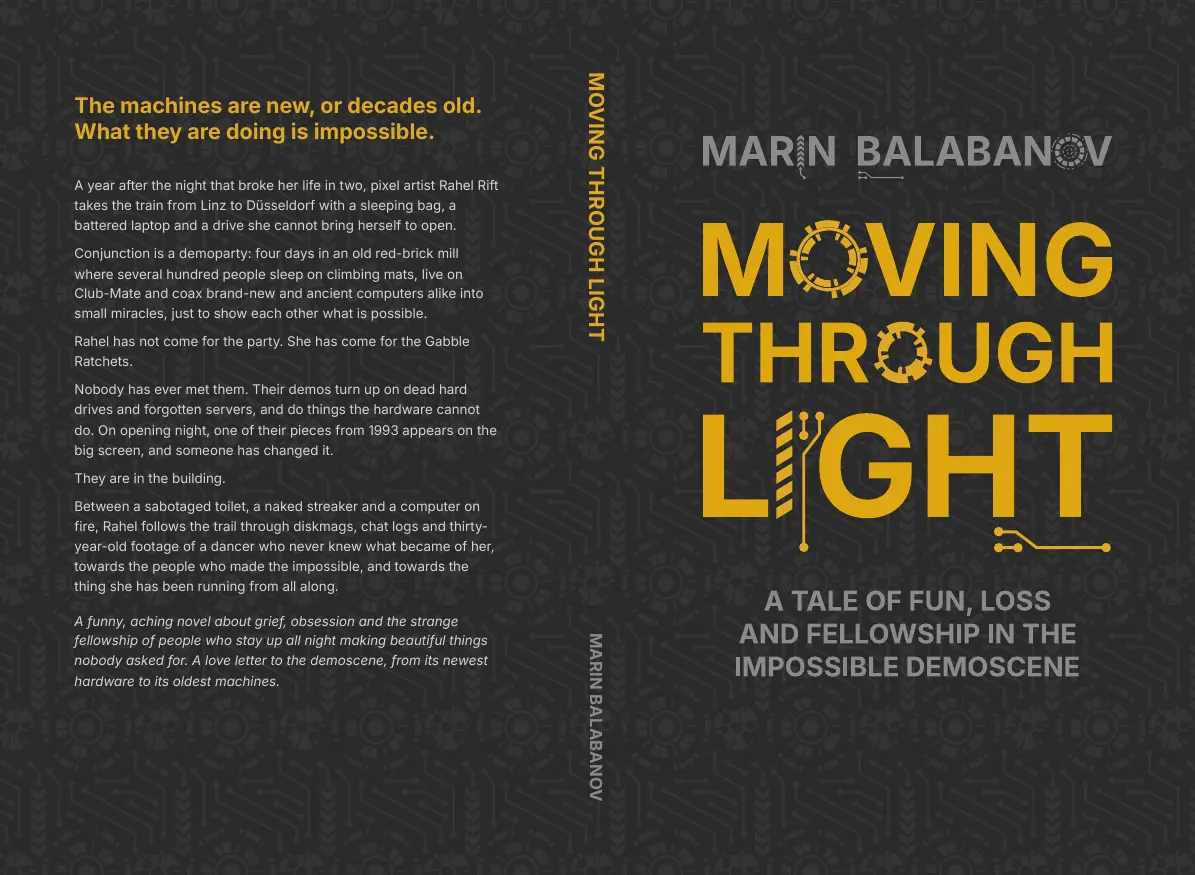
The paperback cover: back, spine, and front.
Paperback: Amazon.de → Amazon.co.uk → Amazon.com →
Kindle ebook: Amazon.de → Amazon.co.uk → Amazon.com →
Many people in the scene have lived all of this far longer and far more deeply than I have. If you read the book and something does not ring true, I would honestly like to hear about it.
For Reviewers
If you would like to review Moving Through Light, on a blog, in a diskmag, in a video, or anywhere else, I am happy to send you a reviewer EPUB free of charge. There are no strings attached and no expectation of a positive review: write what you honestly think. Send a short note to info <at> marincomics.com, or reach me through one of the profiles on the About page.
Frequently Asked Questions
What is Moving Through Light about?
Moving Through Light is a novel about Rahel Rift, a pixel artist from Linz who travels to a demoparty in Düsseldorf a year after her partner's death and goes looking for the Gabble Ratchets, a demo group nobody has ever met. It is a mystery, a story about grief and belonging, and a love letter to the demoscene.
Do I need to know the demoscene to read it?
No. The book explains what it needs as it goes, and a glossary at the back covers the scene's terms, from compo to shader. Readers from the scene will recognize the details, and everyone else gets a way in.
Is Conjunction a real demoparty?
No. Conjunction, its venue, and the people in the story are invented, and real sceners and their handles are kept out of it. Real parties, groups, and productions are mentioned only in passing.
Where can I buy Moving Through Light?
Moving Through Light is available on Amazon as a paperback and as a Kindle ebook. Searching for Moving Through Light Balabanov on your local Amazon store will find it.
Is there a German edition?
Not at present. The book is written in British English, so that sceners from every country can read it. The story takes place mostly in German-speaking Europe, and the characters are understood to be speaking German.
Related on This Site
- Moving Through Light: A Preview: the prelude and the first two chapters of the novel, free to read.
- Why I Love the Demoscene: The Digital Subculture That Keeps Surprising Me: the short version of everything the novel tries to say.
- Finding My People: A Little Demoparty Report of Evoke 2022: my very first demoparty.
- Finding Peace in the Process: How to Survive the Perfect Demoparty: my report from Evoke 2026.
- The Books That Chronicle the History of the Atari ST Demoscene: more reading on the scene's history.
- From Blog Posts to a Book on Amazon: how I wrote and self-published my previous book.