The Freest Being in the Universe
Part 6
Back from Black: The Second Kree–Skrull War
The sixth and final instalment of my book The Freest Being in the Universe, serialised here on the web. This is chapter five of five on the Englehart Surfer: Silver Surfer vol. 3 #25–31 (July 1989 – January 1990) — the war thirty issues in the making, the fool on the throne, the Living Tribunal's lesson, and one perfect moment of infinity.
August 2026
Get it on:
Amazon.com →
Amazon.de →
Amazon.co.uk →
This article series is the full text of the book.
If
you'd like to support the author, please feel free to purchase
a physical copy or the Kindle ebook.
The deal was struck, the handcuffs came off, and Steve Englehart cashed in every chip he had spent two and a half years placing on the table. Issue #25 arrived double-sized under a title that was equal parts story beat and backstage victory lap (“Back from Black?”, question mark and all), and the seven issues that follow are the answer: the second Kree–Skrull war in full flame, fought not by super-teams but by empresses, spies, pirates, puppets and one increasingly weary silver conscience caught in the middle.[1] It is the culmination of everything this book has traced, and it ends — I promise — on one of the most transcendent pages of 1980s Marvel.
The Trick (#25, “Back from Black?”)
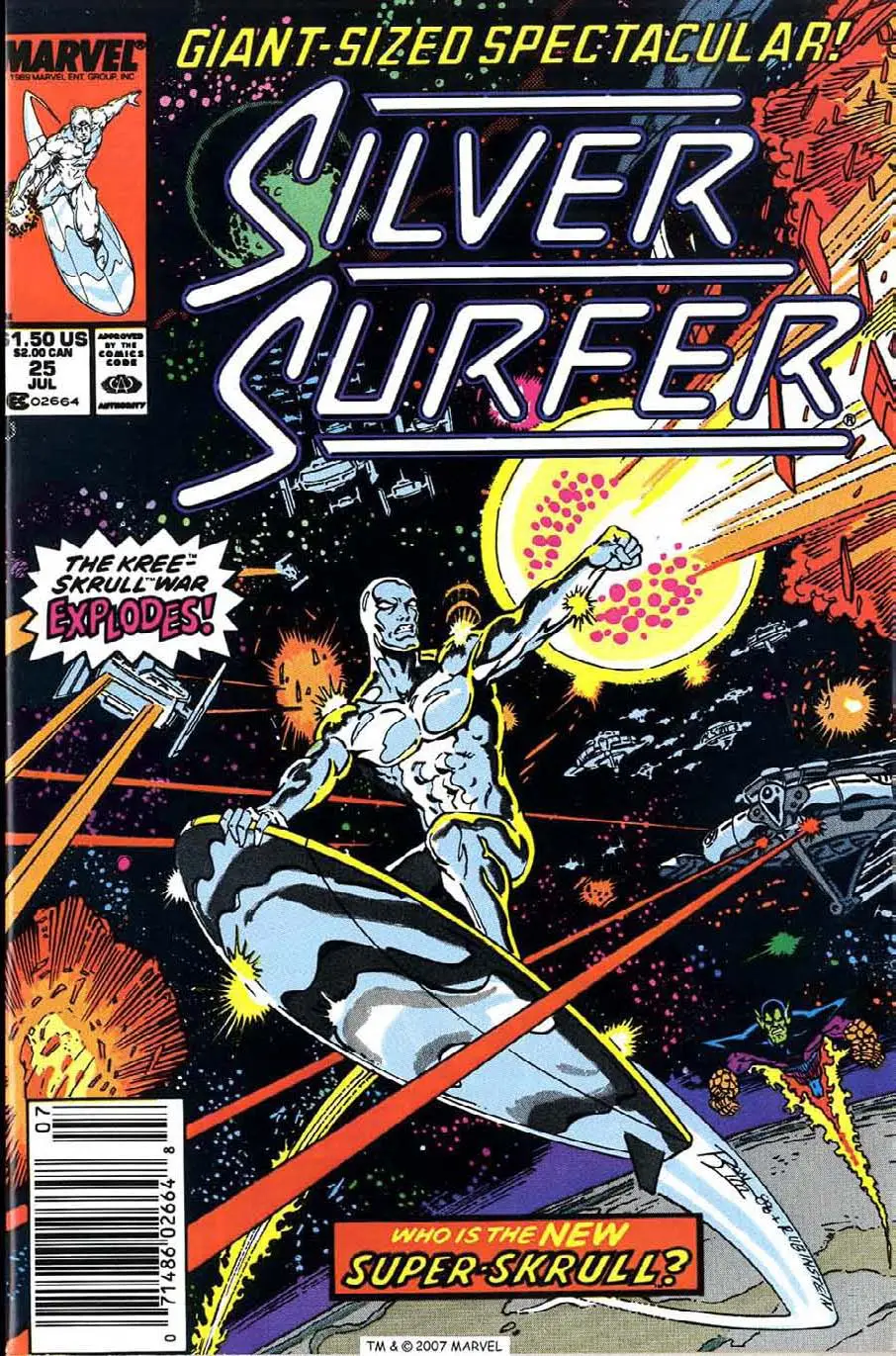
Silver Surfer vol. 3 #25: “Back from Black?”
It begins, fittingly for a war built on deception, with a con. The Surfer stumbles across a space battle between the Skrulls and the Badoon and tries to do what he's been doing for six issues of forced fables: mind his own business. The Badoon fire on him anyway, and the Super-Skrull physically blocks his exit. Then the Surfer, in a line that could caption his whole life, grows tired of fighting to avoid fighting, and agrees to help the Skrulls escape just this once. He dismantles the Badoon armada with surgical efficiency. Only then does Empress S'byll, sweetly, explain the small print: the Badoon are treaty allies of the Kree.
The Silver Surfer has just publicly entered the war on the Skrull side.
The consequences arrive at lightspeed. Racing home in fury, he finds Zenn-La already ringed by a Kree armada under Ronan the Accuser (third round for these two opponents), and this time the stakes strip away all restraint. He puts Ronan down, tears into the fleet, and is nearly drowned by sheer numbers until the Skrull armada arrives to fight beside him. And in the victory's breathing space comes the payoff to a thread planted in an annual eighteen months earlier: with a genetic apparatus, the Surfer's Power Cosmic and the Super-Skrull's shapeshifting gift, they pour Kl'rt's shapeshifting into Empress S'byll. For one horrifying moment she dissolves into a formless blob, and then reforms, restored and more: the transfer amplifies her, making S'byll a living wellspring who can return shapeshifting to any Skrull with a touch. The genetic catastrophe of the hyper-wave bomb, the wound underneath every Skrull scene since 1985's Fantastic Four Annual #19, finally has its cure. And it is the Silver Surfer, of all beings, who helps administer it. When the Kree return for a second pass, a cosmic-charged empress fights beside him, and they do not stay long.
Meanwhile, on a nowhere moon, a figure in a purple cape makes Clumsy Foulup an offer: betray Captain Reptyl, and live to be a hero.
The Price of Home (#26, “Z-Day”)
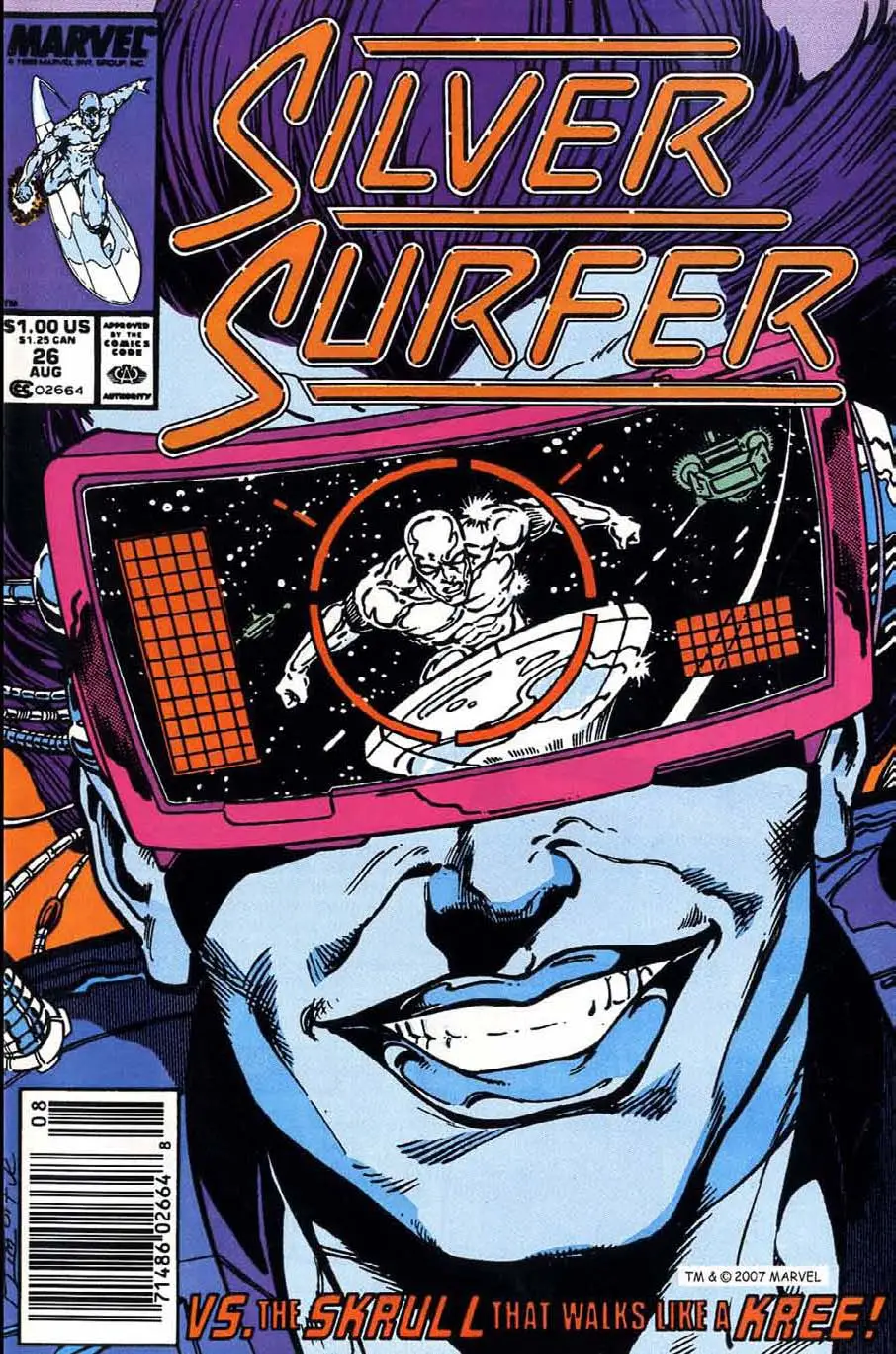
Silver Surfer vol. 3 #26: “Z-Day” — the price of Zenn-La's safety.
Nenora leads the next assault on Zenn-La personally. Or seems to. Amid the battle (Surfer, Super-Skrull and S'byll in the sky, Skrull ground-cannons roaring below), the Surfer smashes into the Kree flagship to end things face to face, and finds only an image. The Supreme Leader was never aboard, commanding remotely from the Kree homeplanet, cautious as only a spy can be. Their negotiation is the issue's cold heart. The Surfer protests that he was tricked into the Skrull camp. Nenora, magnificently indifferent, offers terms anyway: the Kree will strike Zenn-La from the war's map if the Silver Surfer leaves his homeworld and never returns to it.
He agrees. Of course he agrees; protecting Zenn-La by losing it is the oldest reflex he has, the origin story replayed in miniature. The issue twists the knife beforehand: Shalla-Bal asks him, plainly, to stay and live beside her at last, and the Surfer declines with the truest thing he ever says about himself — he cannot live on one world any more; he is “ever the alien”.
Freedom, it turns out, was not a happy ending. It was a revelation.
Restoration and Reptiles (#27, “The R Complex”)
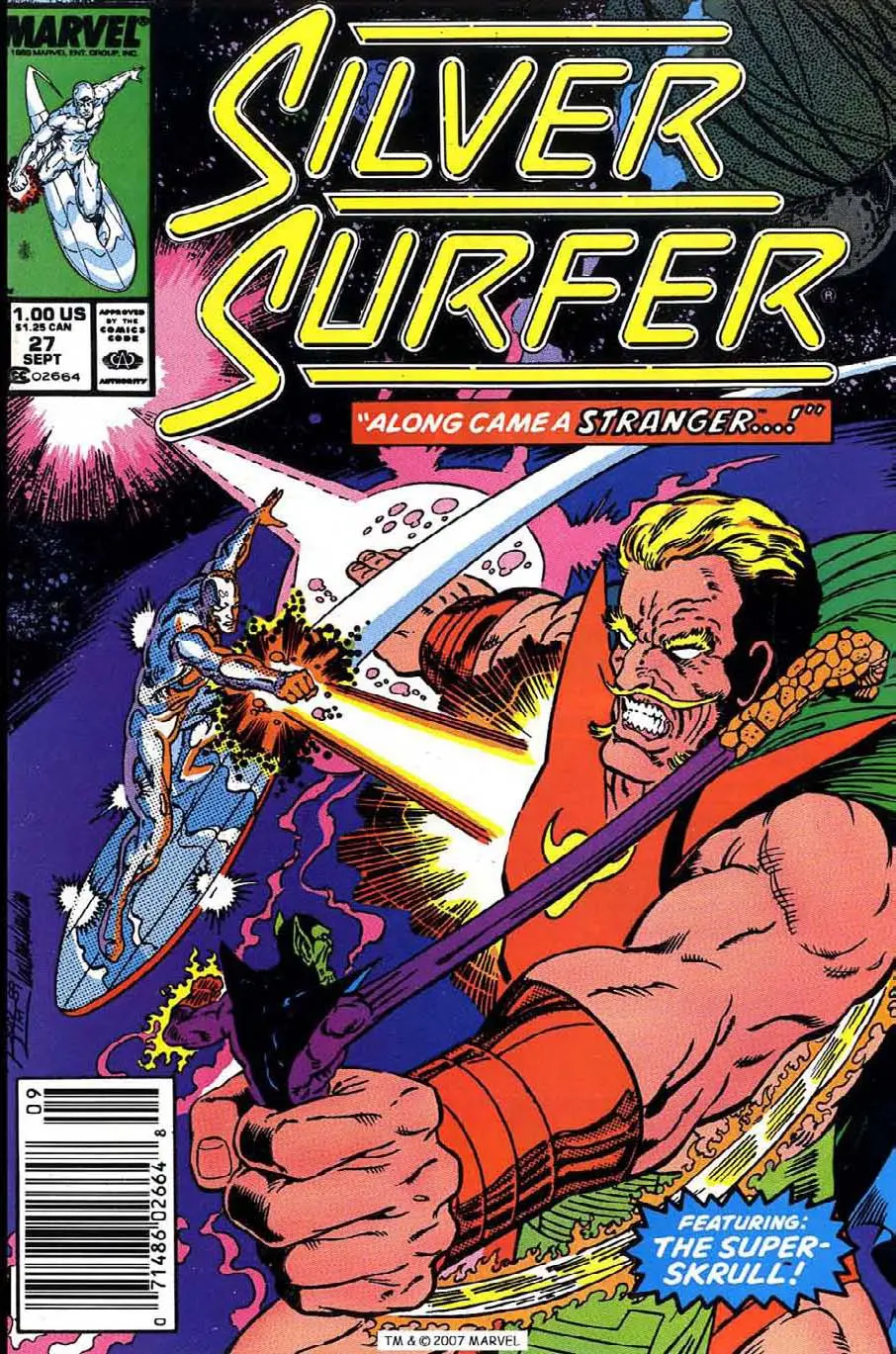
Silver Surfer vol. 3 #27: “The R Complex” — restoration on Satriani.
Then, joy: brief, crowded, hard-won joy. On the Skrull world Satriani (Englehart tipping his hat to the guitarist whose Surfing with the Alien had just put the character on an album cover), vast crowds queue to touch their empress and become themselves again. S'byll restores her people's birthright one hand at a time. It's the warmest image of the war so far, and naturally everything goes wrong at once.
The Stranger, the enigmatic cosmic experimenter the Surfer first met all the way back in the Lee era, descends to collect S'byll as a specimen, her boosted mutation too fascinating to leave in the wild. The Surfer is trapped; the Super-Skrull is hurled into something invisible that turns out to be a cloaked Badoon, unmasking a whole infiltration force; and into the three-way melee sails Captain Reptyl, following a strange energy signature.
His solution to the Stranger problem is Reptyl to the bone: he trades his own loyal pirate crew to the Stranger, souls for a soul, in exchange for the empress. And just like that, the mammal-hating corsair is an ally of the Skrulls and of the Silver Surfer, who is precisely as thrilled as you'd imagine.
As ever, it is in the margins that the knives come out. Clumsy Foulup sits down with Nenora to sell out Reptyl. Behind and above him drifts the astral form of his purple-caped patron, the “Contemplator,” who now reveals his plans: he wants the Skrulls annihilated and the Kree Empire ruled, through instruments, by himself. And on Zenn-La, the thread that has been glowing since #20 finally catches fire: Shalla-Bal's beloved plants whisper the truth to her.
She knows: Nenora, Supreme Leader of the Kree, is a Skrull.
Blood on Satriani (#28, “Neanderthals!”)
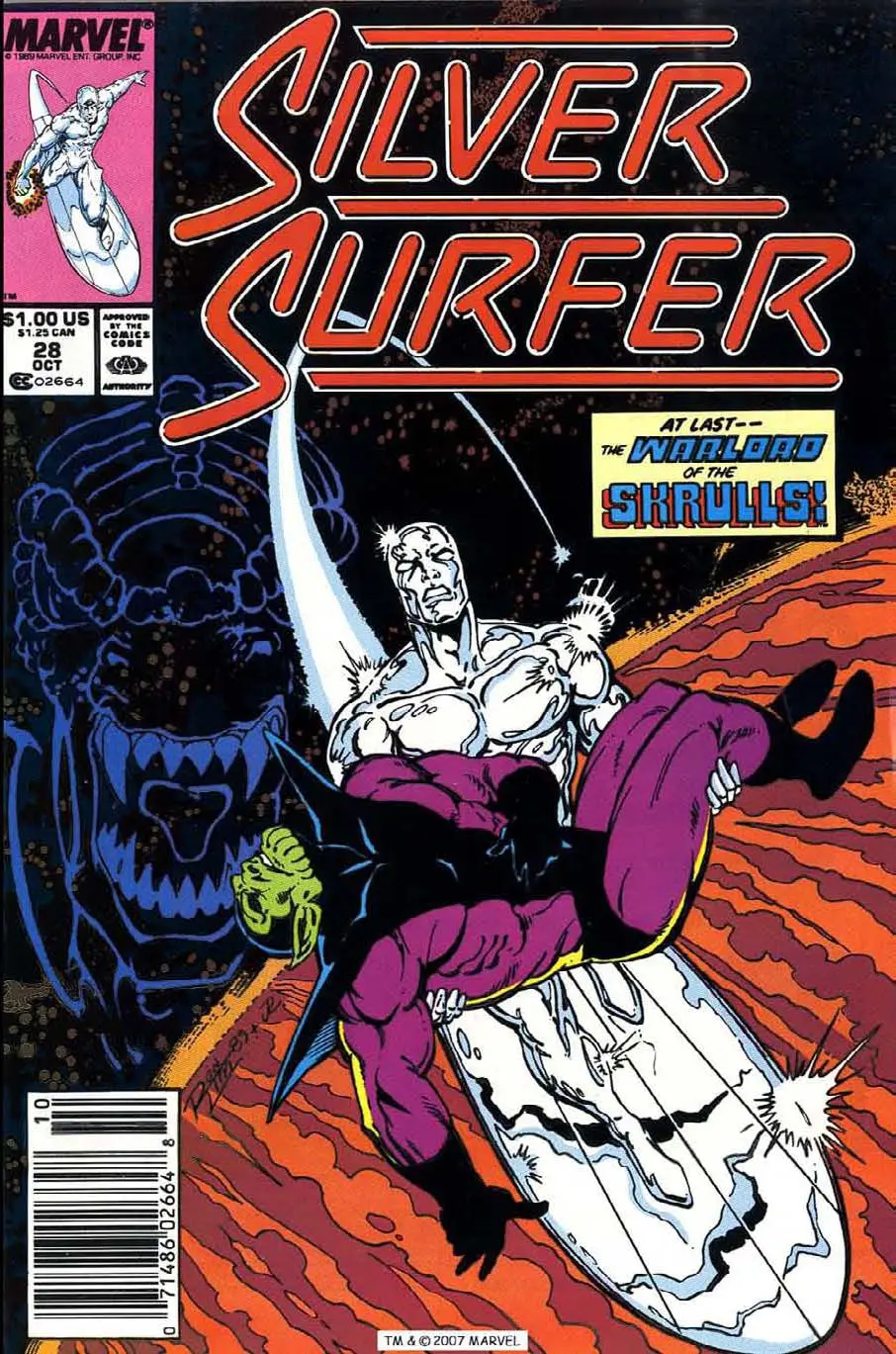
Silver Surfer vol. 3 #28: “Neanderthals!” — Reptyl's betrayal of the Super-Skrull.
The alliance barely survives its first week. Reptyl retrieves his hidden weapons cache. And then, unprovoked, he challenges the Super-Skrull to a duel in front of the whole Skrull camp. It is not a superhero fight; it is a predator establishing dominance. And it ends with Reptyl's teeth in the Super-Skrull's throat. Kl'rt, the Super-Skrull — freed from an energy prison by the Surfer's own mercy, the instrument of his race's salvation, loyal soldier of the empress he served — falls dead on the world where he'd just helped make his people whole.
The Surfer dives to avenge him and is stopped by S'byll herself, in the war's most chilling piece of realpolitik: she needs Reptyl's fleet more than she needs justice. The funeral is held in space, and the Surfer's opinion of his allies drops another fathom.
The Kree match the cruelty. A Sentry erupts from the Zenn-Lavian desert where Shalla-Bal is coaxing new life from the sand (the Power Cosmic the Surfer gifted her in the 1982 one-shot, still blooming) and abducts the empress to Kree-Lar, on Nenora's direct order: the spy has learned that Shalla-Bal knows.
In the same city, drifting unseen, the Contemplator's astral form finds the war's most valuable derelict: the Supreme Intelligence, mad and catatonic since the Surfer tore the Mind Gem from its brow in #8, an empty mind waiting for a squatter.
Midnight and the Long Knife (#29–30)
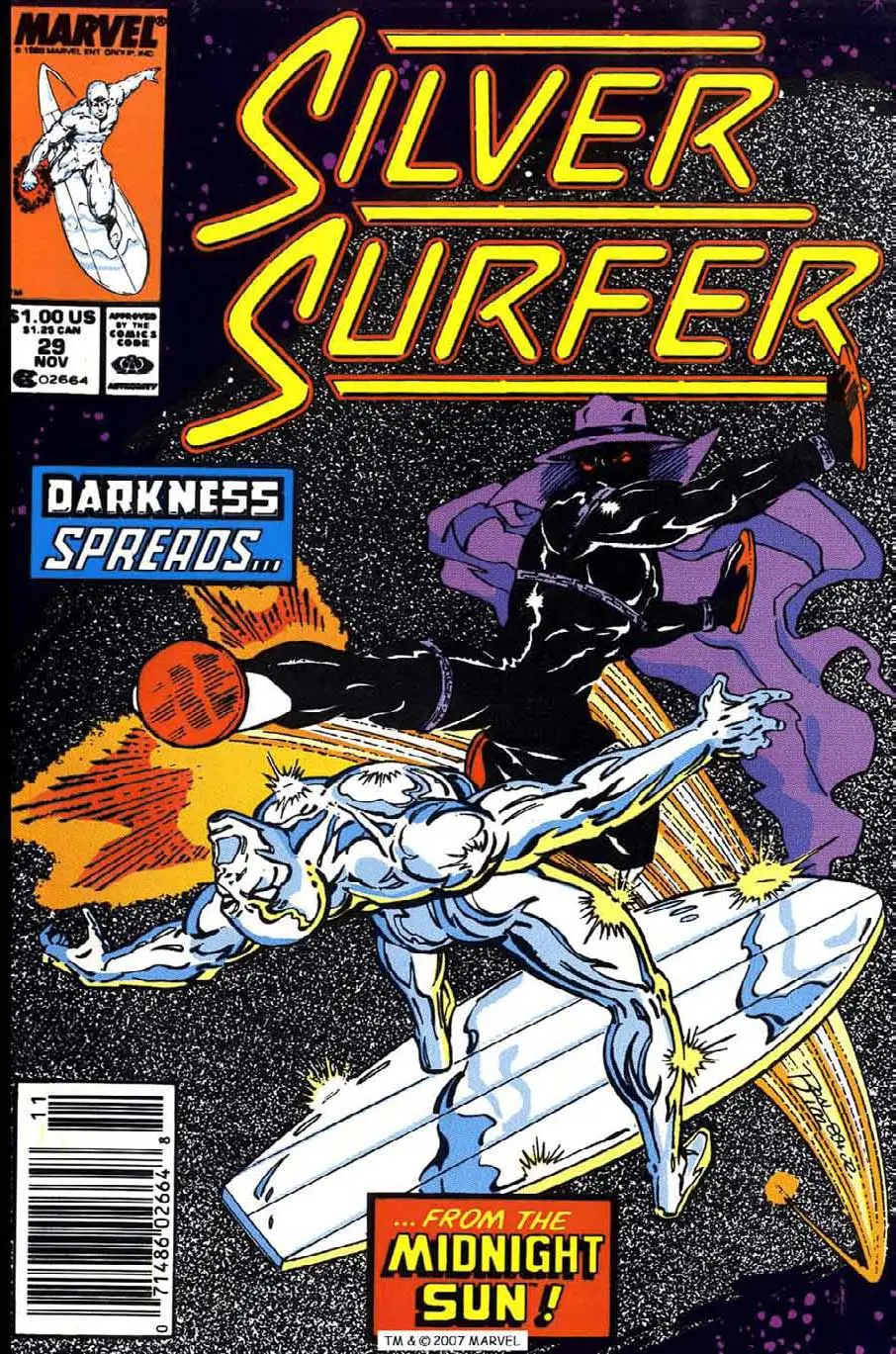
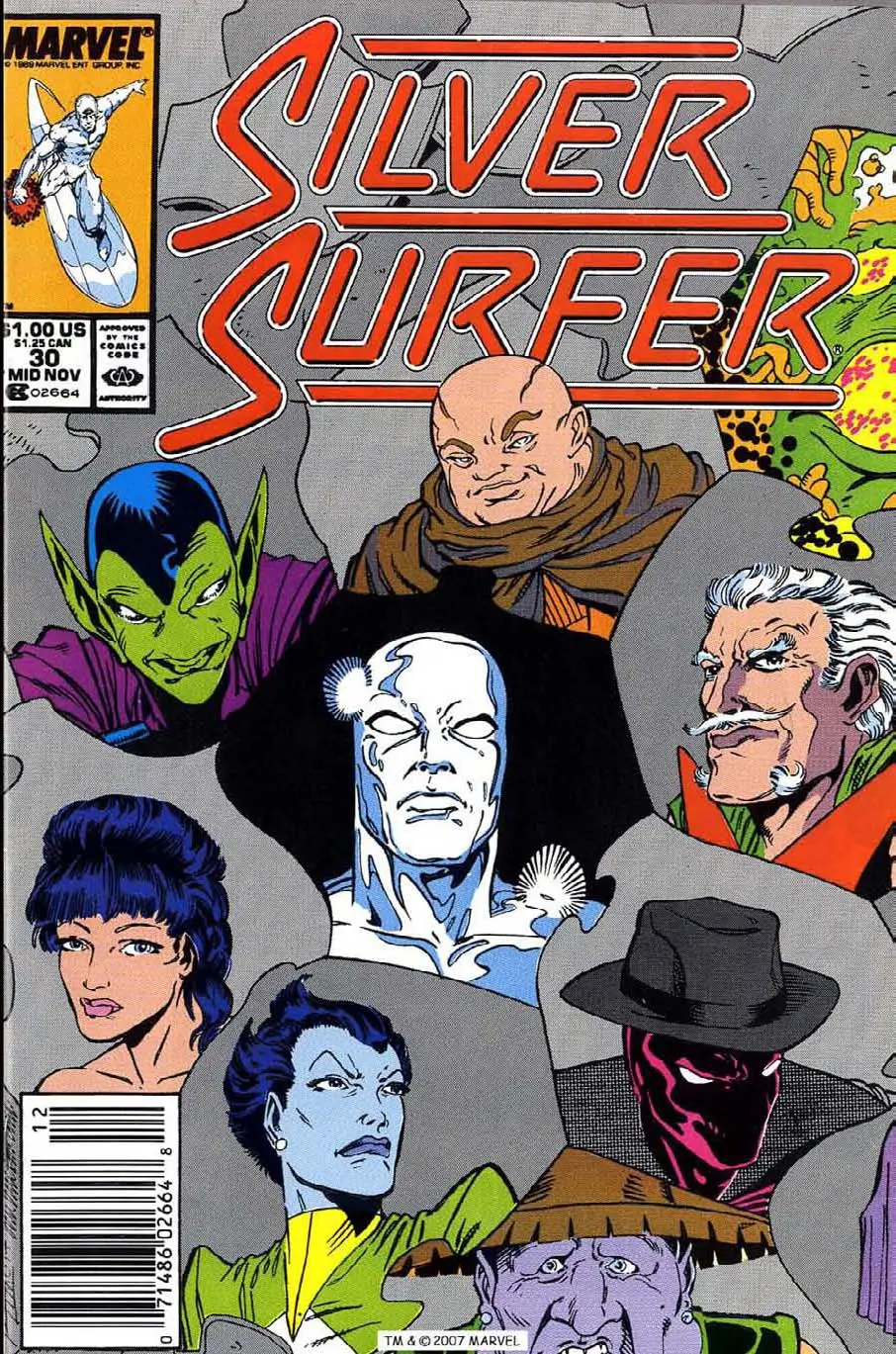
Silver Surfer vol. 3 #29–30: the Midnight Sun, Foulup's betrayal, and Nenora unmasked.
For the endgame's muscle, the Kree unveil their ultimate anti-Surfer weapon, and Englehart reaches all the way back into his own past to build it. The silent silver duellist they deploy is the Midnight Sun: M'Nai, the masked warrior called Midnight, Shang-Chi's doomed childhood friend from Special Marvel Edition #16 (a character Englehart co-created with Jim Starlin in 1973), long dead, now salvaged and rebuilt by Kree science into a mute, gleaming shadow of the Surfer himself, programmed to kill him.[2] Chief among his gifts is a mastery of darkness: he exudes a blackness so absolute that not even the Silver Surfer can see through it, rendering himself invisible to the most perceptive senses in the sector and turning every exchange into an ambush in the dark.
Their first duel is broken off by the Kree's own manoeuvres; the rematch will come at the gates of Hala. One more doppelgänger for the collection: this run has now thrown a Skrull frozen in the Surfer's shape, a soul-stealing gem, and a resurrected silver swordsman at its hero, as if testing from every angle what makes the real one real.
While the Surfer is thus occupied, the war is decided by the smallest man in it. In the middle of the decisive fleet action, Clumsy Foulup, the cowardly, lovestruck, herb-addled pirate who has been comic relief since #11, walks up behind Captain Reptyl and puts the captain's own Sparkutlass through his back. The Skrull fleet, decapitated, is annihilated; Reptyl drifts, gravely wounded, into the dark (villains this good are never quite dead); and Foulup is whisked to Hala, where the Contemplator's stage-management sees him declared a hero of the Kree Empire.
Issue #30 opens on the ashes: the Kree victorious, the Skrull armada gone, and S'byll rising from the rubble of her cause with exactly one companion left. That companion is a Silver Surfer who points out, reasonably, that surrender won't stop the Kree from wanting him dead. So the two of them do the maddest thing in the run: they attack the Kree Empire. Two beings against Hala.
They shatter the orbital defences. The Surfer finishes his duel with the Midnight Sun for good. And they carve a path through the capital itself, where a prisoner is waiting. Shalla-Bal tells them what the plants told her. And in the throne room of the Kree Empire, before its assembled command, S'byll reaches for Supreme Leader Nenora. Nenora defends herself desperately, but S'byll breaks through and lays one restoring hand on her — the touch that gives every Skrull back their true self. Nenora's stolen Kree face melts away mid-sentence.
The most audacious espionage coup in Kree history ends not with a battle but with an unmasking, three years of lies collapsing in a single panel as the empire realises it has been ruled, through an entire war, by the enemy.
And with that, the war is over. The Skrulls have won.
The Crown of Fools and the Court of Gods (#31)

Silver Surfer vol. 3 #31: the finale — the Crown of Fools and the Court of Gods.
The giant-sized finale is two endings stacked on top of each other, one for the war, one for the soul, and both are perfect.
The war dies of embarrassment. With Nenora exposed, the Kree command (Coordinator Tus-Katt stepping into the vacuum) has no leader, no legitimacy and no appetite. S'byll, empress of a fleet that no longer exists, coolly bluffs that vast Skrull reserves stand ready, and offers peace. The Kree refuse a treaty but accept a cease-fire. For the Skrulls, who entered this war as a broken race and leave it whole — shapeshifting restored, an empress confirmed — that amounts to victory. And then Englehart springs the punchline he has been assembling for twenty issues.
The Contemplator now reaches for his prize, puppeting the catatonic Supreme Intelligence's holographic majesty to claim command of the Kree.[3] He has manipulated everyone, and his instrument Foulup stands ready to be his figurehead. Except that Clumsy Foulup, betrayer of betrayers, has acquired patrons of his own: the Cotati, the telepathic plant-race, who owe a debt of atonement. They blame themselves for the loss of Mantis, and helping the Surfer's cause is their penance.
The Cotati strike through Foulup, and the Contemplator's mind is burned out mid-triumph. Then the Cotati-steadied projection of the Supreme Intelligence pronounces, before all Hala, the succession: Clumsy Foulup, Supreme Leader of the Kree Empire.[4]
Consider that for a moment. The thousand-year empire of the Kree, the civilisation of Ronan, of the Supreme Intelligence, of Captain Marvel's wars, ends this saga in the hands of a cowardly space-pirate deckhand who got there by stabbing his boss in the back and eating a suspicious leaf. It is the single most gloriously absurd coronation in Marvel history, and it is not a joke instead of a point: it is the point. Englehart's war of shapeshifters and spies ends with the revelation that empires will follow anyone wearing the right projection.
It was also, as many have read it, a barb aimed very precisely offstage. Foulup's rise is widely taken as a pointed parody of the man who had become Englehart's own Editor-in-Chief: Tom DeFalco. He had ascended at Marvel after the firing of Jim Shooter, the editor who'd greenlit this series and championed it.[5] Just as DeFalco (in Englehart's telling) rose by the fall of his predecessor, Foulup rises by literally stabbing his captain in the back. And just as Foulup becomes the empty figurehead of an empire steered by forces behind the throne, so, the satire implies, had Marvel's own command. The gag has teeth, and Englehart never really hid them. His acid postscript on his website says it in one line: “When I left, Clumsy Foulup ruled the Kree Empire, and four years later, Marvel was bankrupt.”
When the cosmic dust settles, the series returns to the Silver Surfer. He flies S'byll home to Satriani and Shalla-Bal home to Zenn-La, the homeworld he may guard but never again live on. Then, with the last of his anger, he goes looking for the Stranger, to demand to know why he meddled in the Kree/Skrull War. The Surfer never gets his answer. Something vaster interrupts: the Living Tribunal, the multiverse's supreme arbiter, golden and three-faced, who has come not to judge the Silver Surfer but to teach him.[6] The lesson gathers up every metaphysical thread of the run: everywhere in the realms of duality, the Tribunal explains, there is the presence of trinity. Kree and Skrull — and the third force that decided their war. Order and Chaos — and the In-Betweener. Eternity and Death — and Galactus, the third force of our universe, who (the Tribunal adds, dropping the run's final koan) is the opposite of the Silver Surfer: the devourer and the preserver, the vast hunger and the small mercy, bound together since a herald first betrayed his master over one blue world. And then, because a lesson this size cannot be told but only shown, the Tribunal gives the Silver Surfer a gift no one else in this saga could have earned: a moment of godhood. For one page, Norrin Radd is one with the universe entire — every star, every void, every living thing — and comes back down to his board with the only conclusion that has ever mattered, the one that answers twenty-two years of barriers and exiles and cages: space is truly infinite. And he is free in it.
That is where Steve Englehart leaves him. Not victorious — nobody wins this war but a fool — but awake.
The Ledger: Every Thread, Paid
Part of what makes this finale so satisfying is sheer storytelling craft and — dare I say it — bookkeeping. Run the accounts.
The Skrulls' lost shapeshifting (broken in FF Annual #19, 1985): restored, via a chain that runs from the Surfer freeing Kl'rt in Annual #1 to S'byll's touch in #25–27. Nenora, planted as a background courtier in #6: exposed and deposed in #30–31 by the very power her race regained. The Supreme Intelligence, shattered when the Surfer tore out its Mind Gem in #8: its empty mind becoming the Contemplator's puppet throne and the war's final battleground, twenty-three issues later. The severed grey head in the Coalsack Nebula: revealed as the saga's secret arch-villain and destroyed at the moment of victory. Clumsy Foulup, a dance-floor punchline in #11: now emperor. Reptyl, introduced #11: kingmaker's victim, drifting and unfinished (Ron Marz would reclaim him during his own run on the series). The Super-Skrull: freed, weaponised, martyred.
Shalla-Bal's half-caught thought in #20: the seed of the unmasking. Zenn-La: safe twice over, by Galactus's pledge in #10 and the Surfer's sacrifice in #26. Mantis: mourned since #9, lost in FF #325, yet deciding this war from beyond it, because her Cotati kin crown an emperor as penance for her. The love story editorial killed still wins the endgame; Englehart slipped his heart past the gatekeepers.
And the threads deliberately left open are bequests, not oversights: Nova's tangled bond with the Surfer and her possessive master, handed to the next writer; and six Soul Gems seated with five Elders and an imprisoned In-Betweener, the exact chessboard on which Thanos Quest and The Infinity Gauntlet would shortly be played. Even the ban was repealed posthumously: Thanos, forbidden to Englehart, walked into this very title a few issues later and made it the centre of the Marvel Universe.[7]
What the Writer Learned
Englehart's own verdict, on his website, is bracingly unsentimental. Marvel, as he saw it, had resolved to end innovation across its line. The six-month no-interference deal that bought this finale — seven issues, as it turned out — also ended his tenure. Of the whole affair he says simply, “I took one for the team — but despite the benefits it conveyed, I can't say I personally enjoyed it all that much.”[8] His sign-off is the driest in comics: a fool ruled the Kree when he left, and, by his reckoning, the company went bankrupt four years on.
But strip away the acid, and the professional lessons of this run are luminous — the ones every long-form writer since has had to relearn. That serialised comics reward the long game: plant in #6, harvest in #31, and readers will follow you anywhere. That a character who “ought to be great” but never sells is usually imprisoned by his premise, not his nature: free the premise and the character wakes up. That continuity is an instrument, not a burden: this run made music out of a 1985 annual, a Byrne subplot, a 1973 kung-fu comic and Starlin's abandoned cosmology, and repaid every loan with interest. That you can lose the political war and still win the artistic one: the protest pseudonyms washed off; the ending stayed. And that endings matter enough to pay for: Englehart traded his job for the right to finish his story, and thirty-five years later the story is what remains.
What the Reader Learned
And what did we learn, riding along? That identity is the real battlefield: this is a war of a race that forgot how to be itself, a spy trapped as her enemy, a Skrull frozen as the hero's double, a dead man rebuilt as his shadow, an empire ruled by a projection. And at the centre of all of it stands one being who cannot change his shape at all — whose unchangeable self turns out to be the most powerful force on the board.
That good intentions keep ledgers: the Surfer freed the Super-Skrull and broke the Supreme Intelligence, armed both empires with his mercy and his rage, and spent the war paying those debts down. Heroism, in Englehart's telling, is less about never causing harm than about staying to answer for it. That power is not wisdom: the mightiest being in the sector wins every single fight in these thirty-one issues and prevents almost nothing. The war is ended by a bluff, a touch and a truth, not a blast. That empires are exactly as majestic as the fools they'll follow.
That love doesn't need to survive to matter: Mantis is gone, Shalla-Bal is forfeit, Nova is manipulated away, and yet every one of those losses moves the plot and the man forward. The run's emotional education, from the first tantrum in the asteroid field to the quiet dignity of “ever the alien”, is the Surfer growing into his own feelings without being destroyed by them.
And, finally, the Tribunal's lesson, which is Englehart's lesson, which might as well be anyone's: beyond every binary you're offered — this empire or that one, order or chaos, even life or death — there is always a third thing, and the third thing is where the meaning lives.
Coda: The High Note
Step back to 1966 one last time. A stowaway glides into a plotted comic because Jack Kirby was tired of drawing spaceships: no name, no origin, no future, just a herald, a flourish, a man on a flying surfboard. Twenty-three years later, that flourish has an inner life rich enough to carry thirty-one issues about identity, empire, grief and metaphysics; has out-thought gods, out-loved his own losses, and stood in the private counsel of the Living Tribunal; has been, for one incandescent page, the universe itself.
Steve Englehart took a character everyone loved and nobody could sell, threw open the cage Stan Lee built and guarded, gave him a temper and a heart and a war worthy of both. Then he handed a thriving, top-selling, cosmically re-armed Silver Surfer to the next generation, who used it to change Marvel forever.
The run ends with its hero exactly where Norrin Radd was always meant to be: alone on his board between the stars, wiser than he was, freer than he ever dreamed, with infinity ahead of him in every direction.
The sentinel of the spaceways, at last, is home.
Frequently Asked Questions
Which Silver Surfer comics does Part 6 cover?
Part 6, the finale, covers Silver Surfer volume 3, issues #25 to #31, published from July 1989 to January 1990. It follows the second Kree-Skrull war and the end of Steve Englehart's run.
Who wrote and drew these comics?
They were written by Steve Englehart and drawn by Ron Lim.
Is The Freest Being in the Universe free to read online?
Yes. The complete book is free to read here on marincomics.com, all six parts, richly illustrated. If you would like to support the author, you can also buy the paperback or Kindle edition on Amazon.
What is The Freest Being in the Universe about?
The Freest Being in the Universe is Marin Balabanov's chapter-by-chapter appreciation of Steve Englehart's cosmic Silver Surfer, volume 3, issues #1 to #31, published from 1987 to 1990. It recaps every issue and asks what the stories teach us about freedom, identity, grief, and finding a third path beyond false either-or choices.
Notes and Sources
- Silver Surfer vol. 3 #25–31 (July 1989 – January 1990), written by Steve Englehart, pencilled by Ron Lim; issues #25 and #31 double-sized. Credits per the Grand Comics Database (comics.org) and the Marvel Database — marvel.fandom.com. ↩
- The series in which M'Nai/Midnight first appeared, Special Marvel Edition, was shortly retitled Master of Kung Fu. See Midnight (Marvel Comics), Marvel Database. ↩
- The schemer styling himself “the Contemplator” is not the true Elder of that name (Tath Ki) but a Skrull impostor wearing his identity — the same floating head Reptyl bit off and spat into space earlier in the run, who clawed his way back from a disembodied skull to the brink of ruling the Kree. The run never states the deception outright; his Skrull nature was confirmed only later, in Quasar #48 (1993), when the Elder called the Judicator blasted him back into Skrull form and hauled him off to be tried under cosmic law. See Tath Ki, Marvel Database — marvel.fandom.com. ↩
- Foulup did not reign long. In Silver Surfer vol. 3 #53 (Aug. 1991), fittingly titled “The Fool on the Throne,” the Kree generals Ael-Dan and Dar-Benn had the emperor and his advisor Dwi-Zann assassinated live on air — by a robotic duplicate of the Silver Surfer, because this era could never seem to have enough of those — and pinned the killing on the Skrulls before seizing the throne themselves. Ron Marz, by then writing the book, gave Englehart's joke its punchline: the fool was deposed a little over a year and a half after his coronation in #31 (January 1990). See Silver Surfer vol. 3 #53, Marvel Database — marvel.fandom.com. ↩
- The specific DeFalco parallel is Brian Cronin's reading rather than a claim Englehart made outright. See CBR, “The Silver Surfer Storyline That Mocked Marvel's Then Editor-in-Chief” — cbr.com. ↩
- The Living Tribunal, whose three faces represent Equity, Necessity, and Vengeance, was created by Stan Lee and Marie Severin and first appeared in Strange Tales #157 (1967). ↩
- Starlin took over the title with #34, “The Rebirth of Thanos” (1990). See CBR, “How the Silver Surfer's Elders Set Up Infinity Gauntlet” — cbr.com. ↩
- Both quotations come from Steve Englehart, “Silver Surfer 25-31,” steveenglehart.com. (Marvel Entertainment Group in fact filed for Chapter 11 bankruptcy in December 1996; Englehart's “four years” is his own rhetorical reckoning.) — steveenglehart.com. ↩