The Freest Being in the Universe
Part 5
Garbage In, Garbage Out: The Surfer in Shackles
The fifth instalment of my book The Freest Being in the Universe, serialised here on the web. This is chapter four of five on the Englehart Surfer: Silver Surfer vol. 3 #19–24 (January–June 1989) and Silver Surfer Annual #2 — a heartbreak engineered by Titan, a love story exiled off-panel, fables written under protest, and the backstage civil war that nearly broke the run before its finale.
August 2026
Get it on:
Amazon.com →
Amazon.de →
Amazon.co.uk →
This article series is the full text of the book.
If
you'd like to support the author, please feel free to purchase
a physical copy or the Kindle ebook.
On the page, this stretch reads like a breather: the black hole receding in the mirror, a romance detonated by outside interference, and a string of mournful done-in-one stories as the Kree–Skrull war simmers towards a full boil. But the real drama of these months happened off the page. This is the period in which Marvel and Steve Englehart went to war with each other — a conflict the writer waged partly in public, using the credits box itself as a protest banner. Understanding it transforms how these issues read. What looks like a lull is really a hostage situation, and the writer left notes.
Let's be honest about where we are, too: by most measures this is the nadir of the run so far — the thinnest stories, the unhappiest circumstances, a book visibly working against its own grain. There's no pretending otherwise. But it is a valley we have to cross to reach the summit, because everything that makes the finale glorious is being quietly wound up here, in the dark. Read it as the deep breath before the plunge, and the plunge is worth it.
Heartbreak, by Titan (#19–20)
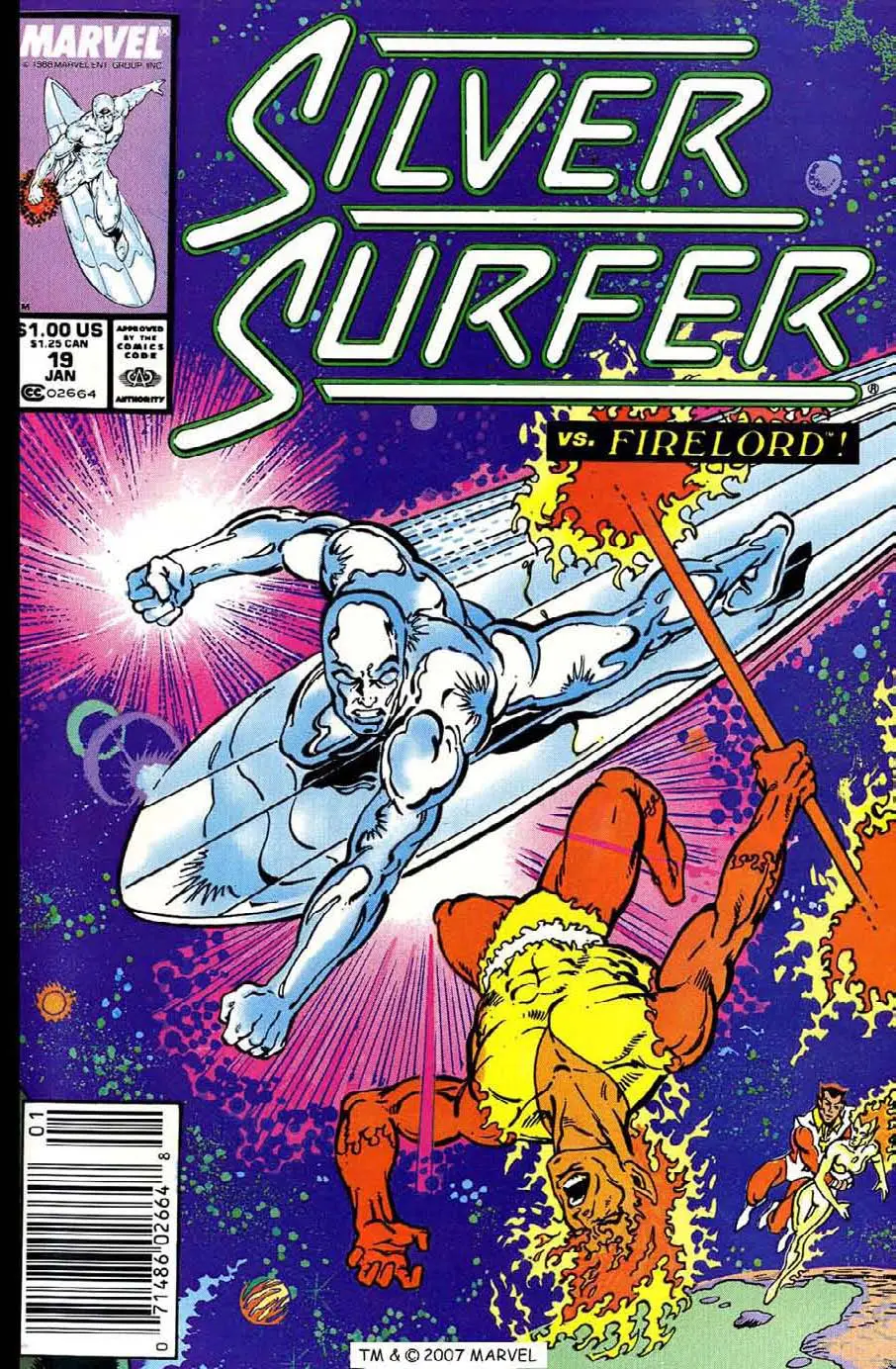
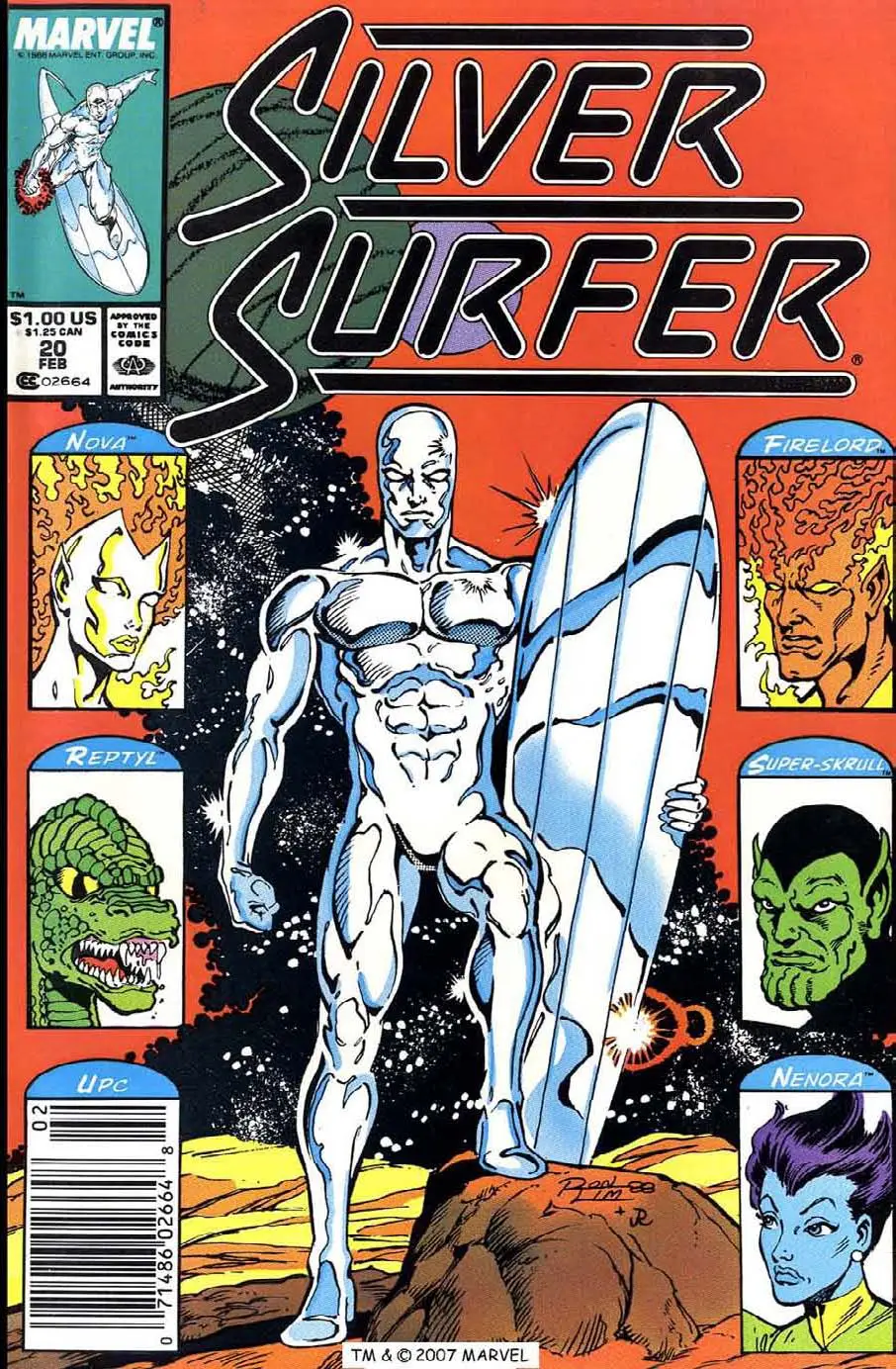
Silver Surfer vol. 3 #19–20: Firelord's ambush, and Eros's cruel manipulation.
First, the hangover from the In-Betweener affair. Issue #19 opens with everyone going their separate ways: the five restored Elders use their gems to vanish, Galactus packs Nova off to find him a meal, and the Surfer ferries Reed, Sue and Franklin home to Earth. Both heralds quietly suspect that errand is really about keeping them apart — the first hint of Englehart's strangest and boldest late-run idea: that the devourer of worlds may be developing feelings for his own herald.[1]
Meanwhile, two fiery figures come knocking at Reptyl's door in the Coalsack: Firelord, the former herald of Galactus, and Eros of Titan (Starfox of the Avengers), hunting the pirate Nebula, destroyer of Firelord's adopted homeworld Xandar. Reptyl, ever the transactional lizard, has no Nebula to sell but happily trades what he does have: the Silver Surfer's whereabouts, in exchange for a vow of non-interference. Firelord wants the Surfer badly: he blames Norrin Radd's original betrayal of Galactus for the chain of events that killed his friend and predecessor, the Air-Walker. And the logic is as thin as grudges often are.
The ambush that follows is a nasty emotional beat, because the real weapon isn't fire at all. While the Surfer efficiently dismantles Firelord (the fight itself is barely a contest), Eros quietly uses his Titan-born power over the emotions, ostensibly to keep Nova out of harm's way. When the dust settles, Nova rushes past the victorious Surfer to cradle the beaten Firelord and kiss him. The Surfer wins the battle and loses the girl in the same panel. Issue #20 is the fallout, and it contains a quotable character moment: the mightiest being in the sector, humiliated in love, flies to a remote asteroid field and vents his frustrations on the rocks — the cosmic tantrum in its purest form, and the definitive proof of how far Englehart's emotional, temperamental Surfer has travelled from Stan Lee's marble saint. The worst of it, we learn, is that Eros manipulated both of them (Nova into her swoon, and the Surfer into passively watching it happen), a violation that leaves Starfox himself quietly ashamed. Nova, for her part, asks Galactus for leave to go and console the Surfer, is refused, and begins to wonder, not unreasonably, why her master cares so much.
There is a genuine ethical horror underneath this soap-opera beat, and it's worth naming, because it rhymes with a lesson we met all the way back in the Surfer's own history. Eros does not force anyone to do anything. He simply reaches into their feelings and adjusts them, and he tells himself it's for a good reason: he was keeping Nova safe. But what he actually does is rob two people of the authorship of their own emotional lives. Nova's tenderness toward Firelord and the Surfer's paralysis are made to feel, from the inside, exactly like their own. And that is precisely the violation. When the Surfer over Manhattan decided he knew what humanity needed and attacked it for its own good, we called that the tyranny of the person who cares too much and trusts too little. Eros commits the intimate version of the same crime. To manage another person's feelings without their knowledge is to treat them as a puppet rather than a person, however benign your motive. It's to decide that their real preferences matter less than the ones you'd prefer they had.[2] The indicator that this is wrong, and not merely helpful, is Starfox's own shame: some part of him knows that a consent you had to bypass was a consent that mattered. Emotional manipulation, the scene insists, is not a lesser harm because it leaves no bruise. It steals the one thing that makes a choice a person's own.
Around the wound, the war board resets with Englehart's usual density. Reptyl, expecting trouble, stashes a secret weapons cache on a remote world and maroons his crew there as guards, Clumsy Foulup in charge, and in a cave on that nowhere moon, something in a purple cape waits patiently for Clumsy to wander in. (Readers who've come this far know exactly which severed head that is.) The second Kree–Skrull war escalates as Empress S'byll's forces unveil their new champion: the Super-Skrull, freshly liberated in Annual #1, now fighting for the throne-claimant who can use him. And on Zenn-La, Supreme Leader Nenora herself comes calling, all diplomacy, asking Shalla-Bal to summon the Silver Surfer for a chat. The empress declines (she'll call him only in true emergency) and adds, pointedly, that if pressed the Surfer might well side with the Skrulls. Nenora laughs inwardly at the irony only she can savour; Shalla-Bal, unsettlingly, half-catches the thought. File that flicker away. And on Earth, at the edge of everything, a green woman is breaking into an airport at night, staring at aeroplanes that cannot take her where she needs to go: Mantis is alive, and pining for the stars.
The Odd One Out (#21)
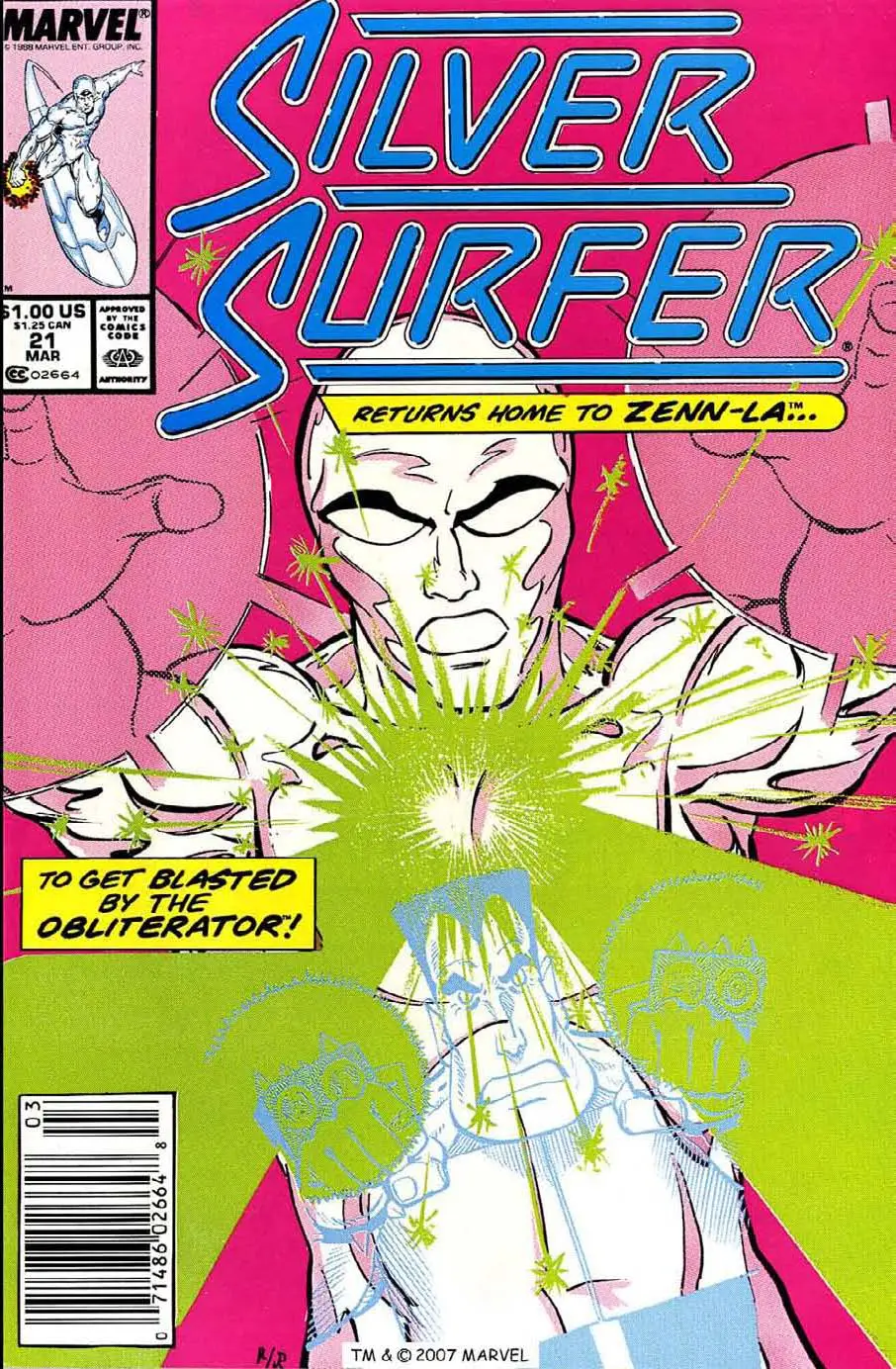
Silver Surfer vol. 3 #21: Marshall Rogers' fill-in, the Obliterator's revenge on Zenn-La.
Issue #21 (March 1989) is a curiosity, and Englehart's own website is briskly honest about it: it was a fill-in, the only issue of the first thirty-one he didn't write.[3] Marshall Rogers returns one last time, plotting as well as pencilling, with Michael Higgins scripting, for a revenge tale that fits awkwardly into the timeline (the Kree attack the Surfer despite their truce; nobody mentions Nova; sharp-eyed fans have long suspected it was built for a slot around #11).
The Obliterator, the weapon-obsessed Elder the Surfer disarmed into catatonia back in #6, has been rotting on his prison world ever since, sustained by a single promise: the Contemplator's astral form once appeared to him, urging him to re-arm and vowing to send a ship. The ship never came, for the excellent reason that Captain Reptyl ate the Contemplator in the interim. (The fill-in winks at the main continuity even while sitting outside it.) So the Obliterator, tired of waiting, steals transport and aims his rage at the most hurtful target available: Zenn-La. Cue a distress call from Shalla-Bal and a Kree armada in the Surfer's way. What follows is a slugfest on the homeworld against an immortal who, fought to a standstill, escalates to threatening the entire planet before the Surfer finally puts his rampage down. It's a serviceable action issue wearing another era's clothes, and its status as the stretch's least compromised story tells you something about what was happening to the issues around it.
Behind the Curtain: Marvel Goes Into Reverse
Now for the story the user of a time machine would actually want to witness. On his own website, Englehart divides his Silver Surfer run (like his Fantastic Four and West Coast Avengers runs of the same period) into three phases. The middle one begins here, with what he calls Marvel's decision to go into reverse.[4] Under new management — Jim Shooter, who had greenlit the series, was fired in 1987; Tom DeFalco now held the Editor-in-Chief's chair — the company-wide mood turned against the kind of long-braided, status-quo-smashing serial storytelling Englehart had been doing. He'd done it on the FF, where he'd benched Reed and Sue, and on the Surfer, where he'd built a twenty-issue cosmic epic. The directives came down.
The first order, as Englehart tells it, was to abandon the approach that had finally made the Silver Surfer sell and return to the formula that had failed for twenty years. That meant single-issue stories with a moral, starring a Surfer once again pining for Shalla-Bal — a lost love who, as he acidly notes on the site, “hadn't been his girlfriend since issue 2 of this run”. You can watch the order take effect in real time: after eighteen issues of interlocking saga, the book abruptly downshifts into stand-alone fables about melancholy wandering.
The second order is the one that should make every cosmic-Marvel fan's jaw drop. Englehart wrote an issue (intended as #23) teaming the Surfer with Thanos and Mantis, and was informed that Thanos was not allowed to appear in Silver Surfer.[5] The script would have united the God of Death (Thanos) and the Goddess of Life (Mantis) more than a decade before Englehart finally staged that pairing in 2001's Avengers: Celestial Quest. It was simply shelved. The irony needs no underlining, but let's underline it anyway: within eighteen months, Jim Starlin, Thanos's creator, would take over this very title, resurrect Thanos in its pages, and launch from it the Thanos Quest and The Infinity Gauntlet, one of the most celebrated cosmic storylines Marvel ever published. The Mad Titan was banned from the book that was about to become his home. Englehart noticed too; his site remarks, with an almost audible sigh, that the prohibition would have come as news to Starlin.
With the Mantis-as-companion plan equally dead (editorial had vetoed her as the Surfer's ongoing partner), her storyline was evacuated into Englehart's other books. The Annual #1 backup had already bridged her to Avengers West Coast; the actual reunion and farewell landed in his Fantastic Four #323–325, in the middle of the line-wide Inferno crossover, of all places.[6] There, at last, the Surfer and Mantis found each other again on Earth. There, too, she left her mortal body to follow her Cotati kindred into space, gone as completely as death. Readers of Silver Surfer itself never saw it happen. The book's own captions in #23 and #24 simply mourn that the moment the Surfer learned Mantis lived was the moment he lost her forever, then footnote the reader to another series. The love story at the heart of the run's first year ends off-panel, in a crossover tie-in, by editorial order.
And here is where the credits box becomes a battlefield. Englehart, by his own account, made sure the public knew what was going on. The clearest signal was his own name. Across this compromised stretch the byline begins to fracture. Issue #22 still carries his full name, but from #23 the coldly anonymous “S.F.X. Englehart” takes over (S.F.X., he'd note, for “Simple Sound Effects”). The second annual's backup stories carry the estrangement to its limit[7]: the affectionate old 1970s Bullpen handle “Stainless Steve” Englehart appears like a memory of better days beside the same “S.F.X.,” and, on one, his name is dropped entirely for “John Harkness,” the disposal pseudonym he reserved for work he refused to own. Harkness was working overtime that season. Over on Fantastic Four, Englehart says he was ordered to bring back Reed and Sue and undo every change he'd made. The entire #326–333 stretch went out under the pseudonym, while the real FF slept in suspended animation and dreamed the stories he'd been forbidden to tell. A writer signing his work in escalating degrees of estrangement, in full view of a hundred thousand readers a month, is one of the strangest and most poignant protests in Marvel history.
It came to a head in what Englehart describes as a period of “civil war inside Marvel”. And then came the armistice. The Editor-in-Chief offered him a deal: “I could have six months or so to wrap up SILVER SURFER with no interference, but then I'd be gone.” He took it.[8] In the event, the “six months or so” stretched to seven: the finale ran across seven issues, #25 to #31 (July 1989 to January 1990), bookended by double-sized issues at #25 and #31. The first issue under the new arrangement, #25, was titled “Back from Black?” — the question mark deliberate. As he notes with satisfaction, the question answered itself. The war he had been building since issue #2 would be fought after all. (His site's postscript on the whole affair is magnificently acidic: “When I left, Clumsy Foulup ruled the Kree Empire, and four years later, Marvel was bankrupt.”)
The Forced Fables (#22–24)
Read against that backstage drama, the three “formula” issues become fascinating artefacts: professionally crafted, handsomely drawn by Ron Lim and Tom Christopher, and visibly a book writing with its hands tied, each one a fable with a moral, each one soaked in mourning for someone beloved.
“Monsters... from the Ego!” (#22, April 1989)
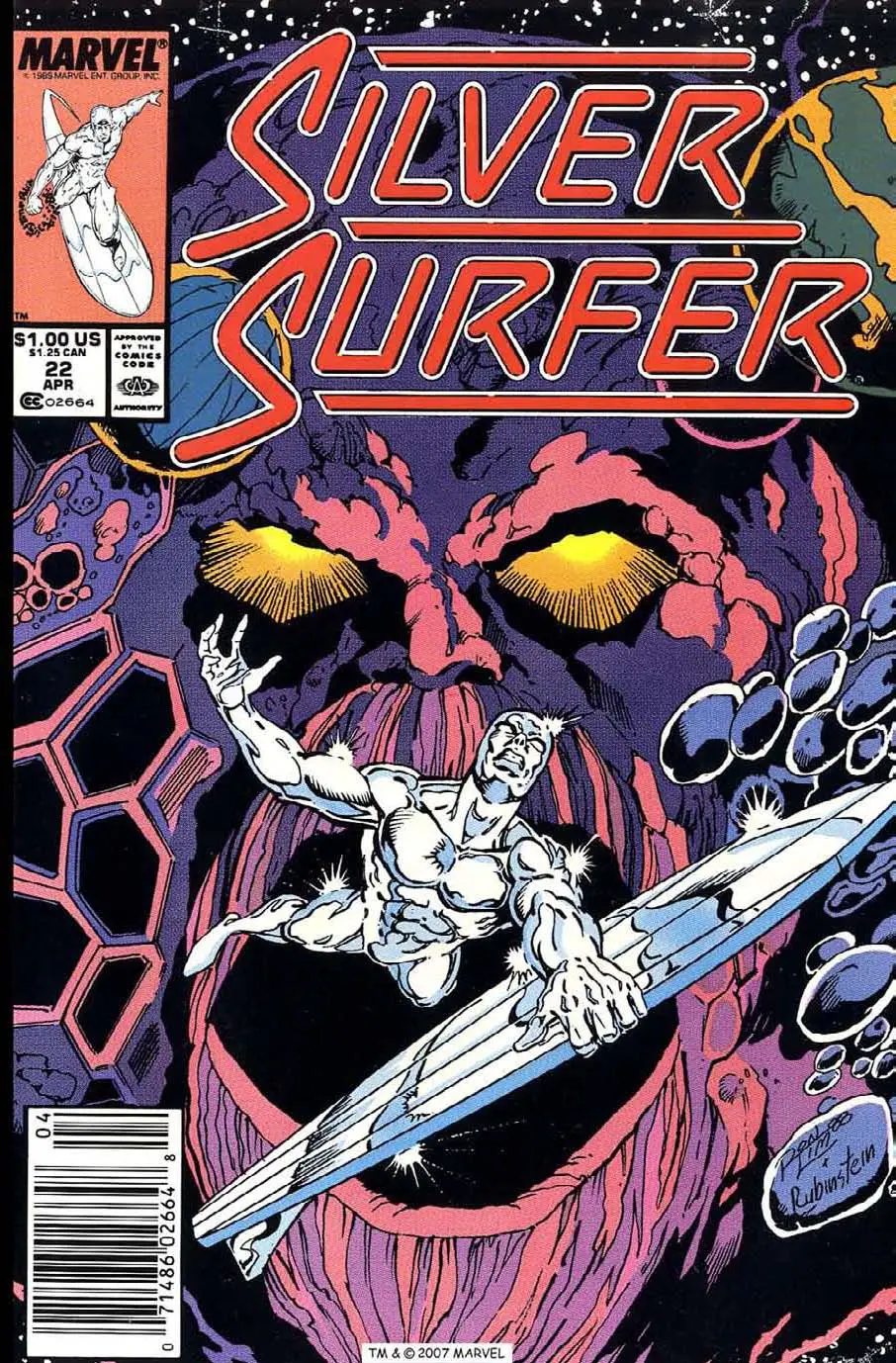
Silver Surfer vol. 3 #22: “Monsters… from the Ego!”
This issue is the best of them, because it builds on real continuity rather than conjuring a moral from nothing. Ego the Living Planet (an Elder, remember, and the venue for the conspiracy's conclave back in #4) ambushes the Surfer in deep space, pins him to his own surface and locks the board in orbit.
What was Ego's grievance? Long ago — while Thor, Hercules and Firelord held the maddened planet at bay — Galactus bolted a colossal starship engine to Ego's south pole, a leash driving him endlessly through space so he could never again menace inhabited worlds, and the strain of resisting it has left the planet ravenous.[9]
He intends to digest the Surfer for the calories. The escape is classic resourceful-Surfer. Unable to blast free, he fights his way to the thruster itself, recognises his old master's handiwork, and seizes control of it. He aims the Living Planet straight at the nearest sun until Ego, screaming, agrees to let him go. Asked to destroy the leash as a parting favour, the Surfer coolly declines — Galactus chained this particular monster for a reason.
He flies off, sensing as he goes that a world has somehow moved within Earth's solar system.
That thread pays off not here but over in Fantastic Four #325 (April 1989), another book Englehart was scripting under the same duress. Chasing the disturbance, the Surfer finds the Human Torch stranded and unconscious in deep space near Mercury, marooned there by Kang in the course of a scheme involving Mantis. The Surfer throws in with the Fantastic Four and Mantis against Kang, the Cotati and their servants the Priests of Pama. The battle ends in a draw: the plant-beings flee into “the realm of pure thought,” and Mantis leaves her own body behind to follow them and rescue her son.
Englehart almost certainly meant this as a holding action for Mantis — a way to set her gently aside, out of the game, until he could pick up her threads in his own time. As he put it afterwards, he “took her untold storyline and moved it, with middling success, to the FF”: a salvage operation for a character Marvel's upheaval had otherwise left stranded.[10]
“Alien!” (#23, May 1989)
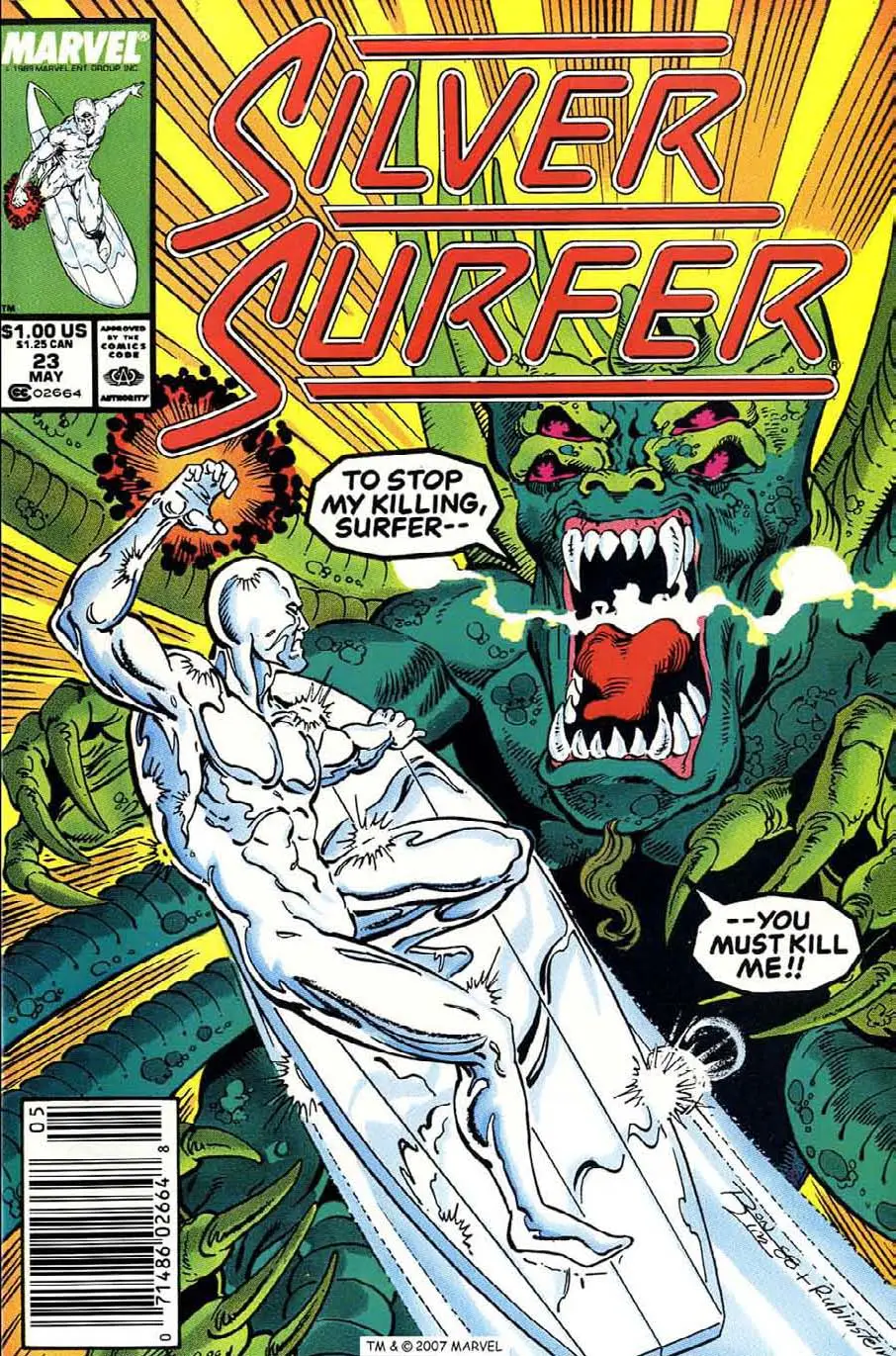
Silver Surfer vol. 3 #23: “Alien!”
Grief-stricken over Mantis, the Surfer drifts to a world he personally spared from Galactus generations ago. There he finds its people setting their own planet ablaze — a desperate beacon for off-world help against a “dragon” that has been killing them one by one from behind a cloaking screen. He strips away the creature's invisibility and confronts it. The dragon insists the accusations are lies. The fable grinds to its bitter end, the creature dead and nobody feeling saved.
It is exactly the kind of morality one-off the directive demanded, delivered with a shrug you can almost feel through the page.
“G.I.G.O.” (#24, June 1989)
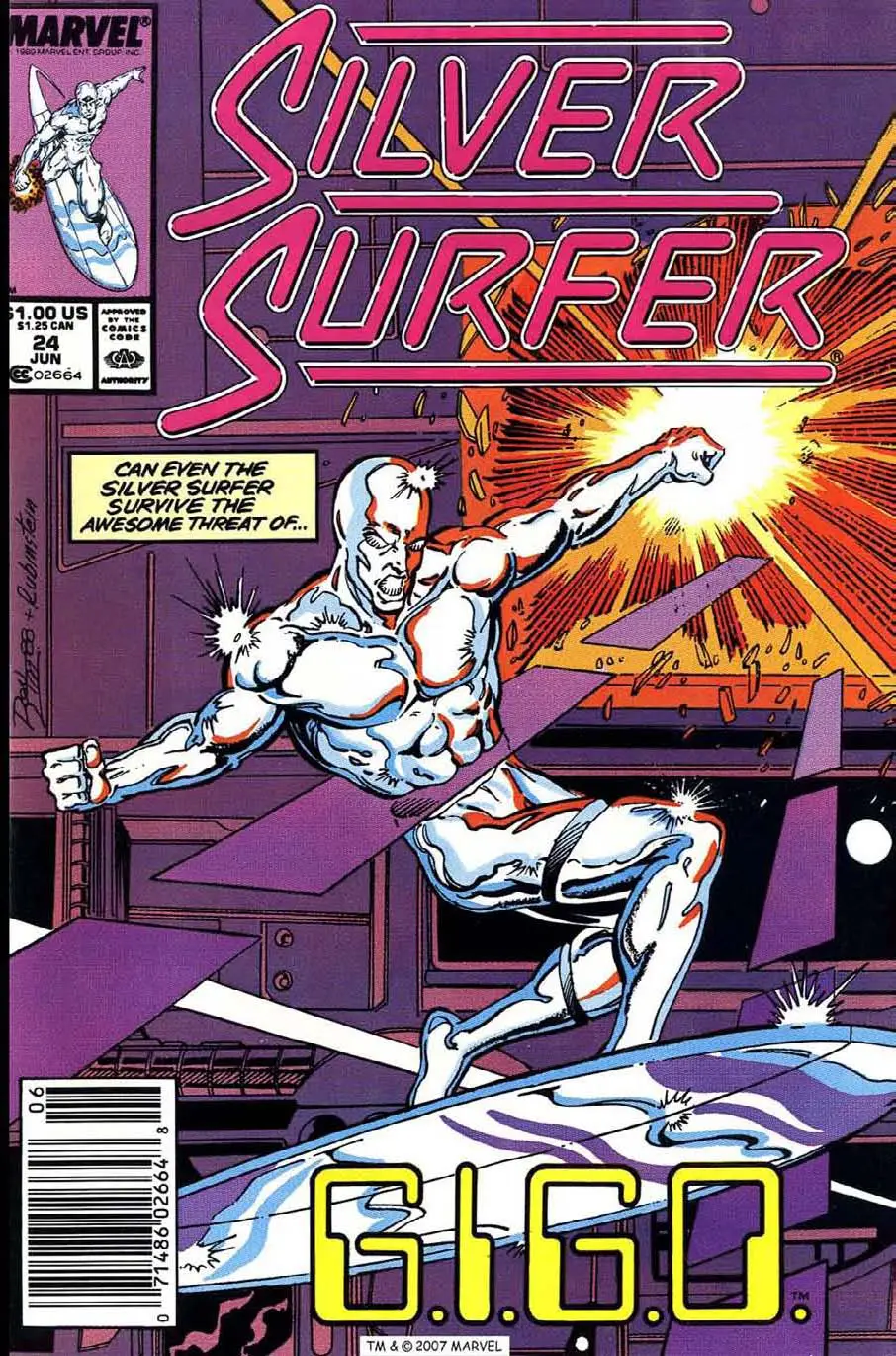
Silver Surfer vol. 3 #24: “G.I.G.O.”
The last of the fables sends the still-mourning wanderer to a gleaming crystalline world that proves to be a single vast computer, Motherboard 49.7.[11] It identifies him as a herald of Galactus — and therefore an existential threat — and throws endless automated armadas at him. The one genuine pleasure here is visual: Randy Emberlin's inks over Ron Lim's pencils, which lend the artwork a crisp, fresh feeling the thin story cannot muster on its own.
The Surfer battles his way to the machine's heart for a debate with a paranoid operating system. And the title is the tell. Englehart's own site dryly notes that G.I.G.O. is a computer term — Garbage In, Garbage Out. From a writer being force-fed a formula he despised, that is about as close to signing the issue “under protest” as a title can get.
Fans combing the run have noticed how little these issues give a summariser to work with, compared to the twenty that preceded them. The writer made sure we'd recognise this shrinkage.
The Second Obligation: Silver Surfer Annual #2 (1989)
The year's annual is the other item produced under the yoke: the Surfer's chapter of Atlantis Attacks, 1989's fourteen-part serpent-god crossover slithering through every Marvel annual.[12]
Drawn by Ron Lim with a committee of inkers, and co-credited with Renée Witterstaetter, it opens on a peculiar hook. Cleaning a green residue from the underside of his board, the Surfer unthinkingly channels the Power Cosmic through it and brings it to life, resurrecting Ghaur, the Deviant high priest. Ghaur promptly sets off for Earth to hunt the Serpent Crown and summon the elder god Set, whose origin the issue pauses to recount — and the Surfer, drawn back into the Kree–Skrull war and the defence of Zenn-La, cannot give chase.
The back pages carry a Peter Sanderson-scripted chapter of the crossover's Serpent Crown history, plus a Nova solo tale in which Englehart, never off duty as a cosmologist, restates his grand design: that our universe balances on the trinity of Eternity, Death and Galactus.
Contemporary and retrospective readers alike rank the annual as eminently skippable. The credits games swirl around this very neighbourhood of the run — the clearest sign of how its writer regarded the obligation. Its one lasting service is calendrical: by the time it shipped, the issues alongside it on the stands were already something else entirely.
What This Chapter Teaches Us
This is the chapter where the book's two stories — the Surfer's and Englehart's — become conjoined, and the lesson lives in that overlap. On the page, a being who was finally set free finds himself constrained all over again: pushed into wandering fables, robbed of the companion he'd chosen, told where he may and may not go. Off the page, the writer who set him free endures the same thing: handed a book, then ordered to unmake the very qualities that had made it work. The chapter's title, “The Surfer in Shackles,” names both prisoners at once.
What Englehart does with those shackles is the actual lesson, and it is a bracing one about integrity under constraint. He does not walk off the job, and he does not phone it in: the “forced fables” are still professionally built, still handsomely drawn, still solid comic books. But he also refuses to pretend the constraint isn't there. He signs his estrangement in the credits; he titles a compromised issue “Garbage In, Garbage Out”; he lets the reader see, without ever breaking the story, that this is honest work done under protest. There is a difference, this chapter insists, between compromise and capitulation. To compromise is to keep making the best thing you can inside limits you didn't choose, while telling the truth about those limits. To capitulate is to internalise them, to start believing the smaller thing is all you ever wanted to make. Englehart compromised and never once capitulated, and the credits box is the proof.
And then there is the deal itself, which is the cleanest moral in the run's whole backstage story: offered six months of freedom to finish the book properly in exchange for his job on it, he took it. He traded the ongoing position (the pay cheque, the security, the future) for the right to give his story a real ending. Most of us are never asked the question that starkly. But it is worth knowing where you stand, because some version of it comes to everyone who makes things: what is finishing this well actually worth to you? Englehart's answer, which is also the answer of every artist who ever chose the work over the sinecure, was that an ending you're proud of outlasts a job you're not. Thirty-five years later the job is long gone and the ending is still here. He was right.
Hold, too, the smaller lesson tucked into the “forced fables”: even the wandering, grief-soaked, editorially mandated one-offs are shot through with genuine emotion. The man was mourning Mantis on the page while mourning his own creative freedom off it, and the grief was unfeigned either way. Sometimes the honest work you do while trapped carries just as much of you as the free work ever did. Suffering, undramatised and undeflected, has a way of getting into the heart of your writing.
The Shackles Come Off
Because the deal had been struck. Six months, no interference, one ending: everything Englehart had been seeding since a spy smiled her way onto the Kree throne was finally cleared for detonation. The Super-Skrull has found his empress. The severed head has found its stooge. Shalla-Bal has half-perceived a thought she was never meant to catch. And issue #25 is titled “Back from Black?”, with a question mark the next seven issues will spend erasing.
The finale is next: the second Kree–Skrull war in full — shapeshifting restored, empires aflame, a pirate admiral, a puppet Supreme Intelligence, the Living Tribunal explaining the universe, and the single most gloriously absurd coronation in Marvel history.
Frequently Asked Questions
Which Silver Surfer comics does Part 5 cover?
Part 5 covers Silver Surfer volume 3, issues #19 to #24 and Annual #2, published in 1989. It follows a heartbreak engineered by Titan and the fill-in fables Englehart wrote under protest.
Who wrote and drew these comics?
They were written by Steve Englehart and drawn by Ron Lim.
Is The Freest Being in the Universe free to read online?
Yes. The complete book is free to read here on marincomics.com, all six parts, richly illustrated. If you would like to support the author, you can also buy the paperback or Kindle edition on Amazon.
What is The Freest Being in the Universe about?
The Freest Being in the Universe is Marin Balabanov's chapter-by-chapter appreciation of Steve Englehart's cosmic Silver Surfer, volume 3, issues #1 to #31, published from 1987 to 1990. It recaps every issue and asks what the stories teach us about freedom, identity, grief, and finding a third path beyond false either-or choices.
Notes and Sources
- Englehart left the book with #31 (January 1990) without ever paying off this thread directly. Thankfully, the only pay-off it ever received came at the climax of Ron Marz's “The Herald Ordeal” (Silver Surfer vol. 3 #70–75, 1992): when Galactus's cast-off herald Nova is killed by her replacement, Morg the Executioner, Galactus reacts with rare grief — stripping Morg of the Power Cosmic — a flash of genuine feeling that vindicates Englehart's tease without ever developing it into the jealous romance he seemed to be building. See Silver Surfer vol. 3 #75 (December 1992), Marvel Database — marvel.fandom.com. ↩
- The principle that persons must be treated as ends in themselves and never merely as means is the second formulation of Immanuel Kant's Categorical Imperative (Groundwork of the Metaphysics of Morals, 1785). Covert emotional manipulation — however well-intentioned — is a paradigm case of using another as a mere means by bypassing their rational consent. ↩
- On #21's fill-in status and credits, see steveenglehart.com and the Grand Comics Database (comics.org). ↩
- Steve Englehart, “Silver Surfer 22-24,” steveenglehart.com: “when Marvel made its decision to go into reverse,” he was told “to go back to the formula which hadn't worked: one issue stories, with a moral, while he pined for his lost girlfriend (who hadn't been his girlfriend since issue 2 of this run).” — steveenglehart.com. ↩
- Steve Englehart, “Silver Surfer 22-24,” steveenglehart.com: “I wrote an issue (what would have been #23) with Thanos and Mantis, and was told Thanos was not allowed in SILVER SURFER.” — steveenglehart.com. ↩
- The Surfer/Mantis reunion and Mantis's departure into space were staged in Englehart's Fantastic Four #323–325 (1989) — a Kang-and-Cotati cosmic subplot running alongside his Inferno tie-in issues (Fantastic Four #322–324) — rather than in Silver Surfer itself. See Fantastic Four #325, Marvel Database — marvel.fandom.com. ↩
- On the precise per-issue attribution — including “S.F.X. Englehart” on Fantastic Four #323–325 and “John Harkness” on Fantastic Four #326–333 — see the discussion of the omnibus credits at Captain Comics — captaincomics.ning.com — and Englehart's own site. ↩
- Steve Englehart, “Silver Surfer 25-31,” steveenglehart.com; he sums up taking the deal as “I took one for the team.” — steveenglehart.com. ↩
- The engine on Ego's south pole dates to Thor #228 (October 1974, by Gerry Conway and John Buscema): after a maddened Ego absorbed the Wanderers, Thor — aided by Hercules and Firelord — held the planet off until Galactus fixed a massive starship engine to it, driving Ego endlessly through space so he could no longer threaten inhabited worlds. Ego explains as much in Silver Surfer #22, which footnotes the reader back to that issue. The thruster therefore long predates the Elders' conspiracy of the Englehart run; Ego's grievance against Galactus is genuinely ancient. See Thor Vol. 1 #228, Marvel Database — marvel.fandom.com. ↩
- Steve Englehart, “Fantastic Four 322-325,” steveenglehart.com — steveenglehart.com. ↩
- Steve Englehart, “Silver Surfer 22-24,” steveenglehart.com — steveenglehart.com. ↩
- Silver Surfer Annual #2 (1989). Credits per the Grand Comics Database (comics.org). ↩