The Freest Being in the Universe
Part 4
Into the Black Hole: Malice, the In-Betweener, and the War of the Third Forces
The fourth instalment of my book The Freest Being in the Universe, serialised here on the web. This is chapter three of five on the Englehart Surfer: Silver Surfer vol. 3 #15–18 (September–December 1988) — the arrival of Ron Lim, a jailbreak between universes, and Steve Englehart at the absolute height of his powers.
August 2026
Get it on:
Amazon.com →
Amazon.de →
Amazon.co.uk →
This article series is the full text of the book.
If
you'd like to support the author, please feel free to purchase
a physical copy or the Kindle ebook.
Every long run has its summit, and for my money this is Englehart's: four issues in which many threads laid down since #1 pull taut at once. The dying Galactus from the annual's backup, the gems down the black hole from #9, the Grandmaster's pact with Death, Sue Richards' buried demons from a Byrne-era Fantastic Four story, Jim Starlin's abandoned 1970s cosmology, and even a passing spaceship from the other comic Englehart was writing that month — all of it converges into a single story about two universes, two trinities, and the god who stands between.
And carrying it all is a new artist whose arrival genuinely changes the book's metabolism.
Enter Ron Lim (On Board at Last)
Ron Lim was twenty-three when he took over Silver Surfer with #15, and the speed of his ascent still startles.[1] A Sacramento kid who'd studied commercial art and grown up drawing Batman and the Fantastic Four, Lim came up through the mid-eighties black-and-white independent boom: his earliest published pages appeared in tiny-press titles (Shadow Star #3, the very first release from Slave Labor Graphics, and The Eradicators for Silverwolf) before his real breakthrough as co-creator and penciller of Ex-Mutants with writer David Lawrence at Eternity Comics in 1986. That post-apocalyptic series became a minor indie phenomenon, surviving a publisher hop amid rights disputes and eventually carrying its creators' names on the masthead: Lawrence & Lim's Ex-Mutants, a remarkable billing for an artist barely out of his teens. He also logged time on Mike Baron's The Badger at First Comics.
Marvel found him at a comic convention in 1987, where he was hired essentially on the spot. His apprenticeship was served in the New Universe, Jim Shooter's ill-starred “realistic” imprint, where Lim pencilled a stretch of Psi-Force in its later days, plus incidental Marvel work: a Solo Avengers fill-in here, Official Handbook entries there, and, as covered last time, the two backup stories in Silver Surfer Annual #1 that served as his audition. Lim himself has described the move from Psi-Force to the Surfer as “my big leap”, and it's hard to think of a bigger one: from a cancelled imprint to the book that would define him. He would stay for the better part of six years and roughly eighty issues (the longest tenure of any artist in the character's history) and go on to draw Thanos Quest, The Infinity Gauntlet, Infinity War and Infinity Crusade, becoming, for a generation of readers, simply what Marvel's cosmos looks like.
There's a lovely alignment in his influences, too. Lim has named his three artistic lodestars as Jim Starlin, George Pérez and John Byrne. And his very first arc on the book is built from Starlin's 1970s cosmic toybox and pivots on a dark persona Byrne created for Sue Richards. What he brought to the page was immediately obvious: clean, open figures; effortless kinetic staging; a gift for making impossibly vast beings read clearly in a panel; and a reliability that would become legendary. After the transitional wobble of the Staton issues, the book visibly straightens its spine. With Joe Rubinstein's polished inks providing continuity, #15 feels like a second launch.
The Setup (#15): A Dying God and a Family Outing
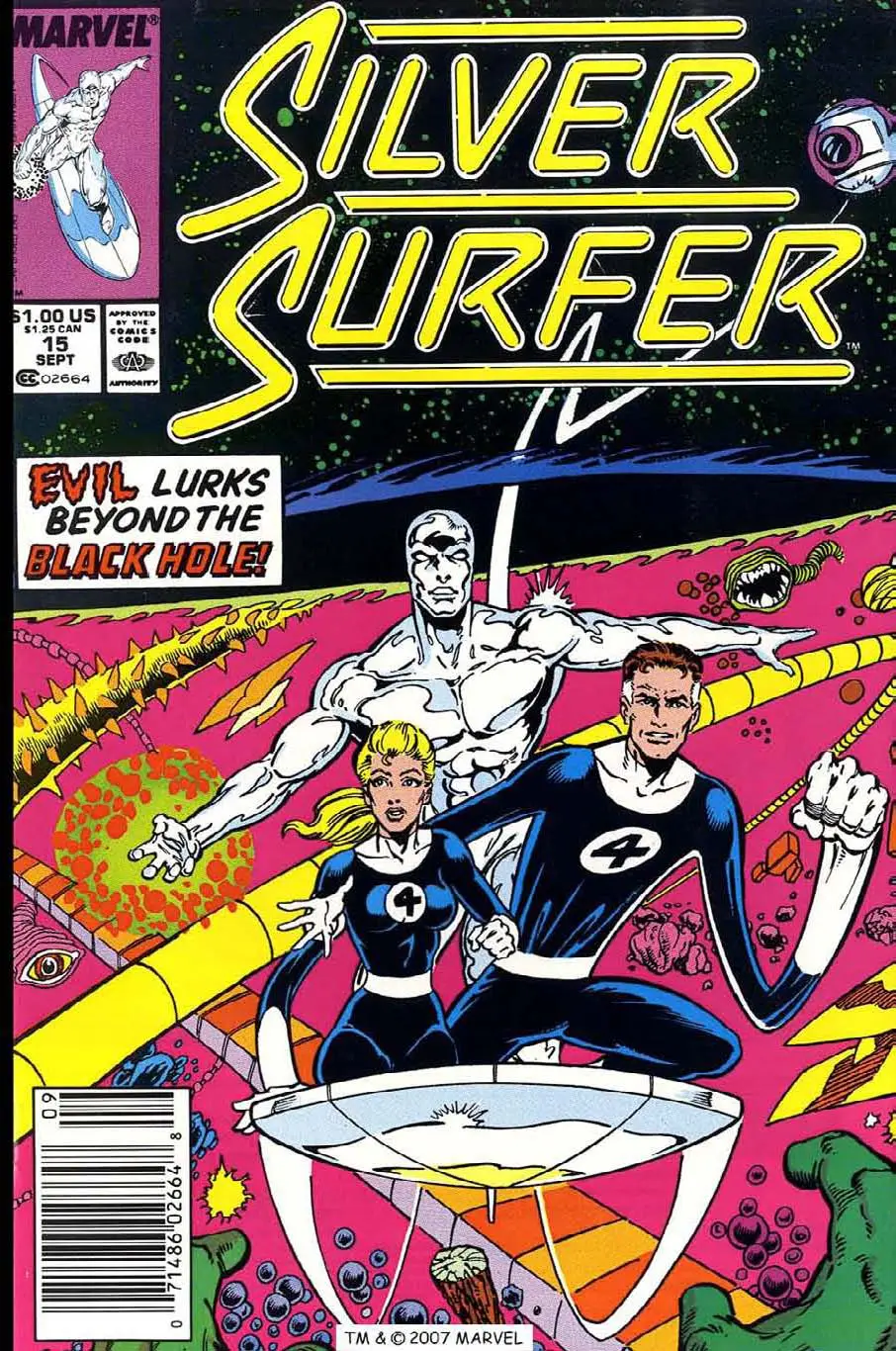
Silver Surfer vol. 3 #15: Ron Lim's first issue — the rescue party enters the Magick Realm.
The fuse lit in the annual's Ron Lim backup now detonates. Galactus is dying: the five Elders of the Universe he devoured in #10 (Grandmaster, Collector, Champion, Runner, Gardener) cannot die, because of the Grandmaster's pact with Death, and cannot be digested, and so they sit inside the devourer of worlds like five immortal tumours, killing him by inches. The only cure lies with the six Soul Gems, which vanished into the black hole in #9 along with the three surviving conspirators: the Trader, the Possessor and the Astronomer. And so Galactus, through Nova, summons the strangest rescue party in the book's history: the Silver Surfer, Mister Fantastic and the Invisible Woman, with little Franklin Richards along for the ride. Why Reed and Sue, semi-retired from the Fantastic Four and enjoying suburban life? Reed for his mind, and Sue quite specifically for her force fields, because Galactus issues one non-negotiable warning about the prize: among the six gems is the Soul Gem itself, Adam Warlock's old vampiric jewel, and no one must touch it. Only invisible force can handle it safely.
What lies through the black hole is not crushed matter but another universe entirely: the Magick Realm, a reality where sorcery holds the place physics holds in ours.[2] Englehart sketches it with delight. The Silver Surfer guides the Galactus-built ship, with Reed and Sue Richards aboard, across the threshold into a cosmos with different rules. There is a first brush with the Elder called the Possessor, and then the quarry itself: the Astronomer and the Trader, gems in hand, suspiciously unbothered by their exile. And then the trap inside the travellers springs. Reed grows colder, more remorselessly logical by the hour. Sue grows wilder — until she stops being Sue at all and turns into Malice, Mistress of Hate.
A word on Malice, for readers who came to this book without the Fantastic Four homework. In John Byrne's celebrated mid-eighties run (FF #280–281), the Psycho-Man and the Hate-Monger corrupted Sue Richards into Malice, Mistress of Hate, a leather-clad embodiment of every resentment the sweetest member of the FF had ever swallowed.[3] Sue broke free, and emerged so changed by the experience that she retired “Invisible Girl” forever and renamed herself the Invisible Woman. Malice was supposed to be buried. In the Magick Realm she claws straight back up. And we'll learn shortly that this is no ambient side effect: something inside the Realm has been actively infecting Reed with pure order and Sue with pure chaos since they arrived, playing the couple like instruments.
Malice is one of the most quietly unsettling ideas in the whole run, and she works because of a psychological truth the story handles with real care: the reason she has such purchase on the sweetest member of the Fantastic Four. It is precisely because Sue is so patient, so accommodating, so reliably kind, that she has a lifetime of unexpressed resentment stored up to be weaponised: every swallowed slight, every time she was overlooked or condescended to and smiled instead of saying so. Malice is not an alien imposition; she is Sue's own buried anger given a face. This is as clean an illustration of the psychological shadow as popular fiction offers: the Jungian insight that the parts of ourselves we refuse to acknowledge don't dissolve when we bury them; they go underground, gather force, and wait for a moment of weakness or the right infection to come roaring back with interest.[4] The lesson is not that Sue should be less kind. It's that kindness which works by suppression rather than by honesty builds up a pressure that will eventually find a crack. The feelings we won't look at own us more completely than the ones we will. And notably, it is not the villains' power that finally frees her later; it's the reassertion of who she actually is. You do not defeat your shadow by pretending it isn't yours. You defeat it by claiming it.
Malice's opening move is breathtaking in its cruelty: she shoots the Silver Surfer point-blank in the face with an energy weapon, stunning him, and trades him to the Trader — a herald of Galactus for the six Soul Gems, straight across. As #15 closes, the most powerful hero in the book is an Elder's chattel, the gems belong to a woman who wants Galactus dead out of spite, and Reed Richards is lying very still on the ground, apparently beaten.
Malice at the Crossroads (#16)
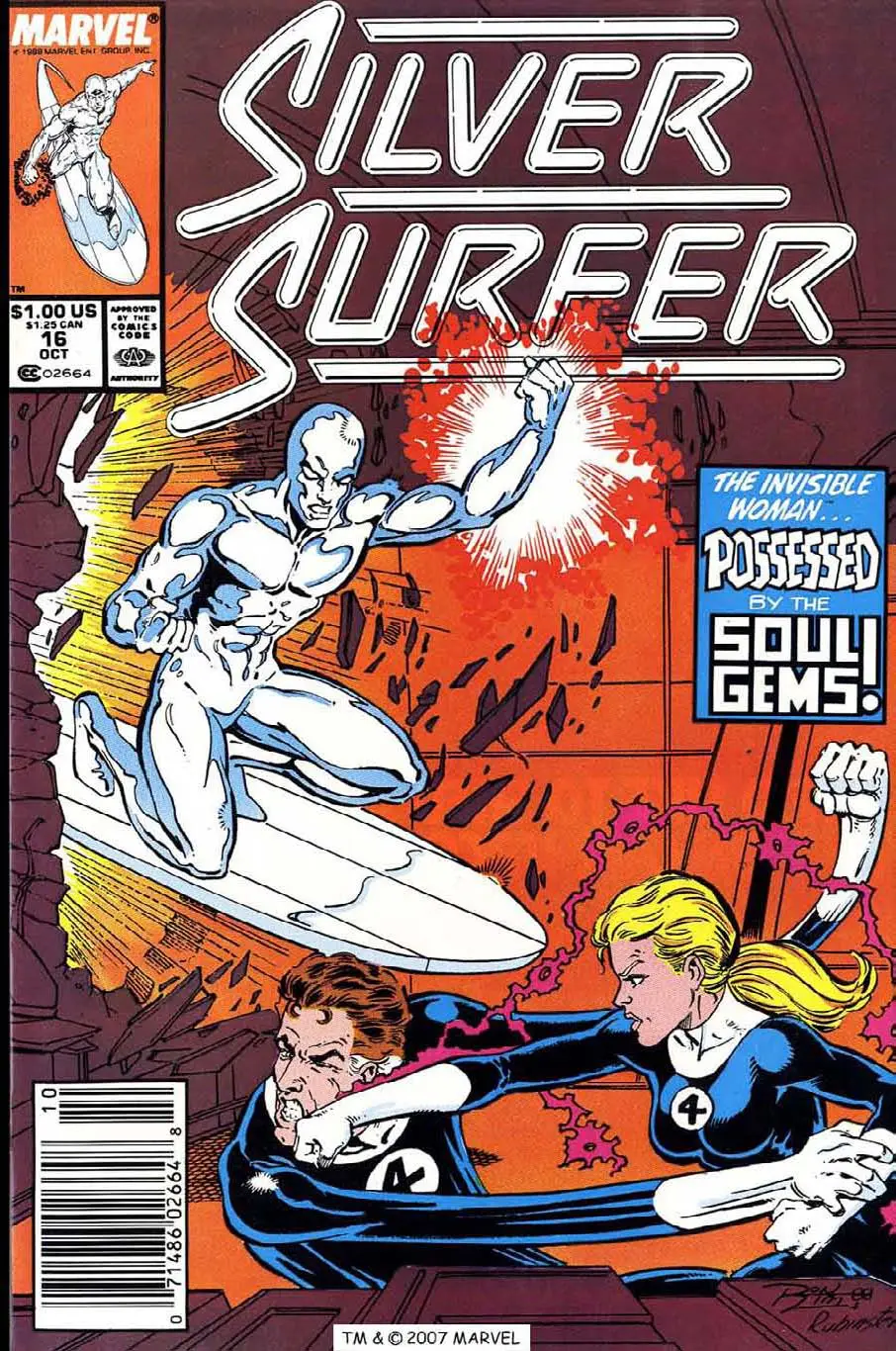
Silver Surfer vol. 3 #16: Malice at the mouth of the black hole.
Reed, it turns out, was playing dead — and #16 opens with him running a con. The Surfer is sealed in the Trader's energy field, a prison he can only leave if the Trader dies, which the Elders find hilarious: Elders cannot die. Except, Reed observes pleasantly, here they can. The Grandmaster's bargain was struck with the Death of our universe; her writ does not run in the Magick Realm. The entire foundation of the Elders saga, twelve issues of smug immortality, inverts in a single page, and suddenly the two exiled Elders very much want to go home, which they cannot do without the Surfer's power. A deal is struck: the Surfer's freedom for passage back. It's Englehart's plotting at its most elegant: the villains' great victory transformed into leverage against them, by the simple act of changing jurisdictions.
And that phrase, changing jurisdictions, is one of the most practically useful ideas in the entire book, so it's worth lifting out of the plot and looking at directly. The Elders' immortality feels like an absolute, a brute fact of reality against which no strategy can succeed. It is nothing of the kind. It is a contract, valid within one jurisdiction and meaningless outside it. Reed Richards defeats it not with greater force but by noticing the boundary of the frame and stepping across it. This is how a great many “impossible” problems actually yield. The constraint that looks like a law of nature turns out to be a rule with a scope, true only inside the context you have been unconsciously accepting. The move, then, is not to push harder against it but to change the context in which it applies. Reframing is not a trick or a dodge; it is often the whole of wisdom in a hard situation. Before you exhaust yourself fighting an immovable object, it is worth asking Reed's question: is it actually immovable, or only immovable here? Half the things that hold us do so only because we never thought to check where their authority ends.
Freed, Reed and the Surfer race after Malice, who has reached the mouth of the black hole in the expedition ship, gems orbiting inside her force field, savouring the thought of letting Galactus rot. Her ship's Galactus-built weapons nearly end the pursuit until the Surfer improvises gorgeously, flaring his silver body brighter than a nova to blind her targeting, and the two men crash through the hull for a superhero brawl with the possessed Invisible Woman.
And mid-brawl comes an unexpected moment in this chapter. Another ship flashes past the viewport, carrying the Thing, the Human Torch, Sharon Ventura and Doctor Doom, and is gone. This is the crossover with Fantastic Four #319, and it is a perfect little jewel of shared-universe play.[5] Englehart was writing both books; that very month, in the giant-sized “Secret Wars III” (art by Keith Pollard, the same artist once attached to Stan Lee's abandoned liberation graphic novel, and Joe Sinnott), the active Fantastic Four are on a cosmic expedition of their own, hauling Doom through the Negative Zone and across the Crossroads of Infinity to confront the Beyonder in the pocket universe his energies became. As they cross that trackless between-space, Ben and Johnny are stunned to see a ship carrying their old teammates Reed and Sue — and the Silver Surfer — streak past and vanish before anyone can react; Ben wants to turn around, and Doom coldly orders them to stay on course. Same instant, two comics, two camera angles: FF #319 shows the encounter from inside the FF's ship, and Silver Surfer #16 shows it from inside the Surfer's, and the issue even points readers across the aisle to its sister title. Englehart seemingly cherishes this kind of inter-book stitching, and here he weaponises it, because the cameo isn't decoration: the sight of his old teammates is precisely the distraction that makes Reed Richards drop his guard, and in that heartbeat one of the circling gems brushes his arm.
It is, of course, the gem. The Soul Gem fixes itself to Reed's brow and takes him. The possessed Mister Fantastic turns on his companions, reaching first for the Surfer's soul — and fails. It is a beat that pays off twenty years of continuity: Norrin Radd has spent a career resisting the greatest soul-thief in creation, Mephisto, and one jewel is not the devil. Thwarted, the gem takes Sue's soul instead. And as the battle tumbles into the black hole itself, the puppeteer finally steps out of the puppet. The entity leaves Reed's body and stands revealed: a being split down the centreline into black and white. He announces that every step of this quest has gone according to his design.
Enter the In-Betweener.
The God Between (#17)
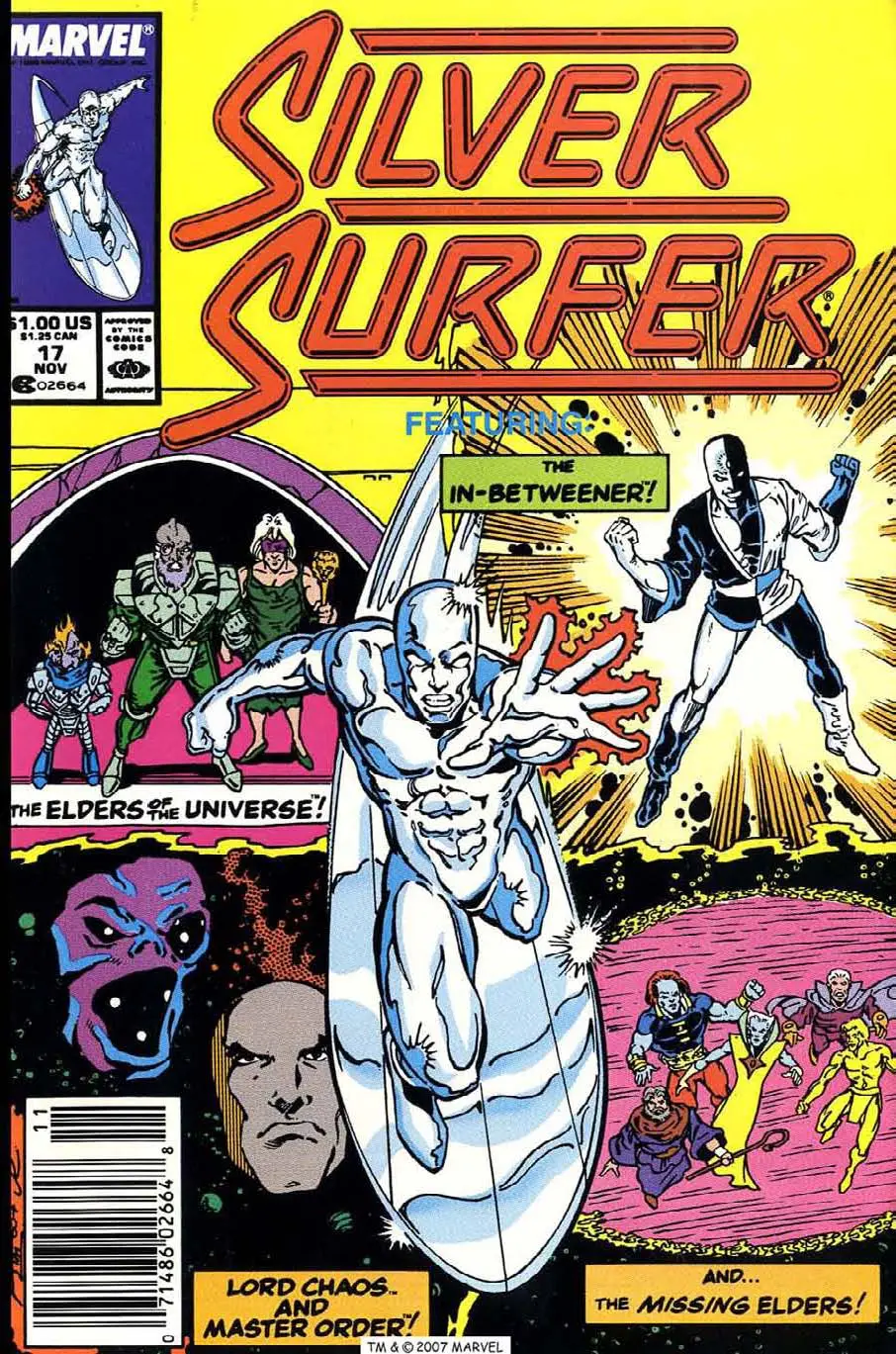
Silver Surfer vol. 3 #17: Master Order, Lord Chaos, and the god between them.
Time to meet the metaphysics. Englehart now unpacks a cosmology he inherited from Jim Starlin and deploys here to masterful effect. Master Order and Lord Chaos (twin abstractions manifesting as vast disembodied heads, one serene, one warped) were revealed in the Thanos-era climax of Marvel Two-in-One Annual #2, the personifications of the two great opposing principles, forever counterweighted against each other. To keep their eternal opposition in balance they created an agent: the In-Betweener, who debuted in Starlin's mid-seventies Warlock saga and later bedevilled Doctor Strange (who beat him, tellingly, by appealing over his head to his masters).[6] The In-Betweener is the living synthesis of every duality — life and death, logic and emotion, reality and illusion, good and evil — and he wears the concept on his body, his face and form divided precisely into black and white halves.
Englehart's masterstroke is to mirror him against Galactus. Back in #10, remember, Eternity paid Galactus a visit, and the reason now snaps into focus: Galactus is the third force of our universe, the balancing element in the trinity he forms with Eternity and Death, a being beyond and absent of all dualities. The Magick Realm is the mirror: its ruling dichotomy is Order and Chaos, and its third force is the In-Betweener, the crossroads of all dualities. Two universes, two trinities, and the two “third men” are each other's reflection and negation. This is the idea the Living Tribunal will spell out fully at the very end of Englehart's run, but it is born here: proper cosmic philosophy smuggled into a monthly superhero comic, with fistfights.
The true design behind the plot mechanics of #17 now comes clear. The whole quest, it emerges, was a jailbreak: the In-Betweener, imprisoned and diminished in the Magick Realm, made a pact with the three exiled Elders (his restoration and their passage home, in exchange for his promise to kill Galactus). The arrival of the Surfer, Reed and Sue was the final piece his freedom required. Restored, he strands the three heroes in the Magick Realm, souls and all, and crosses into our universe with the Elders and all six gems. At the worldship, the defence is heartbreakingly thin. Franklin Richards raises the alarm, Galactus's Punisher robot is swatted into scrap, Nova is beaten down. Then the little boy does the only thing left: he takes Nova's hand and hides the two of them inside Galactus himself.[7] Then the In-Betweener unleashes everything on the ailing devourer... and nothing happens. He cannot kill Galactus in this universe. He attempts to summon Galactus's opposite to do the deed, and the summons returns empty. In a realisation that lands on him like vertigo, he himself is Galactus's opposite. A third force cannot unmake a third force on its home ground.
So the In-Betweener chooses exile instead: he hurls Galactus through the black hole to die in the Magick Realm. And here the alliance shatters, magnificently. The three Elders protest (their five brethren are still trapped inside Galactus, and this plan dooms them), and the In-Betweener's answer is the coldest panel of the issue. He summons Death, and forces her to unmake the Trader, the Astronomer and the Possessor. Her steadfast vow to the Grandmaster is overridden by the one being with authority over the boundary between life and death itself. Three Elders of the Universe, immortals older than stars, simply cease.
Meanwhile, in the Magick Realm, the stranded and soul-damaged trio play their last card: at the Surfer's urging they blaze a signal into the void and summon the Realm's true masters. Master Order and Lord Chaos descend, listen to the Surfer's account of their servant's treason, and act. The five Elders are expelled from Galactus's body, alive, and Franklin and Nova are safely released from their hiding place within him too. The devourer of worlds rises from his sickbed made whole, with exactly one item on his agenda...
The In-Betweener, Galactus declares, must die.
Heavyweights (#18)
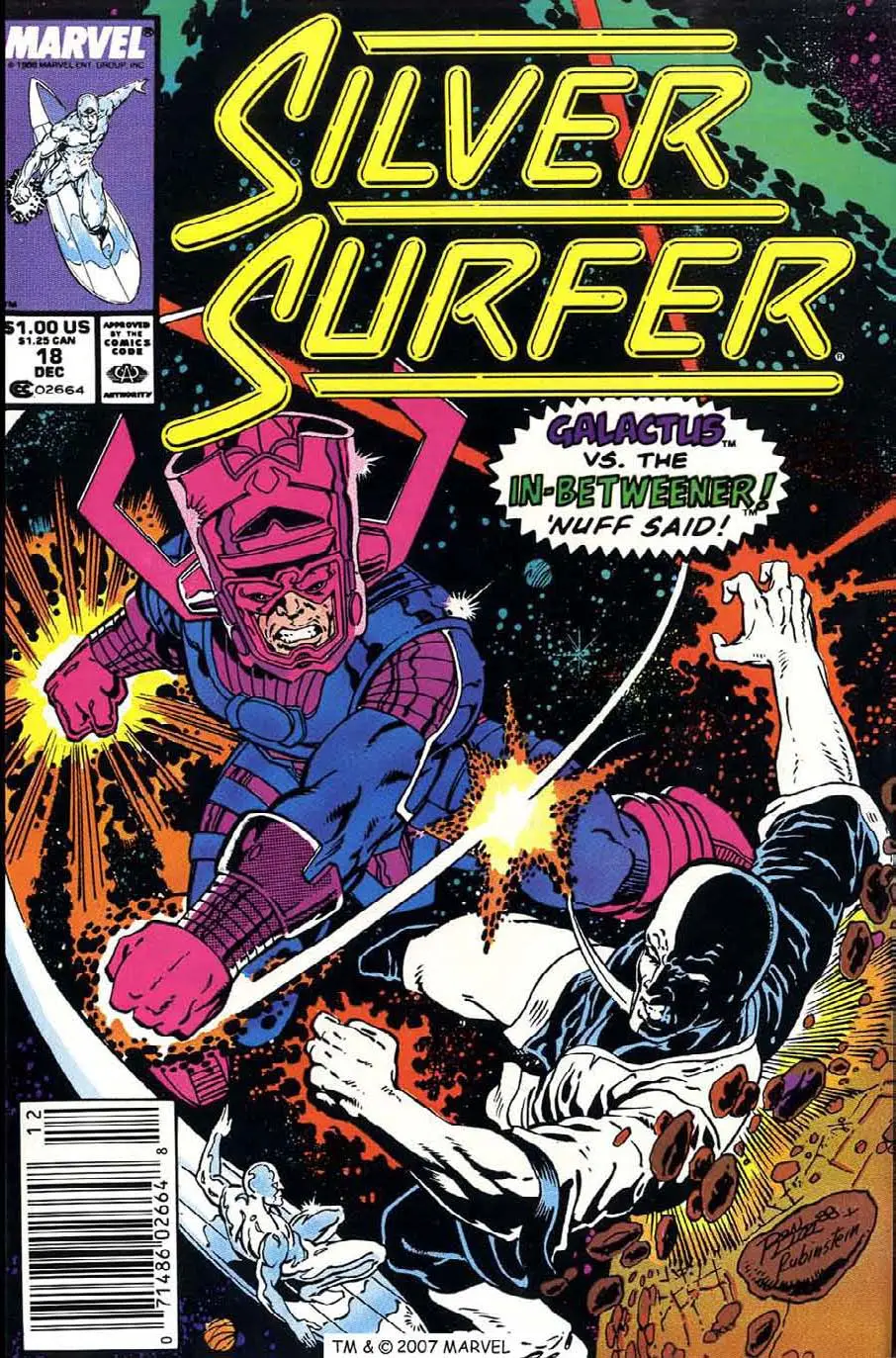
Silver Surfer vol. 3 #18: Galactus versus the In-Betweener, third force against third force.
The finale is the title bout this four-issue saga has been shadow-boxing towards: Galactus versus the In-Betweener, third force against third force, watched from the cheap seats by the Surfer, Nova, the entire Richards family and five freshly-disgorged Elders. Ron Lim goes all-out here, pitching the brawl at a properly cosmic scale: two god-sized combatants trading blows across the void, shattering planets and swatting moons aside as casually as furniture. They are, by definition, evenly matched, which is the problem, and which gives Englehart room for the issue's two great grace notes.
The first belongs to Franklin. While hiding inside Galactus, the boy dreamed of a weapon, and now he asks his father about the Ultimate Nullifier. Attentive readers may recall it from the opening chapter of this book: this is the device Johnny Storm carried out of Galactus's ship in Fantastic Four #48–50, the only thing in creation the devourer fears, the MacGuffin of the original Galactus Trilogy, summoned back after twenty-two years by a child's dream.[8] Reed and Sue refuse; the Nullifier could erase existence itself. Franklin, being a Richards, goes to fetch it anyway, only to be caught and scolded seconds from doomsday. It's funny and a bit terrifying at once, and it reminds you whose son this is.
The second belongs to the Surfer, and it's this story's thesis on its hero: he cannot out-punch a god, so he out-thinks one, with allies. The battle drifts towards the black hole, the In-Betweener steering it there deliberately, believing he'll be mightiest at the midpoint between his two natures, between the universes themselves. There, the Surfer canvasses the five Elders, each now holding a Soul Gem again. He finds them very willing: the In-Betweener made Death break her vow on three of their brothers. The play: the Surfer blends his Power Cosmic with the massed power of the Elders' gems and pours the combined torrent into the black hole, while Nova, insisting on her duty as herald, rides the mouth of it and channels the flow. The current runs one way only, and a creature whose whole existence is balance cannot abide a one-way flow. The In-Betweener is dragged, raging, back through the hole into his home dimension, where his makers are waiting. Master Order and Lord Chaos seize their disobedient creation and imprison him at the very apex of order and chaos, sealed at the balancing point he was built to embody. Then, with the impersonal courtesy of abstractions, they expel Galactus and every mortal back to our universe, and the war of the third forces is over.
What looks like mere housekeeping in the aftermath is anything but. The six gems are redistributed under the auspices of Order and Chaos: five pass to the five living Elders (the Grandmaster, notably, ends up holding the Mind Gem, the very stone the Surfer tore from the Supreme Intelligence's brow in #8) and the Soul Gem itself remains with the imprisoned In-Betweener. Mark that seating plan well. When Jim Starlin comes to write Thanos Quest two years later, sending the Mad Titan to collect six “Infinity Gems” one keeper at a time — the Champion, the Runner, the Gardener, the Collector, the Grandmaster, and a vulnerable, imprisoned In-Betweener — he will find every gem exactly where Steve Englehart left it. The most famous cosmic story of the 1990s eats at a table Englehart set here, in a December 1988 issue of Silver Surfer.[9]
Why This Is a Summit
Consider what these four issues braid together: a backup story from an annual; a poisoning set up eight issues earlier; a pact with Death from an Avengers annual; Sue Richards' darkest hour from another writer's run, honoured rather than ignored; three Starlin abstractions dusted off and given the best story of their existence; a live crossover with the writer's own Fantastic Four, staged so the cameo has plot consequences; and the Ultimate Nullifier, summoned from 1966 by a sleeping child. And underneath the machinery lie real ideas (jurisdiction as a weapon against immortality, a cosmology of mirrored trinities, a hero who defeats gods by understanding what they are) and real character, from Reed's cold-blooded con to Malice's venom to Franklin's terrifying helpfulness. Ron Lim renders all of it with wonderful clarity and vigour, gods and gems and black holes made legible and thrilling.
This is Steve Englehart at his very best, and everything in the run before it now reads as ascent.
What This Chapter Teaches Us
Two ideas rise out of the spectacle, and they are the philosophical heart of the whole run.
You defeat what you cannot overpower by understanding what it is. The Surfer and his allies are, in raw terms, hopelessly outmatched here: by Elders older than stars, by a god, by the living synthesis of every duality in creation. They win anyway, and they win the same way every time: not by hitting harder but by comprehending the nature of the thing in front of them and using that nature against it.
The Elders can't die — but only under one jurisdiction. The In-Betweener can't be killed by Galactus — because he is Galactus's opposite, and a balancing force cannot unmake a balancing force. So the Surfer beats him by exploiting the one thing his essence cannot tolerate: a flow that runs only one way, an imbalance in a being built from balance. In a genre that usually resolves on who can punch hardest, Englehart keeps insisting that the mind that grasps the shape of a problem beats the fist that merely strikes at it. It is a deeply consoling idea for anyone who will never be the strongest person in the room: understanding is a power available to the physically outmatched, and it is very often the decisive one.
And beyond every pair of opposites, look for the third thing. The metaphysics Englehart builds here (Eternity and Death balanced by Galactus; Order and Chaos balanced by the In-Betweener; two universes, two trinities, each with its “third force” standing outside the binary) is not just cosmic set-dressing. It is a genuine philosophical proposition, and one of the key theses of the entire run: that the truth of things is rarely captured by the duality you're offered. Life presents itself as pairs — this side or that, order or chaos, more or less, us or them — and the mind that can only see the two poles is trapped between them, forced to pick. The wisdom the story keeps pointing at is the recognition that almost every real duality is completed by a third element that stands apart from both and gives the pair its meaning. The Taoists intuited it; Hegel systematised a version of it; Aristotle put the virtue in the mean between two vices.[10] Englehart smuggles it into a monthly superhero comic and will let the Living Tribunal spell it out in full at the very end, but it is born here, in the war of the third forces. When you find yourself cornered by a binary, the story advises, the exit is usually not to choose a side. It is to find the third thing.
The next chapter is the hangover. Firelord comes looking for a fight, Eros of Titan commits a romantic crime, and the Surfer mourns his way across the galaxy in a string of melancholy one-offs. And off the page, the writer who built all this goes to war with his own employer.
Frequently Asked Questions
Which Silver Surfer comics does Part 4 cover?
Part 4 covers Silver Surfer volume 3, issues #15 to #18, published from September to December 1988. It follows Sue Richards becoming Malice and the In-Betweener's plot to kill Galactus.
Who wrote and drew these comics?
They were written by Steve Englehart and drawn by Ron Lim, who joined the book as its regular penciller with issue #15.
Is The Freest Being in the Universe free to read online?
Yes. The complete book is free to read here on marincomics.com, all six parts, richly illustrated. If you would like to support the author, you can also buy the paperback or Kindle edition on Amazon.
What is The Freest Being in the Universe about?
The Freest Being in the Universe is Marin Balabanov's chapter-by-chapter appreciation of Steve Englehart's cosmic Silver Surfer, volume 3, issues #1 to #31, published from 1987 to 1990. It recaps every issue and asks what the stories teach us about freedom, identity, grief, and finding a third path beyond false either-or choices.
Notes and Sources
- Ron Lim was born in 1965 in Sacramento, California. For his biography and career, see Ron Lim, Wikipedia — en.wikipedia.org — and Comic Book Historians, “CBH Interviews Ron Lim” (2018) — comicbookhistorians.com. ↩
- The black hole as doorway to another cosmos is one of science fiction's most durable conceits, running from Disney's The Black Hole (1979) through the reboot Star Trek (2009). Physics is less obliging. A non-rotating (Schwarzschild) black hole ends in a singularity, where tidal forces stretch anything that falls in into a thread — the property physicists cheerfully call “spaghettification” — with no exit: crushed matter, precisely. The lone theoretical loophole is the idealised rotating (Kerr) black hole, whose ring singularity and inner horizon admit mathematical paths that avoid destruction and, on paper, open onto another region of spacetime; this is the physics kernel behind every fictional gateway. But such a passage is almost certainly unphysical: the inner (Cauchy) horizon is violently unstable, and any genuinely traversable wormhole would require exotic negative-energy matter never observed in nature. Tellingly, when the physicist Kip Thorne advised Interstellar (2014), its long-distance travel was routed through a wormhole, not a black hole, for exactly this reason. See Singularities — Black Holes and Wormholes, The Physics of the Universe — physicsoftheuniverse.com — and Ring singularity, Wikipedia — en.wikipedia.org. ↩
- The Malice storyline ran in John Byrne's Fantastic Four #280–281 (1985). See Fantastic Four #281, Marvel Database — marvel.fandom.com. ↩
- The “shadow” — the disowned aspects of the self that, unacknowledged, gain autonomous force — is a central concept of Carl Jung's analytical psychology; see Jung, Aion (1951) and The Archetypes and the Collective Unconscious (1959). ↩
- The crossover issue, Fantastic Four #319 (Oct. 1988), is the second half of a two-part story billed as “Secret Wars III,” which began in #318 (Sept. 1988). The quest: Doctor Doom, desperate to reclaim the god-like power and the fragment of memory he had briefly seized and then lost in the original Secret Wars (1984), forces the Fantastic Four to carry him through the Negative Zone to the Beyonder's pocket universe, there to settle once and for all what the Beyonder actually is. The answer, teased across Englehart's whole run, lands here: the Beyonder was a flawed, immature Cosmic Cube, and — with the former Cubes Kubik and the Shaper of Worlds presiding — he merges with the Molecule Man into a new one. See Fantastic Four #319, Marvel Database — marvel.fandom.com. ↩
- First appearances: Master Order and Lord Chaos in Marvel Two-in-One Annual #2 (1977); the In-Betweener in Warlock #9 (Oct. 1975). Both created by Jim Starlin. See In-Betweener, Wikipedia — en.wikipedia.org. ↩
- A clarification for the literal-minded. Galactus is a cosmic being older than the present universe, not a very large man with a rib cage, so “inside” here should conjure no digestive imagery whatsoever. As established at the climax of the Trial of Reed Richards (Fantastic Four #262, Jan. 1984), Galactus has no single true form at all: every species perceives him differently, and the familiar Kirby armour is merely the shape the human mind imposes on something it cannot otherwise hold. Franklin and Nova shelter within his energies, his essence, his frame-of-being — whatever one wishes to call the interior of a living force of nature. Not, to be absolutely clear, his stomach. See Fantastic Four #262, Marvel Database — marvel.fandom.com. ↩
- The Ultimate Nullifier debuted in the original Galactus Trilogy, Fantastic Four #48–50 (1966), as the one weapon Galactus fears. ↩
- The Thanos Quest #1–2 (1990) and The Infinity Gauntlet #1–6 (1991), both written by Jim Starlin with art by Ron Lim (and George Pérez on the latter), sent Thanos to collect the six gems — renamed the “Infinity Gems” — from the Elders of the Universe, exactly where Englehart's Surfer run had placed them. Starlin took over Silver Surfer itself with #34. See The Thanos Quest, Wikipedia — en.wikipedia.org — and CBR, “How Silver Surfer Paved the Way for Infinity Gauntlet” — cbr.com. ↩
- The motif of a resolving or mediating third beyond a pair of opposites recurs across traditions: the Tao Te Ching's account of the interplay of opposites; Aristotle's doctrine of virtue as the mean between two vices (Nicomachean Ethics, Book II); and Hegel's dialectic, in which a thesis and antithesis are taken up into a higher synthesis (Science of Logic, 1812–16). ↩