The Freest Being in the Universe
Part 3
Pirates, Accusers, and the Other Silver Surfer
The third instalment of my book The Freest Being in the Universe, serialised here on the web. This is chapter two of five on the Englehart Surfer: Silver Surfer vol. 3 #11–14 (May–August 1988) and Silver Surfer Annual #1 — the transitional stretch that changes artists, frames the hero, and hands the Skrulls their salvation.
August 2026
Get it on:
Amazon.com →
Amazon.de →
Amazon.co.uk →
This article series is the full text of the book.
If
you'd like to support the author, please feel free to purchase
a physical copy or the Kindle ebook.
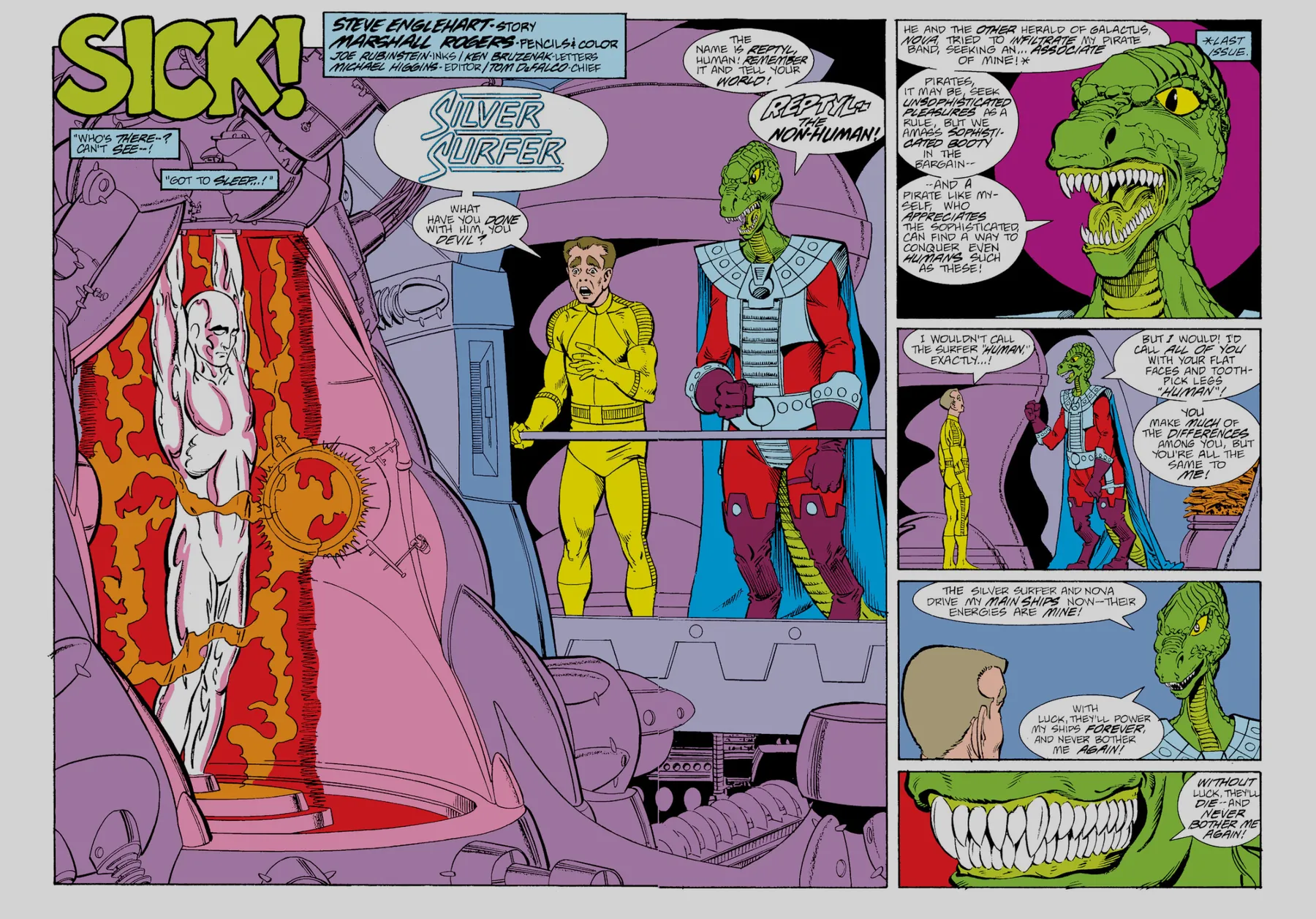
Silver Surfer vol. 3 #12: the "Sick!" opening spread, Marshall Rogers' final issue as regular artist, with the Surfer reduced to a living battery as Captain Reptyl holds court.
After the operatic scale of the Elders saga, the book takes a breath. Yet, these four issues and their accompanying annual are anything but idle. Together, they introduce a new villain to the run and frame the Silver Surfer for war crimes. They also kill off two claimants to the Skrull throne, plant a doomsday device in Earth's radiation belts, and release an old Fantastic Four foe from the energy prison where John Byrne had left him years earlier.
This is a transitional period in the truest sense. Every scene acts as a hand moving a piece into position for the two epics still to come. Behind the curtain, the machinations wound up in the first ten issues keep ticking. Nenora consolidates her stolen throne, the devoured Elders churn undigested inside Galactus, and Death's displeasure hangs over everything like weather.
Changing of the Guard
The most visible transition is at the drawing board. Marshall Rogers, who had pencilled and coloured the first ten issues in that luminous, love-it-or-hate-it palette, bows out. Issue #12 is his final one as the regular artist (he'll return once, for a #21 fill-in). Stepping in for #11, #13 and #14 is Joe Staton, a warm and sturdy storyteller who was no stranger to Englehart: the two had famously worked together on DC's Green Lantern a decade earlier.[1] With Cockrum, Marzan and Rubinstein trading inking duties and Tom Vincent taking over colours, the book's look shifts noticeably: friendlier, rounder, and, without Rogers' radioactive glow, admittedly a shade more earthbound. Contemporary readers felt the dimming; but Staton keeps the machine running smoothly through a stretch dense with plot.
And waiting in the wings is the future. Tucked into this period's annual are two backup stories drawn by a young Ron Lim, his first work in the Surfer's corner of the universe. Within a few months Lim would take over the ongoing series at #15 and become, across years of issues, Thanos sagas and Infinity crossovers, perhaps the most celebrated Silver Surfer artist of them all. This little transitional pocket is literally where the baton gets passed: Rogers hands off to Staton, and Staton warms the series for Lim.
The Pirate King (#11–12)
Galactus's errand (find the Contemplator, the one Elder unaccounted for) takes the Surfer and Nova first to Kree-Lar, where they get a sharp lesson in consequences: with the Supreme Intelligence driven insane (by the Surfer himself, tearing loose from its mind in #8), the empire is now run by Supreme Leader Nenora. Neither herald knows what the reader knows: that the new ruler of the Kree is a Skrull spy. Nenora points them toward the stars ringing the Coalsack Nebula, a region so thick with primitive chemical life that flying through it is like navigating a labyrinth of tar, and now home to a thriving culture of space pirates. She and the Surfer strike a cautious bargain of mutual assistance, a truce that will matter later, in ways nobody at the table intends.
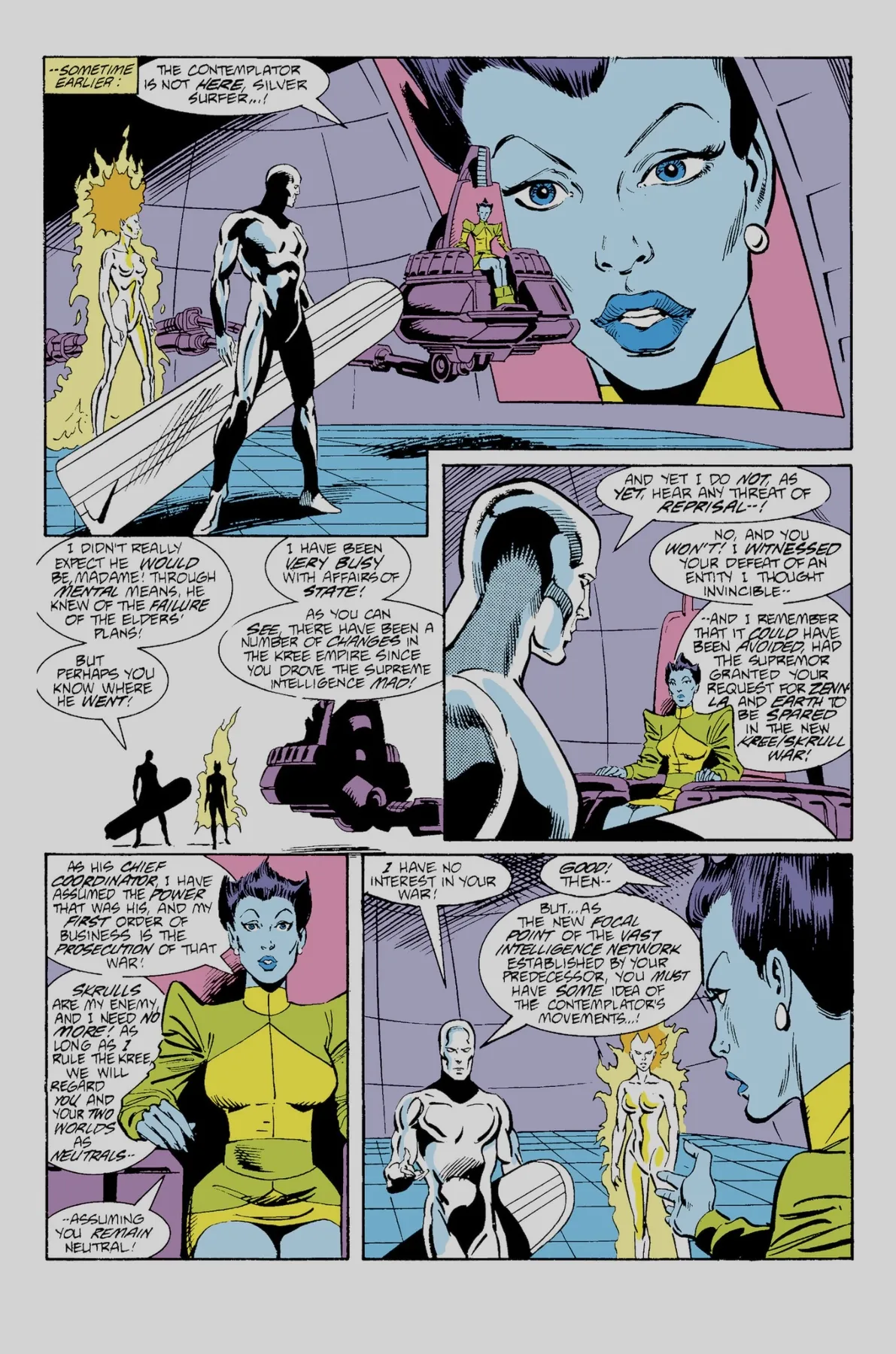
Silver Surfer vol. 3 #11: on Kree-Lar, the Surfer and Nova strike a wary bargain with Supreme Leader Nenora, neither herald knowing she is a Skrull spy.
Enter Captain Reptyl. A hulking saurian corsair with a shark's grin, a three-foot tail and a magnificently uncomplicated worldview (he despises “humans”, a category in which he generously includes every humanoid and mammal in the galaxy), Reptyl is Englehart's best new creation for the series, and Staton clearly relishes drawing him. It emerges that the Contemplator has been hiding among the pirates all along: Reptyl, despite his prejudices, granted the Elder shelter from Galactus's wrath because they were both born of the Coalsack, because the Contemplator's own race died out four billion years ago, and because the Elder had always left Reptyl's people alone. Forewarned by his guest, Reptyl lets the disguised Surfer and Nova infiltrate his own birthday party. Their cover lasts exactly as long as it takes the crewman Clumsy Foulup to get jealous over a dance with Nova and start a brawl, and then Reptyl springs a trap that takes both heralds of Galactus in a single stroke.
Meanwhile, light-years away, the issue plants its nastiest seed: something that looks exactly like the Silver Surfer descends on a Kree outpost, is welcomed as an ally, and slaughters everyone in it.
Issue #12 opens with a cruel image: Nova and the Silver Surfer, two most powerful beings in the sector strapped into Reptyl's machinery as batteries, their cosmic energies siphoned to power his fleet, both of them drained, nauseous and barely conscious. What saves them is, in a lovely touch, Mantis's legacy.
One of the Cotati, the telepathic plant race into which Mantis married, has been living disguised as a decorative plant aboard Reptyl's base, and it reports the Surfer's plight to its kin, who consider him an ally for Mantis's sake. The Cotati reach across space and take control of Clumsy Foulup through a psychogenic herb the hapless pirate happens to have eaten, and the galaxy's least likely rescuer shambles down to the cells and frees Nova. (In her drained delirium, Nova has been having visions: of a false Silver Surfer attacking the Kree, and of Nenora as a Skrull. Both of the era's great secrets, glimpsed and not yet understood.)
Nova promptly declares war on the pirate fleet single-handed; Reptyl, a cold-blooded pragmatist to the last scale, jettisons the comatose Surfer into space as a distraction and runs for the Coalsack, abandoning half his own crew — Foulup included — drifting in their suits. And when the Contemplator dares to criticise the retreat, Reptyl settles the argument in the most Reptyl way imaginable: he bites the Elder of the Universe in the throat and eats him.
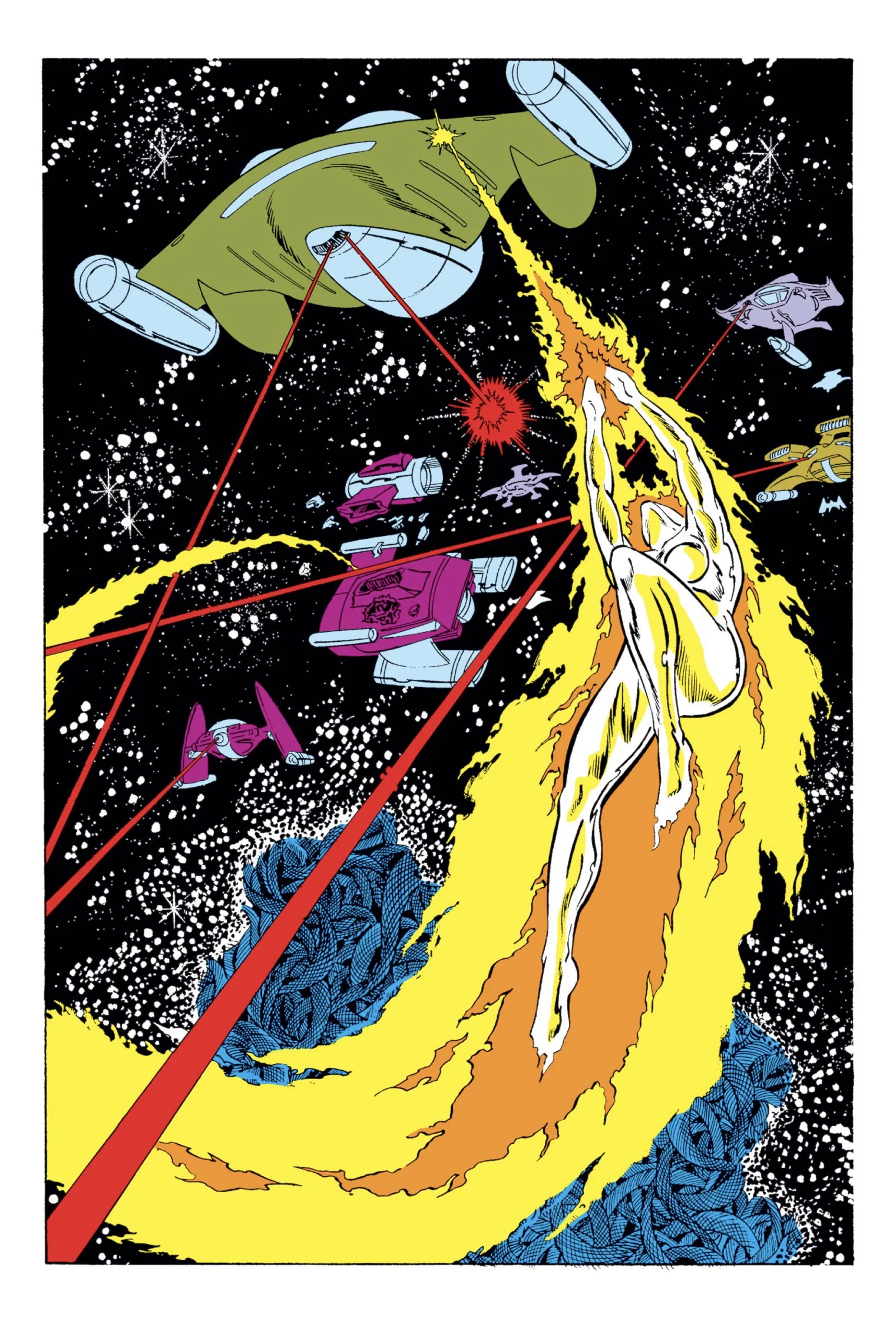
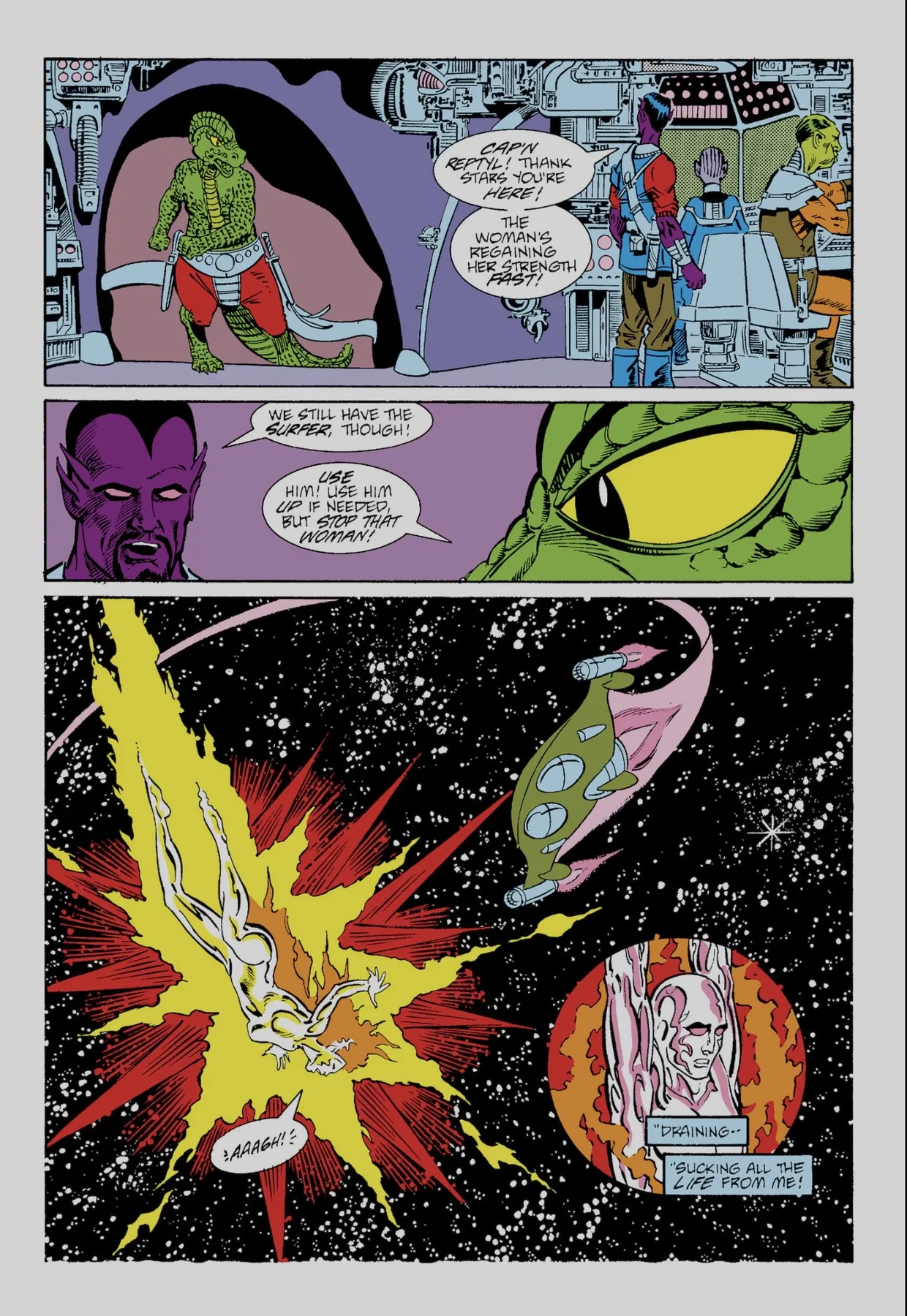
Silver Surfer vol. 3 #12: Nova wages war on the pirate fleet single-handed while Reptyl drains the Surfer to power his ships, then casts him adrift.
Let the record show: as issue #13 opens, a severed head goes tumbling out of an airlock into the void, and when the Surfer and Nova later pass the grisly thing on Reptyl's trail, they leave it where it floats. Remember that head. The full truth of who Reptyl actually ate, and what that leftover is still capable of, is a matter for a later chapter, and it will reshape the entire endgame of this run.
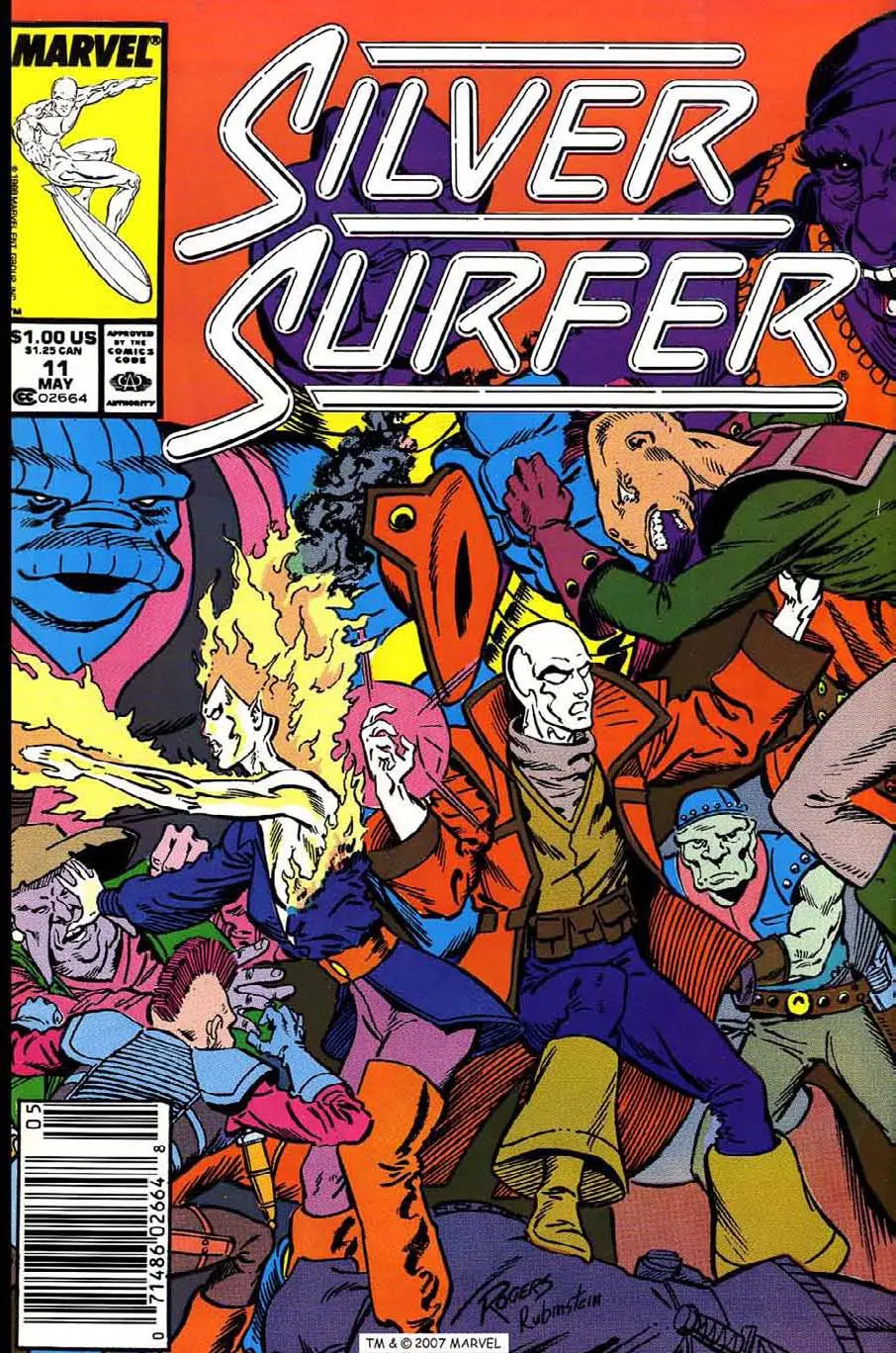
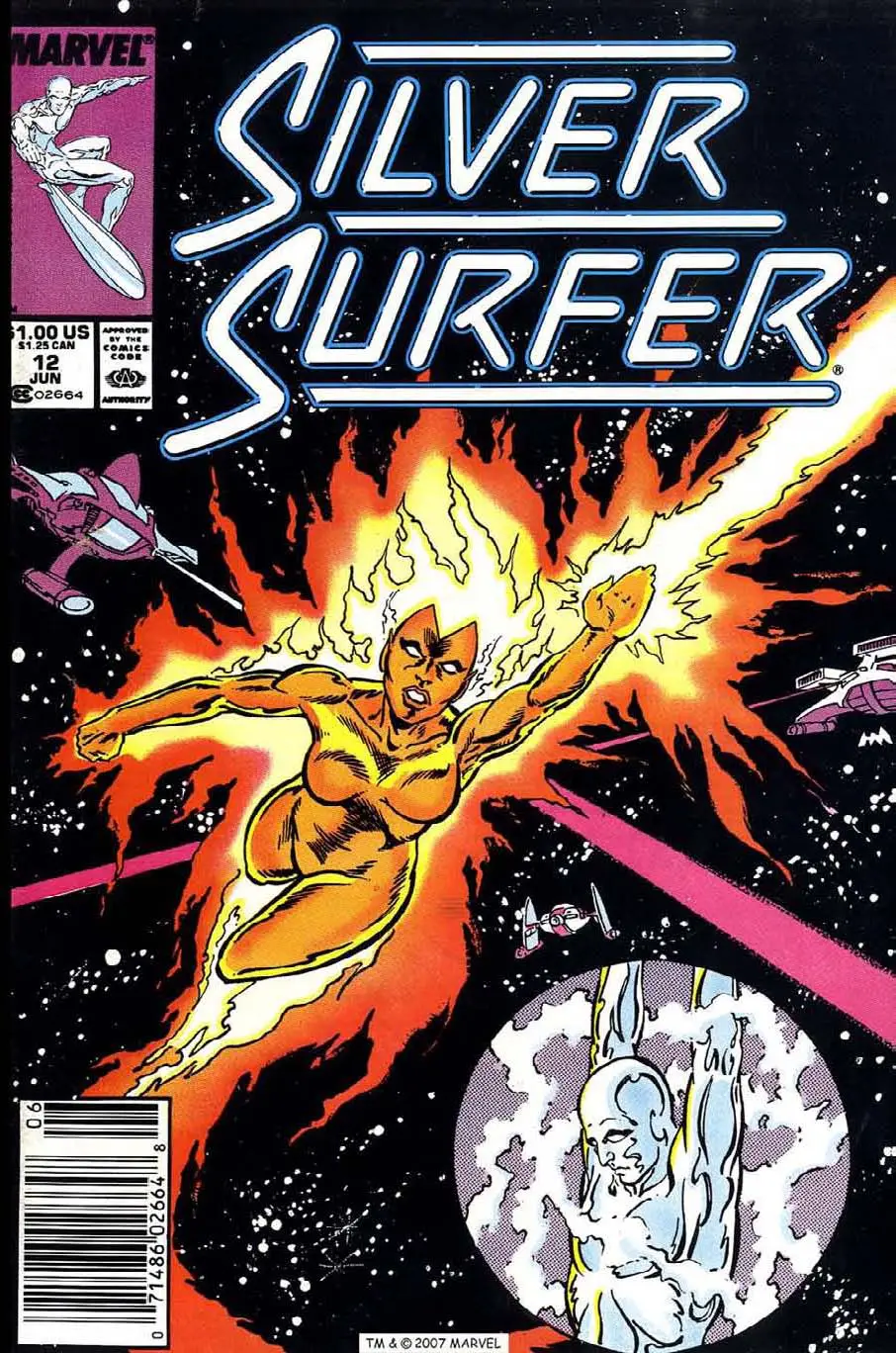
Silver Surfer vol. 3 #11–12: Captain Reptyl and the pirates of the Coalsack Nebula.
Accused (#13)
Back on Kree-Lar, Nenora's purge is breeding dissent. Three Kree colonels slip into her chambers to assassinate their enigmatic new leader, but they are cut down by her formidable protector, Ronan the Accuser, before she can even interrogate them. Ronan, the Kree Empire's living gavel, then turns his attention to a more public outrage: the Silver Surfer's apparent rampage.
Meanwhile, the trail of the impostor leads the real Surfer and Nova to a Kree protectorate world. Its non-Kree inhabitants have revered the Surfer for generations, ever since he spared them from Galactus during his days as a herald. Now, however, they flee at the sight of him, their home reduced to ruins.
Ronan arrives amidst this heartbreak to level his accusation. He freezes Nova out of the fight and gives the Surfer one of the era's better slugfests before being flattened by a well-swung surfboard. With Ronan incapacitated, the Surfer flies off to hunt down whoever is imitating him.
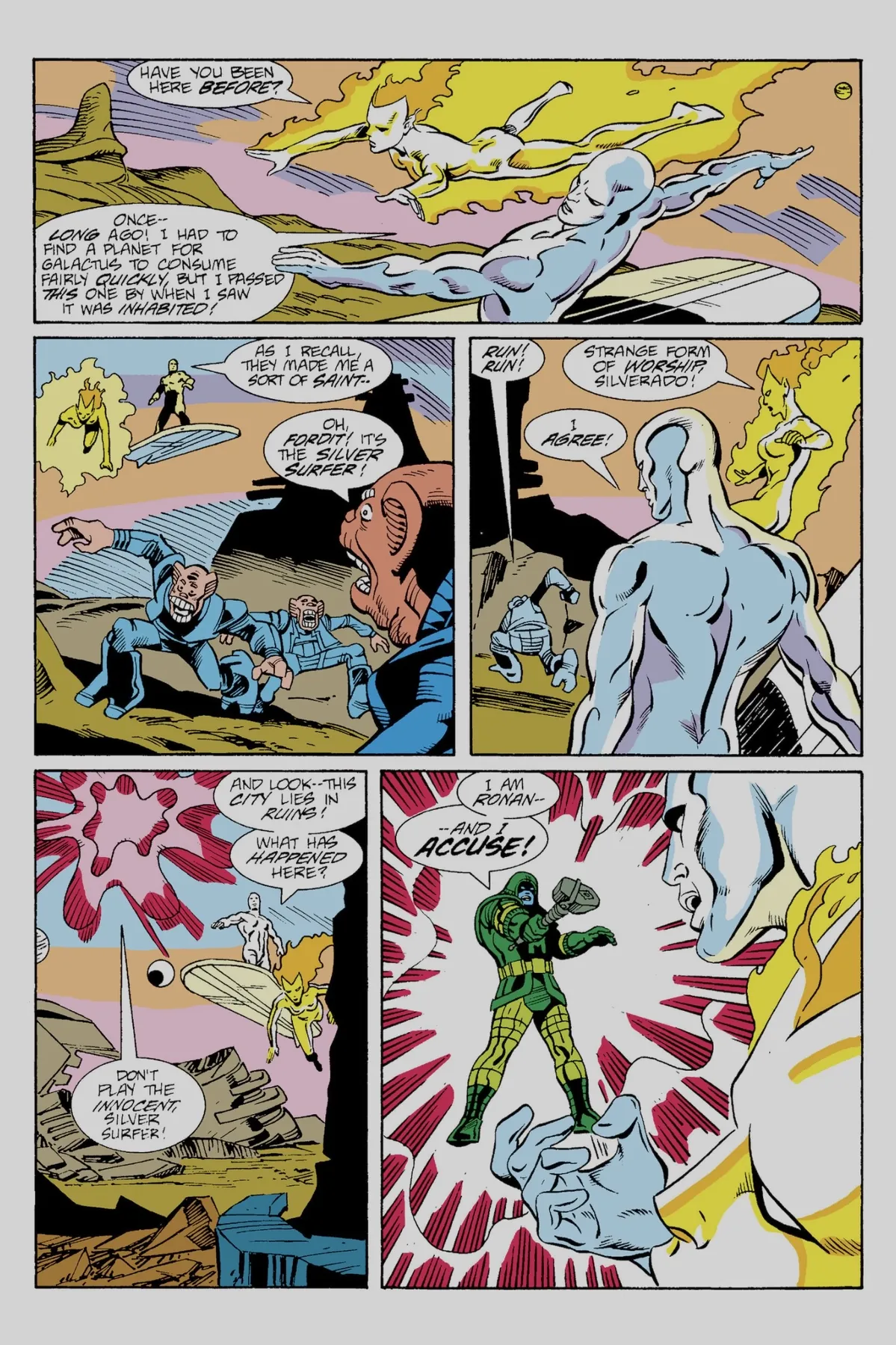
Silver Surfer vol. 3 #13: on a world that once revered him as a saint, the Surfer is met with terror and with Ronan the Accuser's charge.
The issue's real killing, though, is political. Emperor Kylor, the Skrull claimant whose pre-emptive strike started this war, leads his fleet against the Kree expecting an easy victory, because Nenora had secretly promised her fellow Skrull that the Kree shields would fail. They don't. Nenora has decided she rather likes ruling the Kree Empire for its own sake; Kylor and his fleet are annihilated, and with them dies everyone who knew what she really is.
Or almost everyone.
On a distant Skrull world, a rival claimant to the throne, the Empress S'byll, learns of Kylor's death and makes her opening move, dispatching an agent named Krat on a secret mission to Earth.
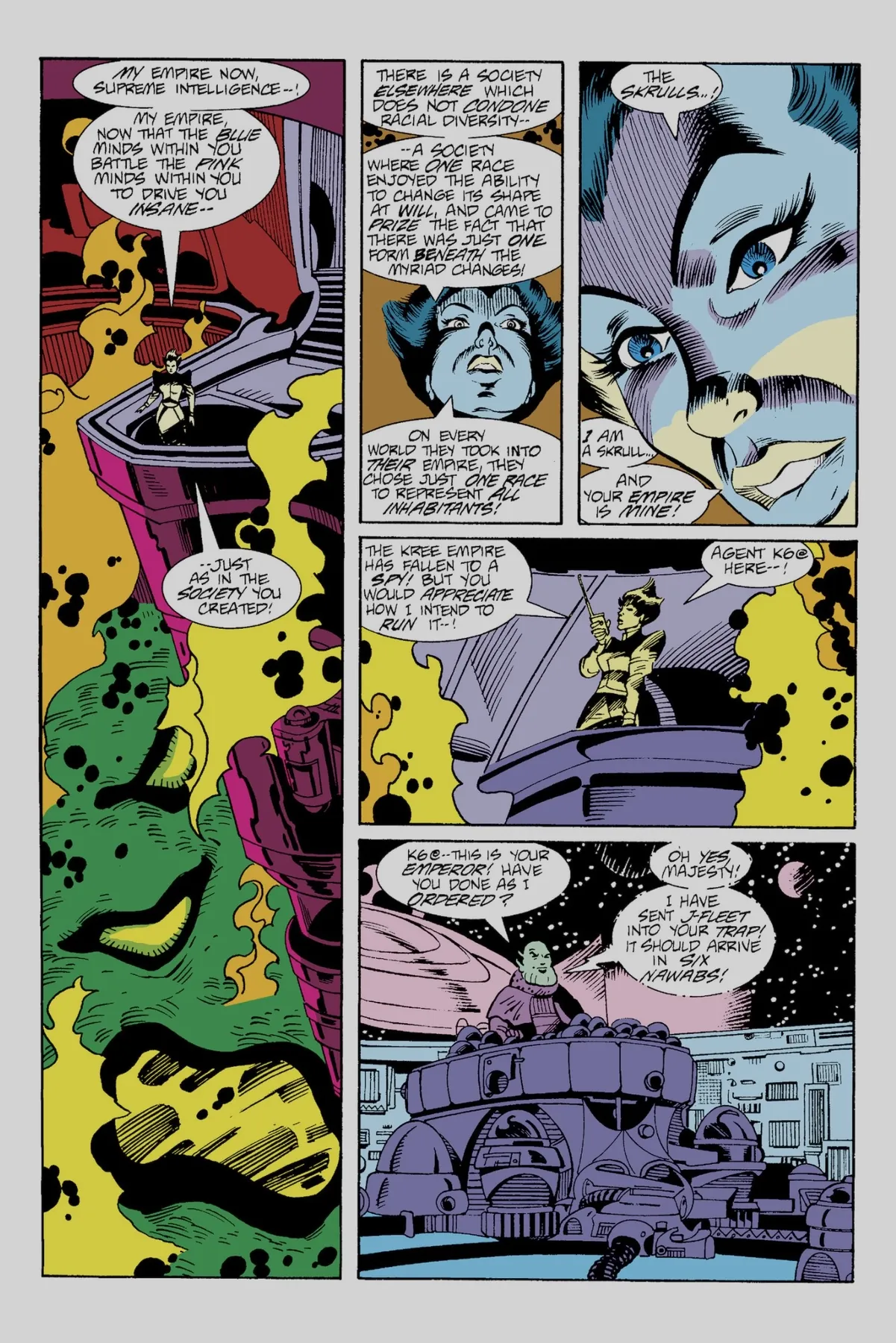
Silver Surfer vol. 3 #13: Nenora reveals herself a Skrull and lures the rival claimant Kylor and his fleet to annihilation, silencing everyone who knew her secret.
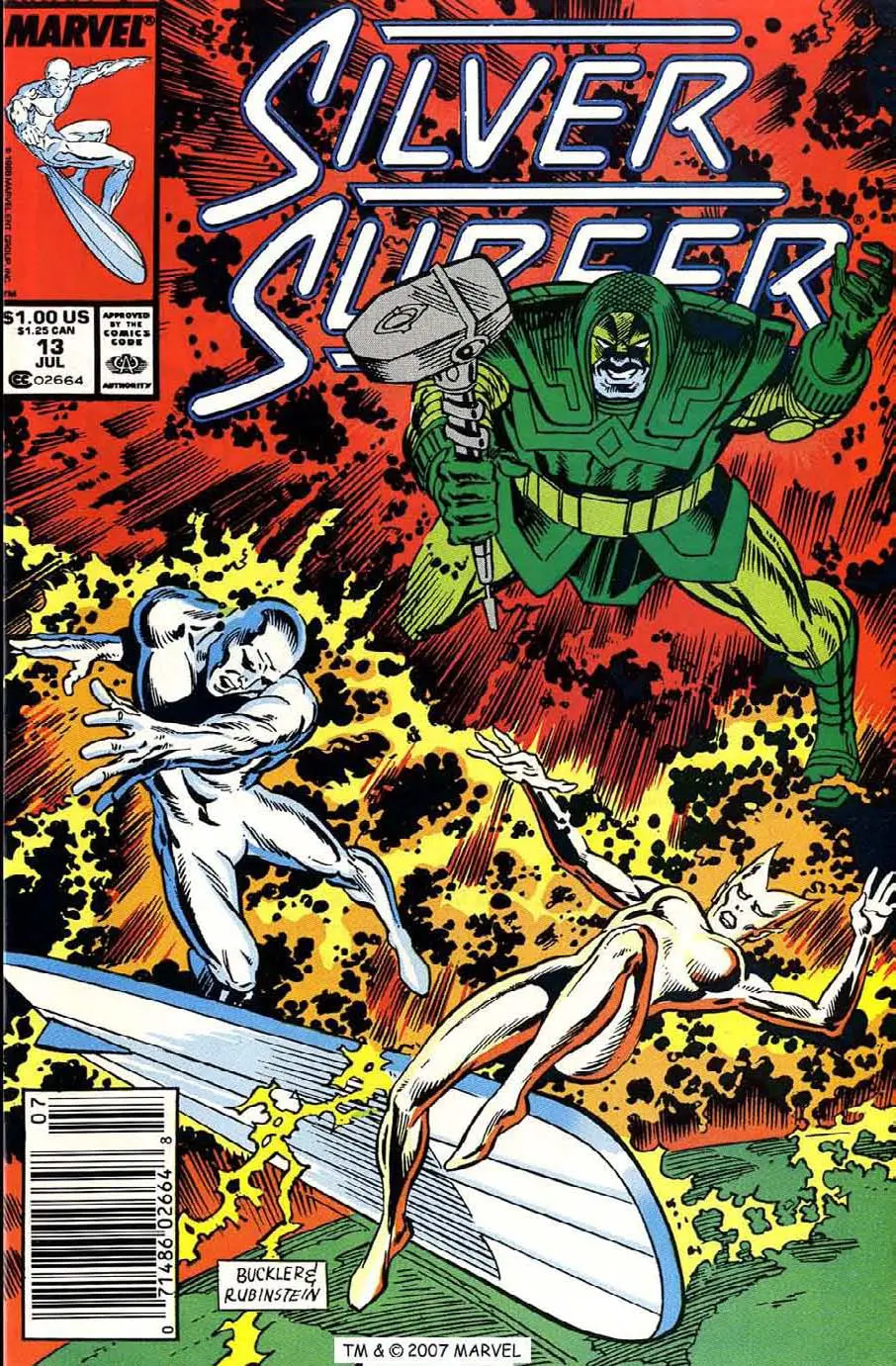
Silver Surfer vol. 3 #13: Ronan the Accuser levels his charge.
The Other Silver Surfer (#14)
The impostor, when unmasked, turns out to be one of Englehart's most elegantly cruel inventions. He is Bartak, a Skrull agent who happened to be wearing the Silver Surfer's form when the hyper-wave bomb detonated years earlier and froze every Skrull in whatever shape they held. Bartak has been trapped as a duplicate Silver Surfer ever since, a walking, permanent identity theft, and has been putting the face to use for Karza, yet another would-be emperor in the Skrull succession scramble, torching Kree outposts to poison the empire against the real article.
It's easy to enjoy Bartak as a plot device and miss that he is the first sounding of what will become the run's deepest theme. This saga is obsessed with identity—with faces that aren't the real face, and with beings frozen into shapes that aren't truly theirs. Bartak represents its purest tragedy. He is a creature caught wearing a self that was never his, and then stuck in it forever. As a result, he is forced to live out a life defined entirely by a surface he happened to be holding at the wrong moment.
There is something horribly recognizable in that. Most of us have, at some point, been frozen into a version of ourselves by an accident of timing. It could be a role, a reputation, a first impression, or a single decision. Eventually, we find the mask hardening into a fate. Other people respond to the surface until it starts to feel like the whole of who we're allowed to be.
The Skrulls' curse literalizes a very ordinary fear: that we will be permanently mistaken for the shape we wore on our worst day. Hold that thought, because the entire Kree–Skrull war to come is about exactly this. It is a conflict of a whole race that has forgotten how to be itself. Crucially, the answer the run eventually offers will turn on the one being on the board who cannot change his shape at all.
The battle of Surfer versus Surfer duly follows, and the genuine item is battered and left for dead. Then Ronan the Accuser, who has technologically enhanced himself specifically for a rematch, arrives and settles matters with brutal finality: he kills Bartak, believing to his considerable satisfaction that he has executed the Silver Surfer.
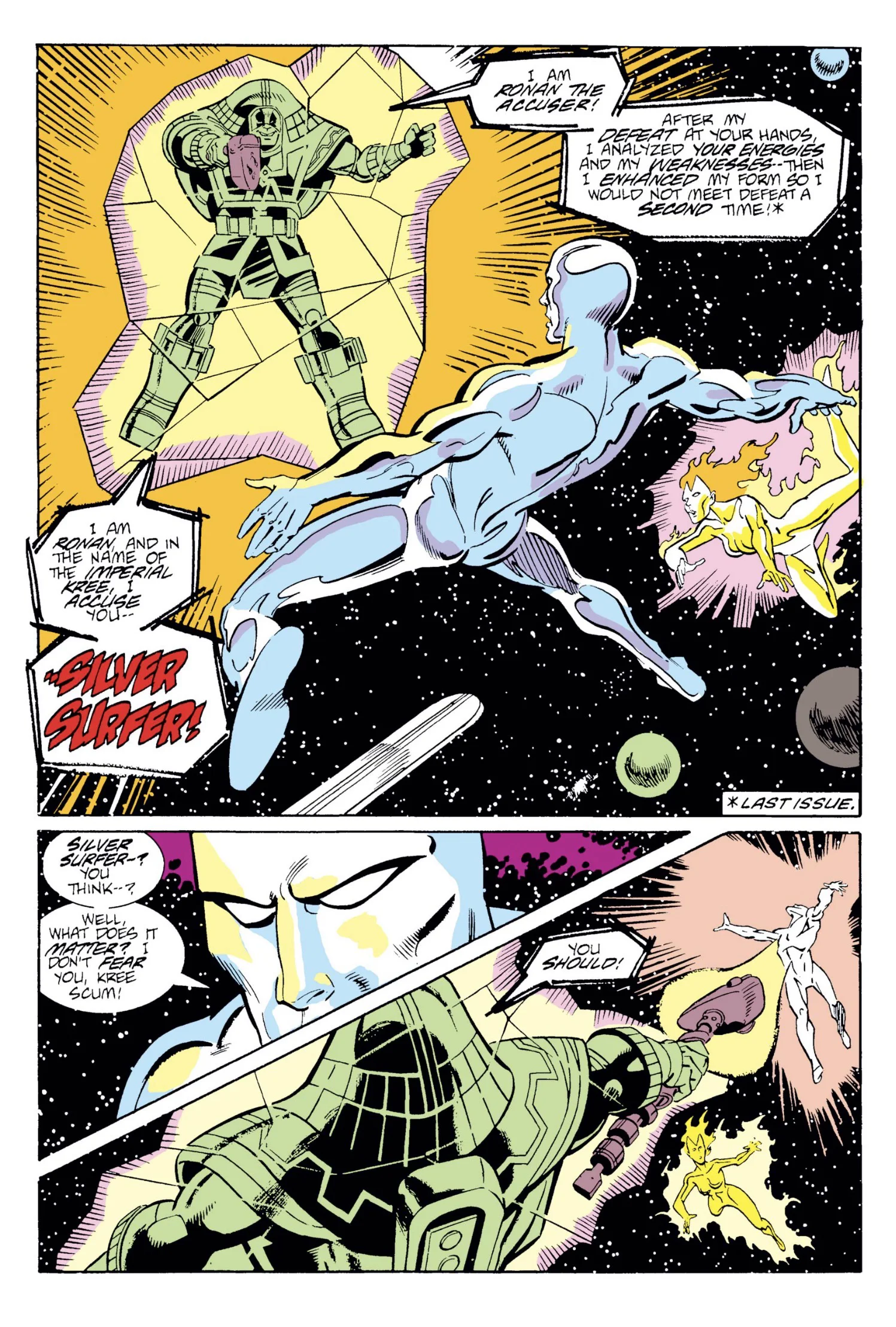
Silver Surfer vol. 3 #14: an upgraded Ronan returns for his rematch and cuts down the impostor, convinced he has executed the real Silver Surfer.
He even frees Nova, who, in a wonderfully pragmatic beat, declines to correct the Kree Empire's most dangerous officer, and simply flies away. The real Surfer, revived by an infusion of Nova's energy, catches up with her, and the period's slow-burning romance finally ignites: he kisses her, to her open astonishment.
When she asks about Mantis, his answer doubles as the run's mission statement for the character: it was Mantis, he says, who taught him to be expressive. The marble saint of the Lee years now kisses first and philosophises after.
And then the sting in the tail. On Earth, a crashed alien is gunned down by panicky locals. It is Krat, S'byll's agent, and with his dying strength he fires a beam into the sky, completing his mission: Earth's radiation belt has been seeded with antimatter. He dies content in the belief that he has completed his mission. Cliffhanger duly lit, the fuse runs directly into the annual.
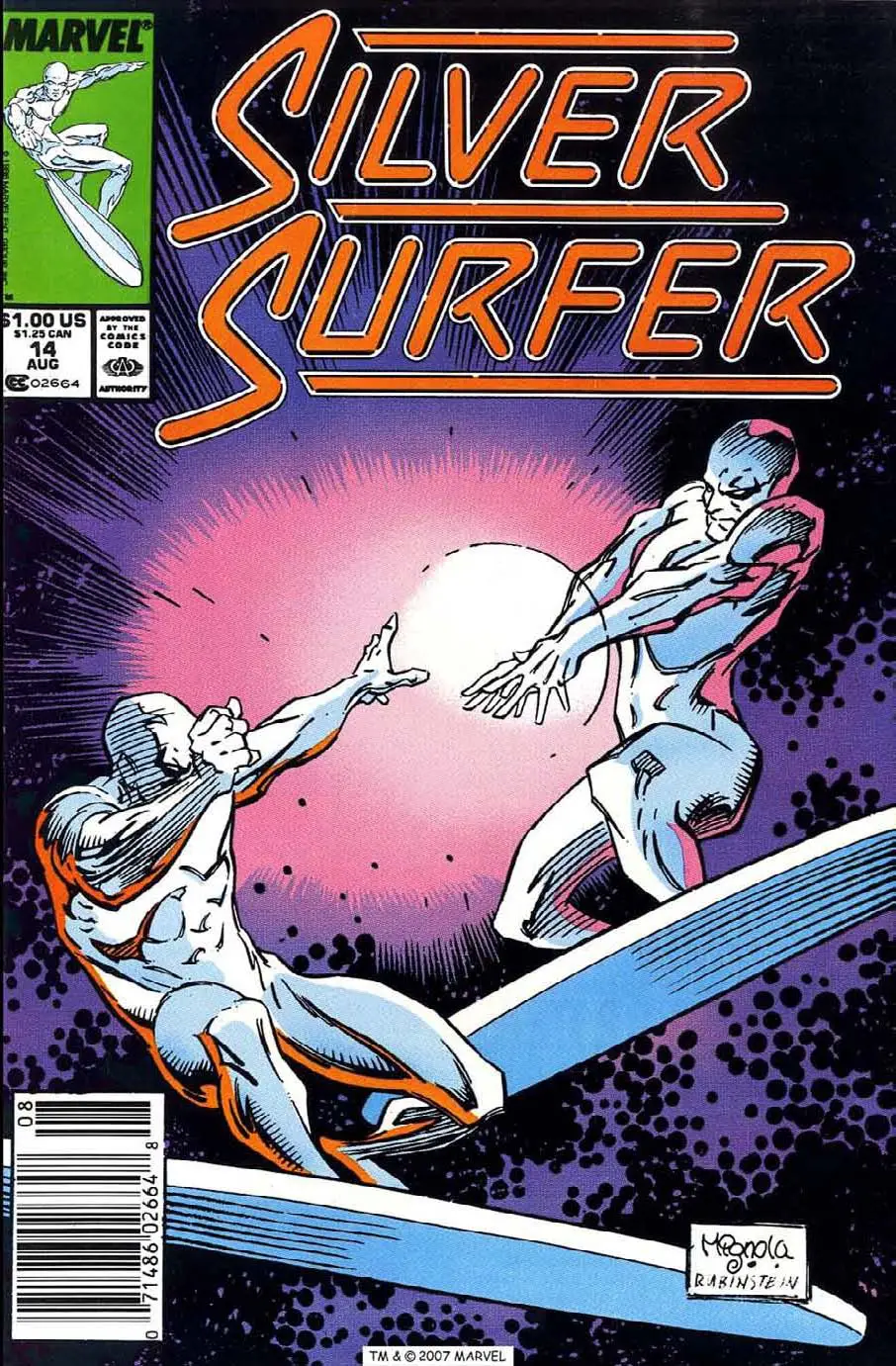
Silver Surfer vol. 3 #14: the battle of Surfer versus Surfer.
The Annual: An Obligation and Two Gifts (Silver Surfer Annual #1, 1988)
The main event of the first annual is, on paper, a crossover obligation: chapter three of the Evolutionary War, the storyline Marvel threaded through all its 1988 annuals, written by Englehart with art by Staton and Rubinstein.[2]
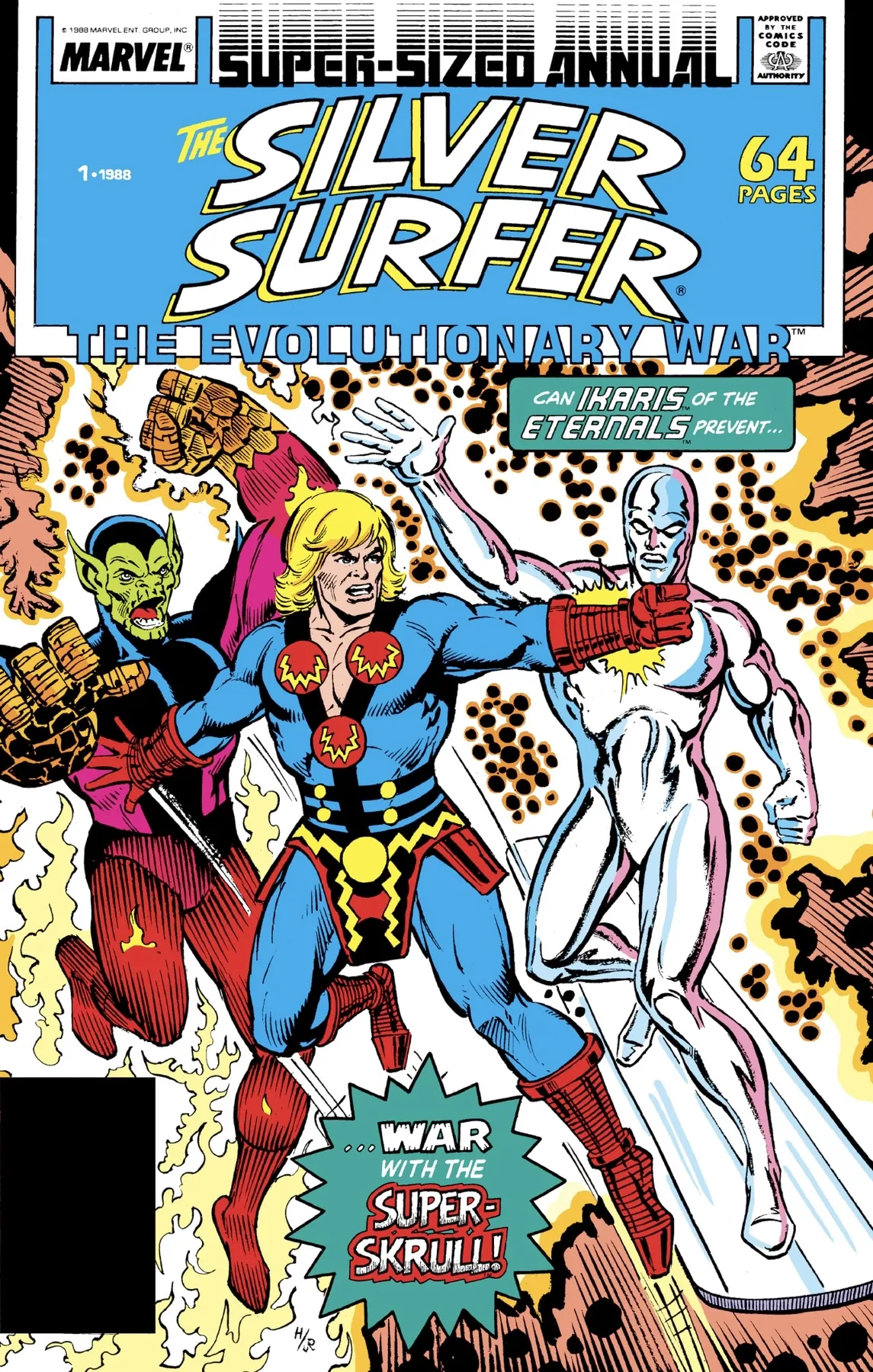
Silver Surfer Annual #1 (1988): the Evolutionary War crossover, pitting Ikaris of the Eternals and the Surfer against the Super-Skrull.
The High Evolutionary, mid-scheme to accelerate humanity, decides he requires the Silver Surfer's DNA, and delegates the collection job to the Eternals. As Evolutionary War chapters go it's a modest one (even sympathetic readers rank it among the crossover's lesser instalments), and the plot mechanics (the Surfer and a foe captured in glass pyramids in Olympia, a DNA scanner calibrated for Deviants, a team-up escape, a gentlemanly truce) evaporate on contact. But buried inside the obligation are two gifts that matter enormously to this series.
The first gift is an opponent and, simultaneously, an ally. Kl'rt the Super-Skrull—the Fantastic Four's old nemesis who wields all four of their powers in one body—had been left imprisoned as bodiless energy in Earth's radiation belts at the end of John Byrne's Alpha Flight #9–10. Most readers had written him off as dead.[3] Now, he is abruptly and furiously corporeal again. After the obligatory punch-up and a period of shared captivity, it is the Silver Surfer himself who ensures his escape from the pursuing Eternals.
The reasoning is pure Norrin Radd, equal parts nobility and consequence-blindness. Frozen in Skrull form when the bomb went off, Kl'rt is now the only Skrull in the universe who can still shapeshift. The Surfer sends him home in the explicit hope that he can help his broken people regain what they lost. Kl'rt departs, frankly baffled that an enemy could be this noble.
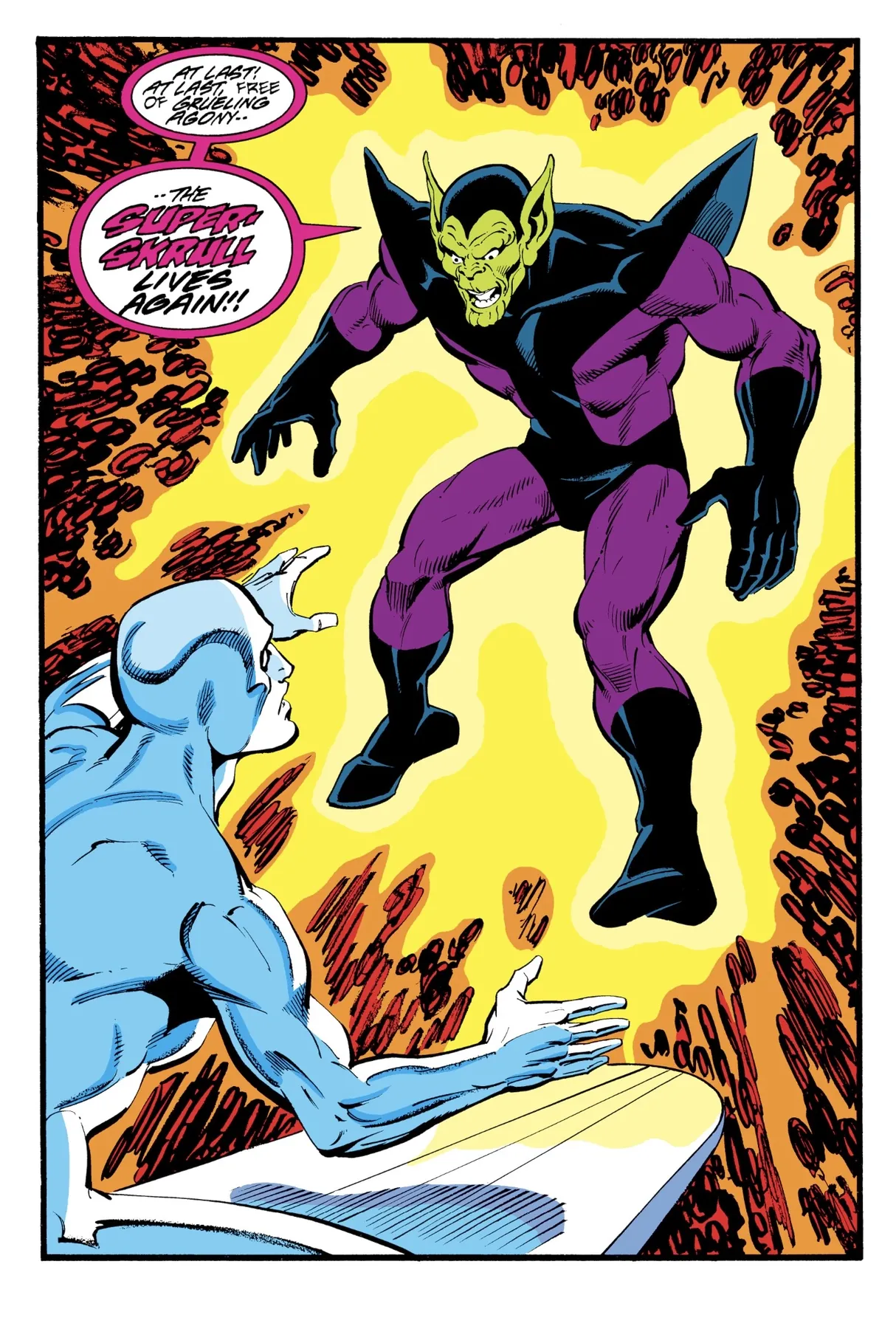
The first gift: Kl'rt the Super-Skrull, long imprisoned as bodiless energy in Earth's radiation belts, is abruptly corporeal once more, and the Surfer sets him free.
File it alongside the severed head. With the best intentions in the galaxy, the Surfer has just re-armed one side of the war. The payoff arrives like clockwork from #20 onward, when the Super-Skrull enters the fighting. It culminates in the war's endgame, where he becomes the literal instrument of his race's restoration.
This central moral mechanism is introduced here almost casually, and it is worth naming because it governs everything that follows: in Englehart's cosmos, good intentions keep ledgers.[4] The Surfer's mercy toward Kl'rt is genuinely admirable, representing exactly the compassion that makes him such a moral centre. Yet it is also, measurably, an act of war—one that will get people killed and empires burned. Both things are true at once, and the story refuses to let the nobility cancel the consequence.
This is a harder, more grown-up ethics than the usual superhero story, where good motives reliably produce good outcomes and the hero's heart is his alibi. Here, a kind act can arm a war. The true measure of a person is not whether their intentions were pure—the Surfer's almost always are—but whether they stay present to answer for what those intentions actually set in motion.
Heroism, Englehart keeps suggesting, is less about never causing harm. No one with power that large can promise that. Instead, it is about not looking away from the harm you cause. Keep that ledger in mind, because the entire endgame consists of the Surfer paying it down.
The second gift sits in the back pages, and it belongs to the future. Both backup stories are drawn by Ron Lim, auditioning for the job he's about to inherit. One, a Mantis solo tale, keeps that ember glowing and hands the thread onward into Englehart's Avengers West Coast. The other, the Nova spotlight “Moth to the Flame!”, is nothing less than the ignition of the next arc: Nova returns to the worldship to find Galactus dying (the five immortal Elders he swallowed cannot be digested and are killing him from within), and the devourer commands her to assemble the Silver Surfer together with Reed and Susan Richards, insisting that Sue, of all people, is the key to his survival. Her hyperspace call to the Surfer closes the annual, and the story continues, quite literally, in issue #15. A throwaway backup in a crossover annual turns out to be the detonator for the next five issues.
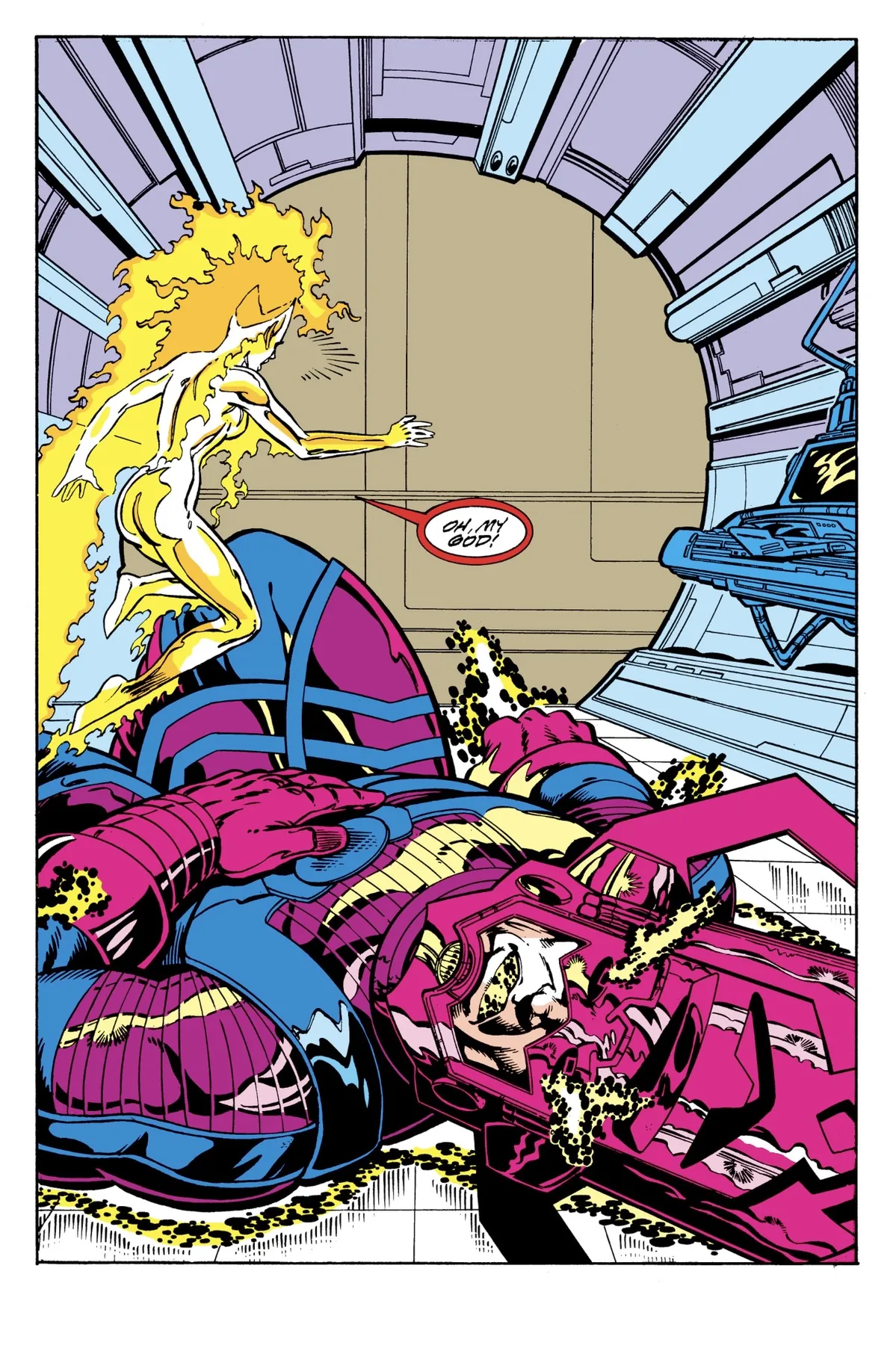
The second gift, in the Ron Lim backup "Moth to the Flame!": Nova returns to the worldship to find Galactus dying, the spark that lights the next arc.
The Board, Reset
Count the pieces this “transitional” stretch has moved. A saurian pirate king is loose in the Coalsack with a grudge against every mammal alive. A severed grey head is drifting in the void, thinking. The Skrull succession has been thinned to a single empress-in-waiting, S'byll, whose antimatter calling card is already ticking in Earth's sky. The Kree believe their Surfer problem has been executed by Ronan. Nenora rules an empire that would vaporise her on sight if it knew what she was. The Super-Skrull is flying home carrying his species' salvation in his frozen shapeshifter's body. And Galactus — the fixed point around which this whole cosmos turns — is being murdered, slowly, from the inside.
What This Chapter Teaches Us
The most useful lesson here is one about time, and it is as structural as it is moral. Nothing in this stretch feels momentous while you are reading it: no god dies, and no universe trembles. By the book's own admission, it is transitional—a hand calmly moving pieces into position. Yet, every single one of those pieces turns out to decide the fate of the entire war.
The Contemplator's severed head becomes the arch-villain. The buffoon who starts a barroom brawl gradually becomes an emperor. The enemy set free out of kindness eventually turns out to be his race's salvation, and then its martyr.
This is what a long game actually looks like from the inside. It is not a montage, but a series of small, unglamorous, apparently minor moves whose significance only becomes visible much later.
In a culture that prizes the momentous and dismisses slower stretches as filler, it is worth remembering that these quiet periods are usually where the most important groundwork is laid. Most of what will one day matter about your life is being set in motion right now, in scenes that do not feel as though they count. Patience, in this context, is not merely a virtue. In hindsight, it is an accurate reading of how consequence actually works.
Alongside that sits the chapter's contrast of temperaments, embodied in Cap'n Reptyl. Reptyl is a pure transactional pragmatist: everything is a trade, loyalty is a currency, and he will sell anyone's whereabouts or jettison half his crew the moment the math turns.
He is also, it must be said, extremely effective, and the series is honest enough to let him win exchange after exchange. But set him beside the Surfer, whose defining flaw is that he keeps doing generous, consequence-blind things for people who haven't earned it, and Englehart is drawing a real question rather than an easy moral. The cold pragmatist wins the transactions; the warm idealist accrues the debts. And yet it is the idealist's reckless kindness toward Kl'rt that will, in the end, heal an entire species, and the pragmatist's every-man-for-himself calculus that will, in the end, get him a knife in the back from a subordinate who learned the philosophy from him. The ledger cuts both ways.
A life run purely on transactions is efficient and, the story suggests, ultimately friendless; a life run purely on open-handed idealism is generous and, the series also admits, dangerous. The Surfer will spend the rest of the saga learning to keep the idealism while paying more attention to the bill.
Onward
The next chapter serves as an intermediate summit. The Silver Surfer, Mister Fantastic and the Invisible Woman fly into a black hole to steal back the Soul Gems, and what's waiting between Order and Chaos steps out to kill a god.
Frequently Asked Questions
Which Silver Surfer comics does Part 3 cover?
Part 3 covers Silver Surfer volume 3, issues #11 to #14 and Annual #1, published in 1988. It follows Captain Reptyl's space pirates, Ronan the Accuser's frame-up, and the impostor Silver Surfer.
Who wrote and drew these comics?
They were written by Steve Englehart, with art by Marshall Rogers and Joe Staton.
Is The Freest Being in the Universe free to read online?
Yes. The complete book is free to read here on marincomics.com, all six parts, richly illustrated. If you would like to support the author, you can also buy the paperback or Kindle edition on Amazon.
What is The Freest Being in the Universe about?
The Freest Being in the Universe is Marin Balabanov's chapter-by-chapter appreciation of Steve Englehart's cosmic Silver Surfer, volume 3, issues #1 to #31, published from 1987 to 1990. It recaps every issue and asks what the stories teach us about freedom, identity, grief, and finding a third path beyond false either-or choices.
Notes and Sources
- Silver Surfer vol. 3 #11–14 (May–Aug. 1988), written by Steve Englehart. Joe Staton pencilled #11, #13, and #14; Marshall Rogers returned to pencil #12. Colours by Tom Vincent; inks variously by Dave Cockrum, José Marzán, and Joe Rubinstein. Ron Lim's two backup stories in Silver Surfer Annual #1 served as his audition for the main title. Credits per the Grand Comics Database (comics.org) and the Marvel Database — marvel.fandom.com. ↩
- Silver Surfer Annual #1 (1988): the main story was chapter three of the line-wide “Evolutionary War” crossover, written by Englehart with pencils by Joe Staton and inks by Joe Rubinstein; the Super-Skrull Kl'rt is freed. The crossover as a whole — Marvel's first staged entirely across its annuals — set the company's heroes against the High Evolutionary (Herbert Wyndham) and his campaign to force humanity up the evolutionary ladder by any means: evolutionary drugs, Purifier troops culling the mutants he judged a threat, and finally a planet-threatening “genetic bomb.” The Avengers stopped him only by hyper-evolving Hercules to match his power, apparently destroying both in the process. Two backup stories in this particular annual (a Nova spotlight and a Mantis solo) were pencilled by Ron Lim. See Silver Surfer Annual #1, Marvel Database — marvel.fandom.com. ↩
- Kl'rt, the Super-Skrull (first appearance Fantastic Four #18, 1963), was reconstituted and then imprisoned in John Byrne's Alpha Flight #9–10 (1984). See Alpha Flight #10, Marvel Database — marvel.fandom.com. ↩
- The idea that outcomes, not just intentions, form part of the moral reckoning is the domain of consequentialist ethics and of the philosophical problem of “moral luck,” articulated by Bernard Williams and Thomas Nagel in their paired 1976 essays of that name. Englehart's “ledger” is a dramatised version: good motives do not cancel bad consequences, and the hero remains answerable for what his choices set in motion. ↩