The Freest Being in the Universe
Part 2
Free! The False Start, the New Norrin, and the Elders' Plot Against Galactus
The second instalment of my book The Freest Being in the Universe, serialised here on the web. This is chapter one of five on the Englehart Surfer: Silver Surfer vol. 3 #1–10 (July 1987 – April 1988) — plus the earthbound first issue that never was.
August 2026
Get it on:
Amazon.com →
Amazon.de →
Amazon.co.uk →
This article series is the full text of the book.
If
you'd like to support the author, please feel free to purchase
a physical copy or the Kindle ebook.
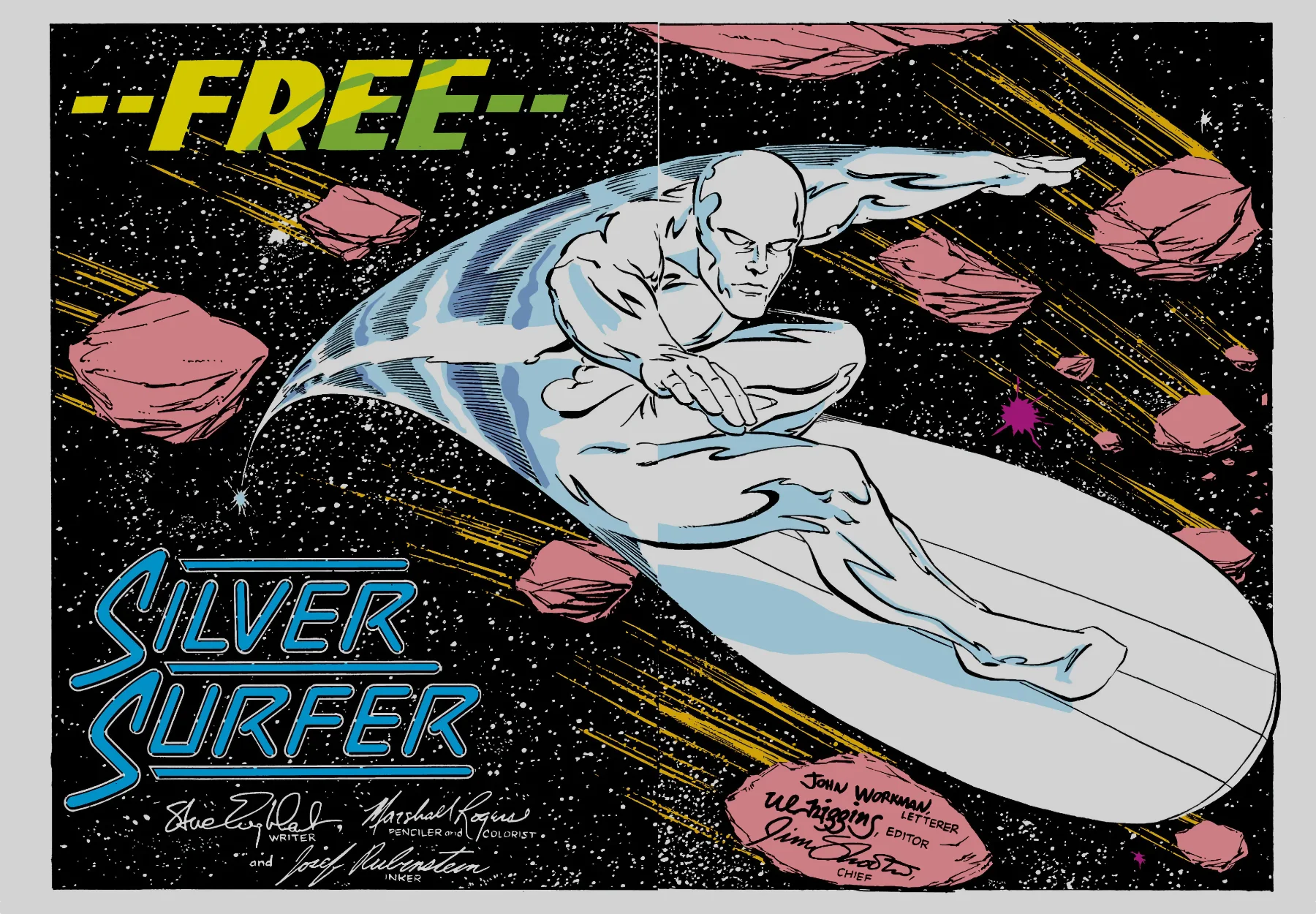
Silver Surfer vol. 3 #1: free at last — the double-page title spread by Marshall Rogers and Joe Rubinstein.
When we last left the sentinel of the spaceways, the vault had finally opened. Editor-in-Chief Jim Shooter had decided the Silver Surfer should be earning his keep, Stan Lee's twenty-year reservation on the character had been lifted, and Steve Englehart (the writer who'd first borrowed the Surfer for the Defenders back in 1972) had the assignment. One wall had come down. But another was still standing: not Lee's, this time, but Galactus's. The barrier around Earth remained in place, in-story and, for a strange little while, editorially too. Which is the odd editorial tangle the new writer stepped into — and before we watch him wrestle it, he is worth a proper introduction.
The Man Who Got the Assignment
Steve Englehart was no safe, workmanlike choice. He was one of the defining writers of Marvel's Bronze Age, the craftsman behind celebrated 1970s runs on Captain America — the paranoid, post-Watergate “Secret Empire” saga that disillusioned Steve Rogers into briefly abandoning the identity altogether — as well as The Avengers and Doctor Strange, a body of work later ranked among the very best Marvel comics of the decade.[1] His signature was already unmistakable: long-fuse plotting that paid off across dozens of issues, an appetite for the cosmic and the mystical, and an insistence that characters carry interior lives and not merely adventures. Which is to say, precisely the sensibility a wandering, soul-searching Silver Surfer required.
He also arrived with an unusual amount of history with the very ingredients of this run. He had created Mantis in the pages of The Avengers back in 1973 — so her reappearance in these issues is not a guest slot but an author returning to one of his own creations. He had co-created Shang-Chi and Star-Lord, characters durable enough to headline films decades later. And when he decamped to DC in the late 1970s after a falling-out at Marvel, he wrote the short, legendary Detective Comics run remembered as “Strange Apparitions” — a definitive modern Batman, widely credited as an influence on both Tim Burton's 1989 film and Batman: The Animated Series — drawn by a young artist named Marshall Rogers. The same Marshall Rogers who pencils the first ten issues of this Silver Surfer.
Their reunion is no accident of scheduling; it is a band getting back together. And the pattern repeats: Englehart's other celebrated DC collaboration was Green Lantern, drawn by Joe Staton — who, as we will see, steps in to pencil the middle stretch of this very run. Englehart did not simply take the Surfer assignment; he brought his people with him. What you are about to read is, in a real sense, a reunion tour staged in deep space.
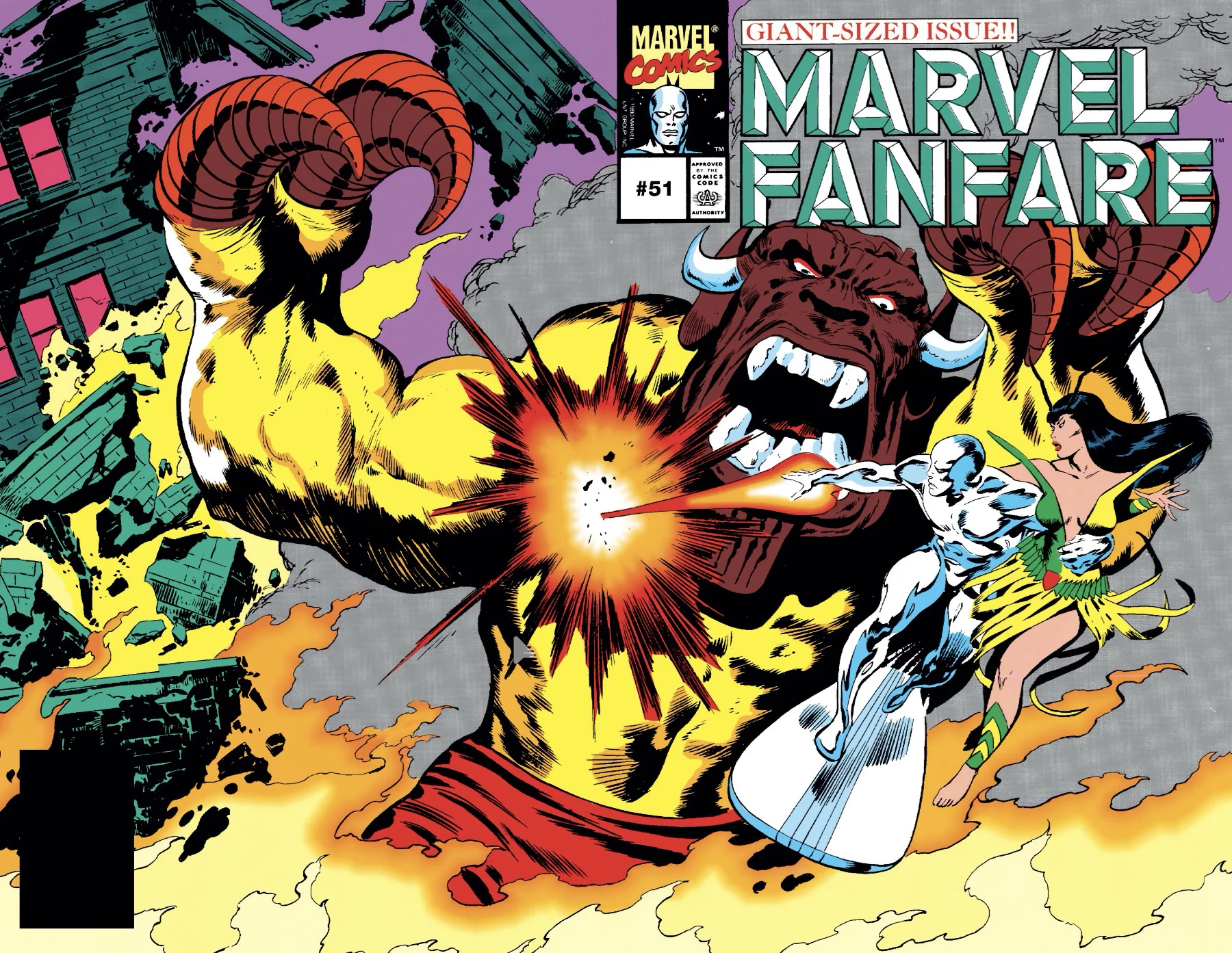
Marvel Fanfare #51 (1990): John Buscema’s wraparound cover for “The Great Terror” — the Surfer and Mantis against a revived Mangog.
The False Start: Twelve Last Adventures on Earth
For all that pedigree, the run got off to a false start — and to one of the great curiosities in the character's history: a complete first issue that would go unread for years. Englehart got the Surfer, but not, at first, the Surfer's freedom. He was told the character had to stay on Earth. And the project, remarkably, wasn't even conceived as an ongoing series.[2] The original plan was a twelve-issue limited series: the last adventure of the earthbound Surfer, with the exile itself intact, positioning our hero as something like the general of an intergalactic resistance fighting the Kree Empire from inside his planetary cell, with the Watcher, the Skrulls, Moondragon, the Badoon and Mantis all promised for the ride. And the liberation itself? That was to be reserved for a Stan Lee graphic novel, drawn by Keith Pollard, which would follow the limited series and finally spring the Surfer from his cage. Even in stepping back, Lee was keeping the key. (That graphic novel, repeatedly delayed, wouldn't actually surface until 1990.)[3]
Under this restriction, Englehart wrote a complete first issue and plotted two more. And the artist chosen for it could hardly have been more poetic: John Buscema, the definitive Surfer penciller of the Lee years, returning to the character he'd made soar in 1968, with finishes by the veteran inker Jack Abel. One whole issue was pencilled, inked and lettered. And then Englehart, by his own account, simply kept pestering Shooter about the premise. The Surfer had been denied the vastness of space since 1966, and he felt the situation had “long outlived its interest.” Then, quite suddenly and for reasons he never fully learned, the answer changed. The Surfer could fly free. The completed issue went into a drawer, and Englehart started over with a brand-new #1.
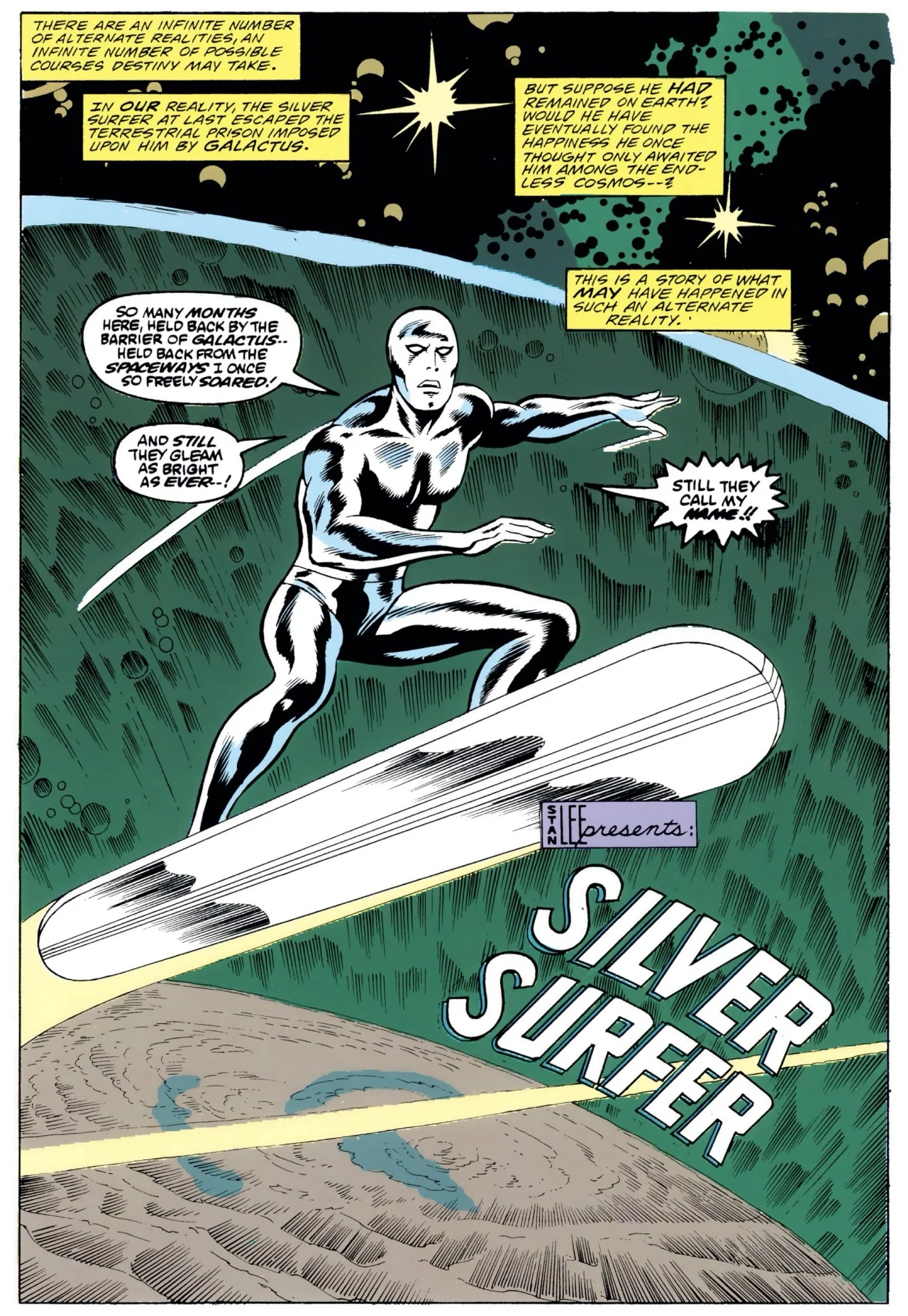
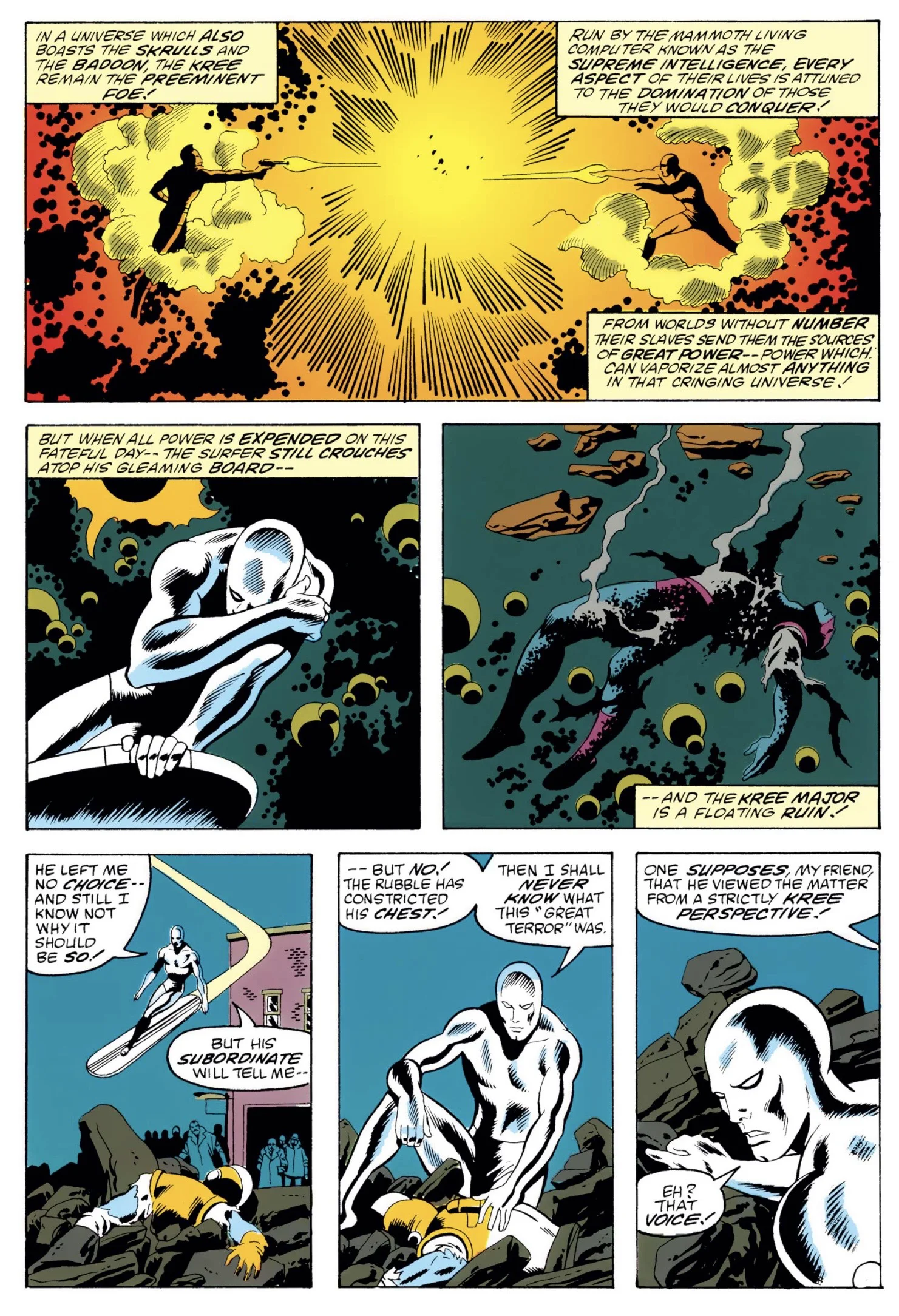
The shelved first issue as it finally saw print: an opening splash reframing it as an imaginary tale, and Buscema and Abel’s earthbound Surfer standing over a ruined Kree outpost.
The orphan didn't stay buried. Three years later, editor Al Milgrom rescued it for Marvel Fanfare #51 (1990), introducing it in his “Editori-Al” column as a story too good to leave unpublished, while flagging it clearly as an out-of-continuity curio, an imaginary tale of a Surfer who never got free. Titled “The Great Terror”, it's a fascinating road-not-taken.[4] A Kree cruiser ambushes the Surfer at the edge of the atmosphere; he wakes in a hospital bed watched over by the Human Torch, Alicia Masters and Namor; S.H.I.E.L.D.'s Clay Quartermain briefs him at the crash site. He meets Mantis, along with her son Sprout, a half-human, half-plant hybrid child whom the Supreme Intelligence has marked for death as a future threat to Kree dominance. To do the killing, the Intelligence restores the monstrous Mangog, still ant-sized from a previous defeat in the pages of Thor.[5] The Surfer wins the climactic battle in a beautifully in-character way: realising Mangog is a creature powered by vengeance and hatred, he simply submits. Starved of resistance, the monster gutters out. Mephisto, naturally, watches the whole affair from the shadows, plotting.
Squint and you can see the real series hiding inside it: the Kree, the Supreme Intelligence, Mantis, machinations at cosmic scale. Englehart didn't throw his deck of cards away when the exile was lifted. He reshuffled it and dealt the same suits across the whole of space. The Buscema art, meanwhile, stands as a lovely final handshake with the Lee era, right down to the wraparound Buscema cover. And in a neat accident of timing, the issue of Marvel Fanfare also carries a Silver Surfer pin-up by one Ron Lim, the young artist who would soon inherit the actual series.
Meet the New Norrin
With the false start behind us, we can turn to the series as it actually reached readers: Silver Surfer vol. 3, launched with the brand-new #1 Englehart wrote once the exile was lifted, and running here through issue #10.
Before the plot, the personality: the character who stars in these ten issues is not quite the one we knew. For two decades the Silver Surfer had been comics' most eloquent mourner: noble, grieving, passive, a marble saint delivering soliloquies about mankind from thirty metres up. Englehart's first and best decision was to thaw him out. Freedom doesn't just change the Surfer's postcode; it changes his temperament.
This Norrin Radd feels everything, at volume. The new #1 opens with pure joy: a five-page hymn to the endlessness of space and the Surfer's place in it, the sheer physical pleasure of a being finally doing what he was built for. But the register runs all the way down as well as up. This Surfer has romantic appetites (three women orbit these ten issues: Shalla-Bal, Mantis, and the first sparks of something with Nova), wounded pride, flashes of outright arrogance, and a genuine temper. When Mantis falls in battle, he doesn't grieve beautifully at a respectful distance. He lashes out in blind rage. When the Elders cheat him, he turns his board around and goes back for revenge, a word the Lee Surfer would hardly have permitted himself. And a little further into the run, in one of the era's most quietly funny character beats, he deals with a romantic humiliation by flying to a remote asteroid field and venting his frustrations on the rocks, an old-soul's version of slamming the bedroom door.[6] The tantrums are real, and they're wonderful.
Contemporary and retrospective readers clocked the shift immediately. Reviewers have described this take as a conflicted, even self-defeating Surfer, and praised the run as a deliberate exploration of who Norrin Radd is as a man rather than a symbol;[7] one affectionately noted that under Englehart the Surfer is, frankly, a bit of a player; another cheerfully diagnosed him as emotionally stunted. All of it lands as praise. Lee's Surfer observed humanity from above. Englehart's finally joined it — vanity, sulks, desire, fury and all — and the character has never been more alive.
And that thaw is the first and most important lesson of the whole run, so it's worth being clear about what it is and isn't. It would be easy to read the marble saint of the Lee years as the wise one (serene, above it all, unmoved) and to read the new, tantrum-throwing, love-struck Surfer as a regression. Englehart argues the reverse, and I think he's right. A serenity that has never been tested by real desire or real rage isn't peace; it's anaesthesia. The earlier Surfer didn't transcend his feelings so much as freeze them, which is why he could be so noble and so strangely lifeless at once. The goal a healthy life is actually reaching for is not the absence of feeling but the inhabiting of it: feeling everything, including the ugly and undignified things, and remaining yourself in the middle of the storm rather than by hiding from it. The Stoics are often misread as recommending numbness; what they actually recommend is composure amid full engagement.[8] Englehart's Surfer, sulking at asteroids and kissing too soon and going back for revenge, is not a lesser being than the one who hovered thirty metres up and grieved beautifully. He is a truer one, because he has finally climbed down into his own life. Growth, the run keeps insisting, looks less like rising above the mess and more like consenting to be in it.
The Plot: Ten Issues to Set a Universe on Fire
The team: Englehart writing, Marshall Rogers pencilling and colouring (a luminous, almost highlighter-bright palette that divided readers then and now, but which makes deep space glow like stained glass), Joe Rubinstein inking, with John Workman and then Ken Bruzenak lettering.[9] The book was an instant hit, routinely landing among Marvel's top-five best-selling titles month after month.
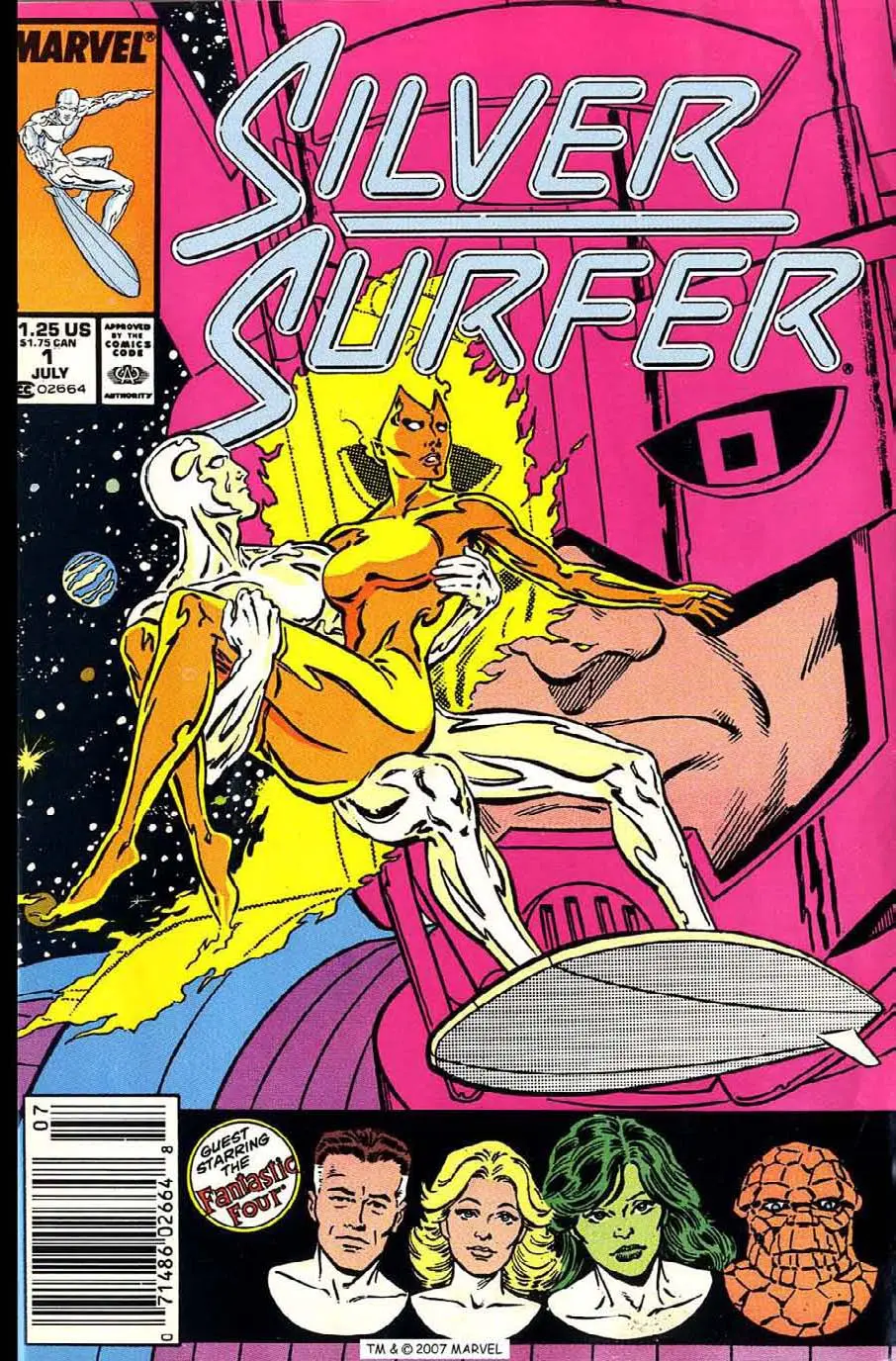
Silver Surfer vol. 3 #1 (July 1987): the Surfer carries Nova clear of Galactus, with the Fantastic Four guest-starring below.
“Free!” (#1, Double-Sized)
We open with the Surfer doing what he's done for twenty years: hurling himself at Galactus's barrier, this time over Antarctica, where his cosmic-energy tantrums are, in a very 1987 touch, worrying the ozone layer. The Fantastic Four arrive to investigate, and it's Ben Grimm, of all people, who hits on the brilliantly simple idea that two of the smartest beings alive never thought of. The barrier is keyed to the Surfer and his power — so what if he doesn't fly out on his board at all, but leaves as a passenger aboard somebody else's ship?
It works.
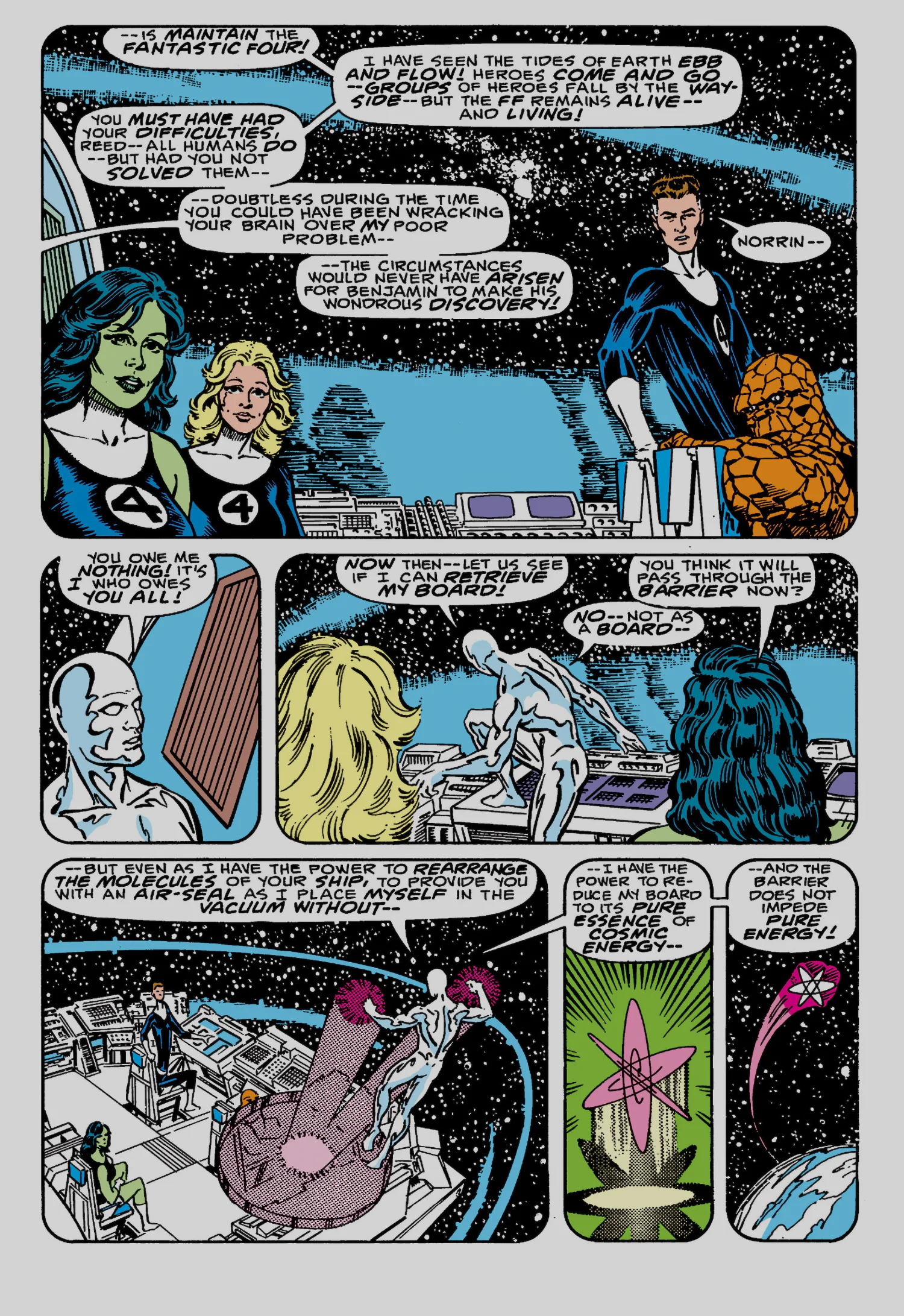
Silver Surfer vol. 3 #1: Ben Grimm’s idea in practice — the Surfer leaves as a passenger, his board dissolved into pure cosmic energy.
After twenty-one years of stories, the Silver Surfer slips through the bars sitting quietly in an FF spacecraft. But the issue's dominoes are already toppling: earlier, the Champion, an Elder of the Universe, attacks the still-earthbound Surfer without explanation and is beaten, the first hint that someone very old wants him out of the way. Out in the void, the Surfer finds the Skrulls (stripped of their shapeshifting years before by a hyper-wave bomb, and desperate)[10] attacking Galactus's current herald, Nova — Frankie Raye.[11] Cue a gorgeous star-system-spanning rescue — and then something braver still: having saved Galactus's herald, the Surfer flies to Galactus himself and argues his case. The devourer of worlds, moved by philosophy and gratitude in roughly equal measure, formally ends the exile. Free at last — and already entangled.
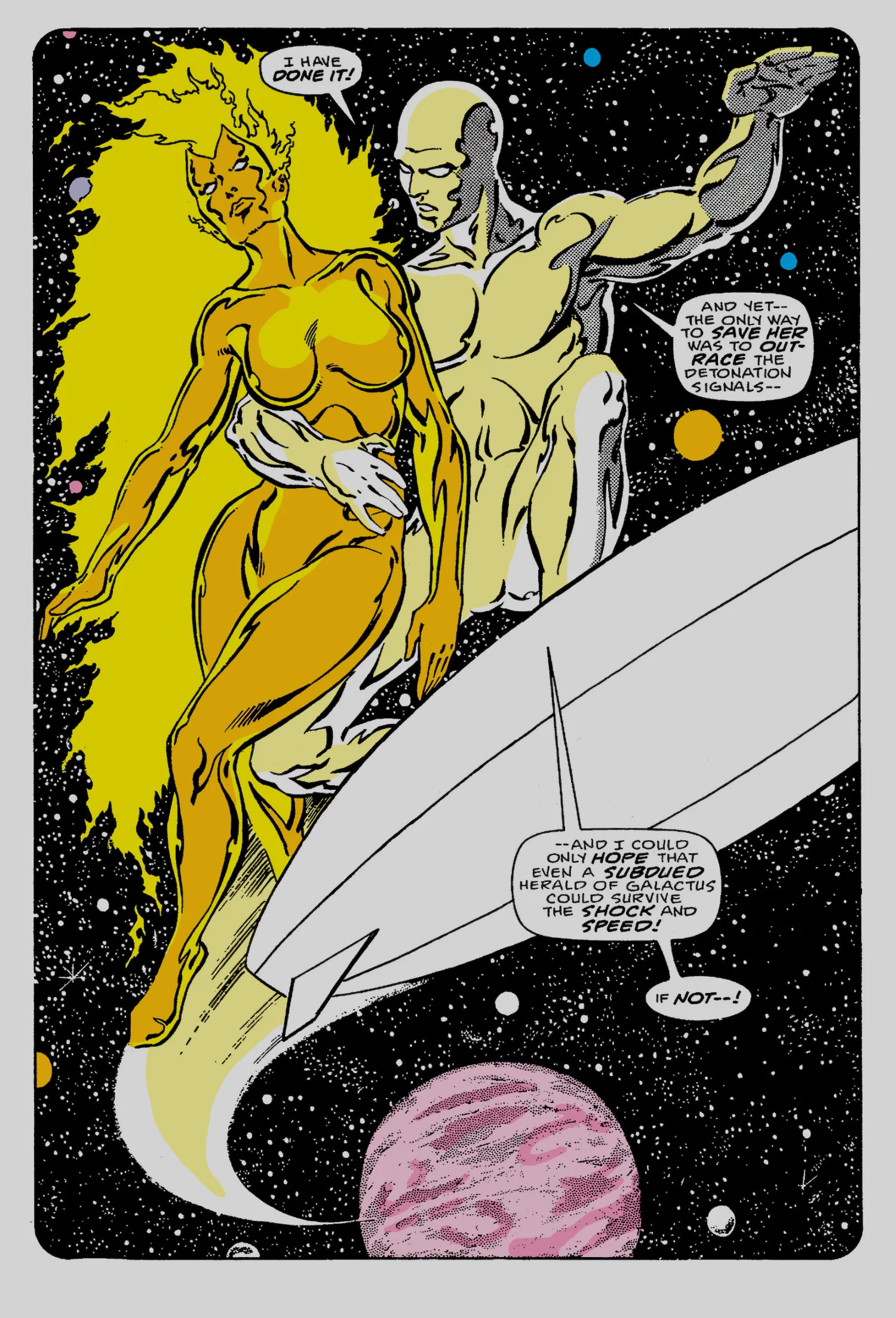
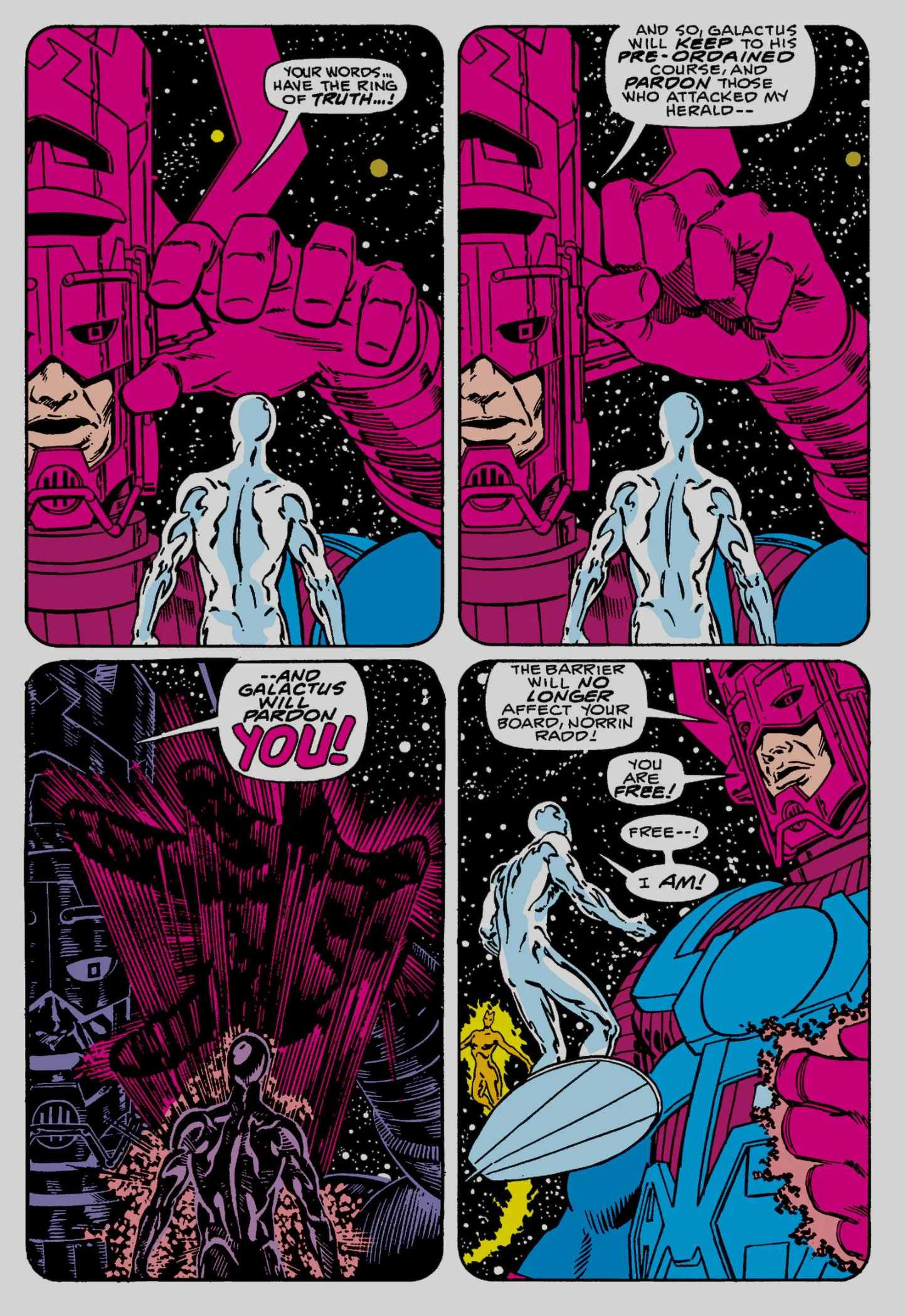
Silver Surfer vol. 3 #1: the rescue of Nova, and Galactus’s verdict — “You are free!”
Homecoming and Heartbreak (#2)
The triumphant return to Zenn-La goes exactly as the previous twenty years of this character's luck would suggest. Shalla-Bal is empress now, bound to the world she resurrected, and the romance that survived two decades of exile cannot, it turns out, survive freedom: she chooses duty. Meanwhile the Skrulls, smarting from #1, send an assassin after him. He foils the attempt, warns them off, and declares Zenn-La strictly off-limits to their war — because a war is coming: the ancient Kree–Skrull feud is heating up again, and it will simmer under every issue of this run.
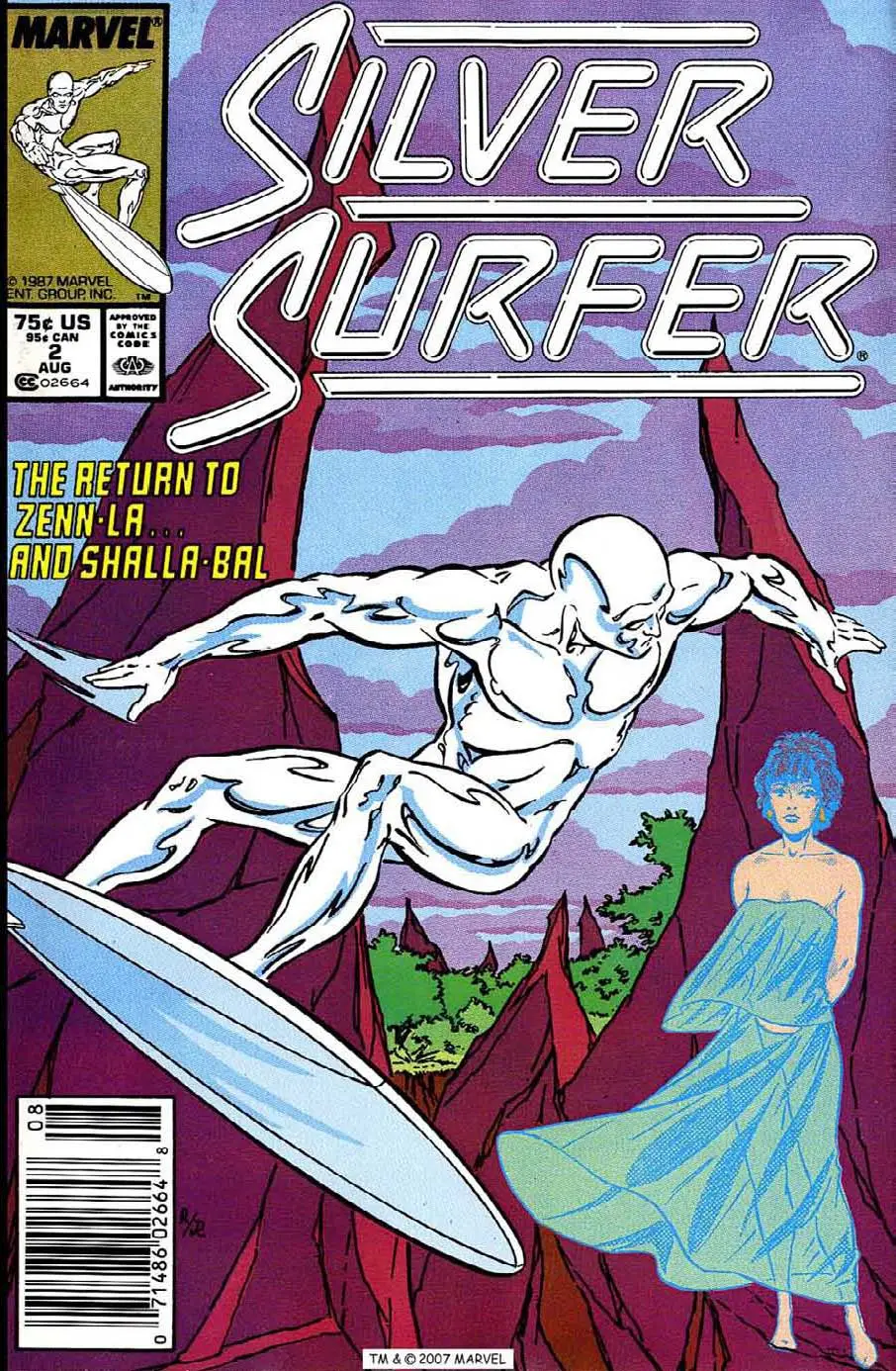
Silver Surfer vol. 3 #2 (August 1987): the return to Zenn-La — and to Shalla-Bal.
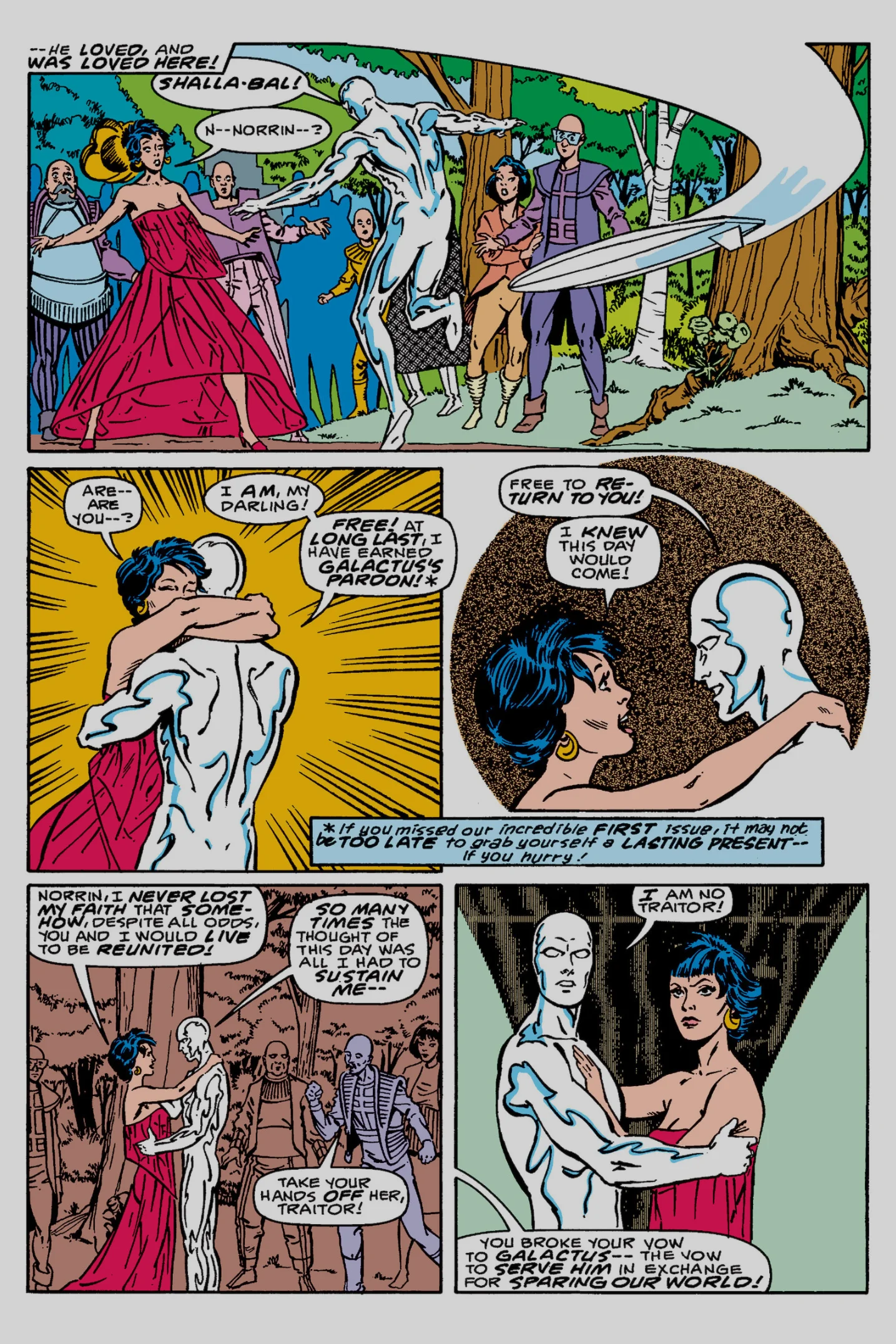
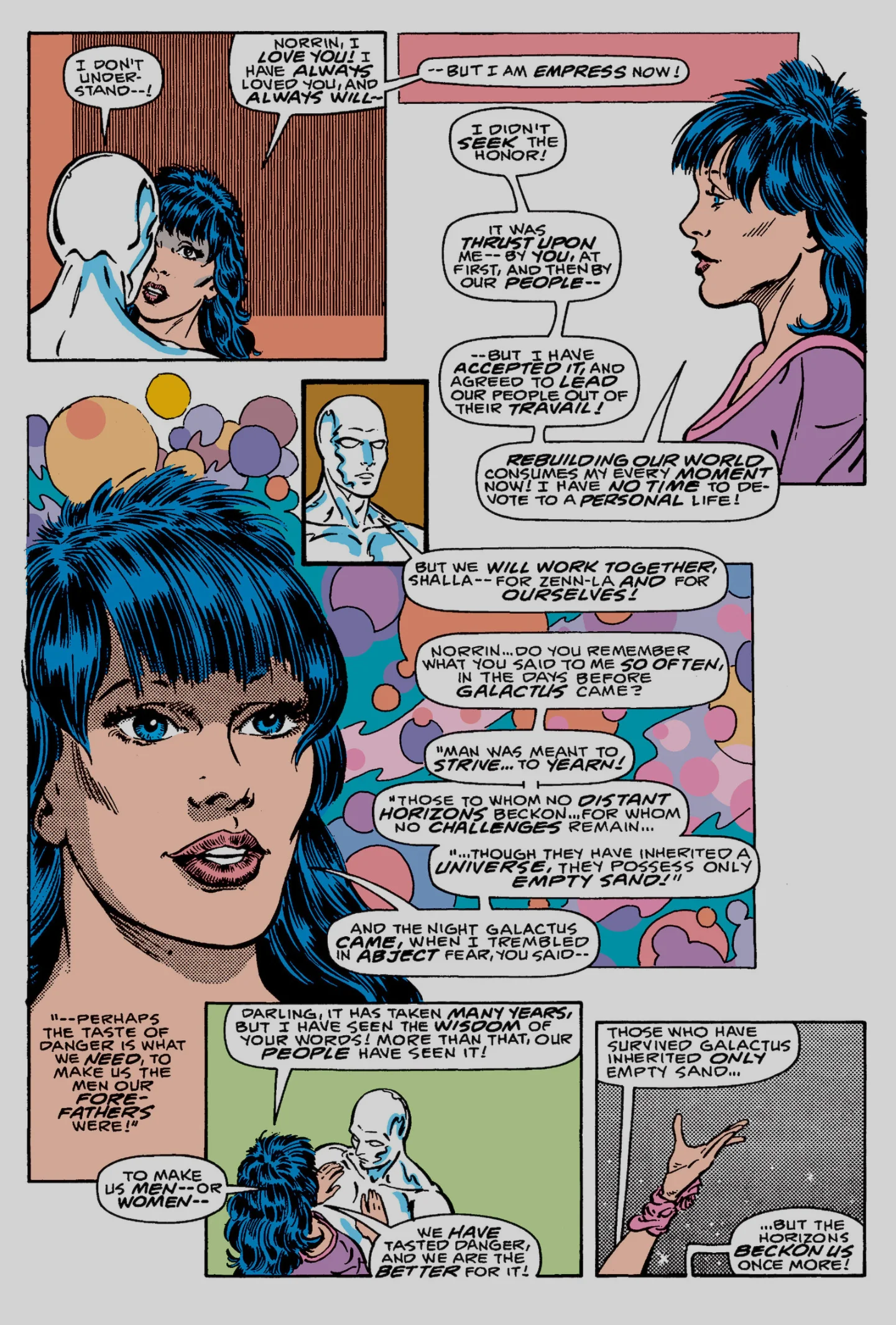
Silver Surfer vol. 3 #2: the reunion lasts barely two pages before the empress chooses her people — “But I am empress now!”
Prelude: The Grandmaster's Game (West Coast Avengers Annual #2 and Avengers Annual #16)
Issue #3 picks up directly out of a two-part Avengers crossover, and it is required reading. The story opens on the two Avengers teams' annual softball game, where the Silver Surfer himself drops in to sound the alarm: an Elder of the Universe, he warns, means to see some of the Avengers dead.[12] He is proved right almost before he has finished speaking. The Grandmaster and the Collector sweep the heroes into a strange realm and set them at one another's throats, Contest of Champions–style,[13] East Coast against West.
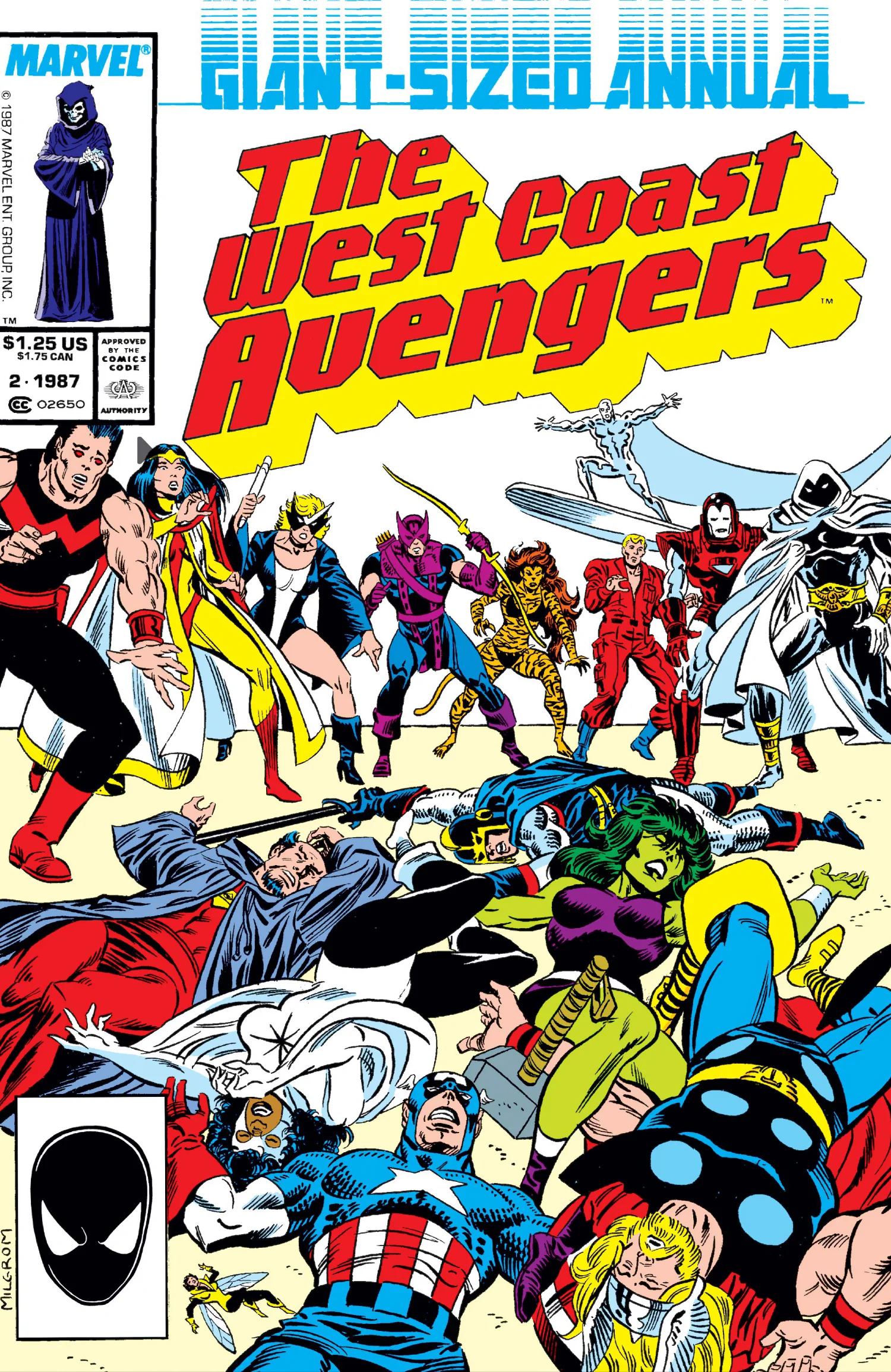
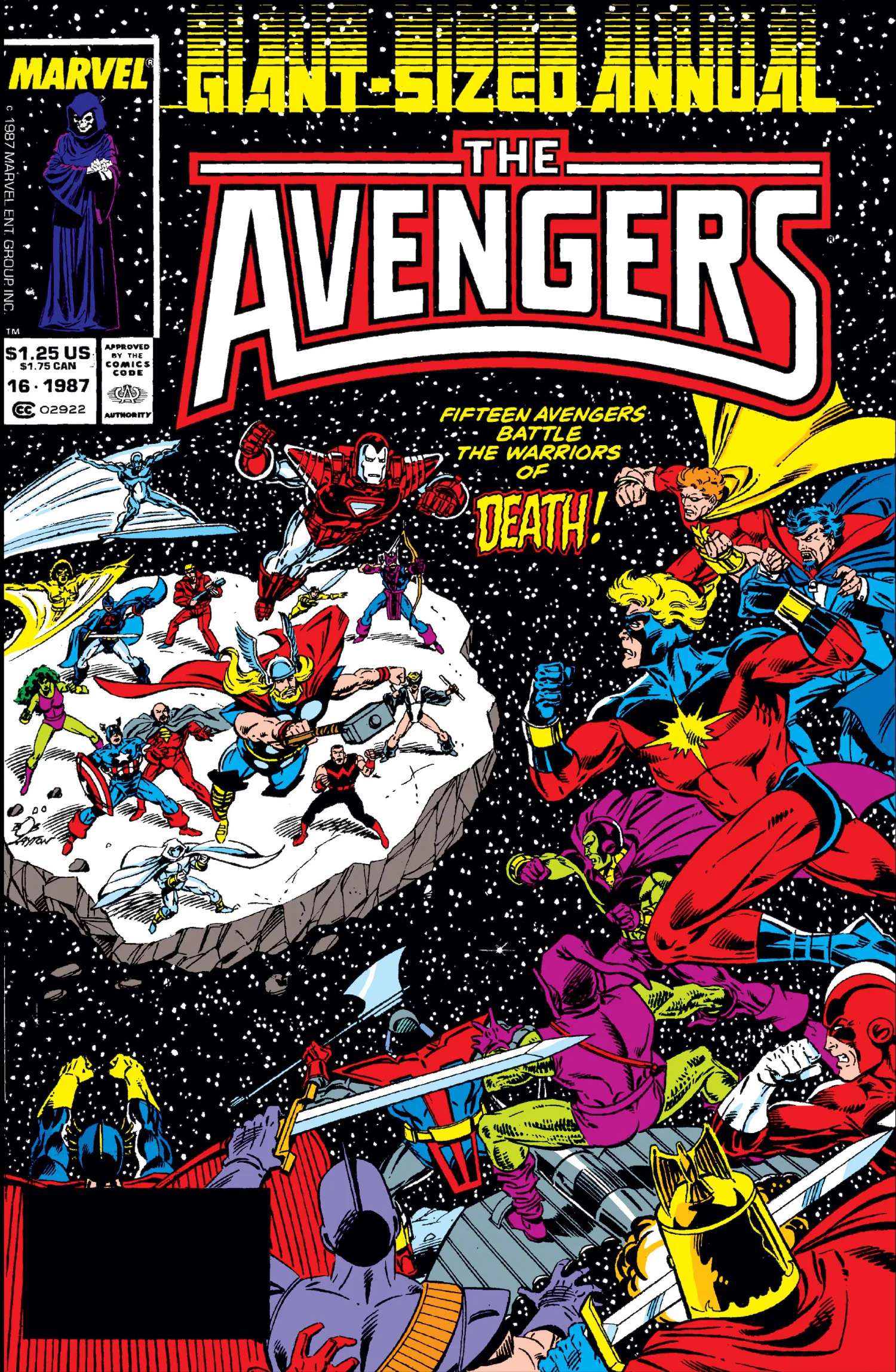
The two halves of the crossover: the West Coast team standing over their dead East Coast counterparts, and fifteen Avengers against the warriors of Death.
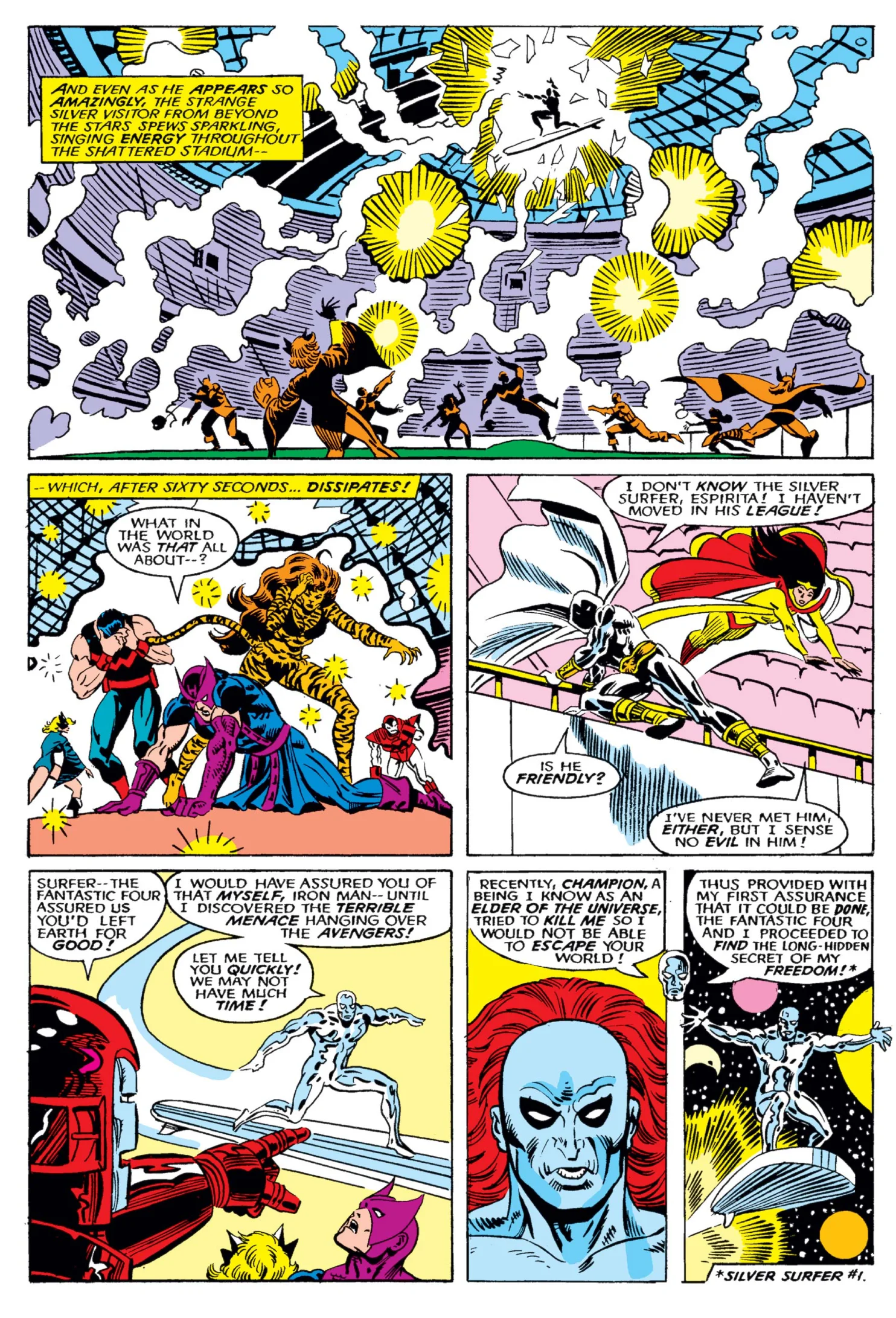
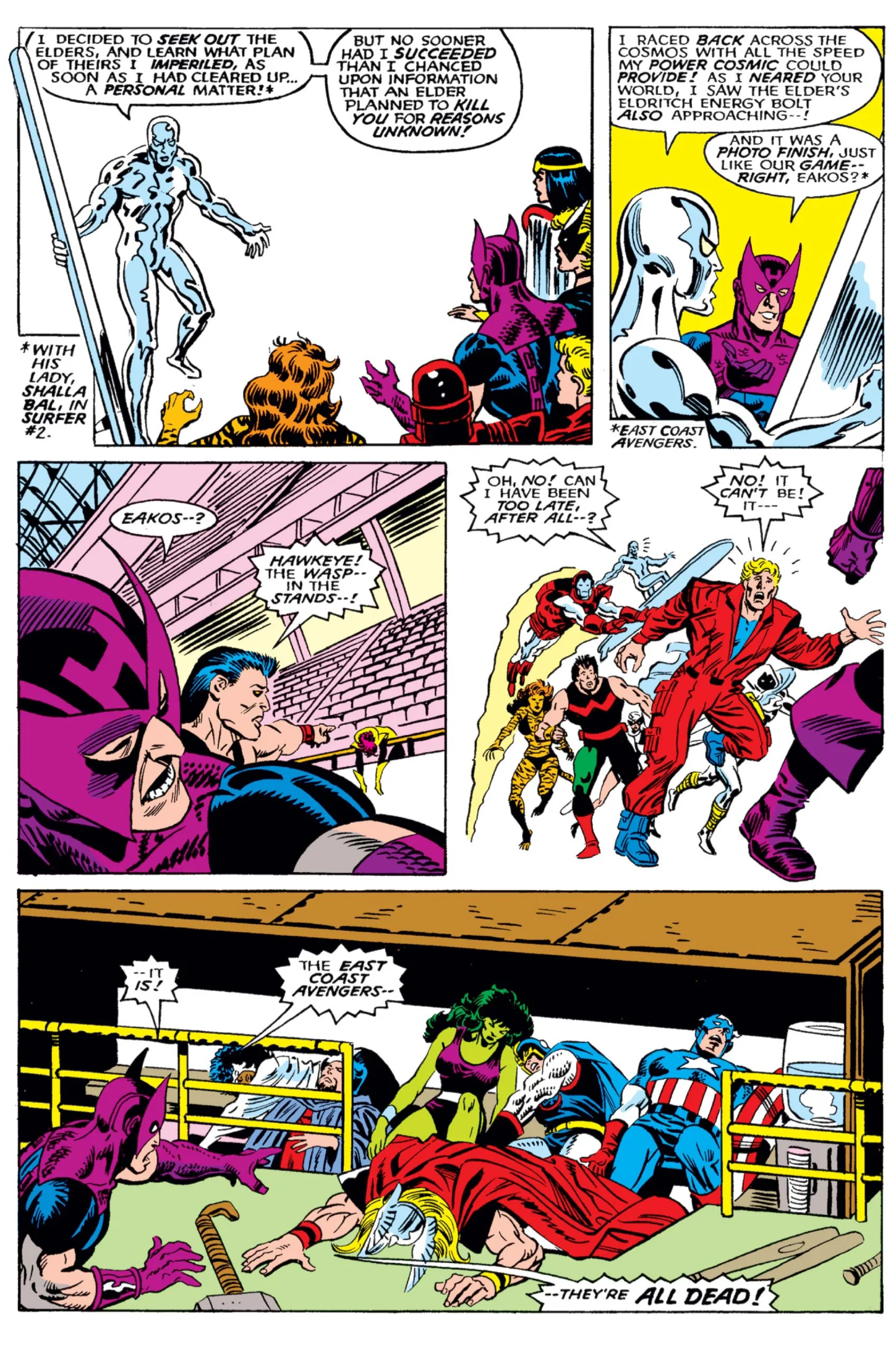
West Coast Avengers Annual #2: the Surfer crashes the Avengers’ game to warn that an Elder means to kill them — and minutes later the East Coast team is lying dead in the stands.
But that is a feint; the Grandmaster's true quarry is Death, whom he distracts and defeats, meaning to detonate five “life-bombs” that will unmake the present universe and replace it with one of his own design. He throws the survivors against a Legion of the Unliving raised from their dead friends and foes until only Captain America and Hawkeye are left standing, and Hawkeye finally beats him at a simple game of chance — by cheating. The routed Grandmaster is cast out of Death's realm, but the Elders walk away with the prize that will drive this whole run: Death agrees to bar every Elder of the Universe from her kingdom, forever.
The Elders cannot die.[14]
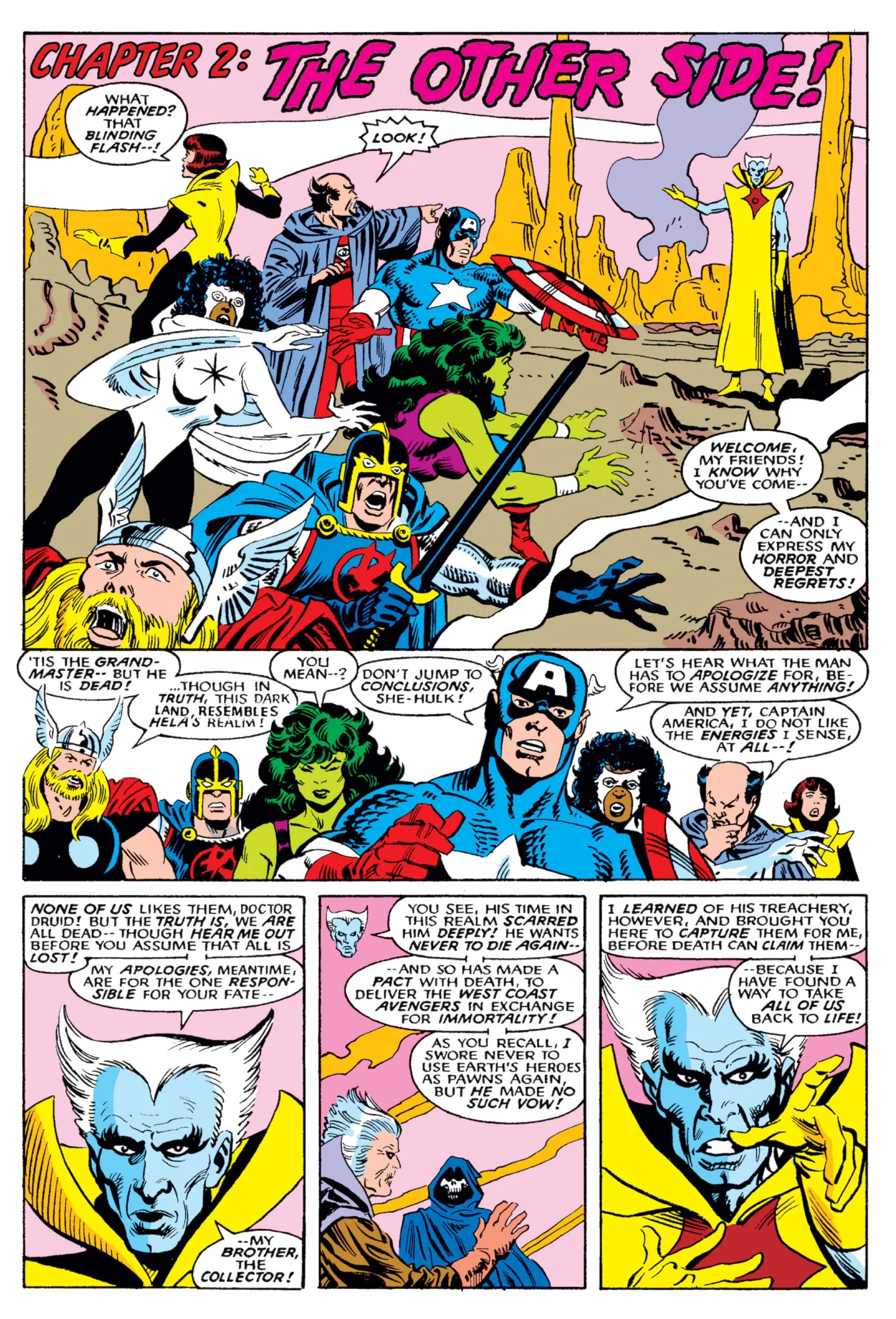
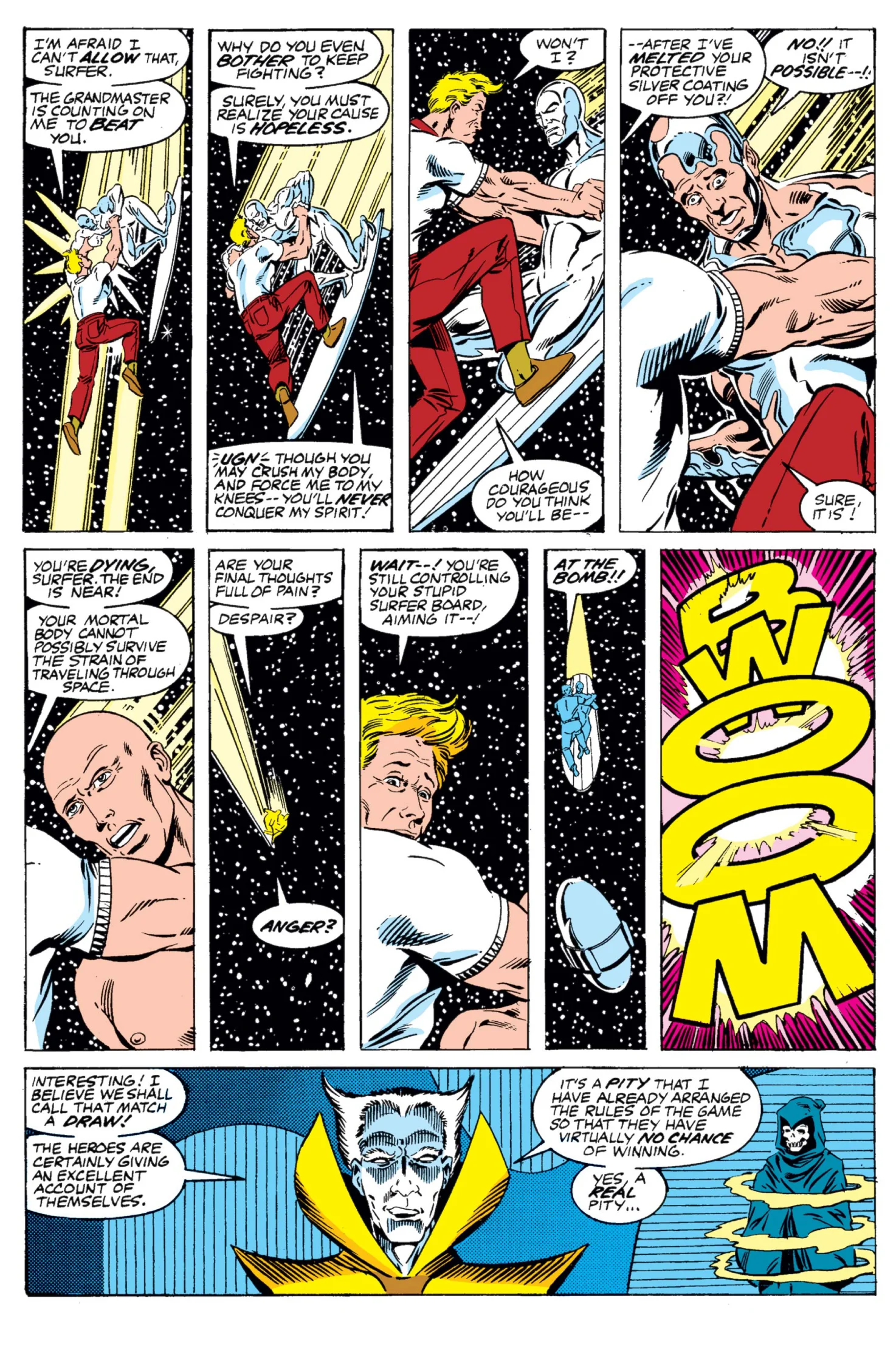
The Grandmaster’s bargain with Death, and the rigged contest that follows: the Surfer, his silver skin melted away, still aims his board at the bomb.
Enter the Elders, Enter Mantis (#3–4)
Picking up directly from the annuals, in #3 the Surfer tangles with the Collector and is then very nearly murdered by the Runner, crashing broken onto a nameless world, where he's found and healed by Mantis.
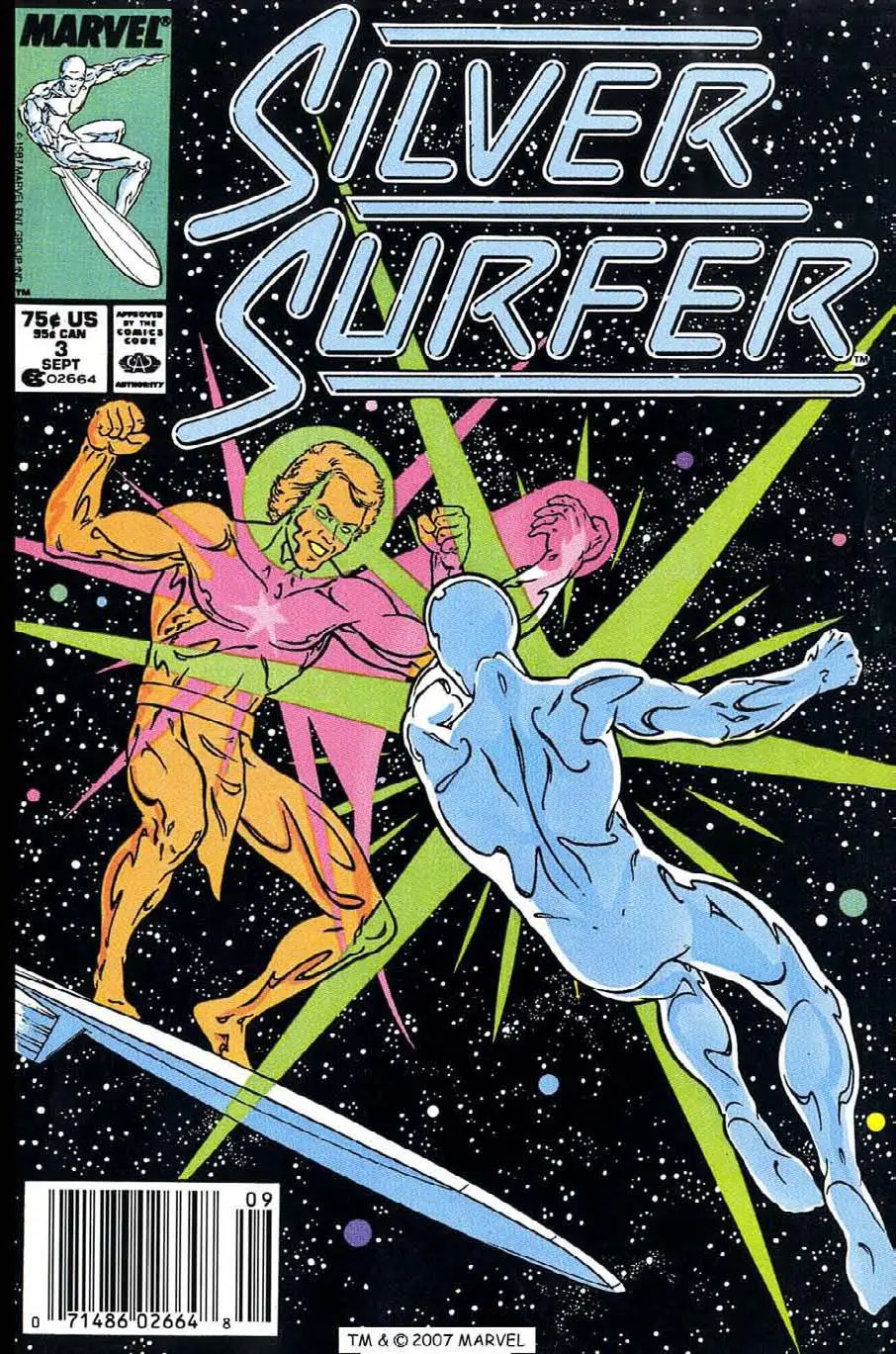
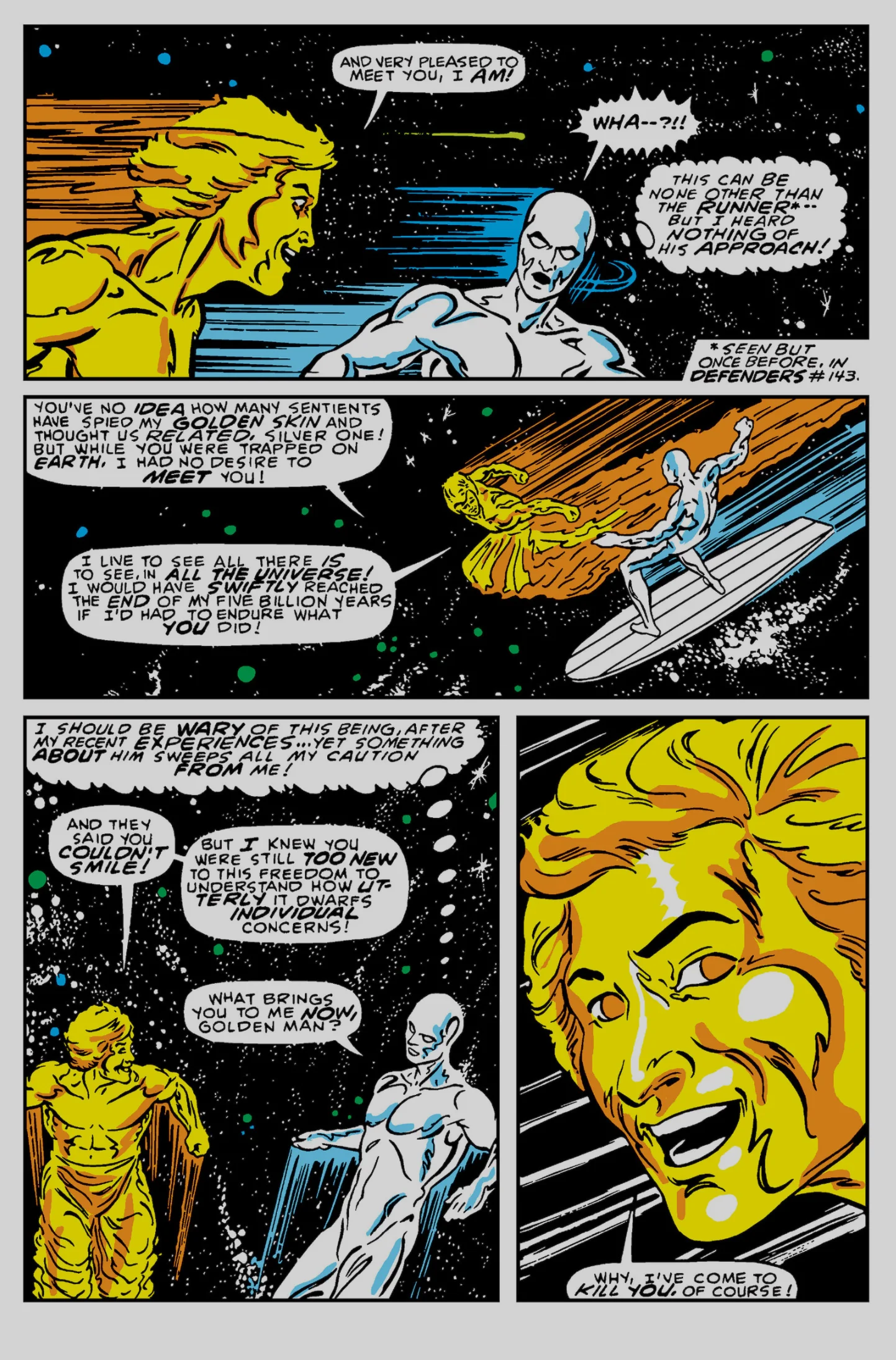
Silver Surfer vol. 3 #3: the Runner introduces himself, admires the Surfer’s new freedom, and then explains that he has come to kill him.
Mantis is no newcomer but one of Englehart's own creations, carried over from his celebrated 1970s Avengers run: a half-Vietnamese martial artist raised by an alien priesthood and prophesied to become the “Celestial Madonna,” a destiny she fulfilled by wedding a member of the plant-like Cotati race and departing Earth to bear their cosmic messiah.[15] Now the Celestial Madonna is back, reborn green and plant-attuned, able to project her consciousness between vegetable bodies across space. She gets her tangled origin retold in #4, where she admits she's been secretly steering the Surfer towards the Elders all along.
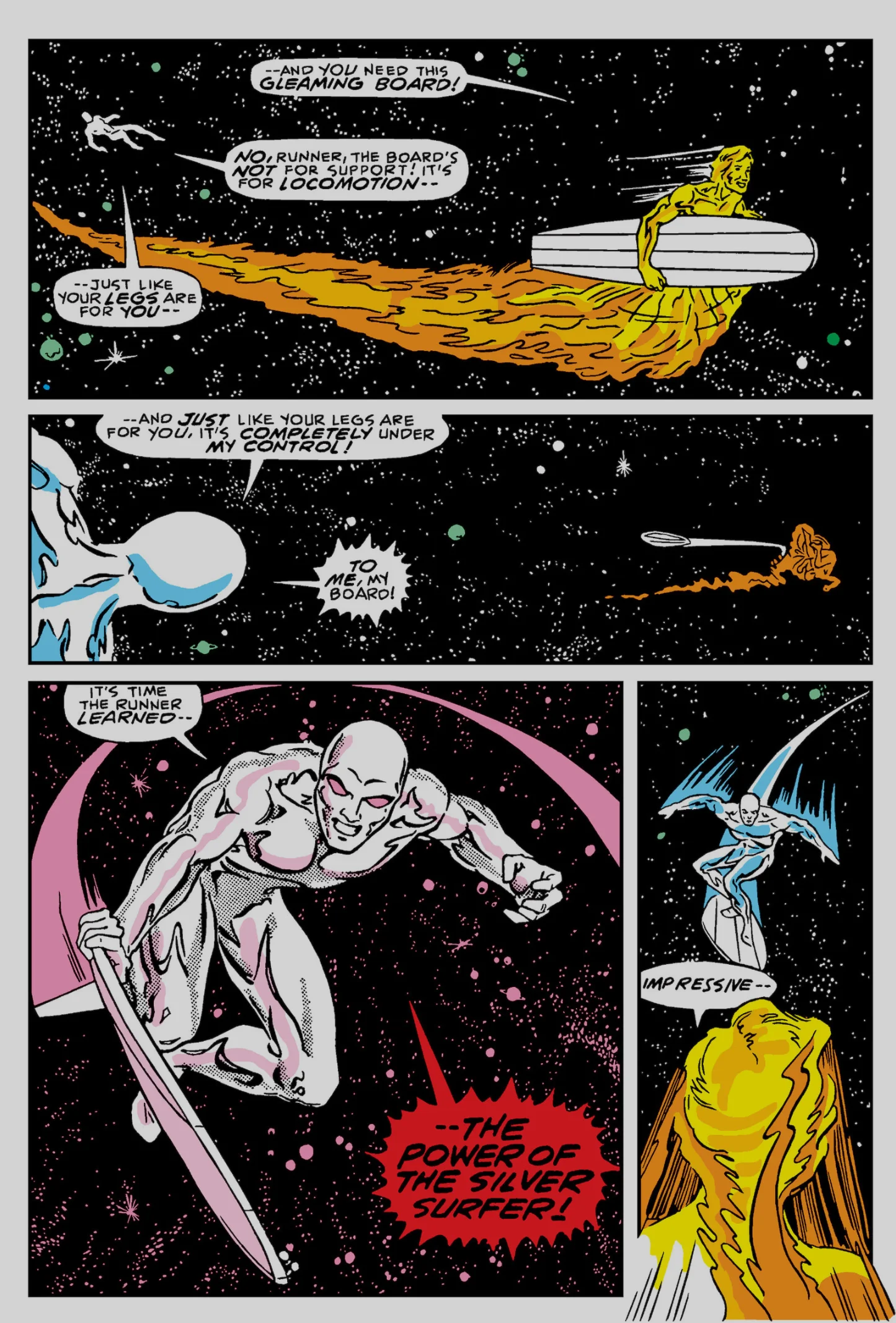
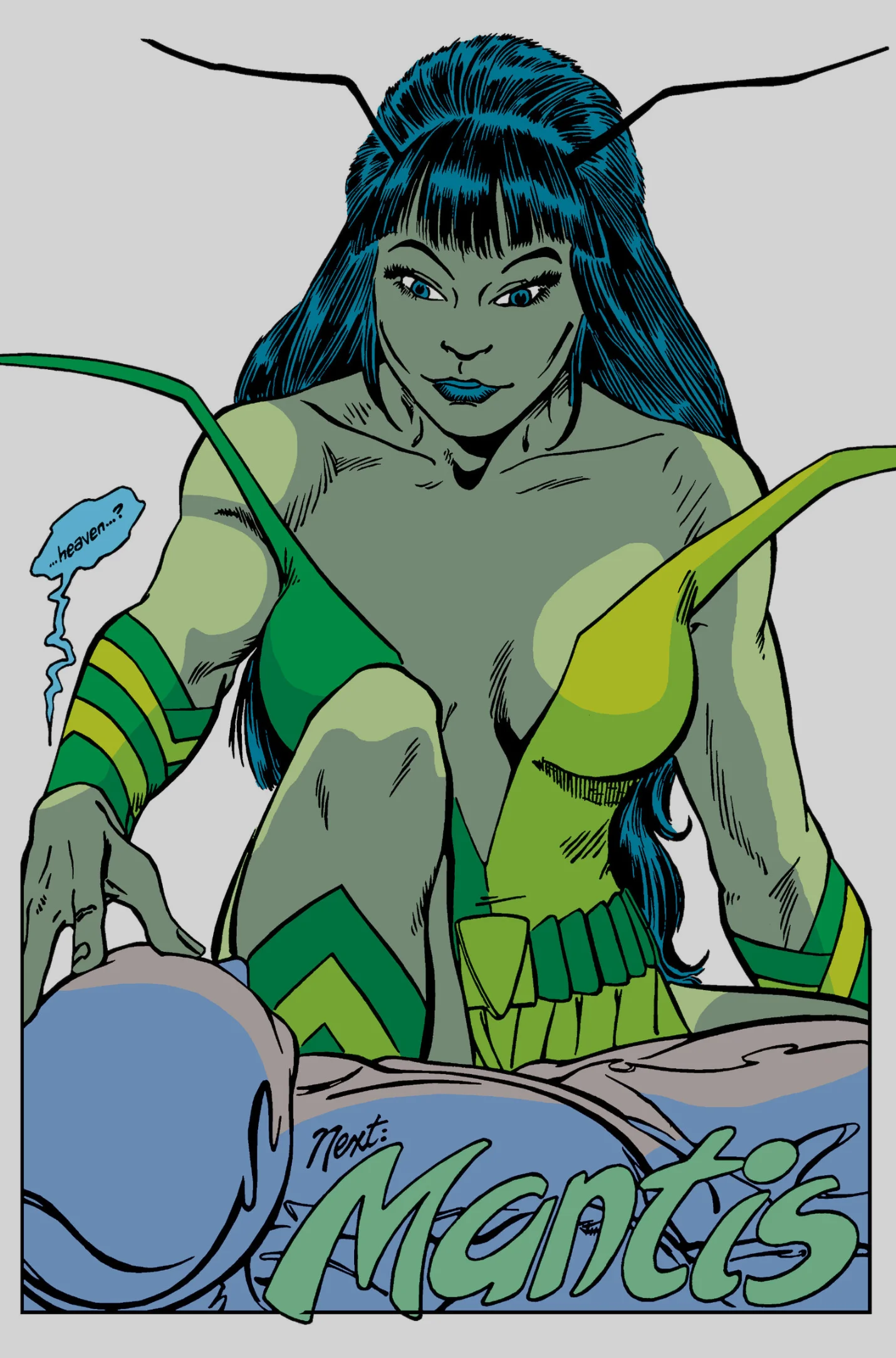
Silver Surfer vol. 3 #3: the power of the Silver Surfer — answered on the final page by a promise: “Next: Mantis.”
Together they gatecrash the Elders' conclave, held, in a typically Englehartian flourish, on Ego the Living Planet, who is both an Elder and the venue. Ten Elders assemble, and Rogers has a field day designing the new ones: the Trader like a troll doll stretched to sticks, the Astronomer a caped cyborg philosopher. The Grandmaster lays it out: with immortality secured — the Elders banished from Death's realm after the match, and so beyond her reach forever — phase two is killing the only being in existence older than they are: Galactus, the Devourer of Worlds. Ego betrays the eavesdroppers, the couple fight their way off the planet's surface, and somewhere in the escape there's a kiss (between Mantis and the Silver Surfer, not with Ego).
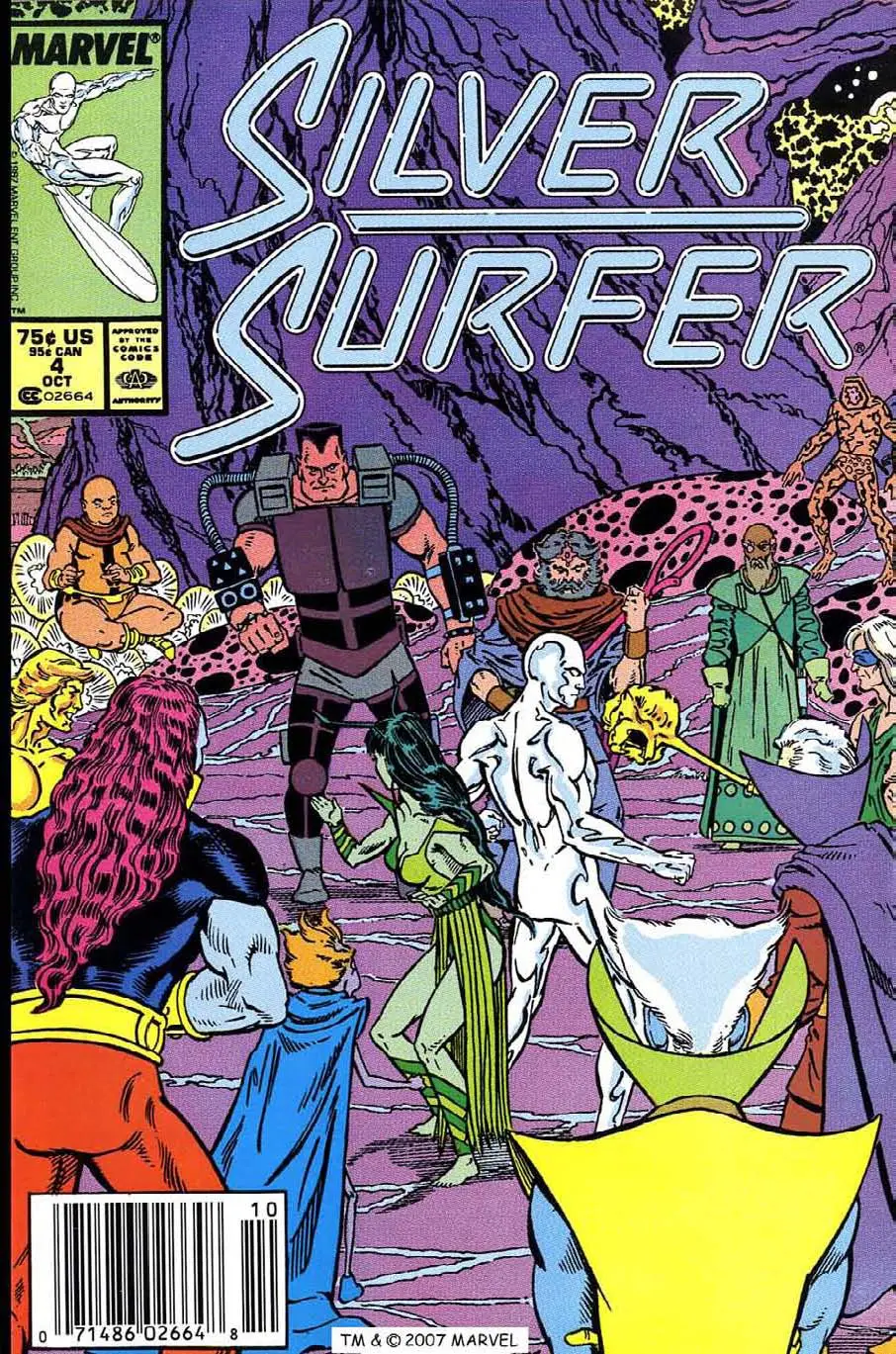
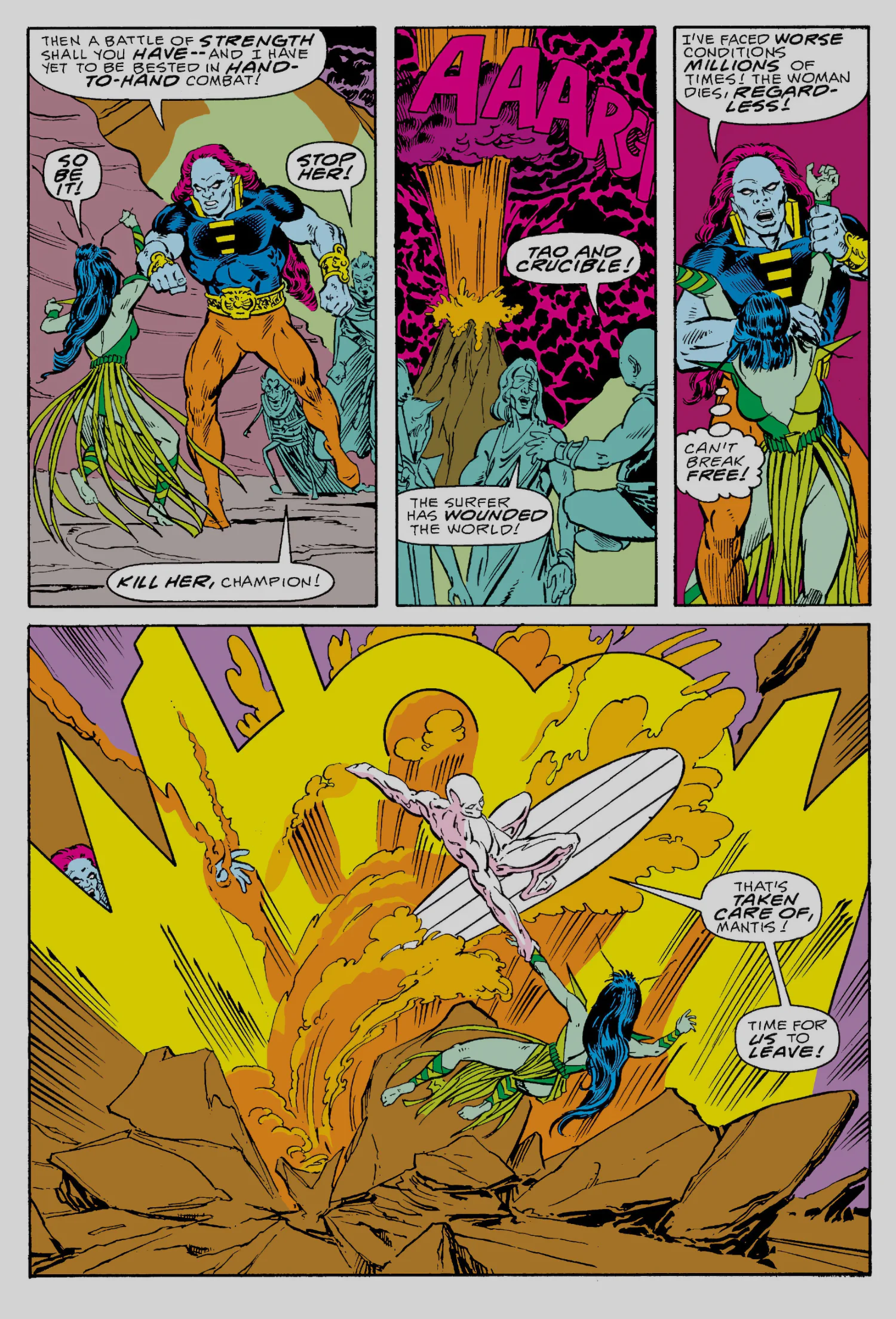
Silver Surfer vol. 3 #4: the Elders’ conclave on Ego the Living Planet — and an escape that wounds the world itself.
Obliteration and Explanation (#5–6)
The Elders send the Obliterator, five billion years old, a being so devoted to annihilation that he exterminated his own species and world, to erase the witnesses. He vaporises Mantis... who promptly returns in a fresh plant body, one of the run's best tricks.
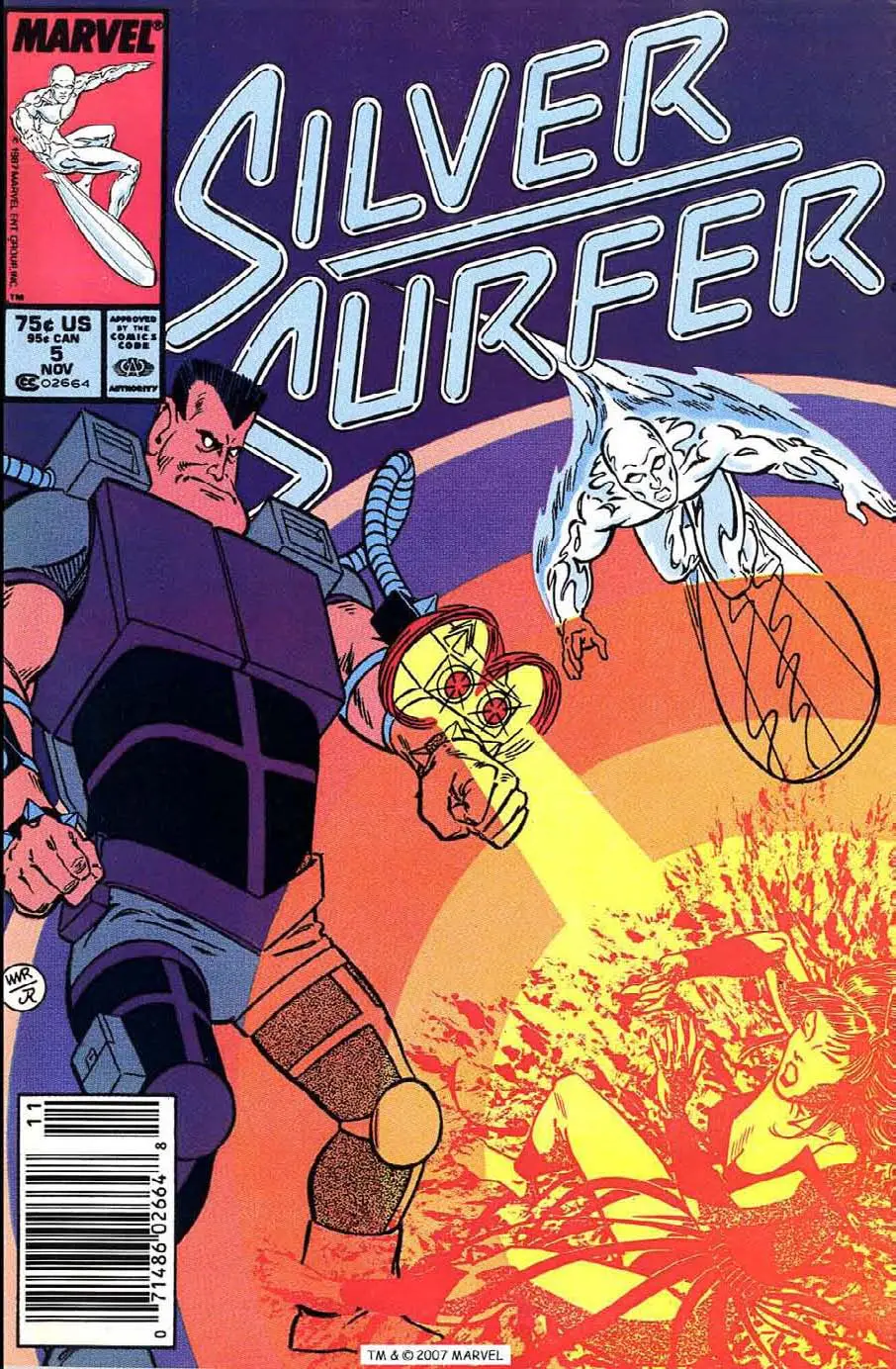
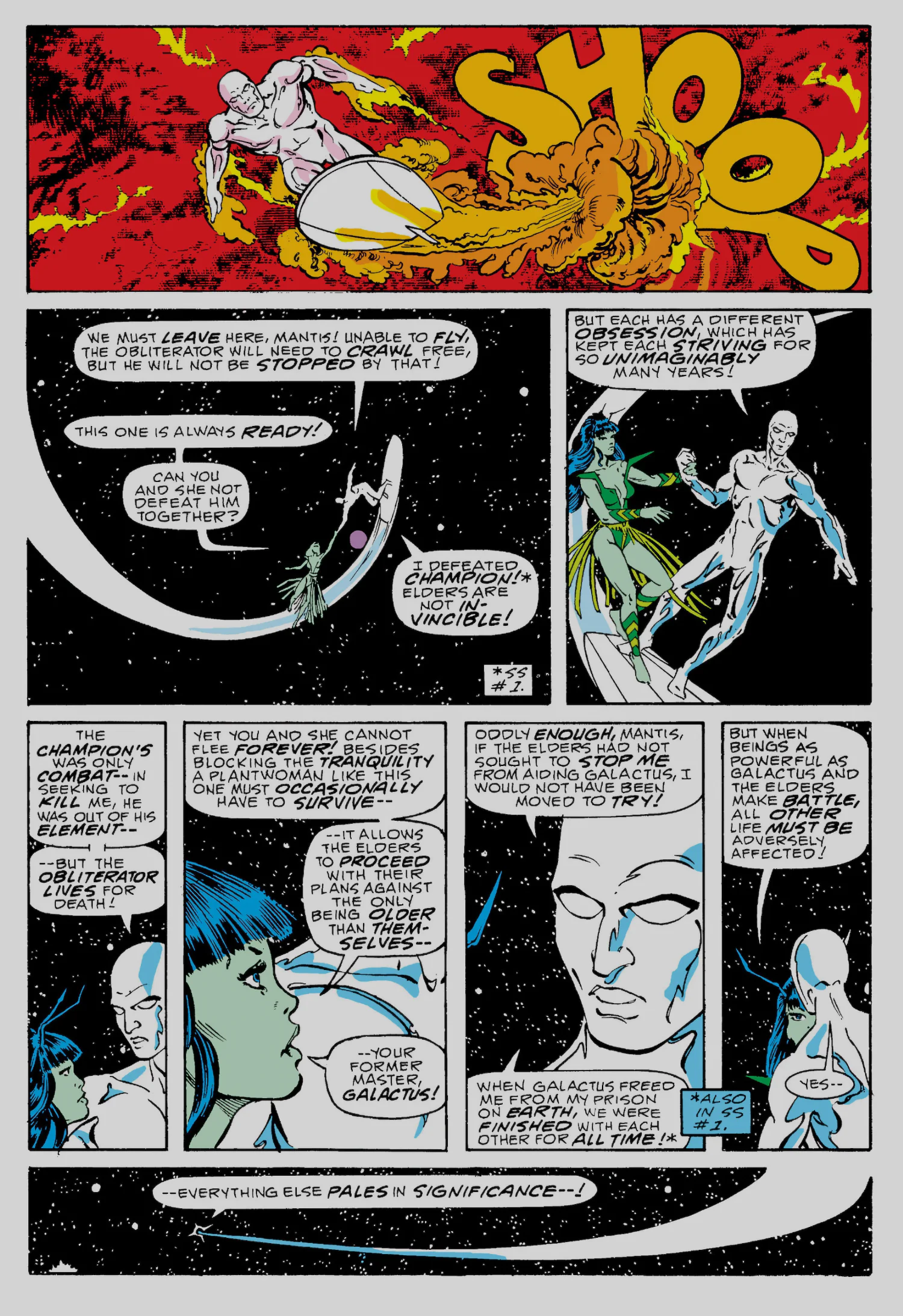
Silver Surfer vol. 3 #5: the Obliterator on the hunt, while the Surfer and Mantis argue about the obsessions that keep an Elder alive.
The enraged Surfer, unable to kill an immortal, does something far more elegant: he transmutes the Obliterator's beloved arsenal into harmless junk, and the Elder, his sole purpose in life dissolved, simply collapses, and talks. The plan, it emerges, is madder than deicide. Galactus is the last survivor of the previous universe; kill him and the balance between Death and Eternity shatters, existence itself collapses, and a new universe is born, into which the deathless Elders alone survive, as its firstborn gods, “a race of Galactuses”.
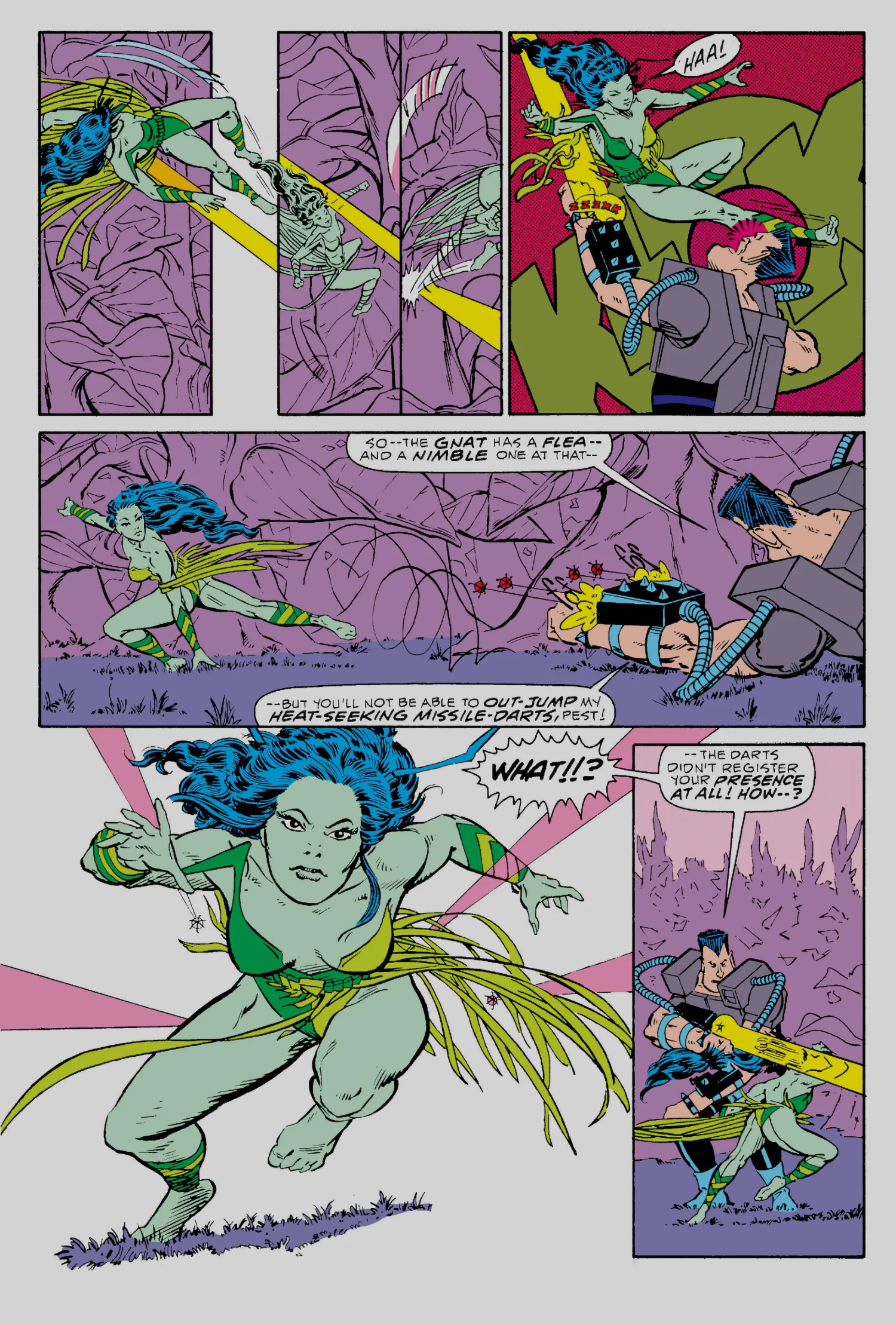
Silver Surfer vol. 3 #5: Mantis outjumps the Obliterator’s heat-seeking missile darts.
Meanwhile the second Kree–Skrull war ignites in the margins: Emperor Kylor's Skrulls strike pre-emptively (spooked, in part, by a Celestial, Jemiah the Analyzer, parking itself over their space), Skrull command is a snake-pit (poor Aptak, a male strategist locked into a female alien body by the shape-freezing bomb, seethes through every scene), and on Kree-Lar the Supreme Intelligence[16] senses a spy in his court, executes his innocent pet Nullet, and never suspects Nenora, the actual Skrull mole standing at his elbow.
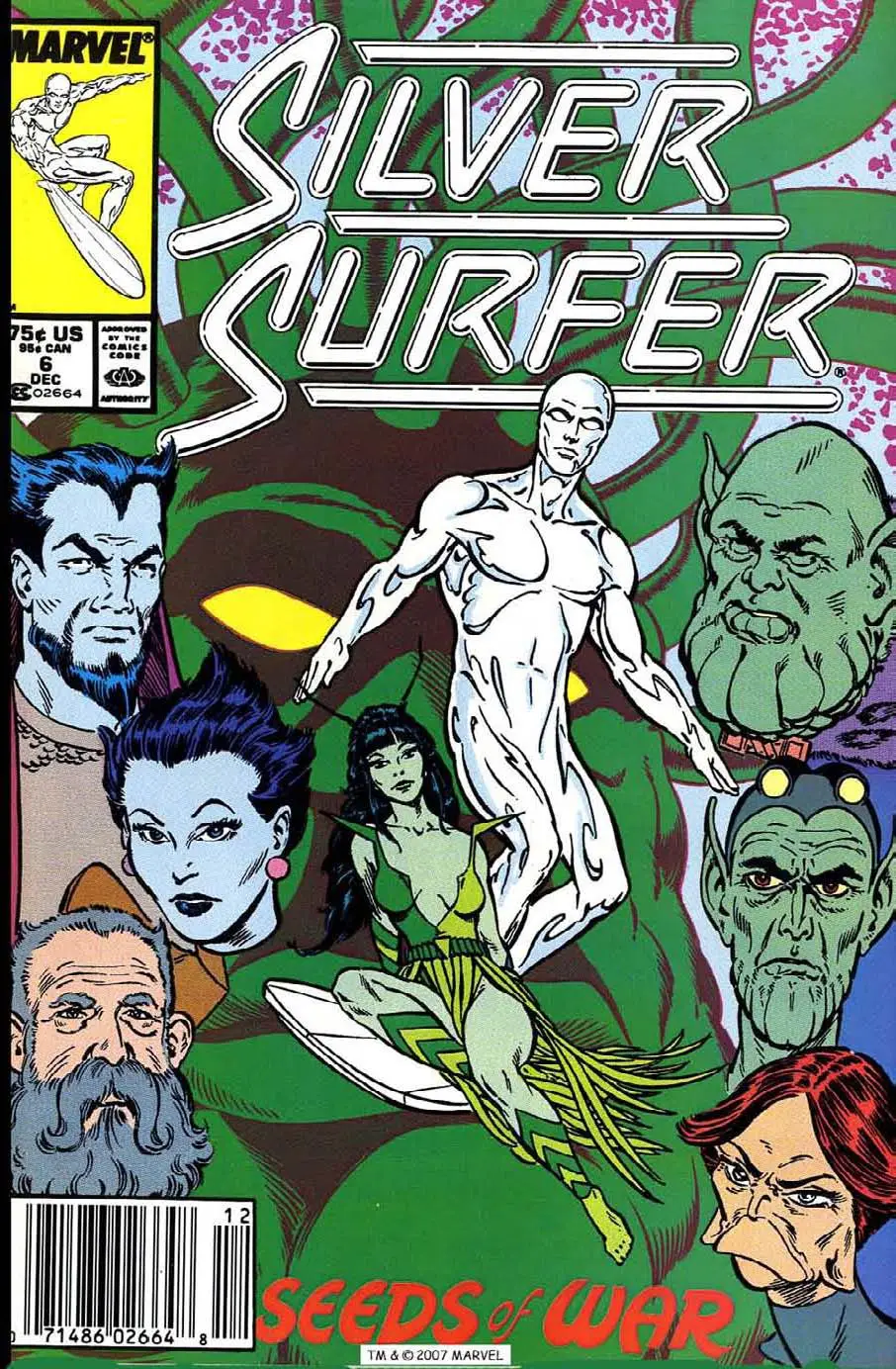
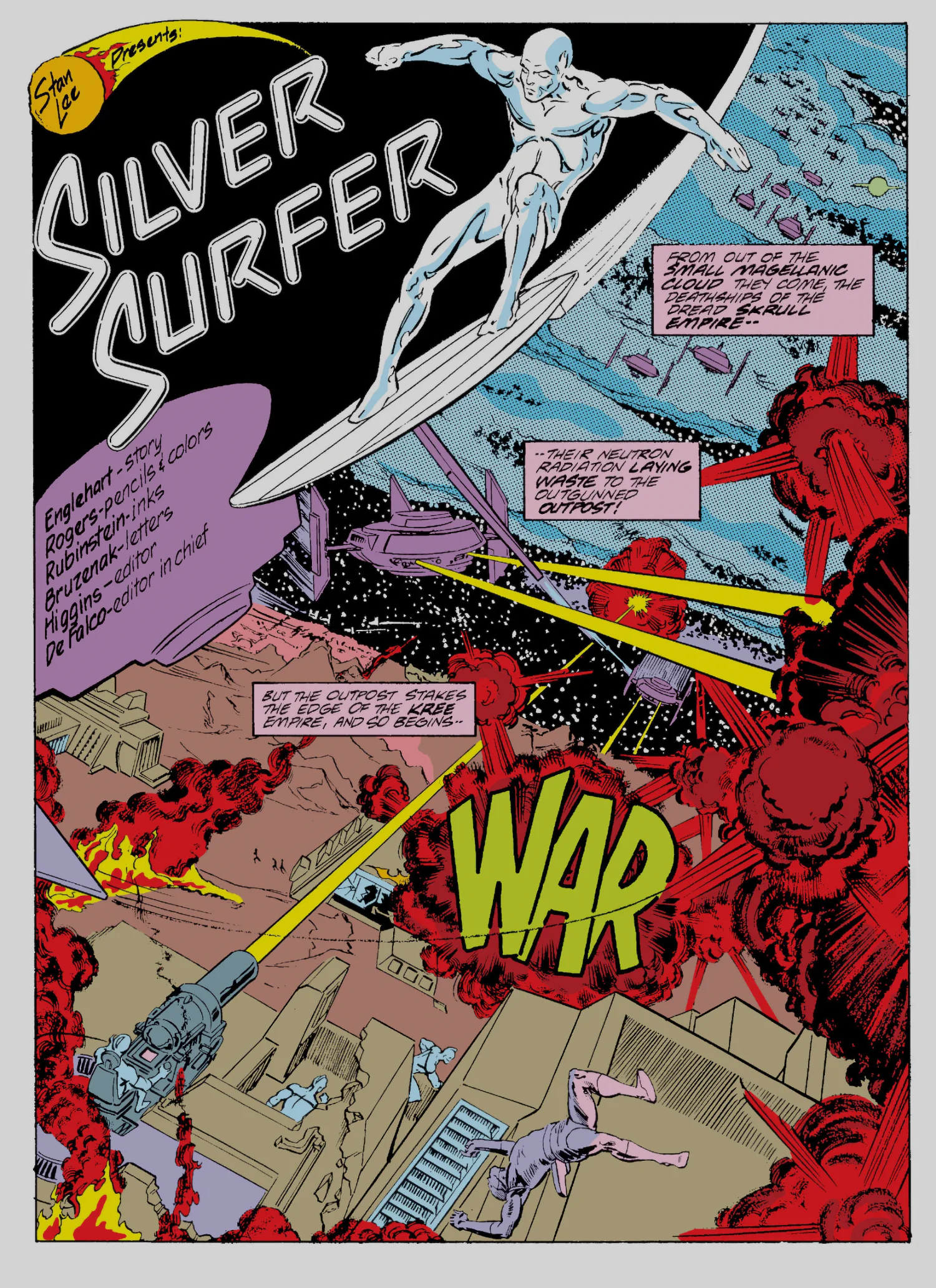
Silver Surfer vol. 3 #6, “Seeds of War”: Skrull ships open the second Kree–Skrull war on a Kree border outpost.
The lovers are forced apart: a distress call from Shalla-Bal pulls the Surfer home, and Mantis heads to Earth to shadow the Elders alone.
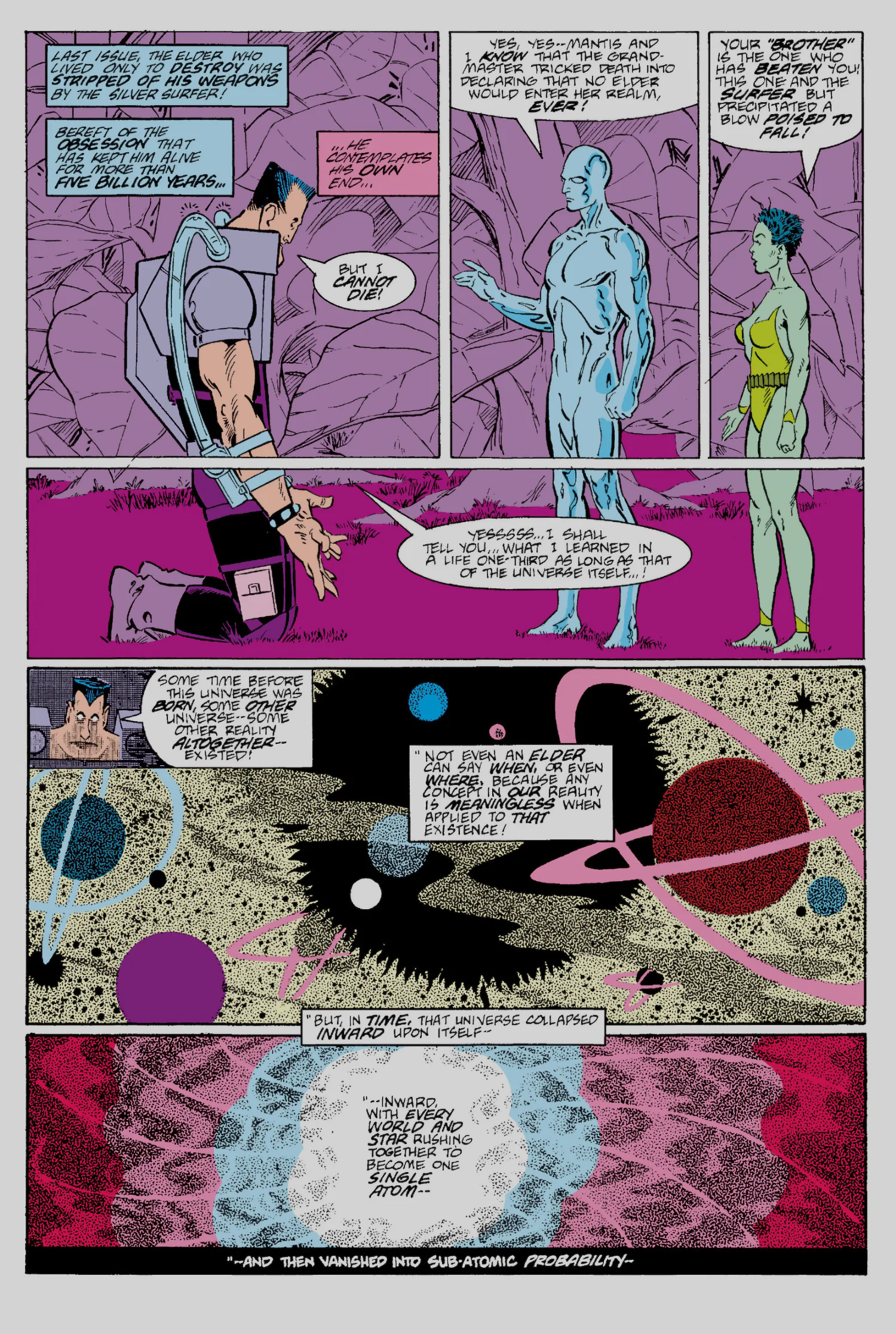
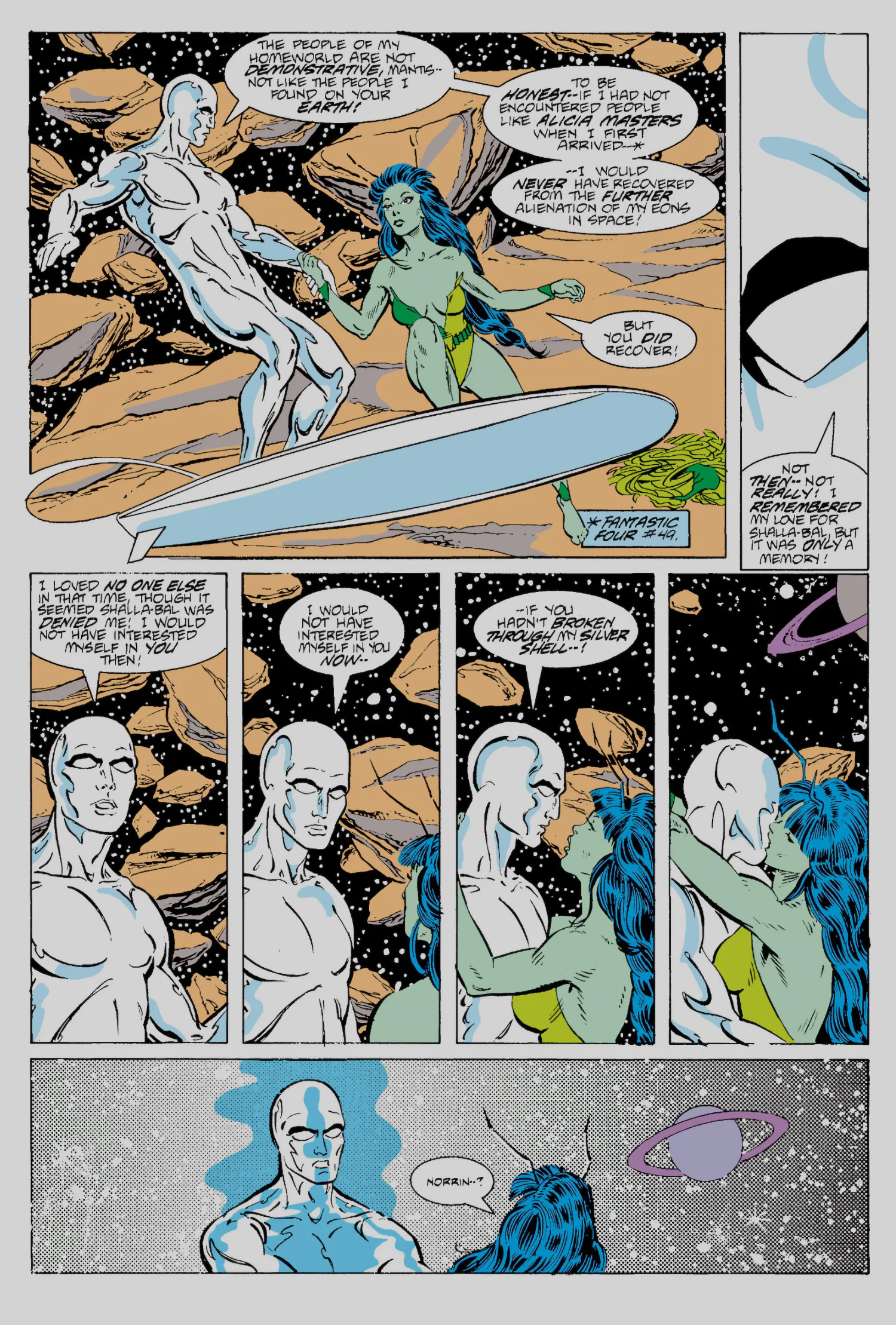
Silver Surfer vol. 3 #6: the disarmed Obliterator — “But I cannot die!” — explains the death of a previous universe, and the lovers say their goodbye.
The Gem, the Hive-Mind, the Hostages (#7–9)
In #7, pointedly titled “Triangle!”, the Surfer swats a Kree invasion force away from Zenn-La and then flies to Kree-Lar to demand neutrality for both Zenn-La and Earth. The Supreme Intelligence concedes the former (Zenn-La has no military value) but refuses the latter, and when the Surfer pushes, the great gestalt-mind reveals its hole card: a Soul Gem, set in its brow, which it uses to rip the Surfer's mind clean out of his body.
And here comes one of the run's most delicious details. We learn what the gem is for: it harmonises the warring pink-Kree and blue-Kree minds absorbed within the Supreme Intelligence. That is the very reason it can never be surrendered to the Elders — who, by now, have gathered the other five gems.
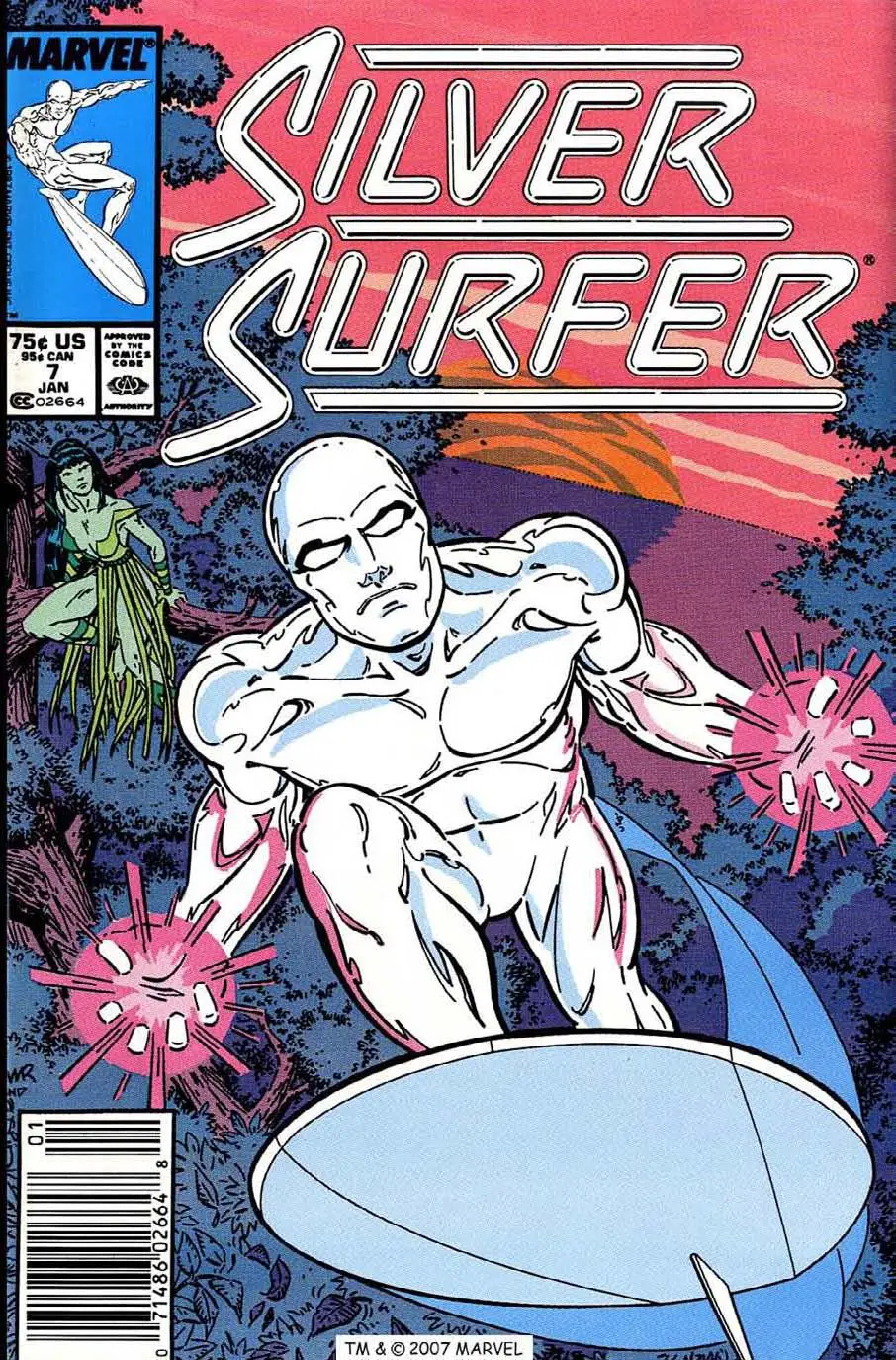
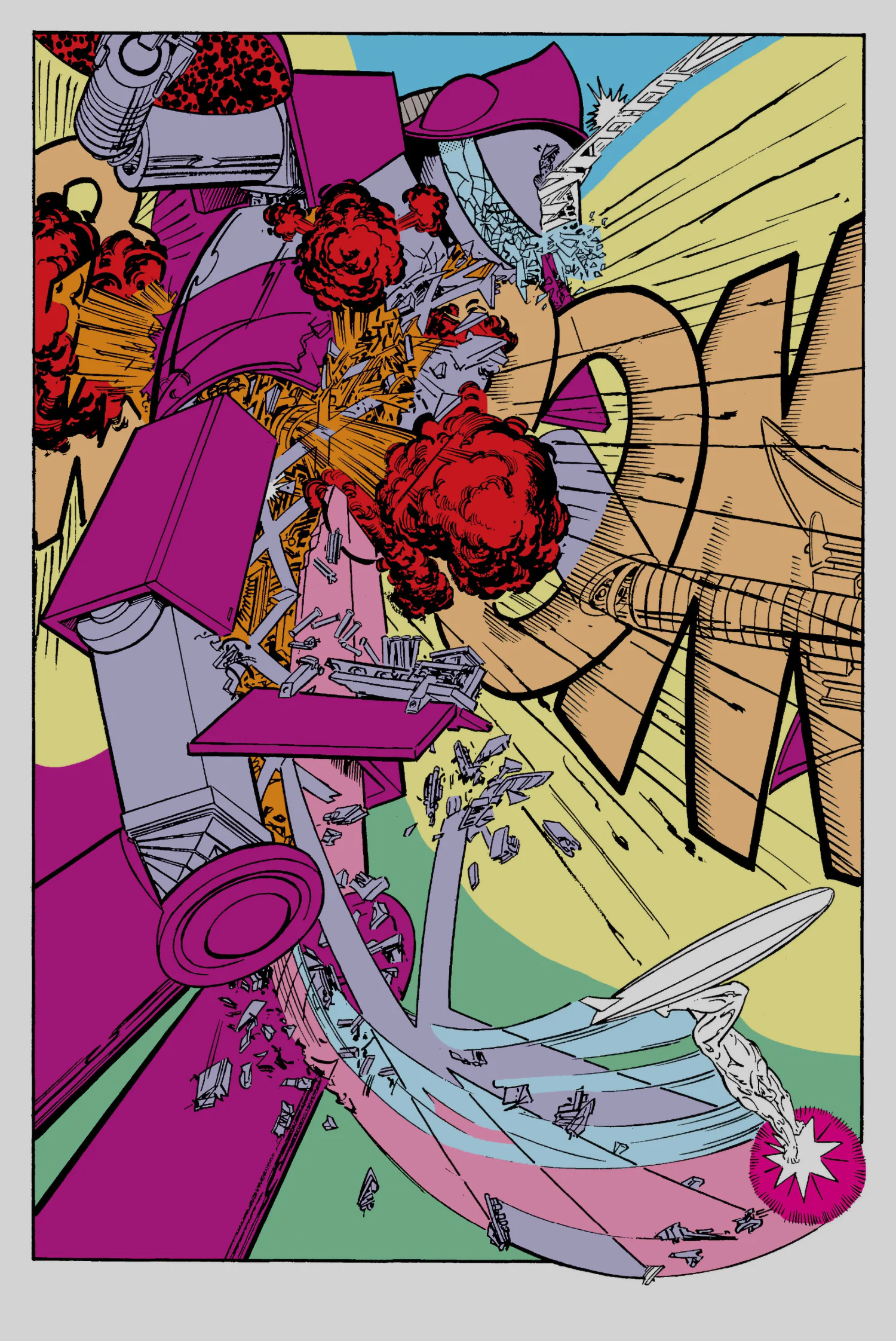
Silver Surfer vol. 3 #7, “Triangle!”: the Surfer takes a Kree invasion fleet apart over Zenn-La.
On Earth, Mantis eavesdrops on the Elders and is snared by the Gardener; her distress call, whispered through the plants, is heard light-years away by Shalla-Bal of all beings.
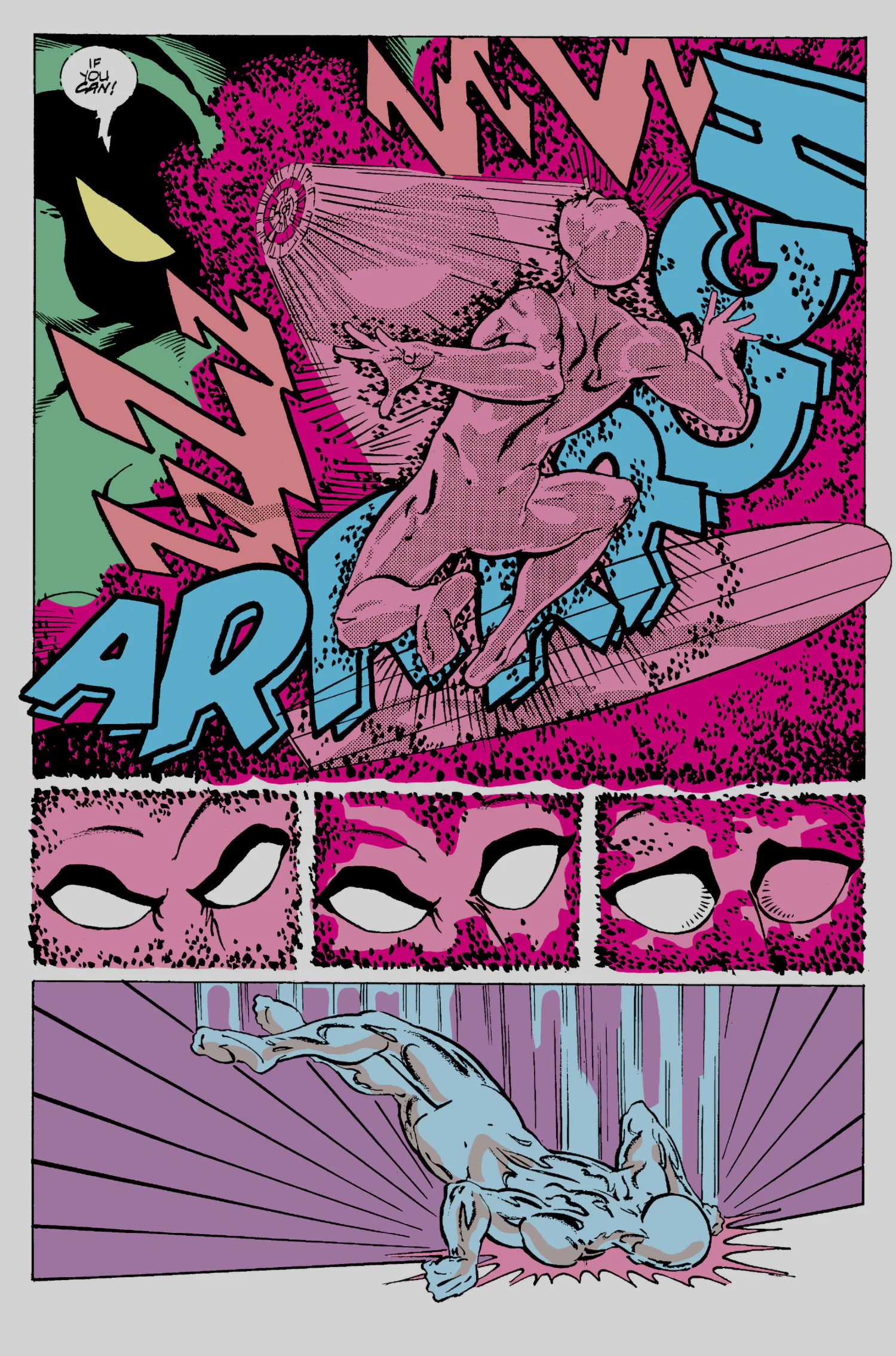
Silver Surfer vol. 3 #7: the Supreme Intelligence’s Soul Gem rips the Surfer’s mind clean out of his body.
Issue #8 is the run's strangest and arguably finest hour. The Surfer's disembodied soul wanders the dream-logic interior of the Supreme Intelligence, powerless and hunted by absorbed Kree minds, aided only by enigmatic silver animals: a rat, a dog, a falcon. Then he realises the one thing in creation still answering to him — his board, which he summons through the gem itself.
He tears free, gem in hand, and behind him the Supreme Intelligence's mind comes apart as its captive pink and blue minds turn on each other. File that act of cosmic vandalism away; it detonates twenty-three issues later.
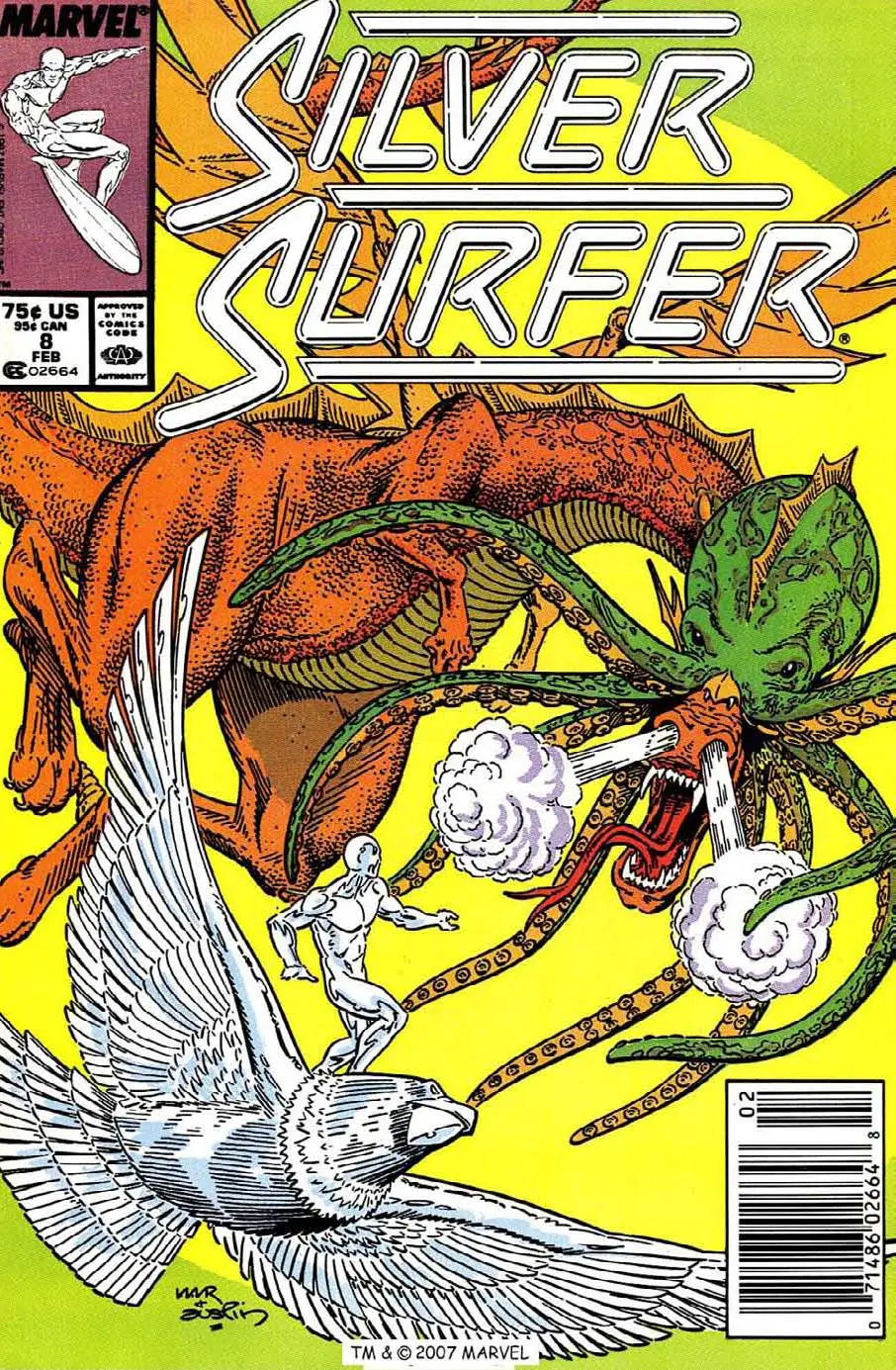
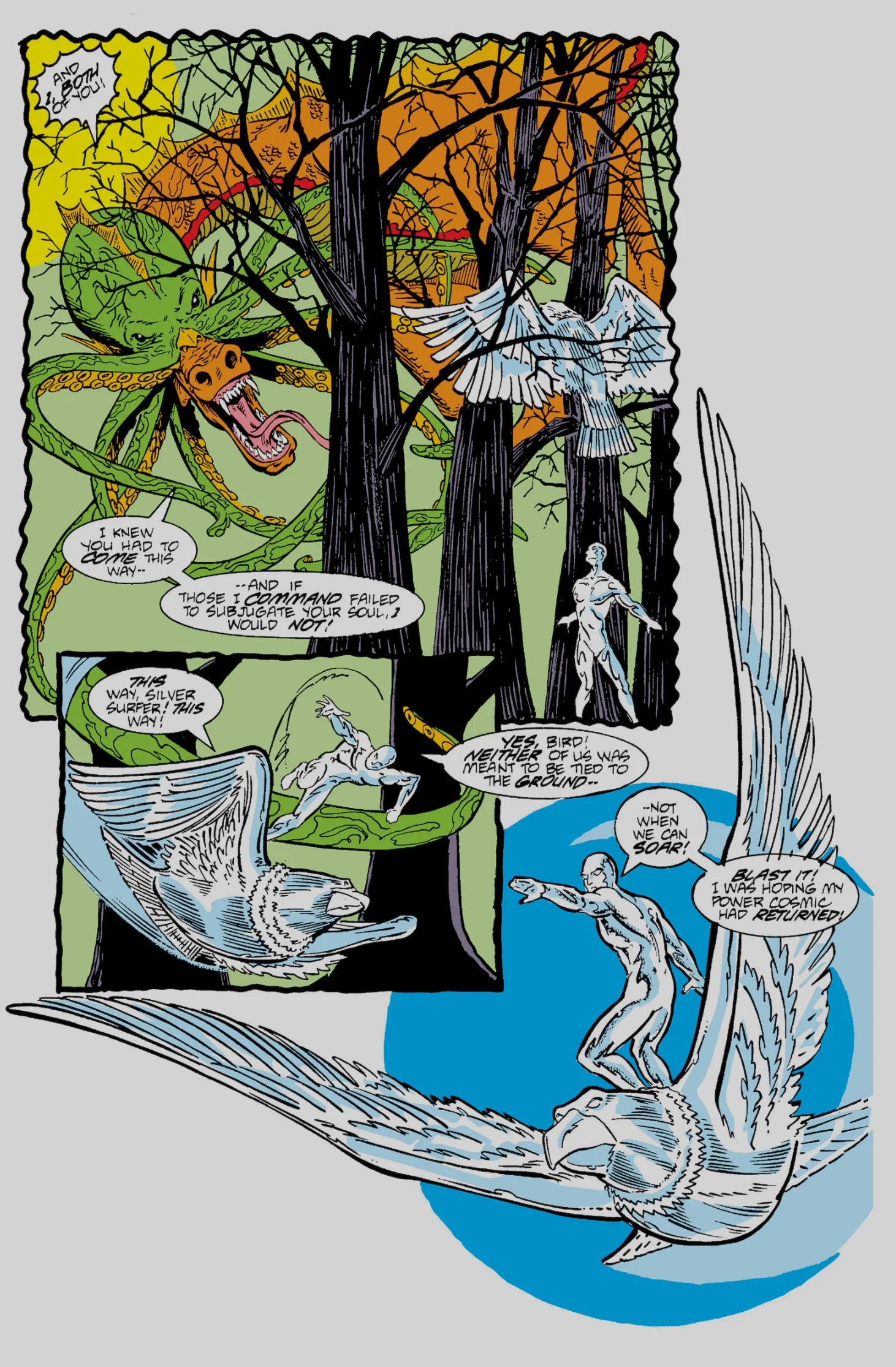
Silver Surfer vol. 3 #8: a disembodied soul in a dream-forest, guided by a silver falcon.
Then #9 turns the screw: the Elders, needing that sixth gem, hold Mantis and Shalla-Bal hostage near the Cone Nebula. The Surfer pays the ransom, and the Grandmaster cheats anyway, flinging the two women away inside an energy sphere rigged to explode. The Surfer reaches them, but can pull only one clear: he saves Shalla-Bal, and Mantis apparently dies in the blast.
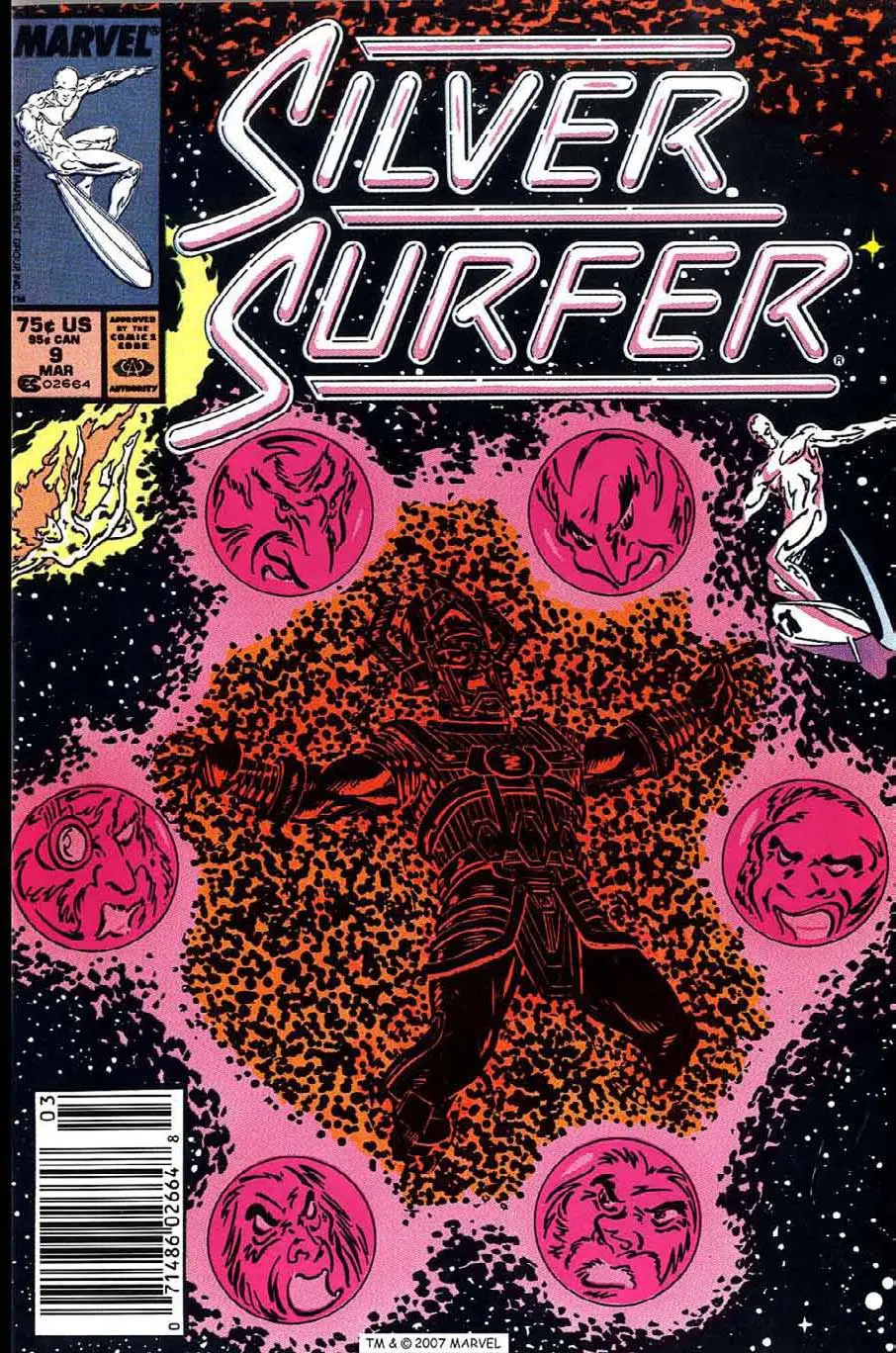
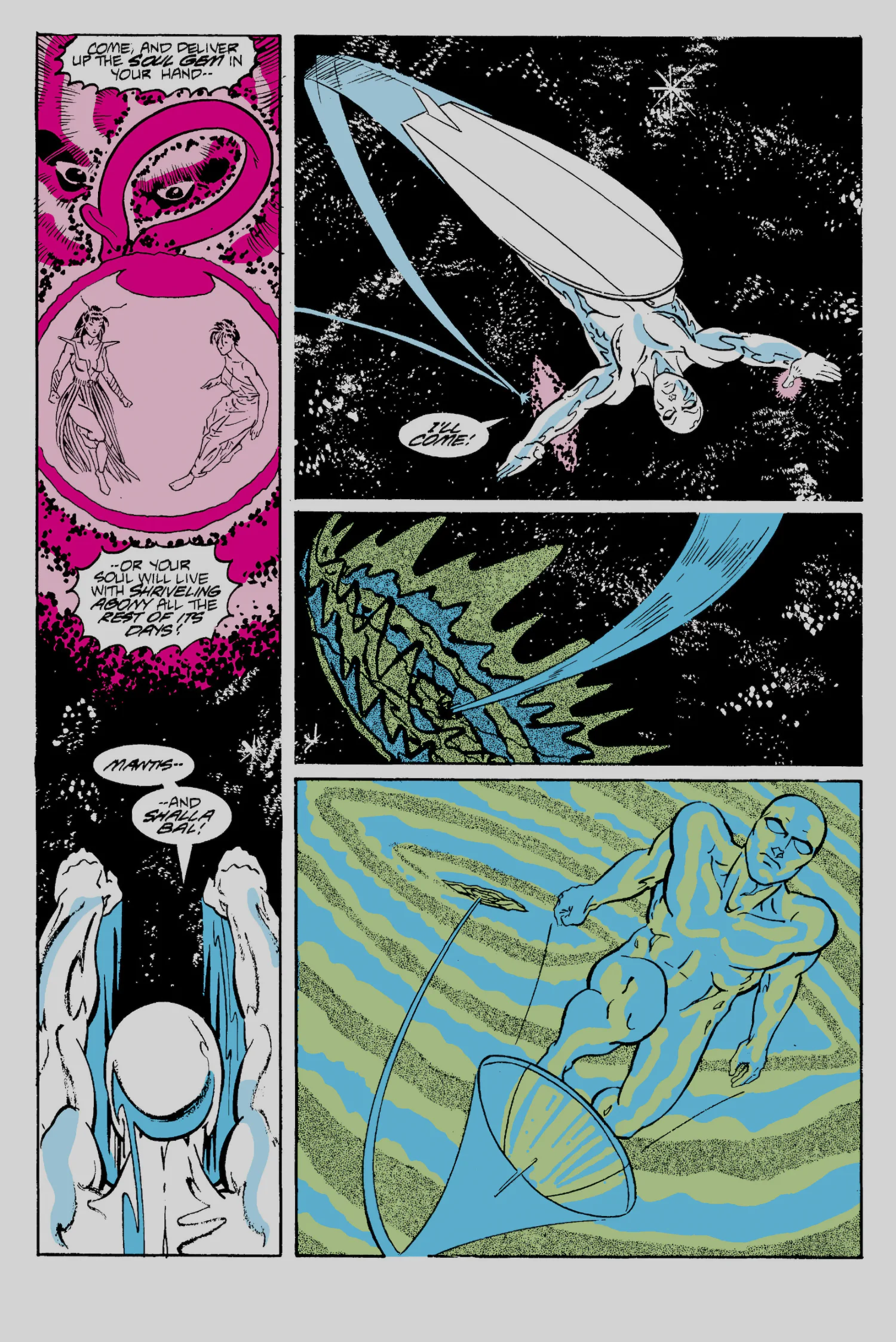
Silver Surfer vol. 3 #9: hand over the Soul Gem, the Elders demand, or Mantis and Shalla-Bal pay for it.
The Elders spring their masterwork: the six Soul Gems mounted on a platform and aligned with a system of six barren worlds, draining Galactus's life-force into a dead planet that blooms even as the devourer withers. It's a grotesquely beautiful inversion, and Englehart surely knows it.
The Surfer arrives for revenge and throws himself into the beam. Nova does something more drastic. She detonates the system's star, and the newborn black hole swallows the gems and three of the Elders (the Trader, the Possessor and the Astronomer) whole. Galactus, saved at the brink, plucks his rescuers from the event horizon and promises a reckoning of his own.
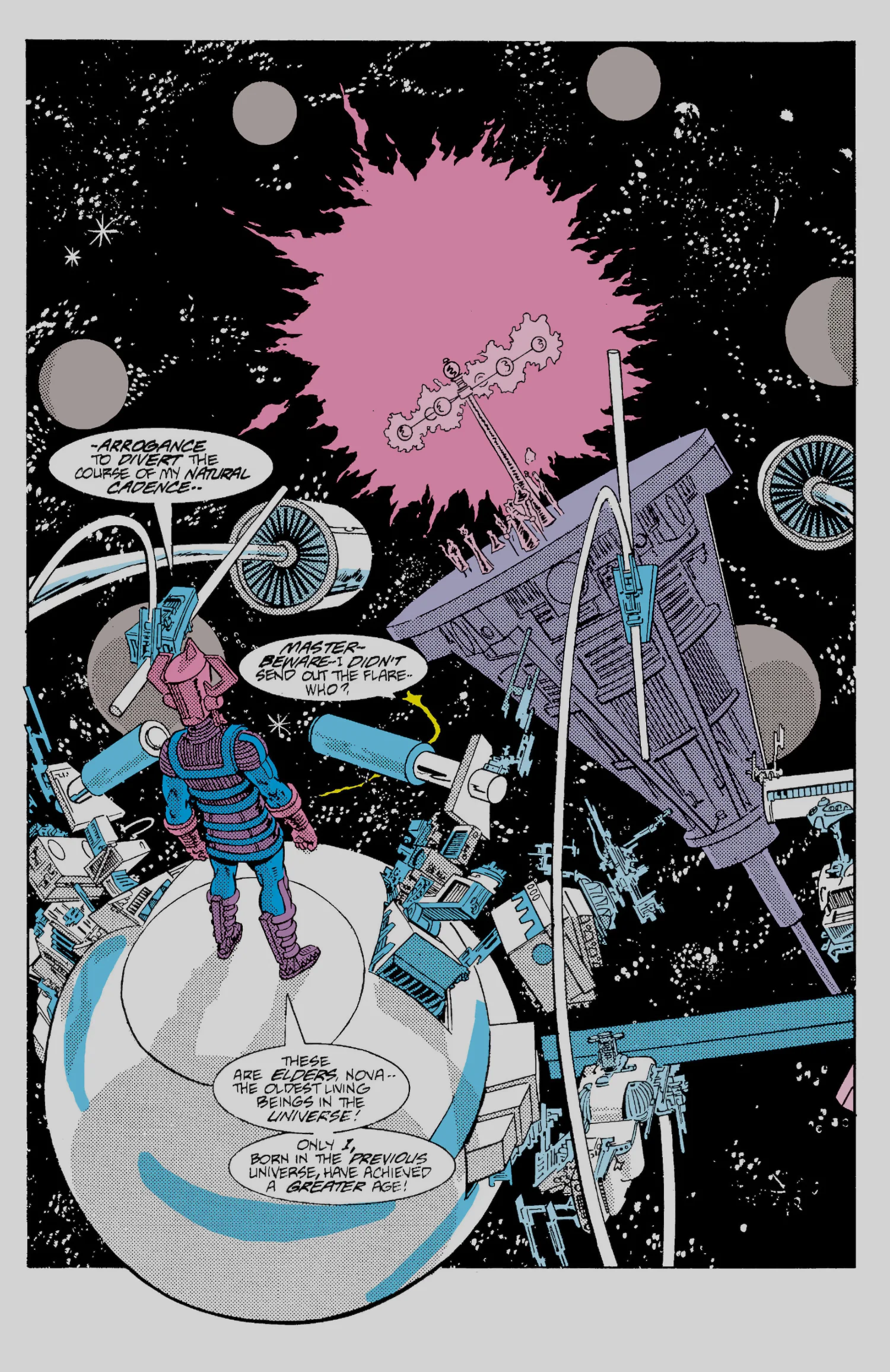
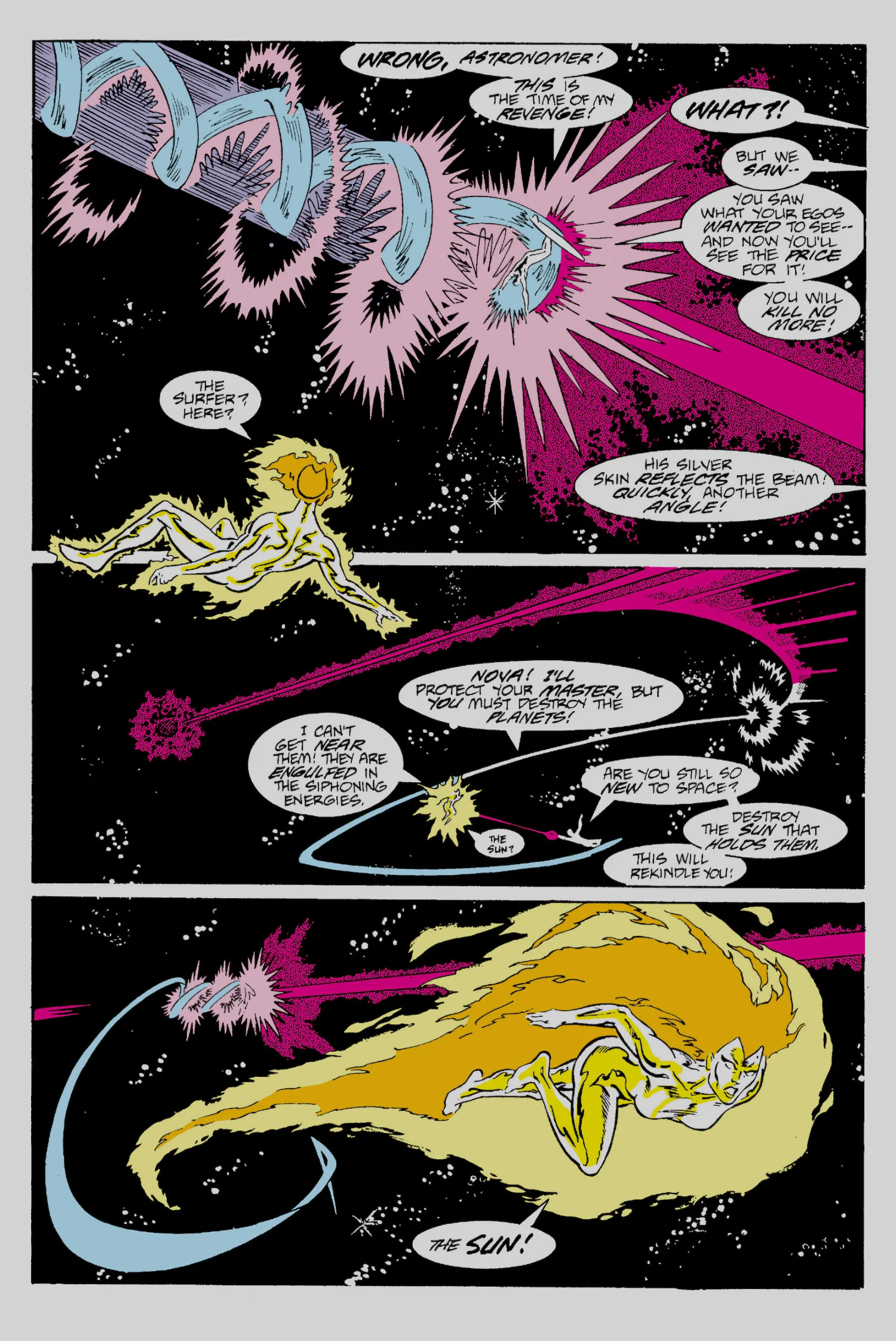
Silver Surfer vol. 3 #9: Galactus tells Nova what the Elders are — and the Surfer’s revenge ends with Nova detonating the system’s sun.
The Feast (#10, “Space Is… Eternity!”)
Galactus's revenge is Old Testament in scale and appetite: he devours the five remaining conspirators — Grandmaster, Collector, Champion, Runner and Gardener — whole.
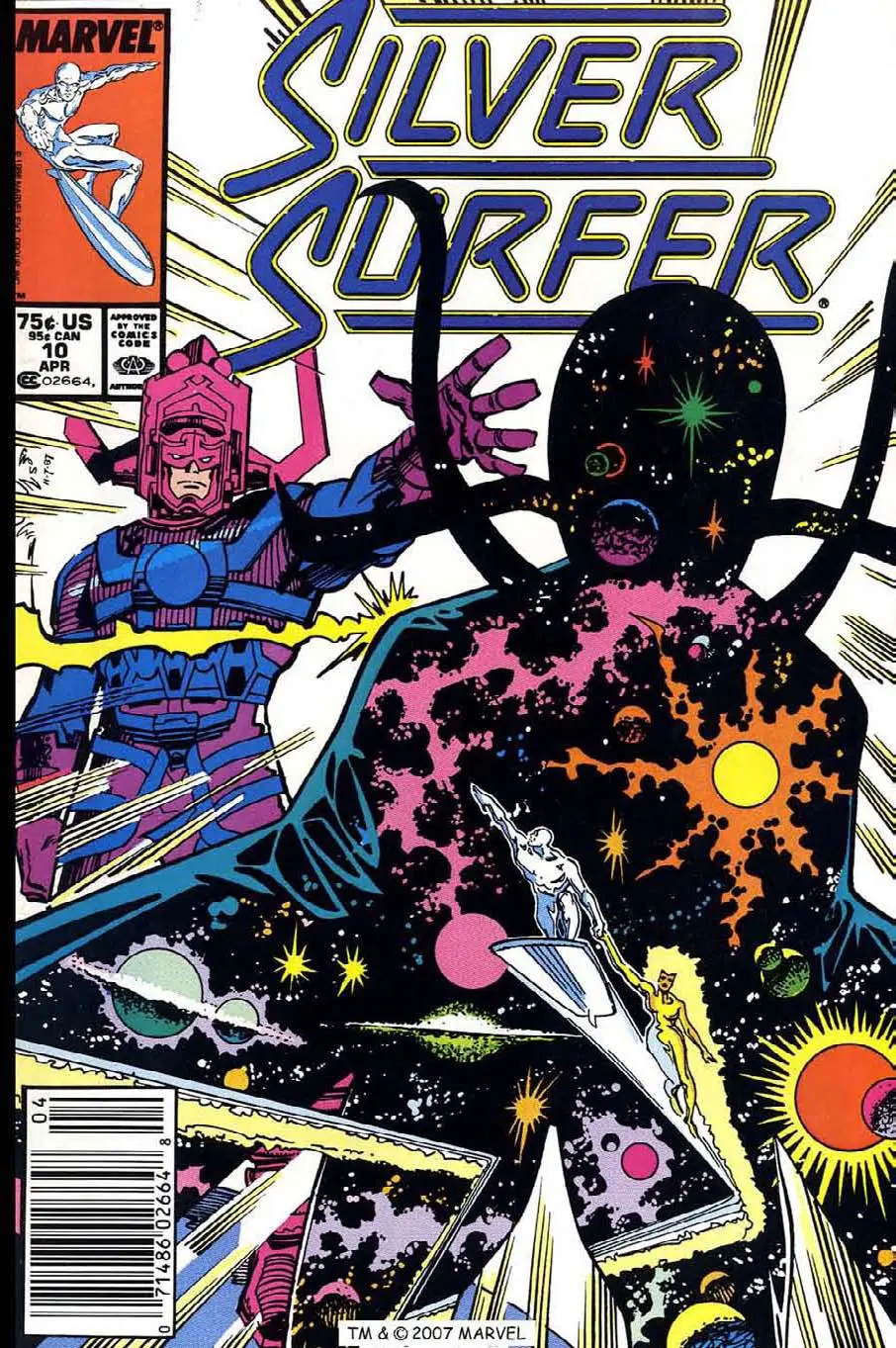
Silver Surfer vol. 3 #10, “Space Is… Eternity!”: Galactus, Eternity, and two heralds caught between them.
Only one Elder remains unaccounted for: the Contemplator, last seen on Hala murmuring at the Supreme Intelligence's side, and Nova is charged with fetching him. The Surfer volunteers to help, for a price extracted from the most powerful being in the universe: Galactus's eternal pledge that Zenn-La is forever off the menu.
Then Englehart lifts the veil entirely. Hidden nearby, the two heralds watch as Galactus's human-scaled form dissolves into something vaster and stranger. He communes with Eternity itself, and Nova begins to grasp just how far above the food chain her master truly sits. For this is the deep architecture the whole run has been circling: Galactus, Eternity, and Death are not ranked one above another but stand as three equal and balanced forces, the pillars on which the very existence of the universe rests.
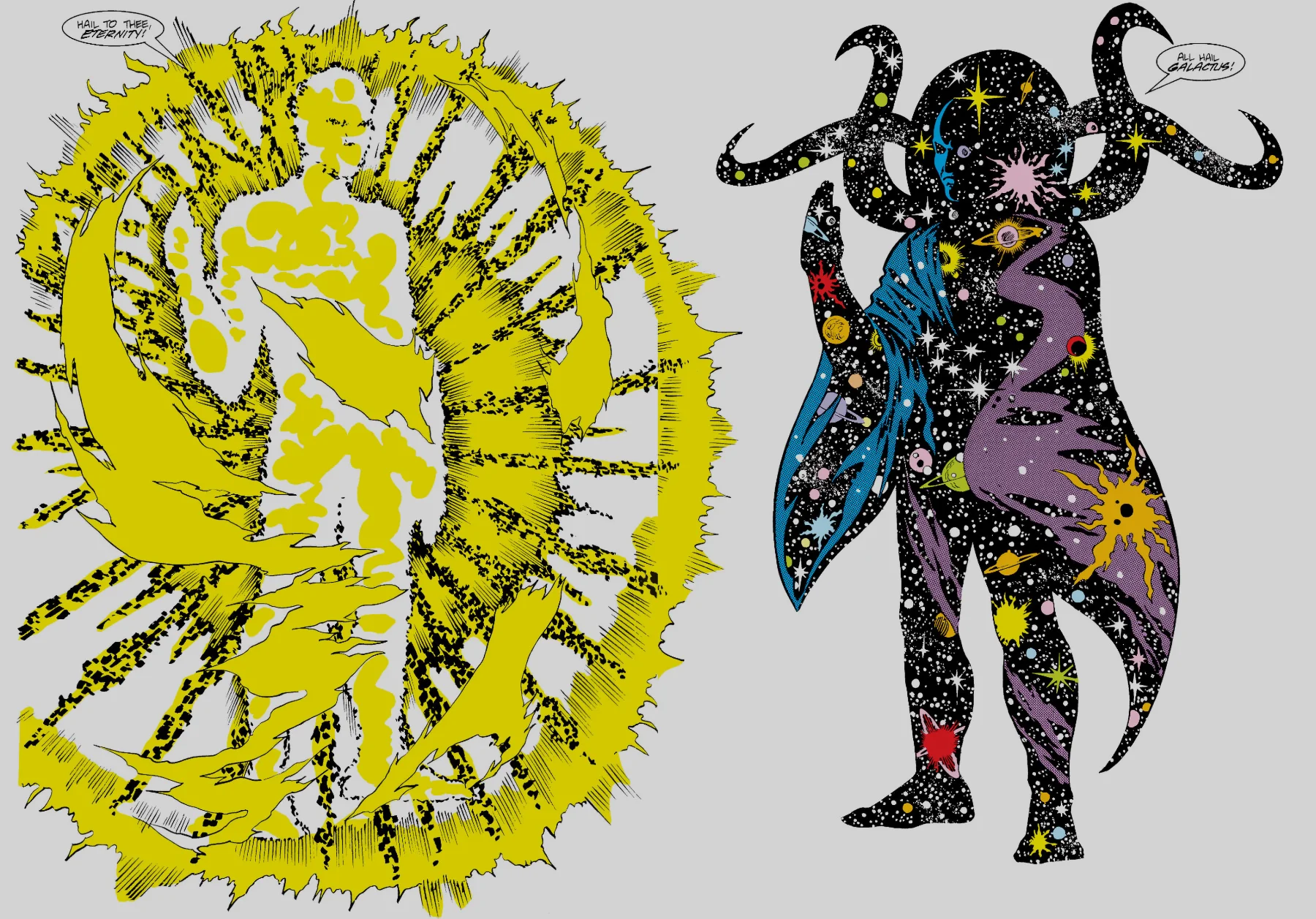
Silver Surfer vol. 3 #10: Galactus shows one of his true forms in conversation with Eternity.
In the political margins, Nenora completes her ascent: Supreme Leader of the Kree now, she poisons her own lover Aptak and begins methodically purging everyone who knows she's a Skrull. And in the final panels comes the hook for everything to follow: Galactus drifts away, visibly discomfited (five immortal Elders, it turns out, do not digest) while behind him, unseen, Death herself manifests. And she is not pleased.
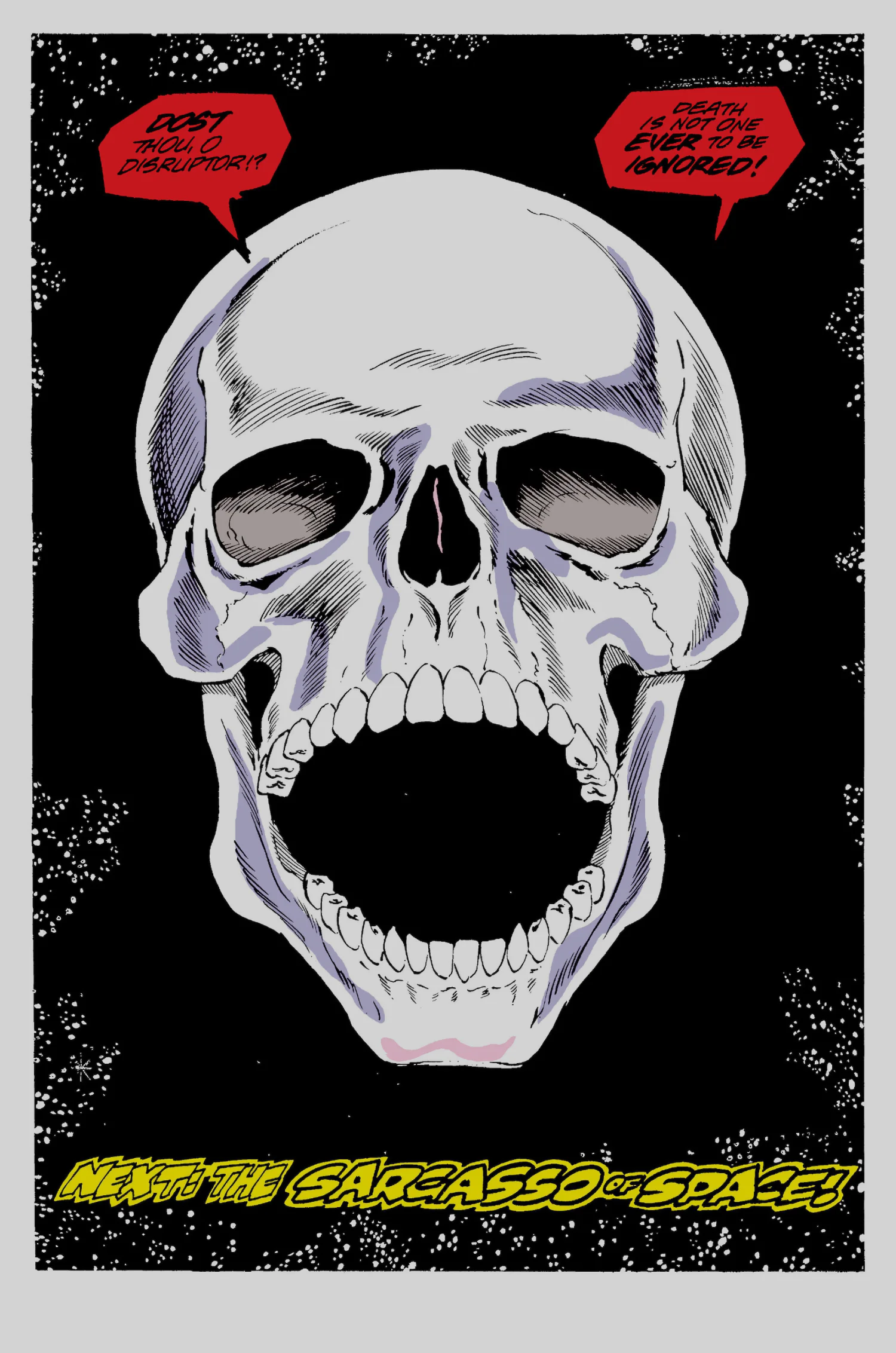
Silver Surfer vol. 3 #10: the final page — Death is not pleased.
What This Chapter Teaches Us
Beneath the space opera, these ten issues are quietly running two arguments about how to live, and they point in opposite emotional directions.
Getting what you want is not the same as being complete. For twenty years the Surfer wanted two things above all others: his freedom and Shalla-Bal. In the space of two issues he gets both handed to him: the barrier falls, and he flies home to the woman he crossed a career of exile for. And it doesn't work. Shalla-Bal chooses her duty to Zenn-La; freedom turns out to deliver not peace but entanglement, a galaxy's worth of new obligations and dangers. This is one of the oldest and least fashionable pieces of wisdom there is, and Englehart states it in cosmic scale: the things we are sure will finally complete us, once acquired, mostly reveal that the ache was never really about them. The existentialists had a bleak name for this and a hopeful use for it: no external acquisition can discharge the task of making a self, and discovering this is not a defeat but the actual beginning of freedom. The Surfer's liberation is the start of his story, not the end of it, precisely because getting what he wanted forces him to find out what he's for.
And the fear of ending can rot a life from the inside. Consider the villains of the piece. The Elders of the Universe have already won the prize every mortal dreams of: they have made themselves deathless, barred from Death's realm forever. And what do they do with their guaranteed eternity? They plot to murder a god, and to collapse the entire universe, so that they might be reborn as its firstborn deities. Their immortality has bought them not serenity but a bottomless, escalating greed; having conquered death, they now cannot stop, cannot rest, cannot be satisfied with merely living forever. It is the sharpest possible illustration of a truth the Stoics and Epicureans both circled: that a life which cannot make peace with its own ending is not thereby freed, but enslaved to an appetite that grows the more it feeds.[17] The Elders are what you get when the terror of finishing is granted everything it asks for. They are deathless and they are hollow, and the two facts are not unrelated.
Set those beside the Surfer's own thawing (his messy, expressive, fully-inhabited new emotional life) and you can see the shape of the whole run already. On one side, beings who have secured everything external and lost everything internal. On the other, a man who has just been stripped of the two things he wanted most and is, for the first time, becoming genuinely alive. Englehart knows which one of them the reader should envy.
Threads Left Burning
Ten issues in, look at the table Englehart has set: six Soul Gems and three Elders down a black hole; five deathless Elders poisoning Galactus from the inside; a missing Contemplator who may not be what he seems; a Skrull spy on the Kree throne beginning her purge; a war metastasising across two empires; a herald's bond with Nova warming into something more; and a green woman whose “death” comes with a demonstrated escape clause. Every one of those threads pays off, some of them years down the line.
The next chapter follows the hunt for the Contemplator straight into the Coalsack Nebula and the jaws of Captain Reptyl's space pirates — plus an Accuser with a grudge, and the small matter of a second Silver Surfer.
Frequently Asked Questions
Which Silver Surfer comics does Part 2 cover?
Part 2 covers Silver Surfer volume 3, issues #1 to #10, published from July 1987 to April 1988. This is the opening arc of Steve Englehart's run, in which the Elders of the Universe plot to murder Galactus.
Who wrote and drew these comics?
They were written by Steve Englehart and drawn by Marshall Rogers.
Is The Freest Being in the Universe free to read online?
Yes. The complete book is free to read here on marincomics.com, all six parts, richly illustrated. If you would like to support the author, you can also buy the paperback or Kindle edition on Amazon.
What is The Freest Being in the Universe about?
The Freest Being in the Universe is Marin Balabanov's chapter-by-chapter appreciation of Steve Englehart's cosmic Silver Surfer, volume 3, issues #1 to #31, published from 1987 to 1990. It recaps every issue and asks what the stories teach us about freedom, identity, grief, and finding a third path beyond false either-or choices.
Notes and Sources
- Steve Englehart (b. 1947) was among the most acclaimed Marvel writers of the 1970s, with landmark runs on Captain America (including the post-Watergate “Secret Empire” storyline), The Avengers, and Doctor Strange; a 2010 Comics Bulletin poll placed all three among the top ten Marvel comics of the decade. He created or co-created Mantis (The Avengers #112, 1973), Shang-Chi (with Jim Starlin, 1973) and Star-Lord (with Steve Gan, 1976) — characters who would each later reach the screen. After leaving Marvel in a dispute in 1976 he moved to DC, where his Detective Comics #469–476 Batman run with Marshall Rogers and Terry Austin — collected as Batman: Strange Apparitions — became one of the most influential modern takes on the character, and his Green Lantern work (with artist Joe Staton) expanded the mythos, ultimately renaming the title Green Lantern Corps. See “Steve Englehart,” Wikipedia — en.wikipedia.org. ↩
- Steve Englehart's account of the assignment appears on his website: Editor-in-Chief Jim Shooter “asked me to do a SURFER book,” but “I was told he had to stay on Earth”; after Englehart “kept bugging Jim,” the restriction was lifted — “The Surfer could fly free.” Steve Englehart, “Silver Surfer 1-20,” steveenglehart.com — steveenglehart.com. ↩
- The Stan Lee graphic novel that was meant to free the Surfer eventually appeared as Silver Surfer: The Enslavers (Marvel, 1990), written by Stan Lee and pencilled by Keith Pollard — a hardcover original graphic novel in which the Surfer confronts the alien conqueror Mrrungo-Mu, who has enslaved humanity. By the time it saw print, Englehart's ongoing series had long since sprung the character from Earth, leaving the graphic novel to stand on its own outside the main run's continuity. See Silver Surfer: The Enslavers, Marvel Database — marvel.fandom.com. ↩
- Marvel Fanfare #51 (1990): “The Great Terror,” written by Steve Englehart, pencilled by John Buscema, inked by Jack Abel — the original, shelved earthbound first issue, published as an out-of-continuity “imaginary story” with an introduction by editor Al Milgrom. See Marvel Fanfare, Marvel Database — marvel.fandom.com. ↩
- Mangog's diminished state traces to Thor #197 (Marvel, March 1972), by Stan Lee and John Buscema, the climax of the storyline running through Thor #195–198. Mangog draws his strength from the psychic hatred of the “billion billion” beings imprisoned within him; in #197 Odin severs that connection, and, cut off from the hate that sustains him, Mangog rapidly dwindles and shrinks away to near-nothingness. It is that near-vanished remnant the Supreme Intelligence revives in “The Great Terror.” On Mangog's dependence on hatred and his consequent shrinking, see Thor #197, Marvel Database — marvel.fandom.com — and the character profile at the Appendix to the Handbook of the Marvel Universe — marvunapp.com. ↩
- “Old soul” is a flourish here, not a figure — but it points at something later writers would make literal. At the time of this run the Surfer's age was an ordinary one: Zenn-La is a thriving, present-day world, Shalla-Bal reigns over it as empress, and Norrin Radd is simply a Zenn-Lavian who left home a couple of decades earlier to become Galactus's herald. Only much later did the character acquire a genuinely cosmic antiquity. In Silver Surfer: Black #1–5 (Marvel, 2019), by Donny Cates and Tradd Moore — spinning out of Guardians of the Galaxy vol. 6 #1 (2019) — the Surfer is dragged through a black hole and stranded billions of years in the past, at the very dawn of the universe, where in the end he uses the last of his Power Cosmic to seed the young cosmos with life, beginning with the world that will one day become Zenn-La itself. Read against that story, the Surfer is in one sense as old as creation and bound up with the origin of his own homeworld — a resonance entirely unavailable in 1987, when Zenn-La and Shalla-Bal were still very much alive, contemporary, and active. See Silver Surfer: Black, Marvel Database — marvel.fandom.com. ↩
- For a representative retrospective assessment along these lines, see James Fulton, “Retro Review: Silver Surfer Vol. 3 #1–33 By Englehart, Rogers, Lim & Others,” Inside Pulse, 5 January 2022, which reads the run as a study of the Surfer's emotional life — tracing him as torn between competing missions, convinced “he's supposed to always be alone in life,” and, in the asteroid-smashing beat, “in a remote region of space, smashing asteroids with his fists out of anger” — a character being written to be “more expressive” rather than to embody cosmic power. insidepulse.com. For a complementary appraisal framing Englehart's Surfer as freed to become a fully rounded person rather than Lee's earthbound philosopher-symbol, see Crushing Krisis, “Silver Surfer by Steve Englehart” — crushingkrisis.com. ↩
- On Stoicism as composure amid engagement rather than the suppression of feeling, see the distinction the Stoics drew between destructive passions (pathē) and rational “good feelings” (eupatheiai); Marcus Aurelius's Meditations and Seneca's Letters both model engaged equanimity rather than numbness. ↩
- Silver Surfer vol. 3 #1–10 (July 1987 – April 1988): written by Steve Englehart; pencilled and coloured by Marshall Rogers; inked chiefly by Joe Rubinstein; lettered by John Workman and later Ken Bruzenak. Issue #1 was double-sized. Credits per the Grand Comics Database (comics.org) and the Marvel Database — marvel.fandom.com. ↩
- The Skrulls' loss of their shapeshifting is dramatised in a two-part crossover, both halves cover-dated 1985: Avengers Annual #14, “The Once and Future Skrull” (plotted and pencilled by John Byrne, scripted by Roger Stern, inked by Kyle Baker), and Fantastic Four Annual #19, “Skrull-Wars” (written and pencilled by John Byrne, inked by Joe Sinnott). The renegade Skrull scientist Zabyk detonates a “hyper-wave bomb” intended to devastate a rival faction; instead it stabilises the Deviant gene of every Skrull in existence, locking each one permanently into whatever form it held at the moment of the blast and stripping the entire race of the shapeshifting that had always defined it. See Fantastic Four Annual #19, Marvel Database — marvel.fandom.com — and Avengers Annual #14 — marvel.fandom.com. ↩
- Frankie Raye — the Human Torch's girlfriend, herself endowed with flame powers — volunteers to become Galactus's new herald and is remade as Nova in Fantastic Four #244 (July 1982), written and drawn by John Byrne. ↩
- The Elders of the Universe are among the very oldest beings in the Marvel cosmos — not a species but a scattered handful of individuals, each one among the last (often the sole) survivor of one of the first races to evolve in the young universe, billions of years ago. What preserves them is obsession: every Elder has devoted his near-endless life to the single-minded pursuit of one activity, and that unbroken purpose is what sustains his effective immortality. Hence their names double as their vocations: the Grandmaster lives for games and contests, the Collector for amassing rare beings and objects, the Champion for combat, the Runner for travel, the Gardener for cultivating life, the Contemplator for meditation, alongside others such as the Astronomer, the Possessor, the Trader and the Obliterator. The Collector was the first to appear, in Avengers #28 (1966), with the Grandmaster following in Avengers #69 (1969); Englehart's Silver Surfer run gathers the group as a body and makes their shared, deathless scheming its central engine. See “Elders of the Universe,” Marvel Database — marvel.fandom.com. ↩
- Marvel Super Hero Contest of Champions (three issues, June–August 1982; written by Mark Gruenwald, Bill Mantlo and Steven Grant, pencilled by John Romita Jr.) was Marvel's first true limited series, and the earlier contest this rematch echoes. It began life as a tie-in to the 1980 Summer Olympics in Moscow: Marvel's heroes gathered for a global sporting spectacle. When the United States boycotted those Games in protest at the Soviet invasion of Afghanistan, the Olympic framing collapsed and the project sat unpublished until 1982, when it was reworked into a cosmic contest — the Grandmaster wagering against a hooded figure called the Unknown (in fact Death) for the resurrection of his fellow Elder the Collector, the two sides using Earth's heroes as pawns to gather the four pieces of the “Golden Globe of Life.” And then the ending was simply miscounted. The deciding, fourth bout was won by Shamrock — who fought on the Unknown's side — which should have levelled the match at two rounds apiece; instead the story credited her victory to the Grandmaster and declared him the winner. On those (botched) terms the Grandmaster revived the Collector but had to take his place among the dead, and so died for a contest he had not actually won. Because his death rested on a scoring blunder, Tom DeFalco and Steve Englehart brought him back for a rematch in the 1987 annuals — the very contest the Silver Surfer stumbles into — where the Grandmaster's second game with Death wins the Elders their permanent exile from her realm. See Marvel Super Hero Contest of Champions, Wikipedia — en.wikipedia.org. ↩
- The two-part crossover opens in West Coast Avengers Annual #2 (written by Steve Englehart, drawn by Al Milgrom; September 1987) and concludes in Avengers Annual #16 (written by Tom DeFalco; October 1987). It stages the Grandmaster's game with Death, whose upshot — the Elders of the Universe permanently barred from Death's realm — hands them the immortality that drives Englehart's Silver Surfer run. While the Silver Surfer's plot-driving role is confined to the opening of the West Coast annual, where he appears at the Avengers' softball game to warn them that an Elder means to kill some of them, he also appears in the conclusion as a surprise participant in the Grandmaster's “Contest of Champions,” fighting to his mutual destruction against Korvac in space. See West Coast Avengers Annual #2, Marvel Database — marvel.fandom.com — and Avengers Annual #16 — marvel.fandom.com. ↩
- Mantis was created by Steve Englehart and Don Heck and first appeared in The Avengers #112 (June 1973). The half-Vietnamese, half-German daughter of Gustav Brandt (later the zodiac-villain Libra), she was raised from childhood at the temple of the Priests of Pama — a pacifist Kree sect — and trained into a formidable martial artist, all in secret preparation for the prophecy that she would become the “Celestial Madonna.” That destiny played out across the Celestial Madonna Saga (Avengers #123–135 and Giant-Size Avengers #2–4, 1974–75), at the end of which she wed the eldest of the plant-like Cotati — inhabiting the reanimated body of her fallen love, the Swordsman — and left Earth to bear the “Celestial Messiah.” Englehart, who had rights tangles with the character over the years, brought her back repeatedly; her reappearance here, reborn in plant form, folds her directly into the Surfer's saga. See “Mantis (Marvel Comics),” Wikipedia — en.wikipedia.org. ↩
- The Supreme Intelligence — “the Supremor” — is the artificial gestalt mind that rules the Kree Empire. Built on Kree-Lar over a million years ago, it preserves the disembodied brains of the greatest Kree thinkers, generals and scientists, absorbing each one at death so that it grows into a single organic supercomputer housing the accumulated genius of the whole species. It typically manifests as a vast, brooding green head fringed with tentacles, and it guides — and often coldly manipulates — Kree civilisation from within its chamber. Created by Stan Lee and Jack Kirby, it first appeared in Fantastic Four #65 (August 1967). Its role in this run turns on a detail Englehart makes much of: the minds it has absorbed include both the pink-skinned and blue-skinned Kree, factions who loathe one another, and it is the Soul Gem in its brow that holds those warring multitudes in check. See “Supreme Intelligence,” Wikipedia — en.wikipedia.org. ↩
- The Stoic and Epicurean traditions each argue that accepting mortality is a precondition of a free life rather than a defeat: see Epicurus, “Letter to Menoeceus” (“death is nothing to us”), and Seneca, On the Shortness of Life. The Elders of the Universe invert the lesson — deathlessness without peace. ↩